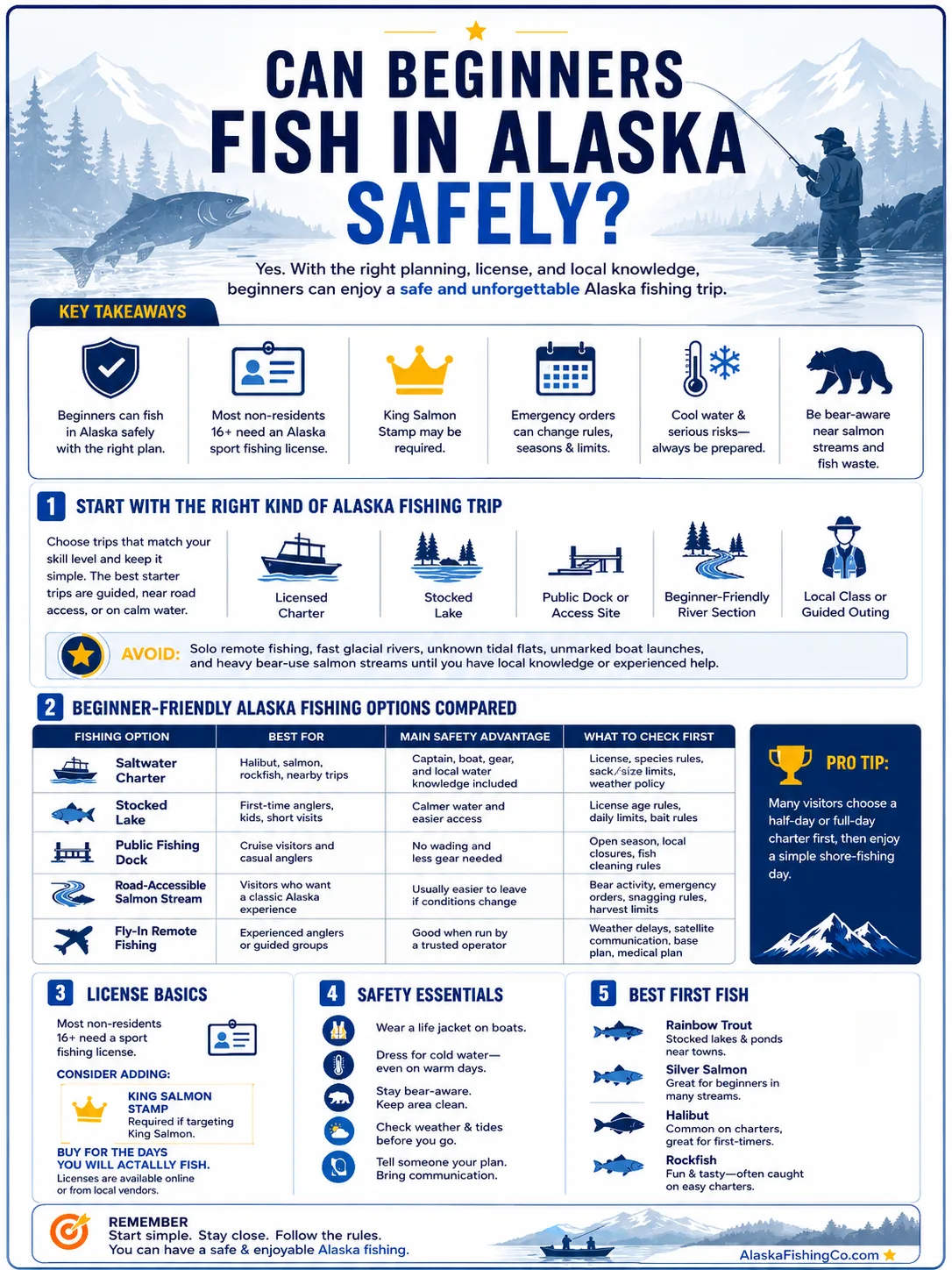
Yes, beginners can fish in Alaska safely, but they should choose the right water, carry the right license, and treat weather, cold water, and wildlife with respect from the first cast. Alaska is not unsafe for new anglers by default. The risk usually comes from fishing too far from help, ignoring local regulations, wading into strong water, or getting careless around bears and fish waste.
If you remember one thing: start simple, stay close to known access points, check the current rules, and do not fish alone in remote places on your first Alaska trip.
What To Know First
- Beginners should start with a charter, stocked lake, public fishing dock, or road-accessible stream.
- Most non-resident visitors age 16 or older need an Alaska sport fishing license.[a]
- A king salmon stamp may be needed if you plan to fish for king salmon.
- Emergency orders can change open seasons, bag limits, and allowed methods during the season.[c]
- Cold water is one of the most serious safety issues, even on warm days.
- Bear-aware fishing matters near salmon streams, campgrounds, and fish-cleaning areas.
Can Beginners Fish in Alaska Safely?
Yes. A beginner can fish in Alaska safely when the trip is planned around skill level, local rules, and realistic conditions. The safest first Alaska fishing trip is usually guided, close to road access, or based around calm water where help is nearby.
The mistake is thinking of Alaska fishing as one activity. A family casting for stocked rainbow trout near Anchorage is doing something very different from a first-time visitor hiking alone into a brushy salmon stream or taking a small boat into cold coastal water. Both are “fishing in Alaska,” but the safety demands are not the same.
For a first trip, choose fishing that gives you control:
- A licensed charter for halibut, salmon, or rockfish
- A stocked lake close to town
- A public fishing platform, dock, or maintained access site
- A beginner-friendly river section with other anglers nearby
- A local class, lodge day trip, or family-oriented fishing outing
Beginners should avoid solo remote fishing, fast glacial rivers, unknown tidal flats, unmarked boat launches, and heavy bear-use salmon streams until they have local knowledge or experienced help.
Start With the Right Kind of Alaska Fishing Trip
The safest beginner trip is the one that removes the hardest decisions. A charter handles boat operation, marine weather, gear, bait, landing fish, and many species rules. A stocked lake removes tides, surf, offshore weather, and most bear concerns.
Alaska has fishing options for many comfort levels. A new angler does not need to begin with a fly-in wilderness trip. In many places, beginners can fish from shore, from a dock, or with a captain who explains each step.
| Fishing option | Best for | Main safety advantage | What to check first |
|---|---|---|---|
| Saltwater charter | Halibut, salmon, rockfish, family trips | Captain, boat, gear, and local water knowledge included | License, species rules, seasickness plan, weather policy |
| Stocked lake | First-time anglers, kids, short visits | Calmer water and easier access | License age rules, daily limits, bait rules |
| Public fishing dock | Cruise visitors and casual anglers | No wading and less gear needed | Open season, local closures, fish cleaning rules |
| Road-accessible salmon stream | Visitors who want a classic Alaska experience | Usually easier to leave if conditions change | Bear activity, emergency orders, snagging rules, harvest limits |
| Fly-in remote fishing | Experienced anglers or guided groups | Good when run by a trained operator | Weather delays, satellite communication, bear plan, medical plan |
For many visitors, the best first choice is a half-day or full-day charter, followed by a simple shore-fishing day. That gives the beginner a safer learning curve without losing the excitement of Alaska fishing.
Worth Noting
A beginner-friendly trip does not mean a boring trip. In Alaska, even an easy-access dock or lake can produce real fish, real scenery, and real rules that must be followed.
License Rules Beginners Should Know Before Casting
Most adult visitors need a license before they fish in Alaska. Alaska requires residents age 18 or older and non-residents age 16 or older to buy and carry a sport fishing license for sport fishing in fresh and marine waters.[b]
Foreign visitors are treated under the non-resident fishing license price schedule. That makes the license choice fairly simple: buy the duration that matches the days you will actually fish, not the number of days you are in Alaska.
| License or stamp | 2026 non-resident price | Typical beginner use |
|---|---|---|
| 1-day sport fishing license | $15 | One charter, cruise stop, or short shore session |
| 3-day sport fishing license | $30 | Weekend fishing or mixed road trip |
| 7-day sport fishing license | $45 | Most weeklong visitor trips |
| 14-day sport fishing license | $75 | Longer Alaska vacation with several fishing days |
| Annual sport fishing license | $100 | Repeat trips or long stays |
| Non-resident king salmon stamp | $15 to $100 by duration | Needed when fishing for king salmon, unless an exemption applies |
Beginners should also know these license details:
- Non-residents under 16 do not need a sport fishing license, but they still must follow regulations.
- Residents under 18 do not need a sport fishing license.
- Harvest record cards may still be required for species with annual limits.
- A king salmon stamp is generally required when fishing for king salmon, except for stocked lakes and listed exemptions.
- Personal use and subsistence fisheries are not normal visitor sport fishing options; Alaska states that those fisheries are for Alaska residents only.[g]
Do not wait until you are standing at the water to solve the license question. Buy online through the official system or from an approved vendor before the trip starts, then save a copy where it can be shown without depending on weak cell service.
Regulations Can Change During the Season
A beginner can follow the printed rulebook and still miss a current change if an emergency order has been issued. In Alaska, emergency orders may open or close waters, change bag limits, or change allowed fishing methods, and they can be issued during the season.
This matters most for salmon, king salmon, steelhead, trout, shellfish, and heavily managed areas. A river that was open last year may be restricted this year. A fish that could be kept in one area may need to be released in another. A method that is allowed in saltwater may be illegal in a freshwater stream.
Before fishing, beginners should check:
- The regional sport fishing regulation booklet for the area
- Current emergency orders for that exact region
- Species limits, size limits, and possession limits
- Whether bait is allowed
- Whether the water is fresh, salt, stocked, closed, or special-regulation water
- Whether a harvest record card must be filled out immediately after keeping a fish
Alaska’s sport fishing regulations are organized by region, including Northern, Southwest, Southcentral, and Southeast areas.[h] That regional setup is helpful, but it also means beginners should not assume one area’s rule applies statewide.
One Detail People Miss
“Open to fishing” does not always mean “open to keeping fish.” Catch-and-release, no-bait rules, size slots, and species closures can still apply.
Cold Water Is a Bigger Risk Than Many Beginners Expect
Cold water is one of the main reasons Alaska fishing requires more care than a casual warm-weather outing. A person can lose calm breathing and clear thinking soon after falling into cold water, even when the air feels mild.[e]
This risk applies on boats, docks, riverbanks, and while wading. Glacial rivers can be fast, opaque, and uneven. Saltwater shorelines can have slippery rocks, kelp, wakes, surge, and tide changes. A beginner who is not used to waders may also lose balance more easily than expected.
Safer cold-water habits include:
- Wear a properly fitted personal flotation device when boating, kayaking, or fishing from exposed docks.
- Do not wade deeper just because other anglers are doing it.
- Use a wading belt with chest waders.
- Carry dry layers in a waterproof bag.
- Keep children and weak swimmers away from steep banks and current edges.
- Turn back if wind, rain, or river level makes footing uncertain.
The U.S. Coast Guard notes that recreational vessels must carry a wearable U.S. Coast Guard-approved personal flotation device for each person onboard, and a PFD only helps if it is available and worn correctly.[f]
Bear Safety Matters Near Salmon Water
Beginners can fish safely in bear country, but they need to act like they are sharing the water. Alaska Department of Fish and Game warns anglers not to make food, backpacks, garbage, fish, or fish waste easy for bears to find.[d]
Bears are not waiting behind every tree, but salmon streams attract both people and bears. The highest-risk moments often come from surprise, noise, fish smell, tight brush, or an angler trying to land or clean fish where a bear also wants to feed.
Basic bear-aware fishing habits:
- Make noise when walking through brush or around loud water.
- Fish with other people when possible.
- Keep fish, bait, snacks, and trash controlled.
- Clean fish only where allowed and dispose of waste properly.
- Give bears space and leave before a close encounter develops.
- Carry bear spray where appropriate and know how to use it before the trip.
Do not keep casting when a bear is moving toward the same pool. A hooked salmon can pull a bear closer to the angler, especially in narrow water. Losing a fish is better than forcing a close encounter.
Before You Move On
If a fishing spot has salmon carcasses, fish smell, thick brush, and poor visibility, it is not a good first Alaska fishing spot for a beginner without local help.
What Gear Makes Alaska Fishing Safer for Beginners?
The safest beginner gear is simple, weather-ready, and easy to manage. Alaska fishing does not always require advanced tackle, but it does reward preparation.
Bring gear that helps with warmth, footing, visibility, and small problems before they turn into larger ones. Beginners often focus on rods and lures first. In Alaska, clothing and safety gear deserve the same attention.
- Layered clothing: A moisture-wicking base layer, warm middle layer, and waterproof outer shell.
- Non-slip footwear: Boots or shoes that grip wet docks, rocks, and muddy banks.
- PFD: Wear it on boats, kayaks, exposed docks, and near swift or cold water.
- Polarized sunglasses: Helpful for glare, hooks, and spotting shallow hazards.
- First-aid kit: Include bandages, blister care, antiseptic, and hook-injury basics.
- Long-nose pliers: Safer hook removal for both fish and hands.
- Waterproof phone protection: A dry pouch or case, plus a power bank.
- Bear spray: Useful in bear country only if carried where it can be reached and used correctly.
A beginner does not need a huge tackle box. A small set of appropriate lures, a valid license, warm clothing, and safer decision-making will do more than a pile of unfamiliar gear.
Best Places for Beginners to Start
Beginners should start where access is clear, rules are easier to check, and leaving is simple if conditions change. Town-adjacent lakes, managed access areas, docks, and guided saltwater trips are usually better first choices than remote rivers.
Good beginner settings often have three things in common: other people nearby, less complicated terrain, and clear information. They also make it easier to ask a local shop, charter captain, or ADF&G office about current rules.
Beginner-friendly Alaska fishing settings include:
- Stocked lakes near Anchorage, Fairbanks, Juneau, or other road-system communities
- Saltwater charters from ports such as Seward, Homer, Whittier, Sitka, Ketchikan, or Juneau
- Public docks where fishing is allowed
- Family fishing events or introductory classes
- Road-accessible river spots recommended by a local shop or official access map
Remote trips can be safe with the right operator. They are not the best place to learn basic casting, knots, fish handling, wading, and local safety all at once.
Ask Locals About the Exact Water
A good local tackle shop can be as useful as another piece of gear. Ask about current water levels, bear activity, local closures, and simple setups that match the exact place you plan to fish.
Common Mistakes That Put Beginners at Risk
Most beginner problems in Alaska come from preventable choices. The fishery may be legal, the weather may look fine, and the water may seem calm, but small mistakes can stack up fast.
Mistake: Buying a license but not checking emergency orders
Correct explanation: A license gives permission to fish, but it does not override area closures, species restrictions, or method changes.
Why it gets confused: Many visitors are used to places where the license is the main rule. Alaska’s in-season management can be more active.
Mistake: Treating all salmon rules as the same
Correct explanation: King salmon, sockeye, coho, pink, and chum salmon can have different limits, seasons, gear rules, and recording requirements.
Why it gets confused: Beginners often hear “salmon fishing” as one category, but Alaska manages species and locations separately.
Mistake: Wading farther than your skill allows
Correct explanation: Cold, fast, cloudy water can hide drop-offs and uneven bottom. A wading belt, staff, and conservative depth matter.
Why it gets confused: Watching experienced anglers stand in moving water can make it look easier than it is.
Mistake: Keeping fish before checking identification
Correct explanation: Some species look similar to a new angler, and the legal outcome may depend on correct identification.
Why it gets confused: Fish look different in real life than they do in clean online photos.
Mistake: Cleaning fish near camp or leaving scraps behind
Correct explanation: Fish smell can attract bears and other wildlife. Use legal cleaning stations and proper disposal methods.
Why it gets confused: Visitors may not realize how quickly fish waste can create a wildlife problem.
Mistake: Assuming a charter covers every license item
Correct explanation: Some charters help with licenses, but the angler is still responsible for having the right license, stamp, and record card when required.
Why it gets confused: “Booked a charter” can feel like an all-inclusive permit, but license rules still apply to the person fishing.
Real-Life Scenarios for Beginner Alaska Anglers
Beginners are safest when they match the plan to the situation. These common visitor scenarios show how the right choice changes with age, location, species, and comfort level.
- A cruise visitor has one afternoon in Ketchikan.
Choose a licensed saltwater charter or a public dock option, buy the correct non-resident license, and confirm whether king salmon will be targeted. - A family with two children wants an easy first fishing day near Anchorage.
A stocked lake or family fishing event is safer than a fast river, and younger non-residents may not need a license if under 16. - A beginner wants to fish for king salmon on a guided trip.
Check the king salmon stamp, any harvest record requirement, and current emergency orders before the boat leaves. - A visitor sees locals fishing a salmon stream from shore.
Do not assume the method is legal for you; check bait, snagging, retention, species, and area rules first. - A solo traveler wants to hike into a quiet river bend.
For a first Alaska trip, choose a public access point with other anglers or hire local help instead of fishing remote water alone. - A foreign visitor wants to fish for one day during a road trip.
The non-resident 1-day sport fishing license is usually the starting point, with a king salmon stamp added only if fishing for kings. - A beginner is invited to dipnet salmon with Alaska residents.
Do not participate unless you are legally eligible; Alaska personal use fisheries are for Alaska residents only. - A warm sunny day makes cold water look harmless.
Wear a PFD when boating or near exposed cold water because the water, not the air, controls immersion risk.
Know When You Are Actually Fishing
Helping another angler with gear does not automatically make you the angler. Alaska defines sport fishing as taking or attempting to take fish with hook and line held in the hand, or with the line attached to a rod that is held or closely attended. If you take control of the rod or line, make sure your license situation is correct.[i]
A Simple Safe Plan for a First Alaska Fishing Day
A beginner’s safest plan is short, local, legal, and flexible. Build the day around good conditions rather than trying to force a dream fishing story in poor weather or closed water.
- Choose the water first. Pick a stocked lake, charter, public dock, or known access area.
- Check the region. Know whether you are fishing Southeast, Southcentral, Southwest, or Northern Alaska rules.
- Buy the correct license. Match the license duration to the fishing days.
- Add a king salmon stamp only if needed. Do this before fishing for king salmon.
- Read the current emergency orders. Check the exact area and species.
- Pack for cold water and rain. Alaska weather can change during the same outing.
- Tell someone your plan. Share where you are going and when you expect to return.
- Stop early if safety changes. Rising water, strong wind, fog, bear activity, or poor footing is enough reason to leave.
This kind of plan may sound basic, but it is how beginners avoid the mistakes that turn a good trip into a stressful one.
When Should a Beginner Hire a Charter or Local Guide?
A beginner should hire help when the fishing involves a boat, remote access, bear-heavy water, complicated species rules, or unfamiliar tides. Local help is not only about catching more fish. It can reduce safety and regulation mistakes.
A charter or local guide is especially useful for:
- Halibut fishing
- Ocean salmon fishing
- Remote fly-out trips
- King salmon trips
- Fast rivers or technical wading
- Trips with children or older family members
- Visitors who have only one or two fishing days
Ask operators direct questions before booking. Good questions include whether they help with license steps, what safety gear is provided, what happens if weather cancels the trip, how fish are handled, and whether current restrictions affect the planned species.
What About Kids, Seniors, and Foreign Visitors?
Kids and foreign visitors can fish in Alaska, but the license answer depends on age, residency, species, and activity. Foreign visitors usually use the non-resident license options, while younger non-residents under 16 are generally exempt from the sport fishing license requirement.
Families should still teach children the rules even when a license is not required. A child can still break a bag limit, keep a closed species, mishandle a fish, or get too close to water. The adult planning the trip should check the rules for every person who will actively fish.
- Non-resident adults: Usually need a sport fishing license at age 16 or older.
- Foreign visitors: Usually buy the same short-term non-resident sport fishing license options shown in the ADF&G price table.
- Children: May be license-exempt by age, but still must follow limits, closures, and harvest record rules where they apply.
- Alaska resident seniors: Separate resident-only cards may apply, but those do not help non-resident visitors.
- Personal use fishing: Not a visitor shortcut; it is for Alaska residents only.
Safer Fish Handling for Beginners
Safe fishing also includes safe fish handling. Alaska fish can be large, slippery, toothy, spiny, or strong enough to injure hands if handled casually.
Beginners should learn how to land, release, or keep fish before the first bite. On a charter, listen to the captain and crew. On shore, carry pliers, know the species, and avoid putting fingers near gills, teeth, or hooks under tension.
- Keep fish wet if you plan to release them.
- Use barbless or pinched-barb hooks where suitable or required.
- Do not lift large fish by the line.
- Dispatch kept fish legally and humanely.
- Record harvest immediately when a record is required.
- Store fish cold and away from wildlife.
Beginners should also know when not to handle a fish. If the hook is deep, the species is restricted, or the fish is too large to manage safely, ask for help from an experienced angler, captain, or local authority.
How Safe Is Alaska Fishing for Total Beginners?
Alaska fishing can be very safe for total beginners when the outing is matched to beginner limits. The best first trip is not the most remote trip. It is the trip where the angler can learn, follow the rules, and leave safely if conditions change.
A short lake session, public dock, or professionally run charter is often a better first memory than an overambitious plan. Once the basics feel comfortable, beginners can add more demanding water, longer days, and more specialized species.
Two things make the biggest difference: do not guess on regulations, and do not underestimate cold water. The most common beginner mistake is treating Alaska like a familiar local fishing spot back home. The rule to remember is simple: choose easy access first, then build up.
Beginner Alaska Fishing Questions Answered
Can someone with no fishing experience fish in Alaska?
Yes. A total beginner can fish in Alaska, especially with a charter, stocked lake, public dock, or local beginner class. The safest choice is a simple, accessible trip where gear, rules, and water conditions are easy to manage.
Do tourists need a fishing license in Alaska?
Most tourists age 16 or older need a non-resident Alaska sport fishing license before fishing. Younger non-residents under 16 generally do not need a sport fishing license, but they still must follow Alaska fishing regulations.
Can foreign visitors buy an Alaska fishing license online?
Yes. Foreign visitors can use Alaska’s non-resident sport fishing license options. The best choice is usually the license duration that matches the actual number of fishing days.
Is Alaska fishing safe for children?
Yes, when the location and conditions are suitable. Stocked lakes, public docks, and family charters are better for children than fast rivers, remote streams, or exposed cold-water locations. Children should be supervised closely near all water.
Do beginners need a king salmon stamp in Alaska?
A king salmon stamp is generally needed when fishing for king salmon unless an exemption applies, such as certain age exemptions or stocked-lake situations. Beginners should check the current rule before targeting king salmon, even on a charter.
Is shore fishing safer than boat fishing in Alaska?
Not always. A calm public dock or stocked lake can be safer than a boat, but a slippery shoreline, fast river, bear-heavy salmon stream, or strong tide can be risky. A well-run charter may be safer than an unfamiliar shore spot.
Should beginners fish alone in Alaska?
Beginners should avoid fishing alone in remote Alaska locations. For a first trip, fish with a charter, local guide, friend, family member, or in a public area where other anglers are nearby.
Alaska Fishing References
- [a] Alaska Department of Fish and Game — General License Information — explains age rules, harvest record cards, and king salmon stamp requirements. (Official Alaska state fish and wildlife agency.)
- [b] Alaska Department of Fish and Game — Sport Fishing License and King Salmon Stamp Prices — lists 2026 resident, non-resident, and foreign/alien license and stamp prices. (Official Alaska state licensing source.)
- [c] Alaska Department of Fish and Game — Sport Fishing Emergency Orders and Press Releases — explains that emergency orders may change seasons, limits, areas, or fishing methods and should be checked before fishing. (Official state regulatory update page.)
- [d] Alaska Department of Fish and Game — Bear Safety for Anglers — gives Alaska-specific advice for fishing in bear country and handling attractants such as fish and garbage. (Official state wildlife safety source.)
- [e] National Weather Service — Cold Water Hazards and Safety — explains cold shock, hypothermia, and why flotation matters in cold water. (Official U.S. weather and safety agency.)
- [f] U.S. Coast Guard Boating Safety — Life Jacket Wear — explains PFD carriage, fit, accessibility, and why wearing a life jacket matters on the water. (Official U.S. recreational boating safety authority.)
- [g] Alaska Department of Fish and Game — Subsistence and Personal Use Fishing Licenses and Permits — explains that Alaska subsistence and personal use fisheries are for Alaska residents only. (Official Alaska state fisheries source.)
- [h] Alaska Department of Fish and Game — Sport Fishing Regulations — provides the regional regulation structure for Northern, Southwest, Southcentral, and Southeast Alaska sport fisheries. (Official Alaska sport fishing regulation source.)
- [i] Alaska Department of Fish and Game — Statewide Definitions for Sport Fishing — defines sport fishing as taking or attempting to take fish with hook and line held in the hand, or with the line attached to a rod that is held or closely attended. (Official Alaska sport fishing definitions.)