
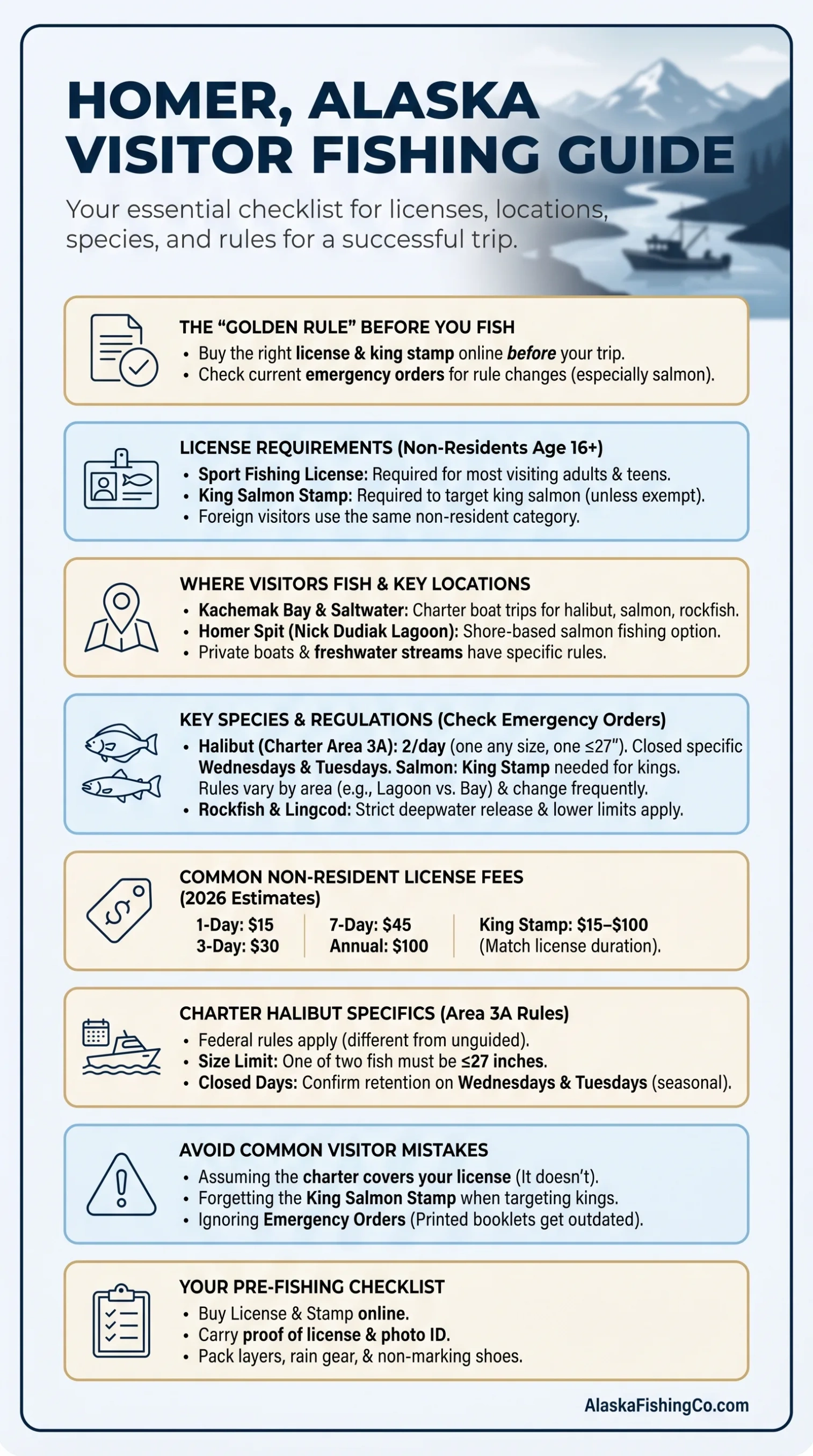
Homer is one of Alaska’s easiest visitor fishing towns to understand: most travelers come for halibut charters, salmon on the Homer Spit, or a mixed saltwater trip in Kachemak Bay and Lower Cook Inlet.
Visitors can fish from shore, join a charter, or plan a private boat day, but the legal details change by age, species, water type, and season. A non-resident license is usually the first step, and a king salmon stamp is needed if king salmon are part of the plan.
If you remember one thing… buy the right Alaska sport fishing license before you fish, then check the current Homer-area emergency orders before targeting salmon, halibut, rockfish, or shellfish.
What To Know First
- Most visiting anglers age 16 or older need an Alaska sport fishing license.
- Foreign visitors buy the same non-resident sport fishing license category used by other non-resident anglers.
- King salmon require an added king salmon stamp unless an age or resident exemption applies.
- Homer charter halibut rules are not the same as unguided halibut rules.
- The Homer Spit has a shore-based salmon option at Nick Dudiak Fishing Lagoon, often called “the Fishing Hole.”
- Razor clam harvest now has a permit requirement. Cook Inlet and North Gulf Coast sport and personal use razor clam fisheries require a household permit in 2026, while East Cook Inlet razor clam fisheries are closed for the rest of 2026.
- Emergency orders matter. In Alaska, salmon, rockfish, and shellfish rules can change during the season.
Where Visitors Usually Fish Around Homer
The short answer: visitors usually fish the salt water first. Homer sits beside Kachemak Bay, with charter access to Lower Cook Inlet and nearby Gulf of Alaska waters. That makes it especially popular for halibut, salmon, rockfish, and combination trips.
There are also shore options. The most visitor-friendly one is the Nick Dudiak Fishing Lagoon on the Homer Spit. It is stocked for salmon fishing and is easier to reach than many wild Alaska streams. ADF&G’s 2026 Region II stocking plan lists annual objectives of 315,000 early-run Chinook salmon smolt and 120,000 early-run coho salmon smolt for Nick Dudiak Fishing Lagoon, which explains why the spot appears so often in Homer visitor plans.[h]
- Halibut charters: best for visitors who want a full saltwater fishing day with gear, boat, and local navigation included.
- Homer Spit shore fishing: best for visitors without a boat who still want a salmon chance.
- Private boat fishing: best for experienced groups who understand tides, weather, charts, and fish handling rules.
- Nearby freshwater trips: possible, but more rule-sensitive because some streams close or restrict gear during salmon conservation periods.
One Detail People Miss
“Homer fishing” does not always mean one set of rules. Kachemak Bay, Cook Inlet salt waters, the Homer Spit lagoon, nearby roadside streams, charter halibut trips, and razor clam beaches can each carry different limits, permits, or closures.
Do Visitors Need an Alaska Fishing License in Homer?
Yes, most visitors do. Alaska requires non-residents age 16 or older to buy and possess a sport fishing license to participate in sport fisheries. Residents follow a different age rule, but that usually does not apply to tourists. A king salmon stamp is also required to fish for king salmon, except for certain exempt anglers and stocked lake situations.[a]
This applies whether the visitor fishes from shore, on a charter, from a rented boat, or with friends. A charter captain may help explain the rule, but the license belongs to the angler, not the boat.
- Non-resident adults and teens age 16+: need an Alaska sport fishing license.
- Non-resident children under 16: generally do not need a sport fishing license.
- Foreign visitors: use the non-resident license category unless they qualify under a special residency rule.
- King salmon anglers: need the stamp unless exempt.
- Harvest record rules: may apply for fish with annual limits, including many king salmon situations.
License Fees Visitors Commonly Use
For 2026, Alaska’s listed non-resident sport fishing license fees are based on trip length. The same listed prices also appear for non-resident foreign or alien sport fishing licenses. King salmon stamps follow the same duration pattern, so a visitor planning to target kings usually matches the license length and stamp length to the fishing dates.[b]
| Item | Best Fit For | 2026 Fee | Visitor Note |
|---|---|---|---|
| 1-day sport fishing license | One charter or one shore-fishing day | $15 | Works well for a single halibut or salmon trip. |
| 3-day sport fishing license | Long weekend in Homer | $30 | Often fits visitors fishing two or three days. |
| 7-day sport fishing license | One full Alaska vacation week | $45 | Useful if fishing plans may shift because of weather. |
| 14-day sport fishing license | Longer Kenai Peninsula trip | $75 | Good for travelers combining Homer, Seward, Soldotna, or other stops. |
| Annual sport fishing license | Repeat Alaska travel in the same year | $100 | May make sense for anglers returning later in the season. |
| Non-resident king salmon stamp | Anyone targeting king salmon | $15 to $100 | Choose 1-day, 3-day, 7-day, 14-day, or annual to match your fishing dates. |
What Can Visitors Fish for in Homer?
Homer visitors most often plan around halibut and salmon, but the area also has rockfish, lingcod, Dolly Varden, sharks, and shellfish rules. Limits depend on the species, the exact water, and whether the trip is guided or unguided.
ADF&G’s 2026 Southcentral Cook Inlet and Kachemak Bay saltwater summary lists general rules for the area, including king salmon seasons, coho and other salmon limits, lingcod dates, rockfish limits by emergency order, and halibut notes. The same summary states that Pacific halibut is managed by the federal government under international treaty, so halibut anglers must pay attention to both state and federal information.[c]
Halibut
Halibut is the main reason many visitors choose Homer. A charter usually supplies the rods, bait, boat, fish storage help, and local knowledge. The visitor still needs the proper Alaska sport fishing license.
- Unguided halibut fishing: in the 2026 state summary, unguided anglers in Cook Inlet and Kachemak Bay salt waters are listed at 2 halibut per day and 4 in possession.
- Charter halibut fishing: federal Area 3A rules apply to Homer charters.
- 2026 charter halibut stamp: anglers age 18 or older aboard a charter vessel need a $20 stamp for each day they intend to catch and retain halibut. The guide handles the stamp.[e]
- Trip timing: tides, wind, and marine forecast can matter as much as the calendar date.
Salmon
Salmon rules around Homer need more attention than halibut rules because king salmon restrictions can change. For 2026, ADF&G announced Cook Inlet saltwater king salmon restrictions that affect waters north and south of Bluff Point. Lower Cook Inlet waters south of Bluff Point, including Kachemak Bay, were listed with a one king salmon daily bag and possession limit from April 1 through September 15, while Nick Dudiak Fishing Lagoon kept a two king salmon bag and possession limit under that seasonal notice.[d]
- King salmon: stamp required for most visiting anglers who target kings.
- Coho salmon: often a practical visitor target later in summer, especially when fish move near shore or into lagoon areas.
- Pink, chum, and sockeye salmon: may be part of the combined salmon rules in the saltwater area.
- Freshwater salmon: nearby streams can have closures, bait limits, or single-hook artificial lure rules.
Worth Noting
Do not assume a salmon rule from another Alaska town applies in Homer. Even within Cook Inlet, the line at Bluff Point can change what is open, closed, or limited.
Rockfish and Lingcod
Rockfish and lingcod are common add-ons during saltwater trips, but they are not casual “bonus fish” from a rules standpoint. Rockfish may have pelagic and nonpelagic categories, and release rules matter because fish pulled from deep water often cannot return safely without proper equipment.
- Rockfish: expect lower limits than many visitors imagine, especially for nonpelagic rockfish.
- Yelloweye rockfish: can have special no-retention periods.
- Deepwater release device: vessels in the Cook Inlet and Kachemak Bay saltwater area must carry one under the 2026 summary.
- Lingcod: the 2026 summary lists a July 1 through December 31 season with size requirements.
Shellfish and Razor Clamming
Razor clamming around Cook Inlet changed in 2026. A household razor clam permit is now required for sport and personal use razor clam harvest in Cook Inlet and the North Gulf Coast. The permit is available through the ADF&G online store or mobile app.[g]
Only one permit is issued per household, and household members who plan to harvest razor clams must be listed on it. Permit holders must report online by December 31, 2026, even if no razor clams were harvested. ADF&G states that a permit holder who does not submit the required report by the deadline will not be eligible for a permit the following year.[g]
East Cook Inlet Razor Clam Closure: 2026
East Cook Inlet sport and personal use razor clam fisheries are closed through the remainder of 2026. ADF&G surveyed Ninilchik and Clam Gulch beaches in April and May 2026 and found adult razor clam abundance below the thresholds needed to open either fishery.[g]
The closure includes East Cook Inlet beaches from the mouth of the Kenai River south to the tip of the Homer Spit. ADF&G states that the fishery will remain closed for the rest of 2026 and at least until abundance is assessed again in spring 2027.[g]
Visitors looking for legal razor clam opportunities should not assume a beach near Homer is open simply because tides are favorable. ADF&G identified Polly Creek and Crescent River Bar in West Cook Inlet as the better 2026 razor clam options after the East Cook Inlet survey results. West Cook Inlet has a 10-gallon daily bag limit and 10 gallons in possession per person, all razor clams dug must be retained, and the 2026 household permit and reporting rules apply.[g]
Homer Charter Halibut Rules Visitors Should Ask About
For a visitor booking a Homer halibut charter, the boat may be local, but the halibut rules are federal. Homer is in Area 3A for guided halibut management. In 2026, Area 3A charter anglers have a two-halibut daily bag limit, with one fish of any size and the other no more than 27 inches. Charter anglers may not retain halibut on Wednesdays, and Tuesday retention was also closed from June 2 through August 25, 2026.[e]
Beginning in 2026, an adult charter angler who intends to retain halibut also needs a $20 charter halibut stamp for each fishing day. The guide handles the stamp, but the angler must tell the guide before fishing that they intend to keep halibut. Unguided anglers do not need this charter stamp.[e]
This is why a charter operator may tell a visitor that a certain day is not available for halibut retention even though the weather looks fine. It is not only a business schedule. It may be a legal no-retention day for charter halibut.
- Ask whether the trip is halibut-only or a combo trip.
- Ask what happens if weather cancels the trip.
- Ask whether the planned date is open for 2026 charter halibut retention.
- Tell the guide before fishing if you intend to retain halibut so the charter stamp can be handled correctly.
- Ask how fish will be cleaned, packed, frozen, or shipped.
- Ask whether the operator uses Guided Angler Fish options. Not every charter does, and it changes what may be retained.
How To Buy an Alaska Fishing License Online Before Fishing Homer
The easiest route for most visitors is to buy the Alaska sport fishing license online before the trip. Licenses and king salmon stamps can also be bought at many sporting goods stores and Fish and Game offices, but online purchase reduces last-minute stress before an early charter departure.
- Choose the first day you will fish. Match the license duration to real fishing days, not hotel nights.
- Select non-resident sport fishing license. Foreign visitors normally use the non-resident option.
- Add a king salmon stamp if you will target king salmon. A halibut-only charter does not require a king stamp.
- Check whether the 2026 charter halibut stamp applies. Adult guided anglers intending to retain halibut in Area 3A need the separate guide-handled stamp.
- Check whether you need a harvest record card. This matters for some annual-limit fisheries.
- Keep proof accessible while fishing. A license is not useful if it cannot be shown when asked.
Before You Move On
Buying a license does not open a closed fishery. The license gives permission to participate only where the season, species, gear, permit, and emergency-order rules allow fishing or harvest.
Best Visitor Plans by Trip Style
The best Homer fishing plan depends less on skill level and more on time, weather tolerance, and target species. A first-time visitor who wants halibut usually does better with a charter. A visitor with only a spare evening may prefer the Homer Spit lagoon.
One-Day Visitor
Choose one clear goal. A one-day visitor should not try to combine shore salmon, halibut, and freshwater exploring unless the schedule is very loose.
- Best choice: halibut charter or Homer Spit shore fishing.
- License fit: 1-day non-resident sport fishing license.
- Add stamp: king salmon stamp if kings are targeted; charter halibut stamp if an adult guided angler intends to retain halibut.
Three-Day Visitor
A three-day visit gives enough room for weather changes. This is useful in Homer, where wind and sea conditions can move a charter to another day.
- Best choice: one halibut charter, one flexible salmon day, one backup day.
- License fit: 3-day non-resident license.
- Planning tip: do not place the charter on the final morning if travel is tight.
Family With Children
Families need to separate “watching” from “participating.” A child under 16 who is a non-resident usually does not need a license, but adults who bait hooks, handle rods, net fish, or take part in the fishing activity do.
- Best choice: short charter, lagoon fishing, or a simple shore plan.
- Watch the rules: youth-only events and lagoon rules can be very specific.
- Practical note: bring layers, snacks, and patience; Homer weather can change fast.
Common Mistakes Visitors Make When Fishing Homer
Most Homer fishing mistakes come from treating Alaska like a simple license-and-go destination. The license is only one part of the rule set.
Thinking a Charter Covers the License
Wrong idea: “The charter boat has the permit, so the customer does not need a license.”
Correct explanation: The charter may have required vessel or federal halibut permits, but each participating angler still needs the proper Alaska sport fishing license unless exempt.
Why it gets mixed up: Visitors hear the word “permit” and assume it covers everyone on board.
Buying a Fishing License but Forgetting the King Salmon Stamp
Wrong idea: “A sport fishing license covers every fish.”
Correct explanation: A king salmon stamp is required for most anglers who fish for king salmon.
Why it gets mixed up: Halibut and coho plans may not need the stamp, so visitors forget that king salmon is treated differently.
Assuming Homer Spit Rules Match Open Saltwater Rules
Wrong idea: “The lagoon is on saltwater, so the same open-water rules apply.”
Correct explanation: Nick Dudiak Fishing Lagoon has special boundaries, snagging rules, youth-only fishery details, and salmon recording rules.
Why it gets mixed up: The lagoon is easy to access, so it feels less regulated than remote water.
Assuming East Cook Inlet Beaches Are Open for Razor Clams
Wrong idea: “If the tide is low enough, I can dig razor clams near Homer.”
Correct explanation: East Cook Inlet sport and personal use razor clam fisheries are closed through the remainder of 2026 after the spring abundance surveys found adult clam numbers below the opening thresholds.[g]
Why it gets mixed up: Older information described the closure as expected to continue, but ADF&G confirmed the 2026 closure after completing its April and May surveys.
Forgetting the New Razor Clam Permit and Report
Wrong idea: “Razor clamming is just a bag-limit check.”
Correct explanation: In 2026, Cook Inlet and North Gulf Coast razor clam harvest requires a household permit. The permit holder must submit the required online report by December 31 even if nobody on the permit harvested razor clams.[g]
Why it gets mixed up: The household permit is new for the 2026 season, so older clamming pages do not include it.
Ignoring Emergency Orders
Wrong idea: “The printed booklet is enough.”
Correct explanation: Emergency orders can close waters, reduce limits, change gear rules, or adjust retention during the season.
Why it gets mixed up: Visitors plan months ahead, but Alaska fisheries are often managed in response to run strength and conservation needs.
Keeping a Rockfish Without Knowing the Category
Wrong idea: “A rockfish is a rockfish.”
Correct explanation: Pelagic and nonpelagic rockfish can have different limits, and yelloweye rules can be stricter.
Why it gets mixed up: Many visitors recognize halibut and salmon more easily than groundfish species.
Planning a Charter on a Closed Halibut Retention Day
Wrong idea: “If the charter is available, halibut can be kept.”
Correct explanation: Area 3A charter halibut retention is closed on Wednesdays under the 2026 rules, and additional Tuesday closures ran from June 2 through August 25.
Why it gets mixed up: A no-retention day can still look like a normal fishing day on a travel calendar.
Real-Life Homer Fishing Scenarios
These examples show how visitor plans usually work once licenses, stamps, species, and timing are placed together.
- A cruise traveler has one free day in Homer.
A 1-day non-resident license fits a halibut charter, but the traveler should confirm whether the date is open for charter halibut retention and arrange the 2026 charter halibut stamp if they intend to keep halibut. - A couple wants to fish the Homer Spit at night.
They need licenses if age 16 or older, and they need a king salmon stamp if targeting kings at the lagoon. - A family with two children books a salmon charter.
The adults need licenses, while non-resident children under 16 generally do not; king salmon plans may still require attention to stamp and harvest record exemptions. - An international visitor wants to buy a license before flying to Alaska.
The visitor can use the non-resident license category and should match license dates to fishing dates. - A group wants halibut, rockfish, and lingcod in one day.
The plan may be legal only if the season, limits, deepwater release device rule, and species identification are handled correctly. - A visitor rents a car and wants to try nearby streams.
That can work, but lower Kenai Peninsula stream rules may be restricted during salmon conservation periods, so current orders must be checked first. - A traveler wants to dig razor clams near Homer in October 2026.
East Cook Inlet razor clam fisheries remain closed for the rest of 2026. West Cook Inlet may offer legal opportunities, but the household permit, reporting requirement, bag limit, access, and exact open area must be checked first. - A visitor booked three fishing days but weather cancels the first charter.
A 3-day or 7-day license may offer more flexibility than a one-day license if dates are uncertain.
Worth Checking the Same Week
ADF&G’s Southern Kenai and Lower Cook Inlet fishing report gives recent notes on Homer-area halibut, king salmon, coho salmon, emergency orders, and the Homer office contact number. It is useful because weather and fish movement can change faster than a vacation plan.[f]
What To Pack for a Homer Fishing Day
Homer fishing is not only about tackle. Visitors should plan for cold air, sun glare, wet decks, fish storage, and rules that may need to be checked while on the move.
- License and stamp proof: keep it easy to reach.
- Photo ID: useful when carrying license documents or boarding a charter.
- Layers: a calm morning can turn cold on open water.
- Rain shell: better than a cotton hoodie on a wet boat.
- Non-marking shoes or deck-safe boots: ask the charter if unsure.
- Motion sickness plan: handle it before the boat leaves the harbor.
- Cooler or fish-box plan: know how fish will get from dock to lodging, freezer, airport, or shipper.
- Rule screenshots: save current emergency orders if cell service may be weak.
- Razor clam permit: if a legal Cook Inlet or North Gulf Coast razor clam harvest is part of the trip, have the 2026 household permit ready before digging.
How Season Timing Changes the Homer Experience
Summer is the easiest season for most visitors, but Homer can offer fishing outside the busiest travel window. The difference is not only weather. Species availability, charter schedules, salmon movement, and legal retention days all change through the year.
Spring
Spring can bring early halibut opportunities and king salmon activity, but visitors should expect cooler weather and more rule-checking around salmon conservation measures.
Summer
Summer is the main visitor season. Charters are active, daylight is long, and more travelers are in town. Book early, especially for halibut-focused dates.
Late Summer
Coho salmon can become more relevant for visitors, and the Homer Spit may be part of a simple shore-fishing plan. Always check current lagoon and emergency-order details before fishing.
Fall and Winter
Some saltwater king salmon opportunities may continue under later-season rules, but visitor services, weather windows, and daylight are different. East Cook Inlet razor clam fisheries remain closed through December 31, 2026, regardless of favorable tides.
A Simple Rule-Check Routine Before You Fish
The safest routine is to check rules in layers: license, species, area, method, then emergency orders. This prevents the most common Homer visitor problems.
- Confirm your license dates. Make sure the license is valid for the exact fishing day.
- Add the king salmon stamp if needed. Do this before targeting kings.
- Identify the water. Homer Spit lagoon, Kachemak Bay, north of Bluff Point, south of Bluff Point, nearby streams, and razor clam beaches may differ.
- Check species rules. Halibut, salmon, rockfish, lingcod, shellfish, and trout do not share one rule.
- Check permit requirements. Razor clam harvest in Cook Inlet and the North Gulf Coast requires the 2026 household permit.
- Read current emergency orders. Do this even if the printed booklet looks clear.
- Ask the charter operator specific questions. “Can we retain halibut on this date?” is better than “Are we going halibut fishing?”
Homer is visitor-friendly because it offers strong saltwater access, shore-based salmon chances, and a town built around fishing travel. The trip goes much better when the license, stamp, species, and location are matched before the first cast.
The most common mistake is assuming one Alaska fishing rule covers every Homer water and every fish. The rule to remember is simple: license first, species second, exact location third, emergency orders last.
Homer Alaska Fishing Questions Answered
Do tourists need a fishing license in Homer, Alaska?
Yes. Most non-resident visitors age 16 or older need an Alaska sport fishing license to fish in Homer, whether fishing from shore, on a charter, or from a private boat.
Can foreign visitors buy an Alaska fishing license online?
Yes. Foreign visitors generally use the non-resident license category and can buy an Alaska sport fishing license online before fishing. The listed non-resident foreign or alien sport fishing license fees match the standard non-resident sport fishing license fees.
Do I need a king salmon stamp to fish the Homer Spit?
You need a king salmon stamp if you are required to have one and you are fishing for king salmon. Many visitors who target king salmon at Nick Dudiak Fishing Lagoon will need both a sport fishing license and a king salmon stamp.
Is Homer better for halibut or salmon fishing?
Homer is especially known for halibut charters, but salmon fishing is also important, especially around Kachemak Bay and the Homer Spit. The better choice depends on season, weather, charter availability, and current salmon restrictions.
Can I keep two halibut on a Homer charter?
In 2026, Area 3A charter halibut rules allow two halibut per day, with one fish of any size and the other no more than 27 inches. Charter retention is closed on Wednesdays, and additional Tuesday closures ran from June 2 through August 25, 2026. Adult charter anglers who intend to retain halibut also need the 2026 $20 charter halibut stamp.
Can visitors dig razor clams near Homer in 2026?
East Cook Inlet sport and personal use razor clam fisheries are closed through the remainder of 2026 after spring surveys found adult razor clam abundance below the opening thresholds. West Cook Inlet has legal razor clam opportunities in open areas, but a 2026 household permit is required and the permit holder must report by December 31, even if no clams were harvested.
Can visitors fish in Homer without a charter?
Yes. Visitors can fish from shore in places such as the Homer Spit area, including Nick Dudiak Fishing Lagoon when open under its rules. A charter is still the easier option for most halibut trips because it provides the boat, gear, navigation, and fish-handling setup.
Are Homer fishing regulations the same every year?
No. Alaska fishing regulations can change by year, and emergency orders may change rules during the season. Visitors should check the current ADF&G regulation summary, Homer-area fishing report, permits, and emergency orders before fishing or harvesting shellfish.
Alaska Fishing References
- [a] Alaska Department of Fish and Game — Sport Fishing Licenses and King Salmon Stamps: explains age rules, license requirements, king salmon stamp requirements, and harvest record cards. (Official Alaska state fish and wildlife agency.)
- [b] Alaska Department of Fish and Game — Sport Fishing License and King Salmon Stamp Prices: lists current non-resident license and stamp fees. (Official state fee source.)
- [c] Alaska Department of Fish and Game — 2026 Cook Inlet and Kachemak Bay Saltwater Sport Fishing Regulations Summary: covers Homer-area saltwater limits, species rules, and special area notes. (Official 2026 regional regulation summary.)
- [d] Alaska Department of Fish and Game — 2026 King Salmon Restrictions in Cook Inlet Salt Waters: explains the 2026 seasonal king salmon restrictions affecting Cook Inlet and Kachemak Bay. (Official emergency order notice.)
- [e] NOAA Fisheries — 2026 Regulations for Charter Halibut Anglers; New Requirements for Halibut Charter Fishing in Alaska: covers the 2026 Area 3A charter bag and size limits, Tuesday and Wednesday retention closures, and the new $20 charter halibut stamp for adult anglers intending to retain halibut. (Official federal fisheries sources.)
- [f] Alaska Department of Fish and Game — Southern Kenai and Lower Cook Inlet Fishing Report: gives recent Homer-area fishing notes and emergency-order reminders. (Official regional fishing report.)
- [g] Alaska Department of Fish and Game — Cook Inlet and North Gulf Coast Sport and Personal Use Razor Clam Permit Now Required: establishes the 2026 household permit, household-member listing, harvest rules, and December 31 reporting requirement. East Cook Inlet Sport and Personal Use Razor Clam Fisheries Will Remain Closed for 2026: confirms the closure after the April-May 2026 abundance surveys and states that the fishery will remain closed through the rest of 2026 and at least until abundance is assessed in spring 2027. (Official ADF&G 2026 shellfish announcements.)
- [h] Alaska Department of Fish and Game — Region II Statewide Stocking Plan for Sport Fish 2026–2030: lists Nick Dudiak Fishing Lagoon stocking objectives for Chinook and coho salmon. (Official ADF&G hatchery stocking plan.)