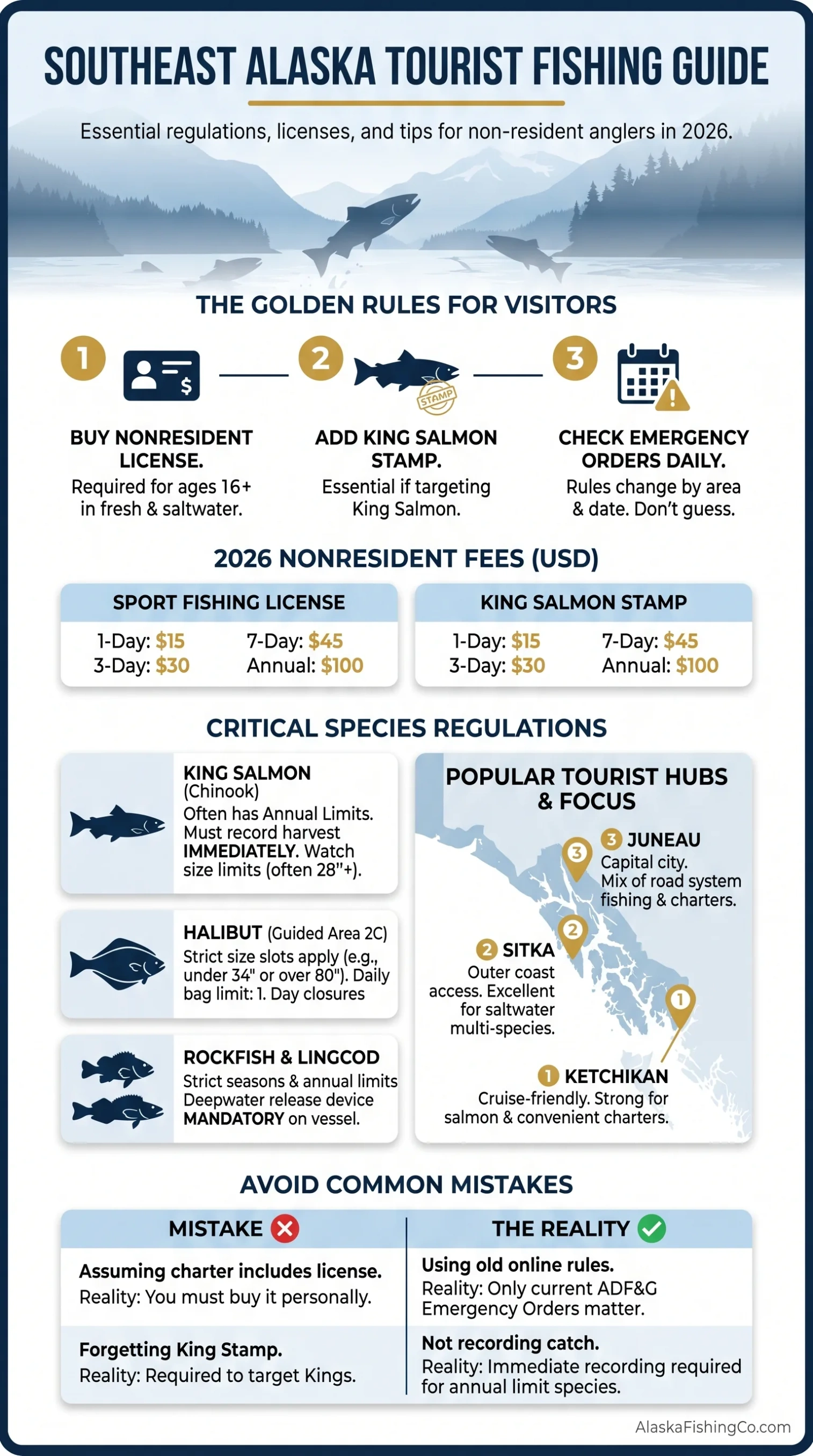
Southeast Alaska is one of the easiest parts of Alaska for tourists to fish, but it is not a place to guess the rules at the dock. Most visitors age 16 and older need a nonresident Alaska sport fishing license, and anyone targeting king salmon also needs a king salmon stamp unless an age-based exception applies.[a]
Southeast Alaska includes Ketchikan, Prince of Wales Island, Wrangell, Petersburg, Sitka, Juneau, Haines, Skagway, Yakutat, and many smaller communities tied together by ferry, floatplane, cruise routes, and coastal charters. The fishing can be simple from a roadside beach or more regulated on a guided saltwater trip for salmon, halibut, lingcod, and rockfish.
If you remember one thing: buy the correct nonresident license before fishing, add a king salmon stamp if you plan to target kings, and check the current Southeast Alaska emergency orders before your trip date.
What To Know First
- Tourists are usually nonresidents. Foreign visitors and U.S. visitors from outside Alaska use the nonresident license options.
- Saltwater and freshwater both count. The license rule applies whether you fish from shore, a charter boat, a dock, a river, or a lake.
- King salmon needs extra attention. A king salmon stamp is separate from the sport fishing license for most visitors who fish for kings.
- Area rules change by town. Ketchikan, Sitka, Juneau, Petersburg/Wrangell, Prince of Wales, Haines/Skagway, and Yakutat can have different in-season restrictions.
- Some species must be recorded right away. King salmon, lingcod, demersal shelf rockfish, and other fish with annual limits may require immediate harvest recording.
Do Tourists Need a Fishing License in Southeast Alaska?
Yes. A tourist generally needs an Alaska nonresident sport fishing license to fish in Southeast Alaska if they are 16 or older. Alaska residents have a different age rule, but visitors should focus on the nonresident requirement.[a]
The rule does not depend on how serious the fishing looks. Casting from a beach in Juneau, fishing from a charter in Sitka, dropping a line near Ketchikan, or fly fishing a stream near Yakutat all fall under Alaska sport fishing rules when you are trying to catch fish.
- Nonresident adults: need a sport fishing license.
- Nonresidents under 16: do not need a sport fishing license, but may still need a harvest record card for species with annual limits.
- Foreign visitors: can buy nonresident licenses and stamps online or through normal vendors.
- Charter guests: still need their own license unless the operator clearly handles the purchase as part of the booking.
Worth Noting
A charter captain can explain the day’s rules, but the license still belongs to the angler. Each person actively fishing should have the correct license and stamp before the first line goes in the water.
Best Fishing Options for First-Time Visitors
The easiest tourist choices are saltwater charters, roadside shoreline fishing, and guided freshwater trips. The best fit depends on how much time you have, whether you want to keep fish, and how comfortable you are reading local regulations.
Southeast Alaska offers fishing opportunities through the year, but individual species, waters, and retention seasons do not all stay open year-round. Visitors may encounter wild trout, all five Pacific salmon species, halibut, lingcod, rockfish, and other species depending on the place and season.
| Trip Style | Best For | Main Rule Issue | Visitor Fit |
|---|---|---|---|
| Saltwater charter | Halibut, salmon, lingcod, rockfish | License, stamps, species limits, charter halibut rules | Best for short trips and cruise visitors |
| Shore fishing near town | Pink salmon, coho salmon, Dolly Varden, trout in some areas | Local closures, snagging rules, salmon ID | Good for flexible travelers with simple gear |
| Freshwater guided trip | Trout, steelhead, salmon in season | Stream-specific openings and catch-and-release rules | Good when rules are complex or access is limited |
| Remote lodge or fly-out | Less crowded rivers, lakes, and coastal water | Area-specific rules, weather delays, possession limits | Best for multi-day visitors |
License Types and 2026 Nonresident Fees
Alaska offers short-term and annual nonresident sport fishing licenses, which makes planning simple for tourists. In 2026, nonresident sport fishing license prices are $15 for 1 day, $30 for 3 days, $45 for 7 days, $75 for 14 days, and $100 for an annual license.[b]
For many Southeast Alaska visitors, the license should match the actual fishing days, not the full vacation length. A seven-day cruise does not always require a seven-day license if you only fish on one port day. A multi-day lodge trip usually does.
- 1-day license: useful for a single Ketchikan, Juneau, or Sitka charter.
- 3-day license: useful for a weekend or a short lodge stay.
- 7-day license: useful for a week of mixed shore and boat fishing.
- 14-day license: useful for longer road, ferry, or lodge trips.
- Annual license: often makes sense if you will return to Alaska or fish on a longer itinerary.
King Salmon Stamp Costs
A king salmon stamp is separate from the sport fishing license for most nonresident tourists who fish for king salmon. In 2026, nonresident king salmon stamp prices are $15 for 1 day, $30 for 3 days, $45 for 7 days, $75 for 14 days, and $100 for an annual stamp.[b]
Do not buy the stamp only after someone on the boat says kings are around. If the plan is to fish for king salmon, have the stamp before fishing starts.
How Southeast Alaska Rules Differ From a Simple Vacation License
A fishing license gives you permission to participate, but it does not override local seasons, species limits, size rules, annual limits, emergency orders, or federal halibut rules. Southeast Alaska is managed by region and by local area, so two towns can have different rules on the same date.
The Alaska Department of Fish and Game posts the Southeast regulations and separate local sections for Yakutat, Haines/Skagway, Juneau/Glacier Bay, Sitka, Petersburg/Wrangell, Prince of Wales, Ketchikan, shellfish, rockfish, and other topics. Emergency orders can change what the printed booklet says.[c]
- King salmon: often managed by emergency order and may have nonresident annual limits.
- Halibut: managed under federal rules, with additional requirements for guided charter anglers in Area 2C.
- Lingcod: has area-based seasons, size slots, and annual limits for nonresidents.
- Rockfish: has conservation rules, release gear requirements, and nonresident restrictions for some species groups.
- Shellfish: may require permits and may be closed by area or season.
One Detail People Miss
Emergency orders are not side notes. In Southeast Alaska, they can change king salmon, lingcod, rockfish, shellfish, and local hatchery-area rules during the season. When an order is temporary, check both its effective date and expiration date before relying on the limit.
King Salmon Rules for Tourists in 2026
Southeast Alaska’s nonresident marine king salmon limits changed several times during 2026. The underlying regional rule set a one-fish bag and possession limit for king salmon 28 inches or longer, but temporary actions changed the annual limit and later the daily limit during July, August, and September.[d]
- April 1-June 30: 1 king salmon per day and in possession; annual limit 3.
- July 1-July 10: 1 king salmon per day and in possession; annual limit 2.
- July 11-July 31: 2 king salmon per day and in possession; annual limit 3.
- August 1-September 30: 2 king salmon per day and in possession; annual limit 4.
- October 1-December 31: the temporary summer liberalizations expired, so the underlying rule again applies: 1 king salmon per day and in possession, with an annual limit of 1 for the July 1-December 31 period.
King salmon retained earlier in the year count toward later annual limits where the applicable order says they do. Nonresidents must record retained king salmon immediately, and local hatchery-area rules or wild-stock protection measures can still be more restrictive or more liberal than the regional rule during their stated effective dates.[d]
For a king-specific explanation of the 2026 changes, annual-limit carryover, and local exceptions, see the Alaska King Salmon Fishing Guide.
Expired 2026 Seasonal Example: Juneau Hatchery Area
This liberalization expired August 31, 2026. From June 1 through August 31, 2026, the designated Juneau saltwater hatchery sport harvest area had a daily bag and possession limit of four king salmon of any size. King salmon harvested there by nonresidents did not count toward the nonresident annual limit.[e]
Those four-fish hatchery-area limits should not be treated as a current September, October, or later-season rule. Beginning September 1, anglers in the area returned to the Southeast regional king salmon regulations then in effect. The Juneau announcement also warned that waters outside the designated hatchery area were more restrictive.
Halibut Fishing for Tourists in Southeast Alaska
Halibut is one of the main reasons tourists book saltwater charters in Southeast Alaska, but guided halibut rules are not the same as general Alaska license rules. Southeast Alaska is IPHC Area 2C for halibut management.
For 2026, a charter vessel angler age 18 or older who intends to catch and retain halibut in Area 2C needs a $20 charter halibut stamp for that charter fishing trip. The guide handles the stamp. Unguided anglers do not need this charter stamp.[f]
Area 2C charter anglers have a one-halibut daily bag limit. A retained charter halibut must measure 34 inches or less, or 80 inches or more. The 2026 Thursday retention closures ran from June 18 through September 10; that temporary day-of-week closure period has ended.[f]
- Unguided and guided trips can differ. Do not copy a private-boat rule onto a charter trip.
- The 2026 charter stamp remains a separate requirement. Adults intending to retain halibut on an Area 2C charter need the stamp even though the Thursday closure period has ended.
- Size slots are strict. Measure before deciding that a fish can be retained.
- Ask before booking. A charter should explain the legal halibut plan for the exact date.
Rockfish, Lingcod, and Deepwater Release Rules
Rockfish and lingcod are common on Southeast saltwater trips, but they carry rules tourists often overlook. These species may have annual limits, size slots, nonresident seasons, and recording duties.
The 2026 Southeast Alaska nonresident demersal shelf rockfish season ran from July 1 through August 25. During that season, the nonresident limit was one fish daily, one in possession, with an annual limit of one fish. ADF&G also requires deepwater release equipment when releasing rockfish and requires vessels to have a functional deepwater release device on board during saltwater sport fishing activity.[g]
- Demersal shelf rockfish include species such as yelloweye, quillback, tiger, China, canary, copper, and rosethorn rockfish.
- Nonresident lingcod rules vary by management area. Sitka-area and Ketchikan-area rules are not always identical.
- Annual limits are not extra by town. Moving from Sitka to Ketchikan does not reset an annual lingcod or rockfish limit.
- Fish-condition restrictions can be local and temporary. Check current port or area emergency orders before filleting or de-heading regulated fish at sea.
Before You Move On
If a charter says “mixed bag,” ask which species are likely, which ones have annual limits, and whether any fish must be recorded before the boat heads back to town.
Best Places in Southeast Alaska for Tourist Fishing
The best place depends on your route. Cruise visitors usually choose Ketchikan, Juneau, Sitka, or Icy Strait-area charters. Independent travelers can add Prince of Wales, Petersburg, Wrangell, Haines, Skagway, and Yakutat depending on ferry schedules, flights, and weather.
Ketchikan
Ketchikan is a strong choice for first-time saltwater visitors because it has many charters, shore access points, and cruise-friendly timing. It is often used for salmon, halibut, lingcod, and rockfish trips, but local emergency orders should be checked before fishing.
- Good for short charter windows.
- Useful for salmon-focused visitors.
- Better with a guide if targeting multiple species.
Sitka
Sitka is known for productive outer-coast saltwater fishing. It is a strong fit for tourists who want salmon, halibut, rockfish, or lingcod from a charter, but it also has area-specific rules that can affect nonresident lingcod and rockfish harvest.
- Good for saltwater charters.
- Often chosen for salmon and groundfish trips.
- Weather and ocean conditions can shape the day’s route.
Juneau and Glacier Bay Area
Juneau is practical for visitors because it has easy flights, cruise stops, road-system fishing, and charters. Local hatchery-area actions can create special seasonal king salmon opportunities, but those orders have defined start and expiration dates. Nearby waters outside the special zone may remain under different rules.
- Good for travelers without a rental car.
- Useful for shore fishing, charters, and short guided trips.
- Local boundary lines and emergency-order dates matter for king salmon.
Yakutat
Yakutat is a better fit for anglers who plan a fishing-focused trip rather than a casual port stop. The Situk River area is well known for steelhead and salmon, and the region can also offer saltwater fishing when conditions allow.
- Good for steelhead and salmon-focused visitors.
- Better for multi-day planning than a short stop.
- Freshwater rules should be checked carefully before fishing.
Prince of Wales, Petersburg, Wrangell, Haines, and Skagway
These areas can be excellent for visitors who want fewer crowds or a more local trip style. They also require more planning because transportation, weather, local closures, and area-specific regulations can shape the entire trip.
- Good for independent travelers.
- Useful for ferry-based itineraries.
- Best planned with current area reports and local rule checks.
How To Buy an Alaska Fishing License Online
Tourists can buy Alaska sport fishing licenses and king salmon stamps online through ADF&G, at many sporting goods stores, and at Fish and Game offices. Online purchase is usually the cleanest option for visitors who want the license ready before travel.
ADF&G’s online license FAQ explains that licenses must be signed physically or electronically to be valid, and that an eSigned license bought through an ADF&G account can be saved to a mobile device or printed. Anglers must still record sport-caught fish with annual limits immediately upon landing them.[h]
- Go to the official ADF&G online store.
- Choose a nonresident sport fishing license for the number of fishing days needed.
- Add a nonresident king salmon stamp if fishing for king salmon.
- Create or use the required account if buying an eSigned license.
- Save the license to your phone and carry a printed backup if possible.
- Keep a harvest record method ready if you may retain fish with annual limits.
Foreign Visitors and Cruise Passengers
Foreign visitors can buy Alaska nonresident sport fishing licenses. Alaska’s license pricing page lists nonresident fishing licenses for foreign or alien visitors with the same short-term sport fishing license prices as other nonresidents.[b]
Cruise passengers should pay close attention to timing. A license is not based on the ship’s time in port; it is based on the license duration and the fishing date. If a charter starts early or crosses midnight on a special trip, confirm the correct license period with the operator before buying.
- Bring ID. Match the name on the license to your passport or travel ID.
- Do not rely on ship Wi-Fi at the dock. Buy and save the license before arrival.
- Ask what species are planned. A “salmon charter” may or may not target king salmon.
- Keep the license accessible. A dead phone can become a practical problem during a field check.
Family License Reminder
For families, each angler’s license situation is separate. One parent’s license does not cover a teenager who is old enough to need their own.
Common Mistakes Tourists Make
Most Southeast Alaska fishing mistakes are not caused by bad intent. They happen because visitors treat Alaska fishing like a simple activity purchase instead of a regulated outdoor activity with local changes.
Thinking a Charter Includes the License Automatically
Wrong assumption: “I paid for the charter, so the license must be included.”
Correct explanation: Some operators help guests buy licenses, but the angler still needs the right license and stamp before fishing.
Why it gets confused: Many tourist activities bundle tickets, permits, and gear. Sport fishing licenses are personal legal documents.
Buying a Fishing License but Forgetting the King Salmon Stamp
Wrong assumption: “My Alaska fishing license covers all salmon.”
Correct explanation: Most nonresident tourists who fish for king salmon need a separate king salmon stamp.
Why it gets confused: Coho, pink, chum, sockeye, and king salmon are all “salmon” in casual speech, but king salmon has its own stamp rule.
Keeping a Fish Without Recording It
Wrong assumption: “The guide will record everything later.”
Correct explanation: Fish with annual limits may need to be recorded immediately by the angler on the license or harvest record.
Why it gets confused: Charter logbooks and personal harvest records are not the same thing.
Using an Expired Emergency Order
Wrong assumption: “The special limit I found from August should still apply now.”
Correct explanation: Temporary Southeast Alaska emergency orders have stated effective and expiration dates. Once an order expires, anglers must return to the rule then in force unless another order replaces it.
Why it gets confused: Search results can continue showing an old liberalization after its expiration date.
Assuming All Southeast Towns Have the Same Rules
Wrong assumption: “Ketchikan, Sitka, and Juneau are all Southeast, so the rules are the same.”
Correct explanation: Southeast is one region, but local management areas can have different emergency orders and special rules.
Why it gets confused: Maps make the region look compact, but the panhandle stretches for hundreds of miles.
Real-Life Scenarios for Southeast Alaska Visitors
These examples show how the rules apply to normal visitor plans.
- A cruise passenger books one salmon charter in Ketchikan.
They likely need a 1-day nonresident sport fishing license and a king salmon stamp if the trip will target kings. - A family fishes from shore in Juneau for pink salmon.
Adults and nonresidents age 16 or older need licenses, but a king salmon stamp is not needed unless they fish for king salmon. - A tourist books a halibut charter in Sitka after September 10, 2026.
The summer Thursday retention closures have ended, but the adult angler still needs the 2026 charter halibut stamp if they intend to retain halibut, and the Area 2C daily and size rules still apply. - A visitor kept a king salmon earlier in 2026 and wants to fish again in October.
The temporary summer liberalizations ended September 30, so the angler needs to check the underlying regional annual limit and how the earlier harvest counts before retaining another king. - A couple plans a week across Juneau and Petersburg.
A 7-day license may fit, but they should check each local emergency order instead of using one town’s rules for both places. - A traveler sees the Juneau four-king hatchery limit in an old search result.
That rule applied only from June 1 through August 31, 2026. It is an expired seasonal example, not a current fall limit. - A foreign visitor saves a license on their phone before flying to Yakutat.
That can work, but a printed backup and offline access are smart because reception and battery life can fail.
What To Check the Day Before You Fish
The day-before check should be simple: license, stamp, area, species, emergency order, and weather. This is especially important in Southeast Alaska because water conditions and management actions can change a visitor’s original plan.
- Confirm the exact town or management area.
- Check ADF&G emergency orders for that area.
- Check both the effective date and expiration date of any temporary order.
- Confirm whether the trip is guided or unguided.
- Ask the charter what species are expected.
- Check whether king salmon, halibut, lingcod, or rockfish rules affect the trip.
- Make sure each angler has a license, stamp if needed, and a way to record annual-limit harvest.
- Save documents offline and carry a backup if possible.
A Practical Rule for Planning
Southeast Alaska is friendly to tourists, but the best trips are planned around the rules rather than patched together at the harbor. A correct license gets you started; the right area rules keep the day legal.
The most common mistake is buying only the basic fishing license and forgetting that king salmon, halibut, lingcod, rockfish, shellfish, and local emergency orders may add extra steps.
Easy rule to remember: license first, stamp if fishing kings, then check the exact water, species, and date before keeping anything.
Southeast Alaska Fishing Questions Answered
Do tourists need a fishing license in Southeast Alaska?
Yes. Most tourists age 16 or older need an Alaska nonresident sport fishing license to fish in Southeast Alaska. The rule applies in saltwater and freshwater.
Can foreign visitors buy an Alaska fishing license online?
Yes. Foreign visitors can buy Alaska nonresident sport fishing licenses online through ADF&G, through many license vendors, or at Fish and Game offices.
Do I need a king salmon stamp in Southeast Alaska?
If you are a nonresident age 16 or older and you fish for king salmon, you generally need a nonresident king salmon stamp in addition to your sport fishing license.
What are the Southeast Alaska nonresident king salmon limits in late 2026?
The temporary July through September liberalizations expired September 30. Beginning October 1, the underlying regional rule again applies: one king salmon 28 inches or longer per day and in possession, with a one-fish annual limit for the July 1-December 31 period. Earlier harvest can affect whether another king may be retained.
Is a halibut stamp required in Southeast Alaska?
For 2026, charter vessel anglers age 18 or older who intend to catch and retain halibut in Area 2C need a $20 charter halibut stamp for the trip. The guide handles the stamp. Unguided anglers do not need this charter stamp.
Is the Juneau four-king hatchery limit still active?
No. The designated Juneau saltwater hatchery-area liberalization that allowed four king salmon of any size ran from June 1 through August 31, 2026 and has expired.
What is the best Southeast Alaska town for a first fishing trip?
Ketchikan, Sitka, and Juneau are often the easiest choices for first-time visitors because they have charters, visitor services, and practical access. Yakutat, Prince of Wales, Petersburg, Wrangell, Haines, and Skagway can be better for travelers planning a more fishing-focused trip.
Can I fish from shore in Southeast Alaska?
Yes. Many Southeast towns have shoreline fishing opportunities, especially for salmon and Dolly Varden in season. You still need the correct license and must follow local area rules.
Alaska Fishing References
- [a] Alaska Department of Fish and Game — Sport Fishing Licenses, King Salmon Stamps, IDs and Harvest Record Cards. Covers who needs a sport fishing license, king salmon stamp requirements, and harvest record card basics. (Official Alaska state fish and wildlife agency.)
- [b] Alaska Department of Fish and Game — Sport Fishing License and King Salmon Stamp Prices. Lists current nonresident and foreign visitor license and stamp fees. (Official Alaska state fee source.)
- [c] Alaska Department of Fish and Game — Southeast Alaska Sport Fish Regulations. Provides Southeast regulation sections and directs anglers to current emergency orders that can supersede printed regulations. (Official regional regulation source.)
- [d] Alaska Department of Fish and Game — 2026 Southeast Alaska marine king salmon actions. These official announcements establish the base regional rule and the temporary July and August liberalizations used in the 2026 timeline: base regional rule, July 1 action, July 11 action, and August 1 action. (Official ADF&G emergency-order and advisory records.)
- [e] Alaska Department of Fish and Game — Sport Fishing for King Salmon Opens in Hatchery Area Near Juneau Starting June 1. Establishes the four-king any-size limit from June 1 through August 31, 2026, the nonresident annual-limit exemption inside the designated area, and the August 31 expiration date. (Official Juneau emergency order and advisory announcement.)
- [f] NOAA Fisheries — 2026 Regulations for Charter Halibut Anglers. Covers the $20 charter halibut stamp, Area 2C daily limit, reverse-slot size rule, and June 18-September 10 Thursday closures. (Official NOAA Fisheries 2026 charter regulation summary.)
- [g] Alaska Department of Fish and Game — Southeast Alaska 2026 Demersal Shelf Rockfish Sport Fishing Season Reduced for Nonresident Anglers. Explains the 2026 nonresident season, limits, harvest recording, and deepwater release requirement. (Official ADF&G advisory announcement.)
- [h] Alaska Department of Fish and Game — Purchasing Your License Online and eSigning Your License FAQ. Explains electronic signatures, carrying licenses, printing licenses, and recording sport-caught fish with annual limits. (Official ADF&G licensing FAQ.)