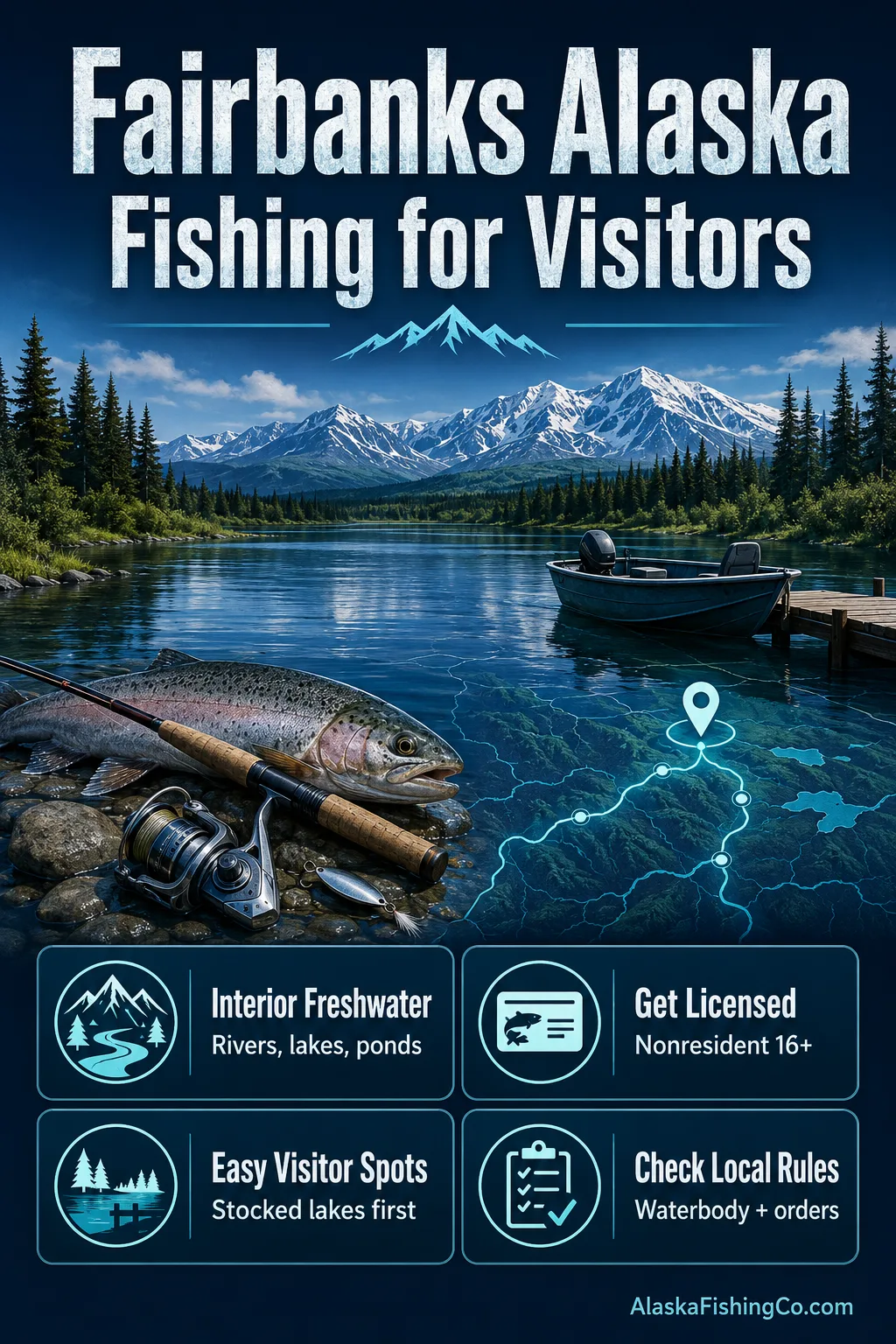
Fairbanks fishing is best understood as an Interior Alaska trip, not a coastal salmon trip. Visitors usually fish for Arctic grayling, stocked rainbow trout, Arctic char, northern pike, burbot, lake trout, and landlocked salmon in rivers, roadside lakes, stocked ponds, and winter ice-fishing spots.
Most out-of-state and foreign visitors age 16 or older need an Alaska nonresident sport fishing license before fishing around Fairbanks. In 2026, king salmon fishing is closed in the Tanana River drainage, which includes major Fairbanks-area waters, so visitors should plan around grayling, stocked lakes, pike, burbot, and lake fisheries instead.[a]
If you remember one thing… buy the right Alaska sport fishing license, check the 2026 Northern Alaska rules for the exact water you will fish, and look for emergency orders before you cast.
What To Know First
- Fairbanks is freshwater-focused: local trips usually mean rivers, sloughs, ponds, stocked lakes, and winter ice-fishing lakes.
- Nonresidents age 16 and older need a license: this includes most visitors from other U.S. states and most international travelers.
- King salmon is not the main visitor target: in 2026, king salmon sport fishing is closed in the Tanana River drainage by emergency order.
- Arctic grayling rules change by water: the Chena River has special catch-and-release and harvest sections.
- Stocked lakes are often the easiest option: places such as Ballaine Lake, Cushman Lake, Chena Lake, Birch Lake, Harding Lake, and Quartz Lake are more visitor-friendly than remote river systems.
Do Visitors Need a Fishing License in Fairbanks?
Yes, most visitors need an Alaska sport fishing license to fish around Fairbanks. Alaska requires a sport fishing license for resident anglers age 18 and older and nonresident anglers age 16 and older when fishing in fresh or salt water.[b]
For a visitor, the word nonresident usually means anyone who has not met Alaska residency rules. A tourist from Texas, Germany, Japan, Canada, the United Kingdom, or another country is normally treated as a nonresident for sport fishing license purposes.
- Nonresident age 16 or older: needs an Alaska sport fishing license.
- Nonresident under 16: does not need a sport fishing license, but harvest record rules may still matter for species with annual limits.
- Alaska resident age 18 or older: needs a resident sport fishing license unless a resident exemption applies.
- Alaska resident under 18: does not need a sport fishing license.
Everyone fishing should carry the license in paper or electronic form. A license is personal; it cannot be borrowed, shared, altered, or transferred to another person.
Worth Noting
A person who is only watching does not need a fishing license. A person who casts, retrieves, hooks fish, or actively helps fish can be treated as fishing and should have the proper license if they are old enough.
Fairbanks Fishing License Costs for Nonresidents
Alaska sells short-term nonresident sport fishing licenses that fit most visitor trips. For 2026, the nonresident sport fishing license fees are $15 for 1 day, $30 for 3 days, $45 for 7 days, $75 for 14 days, and $100 for an annual license.[c]
The right license depends on how many days you will actually fish, not how many days you will be in Fairbanks. A traveler staying one week but fishing only one afternoon may only need a 1-day license. A family planning several lake and river days may be better served by a 7-day or 14-day license.
| License Type | 2026 Fee | Best Fit | Visitor Note |
|---|---|---|---|
| 1-Day Sport Fishing | $15 | One short outing | Useful for a single stocked lake, half-day river stop, or first try at fishing. |
| 3-Day Sport Fishing | $30 | Weekend trip | Good for visitors fishing two or three days around Fairbanks or North Pole. |
| 7-Day Sport Fishing | $45 | One-week visit | Often the best match for travelers who may fish more than once. |
| 14-Day Sport Fishing | $75 | Longer Alaska itinerary | Works for visitors combining Fairbanks with Delta Junction, Denali, or other Interior stops. |
| Annual Sport Fishing | $100 | Repeat or extended visits | Worth considering if fishing many days during the calendar year. |
Foreign visitors use the same general nonresident sport fishing license choices. Alaska also lists nonresident foreign/alien sport fishing licenses with the same 1-day, 3-day, 7-day, 14-day, and annual fees. Residents of Yukon Territory have a special reciprocal license option, but most international travelers should expect to buy a standard nonresident license.
Do Fairbanks Visitors Need a King Salmon Stamp?
A king salmon stamp is required when fishing for king salmon in Alaska, including catch-and-release fishing, unless an exemption applies. Around Fairbanks, this point is easy to misunderstand because the 2026 Tanana River drainage rules close king salmon sport fishing, including catch-and-release, by emergency order.
In plain terms: a king salmon stamp does not let a visitor fish for king salmon where king salmon fishing is closed. If you are only fishing Fairbanks-area stocked lakes, grayling streams, pike waters, or burbot waters, a king salmon stamp is usually not part of the plan.
- Fishing for king salmon where open: license plus king salmon stamp may be needed.
- Fishing Fairbanks-area waters under the 2026 Tanana closure: do not target king salmon.
- Fishing stocked landlocked salmon lakes: these are not the same as fishing for king salmon.
- Children under the nonresident license age: may be exempt from the stamp, but harvest record rules can still apply.
One Detail People Miss
A king salmon stamp is not a general salmon permit. It is tied to king salmon fishing, and local closures still control whether king salmon fishing is allowed at all.
Where Visitors Can Fish Around Fairbanks
Fairbanks visitors usually do best by matching the location to the season and their comfort level. Stocked lakes and roadside ponds are simpler for families and first-time visitors, while rivers and sloughs require more attention to flow, clarity, gear rules, and species limits.
Chena River
The Chena River is the most recognizable Fairbanks-area river for visitors. It can offer Arctic grayling fishing, but the rules are location-specific. In 2026, the Chena River drainage is open year-round to sport fishing, but Arctic grayling is catch-and-release from April 1 through May 31. Downstream from the ADF&G marker 300 feet below the Chena River dam, the grayling limit is one per day from June 1 through March 31. Upstream from that marker, Arctic grayling remains catch-and-release only.[d]
- Good visitor fit: short river sessions near town or along Chena Hot Springs Road.
- Main draw: Arctic grayling, especially with small spinners or dry flies.
- Rule to check: single-hook and bait restrictions.
- Watch for: high or muddy water after rain or snowmelt.
Stocked Lakes and Ponds
Stocked waters are often the easiest Fairbanks fishing choice for visitors. The 2026 Northern Alaska stocked waters list includes Fairbanks-area and nearby waters such as Ballaine Lake, Cushman Lake, Chena Lake, North Pole Pond, Quartz Lake, Birch Lake, Harding Lake, Olnes Pond, and several Chena Hot Springs Road pits.[e]
- Good visitor fit: families, short trips, shore fishing, and casual spinning setups.
- Main targets: rainbow trout, Arctic char, landlocked salmon, and sometimes lake trout.
- Rule to check: stocked lake bag limits and any water-specific exception.
- Watch for: lake-specific access, military land boundaries, and ice safety in winter.
Tanana Lakes Recreation Area and Cushman Lake
Tanana Lakes Recreation Area is a practical choice inside Fairbanks for visitors who want a simple freshwater outing without a long drive. Cushman Lake is listed among stocked Fairbanks-area waters, and the recreation area can also be part of a pike-focused plan depending on current conditions and rules.
- Good visitor fit: short family outings and visitors without a boat.
- Main targets: stocked fish and, in some nearby waters, northern pike.
- Rule to check: current stocking information and local waterbody rules.
Chatanika River, Minto Flats, and Northern Pike Waters
Northern pike fishing near Fairbanks is more seasonal and more water-dependent than stocked lake fishing. In 2026, the Chatanika River drainage is open to sport fishing for species other than northern pike year-round, while northern pike is open from April 15 through October 14. The general Tanana drainage pike limit is five per day, five in possession, with only one 30 inches or longer unless a special rule applies.
- Good visitor fit: anglers who understand pike gear, access, and seasonal water levels.
- Main targets: northern pike.
- Rule to check: open dates, bag limits, bait and hook rules, and emergency orders.
- Watch for: flooded flats, difficult channels, bugs, and navigation issues.
Birch, Harding, and Quartz Lakes
Birch Lake, Harding Lake, and Quartz Lake are well-known roadside lakes between Fairbanks and Delta Junction. ADF&G describes these as major winter fishing waters north of the Alaska Range, with public accessibility and stocked fisheries.
- Good visitor fit: winter ice fishing, roadside lake fishing, and day trips outside Fairbanks.
- Main targets: rainbow trout, Arctic char, landlocked salmon, burbot, lake trout, and grayling depending on the lake.
- Rule to check: Harding Lake has special rules, including catch-and-release only for northern pike.
- Watch for: ice thickness, wind, cold exposure, and lake-specific gear limits.
Best Fish Species for Fairbanks Visitors
The best species for a visitor depends on season, water clarity, and how much driving you want to do. For most summer visitors, Arctic grayling and stocked rainbow trout are the most approachable targets. In winter, stocked lakes, burbot, and lake trout become more practical for anglers prepared for ice fishing.
| Species | Common Visitor Setting | Typical Approach | Rule Reminder |
|---|---|---|---|
| Arctic grayling | Chena River, Delta Clearwater, clear streams | Small spinners, small spoons, dry flies, nymphs | Many waters have single-hook, artificial lure, or catch-and-release rules. |
| Rainbow trout | Stocked lakes and ponds | Small lures, bait where allowed, simple shore fishing | Check stocked lake limits and special lake exceptions. |
| Arctic char | Stocked lakes | Small spoons, spinners, jigs | Often counted with stocked lake combination limits. |
| Northern pike | Minto Flats, Chatanika area, selected ponds and lakes | Large spoons, spinners, topwater lures | Open seasons and size limits vary by water. |
| Burbot | Tanana River and lakes | Bottom fishing, bait where legal, ice-fishing setups | Set line rules differ between lakes and flowing waters. |
| Lake trout | Large cold lakes such as Harding, Birch, Quartz, Fielding, Tangle Lakes | Spoons, jigs, trolling or ice fishing where allowed | Some lakes have size or harvest limits that differ from general rules. |
Before You Move On
Do not assume the same rule follows the same species everywhere. In Interior Alaska, the waterbody name often matters as much as the fish species.
How to Buy an Alaska Fishing License Online
Visitors can buy Alaska sport fishing licenses through the ADF&G online store, the ADF&G mobile app, local ADF&G offices, and licensed vendors. The online route is usually the simplest choice for travelers who want to arrive ready to fish.
- Go to the official ADF&G online store.
- Choose sport fishing license options.
- Select nonresident if you are visiting from outside Alaska.
- Choose the 1-day, 3-day, 7-day, 14-day, or annual license that matches your fishing dates.
- Add a king salmon stamp only if you will legally fish for king salmon in waters where king salmon fishing is open.
- Complete the purchase and keep the license available on your phone or printed copy.
Pick the start date carefully for short-term licenses. A 1-day license is not the right choice if you arrive late, fish briefly, and then plan to fish again the next morning. In that case, a 3-day license may be cleaner and less stressful.
Season Timing Around Fairbanks
Fairbanks fishing changes sharply by season. Late spring can bring high, muddy river water, while summer gives visitors better access to clear streams and stocked lakes. Winter fishing can be productive, but it requires cold-weather planning and ice safety.
Late Spring
Late spring can be uneven. Lakes open at different times, rivers may run high, and Arctic grayling rules can include catch-and-release periods. Visitors in May should check stocking updates and river reports before choosing a spot.
- Best for: early stocked lakes, ice-out lake trout in some lakes, and cautious grayling planning.
- Watch for: snowmelt, muddy launches, and changing access.
Summer
Summer is the easiest season for most visitors. Stocked lakes are active, shore access is simpler, and clear-water grayling opportunities improve as rivers settle. Bugs can be heavy, so bring repellent, long sleeves, and patience.
- Best for: Arctic grayling, stocked trout, pike trips, family lake fishing.
- Watch for: water clarity, wildfire smoke, and local closures.
Fall
Fall can be a good time for stocked lakes and cooler-water fishing. Daylight shortens quickly, so visitors should plan around travel time, evening temperatures, and road conditions.
- Best for: stocked lakes, pike before seasonal closures, and cooler lake fishing.
- Watch for: early freeze, wet roads, and shorter daylight.
Winter
Winter fishing around Fairbanks is real, but it is not casual. Visitors need proper clothing, ice-fishing gear, a way to confirm ice conditions, and a plan for extreme cold. Birch, Harding, and Quartz Lakes are among the well-known winter fishing waters north of the Alaska Range.[f]
- Best for: ice fishing on stocked and larger roadside lakes.
- Watch for: thin ice early and late in the season, overflow, wind, and cold injury.
Common Mistakes Visitors Make
Most Fairbanks fishing problems come from assuming Alaska rules are statewide and simple. They are not. The correct rule can change by drainage, river section, date, fish species, and emergency order.
Wrong idea: “A nonresident child always needs a license.”
Correct explanation: nonresident anglers under 16 do not need an Alaska sport fishing license. They may still need a harvest record card for species with annual limits.
Why it gets mixed up: age rules differ for residents and nonresidents, and hunting age rules are not the same as fishing age rules.
Wrong idea: “A king salmon stamp lets me fish for kings anywhere.”
Correct explanation: a stamp does not override closures. In 2026, king salmon sport fishing is closed in the Tanana River drainage, including catch-and-release fishing.
Why it gets mixed up: visitors often see stamp requirements before they read local emergency orders.
Wrong idea: “The Chena River has one simple grayling rule.”
Correct explanation: Chena River grayling rules differ by date and by whether you are upstream or downstream of the ADF&G marker below the dam.
Why it gets mixed up: maps and casual fishing reports often say “Chena River” without naming the exact section.
Wrong idea: “Stocked lake rules are all the same.”
Correct explanation: many stocked waters share general limits, but special rules can apply. Harding Lake is a good example because it has its own pike and lake trout rules.
Why it gets mixed up: stocked lakes feel simple, so visitors may skip the waterbody-specific regulation page.
Wrong idea: “If locals are fishing, the access must be public.”
Correct explanation: some waters near Fairbanks are on or near military land, private land, or areas with separate access rules.
Why it gets mixed up: Interior Alaska has many informal-looking roads, pullouts, and trails that do not always mean public permission.
One Detail People Miss
Emergency orders override printed regulations. A screenshot of an old rule or a paper booklet is not enough if ADF&G has issued a newer emergency order.
Real-Life Fairbanks Visitor Scenarios
These examples show how Fairbanks fishing plans usually work in real trips. They are not substitutes for checking the current rule for the exact water, but they help narrow the decision.
- A family staying two nights in Fairbanks wants an easy shore option.
Stocked lakes such as Ballaine Lake, Cushman Lake, Chena Lake, or North Pole Pond are usually more practical than a river float or remote pike trip. - A solo visitor wants to try Arctic grayling near town.
The Chena River can work, but the angler should confirm the river section, grayling season, hook rule, and whether harvest is allowed. - A summer visitor wants salmon near Fairbanks.
This is often the wrong expectation in 2026 because king salmon sport fishing is closed in the Tanana drainage, and Fairbanks is not a coastal salmon hub. - A visitor is driving from Fairbanks toward Delta Junction.
Birch, Harding, Quartz, and other Richardson Highway waters can fit a lake-fishing or ice-fishing plan, depending on season and rules. - A pike angler wants larger fish near Minto Flats.
That plan needs more care with dates, water levels, access, navigation, and pike-specific limits than a stocked lake trip. - A winter visitor wants to ice fish once.
A guided or locally supported outing is often the safer path unless the visitor already understands Interior Alaska cold, ice thickness, and lake access. - An international visitor wants to buy everything before arrival.
The ADF&G online store can handle the license purchase, but the visitor should still check emergency orders after arrival.
Gear and Practical Planning for Visitors
Fairbanks fishing does not require ocean tackle. A light spinning rod, small lure box, and weather-aware clothing can cover many summer visitor trips. Fly anglers can do well with small dry flies and nymphs for Arctic grayling when water clarity cooperates.
Simple Summer Setup
- Light spinning rod or 4- to 5-weight fly rod.
- Small spinners in sizes 0-2.
- Small spoons around 1/4 ounce.
- Dry flies and nymphs in small to medium sizes.
- Polarized sunglasses for clear-water spotting.
- Bug protection, rain layer, and footwear that can handle mud.
Stocked Lake Setup
- Small spinners, spoons, and jigs.
- Bait only where allowed.
- Compact landing net.
- Cooler if keeping fish within legal limits.
- Copy of current lake-specific rules.
Pike Setup
- Stronger rod than a grayling setup.
- Wire or bite-resistant leader.
- Large spoons, spinners, and topwater lures.
- Long pliers for safe hook removal.
- Extra attention to pike season dates and size limits.
Safety, Access, and Local Conditions
Fairbanks fishing is accessible, but visitors should not treat it like a city park outing everywhere. Interior Alaska conditions change quickly. Rivers can rise, lakes can remain cold after ice-out, and remote-feeling access points may have limited cell service.
- Check emergency orders: do this the day before fishing and again if your trip changes.
- Respect access boundaries: military lands and some managed areas may require separate permission.
- Carry your license: paper or electronic is acceptable, but it must be available if requested.
- Know the exact water name: “near Fairbanks” is not specific enough for regulations.
- Handle fish properly: if a fish must be released, keep it in the water as much as possible and release it immediately.
- Plan for weather: summer can mean bugs and rain; winter can mean dangerous cold.
Fairbanks can be a rewarding place to fish when the plan matches Interior Alaska rather than coastal Alaska. Buy the right license, choose a water that fits your trip, and check the current rule before fishing. The most common mistake is assuming a general Alaska rule applies to every Fairbanks water. The rule to remember is simple: license first, exact water second, emergency order last.
Fairbanks Alaska Fishing Questions Answered
Do tourists need a fishing license in Fairbanks, Alaska?
Yes. Most tourists age 16 or older need an Alaska nonresident sport fishing license to fish around Fairbanks. Nonresident anglers under 16 do not need a sport fishing license, although harvest record rules may still apply for certain species.
Can foreign visitors buy an Alaska fishing license online?
Yes. Foreign visitors can buy Alaska nonresident sport fishing licenses online through the ADF&G store. Most international travelers use the same short-term nonresident license choices as visitors from other U.S. states.
What fish can visitors catch near Fairbanks?
Common Fairbanks-area visitor targets include Arctic grayling, rainbow trout, Arctic char, landlocked salmon, northern pike, burbot, lake trout, whitefish, and sheefish depending on the water and season.
Is Fairbanks a good place for salmon fishing?
Fairbanks is not usually the best Alaska destination for visitor salmon fishing. In 2026, king salmon sport fishing is closed in the Tanana River drainage, including catch-and-release fishing. Visitors usually have better Fairbanks plans targeting grayling, stocked lake fish, pike, burbot, or lake trout.
Where is the easiest place to fish near Fairbanks?
Stocked lakes and ponds are often easiest for visitors. Options may include Ballaine Lake, Cushman Lake, Chena Lake, North Pole Pond, Birch Lake, Harding Lake, Quartz Lake, and other stocked waters listed by ADF&G. Always check the current stocking list and water-specific rules.
Do I need a king salmon stamp for Fairbanks fishing?
Usually not if you are fishing for grayling, trout, pike, burbot, or stocked lake species around Fairbanks. A king salmon stamp is tied to king salmon fishing, and it does not allow fishing where king salmon is closed.
Can visitors ice fish near Fairbanks?
Yes, but winter fishing requires proper gear, local ice knowledge, and cold-weather planning. Birch, Harding, and Quartz Lakes are well-known winter fishing waters north of the Alaska Range, but visitors should confirm conditions before going.
Alaska Fishing References
- [a] ADF&G Tanana Area Sport Fishing Report, May 28, 2026 — used for 2026 Fairbanks-area conditions, stocked lake updates, and the Tanana drainage king salmon emergency closure. (Official Alaska Department of Fish and Game source.)
- [b] ADF&G 2026 Northern Alaska Sport Fishing Regulations: Licensing, King Salmon, Harvest Records — used for age rules, license possession rules, harvest records, and king salmon stamp details. (Official Alaska Department of Fish and Game regulation booklet.)
- [c] ADF&G License, Stamp, and Tag Pricing List — used for nonresident license and king salmon stamp fees. (Official Alaska Department of Fish and Game pricing page.)
- [d] ADF&G 2026 Northern Alaska Sport Fishing Regulations: Tanana Drainage — used for Chena River, Chatanika River, Tanana drainage, species limits, and water-specific Fairbanks-area rules. (Official Alaska Department of Fish and Game regulation PDF.)
- [e] ADF&G 2026 Northern Alaska Stocked Lakes and Species Stocked — used for Fairbanks-area stocked waters and stocked lake species. (Official Alaska Department of Fish and Game stocked waters list.)
- [f] ADF&G “Ice Fishing on the Big Three” — used for Birch, Harding, and Quartz Lakes as major winter fishing waters north of the Alaska Range. (Official Alaska Department of Fish and Game educational article.)