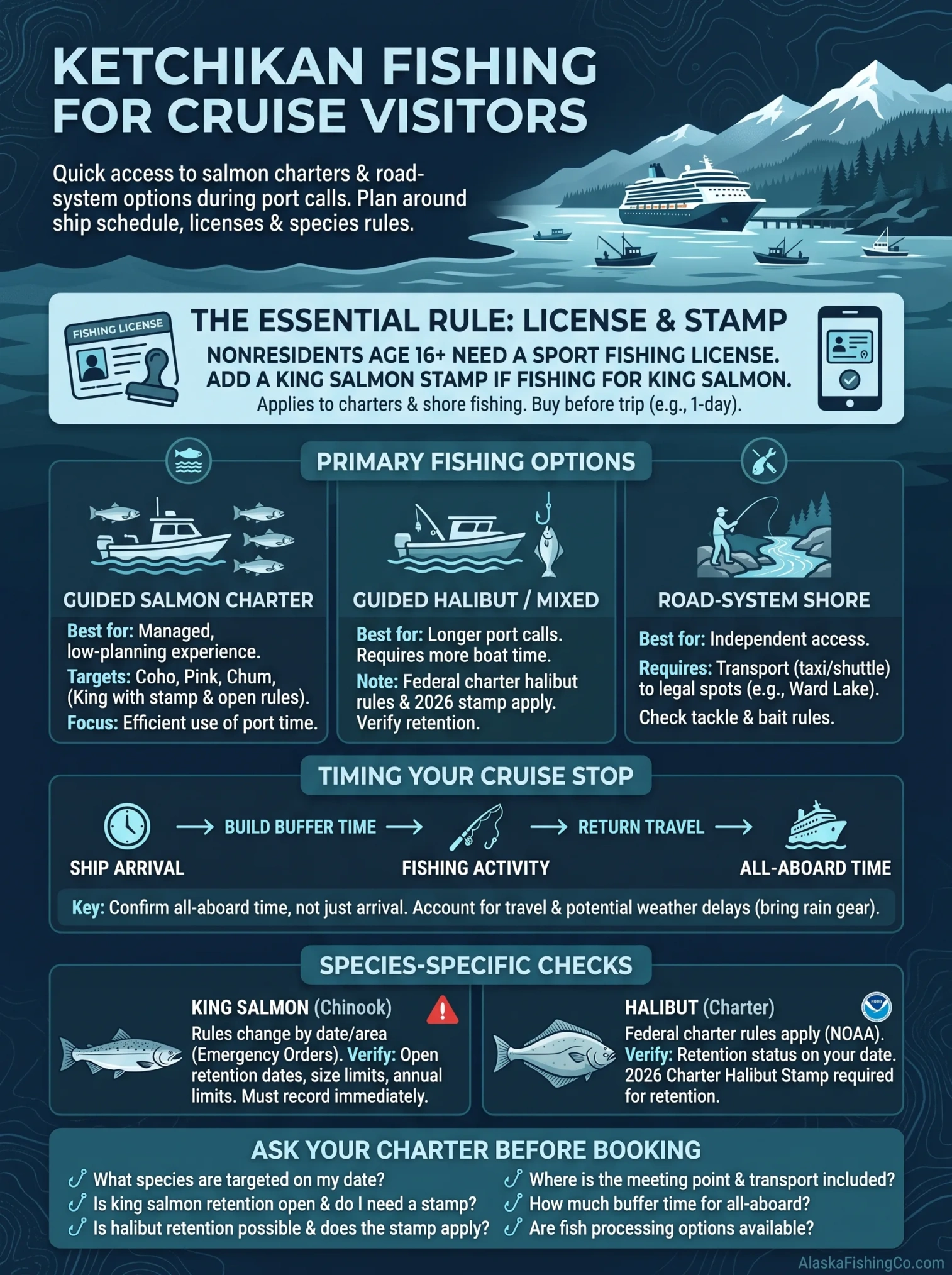
Ketchikan is one of the easiest Alaska cruise ports for a short fishing trip because charters, salmon waters, and road-system fishing are all close enough to plan around a ship schedule.
Most cruise visitors choose either a guided saltwater charter for salmon or halibut, or a shorter road-system outing for salmon, trout, or Dolly Varden. The main thing to sort out before you step off the ship is not the rod. It is your license, your target species, and whether your trip gives you enough time to get back to the cruise dock without stress.
If you remember one thing… nonresident cruise visitors age 16 or older need an Alaska sport fishing license before fishing in Ketchikan, and a king salmon stamp is also needed if they fish for king salmon (unless a listed exception applies).[a]
What To Know First
- Ketchikan is a strong cruise-port fishing stop because saltwater charters can fit into many port calls.
- A 1-day nonresident license is usually enough for a same-day cruise fishing trip.
- King salmon needs extra attention because stamp rules, retention windows, local closures, and annual limits can change by area and date.
- Halibut charters are different from salmon-only trips because federal charter halibut rules may also apply.
- Shore fishing is possible, but the best road-system options usually require transportation, not just a walk from the cruise pier.
Is Ketchikan Good for Cruise Visitors Who Want to Fish?
Yes. Ketchikan works well for cruise visitors because many fishing trips are built around half-day port calls, and the town sits close to productive Southeast Alaska saltwater. Salmon is the most common target for cruise-friendly trips, while halibut is possible when the charter schedule, tides, run time, and port hours line up.
The best plan depends on how much time your ship gives you. A visitor with a six-hour stop needs a different trip than a visitor with a full day in port. Before booking, check three details:
- Your ship’s all-aboard time, not just the arrival time.
- Whether the charter includes transportation from the cruise area or a nearby meeting point.
- Which species the trip will target, because that affects stamps, harvest records, and fish handling.
Worth Noting
Ketchikan is rainy even by Alaska standards. A good fishing plan includes waterproof layers, a dry bag for documents, and enough buffer time to return to the ship without rushing.
Best Fishing Options During a Ketchikan Cruise Stop
Most cruise visitors should think in three choices: a guided salmon charter, a guided halibut or mixed-species charter, or a road-system shore outing. The right choice is mostly a time question.
Guided Salmon Charter
A salmon charter is the most natural fit for many cruise passengers. It usually keeps the trip focused, avoids long overland travel, and gives visitors a realistic shot at fishing without needing local tackle knowledge.
- Best for: visitors who want a managed, low-planning fishing experience.
- Likely targets: coho, pink, chum, and sometimes king salmon depending on date and open rules.
- License need: nonresident sport fishing license for anglers age 16 or older.
- Extra stamp: king salmon stamp if fishing for king salmon.
Halibut or Mixed-Species Charter
Halibut trips can be excellent, but cruise visitors should ask more questions before booking. Halibut grounds may require more boat time, and charter halibut rules are not the same as ordinary salmon rules. In 2026, adult anglers on guided charter vessels in Alaska need a charter halibut stamp for each day they intend to catch and retain halibut in IPHC Areas 2C and 3A; NOAA says guides handle that stamp, and visitors should tell the guide before fishing if they plan to keep halibut.[e]
- Best for: longer port calls and visitors who care more about bottomfish than sightseeing.
- Ask before booking: whether the trip is salmon-only, halibut-only, or mixed.
- Ask about fish processing: whether cleaning, freezing, shipping, or pickup timing is included.
- Ask about retention: which Area 2C rules apply on the exact fishing date.
Road-System Shore Fishing
Shore fishing near Ketchikan is possible, but it is not as simple as stepping off the ship and casting anywhere. Good access often means taking a taxi, rental car, shuttle, or arranged local transportation to a lake, creek, or shoreline area where fishing is legal and practical.
Ward Lake and Ward Creek are common names visitors see when researching Ketchikan road-system fishing. ADF&G describes the Ward Lake/Creek drainage as being on the Ketchikan road system, with access through the U.S. Forest Service trail system, and notes that fishing is popular in spring for steelhead and from July through September for salmon. The same ADF&G page also notes single-hook, no-bait, artificial-lure-only rules for the drainage and catch-and-release rules for steelhead.[f]
Ketchikan Cruise Fishing License and Stamp Needs
For most visitors, the license decision is simple: if you are a nonresident age 16 or older and you will fish in Ketchikan, buy a nonresident Alaska sport fishing license. If you will fish for king salmon, add the correct king salmon stamp. Alaska residents have different age rules, but cruise visitors from outside Alaska usually fall under the nonresident rule.
| Trip Type | Usually Needed | Extra Check |
|---|---|---|
| Salmon charter, no king salmon target | Nonresident sport fishing license for anglers age 16 or older | Confirm target species and current Southeast Alaska regulations |
| King salmon charter | Nonresident sport fishing license plus king salmon stamp | Check open retention, size rules, annual limits, local closures, and harvest record rules |
| Halibut charter | Nonresident sport fishing license | Ask the guide about the 2026 charter halibut stamp and current Area 2C rules |
| Ward Lake or creek fishing | Nonresident sport fishing license if age 16 or older | Check local tackle rules, bait restrictions, and species limits before fishing |
| Child visitor under 16 | No nonresident sport fishing license required for sport fishing | Harvest record rules may still apply for species with annual limits |
ADF&G lists 2026 nonresident sport fishing license prices as $15 for 1 day, $30 for 3 days, $45 for 7 days, $75 for 14 days, and $100 for an annual license. Nonresident king salmon stamps are listed at the same amounts for 1-day, 3-day, 7-day, 14-day, and annual options.[b]
One Detail People Miss
A charter can help with logistics, but the angler is still responsible for having the correct license and following harvest rules. Ask the operator exactly what to buy before the trip date.
King Salmon Rules Around Ketchikan
King salmon is the species that most often creates confusion for cruise visitors. Ketchikan has both year-round closed water and seasonal 2026 restrictions. Those are not the same thing. Some spring and summer restrictions have already expired, while the North and Northeast Behm Canal salmon closure continues year-round.[d]
Current Regional Rule After September 30, 2026
The temporary Southeast Alaska king salmon liberalizations that applied during July, August, and September expired on September 30. From October 1 through December 31, the underlying regional nonresident rule again applies where no more restrictive local rule controls: 1 king salmon 28 inches or greater per day and in possession, with a nonresident annual limit of 1 king salmon for the July 1-December 31 period. King salmon harvested by a nonresident from January 1 through June 30 count toward that one-fish annual limit.[g]
Nonresidents must record a retained king salmon immediately by species, date, and location on the sport fishing license or a nontransferable harvest record.[g]
For the full 2026 Southeast regional timeline, including the July 1, July 11, and August 1 changes, see the Alaska King Salmon Fishing Guide.
Year-Round Closure: North and Northeast Behm Canal
This is not an expired summer emergency-order restriction. Salmon fishing is closed year-round in North and Northeast Behm Canal and the contiguous bays within the boundaries described by ADF&G.[d]
A visitor should not read an October regional king salmon limit and assume that it opens these waters. The year-round salmon closure remains a separate Ketchikan-area restriction.
Expired 2026 Seasonal Ketchikan King Restrictions
The following rules describe parts of the 2026 spring and summer season. Their listed seasonal periods have ended and they should not be read as the current October rule.
- West Behm Canal, Southeast Behm Canal, and Southern Revillagigedo Channel: king salmon retention was prohibited from April 1 through August 14. Any king salmon caught during that period had to be released immediately.[d]
- Remaining waters of District 1, April 1-June 14: king salmon retention was prohibited.[d]
- Remaining waters of District 1, June 15-August 14: the local Ketchikan rule allowed a nonresident bag and possession limit of 1 king salmon measuring 28 inches or greater. Later regionwide summer liberalizations did not remove Ketchikan’s wild-stock protection measures during their stated local season.[d]
- After August 14: those listed seasonal Ketchikan protection periods ended. From August 15 through September 30, the regional rule applied where no other special regulation controlled; by August 1 the regional nonresident limit had been liberalized to 2 king salmon per day and in possession with an annual limit of 4 through September 30.[h]
Ketchikan also had temporary hatchery king salmon opportunities during 2026, including special Herring Bay and other terminal harvest area rules. Those opportunities had their own boundaries and expiration dates and should not be treated as current simply because an older ADF&G notice still appears in search results.
A cruise visitor does not need to memorize every boundary line, but should do these things before fishing:
- Ask the charter whether the trip will target king salmon.
- Ask which Ketchikan management area the boat expects to fish.
- Confirm that the area is open to salmon fishing and king salmon retention on the exact date.
- Buy the right-duration king salmon stamp if king salmon fishing is part of the plan.
- Carry a license format that can be shown and used for harvest recording if needed.
- Check current emergency orders close to the travel date.
Buying the Right License Before Your Ship Arrives
The cleanest option is to buy the license before the cruise day, either online through ADF&G or through the method recommended by your charter. Do not wait until you are already standing on the dock unless the operator has clearly told you they will handle licensing on site.
ADF&G says most licenses and king salmon stamps can be obtained online. It also explains that printed or electronic licenses may be carried after the required signing or eSigning steps, and eSigned licenses are available through an ADF&G account when a person purchases for themselves through the online store.[c]
Simple Buying Checklist
- Choose nonresident sport fishing license unless you legally qualify as an Alaska resident.
- Match the duration to your trip: 1 day for one port stop, 3 or 7 days for multiple Alaska fishing days.
- Add a king salmon stamp if you will fish for king salmon.
- Save the license to your phone and keep a backup printout when practical.
- Make sure the name and date are correct before the trip starts.
When Fishing Is Best for Cruise Visitors
Ketchikan’s cruise season overlaps with useful fishing windows, but the best target changes by month. A May visitor may face a different plan than an August visitor, especially if king salmon retention is restricted or if the main practical target is coho, pink, chum, or bottomfish.
| Cruise Timing | What It Often Means | Planning Note |
|---|---|---|
| May | Early-season saltwater trips and some road-system spring fishing may be possible. | In 2026, local king salmon nonretention rules covered several Ketchikan waters during this period. |
| June | Popular charter month, with salmon opportunities changing by exact water and date. | The 2026 Ketchikan king rules changed on June 15 in some District 1 waters; treat that as a past-season date, not a permanent annual rule. |
| July | Salmon activity can improve in freshwater and nearshore areas. | Pink, chum, coho, or mixed trips may be more practical than a king-only plan depending on current orders. |
| August | Often a practical month for salmon-focused visitors. | The 2026 Ketchikan seasonal wild-stock protection periods ended after August 14 in the listed waters, while regional summer king rules continued through September 30. |
| September | Late-season coho and road-system fishing may still interest visitors. | Temporary 2026 regional king liberalizations ended September 30. |
| October | Most cruise traffic has declined, but legal fishing opportunities can remain. | The Southeast nonresident regional king rule is back to 1 per day and in possession with a 1-fish annual limit for the July-December period, while year-round closures such as North and Northeast Behm Canal still apply. |
Before You Move On
Fishing calendars are useful, but they do not turn an expired seasonal rule into a current one. Check whether a restriction is year-round, tied to fixed seasonal dates, or created by a temporary emergency order before using it for a trip.
Common Mistakes Cruise Visitors Make
Most Ketchikan fishing problems come from assumptions made before the trip. The fishing itself may be well organized, but licenses, species rules, and cruise timing need a separate check.
Mistake: Thinking the Charter Ticket Replaces a License
Correct explanation: A charter booking is not the same as an Alaska sport fishing license. Some operators may help you buy one, but the license still needs to be valid for the angler.
Why it gets mixed up: Many cruise excursions bundle transportation and gear, so visitors assume all legal paperwork is bundled too.
Mistake: Buying Only a License When Fishing for King Salmon
Correct explanation: King salmon fishing usually requires both the sport fishing license and a king salmon stamp for nonresident anglers age 16 or older.
Why it gets mixed up: The word “salmon” covers several species, but king salmon has special stamp and harvest-record rules.
Mistake: Reading an Expired Summer Rule as the Current Rule
Correct explanation: Ketchikan’s April-June and June-August king salmon restrictions described the 2026 spring and summer season. After September 30, the temporary regional liberalizations also expired, returning the nonresident regional rule to 1 king per day and in possession with a 1-fish annual limit for the July-December period.[g]
Why it gets mixed up: Official emergency-order pages can remain online after their seasonal dates have ended.
Mistake: Treating Behm Canal Restrictions as One Seasonal Rule
Correct explanation: North and Northeast Behm Canal are closed to salmon fishing year-round. Other Ketchikan waters had separate seasonal king salmon retention restrictions during spring and summer 2026.[d]
Why it gets mixed up: Both types of restrictions can appear in the same Ketchikan announcement, even though one is year-round and the others have start and end dates.
Mistake: Ignoring Emergency Orders
Correct explanation: Emergency orders can override published regulations, especially for king salmon and regional limits. Check the current Ketchikan and Southeast notices close to the fishing date.
Why it gets mixed up: Visitors often read an older article or a printed brochure and assume the rule is still current.
Mistake: Planning Shore Fishing Like a Downtown Walk
Correct explanation: Some road-system spots are practical, but many require transportation and enough time to fish, move, and return.
Why it gets mixed up: Ketchikan looks compact near the cruise dock, but fishing access is not the same as shopping or sightseeing access.
Real-Life Scenarios for Ketchikan Cruise Fishing
- A family with one adult angler and two children under 16: The adult likely needs a nonresident license; the children may not need sport fishing licenses, but harvest record rules can still matter for annual-limit species.
- A visitor booking a four-hour salmon charter: A 1-day nonresident sport fishing license may be enough, but a king salmon stamp is needed if the trip targets king salmon.
- A couple hoping to keep halibut: They should ask the charter about the 2026 charter halibut stamp, Area 2C rules, and whether the guide charges the stamp separately.
- A visitor fishing for king salmon in Ketchikan in October 2026: Where no more restrictive local rule applies, the regional nonresident limit is 1 king salmon 28 inches or greater per day and in possession with a 1-fish annual limit for the July-December period.
- A visitor considering North or Northeast Behm Canal: Do not apply the regional October king limit there. Salmon fishing is closed year-round in the defined closure area.
- A cruise passenger with only three hours free: A full fishing charter may be too tight; a short sightseeing plan or a prearranged close-access fishing option may be safer.
- A visitor who only wants catch-and-release salmon: A license is still needed for a nonresident age 16 or older, even if no fish is kept.
- A guest planning to fish Ward Lake: Transportation, artificial-lure rules, no-bait rules, and species limits should be checked before leaving the dock area.
- A foreign visitor with no U.S. fishing experience: Alaska’s nonresident fishing rules still apply, and the license should be bought through official channels or with help from the charter.
What To Ask a Ketchikan Fishing Charter Before Paying
A good charter question is specific. Instead of asking, “Is fishing good?”, ask what the trip targets, which rules apply, and how the timing works with your ship. This gives the operator a chance to flag license, stamp, and pickup details before money changes hands.
- What species will the trip target on my cruise date?
- Will we fish for king salmon, and do I need a king salmon stamp?
- Which Ketchikan management waters do you expect to fish?
- Is that area under a year-round closure, seasonal restriction, or temporary emergency order?
- Is halibut retention possible on this date, and does the charter halibut stamp apply?
- Where exactly do we meet from the cruise dock?
- How much buffer time is built in before all-aboard?
- Are fish cleaning, freezing, or shipping options available?
- What happens if weather changes the fishing plan?
Ask About Fish Processing Before Booking
If your main goal is to bring fish home, ask about processing before you book. Catching fish and getting fish safely shipped are two separate steps.
Ketchikan Cruise Fishing Questions Answered
Do cruise visitors need a fishing license in Ketchikan?
Yes, nonresident cruise visitors age 16 or older need an Alaska sport fishing license to fish in Ketchikan. This applies whether they fish from a charter, shoreline, lake, or creek.
Do I need a king salmon stamp in Ketchikan?
You need a king salmon stamp if you are required to have one and you fish for king salmon. For most nonresident cruise visitors age 16 or older, that means buying both a sport fishing license and the correct-duration king salmon stamp when king salmon is part of the trip.
What is the current nonresident king salmon limit in Ketchikan after September 30, 2026?
Where no more restrictive local rule applies, the underlying Southeast regional rule is 1 king salmon 28 inches or greater per day and in possession, with a 1-fish annual limit for the July 1-December 31 period. Earlier king salmon harvest can count toward that annual limit.
Is Behm Canal closed to salmon fishing year-round?
North and Northeast Behm Canal and the defined contiguous waters are closed to salmon fishing year-round. Other parts of Behm Canal had separate seasonal king salmon retention restrictions during 2026, so the exact area matters.
Were the April-June and June-August Ketchikan king salmon rules permanent?
No. Those dates described seasonal 2026 Ketchikan restrictions. The April 1-June 14 nonretention period and the June 15-August 14 local rule in remaining District 1 should be read as past-season rules, not as the current October limit.
Is a 1-day Alaska fishing license enough for a cruise stop?
Usually, yes. If you are only fishing during one Ketchikan port call, a 1-day nonresident sport fishing license is usually the practical match. Choose a longer license if you will fish in other Alaska ports on the same cruise.
Can foreign visitors buy an Alaska fishing license?
Yes. Foreign visitors are treated as nonresidents for Alaska sport fishing license purposes unless they legally qualify under Alaska residency rules. The listed sport fishing license and king salmon stamp prices for foreign nonresidents match the standard nonresident fishing prices on ADF&G’s pricing page.
Is halibut fishing possible on a Ketchikan cruise stop?
Yes, but it depends on the length of your port call, the charter schedule, weather, and current Area 2C charter rules. Ask the guide whether halibut retention is available on your date and whether the charter halibut stamp applies.
Plan the Trip Around the Rule, Not the Rumor
Ketchikan can be a very good fishing stop for cruise visitors, especially when the trip is booked with enough time and the right documents are handled before arrival. The most common mistake is assuming that a charter booking, an old regulation summary, or a general salmon article tells you everything for your exact date.
The easiest rule to remember is simple: license first, species second, current local rule third.
Alaska Fishing References
- [a] Alaska Department of Fish and Game – Sport Fishing Licenses, King Salmon Stamps, IDs and Harvest Record Cards (supports license age rules, king salmon stamp basics, and harvest record notes; official Alaska state fish and wildlife agency).
- [b] Alaska Department of Fish and Game – Sport Fishing License and King Salmon Stamp Prices (supports nonresident sport fishing license and king salmon stamp prices; official Alaska state pricing page).
- [c] Alaska Department of Fish and Game – General License Information (supports license format, online purchase, signing, and age-rule details; official Alaska state licensing information).
- [d] Alaska Department of Fish and Game – Sport Fishing Regulations for King Salmon in Southeast Alaska and the Ketchikan Area for 2026 (supports the year-round North and Northeast Behm Canal salmon closure and the date-specific 2026 Ketchikan king salmon restrictions in Behm Canal, Southern Revillagigedo Channel, and remaining District 1 waters; official ADF&G emergency order and advisory announcement).
- [e] NOAA Fisheries – New Requirements for Halibut Charter Fishing in Alaska (supports the 2026 charter halibut stamp requirement and guide-handled stamp process; U.S. federal fisheries agency).
- [f] Alaska Department of Fish and Game – Ward Lake/Creek Roadside Fishery (supports Ketchikan road-system fishing access, species, timing, and tackle restrictions; official ADF&G fishing opportunity page).
- [g] Alaska Department of Fish and Game – Southeast Alaska Regional King Salmon Sport Fishing Regulations for 2026 (supports the underlying regional nonresident bag and possession limit of one king salmon 28 inches or greater, the July-December one-fish annual limit, harvest recording, and the rule that applies again after temporary summer liberalizations expire; official ADF&G regional emergency order).
- [h] Alaska Department of Fish and Game – Regional King Salmon Limits Increased for All Anglers in Southeast Alaska (supports the August 1-September 30, 2026 regional nonresident limit of two king salmon per day and in possession with a four-fish annual limit, and confirms that the temporary action expired September 30; official ADF&G emergency order and advisory announcement).