
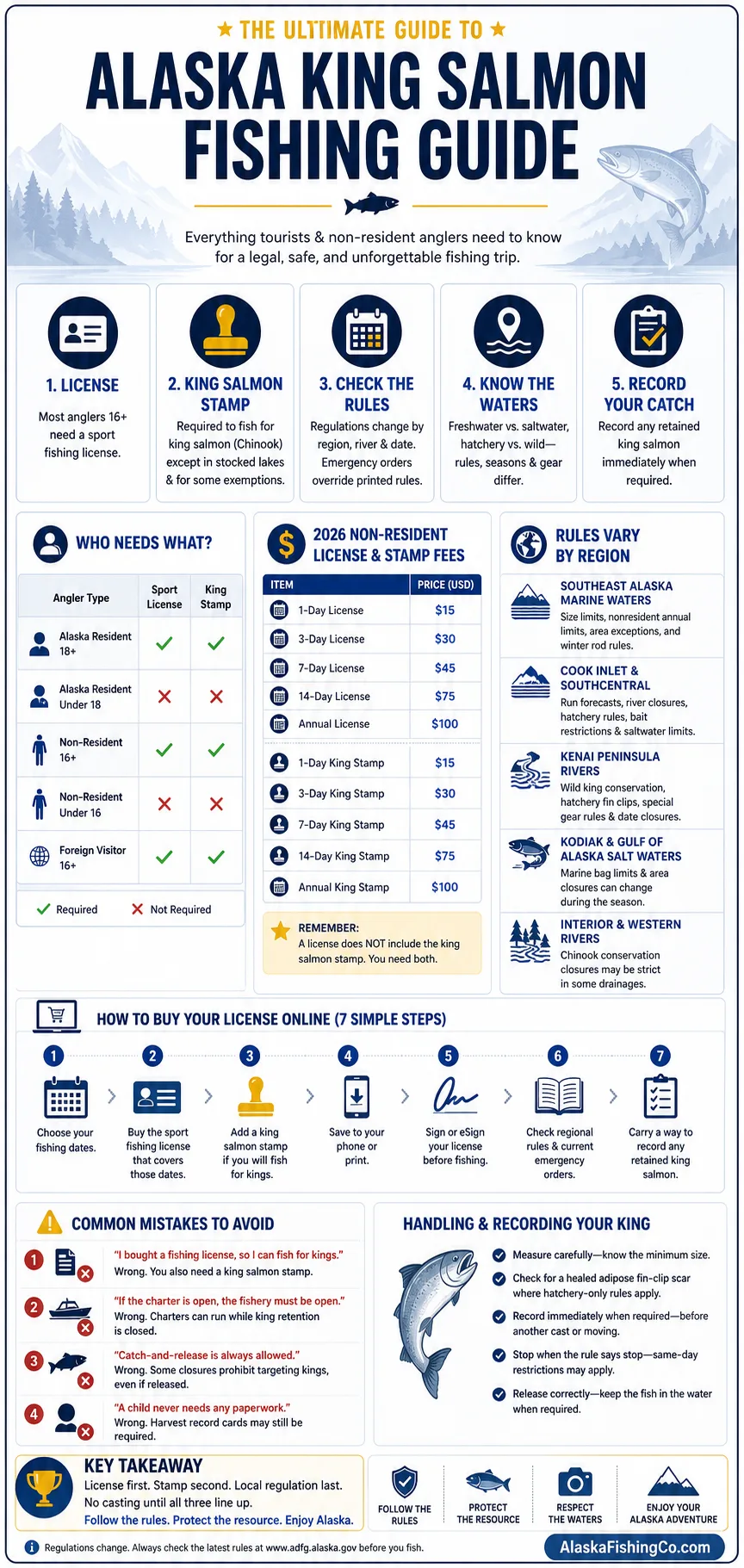
King salmon fishing in Alaska starts with two checks: whether the water is open for king salmon, and whether each angler has the right sport fishing license and king salmon stamp. A license lets you fish, but it does not make every river, marine area, or date open for keeping kings.
King salmon are Chinook salmon, the largest Pacific salmon, and Alaska manages them closely because run strength can change by river and season. Some trips are simple: buy a license, add a stamp, fish an open marine area, and record any retained king when required. Other trips need closer reading because emergency orders can close a river, limit retention, change gear rules, or separate hatchery fish from wild fish.
If you remember one thing… remember this: your Alaska fishing license and king salmon stamp are only the starting point; the local regulation for the exact water and date decides whether you may target, catch, release, or keep a king salmon.
What To Know First
For most visiting anglers, Alaska king salmon fishing comes down to four items: license, king salmon stamp, local open water, and harvest recording. Miss one of those, and the trip can turn into a regulation problem instead of a fishing day.
- King salmon means Chinook salmon. Alaska anglers often call them kings, Chinook, chins, or blackmouth in some saltwater settings.
- Most adult visitors need a sport fishing license. Nonresidents age 16 and older need one to sport fish in Alaska.
- A king salmon stamp is usually required. It is required to fish for king salmon, except for king salmon in stocked lakes and a few exempt angler categories.
- Rules change by region. Southeast, Southcentral, Cook Inlet, Kenai, Kasilof, Kodiak, and Interior waters may all have different king salmon rules.
- Emergency orders matter. Alaska Department of Fish and Game emergency orders can override the printed regulation booklet.
What Counts as King Salmon Fishing in Alaska?
King salmon fishing means targeting Chinook salmon in fresh or saltwater, whether from shore, a private boat, or a charter. Alaska king salmon are large, sea-run fish that hatch in freshwater, grow in the ocean, and return to freshwater to spawn.[a]
That life cycle is why the rules feel different from one place to another. A marine troll fishery near Southeast Alaska, a bank fishery in Ship Creek, a drift boat trip on the Kasilof River, and a Kenai Peninsula roadside stream may all involve king salmon, but they may not share the same season, limit, gear rule, or retention rule.
- Freshwater kings are usually tied to specific river runs and may face more closures when returns are weak.
- Saltwater kings may be available outside peak river timing, but marine areas still have bag limits and special rules.
- Hatchery kings may be treated differently from wild kings in some fisheries.
- Stocked lake kings are the main exception to the king salmon stamp rule.
Worth Noting
Do not use the word “salmon” loosely when checking rules. Sockeye, coho, pink, chum, and king salmon can have different seasons, limits, and recording rules in the same general area.
Who Needs a License and King Salmon Stamp?
Alaska residents age 18 and older and nonresidents age 16 and older must buy and carry a sport fishing license to participate in Alaska sport and personal use fisheries. A king salmon stamp is also required to fish for king salmon, except for king salmon in stocked lakes and certain exempt groups.[b]
For tourists, the clean rule is this: if you are 16 or older and do not qualify as an Alaska resident, buy a nonresident sport fishing license. If you plan to fish for king salmon, add a nonresident king salmon stamp for the same fishing days.
Nonresident and Foreign Visitor Rules
Visitors from another U.S. state and visitors from another country are treated as nonresidents unless they meet Alaska’s legal residency rules. Foreign visitors can buy nonresident/foreign-alien sport fishing licenses and king salmon stamps through the same Alaska Department of Fish and Game license system.
- Nonresident under 16: no sport fishing license required, but harvest recording may still apply for species with annual limits.
- Nonresident age 16 or older: sport fishing license required.
- Fishing for king salmon: king salmon stamp required unless an exception applies.
- Charter fishing: the captain does not replace your personal license and stamp requirement.
License Validity
Annual sport fishing licenses are valid from the date of purchase through December 31 of the calendar year. Short-term nonresident sport fishing licenses are valid only for the selected period: 1 day, 3 days, 7 days, or 14 days.[c]
| Angler Type | Sport Fishing License | King Salmon Stamp | Extra Note |
|---|---|---|---|
| Alaska resident age 18+ | Required | Required for king salmon, unless exempt | Resident annual options are available. |
| Alaska resident under 18 | Not required | Not required | Harvest record card may be required where annual limits apply. |
| Nonresident age 16+ | Required | Required for king salmon | Choose 1-day, 3-day, 7-day, 14-day, or annual options. |
| Nonresident under 16 | Not required | Not required | Still must follow seasons, limits, and harvest recording rules. |
| Foreign visitor age 16+ | Required as nonresident/foreign-alien | Required for king salmon | No separate tourist fishing license is needed. |
2026 Alaska King Salmon License and Stamp Fees
The license cost depends on residency and trip length. For most visiting anglers, the practical choice is a short-term nonresident sport fishing license plus a matching king salmon stamp for the same number of fishing days.
Alaska Department of Fish and Game lists the following sport fishing license and king salmon stamp prices for nonresidents and foreign visitors.[d]
| Item | Resident Price | Nonresident / Foreign Visitor Price | Best Fit |
|---|---|---|---|
| 1-Day Sport Fishing License | Not the usual resident option | $15 | One charter or one shore-fishing day |
| 3-Day Sport Fishing License | Not the usual resident option | $30 | Weekend trip or short lodge stay |
| 7-Day Sport Fishing License | Not the usual resident option | $45 | One-week Alaska itinerary |
| 14-Day Sport Fishing License | Not the usual resident option | $75 | Longer road trip or cruise extension |
| Annual Sport Fishing License | $20 | $100 | Repeat trips or long stay |
| Annual King Salmon Stamp | $10 | $100 | Multiple king salmon fishing dates |
| 1-Day King Salmon Stamp | Not the usual resident option | $15 | Single-day king salmon attempt |
| 3-Day King Salmon Stamp | Not the usual resident option | $30 | Short king salmon trip |
| 7-Day King Salmon Stamp | Not the usual resident option | $45 | One-week king salmon plan |
| 14-Day King Salmon Stamp | Not the usual resident option | $75 | Two-week king salmon plan |
One Detail People Miss
A 3-day sport fishing license does not include a 3-day king salmon stamp. If you plan to fish for kings, you need both items for the correct dates.
Where Alaska King Salmon Rules Change by Region
Alaska does not have one simple statewide king salmon season that works everywhere. The exact water matters. A visitor can be legal in one marine area and illegal in a nearby river on the same day.
ADF&G tells anglers to use the regional regulation pages first, then check the exact drainage or area, and then check current emergency orders because emergency orders override the published regulations.[e]
| Area Type | What Usually Matters | Planning Tip |
|---|---|---|
| Southeast Alaska marine waters | Size limits, nonresident annual limits, area exceptions, and winter rod rules for residents | Check the Southeast regional announcement and the local area notice for Juneau, Sitka, Ketchikan, Petersburg/Wrangell, Haines/Skagway, or Yakutat. |
| Cook Inlet and Southcentral waters | Run forecasts, river closures, hatchery-only rules, bait restrictions, and saltwater limits | Do not assume the Kenai, Kasilof, Ninilchik, Ship Creek, and roadside streams share the same rule. |
| Kenai Peninsula rivers | Wild king conservation, hatchery fin clips, special gear rules, and date-specific closures | Read the river-specific emergency order before booking a king-focused day. |
| Kodiak and Gulf of Alaska salt waters | Marine bag limits and area closures can change during the season | Saltwater does not mean regulation-free. |
| Interior and western Alaska rivers | Chinook conservation closures may be strict in some drainages | Ask the local ADF&G office or check current orders before planning around kings. |
2026 Southeast Alaska King Salmon Timeline
For nonresidents, the 2026 Southeast Alaska marine king salmon rule changed several times during the season. The underlying regional rule set a bag and possession limit of one king salmon 28 inches or greater, with an annual limit of three through June 30 and one from July 1 through December 31.[f]
- April 1-June 30: 1 king salmon per day and in possession; annual limit 3.[f]
- July 1-July 10: 1 king salmon per day and in possession; annual limit 2. King salmon retained before July 1 counted toward that two-fish annual limit.[i]
- July 11-July 31: 2 king salmon per day and in possession; annual limit 3. Fish retained earlier in the year counted toward the revised annual limit.[j]
- August 1-September 30: 2 king salmon per day and in possession; annual limit 4. King salmon retained before August 1 counted toward the four-fish annual limit.[k]
- October 1-December 31: the temporary summer liberalizations expired, so the underlying regional rule again applies: 1 king salmon per day and in possession, with an annual limit of 1 for the July 1-December 31 period. King salmon retained from January 1 through June 30 apply toward that one-fish annual limit.[f]
These regionwide limits are only the starting point. Special hatchery-area regulations, wild-stock protection measures, and local nonretention areas can be more restrictive. Nonresidents must record a retained king salmon immediately on the sport fishing license or harvest record, and anglers fishing in the Southeast exclusive economic zone must follow the nonresident limits in force for that date.[f]
2026 Kasilof River Example
The Kasilof River is a good example of why hatchery and wild fish rules matter. For 2026, ADF&G allowed one hatchery-produced king salmon 20 inches or greater from May 1 through June 30 upstream of the Sterling Highway Bridge and from May 1 through July 31 downstream of the bridge. After retaining a hatchery king 20 inches or greater in the downstream area, an angler could not sport fish for any species in that downstream portion for the rest of the day. Hatchery-produced kings are identified by a healed adipose fin-clip scar.[g]
How to Buy an Alaska King Salmon License Online
The fastest path for most visitors is to buy through the ADF&G online store before fishing. You can carry a printed license, a signed electronic copy, or an eSigned license on your phone, but the license must be signed or eSigned and in your possession before fishing.
ADF&G explains that an eSigned license can be stored on a mobile device, but the license holder is responsible for having a charged device. If you carry an electronic copy and retain a fish with an annual limit, you still need to record the harvest immediately using the allowed method.[h]
- Choose the exact fishing dates for your trip.
- Buy the sport fishing license length that covers those dates.
- Add a king salmon stamp if you will fish for king salmon.
- Save the license and stamp to your phone, or print them.
- Sign or eSign the license before fishing.
- Check the regional regulation page and current emergency orders for the exact water.
- Carry a way to record any retained king salmon when required.
Before You Move On
Buying online from a hotel or airport is fine. Buying after the first cast is not. Have the license and stamp ready before anyone in the group starts fishing.
Planning by Fishing Style
The right preparation depends on how you will fish. A cruise passenger with one charter day, a road-tripping family near Anchorage, and a lodge guest on a remote river may all need different timing and rule checks.
Charter Boat King Salmon Trip
Most charter captains will remind guests about licenses and stamps, but each angler is still responsible for having the correct license. Ask the captain three direct questions before the trip:
- Which license length should cover the fishing day?
- Do all guests need a king salmon stamp for this trip?
- What is the current king salmon retention rule for the exact marine area?
Shore Fishing Near Anchorage
Urban access does not remove the license requirement. A visitor fishing places such as Ship Creek still needs a nonresident sport fishing license, and a king salmon stamp is needed when targeting kings unless a clear exception applies.
- Check the daily limit and any special timing rules.
- Confirm whether bait, snagging, or single-hook rules apply.
- Watch for emergency orders that change limits during the run.
River Fishing on the Kenai Peninsula
Rivers can have strict conservation rules, especially when wild king salmon returns are weak. In some waters, kings may be closed to targeting, open only for hatchery-produced fish, or subject to gear restrictions.
- Know whether the rule covers targeting, retention, or both.
- Learn how to identify a healed adipose fin-clip scar if hatchery-only retention applies.
- Do not remove an incidentally caught king from the water when rules require immediate release.
Common Mistakes When Fishing for King Salmon in Alaska
Most mistakes happen because anglers buy the right license but check the wrong rule. The license side is simple. The water-specific rule is where plans often change.
Mistake 1: “I Bought a Fishing License, So I Can Fish for Kings”
Wrong idea: A sport fishing license alone is enough for king salmon.
Correct explanation: King salmon usually require a king salmon stamp in addition to the sport fishing license.
Why it gets mixed up: Many visitors see “sport fishing license” and assume it covers every sport fish species. Alaska treats king salmon separately for stamp purposes.
Mistake 2: “If the Charter Is Open, the Fishery Must Be Open”
Wrong idea: A booked charter means king salmon retention is allowed.
Correct explanation: A charter can still run for halibut, rockfish, coho, sightseeing, or catch-and-release fishing while king salmon retention rules differ.
Why it gets mixed up: Trip listings often describe the general fishing opportunity, not the exact emergency order in force on your date.
Mistake 3: “Catch-and-Release Is Always Allowed”
Wrong idea: Closed retention still allows targeting kings if you release them.
Correct explanation: Some closures prohibit targeting king salmon, including catch-and-release. If the order says no targeting, fish for another legal species with legal gear.
Why it gets mixed up: In many places, catch-and-release feels harmless. In Alaska king salmon management, even handling and release mortality can matter on weak runs.
Mistake 4: “A Child Never Needs Any Paperwork”
Wrong idea: Young anglers are always free from paperwork.
Correct explanation: Young anglers may not need a license or stamp, but they may still need a harvest record card when fishing for species with annual limits.
Why it gets mixed up: People remember the age exemption but forget that harvest recording is a separate rule.
Record Retained Kings Immediately
When a rule says a retained king must be recorded immediately, do it before making another cast, taking photos, or moving to another spot.
Real-Life Scenarios for Alaska Visitors
These examples show how the rules work in normal travel situations. The exact answer can still change by water and date, so each scenario should end with a regulation check.
- A cruise passenger books one day of saltwater fishing in Juneau.
A nonresident 1-day sport fishing license and 1-day king salmon stamp may fit the trip, but the Southeast marine rule and local Juneau-area notices still control retention. - A family spends three days near Anchorage and wants to try Ship Creek.
Adults and nonresident teens age 16 or older need licenses, and anyone targeting kings needs the stamp unless exempt. - A couple drives to the Kenai Peninsula hoping for a king and sockeye mix.
They should check river-specific emergency orders because king salmon rules may be stricter than sockeye rules in the same region. - A foreign visitor books a lodge that includes guided fishing.
The guide can help explain local rules, but the visitor still needs the correct nonresident license and king salmon stamp. - A parent takes a 14-year-old nonresident child fishing for kings.
The child may not need a sport fishing license or king salmon stamp, but harvest recording may still apply if a king is retained in a fishery with an annual limit. - An angler buys a 7-day license but fishes for kings only on two days.
The king salmon stamp must cover the actual king salmon fishing days; the sport fishing license alone is not enough. - A charter changes from king salmon to halibut because of an emergency order.
The license may still be useful for sport fishing, but the king salmon stamp does not create a right to target kings in closed water.
Handling, Measuring, and Recording a King Salmon
Once a king salmon is landed, the next step is not just celebration. You need to know whether the fish is legal to retain, whether it must be recorded, and whether any same-day rule applies after keeping it.
- Measure carefully. Some king salmon rules use minimum size, such as 20 inches or 28 inches, depending on area and fishery.
- Check hatchery marks. A missing adipose fin with a healed scar can matter where only hatchery-produced kings may be retained.
- Record immediately when required. Nonresident annual limits often require date, species, and location to be recorded right away.
- Stop when the rule says stop. Some waters restrict further fishing after retaining a king salmon over a certain size.
- Release correctly. If a king must be released, keep it in the water when the regulation requires it.
Before You Head for the Water
Alaska king salmon fishing is easiest to plan when the license step and the regulation step are treated as separate tasks. Buy the right sport fishing license and king salmon stamp first, then check the exact water for the exact date.
The most common mistake is assuming that a valid license means the local king salmon fishery is open. The rule to remember is simple: license first, stamp second, local regulation last, and no casting until all three line up.
Alaska King Salmon Questions Answered
Do tourists need a fishing license for king salmon in Alaska?
Yes. Nonresident tourists age 16 and older need an Alaska sport fishing license. If they plan to fish for king salmon, they usually also need a king salmon stamp.
Can foreign visitors buy an Alaska king salmon stamp online?
Yes. Foreign visitors can buy nonresident/foreign-alien sport fishing licenses and king salmon stamps through the Alaska Department of Fish and Game online license system.
Does an Alaska fishing license include the king salmon stamp?
No. The sport fishing license and king salmon stamp are separate items. If you are required to have both, buy both before fishing for king salmon.
Do kids need a king salmon stamp in Alaska?
Nonresidents under 16 and Alaska residents under 18 do not need a king salmon stamp, but they still must follow all seasons, limits, and harvest recording rules.
Can you catch and release king salmon without a stamp?
If you are required to have a king salmon stamp, you need it to fish for king salmon, including catch-and-release fishing, unless a specific exception applies.
Are Alaska king salmon rules the same in every river?
No. King salmon rules vary by region, river, marine area, date, run strength, and emergency order. Always check the exact water before fishing.
What was the Southeast Alaska nonresident king salmon limit in 2026?
It changed during the season. The nonresident limit was 1 per day with an annual limit of 3 through June 30, 1 per day with an annual limit of 2 from July 1-10, 2 per day with an annual limit of 3 from July 11-31, and 2 per day with an annual limit of 4 from August 1-September 30. The temporary summer changes expired after September 30, returning the underlying 1-per-day and 1-fish annual rule for the July 1-December 31 period.
What happens if an emergency order changes the king salmon rule?
The emergency order controls the fishery while it is in effect. It can close an area, reduce or increase limits, change gear rules, or change whether king salmon may be targeted or retained.
Alaska Fishing References
- [a] Alaska Department of Fish and Game, Chinook Salmon Species Profile — used for king salmon identification, size, life history, and common names. (Reliable because it is the official Alaska state fish and wildlife agency.)
- [b] Alaska Department of Fish and Game, Sport Fishing Licenses, King Salmon Stamps, IDs and Harvest Record Cards — used for license, stamp, age, stocked-lake exception, and harvest record rules. (Reliable because it is the official licensing page for Alaska sport fishing.)
- [c] Alaska Department of Fish and Game, General License Information — used for license validity periods, age rules, and harvest record card guidance. (Reliable because it is an official state licensing FAQ.)
- [d] Alaska Department of Fish and Game, Product Prices: Licenses, Stamps, and Tags — used for 2026 sport fishing license and king salmon stamp prices. (Reliable because it is the state’s official price list.)
- [e] Alaska Department of Fish and Game, Sport Fishing Regulations — used for the instruction that anglers must check regional rules and current emergency orders. (Reliable because it is ADF&G’s official sport fishing regulation hub.)
- [f] Alaska Department of Fish and Game, Southeast Alaska Regional King Salmon Sport Fishing Regulations for 2026 — used for the underlying nonresident bag, possession, annual, recording, local-area, and exclusive economic zone rules that apply when later emergency orders do not supersede them. (Reliable because it is the official ADF&G regional king salmon announcement.)
- [g] Alaska Department of Fish and Game, Corrected: Kasilof River King Salmon Regulations for 2026 — used for Kasilof hatchery king salmon rules and fin-clip identification. (Reliable because it is an official ADF&G emergency order/advisory page.)
- [h] Alaska Department of Fish and Game, Purchasing Your License Online and eSigning Your License FAQs — used for online purchase, eSignature, mobile license, and electronic harvest recording guidance. (Reliable because it is the official online licensing FAQ.)
- [i] Alaska Department of Fish and Game, Regional King Salmon Annual Limits Liberalized for Nonresident Anglers in Southeast Alaska — used for the July 1-10, 2026 one-fish daily limit and two-fish annual limit. (Reliable because it is an official ADF&G emergency order and advisory announcement.)
- [j] Alaska Department of Fish and Game, Regional King Salmon Limits Liberalized for Nonresident Anglers in Southeast Alaska — used for the July 11-31, 2026 two-fish daily and possession limit and three-fish annual limit. (Reliable because it is an official ADF&G emergency order and advisory announcement.)
- [k] Alaska Department of Fish and Game, Regional King Salmon Limits Increased for All Anglers in Southeast Alaska — used for the August 1-September 30, 2026 two-fish daily and possession limit and four-fish nonresident annual limit. (Reliable because it is an official ADF&G emergency order and advisory announcement.)