
Anchorage is one of the easiest places in Alaska for a visitor to fish without flying into a remote lodge. You can buy a nonresident license, reach several fishing spots by road, and fish for salmon, trout, Dolly Varden, Arctic char, grayling, or stocked lake species within the Anchorage area.
The main rule is simple: most visitors age 16 or older need an Alaska sport fishing license before they fish. A king salmon stamp is also needed if you fish for king salmon, unless the fishery is a stocked lake exception or the angler is under Alaska’s stamp age rules.[a]
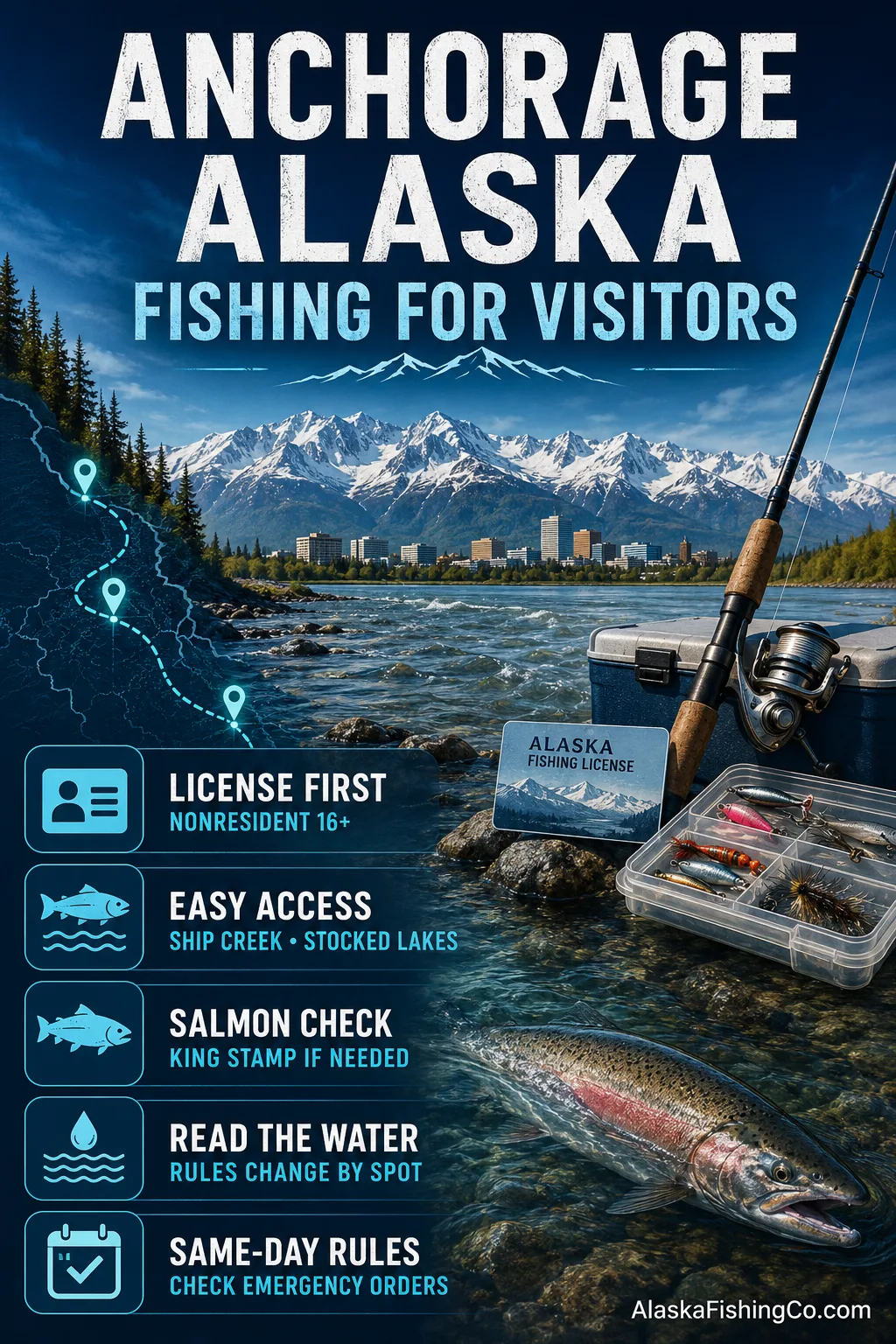
If you remember one thing… buy the right nonresident license before your first cast, check the Anchorage Bowl regulation page for the exact water you plan to fish, and check emergency orders the same day because they can change what is open.
What To Know First
- Visitors are usually nonresidents. This includes travelers from other U.S. states and most international visitors.
- Nonresidents age 16 or older need a sport fishing license. Children under 16 do not need a license, but may still need a free harvest record card in some fisheries.
- King salmon is the species that most often adds a stamp requirement. If you plan to fish for kings at Ship Creek or in nearby salt water, check stamp rules before buying.
- Anchorage rules are local. A statewide rule is not enough; Ship Creek, Campbell Creek, Bird Creek, Eagle River, and stocked lakes can all have different seasons or closures.
- Emergency orders override printed regulations. This is not rare in Alaska salmon fishing, especially when run strength changes during the season.[b]
Do Visitors Need a Fishing License in Anchorage?
Yes. Visitors age 16 or older generally need an Alaska nonresident sport fishing license to fish in Anchorage. This applies whether fishing from shore, casting in Ship Creek, trying stocked lakes, or joining a charter trip elsewhere in Southcentral Alaska.
A license is required when a person is actively sport fishing. That can include casting, working the rod, hooking fish, or helping in a way that counts as participation. If a family member only watches from the bank, they do not need a license. If they take the rod “just for a minute,” they should have one.
- U.S. visitors from outside Alaska: buy a nonresident sport fishing license.
- Foreign visitors: buy under the nonresident foreign/alien category; the listed sport fishing license prices match the standard nonresident sport fishing prices.
- Visitors under 16: no sport fishing license is needed, but some harvest recording rules can still apply.
- Alaska residents: different age rules apply, but most tourists should not use resident license categories unless they truly qualify under Alaska residency rules.
Do not treat a guide, hotel, or rental shop as the source of the rule. They can help, but the license is still the angler’s responsibility. Carry a digital or printed copy while fishing.
Where Visitors Usually Fish Around Anchorage
The easiest visitor fishing in Anchorage is usually at Ship Creek, local stocked lakes, selected Anchorage streams when open, and road-accessible waters toward Turnagain Arm. The Anchorage management area covers waters from the Eklutna River area down toward Ingram Creek, so rules can change quickly from one drainage to the next.[c]
Anchorage is not only a “drive somewhere else” base. It has real urban fishing, but the best choice depends on season, target species, and how much time you have.
Ship Creek
Ship Creek is the best-known visitor option because it runs close to downtown Anchorage and supports stocked king and coho salmon fishing. In 2026, Ship Creek remains a special case: much of the Anchorage Bowl has king salmon restrictions, but Ship Creek has its own open area and rules.[d]
- Best for: visitors who want a real salmon chance without a long drive.
- Main species: king salmon earlier in the season, coho later in summer, plus other salmon under local limits.
- Watch for: daily fishing hours from May 15 through July 13, closed water above the cable near the Chugach Power Plant dam, and youth-only fishery rules.
Stocked Lakes
Stocked lakes are often the most forgiving choice for casual visitors, families, and first-time Alaska anglers. Anchorage-area stocking supports trout, Arctic char, landlocked salmon, and grayling opportunities, depending on the lake and year.
- Best for: short trips, children, relaxed fishing, and visitors without salmon gear.
- Main species: rainbow trout, Arctic char, landlocked salmon, and sometimes Arctic grayling.
- Watch for: stocked water limits, lake-specific notes, and whether a harvest record is required for larger trout.
Campbell Creek, Chester Creek, and Eagle River
These waters can offer trout, Dolly Varden, and limited salmon opportunity, but they also have closures, bridge markers, youth-only zones, and date-based restrictions. They are not places to guess.
- Best for: visitors willing to read the exact drainage rules before fishing.
- Main species: trout, Dolly Varden, coho in some open sections, and other allowed species.
- Watch for: seasonal closures, bait restrictions, single-hook artificial lure rules, and closed salmon sections.
Bird Creek and Turnagain Arm Streams
Bird Creek and nearby Turnagain Arm waters can be useful for visitors with a car, especially later in summer. Public access and private land boundaries matter, so signs and ADF&G markers should be taken seriously.
- Best for: visitors who want a short road trip from Anchorage.
- Main species: pink, chum, coho, and other salmon where open, plus non-salmon species under local rules.
- Watch for: opening dates, ADF&G markers, private land, and streambed-only access notes in some areas.
Worth Noting
Anchorage fishing is very place-specific. A creek can be open below one marker and closed above the next one. Before fishing a stream, match your location to the exact drainage name and the nearest bridge, marker, dam, or mouth described in the regulation booklet.
Anchorage Visitor License Types and Prices
Visitors can choose 1-day, 3-day, 7-day, 14-day, or annual nonresident sport fishing licenses. The best choice depends on how many days you will actually fish, not how long you will be in Alaska.
For 2026, ADF&G lists the following nonresident sport fishing license prices. The foreign/alien nonresident sport fishing prices are the same for these durations.[e]
| License | 2026 Price | Good Fit For | Visitor Note |
|---|---|---|---|
| 1 Day Sport Fishing License | $15 | One quick Ship Creek or stocked lake outing | Best when fishing is only a small part of the trip. |
| 3 Day Sport Fishing License | $30 | Weekend visitors or short Anchorage stays | Often the easiest choice for a Friday-to-Sunday plan. |
| 7 Day Sport Fishing License | $45 | Most weeklong Alaska vacations | Useful if you may fish Anchorage and then the Kenai, Seward, or Mat-Su. |
| 14 Day Sport Fishing License | $75 | Longer road trips | Good when fishing dates are spread across two weeks. |
| Annual Sport Fishing License | $100 | Repeat trips or longer Alaska travel | Can be cheaper than stacking multiple short licenses. |
If fishing for king salmon, add the matching nonresident king salmon stamp unless an exception applies. Nonresident king salmon stamps are also sold as 1-day, 3-day, 7-day, 14-day, and annual options, with the same listed prices as the matching sport fishing license durations in 2026.
- One day of Ship Creek king fishing: 1-day sport fishing license plus 1-day king salmon stamp.
- Three days of mixed fishing with possible kings: 3-day license plus 3-day king salmon stamp.
- Fishing only stocked lakes for trout: sport fishing license only, no king stamp unless fishing for king salmon where required.
Species Rules That Matter in Anchorage
Species rules matter as much as the license. Anchorage visitors often plan around salmon, but trout, Dolly Varden, Arctic char, grayling, northern pike, halibut, and rockfish all have their own limits, seasons, or handling rules.
The safest way to think about Anchorage fishing is this: first choose the water, then choose the species, then check the rule for that exact combination. A rule for Cook Inlet salt water is not the same as a rule for Ship Creek. A rule for stocked lakes is not the same as a rule for flowing waters.
King Salmon
King salmon is the species most likely to require extra attention. A king salmon stamp is generally required to fish for king salmon, except for stocked lake king salmon and certain age-based exceptions. In 2026, Anchorage Bowl king salmon fishing is closed by emergency order except where specific rules allow it, such as Ship Creek.[f]
- Ship Creek has a 20-inch size line for king salmon rules.
- A retained king salmon 20 inches or longer must be recorded immediately where harvest recording is required.
- From January 1 through July 13 at Ship Creek, retaining a king salmon 20 inches or longer can stop you from fishing the same day in waters open to king salmon fishing.
- You must not remove a king salmon from the water before releasing it at Ship Creek.
Coho, Pink, Chum, and Sockeye Salmon
Other salmon rules vary by water. In Ship Creek, chum, coho, pink, and sockeye salmon 16 inches or longer have a combined daily and possession limit, and all three fish may be coho under the listed Ship Creek rule for 2026.[d]
- Do not assume every Anchorage stream is open to salmon fishing.
- Some flowing waters are closed to all salmon fishing unless a special rule opens them.
- Some coho rules require retaining a fish once it is removed from the water.
Trout, Dolly Varden, Arctic Char, and Grayling
Stocked lakes can be good for trout and char, while streams may have more limited retention or catch-and-release sections. Larger rainbow or steelhead trout can trigger harvest recording rules in some waters.
- Stocked waters often have more visitor-friendly retention rules.
- Unstocked lakes and flowing waters may have smaller daily limits or size limits.
- Some creek sections are closed during spring to protect spawning fish.
Halibut and Saltwater Trips
Most Anchorage visitors who want halibut book a charter from coastal towns such as Seward, Whittier, Homer, or other Southcentral ports rather than fishing downtown Anchorage. Pacific halibut sport fishing is managed through federal, international, and state layers, so charter anglers should confirm the current rules for the port, charter type, and date.[g]
- Unguided and guided halibut rules can differ.
- Charter halibut rules may include annual federal updates.
- Saltwater trips can also involve rockfish, lingcod, salmon, or other species with separate rules.
One Detail People Miss
A license lets you fish; it does not automatically let you keep the fish you catch. Keeping a fish depends on species, size, season, water, daily limit, possession limit, and sometimes harvest recording.
How To Buy an Alaska Fishing License Online
The easiest way for most visitors is to buy through the Alaska Department of Fish and Game online licensing system before fishing. Licenses and king salmon stamps are also sold by many sporting goods stores and Fish and Game offices.
Online buying is usually straightforward, but take your time with dates. A short license only covers the dates printed on it. If the fishing day changes because of weather, tides, charter scheduling, or travel delays, the wrong start date can waste the license.
- Choose sport fishing, not hunting, commercial, or personal use.
- Select the nonresident category that fits your status.
- Pick the duration that covers the actual days you will fish.
- Add a king salmon stamp if you plan to fish for king salmon and no exception applies.
- Save the license on your phone and keep a printed copy if you will fish where cell service may be weak.
- Carry photo identification that matches the license information.
For a family, buy each angler’s license separately. Do not assume one adult license covers a spouse, friend, child age 16 or older, or anyone else holding a rod.
Common Mistakes Visitors Make
Most Anchorage fishing mistakes are not complicated. They happen because visitors buy the wrong license duration, forget the king salmon stamp, rely on old rules, or fish a closed section of water.
Wrong: “My charter or guide covers my license.”
Correct: Some operators help customers buy licenses, but the angler still needs a valid license in their own name.
Why it gets confused: Many travel activities include permits in the booking price. Alaska sport fishing usually does not work that way.
Wrong: “Children never need anything.”
Correct: Nonresident anglers under 16 do not need a sport fishing license, but a free harvest record card may be needed when fishing for species with annual harvest limits.
Why it gets confused: People mix up license age, stamp age, and harvest recording rules.
Wrong: “If Ship Creek is open, every Anchorage creek is open.”
Correct: Ship Creek has its own special rules. Other waters may be closed to all salmon fishing or closed to all sport fishing during certain dates.
Why it gets confused: Many Anchorage waters are close together on a map, but they are not regulated as one single fishing spot.
Wrong: “A king salmon stamp lets me fish for kings anywhere.”
Correct: A stamp is only one requirement. The water still has to be open to king salmon fishing.
Why it gets confused: The stamp feels like a permit, but it does not override closures.
Wrong: “I can release a salmon after lifting it out for a photo.”
Correct: Some salmon rules say a fish removed from the water must be retained and counts toward the person’s limit. Ship Creek also has king salmon handling rules that visitors should read before fishing.
Why it gets confused: Catch-and-release habits from other states may not match Alaska’s species-specific handling rules.
Wrong: “Printed regulation booklets are enough for the whole season.”
Correct: Emergency orders can change seasons, methods, limits, or closures after the booklet is published.
Why it gets confused: Visitors expect fishing rules to be stable for a full year, but salmon management can change during the run.
Before You Move On
Check the rule twice: once when planning the trip and again before fishing. For Anchorage salmon, that same-day check can be the difference between a legal outing and fishing a closed water.
Real-Life Scenarios for Anchorage Visitors
Real trips rarely fit a perfect chart. These common Anchorage visitor situations show how the license and rule checks usually work.
- One afternoon at Ship Creek for king salmon: A visitor age 16 or older needs a nonresident sport fishing license and a king salmon stamp, then must follow Ship Creek’s open area, hours, and recording rules.
- Family fishing a stocked lake for trout: Adults and teens age 16 or older need nonresident sport fishing licenses; children under 16 do not, but lake limits still apply.
- International visitor staying downtown: A foreign visitor buys the nonresident foreign/alien sport fishing license for the correct duration, then adds a king stamp only if fishing for king salmon.
- Weeklong Alaska trip starting in Anchorage: A 7-day license often fits better than several 1-day licenses if fishing might happen in Anchorage, Seward, Kenai, or Mat-Su during the same week.
- Visitor booking a halibut charter after two days in Anchorage: The angler still needs an Alaska sport fishing license, and the charter should explain current halibut rules for that date and area.
- Parent with a 15-year-old at the Ship Creek youth-only fishery: The child may qualify for the youth-only opportunity, while the adult may be barred from sport fishing in that youth-only section during the listed time.
- Traveler trying Bird Creek in late summer: The visitor should check the open dates, salmon species allowed, ADF&G markers, and access notes before casting.
- Angler targeting rainbow trout in a stream: The license may be simple, but the water may have seasonal closures, catch-and-release sections, artificial lure rules, or harvest recording for larger fish.
A Simple Anchorage Fishing Plan for Visitors
A good Anchorage fishing plan starts with the fish you want, then backs into the license, water, gear, and timing. Do not start by buying every possible stamp “just in case.” Buy what matches the real plan.
For a first Alaska visit, keep the plan practical. Anchorage rewards anglers who read the rule page, watch the tide for Ship Creek, and choose waters that fit their time and gear.
- If you want salmon close to downtown: start with Ship Creek, check the current emergency orders, and time the trip around the tide.
- If you want a low-pressure family outing: choose a stocked lake and use simple trout gear.
- If you want a road-trip fishing day: look toward Bird Creek, Turnagain Arm streams, or other Southcentral waters, then read the exact drainage rules.
- If you want halibut: plan for a charter or saltwater trip outside the city and confirm federal and charter rules for that year.
- If you are unsure: call the Anchorage ADF&G office or ask a local license vendor to help match the water name to the correct rule page.
Anchorage is a practical base for visitors because it offers real fishing close to hotels, roads, parks, and coastal day trips. The mistake most visitors make is assuming a license is the whole rule. The easy rule to remember is this: license first, exact water second, species rule third, emergency order last.
Anchorage Fishing Questions Answered
Do tourists need a fishing license in Anchorage, Alaska?
Yes. Tourists age 16 or older generally need a nonresident Alaska sport fishing license to fish in Anchorage. This applies to shore fishing, creek fishing, stocked lakes, and most charter-related sport fishing.
Can foreign visitors buy an Alaska fishing license online?
Yes. Foreign visitors can buy a nonresident foreign/alien Alaska sport fishing license online through the Alaska Department of Fish and Game licensing system. The listed 2026 sport fishing prices for foreign/alien nonresidents match the standard nonresident sport fishing license prices.
Do visitors need a king salmon stamp for Ship Creek?
Visitors age 16 or older generally need a king salmon stamp if they fish for king salmon at Ship Creek. They also need the correct sport fishing license and must follow Ship Creek’s open area, hours, size, limit, and harvest recording rules.
Is Ship Creek open for fishing in 2026?
Ship Creek has open sport fishing sections in 2026, but it also has closed water, time limits during May 15 through July 13, king salmon rules, and a youth-only fishery date. Always check the current ADF&G Anchorage Bowl rules and emergency orders before fishing.
Can children fish without a license in Anchorage?
Nonresident children under 16 do not need an Alaska sport fishing license. They may still need a free harvest record card if they are fishing for a species or water with annual harvest recording requirements.
What is the easiest fishing for first-time Anchorage visitors?
Stocked lakes are often the easiest choice for families and casual anglers. Ship Creek is the most famous urban salmon option, but it requires closer attention to salmon rules, tides, dates, and open water boundaries.
Can I fish for halibut in Anchorage?
Anchorage is not the usual place to catch halibut from shore. Most visitors who want halibut book saltwater charters from nearby coastal ports such as Seward, Whittier, Homer, or other Southcentral locations, where federal and state halibut rules apply.
Alaska Fishing References
- [a] Alaska Department of Fish and Game: Sport Fishing Licenses, King Salmon Stamps, IDs and Harvest Record Cards — Used for visitor license ages, king salmon stamp basics, stocked lake stamp exception, and harvest record card notes. (Official Alaska state fish and wildlife agency.)
- [b] Alaska Department of Fish and Game: Sport Fishing Regulations — Used for the rule that emergency orders supersede published regulations and for the region-to-drainage regulation process. (Official Alaska state regulation source.)
- [c] Alaska Department of Fish and Game: Anchorage Management Area Fishing Information — Used for Anchorage-area fishing overview, stocked fisheries, and local visitor context. (Official area management information from ADF&G.)
- [d] Alaska Department of Fish and Game: 2026 Anchorage Bowl Sport Fishing Regulations PDF — Used for Ship Creek, Anchorage Bowl, Campbell Creek, Eagle River, Bird Creek, and local 2026 special regulations. (Official 2026 Southcentral regulation booklet section.)
- [e] Alaska Department of Fish and Game: License, Stamp, and Tag Prices — Used for 2026 nonresident and foreign/alien sport fishing license and king salmon stamp prices. (Official ADF&G license pricing page.)
- [f] Alaska Department of Fish and Game: Emergency Orders and Press Releases — Used for the same-day emergency order check that can change salmon seasons, methods, or closures. (Official ADF&G emergency order portal.)
- [g] NOAA Fisheries: Sport Halibut Fishing in Alaska — Used for Pacific halibut sport fishing management and guided versus unguided rule context. (Official federal fisheries agency source.)