
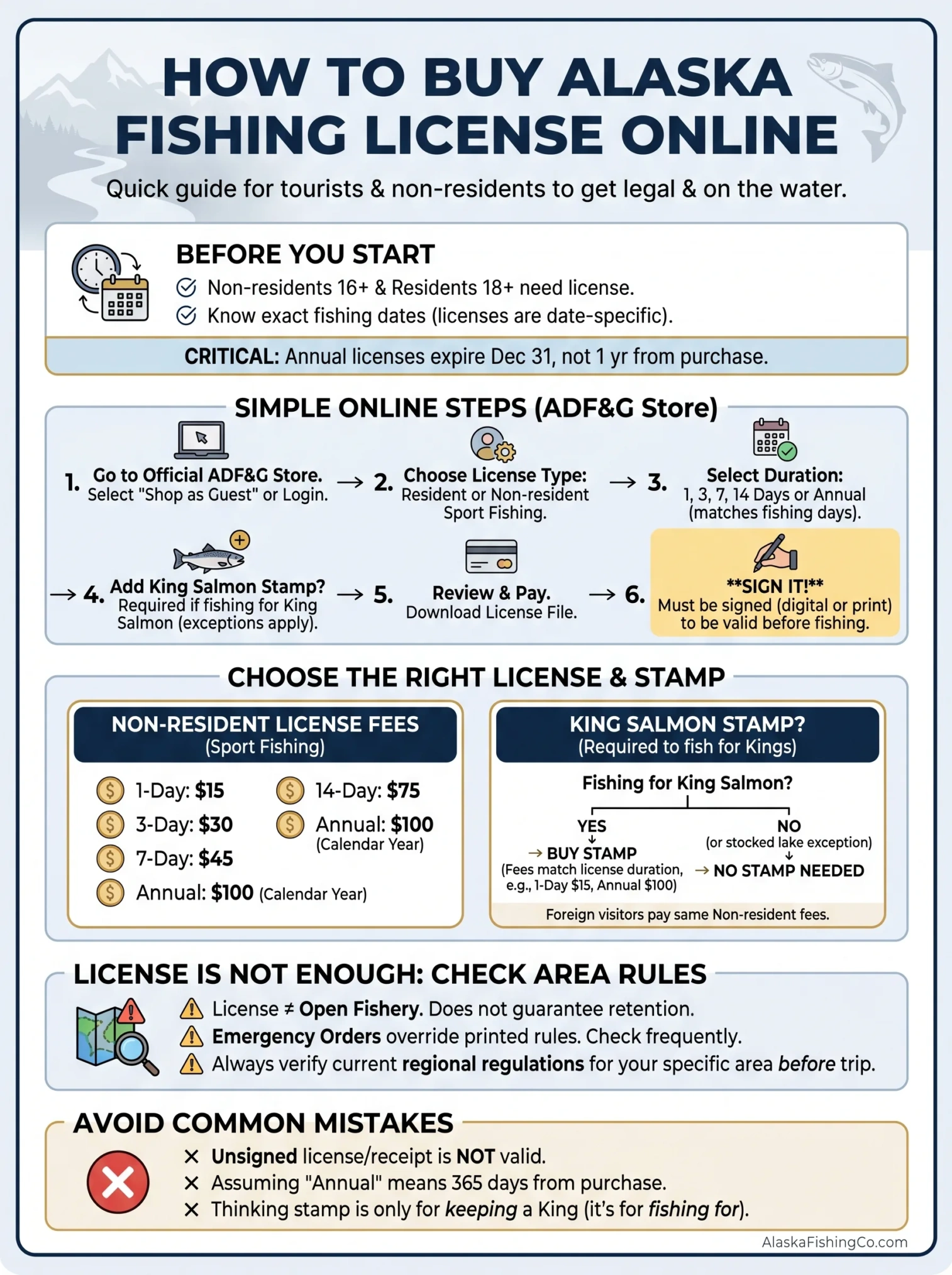
To buy an Alaska fishing license online, go to the official Alaska Department of Fish and Game store, choose Shop as Guest or sign in, select the right sport fishing license, add a king salmon stamp if you plan to fish for king salmon, pay, then carry a signed copy before you fish.[a]
For most visitors, the process is simple. The part that causes trouble is not the checkout screen. It is choosing the wrong license length, forgetting the king stamp, or assuming a receipt alone is enough. Alaska also separates license rules by age, residency, species, and fishing area, so a correct purchase starts with knowing what kind of trip you are actually taking.[b]
If you remember one thing… buy the license that matches your actual fishing dates, add the right extras before you go, and check the area rules again right before your trip.
What To Know First
- Residents age 18 and older need a sport fishing license.
- Nonresidents age 16 and older need a sport fishing license.
- If you plan to fish for king salmon, you usually need a king salmon stamp too.
- Short nonresident licenses come in 1-day, 3-day, 7-day, and 14-day options, plus an annual license.
- An annual license is not always a full 12 months.
- Area rules and emergency orders can still change what is open, closed, or restricted after you buy.
How the online purchase works
The fastest legal path is the ADF&G online store. You can start as a guest, or sign in with an ADF&G account if you want an electronically signed license saved in your profile. If you buy through your account, the store can issue an eSigned license for you, and you can keep it on your phone or print it. Every license still has to be signed to be valid.[e]
Step by step
- Open the official ADF&G store.
- Choose Shop as Guest for a quick purchase, or sign in if you want an eSigned license tied to your account.
- Select the fishing license category that fits your status: resident, nonresident, or the matching visitor option shown in the store.
- Pick the license length that covers the days you will actually fish.
- Add a king salmon stamp if you will target king salmon.
- Review the dates and names carefully before paying.
- Download the license after checkout.
- Sign it, then either print it or carry the signed digital version on your device.
What to have ready
- Your legal personal details
- Your fishing dates
- Your residency category
- A payment card
- A plan for how you will carry the signed license in the field
One Detail People Miss
You can buy a license for another person, but each person must sign their own license. One person cannot eSign for everybody else in the same order.
Which Alaska fishing license should you choose?
Most tourists and foreign visitors need a nonresident sport fishing license. The right one depends on how many days you will actively fish, not how many days you will be in Alaska. If you are only fishing for one charter day, a 1-day nonresident license may be enough. If your trip has weather delays, backup days, or two separate outings, a longer option is usually the safer buy.[c]
Published sport fishing license fees
- Resident annual sport fishing license: $20
- Nonresident 1-day: $15
- Nonresident 3-day: $30
- Nonresident 7-day: $45
- Nonresident 14-day: $75
- Nonresident annual: $100
Published king salmon stamp fees
- Resident annual king salmon stamp: $10
- Nonresident 1-day: $15
- Nonresident 3-day: $30
- Nonresident 7-day: $45
- Nonresident 14-day: $75
- Nonresident annual: $100
| Visitor type | Sport fishing license options | King salmon stamp options | What usually makes sense |
|---|---|---|---|
| Alaska resident | Annual only for most anglers | Annual resident stamp | Best for local anglers fishing across the season |
| U.S. nonresident visitor | 1, 3, 7, 14 days, or annual | 1, 3, 7, 14 days, or annual | Match the license length to the actual fishing days |
| Foreign visitor | Same sport-fishing prices shown for nonresident visitors | Same short-term and annual king stamp prices shown for foreign/alien nonresidents | Useful for travelers arriving from outside the U.S. |
Do foreign visitors buy differently?
Not in any dramatic way for sport fishing. Alaska’s pricing page lists sport fishing and king salmon stamp prices for foreign or “alien” nonresidents at the same amounts shown for other nonresident sport-fishing visitors. The main difference is making sure you choose the right residency category in the purchase flow.[c]
How long the license lasts
Annual licenses are valid from the date of purchase through December 31 of that calendar year. Short-term nonresident sport fishing licenses are valid only for the length you buy: 1, 3, 7, or 14 days. That matters more than many first-time visitors expect. An annual license bought late in the year does not roll forward into the next season.[d]
When to buy
- Buy right before travel if your dates are still moving.
- Buy a little longer than your first plan if weather or charter changes may shift your fishing day.
- Buy the annual option only if you will fish enough days to make it worth it or return later in the same calendar year.
Worth Noting
The most common timing mistake is buying a short-term license that covers the arrival day and not the actual day on the water. Count your fishing days, not your hotel nights.
When the online license is not enough
A sport fishing license gets you the base permission to fish, but it does not replace every other Alaska rule. Depending on the species and area, you may also need a king salmon stamp, a harvest record card, or another area-specific permit. Alaska’s sport fishing regulations are organized by region and drainage, and emergency orders can override the printed rules.[f]
Extras that can matter
- King salmon stamp: required if you are fishing for king salmon, except king salmon in stocked lakes.
- Harvest record card: can be required for fisheries with annual harvest limits, including some king salmon and rainbow trout fisheries.
- Area permits: some fisheries add permit layers on top of the normal license requirement.
- Emergency orders: these can open, close, or restrict fisheries after the season materials are published.
Age rules that change what you buy
Residents under 18 and nonresidents under 16 do not need a sport fishing license. Even so, younger anglers can still need a harvest record card in fisheries with annual limits. The same section of Alaska’s licensing guidance also explains that people who fish for king salmon usually need the stamp unless they fall into a listed exemption category.[b]
Regional rules can change your trip after checkout
Buying online is only the first half of the job. Alaska requires anglers to check the region they will fish, then the specific drainage or area inside that region. The state also says emergency orders supersede the published regulations, so the last check should happen close to the trip, not just when you book the lodge or charter.[f]
What that means in real life
- A valid license does not guarantee the fishery is open.
- A valid king stamp does not guarantee king retention is allowed in your area.
- A charter booking does not remove the need to hold the right personal license unless the operator has already handled that part for you.
- Printed summary booklets can lag behind live emergency orders.
For 2026, Southcentral Alaska already shows live emergency-order changes affecting places and species that many visitors target, including Kenai-area king salmon closures or restrictions and other area-specific changes. That does not change the online purchase method, but it absolutely changes how useful a given license or stamp will be on a certain date and in a certain river or saltwater area.[g]
Before You Move On
If your whole Alaska plan is built around king salmon, do not stop after buying the stamp. Check the area order for the exact place and week you plan to fish.
What 2026 visitors should double-check for king salmon
King salmon is where visitors most often assume the online checkout solved everything. It did not. In Southeast Alaska, for example, 2026 rules already include area-specific nonresident limits and seasonal retention restrictions in some waters. In other words, the stamp lets you participate where legal, but the area rule still decides what you can keep and when.[h]
Check these four things before a king trip
- Whether retention is open in your exact area
- Whether nonresident annual limits changed
- Whether a stocked-lake exception applies
- Whether you need to record retained fish immediately on your license or harvest record
Common mistakes when buying Alaska fishing license online
Most buying errors are easy to avoid once you know how Alaska separates licensing from fishery-specific rules.
“I’m fishing saltwater, so I don’t need the Alaska sport license.”
Correct answer: Alaska’s sport fishing license rules apply in both fresh and marine waters.
Why people mix it up: many visitors connect saltwater trips with charter paperwork and assume the state license works differently offshore.
“I only need a king salmon stamp if I keep a king.”
Correct answer: the stamp is required when you fish for king salmon, not only after retention.
Why people mix it up: many state systems tie extra fees to harvest, but Alaska’s stamp requirement is triggered by the act of fishing for the species.
“An unsigned PDF or confirmation email is enough.”
Correct answer: the license must be signed to be valid, whether on paper or electronically.
Why people mix it up: modern booking systems train people to treat a receipt as the final document.
“Annual means 12 months from the day I buy it.”
Correct answer: annual sport fishing licenses run only through December 31 of that calendar year.
Why people mix it up: many other travel products and memberships last a full year from purchase date.
“Kids never need anything in Alaska.”
Correct answer: younger anglers may be license-exempt, but they can still need a harvest record card in annual-limit fisheries.
Why people mix it up: the no-license rule sounds broader than it actually is.
“The online purchase page will warn me about every local rule.”
Correct answer: the store sells the license, but regional regulations and emergency orders still have to be checked separately.
Why people mix it up: people expect a checkout page to behave like a trip planner.
Real-Life Scenarios
- A couple from Seattle booked one halibut charter day out of Homer.
They usually need one 1-day nonresident sport fishing license each, and no king salmon stamp if they are not fishing for king salmon. - A traveler from Germany has two salmon charters planned on different days in the same week.
A 3-day or 7-day nonresident license may fit better than two separate 1-day licenses, depending on the exact dates and any backup plans. - A family’s 14-year-old wants to fish in Alaska while the adults are licensed.
The child may be exempt from the nonresident sport fishing license, but the family still has to check whether a harvest record card is needed for the fishery they chose. - A Juneau visitor wants to target king salmon for one day only.
The person usually needs both a 1-day nonresident sport fishing license and a 1-day king salmon stamp, then must check the local 2026 rules before the trip. - A visitor buys an annual license in September for a second trip next spring.
That purchase may not cover the next trip at all because the annual license expires December 31. - Two friends place one online order together.
That can work for purchase, but each angler still needs to sign their own license before fishing. - An angler plans to fish a stocked lake for stocked king salmon.
This is exactly the kind of trip where the king salmon stamp exception can matter, so the area details should be checked before paying for extras.
Before you buy, decide these three things
The cleanest way to avoid overbuying or underbuying is to answer three questions first.
- How many days will you actually fish? Base the license length on that.
- Will you target king salmon? If yes, add the stamp unless a listed exception applies.
- Where exactly will you fish? That decides which regulation page and emergency orders you need to check.
Before you head to the water
Buying an Alaska fishing license online is easy once the trip details are clear. The state store handles the purchase well, but the right license still depends on your dates, your species, your age, and the exact place you will fish.
The mistake seen most often is simple: people buy the base license and stop there.
Memorable rule: buy the license, sign it, then check the fishery.
Alaska Fishing License Online Questions Answered
Can tourists buy an Alaska fishing license online before arriving?
Yes. Tourists can buy online through the Alaska Department of Fish and Game store before arriving in Alaska.
Can foreigners buy an Alaska fishing license online?
Yes. Foreign visitors can buy Alaska sport fishing licenses online. Alaska’s pricing page shows sport-fishing options for foreign or alien nonresidents as well.
Do I need a king salmon stamp in addition to the fishing license?
If you plan to fish for king salmon, usually yes. The main exception noted on the official page is king salmon in stocked lakes, along with certain age and resident exemption categories.
How long is an Alaska nonresident fishing license valid?
Short-term nonresident sport fishing licenses are valid for 1, 3, 7, or 14 days, depending on what you buy. An annual license is valid through December 31 of the calendar year.
Do children need an Alaska fishing license?
Residents under 18 and nonresidents under 16 do not need a sport fishing license. Some fisheries with annual harvest limits can still require a harvest record card.
Is a screenshot or downloaded copy enough to carry in the field?
You can carry a printed or digital version, but it still needs to be signed and in your possession before fishing.
Can one person buy and sign licenses for the whole group?
One person can buy licenses for other people, but each individual must sign their own license.
Alaska Fishing References
- ADF&G Store — official online purchase portal for Alaska fishing licenses and stamps, including the live checkout entry point used by anglers. (Reliable because it is the State of Alaska Department of Fish and Game transaction portal.)
- Sport Fishing Licenses, King Salmon Stamps, IDs and Harvest Record Cards — official page covering age thresholds, who needs a license, king salmon stamp rules, stocked-lake exception, and harvest record card basics. (Reliable because it is an Alaska Department of Fish and Game licensing page.)
- Prices: Sport Fishing Licenses and King Salmon Stamps — official fee page for resident, nonresident, military, and foreign or alien sport-fishing licenses and king salmon stamps. (Reliable because it is the state agency’s published price list.)
- General License Information Frequently Asked Questions — official licensing FAQ covering validity periods, age rules, and stamp-related questions. (Reliable because it is maintained by the Alaska Department of Fish and Game licensing section.)
- Purchasing Your License Online and eSigning Your License FAQ — official instructions on ADF&G accounts, eSigned licenses, printing, digital carry, and buying for other people. (Reliable because it is the state agency’s own online purchasing FAQ.)
- Sport Fishing Regulations — official regulations hub explaining that anglers must check region-wide and area rules, and that emergency orders supersede published regulations. (Reliable because it is the Alaska Department of Fish and Game regulations portal.)
- Southcentral Emergency Orders and Press Releases — live 2026 Southcentral updates showing closures, restrictions, and permit changes that can affect visitor fishing plans after license purchase. (Reliable because it is the official Alaska sport fish emergency-order feed for the region.)
- Sport Fishing Regulations for King Salmon in Southeast Alaska and the Petersburg/Wrangell Area for 2026 — official 2026 example of nonresident king salmon limits and seasonal retention restrictions in Southeast Alaska. (Reliable because it is an Alaska Department of Fish and Game 2026 regulatory announcement.)