Rockfish fishing gives Alaska visitors a realistic chance to catch hard-fighting saltwater fish while exploring reefs, rocky ledges, underwater pinnacles, and steep coastal drop-offs. The difficult part is not finding a fishing rod or booking a boat. It is knowing which rockfish may be kept, which management area the boat enters, and what must happen when a fish is released.
Alaska does not manage every rockfish under one statewide bag limit. The applicable rule may change with the species group, fishing area, date, residency status, and an emergency order issued during the season. A visitor leaving from Sitka, Seward, Homer, Whittier, or Kodiak may face a different combination of daily limits, possession limits, seasonal closures, and species restrictions.
The practical rule: identify the fishing area before the trip, identify the rockfish before keeping it, and check current emergency orders on the day of departure.
Choose the Fishing Area Before Choosing a Rockfish Trip
The port where a charter departs does not provide the full regulatory answer. The controlling rule usually depends on the waters where the fish is caught, and a boat can cross a management boundary during the same day.
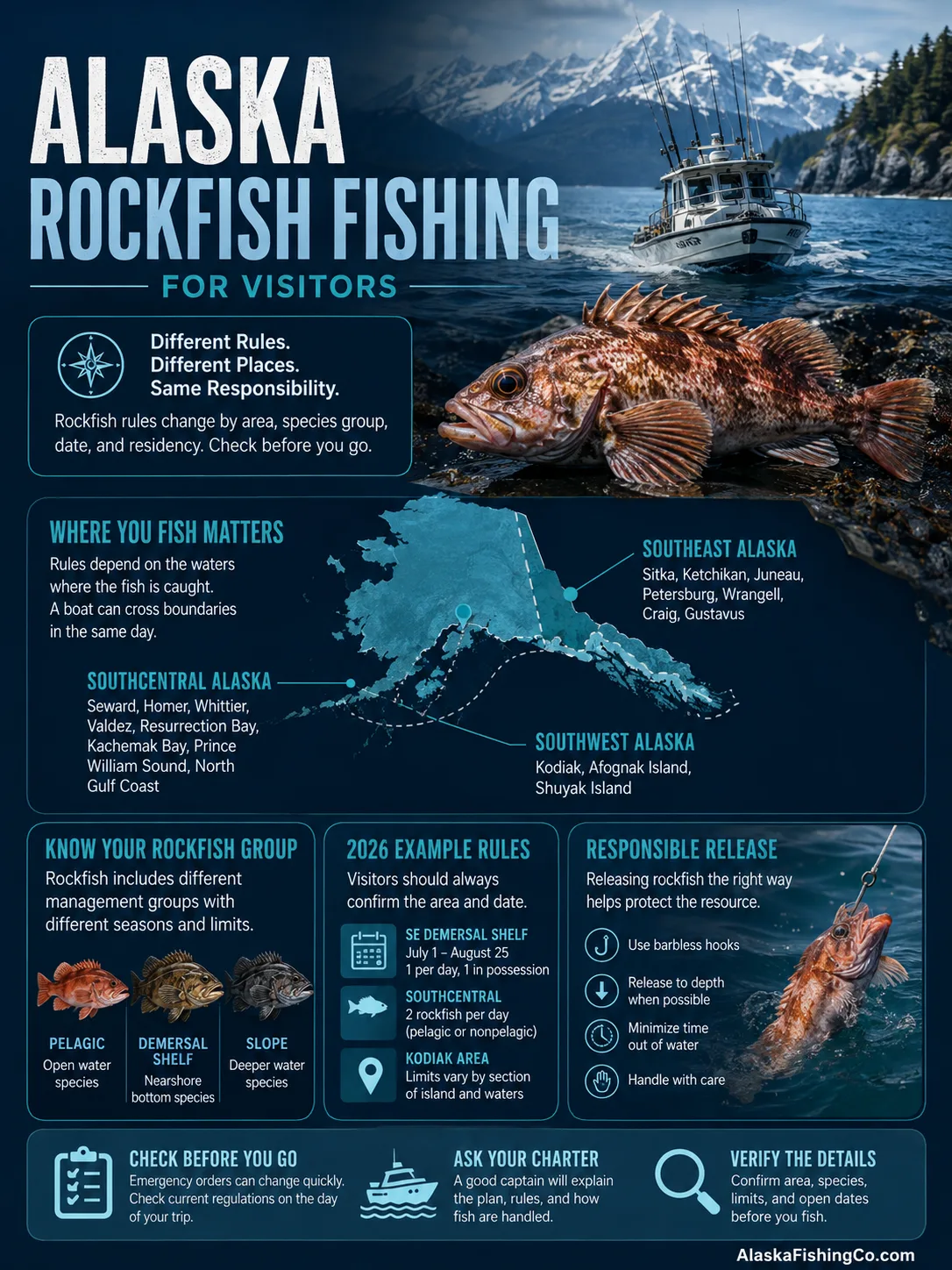
Visitors commonly book rockfish trips from three broad parts of coastal Alaska:
- Southeast Alaska: Sitka, Ketchikan, Juneau, Petersburg, Craig, Wrangell, Gustavus, and nearby coastal communities.
- Southcentral Alaska: Seward, Homer, Whittier, Valdez, Resurrection Bay, Kachemak Bay, Prince William Sound, and the North Gulf Coast.
- Southwest Alaska: Kodiak, Afognak Island, Shuyak Island, and surrounding waters.
These are useful travel regions, but they are not interchangeable legal zones. Southeast Alaska separates pelagic rockfish, demersal shelf rockfish, and slope rockfish. Southcentral rules often divide the catch between pelagic and nonpelagic rockfish. Kodiak-area restrictions may apply to a defined section of an island rather than the entire island group.
Southeast Alaska
Southeast Alaska suits visitors who want a mixed saltwater trip involving salmon, halibut, lingcod, and rockfish. The main regulatory issue is that the word rockfish can refer to several management categories with different seasons and limits.
Before booking from a Southeast port, ask:
- Will the boat fish inside waters, outside waters, or the federal Exclusive Economic Zone?
- Is the trip expected to encounter pelagic, demersal shelf, or slope rockfish?
- Is the target species open to nonresidents on the trip date?
- Must a retained fish be entered on a harvest record?
- Does a port-sampling restriction affect when the fish may be filleted?
Seward, Homer, and the North Gulf Coast
Rockfish trips from Seward and Homer are often sold as combination charters. A boat may spend part of the day targeting halibut, salmon, lingcod, or Pacific cod before moving to rockfish habitat.
This creates a practical decision for the angler. Filling a rockfish limit early can remove flexibility later in the day, especially when the retained catch already includes the maximum allowed number from a restricted species group.
Prince William Sound
Whittier and Valdez provide access to Prince William Sound, where fishing grounds may range from protected passages to exposed outer waters. Visitors should not assume that a rule quoted for Seward, Cook Inlet, or Southeast Alaska applies inside the Sound.
A charter operator should be able to explain:
- The management area the boat normally fishes
- The expected rockfish categories
- The applicable daily and possession limits
- How unwanted rockfish will be returned to depth
Kodiak and Afognak
Kodiak offers strong rockfish opportunities, but the area demands close attention to maps. Different limits may apply around western Kodiak, northeastern Kodiak, southern Afognak, northern Afognak, and Shuyak Island.
A statement such as “the Kodiak rockfish limit is five” can therefore be incomplete. The exact fishing position, individual species limits, and current emergency orders still matter.
How 2026 Rockfish Rules Differ by Region
There is no single 2026 visitor limit covering all Alaska rockfish trips. The examples below show why a nonresident should confirm the destination and fishing coordinates before relying on a number supplied by a lodge, booking platform, or older article.
| Fishing area | 2026 visitor rule example | Planning issue |
|---|---|---|
| Southeast Alaska demersal shelf rockfish | Nonresident season July 1 through August 25; one per day, one in possession, and one for the year | The retained fish must be identified and recorded immediately |
| North Gulf Coast and Cook Inlet | From April 1 through September 15: three total rockfish per day and six in possession, including no more than two pelagic per day and one nonpelagic per day | Yelloweye retention is closed from April 1 through June 30 |
| Selected Kodiak and southern Afognak waters | From June 1 through December 31: five per day and ten in possession, with tighter limits for any single species, black rockfish, and yelloweye | The rule applies only inside the boundaries named in the emergency order |
| Northern Afognak and Shuyak waters | From June 1 through December 31: three rockfish per day, with no more than one from a single species | Crossing an island-area boundary can change the legal catch |
In Southeast Alaska, the 2026 nonresident season for demersal shelf rockfish runs from July 1 through August 25. The category includes yelloweye, quillback, tiger, China, canary, copper, and rosethorn rockfish. A nonresident may keep one per day, possess one, and harvest only one during the year. The species, date, and location must be recorded immediately after landing and retaining the fish.[d]
In the North Gulf Coast and Cook Inlet waters covered by the 2026 restriction, the total limit remains three rockfish per day and six in possession. Within that total, no more than two per day and four in possession may be pelagic rockfish, while no more than one per day and two in possession may be nonpelagic rockfish. Yelloweye may not be retained from April 1 through June 30.[e]
In the affected Kodiak and southern Afognak waters, the June 1 through December 31 limit is five rockfish per day and ten in possession. No more than two per day and four in possession may be from a single rockfish species. Black rockfish and yelloweye each have a further limit of one per day and two in possession. Northern Afognak and Shuyak waters have a separate three-fish daily limit, with no more than one from a single species.[f]
These are area-specific examples, not statewide limits. Emergency orders can change seasons, methods, and bag or possession limits after regulation booklets have been printed.
Fishing License Rules for Visitors
Most visitors aged 16 or older need an Alaska nonresident sport fishing license before participating in a rockfish trip. This applies to travelers from another U.S. state and international visitors who do not qualify as Alaska residents.
A license is needed even when:
- The trip is operated by a licensed charter captain
- The charter provides rods, reels, bait, and fish processing
- The angler intends to release every fish
- The person fishes for only a few hours
- The trip is included in a lodge package
Nonresidents under age 16 do not need a sport fishing license. However, anglers of any age may need a harvest record when fishing for a species that has an annual limit. Alaska offers printed, electronic, and eSigned license formats, and a valid license must be carried while fishing.[b]
Nonresident License Prices
Visitors can choose a short-term license that matches the fishing portion of the trip or buy an annual license when several fishing days are spread across the year.
| License | Price | Typical use |
|---|---|---|
| 1-day license | $15 | One scheduled charter day |
| 3-day license | $30 | A short fishing weekend or weather backup |
| 7-day license | $45 | Several fishing days during a one-week trip |
| 14-day license | $75 | A longer lodge or multi-region trip |
| Annual license | $100 | Several trips or more than 14 fishing days |
Foreign visitors pay the same listed sport fishing license prices as other nonresidents. A foreign passport does not create a separate rockfish permit or a higher sport fishing license fee.[a]
Does a Rockfish Angler Need a King Salmon Stamp?
A king salmon stamp is not required when the person fishes only for rockfish. It becomes relevant when an eligible angler also fishes for king salmon during a combination charter.
Ask the operator before purchasing:
- Will the trip actively target king salmon?
- Could the captain switch to king salmon if conditions change?
- Is the stamp included in a lodge package?
- Does the trip date fall inside an open king salmon season?
A charter described as a “halibut and rockfish trip” normally does not require a king salmon stamp unless the fishing plan changes. A “salmon, halibut, and rockfish combo” may require one.
Buying the License Online
The license can be purchased through the Alaska Department of Fish and Game online store. It is better to complete the purchase before reaching the harbor, where mobile service may be weak and the crew may be preparing the boat.
- Open the official ADF&G online licensing store.
- Create or sign in to a customer account.
- Select a nonresident sport fishing license.
- Choose the correct duration and starting date.
- Add a king salmon stamp only when the trip requires one.
- Review the angler’s name, date of birth, and license dates.
- Complete the purchase and save the license to the phone.
- Keep a printed backup when traveling to an area with limited service.
Do not buy the shortest possible license without considering a weather delay. A one-day charter moved to the following day may fall outside the license date originally selected.
Daily, Possession, and Annual Limits Are Different
A daily limit controls what may be taken during one day, while a possession limit controls how many unpreserved fish the person may have. An annual limit places a separate ceiling on the number that may be harvested during the regulatory year.
Daily Bag Limit
The daily bag limit is the maximum number of fish that may be taken during a calendar day. A person cannot legally create a second daily limit by:
- Changing charter boats
- Returning to shore and leaving again
- Crossing into another nearby fishing area
- Giving the morning catch to another person
Possession Limit
The possession limit matters most on multi-day trips. Fish in a boat, lodge freezer, vehicle, cooler, rental cabin, or processor arrangement may still affect possession depending on whether they meet Alaska’s definition of preserved fish.
Under the statewide definitions, a possession limit is the maximum number of unpreserved fish a person may possess. Fish temporarily held unfrozen in a cooler with ice or dry ice are not treated as preserved merely because they are cold.[h]
Before a second or third fishing day, confirm:
- How the lodge stores each angler’s catch
- Whether the fish has been legally preserved
- Whether the area has a possession limit equal to one or two daily limits
- Whether a species-specific possession limit has already been reached
Annual Limit
An annual limit follows the angler, not the boat. A visitor who retains one Southeast demersal shelf rockfish under a one-fish annual limit cannot take another one later that year from a different Southeast charter.
When an annual limit applies, the required harvest information should be recorded at the time stated in the area regulation. Waiting until the boat returns to the hotel can result in an incomplete record.
Species Sub-Limit
A species sub-limit restricts how much of the total catch may consist of one species or management category. A five-rockfish total limit does not necessarily allow five black rockfish or five yelloweye.
A legal catch must satisfy all applicable parts:
- The total rockfish limit
- The pelagic or nonpelagic limit
- The individual species limit
- The possession limit
- The open season
- Any annual harvest limit
Pelagic, Nonpelagic, and Demersal Shelf Rockfish
“Rockfish” is a group name, not the name of one fish. Alaska has many rockfish species, and visual similarities can make identification difficult for first-time visitors.
Pelagic Rockfish
Pelagic rockfish are commonly found above or around rocky structure rather than resting directly on the bottom. Species treated as pelagic in Alaska regulations can include:
- Black rockfish
- Dark rockfish
- Dusky rockfish
- Deacon rockfish
- Widow rockfish
- Yellowtail rockfish
Black, dark, and dusky rockfish can be difficult to separate when the fish is wet, moving, or viewed in poor light. A dark-colored body by itself is not enough for a reliable identification.
Nonpelagic Rockfish
Nonpelagic species are more closely associated with rocky seafloor habitat. The category can include demersal shelf and deeper slope species.
Visitors may encounter:
- Yelloweye rockfish
- Quillback rockfish
- Copper rockfish
- China rockfish
- Tiger rockfish
- Canary rockfish
- Silvergray rockfish
- Pacific Ocean perch
Demersal Shelf Rockfish
In Southeast Alaska, the demersal shelf category receives special attention. It includes yelloweye, quillback, tiger, China, canary, copper, and rosethorn rockfish.
Several of these species grow slowly and can live for many decades. Yelloweye may not mature until it is more than 20 years old. That life history makes repeated removal from a small reef or pinnacle hard to replace.
Practical Identification on a Charter
The safest process is simple:
- Keep the fish under control beside or inside the boat.
- Ask the captain or deckhand to confirm the species.
- Check the remaining limit for that category.
- Decide whether the fish may be retained.
- Record it immediately when a harvest record is required.
- Use the descending device promptly when the fish must be released.
Do not place an unidentified fish in the fish box and plan to identify it at the dock. If the fish belongs to a closed or restricted category, the error has already occurred.
Charter Fishing or a Self-Guided Boat
A charter is the more practical choice for most first-time Alaska rockfish visitors. The captain supplies local navigation knowledge, fishing equipment, species experience, and a working process for handling released fish.
Shared Charter
A shared charter lowers the per-person cost but gives the group less control over the day. One group may want salmon while another expects a rockfish-focused trip.
Confirm these points before paying a deposit:
- How many passengers will fish?
- Is rockfish a primary target or an incidental part of a combo trip?
- How long is the run to the fishing grounds?
- Does the trip return after limits are reached?
- Are cleaning, vacuum packing, and freezing included?
Private Charter
A private charter gives a family or small group more control over target species, departure time, fishing pace, and weather-related route changes. It is often useful when:
- Young anglers are joining the trip
- Someone has limited mobility
- The group wants to avoid a long offshore run
- Rockfish is the main target
- The group needs time for photography or careful fish handling
Lodge Package
A lodge package may combine lodging, meals, boats, fish processing, and transport. The package price does not always include every expense.
Ask whether the quoted rate covers:
- Fishing licenses and stamps
- Charter taxes or fuel charges
- Fish cleaning and trimming
- Vacuum sealing and freezing
- Insulated airline boxes
- Airport delivery or shipping
- Gratuities
Rental or Personal Boat
A self-guided trip transfers the legal, navigational, and fish-handling responsibility to the visitor. The operator of the boat should understand tides, weather, submerged hazards, fuel range, emergency communications, and the location of management boundaries.
A self-guided rockfish boat should have:
- Navigation charts and a working GPS
- A marine weather source
- A VHF radio
- Appropriate personal flotation equipment
- A landing net or fish-handling tool
- A species identification reference
- A functional deepwater release device rigged for immediate use
Renting a boat is not a practical shortcut when nobody in the group has experience with cold saltwater operations.
Questions to Ask a Rockfish Charter
A useful charter conversation should cover regulations as well as price and departure time. A captain who regularly fishes the area should be able to explain the expected species and how the crew handles an accidental catch.
Before Paying the Deposit
- Which management area will the boat fish?
- Which rockfish species are commonly encountered there?
- Is the trip primarily for rockfish or a mixed-species charter?
- What 2026 emergency orders affect the planned area?
- Is a deepwater release device already rigged?
- How are catches separated for each licensed angler?
- Does the crew identify every rockfish before retention?
- Is fish cleaning included?
- Who handles vacuum packing and freezing?
- What happens when wind or sea conditions cancel the trip?
Also ask for the exact harbor and check-in time. Some operators use different docks depending on tides, fuel availability, or the vessel assigned to the trip.
What Happens During a Rockfish Charter Day
A rockfish charter normally combines a boat run, sonar work, repeated drifts, species checks, and dockside fish handling. The actual time spent with a line in the water may be much shorter than the advertised trip length.
Check-In
The crew may check licenses before departure and explain current limits. This is the time to mention:
- Whether a king salmon stamp was purchased
- Any annual-limit fish already retained during the year
- Whether another day’s catch is still in possession
- Medical or mobility issues affecting the trip
- Seasickness concerns
The Run to the Fishing Grounds
Nearshore rockfish habitat may be reached quickly, while exposed reefs and offshore pinnacles can require a much longer run. Wind direction, swell, tide, and visibility may cause the captain to choose a different location than originally planned.
Finding Fish
Rockfish often gather around:
- Rocky ridges
- Underwater pinnacles
- Steep ledges
- Boulder fields
- Reef edges
- Changes in bottom depth
The captain may use sonar to locate fish above the structure and then set up a controlled drift. The goal is to keep the lure near the fish without dragging it continuously through the rocks.
Hookup and Retrieval
Rockfish may strike hard, but many are caught in water deep enough to make the retrieve steady and tiring. The angler should maintain pressure without pumping the rod wildly.
During the retrieve:
- Keep the rod loaded
- Reel steadily
- Follow crew instructions near the surface
- Keep hands away from exposed hooks
- Do not grab the fish across the dorsal spines
Identification and Retention
The crew should identify the fish before it is added to the retained catch. When the fish cannot legally be kept, it should spend as little time as possible at the surface.
Returning to the Dock
At the dock, fish should be separated by angler and handled according to the current area rules. Do not assume every rockfish may be headed or filleted at sea. Some ports or sampling periods may require fish to remain identifiable until the vessel reaches the docking facility.
Rockfish Tackle and Fishing Methods
Most visitors do not need to bring specialized rockfish equipment because established charters provide suitable tackle. Anglers bringing their own equipment should match it to depth, current, lure weight, and the size of other fish that may be hooked.
Rod and Reel
A typical setup uses a medium-heavy or heavy saltwater rod with a conventional or sturdy spinning reel. Braided line helps the angler feel the lure and maintain contact in deep water.
The setup should provide:
- Enough line capacity for the fishing depth
- A drag that operates smoothly under load
- A leader resistant to abrasion
- A rod capable of working heavy jigs
- Sufficient strength for an incidental halibut or lingcod
Metal Jigs
Metal jigs sink quickly and work well over steep or rocky structure. The angler usually drops to the target depth, reels slightly above the bottom, and works the lure with short lifts.
Avoid leaving the jig on the seafloor. This increases snagging and may place the lure directly among nonpelagic rockfish when the intended target is a pelagic school higher in the water.
Soft Plastic Lures
Large soft plastics can be fished on heavy jig heads. They provide a slower presentation and can reduce the number of exposed hook points compared with a lure fitted with several treble hooks.
Bait and Circle Hooks
Where bait is legal and suitable, a single circle hook can reduce deep hooking. The angler should reel into the weight of the fish rather than making an exaggerated hook-setting motion.
Managing a Mixed-Species Day
When a trip targets several species, the order can matter. Fishing for halibut or lingcod over rocky bottom may produce incidental rockfish.
A more careful approach is to:
- Discuss the target order before fishing begins
- Avoid filling the rockfish limit too early
- Keep lures above the bottom when targeting other species
- Move when unwanted rockfish are repeatedly caught
- Stop targeting a school after the applicable limit is reached
Barotrauma and Deepwater Release
A rockfish brought rapidly from deep water may be unable to swim back down without help. The problem is called barotrauma and is caused by expanding gas in the fish’s closed swim bladder.
Visible signs may include:
- Bulging eyes
- A swollen abdomen
- Tissue protruding from the mouth
- Extended gill membranes
- The fish floating on its side
- An inability to descend after release
A fish can remain alive at the surface and still be unable to return to depth. Releasing it beside the boat and watching it float away is not a successful release.
How a Descending Device Works
A descending device attaches the fish to a weighted line and returns it to deeper water. As pressure increases, the expanded gas is compressed and the fish can regain buoyancy control.
- Keep the device rigged before fishing begins.
- Handle the fish carefully and avoid unnecessary photographs.
- Attach the fish using the device’s approved method.
- Lower it to the capture depth or the depth required by the applicable regulation.
- Release the fish using the device mechanism.
- Retrieve the weight and prepare it for another use.
ADF&G advises anglers to avoid intentionally catching and releasing rockfish in deep water, move away from areas producing unwanted rockfish, use single circle hooks with bait, and return fish to depth promptly when release is necessary.[g]
Do Not Vent the Fish
Do not cut or puncture tissue protruding from the mouth. What appears to be an inflated organ may not be the swim bladder, and untrained venting can cause additional injury.
The better response is to:
- Minimize surface time
- Avoid squeezing the abdomen
- Keep the fish from striking the deck
- Use the descending device immediately
Planning for Weather and Sea Conditions
Rockfish may be available when the boat cannot safely reach the intended grounds. Alaska saltwater trips depend on wind, swell, visibility, tide, vessel size, and the amount of exposed water between the harbor and the fishing location.
Nearshore and Offshore Trips
| Trip feature | Nearshore fishing | Offshore fishing |
|---|---|---|
| Boat travel | Usually shorter | May use a large part of the charter day |
| Sea exposure | Can be more protected | More exposed to swell and wind |
| Fishing depth | May include shallower reefs | Can involve deeper pinnacles and slopes |
| Weather disruption | The captain may have alternate protected areas | The trip may be rerouted or canceled |
| Species mix | Depends on local habitat | May provide access to a wider range of structures |
Leave a Weather Buffer
Do not place the only fishing day immediately before the flight home. A better schedule leaves room for:
- A weather-related charter change
- Fish processing and full freezing
- A delayed return to port
- Transport from a remote lodge
- Repacking an overweight fish box
Seasickness Preparation
Seasickness can develop even on a calm-looking day. Follow medical advice for any medication and take it at the recommended time rather than waiting until the boat reaches open water.
Other practical steps include:
- Eat a light meal before departure
- Avoid heavy alcohol use the night before
- Dress in removable layers
- Stay hydrated
- Look toward the horizon when possible
- Tell the crew early when symptoms begin
Keeping, Processing, and Taking Rockfish Home
The fish-handling plan should be arranged before the charter, not after several boxes of fish reach the dock. Cleaning, vacuum sealing, freezing, airline transport, and shipping may be provided by different businesses.
Ask What the Charter Includes
A charter price may include basic cleaning but exclude:
- Skinning or pin-bone removal
- Vacuum sealing
- Per-pound processing charges
- Freezer storage
- Insulated boxes
- Airport delivery
- Courier or overnight shipping
Keep Each Angler’s Catch Separate
Fish should remain traceable to the person who caught them. This matters when anglers in the same group have different daily, possession, or annual-limit histories.
A processor or lodge should be able to explain:
- How packages are labeled
- How separate limits are tracked
- When fish are considered preserved
- How long complete freezing takes
- When boxes will be ready for departure
Checked Fish Boxes
Frozen rockfish is commonly transported in insulated boxes as checked baggage. Airline rules vary, so confirm:
- Maximum box weight
- Oversize baggage measurements
- Additional bag charges
- Whether wet ice is accepted
- Whether dry ice requires advance approval
- How the package must be marked
- Whether connections involve another airline
A fish box that meets one airline’s rules may not meet the rules of a second carrier used on the same journey. International travelers should also check the food-import requirements of the destination country.
Shipping the Fish
Shipping can be easier than carrying several boxes through airports, but it may cost more than expected. Ask for a written estimate based on:
- Processed fish weight
- Box and insulation cost
- Destination postal code
- Delivery speed
- Weekend or holiday timing
- Replacement terms if a shipment is delayed
Do not calculate value from the whole weight of the fish. Filet yield is lower than round weight, and trimming, skin removal, and packaging further change the final shipment weight.
Common Mistakes Made by Visiting Rockfish Anglers
Most visitor problems begin with an assumption that sounds reasonable but does not match the applicable rule. A few checks before departure can prevent a closed-season fish, an exceeded possession limit, or an unusable travel plan.
Assuming Alaska Has One Rockfish Limit
Limits can differ by management area, rockfish category, species, season, and emergency order.
Checking the Port Instead of the Fishing Location
A charter may depart from one area and fish across a boundary. Ask where the boat expects to fish, not only where it leaves the dock.
Buying a License for the Wrong Date
A short-term license must cover the actual fishing date. Include a weather backup when practical.
Believing the Charter Fee Includes the License
Many operators require clients to purchase their own license. Confirm this before check-in.
Keeping a Fish Before Identifying It
Color alone does not reliably identify every rockfish. Confirm the species and management category first.
Adding Daily Limits Across Several Days
A new day does not erase an existing possession limit. Fish held at the lodge or in a cooler may still count.
Releasing a Deep-Caught Fish at the Surface
A floating fish may be unable to descend. Use a ready deepwater release device.
Filling the Rockfish Limit at the First Stop
This can complicate a mixed-species day when rockfish are later caught incidentally while targeting halibut or lingcod.
Booking the Charter on the Final Morning
A weather delay or slow freezing process may interfere with the flight home.
Assuming Every Fish Can Be Filleted at Sea
Area rules and dockside sampling restrictions may require an identifiable fish to remain intact until the vessel reaches the appropriate docking point.
Alaska Rockfish Questions Answered
Do tourists need a fishing license for rockfish in Alaska?
Yes. Most nonresident visitors aged 16 or older need a valid Alaska sport fishing license before fishing for rockfish. This includes charter clients and anglers who intend to release their catch. Nonresidents under 16 do not need the license, although a harvest record may still be required for species with annual limits.
Can foreign visitors buy an Alaska fishing license online?
Yes. International visitors can buy a nonresident sport fishing license through the Alaska Department of Fish and Game online store. Foreign visitors pay the listed nonresident sport fishing prices and should save an electronic copy before traveling to an area with limited mobile service.
Is a king salmon stamp needed for a rockfish charter?
Not for a rockfish-only trip. A king salmon stamp is needed when an eligible angler fishes for king salmon. Ask the operator whether the trip may include king salmon before deciding whether to purchase a stamp.
Can a nonresident keep yelloweye rockfish in Alaska?
It depends on the fishing area and date. Yelloweye may be included in an open demersal shelf or nonpelagic limit in one area while retention is closed in another. Southeast Alaska also applies a restricted nonresident season and annual limit to demersal shelf rockfish. Confirm the current area rule before retaining a yelloweye.
What is the difference between pelagic and nonpelagic rockfish?
Pelagic rockfish are generally associated with the water column above rocky structure, while nonpelagic species are more closely associated with the seafloor, reefs, and slopes. The legal importance is that many Alaska areas apply different limits to these groups.
Can a rockfish survive after being pulled from deep water?
It may survive when returned promptly to depth with a descending device. A fish showing barotrauma may be unable to swim down from the surface without help. Surface release should not be used as a substitute for recompression.
Does the daily rockfish limit reset the next morning?
The daily limit resets, but the possession limit still applies. A visitor who already possesses the maximum number of unpreserved fish may not be able to keep another daily limit until the earlier catch is legally preserved or otherwise removed from possession in a lawful manner.
Can frozen rockfish be taken home on an airplane?
Usually, but the airline controls baggage weight, box dimensions, packaging, and dry-ice requirements. Confirm the rules with every airline on the itinerary. International travelers must also check whether their destination allows personal imports of fish products.
Alaska Fishing References
- [a] ADF&G Sport Fishing License and King Salmon Stamp Prices — Current nonresident and foreign visitor license fees. (Official Alaska state fish and wildlife agency.)
- [b] ADF&G General License Information — License formats, validity periods, age rules, harvest records, and king salmon stamp requirements. (Official Alaska state licensing authority.)
- [c] ADF&G Sport Fishing Emergency Orders and Press Releases — Current area closures, openings, limit changes, and method restrictions. (Official in-season regulatory source.)
- [d] Southeast Alaska 2026 Demersal Shelf Rockfish Nonresident Season — Season dates, daily limit, possession limit, annual limit, recording rule, and deepwater release requirements. (Official ADF&G emergency-order announcement.)
- [e] 2026 North Gulf Coast and Cook Inlet Rockfish Restrictions — Pelagic and nonpelagic limits and the temporary yelloweye retention closure. (Official ADF&G area management announcement.)
- [f] 2026 Kodiak and Afognak Islands Rockfish Limit Changes — Geographic boundaries, total limits, and individual species restrictions. (Official ADF&G area management announcement.)
- [g] ADF&G Protect Alaska’s Rockfish — Barotrauma prevention, unwanted-catch reduction, tackle choices, and deepwater release practices. (Official state fisheries conservation resource.)
- [h] Alaska Statewide Sport Fishing Definitions — Legal meanings of possession limit, preserved fish, resident, rockfish, and sport fishing. (Official state regulatory reference.)