
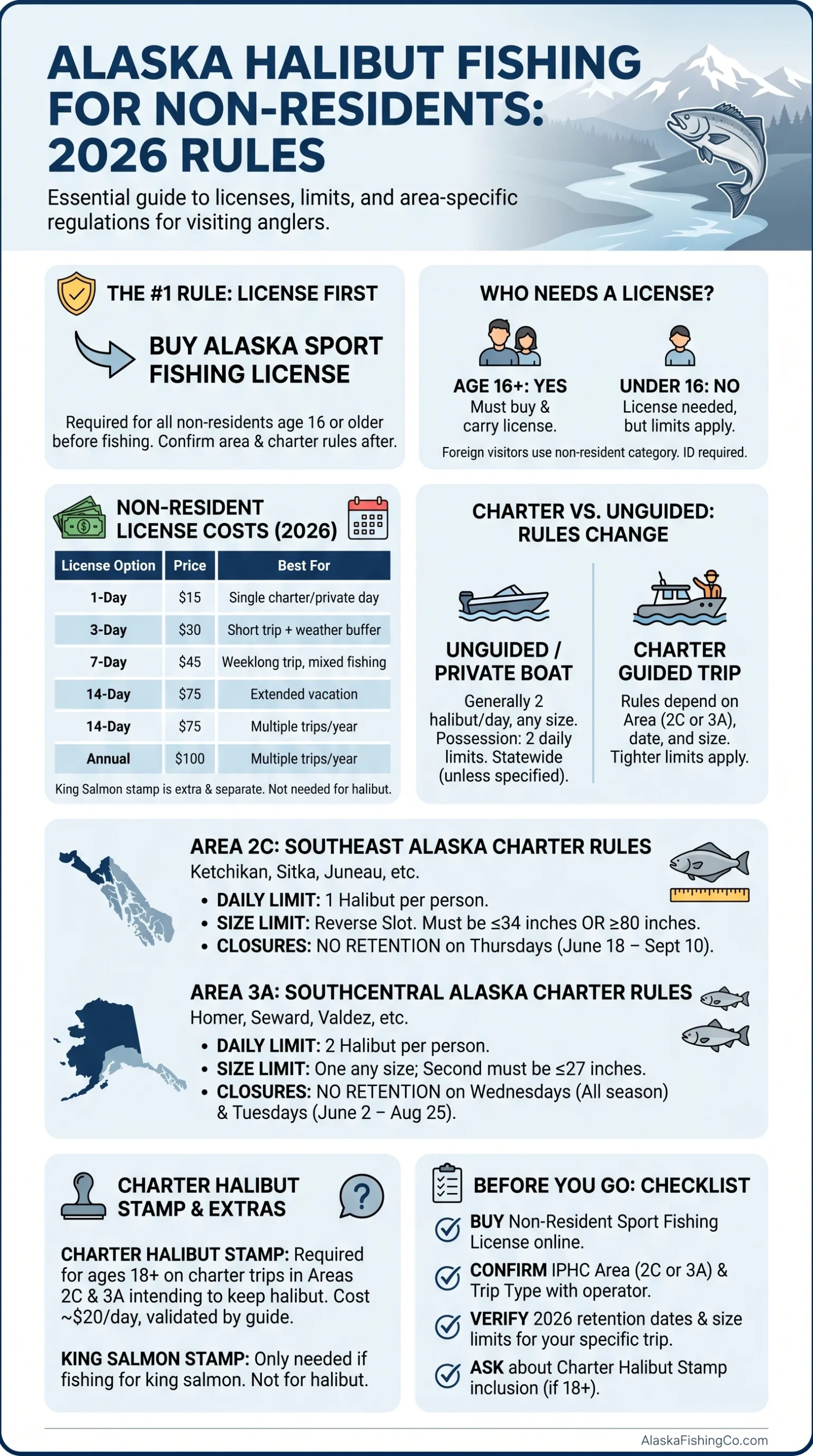
Non-residents can fish for halibut in Alaska, but anyone age 16 or older needs an Alaska sport fishing license before fishing. The main rule is simple: a license gets you onto the water, but the halibut limit depends on whether you fish unguided or with a charter, and whether you are in Southeast Alaska or Southcentral Alaska.
For 2026, unguided halibut fishing in Alaska generally allows two halibut of any size per person per day, with a possession limit of two daily bag limits. Charter anglers follow tighter area rules in the main charter regions, and adults on charter trips in IPHC Areas 2C and 3A must also be covered by a daily charter halibut stamp if they intend to keep halibut.
If you remember one thing… buy the correct Alaska non-resident sport fishing license first, then confirm your charter or private-boat halibut rules by area before the trip date.
What To Know First
- Non-residents age 16 and older need a sport fishing license to fish for halibut in Alaska.
- Foreign visitors use the non-resident license category; Alaska lists separate foreign/alien non-resident fee lines, but the sport fishing license prices are the same.
- A king salmon stamp is not required for halibut. It only matters if you also fish for king salmon, except stocked-lake kings.
- Charter halibut rules are not the same as private-boat rules. A guided trip may have day closures, size limits, and a charter halibut stamp requirement.
- Southeast Alaska and Southcentral Alaska are treated differently. Ketchikan and Sitka are not under the same charter limits as Homer, Seward, or Valdez.
Do Non-Residents Need a License to Fish for Halibut in Alaska?
Yes. Non-residents age 16 or older must buy and carry an Alaska sport fishing license to fish for halibut, whether they fish from a charter boat, a private boat, a lodge boat, or shore where halibut fishing is possible. ADF&G states that all residents age 18 or older and nonresidents age 16 or older must have a sport fishing license for Alaska sport and personal use fisheries.[a]
The license requirement applies to the person actively fishing. That means holding the rod, setting the hook, fighting the fish, or otherwise taking part in the catch. A person who only rides along and does not fish does not need a sport fishing license for that role, though a charter operator may still ask every passenger for trip paperwork.
- Age 16 or older and not an Alaska resident: buy a non-resident sport fishing license.
- Under age 16 and not an Alaska resident: no sport fishing license is required, but all bag, size, possession, and charter rules still apply.
- International visitor: treated as a non-resident for sport fishing license purposes.
- Alaska resident traveling with non-resident guests: the guest uses non-resident rules, not the host’s residency status.
What counts as non-resident?
For most visitors, this is straightforward. If the person does not qualify as an Alaska resident under state rules, they should choose a non-resident sport fishing license. Tourists from other U.S. states, Canadian visitors, cruise passengers, and travelers from overseas all fall into the non-resident side for a normal fishing trip.
Do children need anything for halibut?
A non-resident child under 16 does not need the Alaska sport fishing license. That does not give the child extra fish. The child’s catch still counts toward that child’s daily bag limit, and the charter or captain still must follow the area rules.
Alaska Non-Resident Halibut License Costs and Validity
For a halibut trip, most visitors only need a non-resident sport fishing license. The current ADF&G non-resident sport fishing license prices are $15 for 1 day, $30 for 3 days, $45 for 7 days, $75 for 14 days, and $100 for an annual license.[b]
Short licenses are for visitors who only fish on one part of the trip. Annual licenses make sense if you plan several separate fishing days, return later in the same calendar year, or combine halibut with salmon, trout, or rockfish trips.
| License option | 2026 non-resident price | Best fit for visitors | Halibut note |
|---|---|---|---|
| 1-day sport fishing license | $15 | One charter day or one private-boat day | Valid for the selected fishing day only |
| 3-day sport fishing license | $30 | Short trip with backup weather day | Useful when a charter may move by a day |
| 7-day sport fishing license | $45 | Weeklong lodge, RV, or cruise extension | Good for mixed halibut and salmon plans |
| 14-day sport fishing license | $75 | Long Alaska vacation | Gives room for weather and travel shifts |
| Annual sport fishing license | $100 | Multiple trips in the same year | Often the better value after several fishing days |
Alaska annual licenses generally run from the date of purchase through December 31 of that calendar year. Short-term non-resident fishing licenses are the exception: they are valid only for the 1, 3, 7, or 14 days purchased.[c]
Worth Noting: A non-resident king salmon stamp costs extra, but it is not a halibut stamp. Do not buy one for a halibut-only trip unless you will also fish for king salmon.
Private Boat, Unguided Trip, or Charter: Why It Changes the Halibut Rules
The fastest way to understand Alaska halibut rules is to ask one question: are you fishing with a charter vessel guide? Unguided anglers follow the general sport halibut rules. Charter anglers in Areas 2C and 3A follow annual charter rules that can be more restrictive.
“Unguided” usually means fishing from a private boat, a rental boat without a charter guide, or a self-guided lodge setup where no charter vessel guide is providing sport fishing guide services on that vessel. “Charter” means a guided sport fishing trip on a charter vessel.
- Unguided halibut fishing: generally two halibut of any size per day, per person, in Alaska waters, unless a more restrictive rule applies.
- Charter halibut fishing in Area 2C: one fish per day with a reverse slot size rule and Thursday closures during part of the season.
- Charter halibut fishing in Area 3A: two fish per day, but one must be 27 inches or smaller if two are kept, with Tuesday and Wednesday closures as listed for 2026.
- Guided halibut outside Areas 2C and 3A: NOAA describes those guided rules as the same as unguided sport anglers in those other IPHC areas.
Unguided halibut basics
For 2026 unguided sport halibut fishing in Alaska, NOAA’s Alaska Region summary lists a February 1 to December 31 sport season, a daily bag limit of two halibut of any size per person, and a possession limit of two daily bag limits. It also notes that allowable gear is a single line with no more than two hooks attached or a spear, and that sport-caught halibut may not be sold, traded, or bartered.[d]
Charter halibut basics
Charter rules are built around the area, the date, and the number and size of fish retained. A visitor booking a charter should ask the operator three plain questions before paying: which IPHC area the trip fishes, whether the trip date is open for halibut retention, and whether the charter halibut stamp cost is included or itemized.
2026 Charter Halibut Limits for Non-Residents
Non-residents do not get a separate halibut bag limit just because they are visitors. The same charter halibut limit applies to residents and non-residents on the same regulated charter trip. What changes for the visitor is the license category and, for adults, the need to be covered by a charter halibut stamp when retaining halibut in Areas 2C or 3A.
The 2026 NOAA charter summary gives different rules for Southeast Alaska Area 2C and Southcentral Alaska Area 3A. These rules apply to charter halibut anglers, not to every private-boat angler in Alaska.[e]
| Trip type or area | Daily halibut limit | Size rule | Closed retention days in 2026 |
|---|---|---|---|
| Unguided Alaska sport halibut | 2 halibut per person | Any size, unless another rule applies | Season listed as February 1 through December 31 |
| Area 2C charter, Southeast Alaska | 1 halibut per person | Retained fish must be 34 inches or smaller, or 80 inches or larger | All Thursdays from June 18 through September 10 |
| Area 3A charter, Southcentral Alaska | 2 halibut per person | One fish may be any size; the second must be 27 inches or smaller | All Wednesdays, plus Tuesdays from June 2 through August 25 |
Area 2C: Southeast Alaska
Area 2C covers much of Southeast Alaska, including trips commonly associated with Ketchikan, Sitka, Juneau, Petersburg, Wrangell, and nearby waters. In 2026, the charter daily limit is one halibut per person. The retained fish must fit the reverse slot rule: 34 inches or smaller, or 80 inches or larger. Charter anglers may not retain halibut on Thursdays from June 18 through September 10, except under special GAF rules handled by qualifying operators.
Area 3A: Southcentral Alaska
Area 3A covers major Southcentral charter destinations such as Homer, Seward, Whittier, Valdez, and many central Gulf of Alaska trips. In 2026, the charter daily limit is two halibut per person. If two are kept, one can be any size and the other must be 27 inches or smaller. Charter anglers may not retain halibut on Wednesdays, and they may not retain halibut on Tuesdays from June 2 through August 25. Charter vessels and charter halibut permits in Area 3A are also limited to one halibut-retention charter trip per day.
One Detail People Miss: “Two halibut per day” in Area 3A does not mean two large halibut on a charter. If you keep two, one must meet the 27-inch maximum size rule.
Do Non-Residents Need a Halibut Stamp?
For private or unguided halibut fishing, a normal Alaska sport fishing license is the document visitors usually need. For charter fishing in IPHC Areas 2C and 3A, adults age 18 or older must have a charter halibut stamp validated for each charter vessel fishing trip in a calendar day when they intend to catch and keep halibut.
The charter halibut stamp is a federal charter-program requirement, not the same thing as the Alaska king salmon stamp. NOAA states that the daily charter halibut stamp costs $20, is valid for one day, and applies to charter vessel anglers age 18 or older in Areas 2C and 3A who intend to catch and retain halibut, with limited GAF-related exceptions. The charter halibut permit holder is responsible for purchasing the stamps, and the guide validates them through the ADF&G logbook before the first deployment of fishing gear.[f]
- Age 18 or older on a 2C or 3A charter and planning to keep halibut: charter halibut stamp must be validated.
- Age 16 or 17 on a charter: Alaska sport fishing license is still needed, but the charter halibut stamp rule starts at 18.
- Catch-and-release only: the charter halibut stamp is not required if the angler does not intend to retain halibut.
- Incidental halibut on a charter: if a stamp was not validated before gear was deployed, the halibut must be released.
How to ask your charter about the stamp
Visitors should not assume the stamp is already handled. Ask: “Is the 2026 charter halibut stamp included in my trip price, and will it be validated before we fish?” A good operator will know the process and explain whether the $20 daily stamp is built into the fare or shown as a separate charge.
Species Rules: Halibut Is Not Salmon, Rockfish, or Lingcod
An Alaska sport fishing license can cover the act of sport fishing, but species rules still matter. Halibut, king salmon, rockfish, lingcod, sablefish, and shellfish can each have different limits, seasons, retention rules, and recording duties.
For halibut, the big visitor mistake is buying or skipping the wrong add-on. The Alaska king salmon stamp is not needed for halibut. It is needed when fishing for king salmon, except king salmon in stocked lakes. Halibut has its own charter stamp rule only for adult charter anglers in Areas 2C and 3A who intend to retain halibut.
- Halibut-only charter: non-resident sport fishing license, plus charter halibut stamp validation if age 18 or older in 2C or 3A and keeping halibut.
- Halibut and king salmon combo: sport fishing license, king salmon stamp if fishing for king salmon, and charter halibut stamp if the charter halibut rule applies.
- Halibut and rockfish: check the region’s rockfish retention and release rules before the trip.
- Halibut and lingcod: lingcod seasons and non-resident limits can be different from halibut.
Harvest records and annual limits
Some Alaska sport fisheries require recording retained fish on a license or harvest record card. For halibut in 2026, the federal annual measures note that there is no annual limit for charter halibut anglers, so the annual-limit harvest-record rule for halibut is not triggered that year. Other species on the same trip can still require recording.
Before You Move On: A combo trip can change the paperwork. The license may be the same, but the stamp and harvest-record duties can change as soon as king salmon, lingcod, or certain rockfish enter the plan.
How Foreign Visitors Can Buy an Alaska Halibut Fishing License Online
Foreign visitors can buy an Alaska non-resident sport fishing license online through ADF&G, just like U.S. out-of-state visitors. The license should be bought before fishing, and the name and details should match the ID the angler carries on the trip.
The online process is usually simple, but visitors should not leave it until they are standing on the dock. Rural ports, early morning departures, weak phone signal, and last-minute charter paperwork can make a simple task stressful.
- Go to the ADF&G online license store.
- Choose the non-resident sport fishing license length that covers your fishing date or dates.
- Enter your legal name, birth date, and contact details carefully.
- Do not add a king salmon stamp unless you will also fish for king salmon.
- Save the electronic license and keep a printed or offline copy if possible.
- Send the license number to your charter operator if they request it before the trip.
- Carry photo ID with the license while fishing.
Picking the right start date
For a one-day charter, the start date should match the actual fishing day. For a trip with weather risk, a 3-day or 7-day license often gives more room if the captain moves the trip. This is common in ports where wind, swell, or harbor conditions can shift plans.
Buying through a charter or lodge
Some operators help guests buy a license or remind them by email. That is useful, but the angler is still responsible for having the right license. Check the name, dates, and license type before leaving the dock.
Regional Differences Non-Residents Should Understand
Alaska halibut fishing is not one uniform rule across every dock. The port, the IPHC regulatory area, and the type of trip decide the practical rules for a visitor. NOAA, IPHC, and federal rules handle Pacific halibut management, while ADF&G handles sport fishing licenses and publishes regional sport fishing regulation pages with local notices and emergency orders.[g]
For most tourists, the two areas that matter most are Area 2C and Area 3A. The names can feel abstract, so it helps to connect them to real trip planning.
- Southeast Alaska / Area 2C: common for Ketchikan, Sitka, Juneau, Petersburg, Wrangell, and many Inside Passage trips.
- Southcentral Alaska / Area 3A: common for Homer, Seward, Whittier, Valdez, and many Kenai Peninsula or Prince William Sound trips.
- Western and far Alaska areas: fewer tourist charters, but halibut rules still depend on the IPHC area and whether the trip is guided.
- Freshwater trips: not halibut trips. A salmon or trout day may have different license add-ons and local rules.
Emergency orders and late changes
ADF&G warns anglers to check current emergency orders and news releases before finalizing fishing plans because emergency orders supersede published sport fishing regulations.[h] Halibut charter rules are normally set through annual federal management measures, but visitors should still confirm current rules with official sources and the operator before the trip.
Worth Noting: The most accurate question is not “What are Alaska’s halibut rules?” It is “What are the rules for my date, my port, my IPHC area, and my trip type?”
Common Mistakes Non-Residents Make
Most license problems happen before the first bait hits bottom. Visitors often buy the wrong document, misunderstand charter limits, or assume a rule from one port works in another port.
Wrong idea: “My charter license is included, so I do not need to check anything.”
Correct explanation: Some charters help with licensing, but every angler should still confirm they have the right Alaska non-resident sport fishing license and that the charter halibut stamp process is handled if they are age 18 or older and keeping halibut in Area 2C or 3A.
Why it gets confused: Charter companies often send reminders, links, or package details, so visitors assume every legal item is automatic.
Wrong idea: “A king salmon stamp is the halibut stamp.”
Correct explanation: The king salmon stamp is for king salmon. The charter halibut stamp is a separate federal charter requirement for adult charter anglers in Areas 2C and 3A who intend to retain halibut.
Why it gets confused: Both use the word “stamp,” and many Alaska trips combine salmon and halibut.
Wrong idea: “Area 3A lets everyone keep two big halibut.”
Correct explanation: On a 2026 Area 3A charter, one halibut may be any size, but the second retained halibut must be no more than 27 inches.
Why it gets confused: People hear “two-fish limit” and miss the size rule attached to the second fish.
Wrong idea: “If a halibut is too small for my plan, I can hold it alive and trade up later.”
Correct explanation: A halibut that is not immediately released with minimum injury counts toward the angler’s daily bag limit.
Why it gets confused: Some freshwater catch-and-release habits do not match federal halibut handling rules.
Wrong idea: “Ketchikan and Homer follow the same charter limits.”
Correct explanation: Ketchikan is in Southeast Alaska Area 2C, while Homer is tied to Southcentral Area 3A. The 2026 charter rules are different.
Why it gets confused: Visitors plan by city name, while halibut rules are written by IPHC regulatory area.
Real-Life Scenarios for Alaska Visitors
These examples show how the rules work for normal travel plans. The exact answer can still change with date, vessel type, and area, so the final check should always be tied to the actual trip.
- A 32-year-old from California books a Homer halibut charter.
They need a non-resident sport fishing license and, if keeping halibut, the Area 3A charter halibut stamp must be validated for that day. - A family from Germany has a 15-year-old fishing in Seward.
The 15-year-old does not need a non-resident sport fishing license, but still follows the same halibut bag and size rules for the trip. - A cruise passenger books a Ketchikan charter in July.
This is usually Area 2C planning, so the visitor should expect the one-fish charter limit, the reverse slot rule, and Thursday retention closures during the listed 2026 dates. - Two friends rent a boat and fish without a guide near a coastal port.
They are generally in the unguided category, so each licensed non-resident angler follows the unguided daily and possession limits, not the 2C or 3A charter size rules. - A visitor books a salmon and halibut combo trip.
The halibut license need may be simple, but a king salmon stamp is also needed if the person fishes for king salmon. - An adult on a charter says they only want catch-and-release halibut.
A charter halibut stamp is not required if they do not intend to retain halibut, but they cannot decide to keep one later unless the stamp was validated before fishing gear was deployed. - A group books a multi-day charter.
Adult anglers who intend to retain halibut need stamp validation for each calendar day they fish and keep halibut under the charter stamp rule. - An angler fishes in Juneau, then drives to the Kenai Peninsula.
They may move from Area 2C planning to Area 3A planning, so the same annual license can remain useful while the charter limits change.
One Detail People Miss: Weather changes can move a charter by a day, but your license dates and closed retention days still matter. A 3-day license is often safer than a 1-day license when the fishing day is not locked in.
Before You Book an Alaska Halibut Trip
A non-resident halibut trip is easier when the paperwork is handled before travel day. Start with the license, then confirm the port, the IPHC area, the charter or unguided status, the retention day, and any size rule that applies.
Ask the operator for the exact 2026 rule set they are fishing under. A reliable answer should include the area, the daily limit, any size limit, any closed retention days, and how the charter halibut stamp is handled for adults.
- Buy the sport fishing license before the trip.
- Keep a copy that works without cell service.
- Do not buy a king salmon stamp for halibut unless salmon is also part of the plan.
- Ask whether the trip is in Area 2C, Area 3A, or another IPHC area.
- Check whether the trip date is open for halibut retention.
- Ask how retained fish will be measured, filleted, transported, and shipped.
Alaska halibut fishing is very manageable for non-residents when the license and area rules are clear before the boat leaves. The most common mistake is treating “Alaska halibut rules” as one statewide charter rule. The rule to remember is simple: license first, then area, then trip type, then date.
Alaska Halibut Fishing for Non-Residents Questions Answered
Do tourists need a fishing license for Alaska halibut?
Yes. Non-resident tourists age 16 or older need an Alaska sport fishing license to fish for halibut. Non-resident children under 16 do not need the sport fishing license, but the fishing limits still apply to them.
Can foreign visitors buy an Alaska halibut fishing license online?
Yes. Foreign visitors can buy a non-resident Alaska sport fishing license online through ADF&G. They should choose the license length that covers the fishing date or dates and keep the license available while fishing.
Do non-residents need a king salmon stamp for halibut?
No. A king salmon stamp is not needed for halibut-only fishing. It is needed if the angler fishes for king salmon, except king salmon in stocked lakes.
What is the 2026 unguided Alaska halibut limit?
For 2026, NOAA lists unguided Alaska sport halibut fishing as two halibut of any size per person per day, with a possession limit of two daily bag limits, unless a more restrictive rule applies.
What is the 2026 Area 2C charter halibut limit?
For 2026, Area 2C charter anglers may retain one halibut per day. The fish must be 34 inches or smaller, or 80 inches or larger, and Thursday retention closures apply from June 18 through September 10.
What is the 2026 Area 3A charter halibut limit?
For 2026, Area 3A charter anglers may retain two halibut per day. One may be any size, and the second must be 27 inches or smaller. Halibut retention is closed on all Wednesdays and on Tuesdays from June 2 through August 25.
Who needs the Alaska charter halibut stamp?
Charter vessel anglers age 18 or older need a charter halibut stamp validated for each charter trip day in Areas 2C or 3A when they intend to catch and retain halibut, unless a narrow GAF exception applies.
Can non-residents keep halibut caught on a charter and ship it home?
Yes, if the halibut was legally retained and processed under the applicable rules. Visitors should ask the charter or processor how fish will be filleted, labeled, frozen, and shipped, because on-vessel filleting and possession rules still apply before offload.
Alaska Fishing References
- [a] Alaska Department of Fish and Game, Sport Fishing Licenses, King Salmon Stamps, IDs and Harvest Record Cards — used for license age rules, king salmon stamp scope, and online purchase paths. (Official Alaska state wildlife agency source.)
- [b] Alaska Department of Fish and Game, Sport Fishing License and King Salmon Stamp Prices — used for current non-resident and foreign/alien non-resident sport fishing license fees. (Official Alaska state fee schedule.)
- [c] Alaska Department of Fish and Game, Fishing and Hunting License General Information — used for license validity and short-term non-resident license duration. (Official Alaska state licensing FAQ.)
- [d] NOAA Fisheries Alaska Region, 2026 Regulations Summary and Frequently Asked Questions for Unguided Pacific Halibut Fishing in Alaska — used for unguided halibut season, daily bag, possession, gear, and handling rules. (Official federal fisheries agency PDF.)
- [e] NOAA Fisheries Alaska Region, 2026 Regulations for Charter Halibut Anglers — used for Area 2C and Area 3A charter limits, closures, size rules, and charter stamp summary. (Official federal fisheries agency PDF.)
- [f] NOAA Fisheries Alaska Region, Charter Halibut Stamp Program Frequently Asked Questions and Small Entity Compliance Guide — used for the 2026 charter halibut stamp age, cost, validation, and responsibility details. (Official federal program guide.)
- [g] NOAA Fisheries, Sport Halibut Fishing in Alaska — used for the management split among IPHC, NPFMC, NOAA Fisheries, and ADF&G, and for guided versus unguided reference links. (Official NOAA Fisheries topic page.)
- [h] Alaska Department of Fish and Game, Sport Fishing Regulations — used for regional regulation pages and the notice that emergency orders supersede published regulations. (Official Alaska state regulation portal.)