
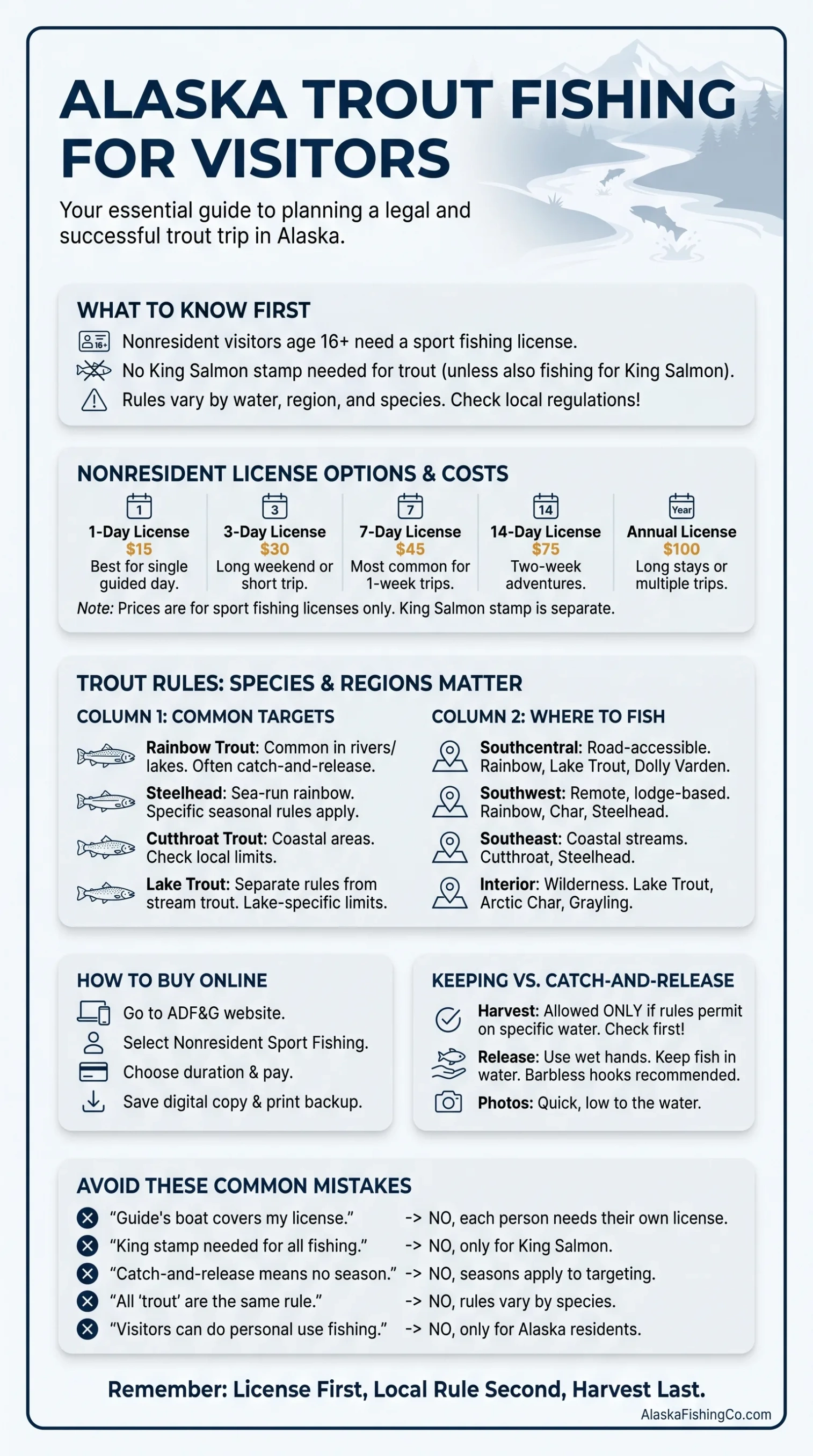
Alaska trout fishing is simple to start, but easy to plan wrong if you treat the whole state as one rulebook.
Visitors age 16 and older need a nonresident Alaska sport fishing license to fish for trout, and the rules depend on the exact water, region, and species you plan to target.[a] A stocked lake near Anchorage, a Kenai River rainbow trout float, a Bristol Bay lodge trip, and a Southeast cutthroat stream can all feel like “Alaska trout fishing,” but they may not follow the same limits, seasons, or gear rules.
If you remember one thing… buy the right nonresident sport fishing license first, then check the current ADF&G regulation page for the specific river, lake, or drainage before you keep any trout.
What To Know First
- Nonresident visitors age 16 and older need an Alaska sport fishing license.
- A king salmon stamp is not needed for trout unless you also plan to fish for king salmon.
- Rainbow trout, steelhead, cutthroat trout, lake trout, Dolly Varden, and Arctic char may be managed differently.
- Many popular trout waters are catch-and-release, artificial-lure-only, seasonal, or size-restricted.
- Emergency orders can change the rules after the printed regulation booklet is released.
The Short Answer for Visitors
Most Alaska visitors can trout fish legally by carrying a valid nonresident sport fishing license and following the local sport fishing regulations for the water they are on.
That sounds basic, but trout fishing in Alaska is often more local than visitors expect. ADF&G regulations are organized by region and then by drainage, river, lake, or special area. The rule that matters is not just “Alaska trout rule.” It is the rule for the exact place where the line is in the water.
- Fishing from shore: license required for nonresidents age 16 or older.
- Fishing with a guide: license still required unless the visitor is under the nonresident age threshold.
- Catch-and-release fishing: still counts as fishing, so the license and local rules still apply.
- Fishing for trout and salmon on the same trip: check whether a king salmon stamp is needed for the salmon part.
A good visitor plan starts with three questions: Who is fishing? Where exactly will they fish? What species are they likely to catch?
License Rules for Alaska Trout Fishing
Visitors should treat a trout trip as sport fishing. Nonresidents age 16 or older must buy and carry a sport fishing license, whether they fish one afternoon from a roadside lake or several days on a remote river.
Alaska does not have a separate “tourist trout license.” International visitors, U.S. out-of-state visitors, and most temporary visitors use the nonresident sport fishing license category. ADF&G also lists foreign/alien nonresident sport fishing licenses at the same short-term sport fishing prices shown for nonresident visitors.[b]
- Resident vs. nonresident: most tourists are nonresidents unless they meet Alaska residency rules.
- Age rule: nonresidents under 16 do not need a sport fishing license.
- License possession: carry the license while fishing, either in an accepted printed or electronic format.
- Harvest record card: some fisheries with annual harvest limits may require recording harvested fish.
Worth Noting: A guide, lodge, or charter can help explain local rules, but the visitor is still responsible for having the right license and following the regulation for the water being fished.
Alaska Nonresident Trout Fishing License Options and Costs
Most visitors choose a short-term nonresident sport fishing license based on the number of fishing days. Annual nonresident licenses are useful for longer trips, repeat visits, or a season that includes several Alaska fishing stops.
Short-term nonresident sport fishing licenses are valid for the purchased number of days. Annual licenses are generally valid from the date of purchase through December 31 of that calendar year, while short-term nonresident fishing licenses run for 1, 3, 7, or 14 days.[c]
| License type | Current fee | Best fit for visitors | Trout note |
|---|---|---|---|
| 1-day nonresident sport fishing license | $15 | One guided day, cruise stop, or short roadside lake visit | Enough for trout if you fish only that date |
| 3-day nonresident sport fishing license | $30 | Long weekend or two active fishing days with a buffer | Useful for Anchorage, Mat-Su, Kenai, or Southeast stops |
| 7-day nonresident sport fishing license | $45 | Most one-week visitor itineraries | Often the cleanest choice for lodge or road-system trips |
| 14-day nonresident sport fishing license | $75 | Two-week Alaska travel plans | Good for mixed trout, salmon, and lake fishing plans |
| Annual nonresident sport fishing license | $100 | Long stay, multiple trips, or flexible summer plans | Usually worth it if fishing days may spread across the season |
The prices above are for sport fishing licenses. A king salmon stamp is a separate item and is not required for trout fishing by itself. Buy a king salmon stamp only if you plan to fish for king salmon, including catch-and-release king salmon, unless a specific stocked-lake exception applies.
- Choose the license length by actual fishing dates, not total vacation length.
- Buy before the first cast, not after arriving at the river.
- Save a phone copy and a backup screenshot if traveling to remote areas.
- Print a copy if your trip includes poor service, floatplanes, or overnight river camps.
Trout Rules Change by Species, Water, and Region
Alaska trout regulations are not one statewide limit. ADF&G tells anglers to choose a region, then check the specific drainage or area, and it notes that emergency orders supersede published regulations.[d]
That matters because “trout” in visitor language may include several fish that Alaska regulations may separate. Rainbow trout and steelhead are the same species, but ADF&G describes them as different forms based on whether the fish stays mainly in freshwater or migrates to the ocean before returning to spawn.[e] Cutthroat trout are another visitor target, especially in coastal areas; ADF&G describes coastal cutthroat forms in streams, lakes, and nearshore environments from lower Southeast Alaska to Southcentral Alaska.[f]
- Rainbow trout: common target in rivers, streams, and stocked lakes.
- Steelhead: sea-run rainbow trout, often managed with careful seasonal and retention rules.
- Cutthroat trout: common in parts of Southeast and coastal Southcentral Alaska.
- Lake trout: often treated separately from stream trout; check lake-specific limits.
- Dolly Varden and Arctic char: not trout, but often caught on trout-style trips.
One Detail People Miss: A trout may be legal to catch and release in one section of a river but not legal to keep, or not legal to target at all during a closed season. “We are only releasing them” does not override a closure.
Where Visitors Usually Fish for Trout in Alaska
The best trout area for a visitor depends on travel style. Road-system visitors usually look at Southcentral and Southeast waters first, while lodge and float-trip visitors may target remote Southwest or Interior waters.
For a first Alaska trout trip, pick a region based on access, weather tolerance, guide availability, and the kind of water you want to fish. Do not choose only by the name of the fish. A visitor who wants easy half-day fishing near a city needs a different plan than someone booking a fly-out river trip for large rainbow trout.
| Region | Common visitor angle | Possible trout-style targets | Planning note |
|---|---|---|---|
| Southcentral Alaska | Anchorage, Mat-Su, Kenai Peninsula, road-access lakes and rivers | Rainbow trout, lake trout, Dolly Varden, stocked trout in some lakes | Good for visitors who want trout fishing without a remote lodge |
| Southwest Alaska | Bristol Bay, Kodiak, Alaska Peninsula, remote lodge or float trips | Rainbow trout, char, Dolly Varden, steelhead in some systems | Rules can be highly water-specific; guides are common for remote travel |
| Southeast Alaska | Juneau, Sitka, Ketchikan, Prince of Wales, Haines, coastal streams | Cutthroat trout, steelhead, rainbow trout in selected waters | Federal public lands and local special rules may matter in some areas |
| Northern and Interior Alaska | Fairbanks-area lakes, highway corridors, wilderness waters | Lake trout, Arctic char, grayling, some rainbow trout opportunities | Great scenery, but access and season timing need more planning |
- For a short city-based trip: look for stocked lakes or road-access waters near your route.
- For trophy-style rainbow trout: expect more planning, local rule checks, and often a guide or lodge.
- For Southeast cutthroat: prepare for smaller water, wet weather, and fish that may move between lake, stream, and saltwater habitat.
- For lake trout: plan around cold water, boat access, and lake-specific limits.
How to Buy an Alaska Trout Fishing License Online
The easiest path for most visitors is to buy through the ADF&G online store before the fishing day. Licenses can also be purchased through many vendors and Fish and Game offices, but online purchase reduces last-minute problems.
Before buying, confirm the exact dates you will fish. A 7-day license is often better than stacking several 1-day licenses if your plans might shift due to weather, river level, ferry timing, or guide availability.
- Go to the ADF&G license purchasing page.
- Choose the sport fishing license category.
- Select nonresident or foreign/alien nonresident if that applies to your status.
- Choose 1-day, 3-day, 7-day, 14-day, or annual.
- Enter your personal details exactly as you will carry identification.
- Save the license file and make sure it is signed or eSigned in an accepted format.
- Check the current regulation page for the exact water before fishing.
Visitors should not wait until standing at a remote boat launch. Alaska travel often includes weak cell service, early departures, and weather changes. A license saved the night before can prevent a poor start to an expensive fishing day.
Before You Move On: If the plan includes both trout and king salmon, buy the sport fishing license first, then add the king salmon stamp only if you will actually fish for king salmon.
Keeping Trout vs. Catch-and-Release
Visitors should assume nothing about keeping trout until they read the local rule. Some waters allow harvest, some have size or annual limits, and many popular trout waters are managed for release or careful selective harvest.
Catch-and-release is common in Alaska trout fishing, especially where wild rainbow trout, steelhead, or trophy-style fisheries are part of the draw. ADF&G recommends practices such as wet hands, keeping fish in the water, using single hooks or flies when release is likely, and avoiding bait when planning to release fish.[g]
- Use barbless or pinched-barb hooks when release is expected.
- Keep the fish in the water while removing the hook.
- Wet hands before touching a fish.
- Do not grip trout by the gills, eyes, or jaw plate.
- Take photos fast, low, and close to the water.
- Check whether the local rule forbids removing released fish from the water.
Keeping a legal stocked trout from a lake is different from keeping a wild trout from a regulated river. For visitors, the safer habit is simple: decide whether harvest is allowed before the first fish is hooked.
Common Mistakes Visitors Make
Most Alaska trout problems come from assuming the rule is the same everywhere. The license is only the first step; the water-specific rule decides what happens after the fish is hooked.
Wrong idea: “A guide’s boat covers my license.”
Correct explanation: A guided visitor still needs their own license unless they fall under the nonresident age exemption.
Why it gets mixed up: Some guided trips include gear, tackle, and planning help, so visitors assume the legal paperwork is included too.
Wrong idea: “A king salmon stamp is needed for all Alaska fishing.”
Correct explanation: A king salmon stamp is for fishing for king salmon, not for trout by itself.
Why it gets mixed up: Many Alaska fishing pages talk about salmon first, so visitors connect the stamp with fishing in general.
Wrong idea: “Catch-and-release means the season does not matter.”
Correct explanation: A closed season can mean no targeting, even if every fish would be released.
Why it gets mixed up: In many places outside Alaska, release fishing is treated casually, but Alaska closures can be strict.
Wrong idea: “All trout-looking fish count the same.”
Correct explanation: Rainbow trout, steelhead, cutthroat trout, lake trout, Dolly Varden, and Arctic char can fall under different rules.
Why it gets mixed up: Visitors often use “trout” as a broad travel word, while regulations use species names.
Wrong idea: “Personal use fishing is another visitor option.”
Correct explanation: ADF&G states that all Alaska residents, and only Alaska residents, are eligible for subsistence and personal use fisheries.[h]
Why it gets mixed up: Visitors hear about dipnetting, household harvest, and local food fisheries, then assume those options apply to tourists.
- Check your license before fishing.
- Check the water before keeping fish.
- Check emergency orders before travel days.
Real-Life Scenarios for Alaska Trout Visitors
Visitor trout trips often fail or succeed based on small planning details. These examples show how the rules can change with age, location, species, and trip style.
- A 15-year-old visitor fishes a stocked lake near Anchorage with family.
They do not need a nonresident sport fishing license yet, but the adults age 16 and older do. - A cruise visitor has four hours in port and wants to cast for cutthroat trout.
A 1-day nonresident sport fishing license can fit the plan, but the local stream or lake rule still needs to be checked. - A couple books a Kenai-area rainbow trout float.
Each person actively fishing needs a license, and the guide’s local instructions should be matched with current ADF&G rules. - A family buys a 3-day license but bad weather moves the fishing day.
If the license dates do not cover the new day, they need a new valid license before fishing. - An international visitor plans trout one day and king salmon the next.
The trout day needs the sport fishing license; the king salmon day may also need a king salmon stamp. - A lodge guest catches a fish that looks like a trout but might be Dolly Varden.
They should identify the species before harvest because limits may differ. - A visitor wants to keep one wild rainbow trout for dinner.
They should first confirm that harvest is open on that exact water and that size, annual, and recording rules allow it.
Worth Noting: Alaska rewards flexible plans. A visitor who buys the right license, checks the water, and stays open to release fishing usually has a smoother trout trip.
Simple Gear and Timing Notes for Visitors
Visitors do not need overly specialized gear for every trout trip, but they do need gear that matches local rules. Some waters restrict bait, require artificial lures or flies, or limit hook style.
For road-system fishing, pack for changing weather and cold water rather than only for the fish. For remote trout fishing, ask the lodge or guide about waders, layers, bear-safe food storage, and whether felt-soled boots are accepted on the trip.
- For stocked lakes: simple spinning gear or fly gear may be enough, depending on local rules.
- For river rainbows: expect more catch-and-release habits and water-specific gear limits.
- For Southeast cutthroat: small streams, lakes, and wet weather can shape the day more than casting distance.
- For remote trips: pack backup layers, dry storage, and printed rule information.
Season timing is also local. Some trout fishing is tied to cold-water spring conditions, salmon spawning periods, fall steelhead movement, lake ice, or closures that protect fish during spawning. A calendar month alone is not enough; use the region and waterbody rule as the final check.
A Practical Visitor Checklist Before the First Cast
The cleanest trout plan is built before the fishing day. Confirm the license, the water, the species, the emergency order status, and the harvest plan while there is still time to fix a mistake.
- Confirm every angler’s age and residency status.
- Buy the correct nonresident sport fishing license length.
- Save the signed or eSigned license on your phone.
- Print a backup copy for remote areas.
- Find the correct ADF&G region and waterbody page.
- Check for emergency orders and news releases.
- Confirm whether harvest is allowed before keeping any trout.
- Carry simple release tools: pliers, rubber net, and barbless or pinched-barb options.
Alaska trout fishing is easiest when the visitor treats licensing and regulations as part of the trip plan, not a last-minute formality. The most common mistake is buying the license but skipping the water-specific regulation check. A reliable rule is easy to remember: license first, local rule second, harvest last.
Alaska Trout Fishing Questions Answered
Do tourists need a fishing license for trout in Alaska?
Yes. Nonresident tourists age 16 and older need an Alaska sport fishing license to fish for trout. Nonresident anglers under 16 do not need a sport fishing license, but local species and harvest rules still matter.
Do foreign visitors need a different Alaska trout fishing license?
No separate tourist trout license is used. Foreign visitors generally buy the nonresident or foreign/alien nonresident sport fishing license option through ADF&G.
Do I need a king salmon stamp for trout fishing in Alaska?
No. A king salmon stamp is not needed for trout fishing by itself. It is needed when fishing for king salmon, unless a specific exception applies.
Can visitors keep trout in Alaska?
Sometimes, but not everywhere. Trout harvest rules depend on the region, drainage, species, size limit, annual limit, and emergency orders. Check the exact water before keeping fish.
Is catch-and-release trout fishing still regulated in Alaska?
Yes. Catch-and-release is still fishing. A license may be required, and some waters may have closures or rules that limit whether fish can be targeted, handled, or removed from the water.
What is the best nonresident license length for a one-week Alaska trout trip?
Many visitors choose the 7-day nonresident sport fishing license for a one-week trip. If your fishing dates may shift, choose a license length that covers the full range of possible fishing days.
Can nonresidents do personal use fishing in Alaska?
No. Personal use and subsistence fisheries are for eligible Alaska residents. Visitors should plan on sport fishing rules unless they have a very specific legal basis to do otherwise.
Alaska Fishing References
- [a] Alaska Department of Fish and Game — Sport Fishing Licenses, King Salmon Stamps, IDs and Harvest Record Cards. This source explains who needs a sport fishing license, when king salmon stamps apply, and when harvest record cards may be needed. (Official Alaska state fish and wildlife agency.)
- [b] Alaska Department of Fish and Game — Product Prices: Licenses, Stamps, and Tags. This source lists current nonresident and foreign/alien nonresident sport fishing license prices. (Official state licensing price page.)
- [c] Alaska Department of Fish and Game — General License Information. This source explains license validity periods, short-term nonresident license lengths, and license formats. (Official state license information page.)
- [d] Alaska Department of Fish and Game — Sport Fishing Regulations. This source explains how to use regional regulations and states that emergency orders supersede published regulations. (Official state sport fishing regulations portal.)
- [e] Alaska Department of Fish and Game — Steelhead / Rainbow Trout Species Profile. This source explains rainbow trout and steelhead forms, identification, habitat, and status. (Official ADF&G species profile.)
- [f] Alaska Department of Fish and Game — Cutthroat Trout Species Profile. This source explains cutthroat trout forms, habitat, range, and identification issues. (Official ADF&G species profile.)
- [g] Alaska Department of Fish and Game — Proper Release Methods. This source explains wet-hand handling, in-water release, hook choice, and fish survival practices. (Official ADF&G sport fish handling guidance.)
- [h] Alaska Department of Fish and Game — Subsistence and Personal Use Fishing Licenses & Permits. This source explains that only Alaska residents are eligible for subsistence and personal use fisheries. (Official state resident fishing permit page.)