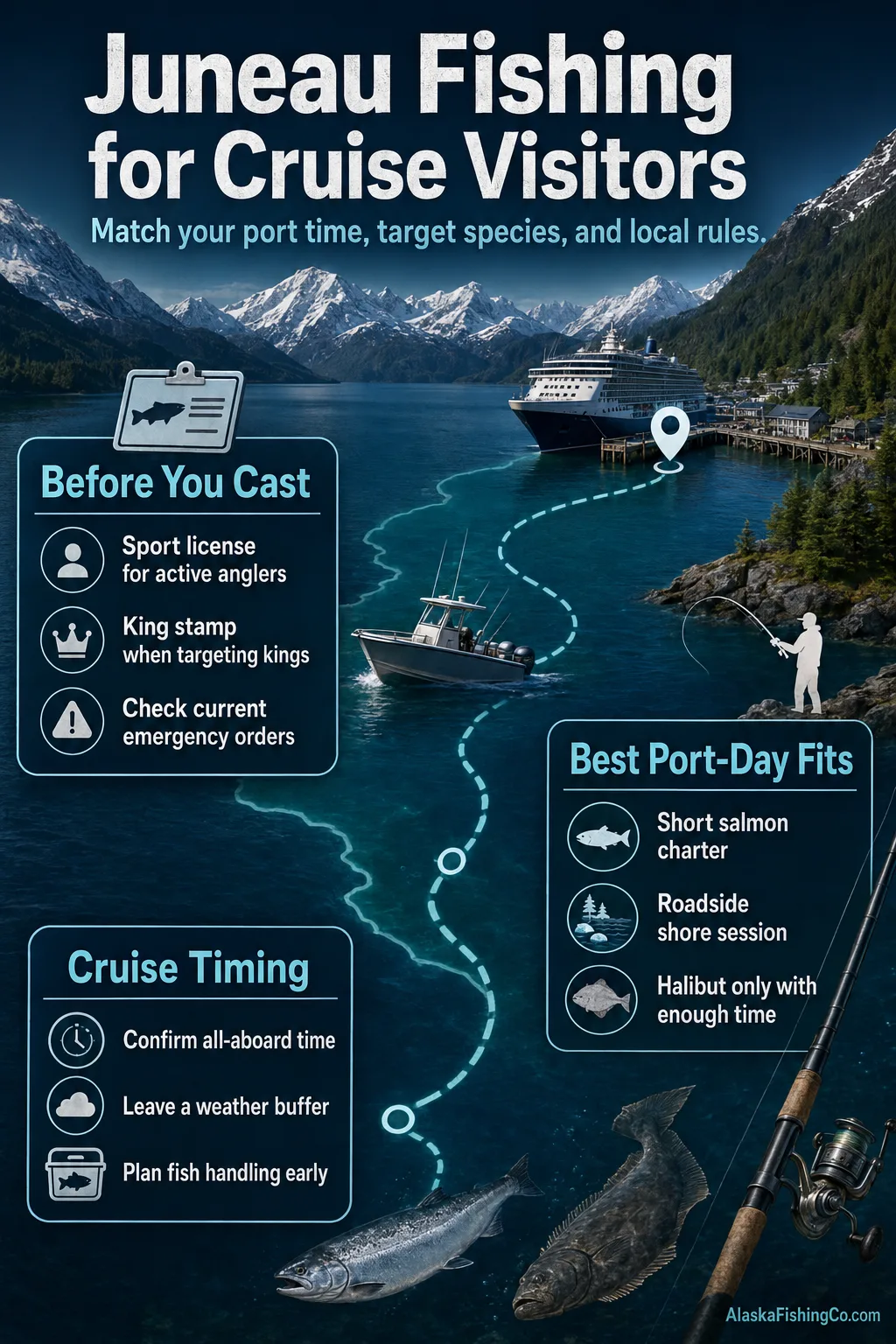
Fishing in Juneau during a cruise stop is realistic, but the best plan depends on your port time, your target species, and whether you fish from shore or with a charter. Most cruise visitors who actively fish in Alaska need a nonresident sport fishing license, and anyone targeting king salmon usually needs a king salmon stamp as well.
Juneau is one of the easier Alaska cruise ports for a short fishing outing because saltwater, hatchery salmon areas, roadside shoreline spots, and charter departures are all within reach. The catch is that Alaska rules are location-specific and can change during the season, especially for salmon and halibut.
If you remember one thing… buy the right license before you fish, check the current Juneau emergency orders, and do not assume a charter booking automatically covers your personal license.
What To Know First
- Most cruise visitors are nonresidents. Nonresidents age 16 or older need an Alaska sport fishing license to participate in sport fishing.[a]
- King salmon is the extra step. A king salmon stamp is generally required if you fish for king salmon, including in saltwater.
- Short licenses work well for cruise stops. One-day, three-day, seven-day, and longer nonresident options are available.
- Juneau rules can shift midseason. Emergency orders and advisory announcements can close waters, reopen them, or change bag and possession limits.
- Charters help with logistics, not personal paperwork. A good operator can explain what you need, but the license is still your responsibility.
Do Cruise Visitors Need a Fishing License in Juneau?
Yes, most cruise visitors need a license if they actively fish in Juneau. Alaska requires nonresidents age 16 or older to buy and carry a sport fishing license when taking part in sport fishing. That rule applies whether the visitor is fishing from a charter boat, casting from shore, or joining a short salmon trip near town.
“Taking part” means more than reeling in the final fish. If you hold the rod, cast, jig, bait hooks, or help land fish as part of the fishing activity, you should be properly licensed. A person who only watches from the boat or dock does not need a sport fishing license.
Worth Noting: A foreign visitor is treated as a nonresident for Alaska sport fishing license purposes. The same short-term nonresident sport fishing license prices apply to most international cruise visitors.
Which License Works Best for a Juneau Cruise Stop?
For a single day in port, the one-day nonresident sport fishing license is usually the simplest fit. If Juneau is one of several Alaska ports where you may fish, a three-day or seven-day license may cost less than buying separate one-day licenses.
Alaska’s nonresident sport fishing license prices include several short-term options. Current ADF&G pricing lists a nonresident one-day sport fishing license at $15, a three-day license at $30, a seven-day license at $45, a fourteen-day license at $75, and an annual license at $100.[b]
| Visitor Plan | Likely License Fit | Why It Fits |
|---|---|---|
| One Juneau port day | 1-day nonresident sport fishing license | Covers a single charter or short shore session on that date. |
| Fishing in Juneau and another Alaska port | 3-day or 7-day nonresident sport fishing license | Often easier than buying separate one-day licenses. |
| Long Alaska land-and-cruise trip | 7-day, 14-day, or annual nonresident license | Better for visitors fishing on multiple days before or after the cruise. |
| Watching only | No license needed | A non-fishing companion does not need a sport fishing license. |
When Do You Need a King Salmon Stamp?
You need a king salmon stamp if you are fishing for king salmon in Alaska, unless a narrow exception applies, such as stocked lakes. Juneau cruise visitors should assume they need the stamp if their trip targets king salmon in saltwater, near hatchery return areas, or from a shoreline spot known for kings.
The stamp is separate from the sport fishing license. For nonresidents, current ADF&G pricing lists a one-day king salmon stamp at $15, a three-day stamp at $30, a seven-day stamp at $45, a fourteen-day stamp at $75, and an annual stamp at $100.[b]
- Targeting coho salmon only? You still need the sport fishing license, but not a king salmon stamp unless you fish for kings.
- Targeting halibut only? You need the sport fishing license, but the king stamp is not for halibut.
- Fishing a mixed salmon charter where king salmon may be targeted? Ask the captain before buying, but expect to need the stamp.
- Nonresident youth under 16 do not need a sport fishing license or king salmon stamp, though harvest record rules may still matter for certain annual-limit fisheries.
One Detail People Miss: A king salmon stamp is tied to fishing for king salmon, not simply keeping one. If your gear and trip are aimed at kings, buy the stamp before you start.
Best Fishing Options Near Juneau for Cruise Visitors
The easiest Juneau fishing options for cruise passengers are guided salmon charters, halibut charters, and roadside saltwater shore fishing. Juneau’s management area includes marine waters around Juneau, Douglas Island, Admiralty Island, northern Chichagof Island, southern Lynn Canal, and the Glacier Bay harvest area. Major sport fisheries include king salmon, coho salmon, halibut, king crab, Dungeness crab, trout, and Dolly Varden.[c]
For most cruise visitors, the practical choice comes down to time. A full halibut charter can be harder to fit into a tight port call. A shorter salmon charter or a shore-based outing near the road system may be more realistic when the ship is in port for only part of the day.
Salmon Charters
Salmon charters are the most common fit for visitors who want a real Alaska fishing experience without planning every detail. Boats may target king salmon, coho salmon, or other salmon depending on the date, rules, and local run timing.
- Good for visitors who want gear, local knowledge, and fish handling included.
- Best booked early during busy cruise season.
- Requires a sport fishing license, and usually a king salmon stamp if kings are targeted.
Halibut Charters
Halibut fishing is possible from Juneau, but cruise visitors should check trip length carefully. Halibut trips often need more travel and fishing time than a quick salmon outing. Federal rules apply to guided halibut fishing in Southeast Alaska, and 2026 added a separate charter-halibut stamp requirement for adult anglers who intend to retain halibut.[g]
- Ask the operator which IPHC area applies and what the current charter limit is.
- In Area 2C, anglers age 18 or older who intend to retain halibut on a charter need a $20 charter halibut stamp for the fishing day; the guide handles the stamp.[g]
- Confirm whether the trip fits your ship’s all-aboard time.
- Check fish processing, shipping, and same-day pickup details before booking.
Shore Fishing
Juneau has saltwater shoreline fishing on the road system, especially for visitors who have transportation or a local guide. ADF&G lists popular shoreline king salmon locations such as False Outer Point, Point Louisa, The Breadline, Gastineau Channel, Auke Bay, Fritz Cove, and areas near Macaulay Hatchery, depending on season and rules.[d]
- Shore fishing is flexible, but it is more weather- and timing-dependent.
- Rental gear may be harder to arrange than a charter.
- Know the exact open area before fishing near hatcheries, creek mouths, lagoons, or marked closures.
Current Late-2026 Coho Rules Around Juneau
Two Juneau coho actions matter for visitors fishing late in 2026. Montana Creek and Peterson Creek/Lagoon remain closed to coho salmon fishing through December 31, 2026, while North Gastineau Channel saltwaters reopened to sport fishing on September 19 with a six-coho limit.[h][i]
Montana Creek and Peterson Creek/Lagoon
From September 1 through 11:59 p.m. December 31, 2026, the waters of Montana Creek, including McGinnis Creek, are closed to coho salmon fishing. Coho salmon may not be targeted, retained, or possessed there.[h]
The same closure applies to Peterson Creek and Peterson Lagoon from the intertidal saltwaters within a 200-yard radius of the creek mouth upstream to the falls approximately 1.5 miles from the mouth. Coho salmon may not be targeted, retained, or possessed in the closed waters.[h]
- Montana Creek, including McGinnis Creek: closed to coho fishing through December 31, 2026.
- Peterson Creek and Lagoon: specified waters closed to coho fishing through December 31, 2026.
- Closure means no targeting: this is not simply a no-retention rule.
North Gastineau Channel Reopened September 19
The North Gastineau Channel saltwaters near Macaulay Salmon Hatchery were closed earlier in the season, but ADF&G reopened them to sport fishing effective September 19 through December 31, 2026. The current coho salmon daily bag and possession limit in the reopened waters is 6 coho salmon of any size.[i]
Current Status: Do not use the earlier North Gastineau Channel closure as the current rule. The saltwaters reopened September 19, 2026, and the reopening order remains in effect through December 31, 2026, with a six-coho daily bag and possession limit.
Juneau King Salmon Timing for Cruise Passengers
King salmon timing around Juneau varies by area, but spring and early summer are especially relevant for cruise visitors. ADF&G notes that anglers cast for king salmon along local saltwater shorelines in April, May, and June, while hatchery king salmon return around the Juneau road system from about early June through August.
Expired 2026 Seasonal Example: Juneau Hatchery King Salmon Area
This opportunity ended August 31, 2026. From June 1 through August 31, the designated Juneau saltwater hatchery sport harvest area had a daily bag and possession limit of four king salmon of any size. King salmon harvested there by nonresidents did not count toward the nonresident annual king salmon limit.[f]
Beginning September 1, anglers in the designated hatchery area returned to the regional king salmon regulations then in effect. The four-king hatchery rule should not be treated as a current fall or winter opportunity.
The hatchery example shows why Juneau anglers need to check both dates and boundaries. A special rule may apply inside one marked saltwater area for part of the season while nearby water follows a different regional limit.
Before You Move On: Temporary Juneau openings and closures have exact start and end dates. When you find an emergency-order limit online, check whether it is still active before using the number for a current trip.
How to Buy Your Alaska Fishing License Before the Ship Arrives
The cleanest approach is to buy your Alaska sport fishing license online before the cruise reaches Juneau. That gives you time to check the date, print or save proof, and add a king salmon stamp if your trip needs it.
- Choose the date you will actually fish in Juneau.
- Buy the correct nonresident sport fishing license length.
- Add a king salmon stamp if your charter or shore plan targets king salmon.
- Save the license where you can access it without relying on weak cell service.
- Carry a photo ID that matches the license information.
- Ask your charter operator whether any harvest record or local rule applies to your target species.
If your plans are uncertain, wait until the charter confirms the target species. Buying a sport fishing license is usually straightforward. The part visitors get wrong is buying no king stamp for a king salmon trip, buying the wrong date, or assuming one person’s license covers the whole family.
Common Mistakes Cruise Visitors Make in Juneau
Most fishing problems in Juneau come from timing, paperwork, or misunderstanding local boundaries. These mistakes are easy to avoid if you settle the license and rules before stepping onto the dock.
“The charter includes my license.”
Correct explanation: Some operators help guests understand license needs, but your Alaska sport fishing license is personal. Confirm before the trip, and do not assume it is bundled into the booking.
Why it gets mixed up: Cruise excursions often include gear and transport, so visitors may think official fishing paperwork is included too.
“I only need a license if I keep fish.”
Correct explanation: The license requirement applies to participating in sport fishing, not only harvesting fish.
Why it gets mixed up: Many visitors think of a license as a harvest permit, but Alaska treats active fishing itself as the licensed activity.
“A salmon license covers king salmon.”
Correct explanation: Alaska does not sell a separate “salmon license” for cruise visitors. You buy a sport fishing license, and you add a king salmon stamp if fishing for king salmon.
Why it gets mixed up: People often use “salmon fishing” as a single category, but king salmon has its own stamp rule.
“The North Gastineau Channel closure is still in effect.”
Correct explanation: The earlier closure was superseded by a September 17 action reopening the saltwaters to sport fishing beginning September 19, 2026. The reopened waters have a six-coho daily bag and possession limit through December 31.[i]
Why it gets mixed up: The earlier closure can still appear in search results even though a later emergency order changed the status.
“If others are fishing there, it must be open for coho.”
Correct explanation: Montana Creek and the specified Peterson Creek/Lagoon waters remain closed to coho fishing through December 31, 2026. Coho may not be targeted, retained, or possessed in those closed waters.[h]
Why it gets mixed up: A waterbody can remain open for some legal fishing while a particular species is closed.
“The printed booklet is always enough.”
Correct explanation: Emergency orders can override published regulations. ADF&G advises anglers to check current emergency orders and news releases before finalizing plans.[e]
Why it gets mixed up: Visitors may download one PDF before traveling and never check for updates during the cruise.
Real-Life Scenarios for Juneau Cruise Visitors
These examples show how the license and rule checks usually work in common port-day situations.
- One adult books a four-hour salmon charter. Buy a nonresident sport fishing license for that day, and add a king salmon stamp if the charter may target king salmon.
- A couple takes a halibut charter and plans to retain fish. Each active angler needs a sport fishing license, and adults age 18 or older need the 2026 charter halibut stamp for the trip. No king salmon stamp is needed if they do not fish for kings.
- A parent fishes while a 14-year-old child watches. The adult needs a nonresident sport fishing license; the child does not need one if not fishing.
- A 15-year-old visitor wants to fish for salmon. A nonresident under 16 does not need a sport fishing license, but local harvest record rules may still apply in certain annual-limit fisheries.
- A visitor wants to fish Montana Creek for coho in October 2026. Do not target coho there. The coho closure remains in effect through December 31.
- A visitor finds an August notice saying North Gastineau Channel is closed. That notice is no longer the current status. The saltwaters reopened September 19, with a six-coho daily bag and possession limit.
- A family finds the four-king Juneau hatchery limit in an old fishing report. That liberalization applied only through August 31, 2026 and is now an expired seasonal example.
- A cruise passenger fishes in Juneau and Ketchikan in the same week. A three-day or seven-day nonresident license may be simpler than separate one-day licenses, but local rules still need to be checked separately.
What About Fish You Keep?
If you keep fish in Juneau, think about two things before the trip: legal retention and practical handling. Legal retention means the fish is open to harvest under current rules, within the bag and possession limits, and recorded if a harvest record rule applies. Practical handling means the fish can be cleaned, packed, frozen, shipped, or eaten within your travel plan.
Charter operators often help with cleaning and processing advice, but the details vary. Cruise visitors should ask these questions before booking:
- Can the fish be cleaned before returning to the ship area?
- Is local processing available the same day?
- Can fish be frozen or shipped home?
- Will the timing work with the ship’s departure?
- Are there cruise line rules about bringing fish or packaged seafood onboard?
For halibut and larger salmon, same-day logistics can matter as much as the catch itself. A short port stop leaves little room for delayed processing or late returns.
How to Choose Between Charter and Shore Fishing
A charter is usually the better choice for cruise visitors who want the highest chance of fishing efficiently during a short stop. Shore fishing is better for flexible visitors who want a lower-cost outing and understand that catch rates may be less predictable.
| Option | Best For | Main Caution |
|---|---|---|
| Salmon charter | Visitors who want gear, boat access, and local timing help | Confirm license, king stamp needs, and current salmon orders before the trip. |
| Halibut charter | Visitors with enough port time for a longer marine trip | Federal Area 2C rules, the charter halibut stamp, and trip length need close checking. |
| Shore fishing | Visitors who want a flexible roadside session | Exact boundaries, species closures, and current emergency orders can change the plan. |
| Watching only | Family members joining without fishing | Do not handle fishing gear unless licensed if you are required to be. |
Juneau Cruise Fishing Questions Answered
Can cruise passengers fish in Juneau, Alaska?
Yes. Cruise passengers can fish in Juneau by booking a charter, joining a shore-based outing, or fishing from accessible saltwater areas where fishing is open. The main limits are port time, transportation, license rules, and current local regulations.
Do I need an Alaska fishing license for a Juneau cruise excursion?
Most nonresident cruise visitors age 16 or older need an Alaska sport fishing license if they actively fish. This applies on charter boats and from shore.
Do I need a king salmon stamp in Juneau?
You generally need a king salmon stamp if you fish for king salmon in Juneau. If your trip targets only halibut or non-king species, the king stamp may not be needed.
Can I fish for coho salmon in Montana Creek or Peterson Creek in late 2026?
No. Montana Creek, including McGinnis Creek, and the specified Peterson Creek and Peterson Lagoon waters are closed to coho salmon fishing through December 31, 2026. Coho salmon may not be targeted, retained, or possessed in the closed waters.
Is North Gastineau Channel open to sport fishing now?
Yes. The North Gastineau Channel saltwaters near Macaulay Salmon Hatchery reopened September 19, 2026. The reopening order runs through December 31, and the coho salmon daily bag and possession limit is six fish of any size.
Is the Juneau four-king hatchery limit still active?
No. The designated Juneau hatchery-area rule allowing four king salmon of any size applied from June 1 through August 31, 2026. It is an expired seasonal rule.
Do Juneau halibut charter anglers need a halibut stamp?
In 2026, charter anglers age 18 or older who intend to catch and retain halibut in Area 2C need a $20 charter halibut stamp for the fishing day. The guide handles the stamp. Unguided anglers do not need this charter stamp.
Can I bring fish back from a Juneau charter?
Often yes, but it depends on the catch, processing options, timing, and cruise line rules. Ask the charter operator about cleaning, freezing, shipping, and how long processing usually takes after the boat returns.
Juneau can be a very good fishing stop for cruise visitors when the plan matches the time in port and the current rules. The most common mistake is treating the license, king salmon stamp, and local emergency orders as afterthoughts. The easy rule is simple: know your species, know your date, and check the Juneau rules before your first cast.
Alaska Fishing References
- [a] Alaska Department of Fish and Game — Sport Fishing Licenses, King Salmon Stamps, IDs and Harvest Record Cards — explains who needs a sport fishing license, king salmon stamp rules, and youth/resident exceptions. (Official Alaska state fish and wildlife agency.)
- [b] Alaska Department of Fish and Game — License, Stamp, and Tag Pricing List — gives current nonresident sport fishing license and king salmon stamp prices. (Official state licensing source.)
- [c] Alaska Department of Fish and Game — Juneau Management Area — describes the Juneau management area and major sport fisheries. (Official state management page.)
- [d] Alaska Department of Fish and Game — Juneau Chinook Salmon Marine Fisheries — lists Juneau-area king salmon timing, tackle notes, and shoreline/boat locations. (Official ADF&G fishing opportunity page.)
- [e] Alaska Department of Fish and Game — Southeast Alaska Sport Fish Regulations — notes that emergency orders supersede published regulations and links current Southeast regulation materials. (Official state regulation page.)
- [f] Alaska Department of Fish and Game — Sport Fishing for King Salmon Opens in Hatchery Area Near Juneau Starting June 1 — establishes the June 1-August 31, 2026 four-king hatchery-area liberalization and confirms its expiration date. (Official ADF&G emergency order and advisory announcement.)
- [g] NOAA Fisheries — New Requirements for Halibut Charter Fishing in Alaska — explains the 2026 $20 charter halibut stamp for adult charter anglers intending to retain halibut in Area 2C or 3A and the unguided exemption. (Official federal fisheries agency.)
- [h] Alaska Department of Fish and Game — Montana Creek, Peterson Creek and Lagoon Closed to Coho Salmon Fishing — establishes the September 1-December 31, 2026 coho closures, including the no-targeting, no-retention, and no-possession rules. (Official ADF&G emergency order and advisory announcement.)
- [i] Alaska Department of Fish and Game — North Gastineau Channel Saltwaters Reopening to Sport Fishing September 19, 2026 — confirms the September 19 reopening through December 31 and the six-coho daily bag and possession limit. (Official ADF&G emergency order and advisory announcement.)