
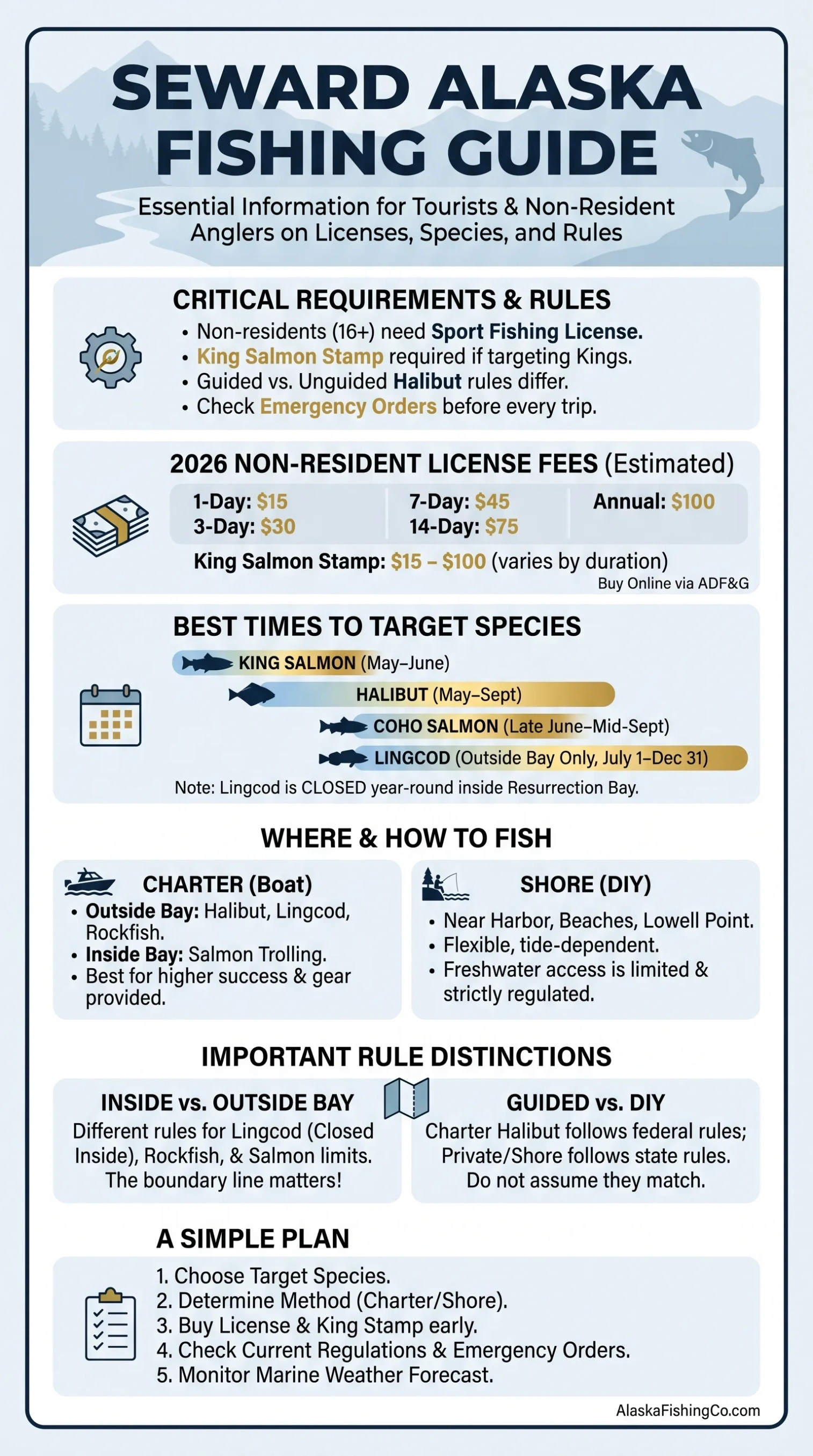
Fishing in Seward, Alaska is mainly a saltwater trip built around Resurrection Bay, nearby North Gulf Coast waters, and seasonal runs of salmon, halibut, rockfish, and lingcod. Most visitors age 16 or older need an Alaska nonresident sport fishing license, and anyone fishing for king salmon usually needs a king salmon stamp as well.
Seward is one of the easier Alaska fishing towns for travelers because the small boat harbor, beach access, charter fleet, and nearby road system are all close together. The part that catches people off guard is not the fishing itself. It is knowing whether they are inside Resurrection Bay, outside the bay, in freshwater, or on a guided halibut charter, because each of those can change what they may keep.
If you remember one thing… buy the right Alaska fishing license before you fish, check the current ADF&G rules for the North Gulf Coast, and treat Resurrection Bay as its own regulation area rather than assuming all Seward waters follow one simple limit.
What To Know First
- Seward sits at the head of Resurrection Bay on Alaska’s Kenai Peninsula.
- Nonresidents age 16 and older need a sport fishing license for fresh and salt water fishing.
- A king salmon stamp is needed when fishing for king salmon, including catch-and-release, unless an exemption applies.
- Charter halibut rules are different from unguided halibut rules because federal regulations apply to guided halibut trips.
- Freshwater salmon access is limited near Seward; many streams are closed to salmon fishing except marked areas and seasons.
- Emergency orders can override printed regulations, so check them before the trip, not after you reach the harbor.
Seward Fishing in Plain Terms
Seward is best understood as a saltwater fishing base with several types of trips: half-day salmon trolling in Resurrection Bay, full-day halibut or combo charters outside the bay, shore fishing near town, and limited freshwater fishing in marked areas.
The town is practical for visitors because the harbor is close to lodging, restaurants, tackle shops, beaches, and charter docks. Many travelers arrive from Anchorage by car, train, or cruise connection, then fish the same day or the next morning. That makes Seward a good choice for people who want an Alaska fishing trip without flying to a remote lodge.
- Inside Resurrection Bay: common for salmon trolling, coho trips, shore casting, and some rockfish opportunities.
- Outside Resurrection Bay: more common for halibut, lingcod, rockfish, and longer combo charters.
- Shoreline near Seward: used for salmon, especially later in the summer when fish move toward town beaches.
- Freshwater near town: more restricted for salmon than many visitors expect.
ADF&G defines Resurrection Bay saltwaters as the waters north of a line between Cape Resurrection and Aialik Cape. That line matters because regulations can change once a boat leaves the bay and enters the broader North Gulf Coast area.[a]
Worth Noting: A trip advertised as “Seward fishing” may not stay inside Seward waters all day. Halibut and lingcod charters often run outside Resurrection Bay, where the ride is longer and the rules can differ.
Fishing License Rules for Seward Visitors
Most visiting anglers need an Alaska nonresident sport fishing license before they fish in Seward. The license must be carried while fishing, either on paper or electronically, and it applies to both fresh water and salt water.
For Seward, the main license question is simple: if the angler is a nonresident age 16 or older, buy a nonresident sport fishing license. International visitors are treated as nonresidents for sport fishing purposes unless they actually qualify as Alaska residents. A charter captain may help explain the rules, but the angler is still responsible for having the correct license and stamp.
| Item | Who Usually Needs It | Typical Visitor Use | 2026 Fee Listed by ADF&G |
|---|---|---|---|
| Nonresident 1-day sport fishing license | Nonresidents age 16 and older | One charter day or one short shore fishing day | $15 |
| Nonresident 3-day sport fishing license | Nonresidents age 16 and older | Weekend or cruise add-on trip | $30 |
| Nonresident 7-day sport fishing license | Nonresidents age 16 and older | One-week Kenai Peninsula visit | $45 |
| Nonresident 14-day sport fishing license | Nonresidents age 16 and older | Longer Alaska road trip | $75 |
| Nonresident annual sport fishing license | Nonresidents age 16 and older | Multiple Alaska trips in one calendar year | $100 |
| Nonresident king salmon stamp | Anglers fishing for king salmon | Needed on top of the license when targeting kings | $15 to $100, depending on duration |
How to Buy the License Online
The cleanest option for most visitors is to buy through the ADF&G online store before leaving for Seward. Licenses and king salmon stamps are also available through ADF&G offices, licensed vendors, and the ADF&G mobile app.
- Choose the correct residency status: nonresident for most tourists and foreign visitors.
- Select the license duration that covers every day you may fish.
- Add a king salmon stamp if you may target, retain, or catch-and-release king salmon.
- Save the electronic copy where it works without cell service, or print a paper copy.
- Carry ID and be ready to show the license, stamp, and harvest record if asked.
Alaska resident rules are different. Residents age 18 and older need a sport fishing license, while resident youth under 18 do not need a license. Nonresident youth under 16 do not need a sport fishing license, but harvest record rules can still matter for species with annual limits.[b]
Best Fish to Target in Seward by Season
The best Seward fishing season depends on the species. Many visitors come for halibut and salmon from May through September, while winter or early spring trips are more weather-dependent and usually focused on local opportunity rather than big-volume harvest.
Run timing changes from year to year, and a late spring or rough marine weather can move the practical fishing window. Still, Seward follows a fairly recognizable pattern: kings arrive first, halibut improves as fish move closer to summer feeding areas, coho build through July and August, and shore fishing near town often improves late in the season.
| Species | Usual Visitor Window | Common Approach | Rule Note |
|---|---|---|---|
| King salmon | Mid-May through June, with local peaks often around mid-June | Trolling in Resurrection Bay or shore fishing near Seward | King salmon stamp usually required |
| Coho salmon | Late June through mid-September; shore fishing often improves late August into September | Trolling, mooching, casting spoons, spinners, or bait where legal | Inside and outside Resurrection Bay may have different coho limits |
| Pink salmon | Early July through early September, often stronger in even-numbered years | Shore casting near stream mouths and beach areas | Count them as part of the salmon bag limit if retained |
| Sockeye salmon | Early summer, timing varies | Mostly shore opportunity near terminal areas | Often more local and timing-sensitive than coho |
| Halibut | May through September | Charter or private boat, often outside the immediate town area | Guided and unguided rules are not the same |
| Rockfish | Year-round where open, often caught on boat trips | Jigging around rocky structure | Deepwater release device rules matter |
| Lingcod | Outside Resurrection Bay from July 1 through December 31 where open | Boat fishing near rocky reefs outside the bay | Closed year-round inside Resurrection Bay |
ADF&G’s Seward-area information notes that most saltwater anglers target coho, king, and pink salmon, plus halibut, lingcod, and rockfish. It also points out that freshwater lakes near the area can hold rainbow trout, Dolly Varden, lake trout, Arctic char, and Arctic grayling.[c]
One Detail People Miss: A “good month” for Seward fishing does not mean every species is strong at the same time. A late June salmon plan, an August coho plan, and a July halibut-combo plan are three different trips.
Where to Fish Around Seward
The easiest place to start is the Seward Small Boat Harbor area, but the best fishing location depends on whether the angler is booking a charter, fishing from shore, or looking for a short freshwater session.
Boat anglers usually have more options because they can troll the bay, cross to the east side, or run outside Resurrection Bay when weather allows. Shore anglers have less reach, but Seward still offers practical access from beaches, breakwater walls, Lowell Point, the lagoon area, and places near stream mouths when fishing is open and legal.
Charter Boat Fishing
Charters are the standard choice for visitors who want halibut, lingcod, rockfish, or a salmon-and-bottomfish combo. Seward has a large charter fleet, and many boats leave early from the harbor. A half-day salmon trip may stay closer to town, while a full-day halibut or combo trip may run far enough that weather, seas, and fuel range shape the day.
- Ask whether the trip stays inside Resurrection Bay or runs outside the bay.
- Ask whether the trip targets salmon, halibut, rockfish, lingcod, or a mix.
- Ask whether the operator sells or helps with licenses, but buy early if unsure.
- Ask how fish cleaning, freezing, and shipping are handled after the trip.
Shore Fishing Near Town
Shore fishing in Seward is real, not just a backup plan. It is most useful when salmon are moving close to town, especially later in the coho season. Shore anglers often try beaches near the harbor, the lagoon outflow, the Lowell Creek area, Lowell Point, Spring Creek, and the Fourth of July Creek side of the bay when access and rules allow.
- Fish around tide movement rather than choosing a random hour.
- Bring spoons, spinners, and legal bait options for saltwater areas.
- Know where salt water ends and freshwater begins.
- Do not assume snagging is legal just because other people are doing it nearby.
Freshwater Near Seward
Freshwater salmon fishing near Seward is narrower than many visitors expect. The open freshwater salmon area is tied to marked sections downstream of the Seward Highway and Nash Road, and the legal gear rules are stricter than in nearby saltwater.
For visitors who mainly want an easy fishing experience, freshwater near Seward is usually a secondary option. It can be worthwhile, especially for youth fisheries or local trout and char opportunities, but it requires closer reading of the regulation map and markers.
Species Rules That Can Change Your Seward Plan
Seward fishing rules are not only about the license. The species you target can change the stamp you need, the hook or bait you may use, the area where you may fish, and whether a charter trip follows state or federal rules.
Before booking, match the trip to the fish. A coho trolling trip inside the bay is not managed the same way as a guided halibut trip, and a beach salmon session is not the same as freshwater fishing near the Resurrection River markers.
King Salmon
King salmon are the first species that can affect a visitor’s license cost. If you fish for king salmon, including catch-and-release, you usually need a current year king salmon stamp unless you are under the age exemption or another listed exemption.
- Inside Resurrection Bay saltwater, the May 1 through August 31 king salmon limit is listed separately from the September 1 through April 30 period.
- Outside Resurrection Bay, king salmon limits can differ from the inside-bay rule.
- Freshwaters are closed year-round to king salmon fishing except listed youth-only opportunities.
Halibut
Halibut is one of Seward’s main charter draws, but guided halibut trips follow federal charter rules that can change by year. Unguided anglers and charter anglers should not assume they share the same bag, size, day-of-week, or permit rules.
NOAA Fisheries explains that Alaska sport halibut regulations are developed through international, federal, state, and council processes, and that guided sport halibut rules for Areas 2C and 3A are set annually. Seward is in the Central Gulf of Alaska side of that larger management picture, so charter clients should confirm the current year’s halibut rule with the operator before booking.[d]
Rockfish
Rockfish rules matter because these fish can suffer pressure injury when brought up from depth. In North Gulf Coast saltwater, anglers must carry a deepwater release device onboard and use it when releasing rockfish that are not kept at depth of capture or 100 feet.
- Ask the captain where the release device is kept.
- Learn the difference between pelagic and nonpelagic rockfish before keeping fish.
- Check yelloweye rockfish restrictions before the trip.
Lingcod
Lingcod are closed year-round inside Resurrection Bay. Outside the bay, the 2026 North Gulf Coast regulations list a July 1 through December 31 season with a daily limit and size rules, but the inside-bay closure is the part visitors most often miss.
That means a boat may be legal to keep lingcod after it runs outside Resurrection Bay, while another angler fishing inside the bay must release a lingcod immediately if one is hooked incidentally.
Before You Move On: The line between “inside Resurrection Bay” and “outside Resurrection Bay” is not a casual landmark. It is a legal boundary used in the North Gulf Coast regulations.
Guided Charter vs DIY Shore Fishing in Seward
A charter is the better choice for visitors who want halibut, a high chance at fish, help with tackle, and access to offshore water. DIY shore fishing is better for flexible travelers who want a lower-cost option and do not mind timing their effort around tides and salmon movement.
Both can be worth doing on the same trip. A common visitor plan is one charter day, then one evening or next-morning shore session near town. The mistake is booking a shore-only trip while expecting the same species mix as a full-day boat charter.
| Option | Best For | What You Usually Need | Main Limitation |
|---|---|---|---|
| Guided salmon charter | Visitors who want help finding salmon and handling gear | License, king stamp if kings are targeted, rain gear, motion-sickness plan | Weather and run timing can change the day |
| Guided halibut or combo charter | Visitors who want halibut, rockfish, or a mixed freezer trip | License, possible stamp if salmon are included, charter-specific halibut rule check | Longer boat ride and stricter annual halibut rules |
| DIY shore fishing | Travelers with limited time, lower budget, or flexible evenings | License, stamp if targeting kings, legal tackle, tide awareness | Fish must be close enough to shore |
| Freshwater walk-in fishing | Anglers who want a shorter session away from the harbor | License, close reading of freshwater closures and hook rules | Salmon water is limited and closely regulated |
- Choose a charter for halibut unless you have a capable boat and local water knowledge.
- Choose shore fishing for a flexible add-on, not as a guaranteed replacement for a boat trip.
- Choose freshwater only after checking the exact drainage, date, and legal gear.
Common Mistakes in Seward Fishing
Most Seward fishing mistakes come from treating Alaska rules as if they are the same everywhere. They are not. A water boundary, species name, or guided-trip rule can change the answer quickly.
Mistake 1: “My charter includes everything, so I do not need to think about a license.”
Wrong assumption: The charter fee automatically covers the legal fishing license and stamp.
Correct explanation: Some operators may help sell or check licenses, but anglers should confirm this before the trip. The safe plan is to buy the correct Alaska sport fishing license and any needed king salmon stamp before fishing.
Why it gets confused: Charter boats often include rods, bait, fish cleaning, and advice, so visitors assume the license is also included.
Mistake 2: “Seward has one salmon limit.”
Wrong assumption: Salmon limits are the same from the harbor, the beach, the bay, and the nearby freshwater.
Correct explanation: Resurrection Bay saltwater, outside-bay saltwater, and freshwater can follow different rules. Coho, king salmon, and other salmon may also be treated differently.
Why it gets confused: The town is compact, so the water looks like one fishing area from a visitor’s point of view.
Mistake 3: “Snagging is legal everywhere in Seward.”
Wrong assumption: If snagging is seen in saltwater, it must also be legal in freshwater.
Correct explanation: Snagging is legal year-round in North Gulf Coast saltwaters, but it is not allowed in freshwater. Freshwater salmon areas near Seward also have single-hook artificial lure or fly rules in marked sections.
Why it gets confused: The saltwater-freshwater boundary can be close to the same stream mouth or beach area.
Mistake 4: “Halibut rules are simple if the state license is valid.”
Wrong assumption: The Alaska sport fishing license tells the whole story for halibut.
Correct explanation: Halibut rules also involve federal management, especially for guided charter anglers. Charter operators should explain the current year’s limits before departure.
Why it gets confused: Halibut is caught from Alaska waters, but the sport fishery is not managed only through the state license system.
Mistake 5: “Rockfish are just a bonus fish.”
Wrong assumption: Rockfish can be kept or released casually like many shallow-water fish.
Correct explanation: Rockfish have specific limits and deepwater release device requirements. Some rockfish types face tighter retention rules than others.
Why it gets confused: Rockfish are often caught while targeting halibut or lingcod, so visitors may not plan for them in advance.
Real-Life Seward Fishing Scenarios
These examples show how the rules and trip choices come together for actual Alaska visitors.
- A cruise passenger books a half-day salmon charter. They need a nonresident license, and if the trip targets king salmon, they should add a king salmon stamp before boarding.
- A family drives from Anchorage for one full-day halibut charter. Each nonresident angler age 16 or older needs a license, and the captain should explain the current guided halibut limits before lines go down.
- Two friends try evening shore fishing after hiking near Lowell Point. A short-duration nonresident license may be enough, but they still need to know whether they are fishing saltwater or freshwater.
- A parent brings a 14-year-old visitor from outside Alaska. The child does not need a nonresident sport fishing license, but adults in the group do, and harvest record rules may still apply for some species.
- A visitor wants to keep a lingcod caught near town. If the fish was caught inside Resurrection Bay, it must be released because the bay is closed year-round to lingcod fishing.
- An angler plans to keep rockfish on a private boat. The boat must carry a deepwater release device, and the angler needs to know the difference between pelagic and nonpelagic rockfish.
- A shore angler sees salmon rolling near a stream mouth. They should check the freshwater boundary and hook rules before casting, because nearby water may not be open to the same method.
Worth Noting: A legal plan at 8 a.m. can become a poor plan by afternoon if wind rises, tides change, or an emergency order affects the target species. Build a little flexibility into Seward fishing days.
A Simple Plan for a First Seward Fishing Trip
A first Seward fishing trip is easiest when the visitor chooses the species first, then buys the license, then checks area rules. Starting with tackle or a random charter date often creates avoidable problems.
- Choose the main fish. Pick salmon, halibut, rockfish, lingcod, or a combo trip.
- Choose the method. Decide between charter, private boat, shore fishing, or limited freshwater access.
- Buy the license early. Match the license duration to every possible fishing day.
- Add the stamp if kings are possible. Do this before fishing, not after a king is hooked.
- Read the North Gulf Coast section. Pay close attention to Resurrection Bay boundaries.
- Check emergency orders. ADF&G says emergency orders can change seasons, limits, areas, or methods and override the printed booklet.[e]
- Check the marine forecast. Resurrection Bay can look calm near town while outer water is not comfortable for every angler.
- Plan fish care. Ask how fillets will be cleaned, boxed, frozen, or shipped if keeping fish.
For boat trips, marine weather matters as much as the calendar. The National Weather Service marine forecast for Resurrection Bay gives current wind, seas, and short-term conditions that can help travelers understand why a captain may adjust the route or cancel a run outside the bay.[f]
Before You Head to the Harbor
Seward rewards visitors who make a simple plan: choose the species, confirm the water area, buy the correct license, and check the current rule updates. The town is visitor-friendly, but the regulations are still Alaska regulations, not casual vacation guidelines.
The most common mistake is assuming a saltwater rule, charter rule, or salmon limit applies everywhere around Seward. The rule to remember is simple: license first, boundary second, species third, emergency orders last before you cast.
Seward Alaska Fishing Questions Answered
Do tourists need a fishing license in Seward, Alaska?
Yes. Most tourists age 16 or older need an Alaska nonresident sport fishing license to fish in Seward, whether they fish from shore, from a private boat, or on a charter.
Can foreign visitors buy an Alaska fishing license online?
Yes. Foreign visitors can buy a nonresident Alaska sport fishing license online through the Alaska Department of Fish and Game store. They should choose the license duration that covers the full period they may fish.
Do I need a king salmon stamp in Seward?
You usually need a king salmon stamp if you fish for king salmon in Seward, including catch-and-release fishing, unless you qualify for an age-based or listed exemption.
Is Seward better for salmon or halibut?
Seward can be good for both, but the trip type differs. Salmon can be targeted inside Resurrection Bay and sometimes from shore, while halibut usually requires a boat trip and often a longer run outside the immediate harbor area.
Can you fish from shore in Seward?
Yes. Shore fishing is possible near the Seward harbor area, beaches, lagoon outflow, Lowell Creek area, Lowell Point, and other local access points when fish are close to shore and the water is open under current regulations.
Is lingcod open inside Resurrection Bay?
No. Lingcod is closed year-round inside Resurrection Bay. Lingcod caught incidentally inside the bay must be released immediately.
Are guided halibut rules the same as unguided halibut rules?
No. Guided halibut trips can have different federal rules from unguided fishing. Charter clients should confirm the current year’s halibut limits, size rules, and any closed days with the operator before the trip.
Alaska Fishing References
- [a] Alaska Department of Fish and Game — Southcentral Alaska Sport Fish Regulations. Used for the official 2026 Southcentral regulation page and North Gulf Coast booklet access, including Resurrection Bay boundaries and species rules. (Reliable because ADF&G is the state agency that publishes Alaska sport fishing regulations.)
- [b] Alaska Department of Fish and Game — 2026 Southcentral Licensing, King Salmon, and Harvest Records PDF. Used for license age rules, possession requirements, license fees, and king salmon stamp fees. (Reliable because it is an official ADF&G regulation booklet section.)
- [c] Alaska Department of Fish and Game — Fishing in the Seward Area. Used for Seward-area access notes, common species, run timing, and local fishing context. (Reliable because it is an official ADF&G Seward-area sport fishing publication.)
- [d] NOAA Fisheries — Sport Halibut Fishing in Alaska. Used for guided and unguided halibut management context and federal charter halibut rule structure. (Reliable because NOAA Fisheries is the federal agency that publishes U.S. federal halibut sport fishing information.)
- [e] Alaska Department of Fish and Game — Emergency Orders and Press Releases, Sport Fishing. Used for the rule that emergency orders can change seasons, areas, limits, and methods. (Reliable because it is ADF&G’s official update page for active regulation changes.)
- [f] National Weather Service — Marine Point Forecast for Resurrection Bay. Used for current marine forecast planning around Seward waters. (Reliable because it is an official NOAA/NWS marine forecast page.)