
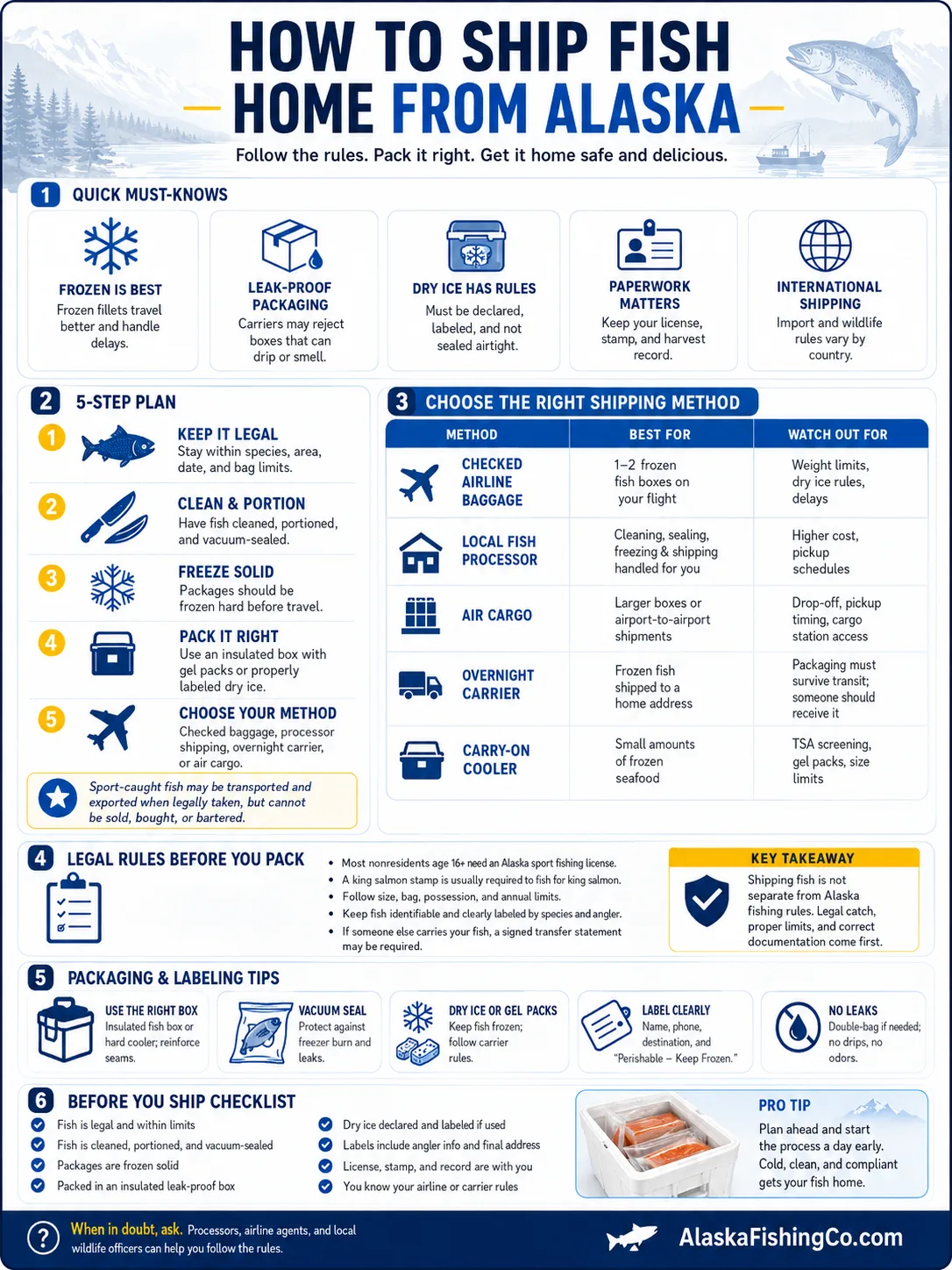
Shipping fish home from Alaska is usually done in one of three ways: checked airline baggage, a local fish processor that ships overnight, or air cargo from an Alaska airport. The safest plan is to clean, vacuum-seal, freeze, label, and pack the fish in a leak-proof insulated box before it leaves town.
For most visitors, the easiest route is to use a processor near the harbor, lodge, charter dock, or airport. They can portion the fish, freeze it hard, pack it for travel, and either hold it for pickup or arrange shipping. If you pack it yourself, the same rule still applies: the fish should be legal, frozen solid, clearly labeled, and packed so it will not leak.
If you remember one thing… do not treat shipping as separate from Alaska fishing rules. The fish must be legally harvested, within your limits, and packed in a way that a carrier can accept.
What To Know First
- Frozen is better than chilled. Frozen fillets travel better and give you more time if a flight or delivery is delayed.
- Leak-proof packaging matters. Airlines and cargo carriers may reject boxes that can drip or smell.
- Dry ice has rules. It cannot be sealed in an airtight box, and it must be declared and labeled when used for air travel.
- Your fishing paperwork still matters. Keep your license, stamp, harvest record, and any transfer note where you can show them if asked.
- International shipping is not simple. Food import rules, customs, and wildlife rules vary by country.
The Best Way To Ship Fish Home from Alaska
The best method depends on how much fish you have, how soon you are flying, and whether you want to handle the box yourself. For a small amount of frozen salmon or halibut, checked baggage is often simple. For larger catches, a processor or cargo shipment is usually cleaner and less stressful.
A practical visitor plan looks like this:
- Keep only fish that are legal for the species, area, and date.
- Have the fish cleaned, portioned, and vacuum-sealed.
- Freeze the packages solid before travel.
- Pack them in an insulated fish box or hard cooler with gel packs or properly labeled dry ice.
- Use checked baggage, overnight shipping, or air cargo depending on weight and timing.
Alaska allows sport-caught fish to be transported and exported when legally taken, but sport-caught fish cannot be sold, bought, or bartered. If someone else carries your unpreserved fish without you present, Alaska rules may require a signed statement with details such as species, number of fish, location, date taken, and license number.[a]
Worth Noting
“Shipping fish home” usually means shipping processed frozen fish, not live fish, loose fillets, or a wet cooler full of ice. The more finished and frozen the fish is, the fewer problems you are likely to have at the counter.
Choose the Right Shipping Method
There is no single best choice for every Alaska trip. A cruise passenger in Ketchikan, a fly-out lodge guest, and a Kenai road-trip angler may all need different plans.
| Method | Best For | Main Advantage | Watch Out For |
|---|---|---|---|
| Checked airline baggage | One or two frozen fish boxes on your flight | Often simple if the box is frozen, sealed, and within baggage limits | Airline weight limits, dry ice rules, and delays |
| Local fish processor | Visitors who want cleaning, vacuum sealing, freezing, and shipping handled | Less work and better packaging | Higher cost during peak season and pickup/shipping schedules |
| Air cargo | Larger boxes or shipments going airport to airport | Useful for heavier loads and planned freight movement | Drop-off, pickup timing, labeling, and cargo station availability |
| Overnight carrier | Frozen fish going to a home address | Door-to-door delivery | Packaging must survive transit and someone should be home to receive it |
| Carry-on cooler | Small amounts of frozen seafood | You keep the fish with you | TSA screening, melted gel packs, and airline carry-on size limits |
Legal Rules Before You Pack the Fish
Before thinking about boxes, ice, or flights, make sure the fish can legally leave with you. Alaska fishing rules are based on species, area, date, residency, size, bag limits, possession limits, and annual limits.
Most visitors are nonresidents. Alaska requires all residents age 18 or older and nonresidents age 16 or older to have a sport fishing license for Alaska sport and personal use fisheries. A king salmon stamp is also required to fish for king salmon, except in stocked lakes and except for certain age and resident exemption categories.[b]
- Nonresident adults: generally need a sport fishing license.
- Nonresident children under 16: do not need a sport fishing license, but harvest record rules can still apply.
- King salmon anglers: usually need a king salmon stamp unless an exemption applies.
- Species with annual limits: may require immediate recording on a harvest record.
- Halibut: sport halibut rules are managed through federal and international measures, and guided trips can have different limits from unguided fishing.[c]
Do You Need To Keep Fish Identifiable?
There is not currently a new blanket statewide evidence-of-species-and-size requirement under the 2026 rule. Alaska Board of Fisheries Proposal 183 would require evidence of species for rockfish, lingcod, and king salmon, plus evidence of length for lingcod and king salmon in fisheries with length restrictions. ADF&G states that this new statewide regulation is not in effect until further notice.[g]
That does not mean fish can always be filleted or de-headed immediately. Separate regional regulations and emergency orders can impose handling restrictions for particular waters, ports, species, or dates. ADF&G used such an emergency order in Southeast Alaska during the 2026 season, so anglers should check the current regional regulations and emergency orders before processing fish on the boat or before returning to port.
A safe habit is to label each bag with:
- species name, such as king salmon, sockeye salmon, coho salmon, rockfish, lingcod, or halibut;
- date caught;
- angler name;
- number of fish or approximate weight;
- location or charter/lodge reference when useful.
One Detail People Miss
Freezing or shipping fish does not erase a fish already counted in a daily bag or an annual harvest limit. Under Alaska’s general state definition, a possession limit applies to unpreserved fish, so fish that has been properly preserved may no longer count toward that general possession limit. Pacific halibut follows separate federal possession rules, and required harvest records still remain in effect.[i]
How To Prepare Fish for Shipping
Fish should be cleaned, portioned, sealed, and frozen before it is packed. The University of Alaska Fairbanks Cooperative Extension recommends freezing fish at 0°F or lower for long-term storage and sending mailed fish by overnight or next-day service.[d]
The best packing process is simple:
- Bleed and chill the fish quickly. Better care on the boat means better fish at home.
- Clean and portion the fish. Fillets should be sized for meals, not packed as one large frozen block.
- Vacuum-seal or tightly wrap. Remove air and prevent freezer burn.
- Freeze solid. Soft or partially frozen fish is harder to protect.
- Double-bag if needed. A second watertight layer helps if a seal fails.
- Fill empty space. Paper, padding, or extra frozen gel packs reduce shifting.
- Use a strong outer box. The package may be turned, stacked, or handled roughly.
Should You Use Gel Packs or Dry Ice?
Use gel packs when the fish is already frozen and the trip is short. Use dry ice when the fish must stay frozen longer, but only if you can follow the carrier’s rules.
The FAA allows dry ice for perishables in limited quantities, but the package must not be airtight, airline approval is required, and checked baggage must be marked with “Dry ice” or “Carbon dioxide, solid” and the net quantity of dry ice.[e]
- Gel packs: easier to use, no hazardous-material label in most travel situations, but they can thaw.
- Dry ice: colder and useful for frozen fish, but it requires venting, labeling, and careful handling.
- Wet ice: usually a poor choice for flights and cargo because it melts, leaks, adds weight, and can be rejected.
Flying Home with Fish as Checked Baggage
Checking fish as baggage is common in Alaska. The fish should be frozen solid, packed in a leak-proof box or cooler, and accepted by your airline before you arrive at the airport.
Alaska Airlines’ seafood-related cargo guidance and Alaska Air Cargo rules point to the same practical issue: the box must prevent leakage, gel ice is recommended, wet ice is not allowed, and dry ice has marking and documentation rules depending on the amount used.[f]
Before your flight, check:
- your airline’s baggage weight limit;
- whether fish boxes count as standard checked bags or special items;
- dry ice limits per passenger or per package;
- whether the container must be hard-sided, waxed, or commercially made;
- connection time, because delays are the enemy of frozen fish.
Can You Bring Fish in a Carry-On?
Small amounts may be possible, but carry-on is usually not the best choice for a large Alaska catch. Security officers may need to inspect the cooler, and any ice packs should be frozen solid at screening. If the gel pack has melted and liquid has collected, it can create problems under liquid rules.
For carry-on travel, keep it simple:
- use a small insulated bag or cooler that fits airline size rules;
- freeze the fish and gel packs hard;
- avoid loose ice or liquid in the container;
- expect extra screening time.
Before You Move On
Airline staff and TSA officers are not checking Alaska fishing limits for you. Their job is transport and screening. The legal responsibility for the fish remains with the angler.
Using a Fish Processor in Alaska
A processor is often the easiest option for visitors who catch more than a few meals of fish. Many Alaska fishing towns have businesses that clean, vacuum-seal, freeze, box, and arrange shipment.
This helps with three problems at once:
- Time: your fish can freeze properly before travel.
- Packaging: processors use fish boxes and liners made for frozen seafood.
- Shipping: they usually know which carriers work best from that town.
Ask these questions before booking your charter or lodge:
- Do you clean and vacuum-seal fish on site?
- Do you freeze fish before departure?
- Can you ship to my home address?
- Can you hold fish until my flight day?
- How are boxes labeled by species and weight?
- What happens if a carrier delays delivery?
How Much Does It Cost?
Costs vary too much by town, weight, carrier, box size, season, and delivery speed to give one reliable price. A checked fish box may only involve airline baggage fees, while processor-packed overnight shipping can cost much more. The right question is not only “How cheap is it?” but “Will the fish still be frozen when it arrives?”
Shipping Fish by Overnight Carrier or Air Cargo
Overnight shipping works best when the fish is frozen hard and packed for more time than the delivery promise. Use an insulated container, a watertight liner, enough coolant to protect the fish through delays, and a strong outer carton. University of Alaska Fairbanks Cooperative Extension recommends overnight or next-day service when mailing frozen fish.[d]
For air cargo, the shipment may travel airport to airport rather than door to door. This can be useful for heavier shipments, but it requires planning. Someone must drop it off correctly, and someone must collect it quickly at the destination.
When shipping by carrier or cargo, prepare:
- shipper name, address, and phone number;
- recipient name, address, and 24-hour phone number;
- species name and quantity or weight;
- frozen, fresh, or live marking where required;
- dry ice label and net dry ice weight if used;
- delivery day when someone can receive the box.
Federal marking rules for interstate fish and wildlife shipments require package markings and shipment documents that identify the shipper, consignee, species, and quantity in certain situations.[h] A processor or cargo counter can help, but the information should be accurate before the box leaves Alaska.
Can International Visitors Ship Fish Home from Alaska?
International visitors can fish in Alaska if they meet Alaska license, stamp, and harvest rules, but shipping fish outside the United States is more complicated than sending it to a U.S. address.
Before planning an international shipment, check:
- your home country’s rules for importing fish or seafood for personal use;
- customs declaration requirements;
- whether frozen vacuum-packed fish is allowed;
- carrier restrictions for dry ice and perishable food;
- whether the shipment needs commercial paperwork even if the fish is for personal use.
For many tourists, the simpler option is to bring a properly packed fish box as checked baggage to a U.S. destination first, then decide whether international travel with frozen fish is practical. Do not assume that “personal use” means your country will allow it without inspection or paperwork.
International Transit Changes the Rules
If you are flying through Canada or another country on the way home, rules can change. A box that is fine on a domestic Alaska-to-Seattle flight may raise different questions on an international itinerary.
Common Mistakes When Shipping Fish from Alaska
Thinking frozen fish does not count anymore
Wrong idea: Once fish is packed or shipped, it no longer matters for limits.
Correct explanation: Freezing or shipping does not erase daily bag counts, annual harvest limits, or required harvest records. Under Alaska’s general state rule, properly preserved fish may no longer count toward the possession limit that applies to unpreserved fish; halibut follows separate federal rules.
Why people mix it up: Visitors often think of fish boxes as luggage, not regulated sport-caught fish.
Using wet ice in a fish box
Wrong idea: Regular ice is the safest way to keep fish cold.
Correct explanation: Wet ice melts, leaks, and can cause rejection by airlines or cargo carriers. Frozen gel packs or properly labeled dry ice are safer choices.
Why people mix it up: Wet ice works in a cooler on the dock, so people assume it works the same way on a plane.
Sealing dry ice in an airtight cooler
Wrong idea: A tighter seal keeps the fish colder.
Correct explanation: Dry ice releases carbon dioxide gas and must be able to vent. Airtight dry ice packaging is unsafe.
Why people mix it up: Most food packaging advice tells people to seal everything tightly, but dry ice is different.
Letting someone else carry fish without a note
Wrong idea: A friend or family member can take any fish box home for you.
Correct explanation: If the fish is unpreserved and the person who caught it is not present, a signed statement may be needed under Alaska rules.
Why people mix it up: Fishing groups often split coolers at the airport without thinking about who actually harvested each fish.
Shipping late in the week
Wrong idea: Any overnight label is enough.
Correct explanation: Perishable shipments should avoid weekends and holidays when a delay can leave fish sitting in a warehouse.
Why people mix it up: Delivery estimates feel exact, but weather, missed connections, and remote Alaska logistics can change the plan.
Real-Life Alaska Shipping Scenarios
- Cruise passenger in Ketchikan: A processor near the dock is usually the cleanest option because cruise luggage timing is tight.
- Kenai River salmon angler: Freeze fillets solid before the flight and keep each angler’s fish labeled separately.
- Homer halibut charter guest: Confirm halibut rules with the charter, then use a processor for large fillets and fish boxes.
- Anchorage day-trip visitor: A small amount of frozen fish may work as checked baggage if packed in a leak-proof insulated box.
- Remote lodge guest: Ask the lodge before arrival how they freeze, store, and move fish to the nearest airport.
- Family group with mixed species: Label salmon, halibut, rockfish, and lingcod separately so the box contents are clear.
- Friend flying home first: Use a signed transfer note if Alaska rules require it, and keep the license and harvest details accurate.
- International visitor: Check home-country import rules before paying for processing or export shipping.
A Simple Packing Checklist
Use this checklist the night before your fish leaves Alaska:
- Fish was legally harvested and recorded if required.
- License, stamp, and harvest record are available.
- Each package is labeled by species and angler.
- Fish is vacuum-sealed or tightly wrapped.
- Fish is frozen solid.
- Box is insulated and leak-proof.
- Wet ice is not used.
- Dry ice, if used, is vented, labeled, and within carrier rules.
- Recipient is available to receive the box.
- Shipment avoids weekends and holidays where possible.
Before the Fish Leaves Alaska
Shipping fish home from Alaska is mostly about preparation: legal catch, solid freezing, leak-proof packaging, and the right carrier. A processor costs more, but it can save time and reduce the chance of a rejected or thawed box.
The most common mistake is waiting until the last travel day to figure out freezing and shipping. A good rule is simple: plan the fish box before you catch the fish.
Shipping Fish Home from Alaska Questions Answered
Can you ship fish home from Alaska?
Yes. Visitors commonly ship fish home from Alaska by using a local fish processor, overnight carrier, air cargo, or checked airline baggage. The fish should be legally harvested, frozen, packed in a leak-proof insulated container, and labeled correctly.
Is it better to ship fish or check it as luggage?
Checked baggage can be easier and cheaper for one or two frozen boxes on your own flight. Shipping through a processor or carrier is better for larger catches, tight flight schedules, or visitors who do not want to handle the box at the airport.
Can I bring frozen fish on a plane from Alaska?
Usually yes, if the fish is packed according to TSA and airline rules. Frozen fish should be in a leak-proof container, and any gel packs should be frozen solid at screening. Dry ice must follow airline and FAA limits.
Can I use dry ice to ship fish from Alaska?
Yes, but dry ice has special rules. It must not be sealed in an airtight container, it must be labeled when required, and the amount allowed depends on whether you are using airline baggage, cargo, USPS, FedEx, UPS, or another carrier.
Do I need a fishing license to bring fish home from Alaska?
If you caught the fish yourself, you needed the proper Alaska fishing license, stamp, and harvest record at the time of fishing. For most visitors, that means a nonresident sport fishing license if age 16 or older, plus a king salmon stamp if fishing for king salmon unless an exemption applies.
Can someone else fly home with my Alaska fish?
Possibly, but do not hand over a fish box casually. If the person carrying the fish is not the person who caught it, Alaska rules may require a signed statement with details about the fish, harvest location, harvest date, and license number.
Can international tourists take Alaska fish home?
They may be able to, but international travel adds customs, food import, wildlife, and airline rules. Before shipping or flying with fish outside the United States, check the destination country’s rules and the carrier’s dry ice and perishable-food policies.
How long will frozen fish stay frozen in a fish box?
It depends on box quality, fish temperature, refrigerant, weight, outside temperature, and delays. A tightly packed frozen fish box often travels well for a same-day flight, but shipped fish should be packed to handle extra time in transit.
Alaska Fishing References
- [a] Alaska Department of Fish and Game — Sport Fish Statewide Regulations (explains possession, transport, export, and sale rules for sport-caught fish; reliable because it is the official Alaska fish and game agency).
- [b] Alaska Department of Fish and Game — Sport Fishing Licenses, King Salmon Stamps, IDs and Harvest Record Cards (covers license ages, king salmon stamp rules, and harvest record cards; reliable because it is the official state licensing source).
- [c] NOAA Fisheries — Sport Halibut Fishing in Alaska (explains federal and international management of Alaska sport halibut; reliable because NOAA Fisheries is the federal authority for Pacific halibut regulations).
- [d] University of Alaska Fairbanks Cooperative Extension Service — Mailing Alaska Fish (gives practical freezing, packing, temperature, and mailing steps; reliable because it is a university extension food-safety resource).
- [e] Federal Aviation Administration — PackSafe Dry Ice (sets air-travel dry ice limits, approval, venting, and marking rules; reliable because it is the U.S. aviation safety regulator).
- [f] Alaska Air Cargo — Shipping Seafood (lists seafood packaging, wet ice, gel ice, dry ice, weight, and marking requirements; reliable because it is a carrier policy page for seafood freight).
- [g] Alaska Department of Fish and Game — 2026 Sport Fishing Regulation Update (states that Proposal 183’s statewide evidence-of-species and evidence-of-length requirements are not in effect until further notice and notes that separate emergency orders may apply; reliable because it is an official ADF&G regulation update).
- [h] eCFR — 50 CFR Part 14, Importation, Exportation, and Transportation of Wildlife (details federal marking requirements for fish and wildlife packages in commerce and transport; reliable because eCFR publishes current federal regulations).
- [i] Alaska Department of Fish and Game — Statewide Definitions for Sport Fishing (defines possession limit as the maximum number of unpreserved fish a person may possess and defines preserved fish for Alaska sport fishing; reliable because it is the official ADF&G statewide definitions page).