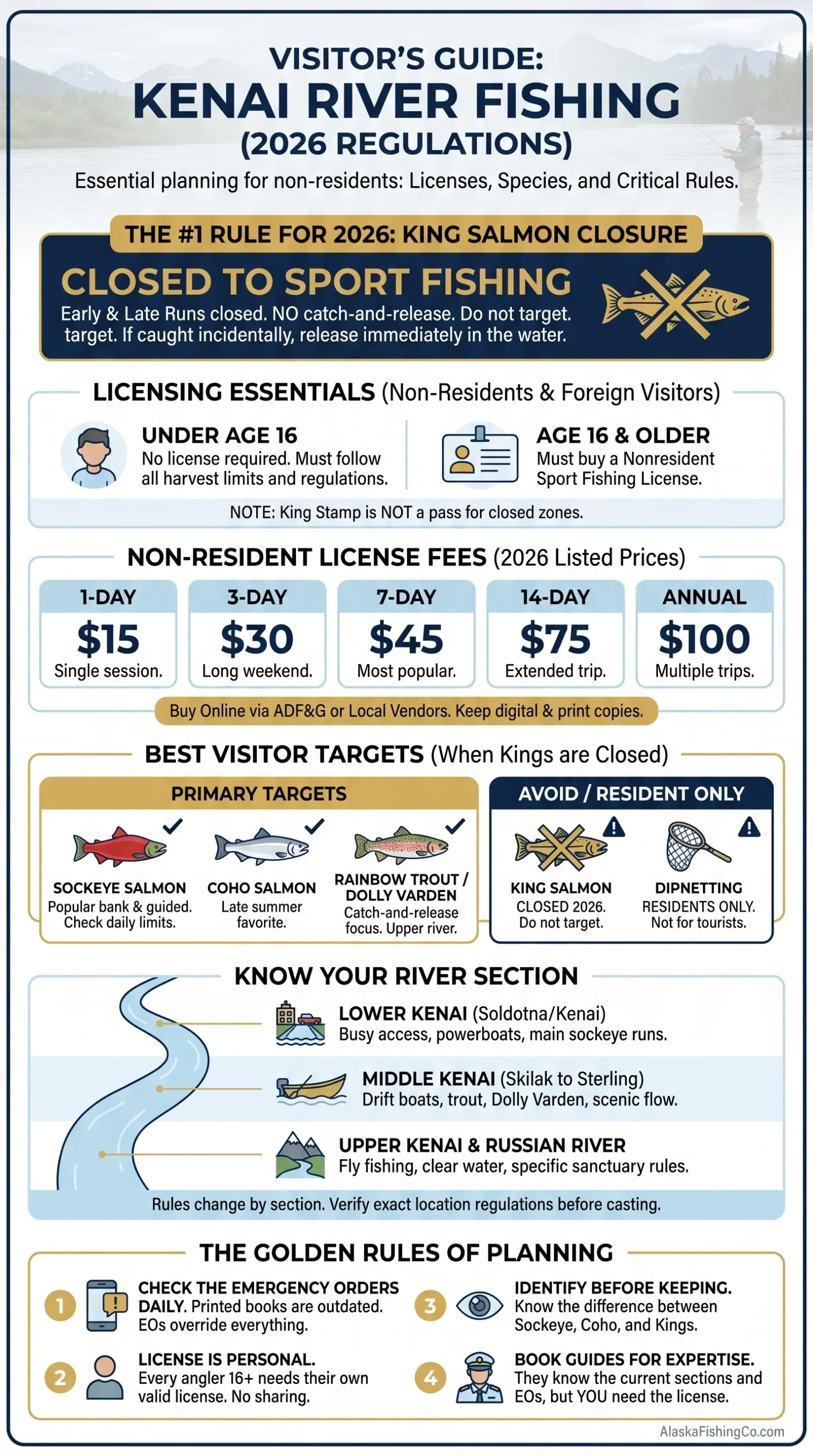
Kenai River fishing is simple to plan once you separate three things: your license, your target species, and the exact stretch of river you will fish. Visitors can fish the Kenai with an Alaska sport fishing license, but the rules change by age, residency, species, date, river section, and emergency order. For 2026 planning, the biggest rule to know is this: Kenai River king salmon sport fishing is closed during the traditional early and late runs, including catch-and-release fishing.[d]
The Kenai is not one uniform fishing spot. The lower river near Soldotna and Kenai, the middle river around Skilak Lake and Cooper Landing, the upper river near Kenai Lake, the Russian River area, and nearby Cook Inlet all follow different rule layers. A visitor who buys the right license but fishes the wrong section, keeps the wrong salmon, or misses an emergency order can still be out of compliance.
If you remember one thing… treat the Kenai River as a section-by-section fishery. Buy the correct nonresident license before fishing, check the current Alaska Department of Fish and Game notices the same day you go, and do not target Kenai River kings when a closure is in place.
What To Know First
- Most visitors need a nonresident sport fishing license. Alaska residents age 18 and older and nonresidents age 16 and older must have a sport fishing license to participate in sport fisheries.[a]
- Foreign visitors are treated as nonresidents. ADF&G lists foreign/alien nonresident sport fishing licenses at the same main sport fishing prices shown for nonresidents.
- A king salmon stamp is separate from the license. It is needed when fishing for king salmon where king fishing is open, but it does not allow fishing for kings during a closure.
- Emergency orders override the printed booklet. The printed regulation summary is only your starting point; current orders control the final rule for the day.
- Personal use dipnetting is not a tourist activity. The Kenai personal use salmon fishery is for Alaska residents who meet permit rules, not ordinary nonresident visitors.[h]
Can Visitors Fish the Kenai River?
Yes. Visitors can fish the Kenai River if they have the correct Alaska sport fishing license and follow the rules for the exact water, species, gear, and date. A guided trip does not remove the license requirement; each person who is actively fishing still needs the right license unless an age exemption applies.
The most common visitor setup is simple: one nonresident sport fishing license for the number of days you plan to fish. A king salmon stamp is added only if you plan to fish for king salmon in waters where king fishing is open. On the Kenai River in 2026, that distinction matters because the river’s king salmon sport fishery is closed by emergency order during both the early and late run periods.
- Bank fishing: common around Soldotna, Kenai, public parks, campgrounds, and selected access points.
- Guided drift or powerboat fishing: useful for learning river sections, boat rules, and timing, but the visitor still needs a license.
- Russian River and upper Kenai trips: popular for sockeye and trout, with separate access patterns and rule details.
- Nearby saltwater trips: Cook Inlet or Gulf-side trips may involve different species and rules from the river itself.
Think of “Kenai River fishing” as a trip area, not a single rule. The name may cover sockeye from shore in July, coho in late summer, rainbow trout in the middle or upper river, or a mixed guided day that changes location based on conditions.
Kenai River Licenses and Visitor Fees
For most travelers, the correct license is a nonresident sport fishing license. In 2026, ADF&G lists nonresident sport fishing license options from 1 day through annual, with the same main sport fishing fee schedule shown for foreign/alien nonresidents.[b]
Pick the license length that matches the days you will actually fish, not the full length of your Alaska vacation. A person who fishes only one afternoon needs a license for that day. A person fishing three separate days over a week may find a 7-day license easier than buying separate daily licenses.
| Item | Who usually needs it | 2026 listed fee | Visitor note |
|---|---|---|---|
| Nonresident 1-day sport fishing license | Visitor fishing one calendar day | $15 | Good for a short bank session or one guided day. |
| Nonresident 3-day sport fishing license | Visitor fishing a long weekend | $30 | Often fits a short Kenai Peninsula stay. |
| Nonresident 7-day sport fishing license | Visitor fishing several days in one week | $45 | Useful if weather may shift your fishing days. |
| Nonresident 14-day sport fishing license | Visitor on a longer Alaska trip | $75 | Works for a Kenai plus Seward, Homer, or Mat-Su route. |
| Nonresident annual sport fishing license | Visitor making repeated Alaska trips in the year | $100 | Check the year printed on the license before buying. |
| Nonresident king salmon stamp | Angler fishing for king salmon where open | $15 to $100 by duration | Not a pass around a Kenai River king closure. |
Worth Noting
A license is personal. It cannot be loaned to a spouse, friend, child, or travel partner. If two adults are casting, netting fish, or taking turns with the rod, both should be properly licensed unless an age rule says otherwise.
Age Rules for Visitors and Families
Nonresident anglers age 16 and older need an Alaska sport fishing license. Nonresident children under 16 do not need a sport fishing license, but they still must follow seasons, bag limits, gear rules, and closed-water rules.
This is where families sometimes make a mistake. A child may be exempt from buying the license, but the fish they catch still count under the applicable fishing rules. If a child fishes for a species with an annual harvest limit, the free harvest record card rule may apply. Parents should check this before the trip, especially for waters where king salmon, large trout, or other annual-limit species are involved.
- Nonresident age 16 or older: buy and carry a valid sport fishing license.
- Nonresident under 16: no sport fishing license required, but regulations still apply.
- Resident age rules are different: Alaska resident anglers generally follow the resident age threshold, not the nonresident one.
- Harvest records can still matter: some annual-limit species require recording, even when the angler is exempt from buying a license.
For mixed groups, do not assume everyone follows the same rule. A family might include an Alaska resident host, an out-of-state adult, a foreign visitor, and a 15-year-old. Each person’s license need depends on their own status.
King Salmon on the Kenai River in 2026
Visitors should not plan a 2026 Kenai River trip around king salmon. ADF&G issued orders closing the early-run and late-run Kenai River king salmon sport fisheries. That means no targeting, no catch-and-release, no keeping kings, and no removing an incidentally caught king from the water during the closure periods.
The early-run closure applies from May 1 through June 19, 2026, from the mouth of the Kenai River upstream to ADF&G markers at the outlet of Skilak Lake. It also prohibits bait and multiple hooks in that reach during the order period.[e] The late-run closure applies downstream of the outlet of Skilak Lake from June 20 through August 15, 2026, with only one unbaited, single-hook artificial lure allowed while fishing for other species.[f]
- Do not target kings. “Just trying for one” is not allowed when the fishery is closed.
- Do not lift an incidental king from the water. Release it immediately while keeping it in the water.
- Do not rely on old photos or past trip reports. Kenai king rules have changed in recent seasons.
- Ask your guide what the current order says that morning. A responsible guide should already be tracking it.
One Detail People Miss
A king salmon stamp does not make closed king fishing legal. The stamp is a requirement for fishing kings where fishing is open; it is not permission to fish through a Kenai River closure.
Best Kenai River Species for Visitors
For many visitors, the practical Kenai targets are sockeye salmon, coho salmon, pink salmon in even-numbered years, rainbow trout, and Dolly Varden. The best option depends on the month, river section, water level, emergency orders, and whether you want bank access or a guided boat day.
Sockeye draw many first-time visitors because they can be reached from shore in the right places and the run timing can be easier to plan around than some other species. Coho often become the late-summer target. Rainbow trout and Dolly Varden can offer a strong option when salmon rules are tighter or when the goal is a catch-and-release day rather than taking fish home.
| Species | Usual visitor interest | General timing | Rule reminder |
|---|---|---|---|
| Sockeye salmon | Popular shore and guided target | Often June through July, with late-run attention in July | Daily and possession limits can change by order. |
| Coho salmon | Late-summer salmon target | Often August into fall, depending on section | Check date, section, and current bag limit before keeping fish. |
| Pink salmon | Family-friendly action in even years | Typically late summer in even-numbered years | Often mixed with other salmon rules; identify before keeping. |
| Rainbow trout | Middle and upper river favorite | Often stronger after salmon activity begins | Size, retention, and catch-and-release rules vary by area. |
| Dolly Varden | Good add-on with trout fishing | Often summer into fall | Check retention rules and river section before keeping. |
The Kenai late-run sockeye count is tracked by ADF&G using sonar at river mile 19, and the public fish count tool can help visitors understand whether fish are moving in real time.[g] Counts do not promise a good fishing day, but they can help a traveler decide whether to stay near Soldotna, move toward the Russian River area, or ask a guide about another plan.
Lower, Middle, and Upper Kenai: Why the Section Matters
The Kenai River is commonly discussed in sections because rules, access, methods, and fish timing are not the same from Cook Inlet to Kenai Lake. Visitors should know the section name before fishing, not just the town they are staying in.
The lower Kenai is the area most visitors picture around Kenai and Soldotna. It is easier to combine with lodging, parks, stores, and public bank access. The middle and upper Kenai feel more river-focused and are often tied to trout, Dolly Varden, sockeye movement, drift trips, and the Russian River area. The official Southcentral regulation page links the current Kenai River regulation PDF and related definitions, which is the place to check section language before choosing a spot.[c]
- Lower Kenai: more road access, more bank crowds in peak sockeye weeks, and many visitor services nearby.
- Middle Kenai: often tied to drift boat trips, trout, Dolly Varden, and salmon movement between Skilak Lake and upstream areas.
- Upper Kenai: clearer water in many conditions, popular scenic fishing, and close connection to Cooper Landing access.
- Russian River area: famous but rule-heavy; check sanctuary, ferry, and section rules before casting.
Before You Move On
Do not ask only “Is the Kenai open?” Ask “Which part of the Kenai, for which species, with which gear, on which date?” That question prevents most visitor mistakes.
How To Buy an Alaska Fishing License Online
Visitors can buy Alaska sport fishing licenses through the ADF&G online store, at many local vendors, and at Fish and Game offices. Online purchase is usually easiest for travelers because the license can be handled before the fishing day.
Before buying, decide how many days you will fish and whether your trip includes any waters where king salmon fishing is open. For a Kenai-only 2026 plan focused on sockeye, coho, trout, or Dolly Varden, a king stamp may not be needed. For a mixed trip that includes another open king salmon fishery outside the Kenai closure, check the rules for that water before deciding.
- Choose the license year and your residency status.
- Select the nonresident sport fishing license length that matches your fishing days.
- Add a king salmon stamp only if you will fish for kings in open waters.
- Enter your legal name and birth date carefully.
- Save the electronic copy and carry a printed copy if you prefer a backup.
- Sign where required and keep the license available while fishing.
Cell coverage can be uneven on parts of the Kenai Peninsula. A screenshot alone may not be enough if details are unreadable, so keep a reliable digital or paper version ready before leaving town.
Common Mistakes Visitors Make on the Kenai River
Most Kenai River problems come from assuming the rule is simple because the river is famous. The fishery is visitor-friendly, but it is not rule-light. ADF&G emergency orders, river sections, gear restrictions, and harvest records all matter.
Thinking a guide covers the license
Wrong idea: “The guide has a permit, so the guests are covered.”
Correct rule: Each angler who needs a sport fishing license must have their own license.
Why it gets mixed up: Guides handle the boat, tackle, and local planning, so visitors sometimes assume paperwork is included too.
Buying a king stamp during a king closure
Wrong idea: “A king stamp lets me fish for kings anywhere.”
Correct rule: A stamp is required where king fishing is open; it does not override a closure.
Why it gets mixed up: The stamp sounds like permission, but it is only one part of the legal requirement.
Confusing sport fishing with dipnetting
Wrong idea: “The big dipnet fishery at the river mouth is open to tourists too.”
Correct rule: Kenai personal use salmon dipnetting is an Alaska resident fishery with permit requirements.
Why it gets mixed up: Visitors see the crowds in July and assume it is another form of sport fishing.
Keeping a salmon before identifying it
Wrong idea: “It is a salmon, and salmon are open.”
Correct rule: King, sockeye, coho, chum, and pink salmon can have different dates, limits, and restrictions.
Why it gets mixed up: Fresh salmon can look similar to new anglers, especially in fast water or low light.
Relying on last year’s trip report
Wrong idea: “This was legal when my friend went.”
Correct rule: Use the current regulation booklet plus current emergency orders for the day you fish.
Why it gets mixed up: Kenai River fishing advice travels fast online, but rule changes travel unevenly.
Worth Noting
Kenai River rules are enforced on the water and at access points. Keep your license, harvest record, and fish easy to check rather than packed deep in the vehicle.
Real-Life Kenai River Scenarios for Visitors
These examples show how the same river can require different planning depending on the traveler, target, and date. Use them as planning patterns, then verify the current ADF&G rules before fishing.
- A couple from Oregon books one day with a Soldotna guide.
Each adult needs a nonresident sport fishing license for that day, and the guide should confirm the species and gear rules before launching. - A family from Germany wants to fish from shore for sockeye.
Adults and teens age 16 or older need nonresident licenses; younger children may be license-exempt but still follow bag and possession limits. - A visitor asks for a Kenai king salmon trip in 2026.
The practical answer is to choose another legal target or another open water because Kenai River king salmon sport fishing is closed during the early and late run closure periods. - A traveler stays in Cooper Landing and wants trout photos.
A nonresident sport fishing license is needed for adults, and trout handling rules should be checked before any fish is removed from the water. - A group sees dipnetters near the river mouth in July.
That is a personal use fishery for Alaska residents who meet permit rules, not a nonresident visitor option. - A road-trip angler plans Kenai, Homer, and Seward in one week.
A 7-day nonresident license may fit better than daily licenses, but saltwater and river rules still need separate checks. - A visitor catches a king while fishing for sockeye during a closure.
The fish must stay in the water and be released immediately; keeping it, posing with it, or lifting it for photos can violate the order.
Bank Fishing, Guided Trips, and Access Planning
Bank fishing can work well on the Kenai, especially for visitors who want a flexible day without hiring a boat. Guided trips can be the better choice when you are new to the river, short on time, or trying to fish sections where boat handling and local rule knowledge matter.
Public access is popular for a reason, but it also means crowding, parking limits, bank protection rules, and fast-changing conditions. In peak sockeye weeks, arrive early, use marked access, stay off closed riverbanks, and avoid stepping into private property. Many productive-looking banks are not open for public fishing.
- Choose bank fishing when: you want lower cost, flexible timing, and simple gear.
- Choose a guide when: you need local help with timing, boat position, section choice, and fish handling.
- Ask before booking: what species are legal and realistic for your dates?
- Confirm what is included: rods, waders, fish cleaning, transport, and license assistance vary by operator.
One Detail People Miss
The best legal spot is not always the most crowded spot. On the Kenai, safe access, open water, and current regulations matter more than where everyone appears to be standing.
What To Pack for a Kenai River Fishing Day
Pack for cold water, changing weather, and a long day away from easy supplies. The Kenai is accessible by Alaska standards, but it is still a cold, fast river where small comfort and safety choices matter.
Visitors often focus on rods and forget paperwork, layers, and fish transport. If you plan to keep salmon, know how fish will be bled, cooled, stored, and transported before you catch them. Warm weather in town does not mean fish can sit unrefrigerated in a vehicle.
- Valid sport fishing license and any required stamp or harvest record.
- Polarized sunglasses for reading water and protecting eyes.
- Rain shell, warm layer, and dry socks.
- Waders or waterproof boots if bank fishing where allowed.
- Measuring tool if fishing species with size rules.
- Cooler or fish box if keeping salmon.
- Bear-aware food storage habits, especially away from town access.
- A local rule check saved on your phone before leaving cell coverage.
How Emergency Orders Change a Kenai Trip
Emergency orders are not rare side notes on the Kenai. They are part of normal Alaska fisheries management and can close a species, change a limit, restrict bait, limit hooks, or change where anglers may fish. Visitors should check them before buying travel add-ons and again before fishing.
The ADF&G Southcentral emergency order page lists current orders by area, date, expiration, and action type. In 2026, the list includes Kenai River early-run and late-run king salmon closures, along with other Cook Inlet and Kenai Peninsula actions.
- Before booking: check whether your target species is open for your dates.
- Before buying a stamp: confirm that the species is open in the water you will fish.
- The night before: review new orders and advisory announcements.
- The morning of: ask the guide, vendor, or local ADF&G office if anything changed.
This is not just about avoiding a ticket. It also saves a trip. A visitor who knows the king closure early can switch plans toward sockeye, coho, trout, or another legal fishery instead of arriving with the wrong expectations.
A Simple Planning Path for First-Time Visitors
A good Kenai River plan starts with the fish, not the hotel. Choose the species first, match it to the likely month and river section, then buy the license that fits the fishing days.
- Pick the target: sockeye, coho, trout, Dolly Varden, pink salmon in even years, or another nearby fishery.
- Match the month: June, July, August, and September can feel like different trips.
- Choose the section: lower, middle, upper, Russian River area, or nearby saltwater.
- Check the regulation PDF: confirm season, bag limit, possession limit, and gear rule.
- Check emergency orders: do this close to the fishing date.
- Buy the license: choose 1-day, 3-day, 7-day, 14-day, or annual.
- Confirm fish handling: know whether you are releasing, eating locally, freezing, or shipping fish home.
For many tourists, the smoothest plan is a flexible one: reserve a legal target, leave room for weather and water changes, and avoid building the whole trip around one species that may be restricted.
Kenai River Fishing Questions Answered
Do tourists need a fishing license on the Kenai River?
Yes, most tourists age 16 and older need a nonresident Alaska sport fishing license to fish the Kenai River. Children under 16 who are nonresidents do not need a sport fishing license, but they still must follow all fishing regulations.
Can foreign visitors buy an Alaska fishing license online?
Yes. Foreign visitors can buy nonresident Alaska sport fishing licenses online through the Alaska Department of Fish and Game store. ADF&G lists foreign/alien nonresident sport fishing license fees alongside the nonresident fee schedule.
Can visitors fish for king salmon on the Kenai River in 2026?
Visitors should not plan to fish for Kenai River king salmon in 2026 during the early-run and late-run closure periods. ADF&G orders close those sport fisheries, including catch-and-release fishing, and kings caught incidentally must be released immediately without being removed from the water.
What is the best Kenai River fish for first-time visitors?
Sockeye salmon are often the most practical first-time salmon target when timing and access line up. Coho salmon, rainbow trout, and Dolly Varden can also be strong choices depending on the month and river section.
Does a Kenai River guide provide the fishing license?
A guide may help explain what to buy, but each angler who needs a license is responsible for having a valid sport fishing license. Ask the guide before the trip if licenses, stamps, or harvest record help is offered.
Can nonresidents dipnet salmon on the Kenai River?
No. Kenai River personal use dipnetting is for Alaska residents who meet the sport fishing license and permit rules. Nonresident visitors should plan on sport fishing, not personal use dipnetting.
How often should visitors check Kenai River regulations?
Check the printed regulation summary when planning, then check current emergency orders close to the fishing date and again before fishing. Emergency orders can change what is open, what can be kept, and what gear may be used.
Before You Fish the Kenai
Kenai River fishing rewards visitors who plan with the current rules instead of old assumptions. The safest plan is to choose a legal target, confirm the river section, buy the right license, and check emergency orders close to the fishing day.
The most common mistake is treating the Kenai like one river with one rule. The rule to remember is simple: license first, species second, section third, emergency orders every time.
Alaska Fishing References
- [a] Alaska Department of Fish and Game — Sport Fishing Licenses and King Salmon Stamps. This source explains who needs a sport fishing license, age thresholds, king salmon stamp basics, and harvest record card notes. (Official Alaska state fish and game agency.)
- [b] Alaska Department of Fish and Game — Sport Fishing License and King Salmon Stamp Prices. This source provides the 2026 listed resident, nonresident, and foreign/alien nonresident license and stamp fees. (Official Alaska state fee schedule.)
- [c] Alaska Department of Fish and Game — Southcentral Alaska Sport Fishing Regulations. This source links the current Southcentral regional booklet, Kenai River regulation PDF, licensing pages, definitions, and species identification pages. (Official regional regulation source.)
- [d] Alaska Department of Fish and Game — Southcentral Emergency Orders and Press Releases. This source lists active emergency orders by area, date, expiration, and action type. (Official emergency order index.)
- [e] Alaska Department of Fish and Game — Emergency Order 2-KS-1-8-26, Kenai River Early-Run King Salmon Sport Fishery Closure. This source gives the 2026 early-run closure dates, affected waters, bait and hook limits, and release rule. (Official emergency order PDF.)
- [f] Alaska Department of Fish and Game — Kenai River Late-Run King Salmon Sport Fishery Is Closed. This source explains the 2026 late-run closure downstream of Skilak Lake, release rule, artificial lure limit, and preseason forecast context. (Official ADF&G advisory announcement.)
- [g] Alaska Department of Fish and Game — Kenai River Late-Run Sockeye Fish Count Data. This source shows the public sonar count tool for late-run sockeye at river mile 19. (Official ADF&G fish count database.)
- [h] Alaska Department of Fish and Game — Kenai River Salmon Personal Use Fishery Permits and Regulations. This source explains Alaska resident eligibility and permit rules for the Kenai personal use salmon fishery. (Official Alaska personal use fishery source.)