
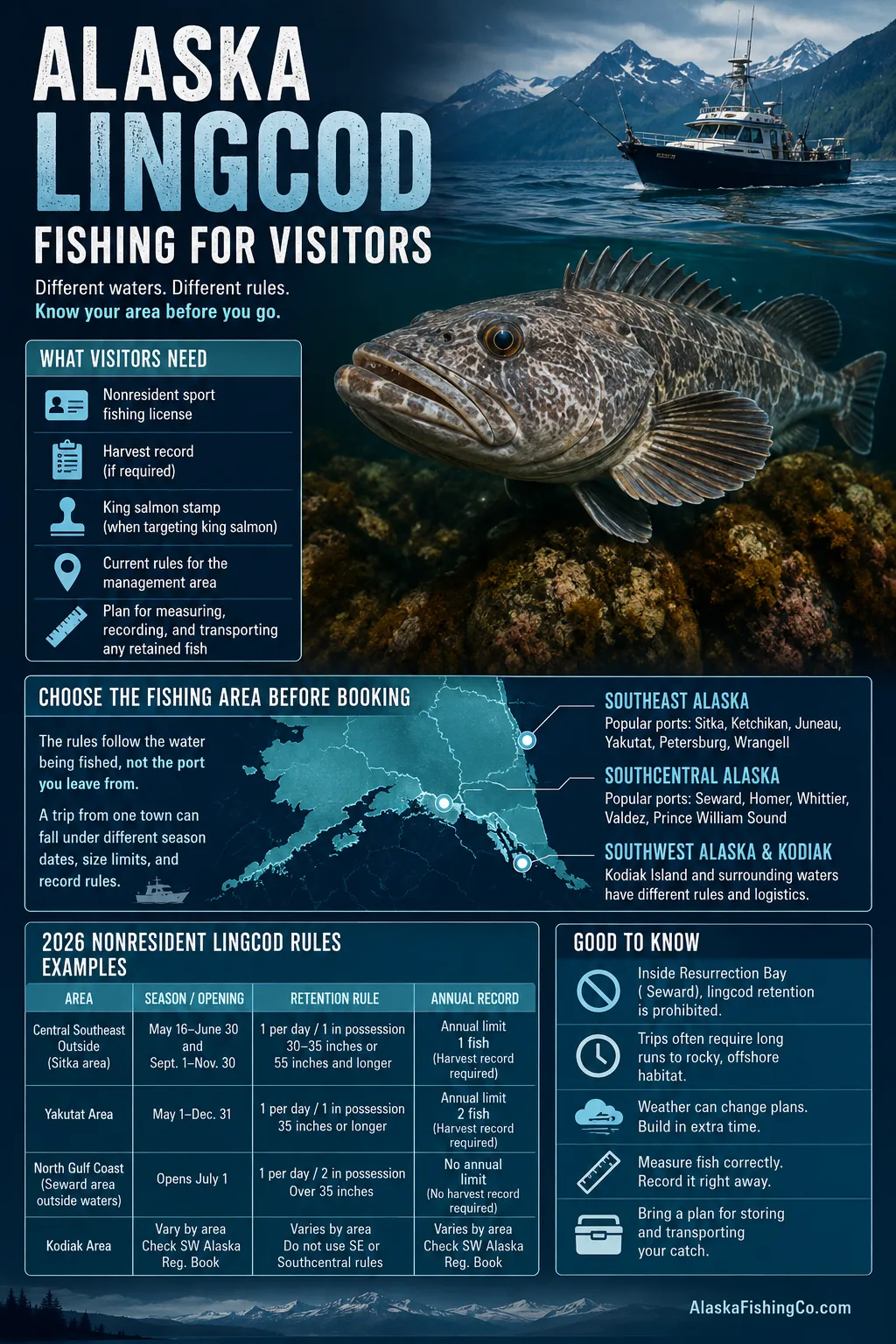
Alaska visitors can fish for lingcod, but the legal season and the fish they may keep depend on the exact water where the boat fishes. A trip leaving Sitka can have different nonresident dates and size limits from one leaving Yakutat, Seward, or Kodiak. Choose the fishing area before choosing travel dates, carry the correct license and harvest record, and check for emergency orders shortly before departure.
For most first-time visitors, a licensed saltwater charter is the practical option. Lingcod are commonly caught around offshore rock, reefs, pinnacles, and steep bottom contours. Reaching those places may require a long run in exposed water, heavy tackle, local navigation knowledge, and careful handling of rockfish caught along the way.
What visitors need before fishing:
- A valid Alaska nonresident sport fishing license if aged 16 or older.
- A harvest record when fishing under a lingcod annual limit that requires one.
- A king salmon stamp only when fishing for king salmon as part of the trip.
- The current rules for the management area where the boat will actually fish.
- A plan for measuring, recording, processing, and transporting any retained fish.
Choose the Fishing Area Before Booking the Trip
The departure port is only the starting point. The enforceable lingcod rule follows the water being fished, which may be outside the immediate port area or in a separate management area.
A charter advertised as a “Sitka lingcod trip,” for example, may operate in Central Southeast Outside waters. A boat leaving Seward may travel outside Resurrection Bay because lingcod retention inside the bay is prohibited. Visitors should ask the operator to name the management area rather than accepting a general answer such as “offshore” or “outside the harbor.”
Southeast Alaska
Southeast Alaska includes popular departure points such as Sitka, Ketchikan, Craig, Klawock, Juneau, Yakutat, Petersburg, and Wrangell. These ports do not share one nonresident lingcod season.
Several Southeast areas use a protected-size system for nonresidents. A fish may need to fall within a smaller legal range or exceed a much larger trophy-size threshold. Other areas, including Yakutat in 2026, use a different annual-limit structure.
- Sitka: Access to productive outside waters, but the nonresident retention season contains a summer closure in 2026.
- Yakutat: A longer published nonresident season in 2026, with a different annual-size requirement.
- Prince of Wales Island: Rules can change by side of the island, latitude, and Southeast management area.
- Ketchikan: Charter routes may extend into waters governed by rules that differ from Sitka or Yakutat.
Southcentral Alaska
Southcentral trips commonly leave Seward, Homer, Whittier, Valdez, or ports around Prince William Sound. Lingcod fishing generally requires reaching rocky marine habitat outside protected inner waters.
Seward is a good example of why the fishing boundary matters. Lingcod retention is prohibited inside Resurrection Bay. In the outside waters covered by the North Gulf Coast report, the 2026 season opened July 1, the limit was one per day and two in possession, and the whole fish had to exceed 35 inches.[e]
- Ask whether the trip remains inside a bay or runs into exposed Gulf waters.
- Confirm the expected one-way travel time to lingcod habitat.
- Leave room in the schedule for weather delays or route changes.
Southwest Alaska and Kodiak
Kodiak offers access to rocky coastal habitat, but visitors must use the Southwest Alaska regulation booklet and the rules for the specific Kodiak management area. Southeast size slots should never be applied automatically to Kodiak, and a Southcentral opening date should not be assumed to cover Southwest waters.
A Kodiak trip may also involve longer road transfers, remote lodges, floatplane connections, or full-day boat runs. These logistics often influence the trip more than the fishing technique itself.
How 2026 Nonresident Lingcod Rules Differ by Area
There is no single statewide nonresident lingcod limit that can be used for every Alaska trip. Season dates, possession limits, annual limits, legal lengths, and harvest-record duties can change by management area.
| Area | Nonresident season or opening | Retention rule | Annual record |
|---|---|---|---|
| Central Southeast Outside, including the Sitka area | May 16–June 30 and September 1–November 30 | One per day and one in possession; 30–35 inches or 55 inches and longer | Two annually: one 30–35-inch fish and one fish measuring 55 inches or longer |
| Yakutat area | May 16–November 30 | One per day and one in possession | Two annually, one of which must measure at least 55 inches |
| North Gulf Coast outside Resurrection Bay | Opened July 1 in 2026 | One per day and two in possession; whole fish must exceed 35 inches | Check the current Southcentral booklet and emergency orders |
| Inside Resurrection Bay | Lingcod fishing and retention prohibited | No lingcod may be retained | Not applicable |
The Sitka-area order also requires nonresidents to record the date and body of water immediately after retaining a lingcod. Its annual limit is two fish, but the two legal size categories cannot be replaced with two fish from the same category.[c]
Yakutat uses a different 2026 structure. A nonresident may retain one lingcod per day and possess one, with an annual limit of two fish. One of those two annual fish must measure 55 inches or longer. The date and body of water must also be recorded immediately.[d]
Management-area limits are not additive. Catching a lingcod in one Southeast area does not create a new daily or annual allowance when the boat crosses into another area. A visitor cannot take one area’s limit and then move to a second area to start again.
Why the Size Gap Matters in Southeast Alaska
A fish outside a protected-size rule must be released even when it looks large enough to keep under rules used elsewhere. In the Sitka example, a 40-inch lingcod is not legal for a nonresident because it is larger than 35 inches but smaller than 55 inches.
This creates three practical categories:
- Below the smaller legal range: Release the fish.
- Inside the smaller legal range: The fish may qualify for the smaller annual category.
- Above the smaller range but below 55 inches: Release the fish in an area using the 30–35 or 55-plus rule.
- At least 55 inches: The fish may qualify for the larger annual category.
The operator should measure the fish before using a gaff or making an irreversible retention decision. A fish resting beside the boat can look several inches longer than it measures on a straight board.
Fishing Licenses for Tourists and Foreign Visitors
Every nonresident aged 16 or older needs an Alaska sport fishing license to take part in sport fishing. This applies to visitors from other U.S. states and visitors arriving from another country.
Participation is broader than personally catching the fish. Anyone actively fishing should carry a license rather than relying on another member of the group. Nonresidents younger than 16 do not need the paid sport fishing license, but they need a free harvest record when taking part in a fishery with a required annual record.[a]
Nonresident License Prices
Alaska sells short-duration licenses that fit most visitor itineraries. Foreign visitors pay the same listed sport fishing prices as other nonresidents.
| License duration | Price | Typical use |
|---|---|---|
| 1 day | $15 | One charter or one port day |
| 3 days | $30 | A short fishing break or weather flexibility |
| 7 days | $45 | A week with several fishing days |
| 14 days | $75 | A longer Alaska itinerary |
| Annual | $100 | Trips longer than 14 days or multiple Alaska visits |
The price difference can make a longer license the better choice even when only a few days are expected. A seven-day license, for example, costs less than buying two separate three-day licenses. The official pricing list also shows the same 1-, 3-, 7-, 14-day, and annual fees for nonresident alien anglers.[b]
Is a King Salmon Stamp Needed?
A king salmon stamp is not needed for a lingcod-only trip. It is required when an angler fishes for king salmon, including catch-and-release fishing for kings in waters where the stamp requirement applies.
This matters on combination charters. A trip may be sold as a halibut, salmon, rockfish, and lingcod day. Ask whether the captain expects the group to target king salmon. Do not assume the absence of a retained king means no stamp was needed; the requirement is connected to fishing for the species, not only keeping one.
How to Buy the License Online
The license can be purchased through the official ADF&G online store before arriving in Alaska. It is also sold through many licensed vendors and ADF&G offices.
- Open the official Alaska Department of Fish and Game license store.
- Sign in or continue with the guest-purchase option.
- Select a nonresident sport fishing license.
- Choose a duration that covers every date on which fishing may occur.
- Add a king salmon stamp only when the planned trip includes fishing for kings.
- Check the angler’s name, date of birth, and license dates before paying.
- Keep an accessible electronic or printed copy while fishing.
Do not buy a one-day license for the scheduled date when the charter may be moved to another day because of weather. A three- or seven-day license may be a better fit when the itinerary has a spare day.
Harvest Records and Immediate Recording
A license and a harvest record serve different purposes. The license gives the visitor authority to fish, while the harvest record documents fish taken from fisheries with annual limits.
In Southeast areas where a nonresident lingcod annual limit applies, the angler must record the retained fish immediately. Waiting until the boat reaches the dock is not the safe approach.
The entry normally needs:
- The date of harvest.
- The location or body of water fished.
- The species being recorded.
- The applicable annual-limit entry on the license or nontransferable harvest record.
A charter captain may keep an operator log, but that does not replace the visitor’s personal recording duty. Each licensed angler should know where the harvest-record section appears before the first fish is brought beside the boat.
What “Immediately” Means on a Charter
The decision to retain the fish should be followed by the record entry while the details are fresh and before fishing resumes. The sequence should be simple:
- Land or control the fish without damaging it unnecessarily.
- Measure it using the rule for the area.
- Confirm that the angler has room under the daily and annual limits.
- Decide whether the fish will be retained.
- Enter the date and fishing location on the harvest record.
Visitors should carry a pen that works in wet conditions. A small waterproof pouch for the license and harvest record is useful even when an electronic copy of the license is carried on a phone.
Charter Fishing or a Self-Guided Boat
A charter is usually the better fit for a first Alaska lingcod trip. The fishing commonly takes place around offshore structure where depth, current, weather, navigation, fish identification, and changing boundaries all matter.
When a Charter Makes Sense
- This is the visitor’s first saltwater trip in Alaska.
- The group is not bringing heavy bottom-fishing tackle.
- There is only one fishing day in the itinerary.
- The trip needs fish cleaning, freezing, or shipping assistance.
- The visitors are arriving on a cruise ship and must return by a fixed time.
- No one in the group has experience operating a boat in cold, exposed marine water.
A captain can choose the fishing area, position the boat over rock, adjust jig weight, interpret the fish finder, and explain the day’s retention rule. The angler still remains responsible for having a valid license and following personal annual-record requirements.
When Self-Guided Fishing Is Realistic
A self-guided trip is better suited to visitors with local route information and real experience handling a marine boat in current, swell, fog, and rapidly changing weather.
The group must be able to manage:
- Marine navigation and fuel planning.
- Current weather and sea-state decisions.
- Management-area boundaries.
- Legal measuring equipment.
- Rockfish identification and deepwater release.
- Fish storage and processing after returning to port.
- Emergency communication and cold-water safety equipment.
Renting a boat does not transfer regulatory responsibility to the rental company. The operator and anglers must still determine where retention is open and which rule applies.
Questions to Ask a Lingcod Charter
- Which lingcod management area will the boat fish?
- Is nonresident retention open on the booked date?
- Which size rule applies to clients?
- How long is the normal run from the dock to lingcod habitat?
- Are rods, reels, jigs, rain gear, and boots included?
- Is the trip dedicated to lingcod or shared with salmon and halibut fishing?
- How much actual jigging time is expected on a combination trip?
- What happens when offshore weather prevents reaching the planned area?
- Where will the fish be cleaned, vacuum-packed, and frozen?
- Can the operator arrange storage when the visitor flies home on another day?
Choose Dates by Legal Access and Sea Conditions
The best month is the one that combines an open nonresident season with a realistic offshore weather window. A general “summer is best” answer can lead to a booking during a local closure.
In the Sitka area, nonresident retention closed during July and August in 2026, even though those months fall in Alaska’s busiest visitor season. Yakutat had a published May 16–November 30 season, while the North Gulf Coast outside Resurrection Bay opened July 1.
Early-Season Trips
Late spring can provide legal Southeast opportunities, but sea temperatures remain cold and the weather can interrupt offshore plans.
- Some lingcod may be encountered in shallower water than later in the season.
- Cold spray can make an otherwise sunny day uncomfortable.
- Remote lodges and processors may still be moving into their full summer schedules.
- A spare day helps when the trip depends on reaching outside waters.
Mid-Summer Trips
July brings long daylight and the Southcentral lingcod opening, but it is not automatically open season for every nonresident in Southeast Alaska.
- Popular charter dates can fill early.
- Combination trips may spend more time on salmon or halibut.
- Some Southeast areas close nonresident lingcod retention for part or all of midsummer.
- Busy processing facilities may need advance arrangements.
September Trips
September can reopen nonresident opportunity in areas with summer closures. The trade-off is shorter daylight, fewer tourism services, and a greater need for schedule flexibility.
- Confirm that the chosen charter is still operating on the travel date.
- Check processor hours rather than assuming summer schedules continue.
- Allow extra time between the fishing day and the flight home.
- Bring warmer layers and full waterproof clothing.
Where Lingcod Are Found
Lingcod are structure-oriented predators. Alaska charters generally search for rocky pinnacles, reefs, ledges, steep drop-offs, and broken bottom rather than drifting across featureless sand.
Adult lingcod have large mouths, sharp teeth, and a diet that includes bottom-dwelling fish, squid, octopus, and crab. They can reach about five feet and 80 pounds, although most fish encountered by visitors will be smaller.[h]
Rocky Pinnacles and Reef Edges
A productive feature may rise sharply from deep water and hold fish around its top, sides, or current-facing edge. The captain normally sets up a drift so the jigs pass close to the structure without remaining buried in it.
The boat rarely stays in one place. A typical sequence is:
- The captain positions the boat up-current of the feature.
- Anglers lower their jigs and find bottom.
- The jigs are lifted slightly above the rock.
- The boat drifts across the target area.
- Lines are retrieved before they trail too far behind the boat.
- The captain returns to the starting position for another drift.
Why the Productive Depth Changes
Lingcod depth can vary with season, tide, prey, location, and the shape of the bottom. The correct jig weight is therefore not fixed. A lure that reaches bottom easily in one location may never fish vertically in stronger current elsewhere.
Follow the captain’s depth calls. When the bottom rises from 300 feet to 180 feet, leaving the jig at the original depth can place it deep in the rocks and create a snag.
Tackle Used on Alaska Lingcod Charters
Alaska lingcod tackle is built to work heavy lures near rock and control a powerful fish before it returns to cover. Most visitors do not need to bring their own setup when booking a full-service charter.
Rod and Reel
A suitable outfit normally includes a stout saltwater rod, a conventional or heavy spinning reel, braided main line, and an abrasion-resistant leader.
- The rod must handle the jig weight used at the fishing depth.
- The reel needs enough line capacity for deep drops and angled drifts.
- The drag should apply smooth pressure without locking abruptly.
- The handle should remain comfortable during repeated retrieves from deep water.
- The leader should be checked after rubbing rock or fighting a fish.
Jig Weight
The best jig is generally the lightest one that maintains clear bottom contact and keeps the line reasonably close to vertical. A lure that is too light drifts away from the structure, crosses other lines, and becomes difficult to control.
| Condition | Practical adjustment | Reason |
|---|---|---|
| Shallow water and light current | Use a lighter metal jig or large soft plastic | Allows movement without unnecessary weight |
| Moderate depth | Move to a heavier vertical jig | Maintains contact with the bottom zone |
| Deep water or strong current | Use a dense, compact jig | Reduces drift and line angle |
| Fast boat drift | Increase weight or retrieve for a new drift | Prevents the lure from trailing through rock |
Lures and Bait
Large metal jigs, twister-tail jigs, paddle-tail soft plastics, and bait-assisted jigs are common choices. The current North Gulf Coast fishing report specifically points anglers toward rocky pinnacles and outcroppings using a large twister-tail jig tipped with herring.
More action is not always better. A controlled lift followed by a managed drop keeps the lure in the strike zone while reducing contact with the rocks.
How to Jig Without Spending the Day Snagged
The lure should reach the bottom, but it should not remain there. Most preventable snags occur when an angler allows the jig to drag or fails to react as the bottom rises.
Finding Bottom
- Lower the jig under control rather than letting the spool overrun.
- Watch for the line to stop or slacken when the lure touches bottom.
- Engage the reel immediately.
- Lift the jig a short distance above the rock.
- Check bottom again after several movements or when the captain calls a depth change.
Working the Lure
Use firm, controlled lifts rather than uncontrolled swings. Many strikes occur as the lure falls. Keep enough contact to feel the line tighten unexpectedly or stop before the lure reaches the expected depth.
- Avoid excessive slack during the drop.
- Do not continue fishing when the line passes under the boat.
- Retrieve when the captain ends the drift.
- Check the leader after every serious snag.
- Replace damaged knots rather than hoping they will hold.
Fighting the Fish
The first part of the fight often determines whether the fish reaches open water or returns to the rocks. Apply steady pressure and gain line without jerking the rod.
Once the fish nears the surface:
- Keep its head in the water until the crew is ready.
- Do not reach toward the mouth or gill area.
- Wait for instructions about netting, gaffing, or release.
- Do not lift a large fish by the line.
- Keep feet clear of loose tackle and the fish’s head on deck.
Measure the Fish Before Committing to Retention
A legal-looking lingcod can still fall inside a protected size gap. The crew should measure it under the exact rule for the fishing area before the fish is gaffed or processed.
Minimum Length and Protected-Size Rules
A minimum-length rule allows fish above a stated measurement. A protected-size system is different because fish within an intermediate range may be illegal even though they exceed the smaller legal category.
For a nonresident fishing the 2026 Sitka-area rule:
- A 29-inch fish must be released.
- A 32-inch fish may fit the 30–35-inch annual category.
- A 40-inch fish must be released.
- A 56-inch fish may fit the 55-inch-and-longer annual category.
The angler must also have unused room in the applicable annual category. Catching a second 32-inch fish later in the trip does not make it legal when the smaller annual category has already been filled.
Measure on a Firm Surface
Use a straight measuring device that is long enough for the fish. Do not estimate length from a cooler lid, deck seam, or the angler’s height.
- Place the fish in the position required by the applicable regulation.
- Identify the correct starting and ending points.
- Keep the measuring device straight.
- Repeat the measurement when the fish is close to a legal boundary.
- Release a doubtful fish rather than forcing the measurement.
Some Southeast Fish Must Remain Whole Until the Dock
During designated 2026 periods, marine boat anglers returning to listed Southeast ports may not fillet, mutilate, or remove the head from a retained lingcod at sea. Gutting and gilling are excluded from that prohibition.
The rule applies according to the return port and the designated dates, not simply because the fish was caught somewhere in Southeast Alaska.[f]
| Return port | Start | End |
|---|---|---|
| Juneau and Sitka | April 27 | September 13 |
| Yakutat | April 27 | August 30 |
| Elfin Cove, Gustavus, Craig, Klawock, Petersburg, and Wrangell | May 11 | August 30 |
| Ketchikan | May 25 | September 13 |
The purpose is to allow ADF&G creel staff to identify, measure, and sample intact fish when boats return. Processing can begin after the vessel is tied to the docking facility where the fish will be offloaded.
Do not base the day’s processing plan on what happened during an earlier Alaska trip. Ask the captain whether a current emergency order requires the lingcod to remain intact until the dock.
Rockfish Bycatch Must Be Planned For
Lingcod and rockfish occupy many of the same rocky areas. A visitor targeting lingcod should expect to catch rockfish and should know how the crew will identify and release them.
Why Surface Release Can Fail
Rockfish brought up from depth can suffer pressure-related injuries that prevent them from swimming back down. Leaving a floating fish on the surface is not an adequate release method.
In Southeast Alaska, a functional deepwater release device must be on board and ready for use during saltwater sport fishing. Rockfish not retained must be returned to depth using the device under the applicable release rule.[g]
What Visitors Should Do
- Ask where the release device is before fishing starts.
- Learn which crew member will operate it.
- Keep the fish in the water or minimize its time at the surface.
- Do not assume every rockfish species has the same retention rule.
- Follow the captain’s identification and release instructions promptly.
A deepwater release device should be rigged before the first drift. Searching for it after a rockfish reaches the surface wastes time and lowers the chance of a good release.
Boat Conditions Visitors Often Underestimate
A lingcod charter can involve several hours of travel and repeated heavy jigging in cold, moving water. Air temperature at the dock does not describe conditions on an open deck offshore.
Cold Spray and Wind
Wear layers that can be adjusted without exposing cotton clothing to spray. A suitable packing list includes:
- Waterproof jacket and bib-style pants.
- Warm insulating layer.
- Non-slip waterproof boots.
- Warm hat and neck covering.
- Thin gloves for fishing and a dry backup pair.
- Polarized eye protection.
- Sunscreen, even on overcast days.
- A waterproof pouch for the license, phone, and medication.
Seasickness
Lingcod grounds may be reached after a long run through exposed water. Anyone prone to motion sickness should make a plan before the boat leaves.
- Discuss medication with a pharmacist or medical professional when needed.
- Follow the timing instructions rather than waiting until symptoms are severe.
- Eat a light meal and avoid excessive alcohol the night before.
- Stay where fresh air and the horizon are visible.
- Tell the crew early when nausea begins.
Sharp Teeth and a Moving Deck
Lingcod have a large mouth and sharp teeth. Keep hands away from the mouth, even when the fish appears tired. A lingcod can twist suddenly when placed on deck.
Large fish should be handled by the crew. Visitors should not carry one across a wet deck for a photograph or hold it unsupported at shoulder height.
What a Charter Day Usually Looks Like
A lingcod day is built around travel, short drifts, measuring decisions, and changing sea conditions. Fishing time may be only one part of a long full-day charter.
- The captain checks licenses, weather, and the planned fishing area.
- The crew explains retention limits and fish-handling rules.
- The boat travels from the harbor to rocky outside water.
- The captain searches for pinnacles, ledges, and fish marks.
- The crew selects jig weights for the depth and current.
- Anglers fish a series of short controlled drifts.
- Potentially legal lingcod are measured beside the boat or on deck.
- Retained fish are entered on required harvest records.
- Rockfish bycatch is identified, retained legally, or returned to depth.
- The boat returns with enough time for unloading and dockside sampling.
- The catch is transferred to the charter’s cleaning station or processor.
A legal lingcod is never guaranteed. The boat may find fish that fall inside a protected size gap, offshore weather may restrict access, or the group may spend part of the day targeting other species.
Processing and Taking Lingcod Home
Visitors should arrange processing before the fishing day, especially when leaving Alaska soon after the charter. A whole fish still needs to be cleaned, portioned, frozen, stored, and transported.
Processing Services
Depending on the port, the charter may clean the fish or transfer it to a separate processor. Services can include:
- Filleting and trimming.
- Vacuum sealing.
- Meal-size portioning.
- Commercial freezing.
- Frozen storage.
- Insulated airline boxes.
- Home shipping.
Ask whether processing charges are based on whole-fish weight, finished fillet weight, package count, or shipment weight. A low advertised price can mean something different when packaging and freezing are added separately.
Flying With Frozen Fish
Airline rules, baggage fees, dry-ice limits, and packaging standards can change. Check the operating airline rather than relying on a general Alaska travel rule.
- Confirm whether the box counts as standard checked baggage.
- Ask the processor how long the fish normally remains frozen in its packaging.
- Avoid scheduling the charter too close to the departing flight.
- Keep the processor’s contact details in case a flight is delayed.
- Check customs rules when taking fish outside the United States.
Cruise-Ship Visitors
Cruise passengers face two additional limits: the vessel’s all-aboard time and its food-storage policy. A full offshore lingcod trip may not fit a short port call.
Before booking:
- Compare the charter’s dock-return time with the ship’s all-aboard deadline.
- Include transfer time between the charter harbor and cruise terminal.
- Ask whether the operator routinely serves cruise passengers.
- Check whether the cruise line accepts raw or frozen fish on board.
- Arrange shipping when the ship cannot store the catch.
Common Visitor Mistakes
Most avoidable problems come from using the wrong area rule or leaving licensing and processing decisions until the fishing day.
- Choosing dates before checking the area: A summer booking may fall inside a nonresident closure.
- Assuming every large fish is legal: A medium-size lingcod may fall inside a protected range.
- Buying the shortest possible license: A weather reschedule can move the trip outside the license dates.
- Forgetting the harvest record: Younger nonresidents may need the free record even though they do not need a paid license.
- Waiting until the dock to record a fish: Some annual-limit fisheries require an immediate entry.
- Processing the fish at sea: A Southeast return-port order may require the fish to remain whole.
- Ignoring rockfish release rules: Lingcod tackle commonly catches rockfish on the same structure.
- Booking a combination trip without checking stamps: Fishing for king salmon may require a king salmon stamp.
- Leaving no weather day: Offshore conditions can prevent the boat from reaching the intended area.
- Having no frozen-fish plan: Cleaning, freezing, storage, baggage, and shipping are separate parts of the trip.
Visitor Booking Checklist
A good booking confirms the fishing area, legal dates, included services, and return logistics before any payment becomes nonrefundable.
Before Paying a Deposit
- Identify the exact departure port.
- Ask for the lingcod management area.
- Confirm that nonresident retention is open.
- Ask which size and annual-limit rule applies.
- Confirm whether the trip is dedicated or a multi-species charter.
- Ask how much travel time is expected.
- Read the weather cancellation and refund policy.
- Confirm what tackle and clothing are provided.
- Arrange fish processing and storage.
Before Boarding
- Carry a license covering the fishing date.
- Add a king salmon stamp when the trip will target kings.
- Carry the required harvest record.
- Bring a working pen.
- Use waterproof and insulating clothing.
- Follow the planned seasickness routine.
- Confirm the return-port whole-fish rule.
- Know the flight, cruise, or processor deadline after the trip.
When a Lingcod Is Caught
- Keep the fish controlled while the crew prepares to measure it.
- Confirm the management-area size rule.
- Check the angler’s daily and annual limits.
- Decide on retention before unnecessary gaffing.
- Record a retained fish immediately when required.
- Keep the fish intact at sea when a return-port order applies.
Alaska Lingcod Questions Answered
Do tourists need a fishing license for lingcod in Alaska?
Yes. Nonresident visitors aged 16 or older need a valid Alaska sport fishing license. Nonresidents younger than 16 do not need the paid license, but they need a free harvest record when fishing in a fishery with a required annual record.
Can foreign visitors buy an Alaska fishing license online?
Yes. Foreign visitors can use the official ADF&G online store and purchase the same short-term sport fishing licenses offered to other nonresidents. The listed sport fishing prices are the same for nonresident alien anglers.
Is there a separate stamp for lingcod?
No lingcod-specific stamp is required. A regular sport fishing license covers lingcod fishing. A king salmon stamp is needed only when the angler will fish for king salmon as part of the trip.
What is the nonresident lingcod limit in Alaska?
It depends on the management area. Sitka, Yakutat, Seward outside waters, Kodiak, and other Alaska areas can have different seasons, possession limits, legal sizes, and annual limits. Check the rule for the water where the boat will fish rather than using a statewide number.
Can a visitor keep a 40-inch lingcod near Sitka?
Not under the 2026 Central Southeast Outside nonresident rule. That rule allows fish measuring 30–35 inches or at least 55 inches. A 40-inch fish falls within the protected gap and must be released.
Can lingcod be filleted on the boat?
Not always. A 2026 emergency order required lingcod returning to several Southeast ports to remain unfilleted and headed until the vessel reached the docking facility during listed periods. The captain should check the current return-port order before processing fish at sea.
Is lingcod fishing available inside Resurrection Bay?
No. Lingcod fishing and retention are prohibited inside Resurrection Bay. Seward charters targeting lingcod generally need to travel into legal outside waters, where the North Gulf Coast rules apply.
Is Alaska lingcod fishing suitable for beginners?
Yes, when booked with a capable charter. Beginners should be prepared for heavy jigs, repeated deep-water retrieves, cold boat conditions, and a potentially long run to offshore structure. The crew can provide tackle and instruction, but each visitor remains responsible for licensing and personal harvest records.
Alaska Fishing References
- [a] Alaska Department of Fish and Game — Sport Fishing Licenses, King Salmon Stamps, IDs and Harvest Record Cards — Covers nonresident age requirements, king salmon stamps, license purchase options, and free harvest records for younger anglers. (Reliable because ADF&G is the state agency administering Alaska sport fishing licenses.)
- [b] Alaska Department of Fish and Game — License, Stamp, and Tag Pricing List — Lists current nonresident and nonresident alien sport fishing license prices. (Reliable because it is the official state licensing price list.)
- [c] Alaska Department of Fish and Game — 2026 Central Southeast Outside Lingcod Regulations — Provides the Sitka-area nonresident season, protected sizes, annual limit, and recording requirement. (Reliable because it is the official 2026 ADF&G area announcement.)
- [d] Alaska Department of Fish and Game — 2026 Yakutat Lingcod Regulations — Gives the Yakutat nonresident season, daily and annual limits, large-fish condition, and harvest-record duty. (Reliable because it is the official 2026 ADF&G management-area announcement.)
- [e] Alaska Department of Fish and Game — North Gulf Coast and Resurrection Bay Fishing Report — Describes the 2026 outside-water opening, size and possession rules, Resurrection Bay closure, habitat, and jigging approach. (Reliable because it is the current area report published by the state fishery manager.)
- [f] Alaska Department of Fish and Game — Emergency Order 1-MHS-R-11-26 — Lists the 2026 Southeast ports and periods when lingcod may not be filleted, mutilated, or de-headed at sea. (Reliable because it is the signed emergency order governing the listed return ports.)
- [g] Alaska Department of Fish and Game — 2026 Southeast Rockfish Regulations — Explains deepwater release duties and the requirement to carry a functional release device during saltwater fishing. (Reliable because it is an official ADF&G sport fishing regulation announcement.)
- [h] Alaska Department of Fish and Game — Lingcod Species Profile — Describes lingcod identification, size, feeding behavior, and life history. (Reliable because it is the state wildlife agency’s species reference.)