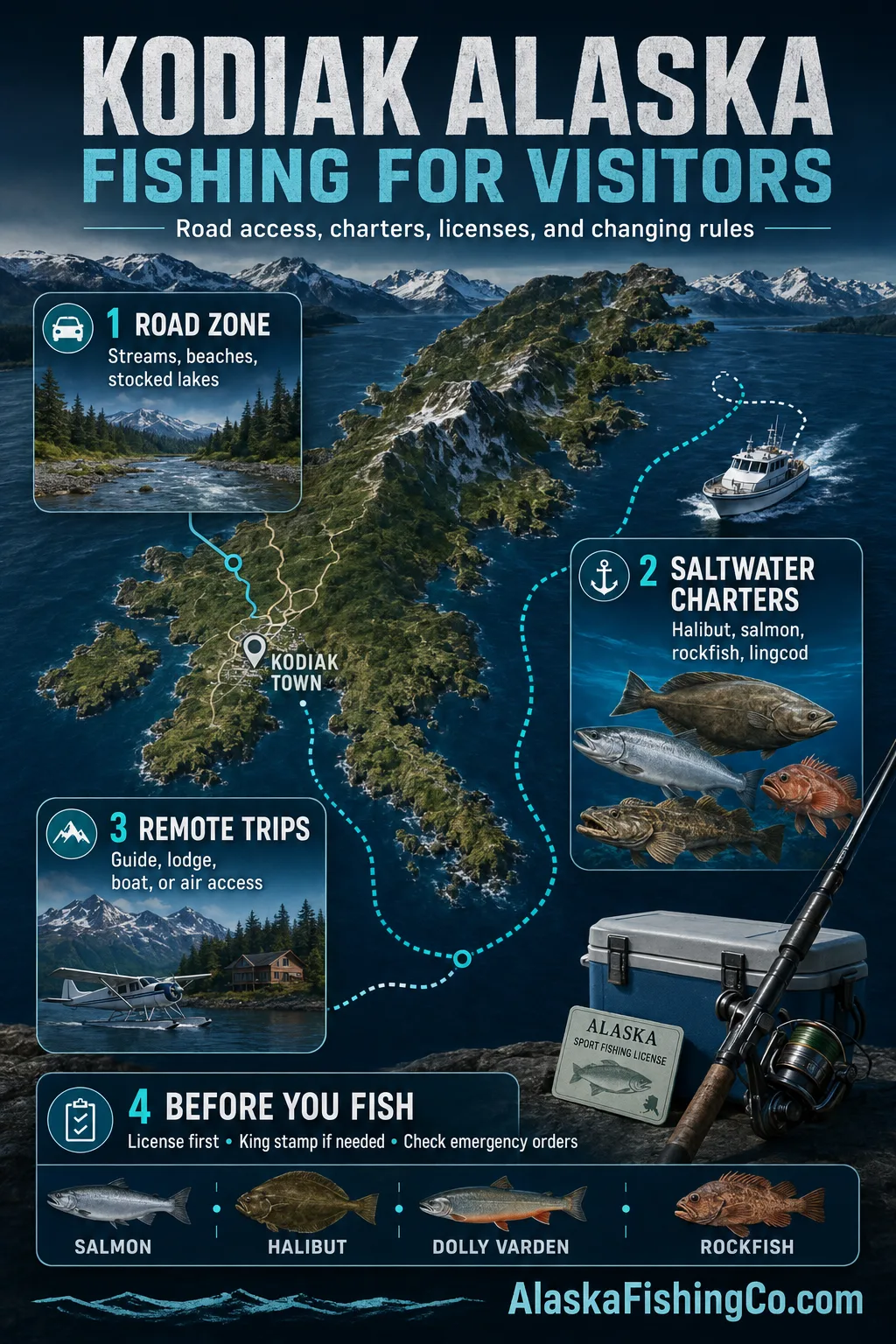
Kodiak is one of Alaska’s most practical fishing destinations for visitors because it offers both easy road-system fishing and serious saltwater charter options from the same base. Most visitors should plan around three questions first: where they will fish, which species they are targeting, and whether they need only a sport fishing license or a king salmon stamp as well.
For most out-of-state and foreign visitors, fishing in Kodiak starts with a nonresident Alaska sport fishing license. If king salmon is part of the plan, a king salmon stamp may also be needed. Rules can change during the season, especially for salmon, rockfish, and lingcod, so checking the current Kodiak emergency orders before the first cast is part of the trip plan, not a last-minute detail.
If you remember one thing… buy the right license before fishing, match your plan to the Kodiak Road Zone or a saltwater/remote trip, and check current emergency orders before keeping fish.
What To Know First
- Nonresident visitors age 16 and over need an Alaska sport fishing license to fish in fresh or marine waters.
- King salmon usually requires an added stamp unless a specific exception applies.
- Kodiak has a Road Zone and Remote Zone, and the rules can differ between them.
- Saltwater trips often focus on halibut, salmon, lingcod, and rockfish.
- Emergency orders override printed regulations, so always check the latest ADF&G notices before fishing.
Do Visitors Need a Fishing License in Kodiak?
Yes. Nonresidents age 16 and older need an Alaska sport fishing license to take part in sport fishing in Kodiak. Alaska residents have different age rules, but most tourists should use the nonresident rule as their starting point.
The Alaska Department of Fish and Game states that nonresidents age 16 or older must purchase and possess a sport fishing license for Alaska sport fisheries, and that the rule applies in both fresh and marine waters.[a] This means the license requirement applies whether a visitor is casting in a road-system stream, fishing from shore, or joining a saltwater charter.
- Foreign visitor: treated as a nonresident for sport fishing license purposes.
- U.S. visitor from another state: also treated as a nonresident.
- Teen visitor: nonresident anglers under 16 do not need a sport fishing license, but harvest record rules may still matter for some fisheries.
- Charter customer: still needs the correct license unless the operator specifically confirms a legal exception, which is uncommon for ordinary sport fishing.
Worth Noting: A charter booking does not replace an Alaska sport fishing license. Most operators will remind guests, but the angler is still responsible for having the correct license and stamp before fishing.
Kodiak Visitor License Options and Costs
Most visitors choose a short nonresident sport fishing license based on trip length. A one-day license can work for a single charter, while a 3-day, 7-day, or 14-day license may be better for a mixed trip with road-system fishing and saltwater days.
The current ADF&G pricing list shows these nonresident sport fishing license prices and matching nonresident king salmon stamp prices.[b]
| Visitor Option | Sport Fishing License | King Salmon Stamp | Best For |
|---|---|---|---|
| 1 day | $15 | $15 | One charter or one short fishing day |
| 3 day | $30 | $30 | Weekend trip or short Kodiak stop |
| 7 day | $45 | $45 | Most weeklong visitor trips |
| 14 day | $75 | $75 | Longer Alaska travel with several fishing days |
| Annual | $100 | $100 | Repeat visitors or extended stays |
A king salmon stamp is separate from the fishing license. If the plan includes targeting king salmon, add the stamp for the same period as the license. If the trip is only for halibut, rockfish, Dolly Varden, stocked rainbow trout, or non-king salmon, the king stamp may not be needed.
Where Visitors Usually Fish Around Kodiak
Kodiak fishing is best understood in three buckets: the road system, remote freshwater trips, and saltwater trips. The right choice depends on budget, time, mobility, and target species.
ADF&G describes the Kodiak Management Area as including the Kodiak Island Archipelago, with many sport fisheries being remote, while road-accessible streams near Kodiak are the easier option for visitors without aircraft or boat access.[c]
Kodiak Road System
The road system is the most practical starting point for first-time visitors. It includes streams, stocked lakes, beaches, and saltwater access near town. ADF&G notes that the road system has about 70 miles of paved and hard-packed gravel roads, crosses 10 major streams, and provides access to more than 20 stocked lakes.[d]
- Good for: salmon, Dolly Varden, stocked rainbow trout, and flexible half-day plans.
- Common waters: Buskin River, Pasagshak River, Olds River, American River, Salonie Creek, Monashka Creek, Pillar Creek, and stocked lakes.
- Access note: some areas are easy by rental car, while Saltery Cove access may require 4-wheel drive or an ATV.
Remote Zone
The Remote Zone is better for visitors booking a lodge, air taxi, guided river trip, or boat-supported outing. It can produce excellent fishing, but it is not a casual “drive up and cast” plan.
- Good for: wilderness salmon, steelhead, Dolly Varden, and less crowded fishing.
- Planning need: transportation, weather flexibility, and guide timing matter.
- Rule note: Remote Zone and Road Zone limits are not always the same.
Saltwater Charters
Saltwater charters from Kodiak are popular for halibut, salmon, lingcod, and rockfish. NOAA Fisheries notes that Pacific halibut sport fishing in Alaska is managed through international, federal, and state layers, with guided and unguided rules handled differently in some cases.[e]
- Good for: halibut, salmon, lingcod, and rockfish trips.
- Ask before booking: what license and stamp to buy, whether the boat targets king salmon, and which emergency orders affect the date.
- Bring: license, ID, rain gear, motion-sickness supplies if needed, and a plan for fish processing or shipping.
One Detail People Miss: “Kodiak fishing” does not mean one single rule set. Freshwater, saltwater, Road Zone, Remote Zone, charter halibut, and king salmon can each change what a visitor needs to check.
Best Fish Species for Kodiak Visitors
Kodiak visitors commonly plan around salmon, halibut, Dolly Varden, trout, lingcod, and rockfish. The best target depends on the month and whether the trip is shore-based, road-based, remote, or charter-based.
- Halibut: usually targeted by saltwater charter; rules differ for guided and unguided anglers.
- King salmon: high-interest species, but often subject to extra restrictions and stamp requirements.
- Sockeye salmon: popular in some freshwater systems, with river-specific changes possible.
- Coho salmon: a strong late-summer visitor target on road-system waters and beaches.
- Pink and chum salmon: common in season and useful for visitors who want action.
- Dolly Varden: a good road-system option when salmon timing is not ideal.
- Rainbow trout and steelhead: subject to special handling and release rules in some waters.
- Rockfish and lingcod: saltwater species where annual rule changes and area limits deserve close attention.
For freshwater Kodiak Island rules, the 2026 ADF&G Southwest regulation summary lists year-round fishing unless otherwise noted, but then gives species and area limits, including separate Road Zone and Remote Zone rules for salmon and trout.[f] Visitors should treat that booklet as the planning base, then check emergency orders for the exact date.
King Salmon, Stamps, and 2026 Restrictions
Visitors should be careful with king salmon in Kodiak. A stamp may be required, and 2026 emergency orders have reduced or closed some king salmon opportunities in parts of the Kodiak area.
For example, ADF&G’s 2026 Kodiak emergency order list includes king salmon restrictions for Gulf of Alaska salt waters, Ayakulik and Karluk River closures, and other Kodiak-area actions. The same page also lists sockeye, rockfish, and lingcod changes for the year.[g]
- If targeting king salmon: buy the king salmon stamp unless ADF&G rules clearly say an exception applies.
- If fishing westside Kodiak: check closures carefully before targeting king salmon.
- If fishing Karluk or Ayakulik: do not assume king salmon fishing is open because older articles mention those rivers.
- If fishing with a charter: ask whether the trip may target king salmon or only other species.
How to Buy the Right License Before a Kodiak Trip
Visitors can buy an Alaska sport fishing license online, through many license vendors, or at Fish and Game offices. Buying online before travel is usually the cleanest option because weather, flight delays, and early charter departures can make same-day errands awkward.
- Choose the exact fishing dates.
- Select a nonresident sport fishing license that covers those dates.
- Add a king salmon stamp if targeting king salmon.
- Save a digital copy and carry a usable backup.
- Bring photo ID that matches the license information.
- Check current emergency orders for Kodiak before fishing.
If the trip includes children, confirm each person’s age against Alaska’s nonresident license rule. If a child does not need a license, that does not automatically remove every record or species rule. For species with annual limits or harvest recording, check the ADF&G instructions before the trip.
Common Mistakes Visitors Make
Thinking a charter includes the license
Wrong idea: “The boat booked the trip, so the license is covered.”
Correct explanation: Most visitors still need to buy and carry their own sport fishing license.
Why it gets mixed up: Charters often help guests choose the right license, but help is not the same as legal coverage.
Buying a fishing license but skipping the king salmon stamp
Wrong idea: “A sport fishing license covers every fish.”
Correct explanation: King salmon normally needs a separate stamp if the angler is fishing for king salmon.
Why it gets mixed up: Visitors may hear “salmon fishing” and not realize king salmon has its own stamp rule.
Using old Kodiak fishing reports as rule guidance
Wrong idea: “This river was open last season, so it should be open now.”
Correct explanation: Emergency orders can close or restrict a fishery during the season.
Why it gets mixed up: Fishing reports often stay online long after the rule situation has changed.
Assuming Road Zone and Remote Zone limits are the same
Wrong idea: “Kodiak is one island, so the limits are the same everywhere.”
Correct explanation: ADF&G separates Kodiak Road Zone and Remote Zone rules in several places.
Why it gets mixed up: Visitors often plan by place names, while regulations are written by area definitions.
Real-Life Kodiak Visitor Scenarios
- One-day halibut charter: A nonresident adult usually buys a 1-day sport fishing license and confirms current halibut rules with the operator.
- Weeklong family trip: Adults may choose 7-day licenses, while children under 16 may not need nonresident licenses.
- Road-system coho trip: The visitor checks Road Zone salmon limits and any emergency orders before keeping fish.
- King salmon charter plan: The angler adds a king salmon stamp and confirms whether current restrictions allow the target fishery.
- Remote lodge trip: The guest asks the lodge which zone and species rules apply to each river on the itinerary.
- Rainy backup day: A visitor uses a stocked road-system lake plan instead of canceling the whole fishing day.
- Mixed saltwater trip: The group confirms rockfish, lingcod, and halibut rules because those species are not managed exactly like salmon.
Before You Move On: The safest Kodiak plan is simple: choose the area, choose the species, buy the right license and stamp, then check emergency orders for that exact date.
Kodiak Alaska Fishing Questions Answered
Do tourists need a fishing license in Kodiak, Alaska?
Yes. Nonresident tourists age 16 and older need an Alaska sport fishing license to fish in Kodiak fresh or marine waters.
Can foreign visitors buy an Alaska fishing license online?
Yes. Foreign visitors can buy a nonresident Alaska sport fishing license online. They should use the same identity details they will carry while traveling.
Do Kodiak visitors need a king salmon stamp?
Visitors need a king salmon stamp if they are fishing for king salmon unless a specific exception applies. If the trip does not target king salmon, the stamp may not be needed.
Is Kodiak better for shore fishing or charter fishing?
Kodiak works for both. The road system is better for flexible shore and stream fishing, while charters are usually better for halibut, offshore salmon, rockfish, and lingcod.
What is the easiest fishing area for first-time Kodiak visitors?
The Kodiak Road Zone is usually the easiest starting point because it has road-accessible streams, stocked lakes, and saltwater access near town.
Are Kodiak fishing rules the same every year?
No. Printed regulations can change through emergency orders, especially for salmon and some saltwater species. Always check the current ADF&G notices before fishing.
Kodiak can be simple for visitors when the trip is planned by area and species instead of by wish list alone. The most common mistake is buying a license without checking whether a stamp, harvest record, closure, or emergency order also applies. The easy rule: license first, species check second, emergency order check last before fishing.
Alaska Fishing References
- [a] Alaska Department of Fish and Game: Sport Fishing Licenses, King Salmon Stamps, IDs and Harvest Record Cards — explains Alaska sport fishing license age rules, king salmon stamp requirements, and fresh/marine water coverage. (Official state fish and wildlife agency.)
- [b] Alaska Department of Fish and Game: License, Stamp, and Tag Pricing List — lists current sport fishing license and king salmon stamp prices. (Official state licensing source.)
- [c] Alaska Department of Fish and Game: Kodiak and Alaska Peninsula/Aleutian Islands Management Area Overview — defines the Kodiak Management Area and explains road-accessible versus remote fisheries. (Official area management page.)
- [d] Alaska Department of Fish and Game: Kodiak Road System Fishing Management — describes the road system, access, streams, lakes, and visitor-relevant fishing opportunities. (Official Kodiak area management source.)
- [e] NOAA Fisheries: Sport Halibut Fishing in Alaska — explains recreational Pacific halibut management for guided and unguided anglers. (Federal fisheries authority.)
- [f] Alaska Department of Fish and Game: 2026 Kodiak Island Fresh Water Sport Fishing Regulations — gives Kodiak Road Zone and Remote Zone freshwater limits and special regulations. (Official regulation summary PDF.)
- [g] Alaska Department of Fish and Game: Kodiak 2026 Emergency Orders and Press Releases — lists current Kodiak emergency orders for salmon, rockfish, lingcod, and other sport fishing changes. (Official emergency order source.)