
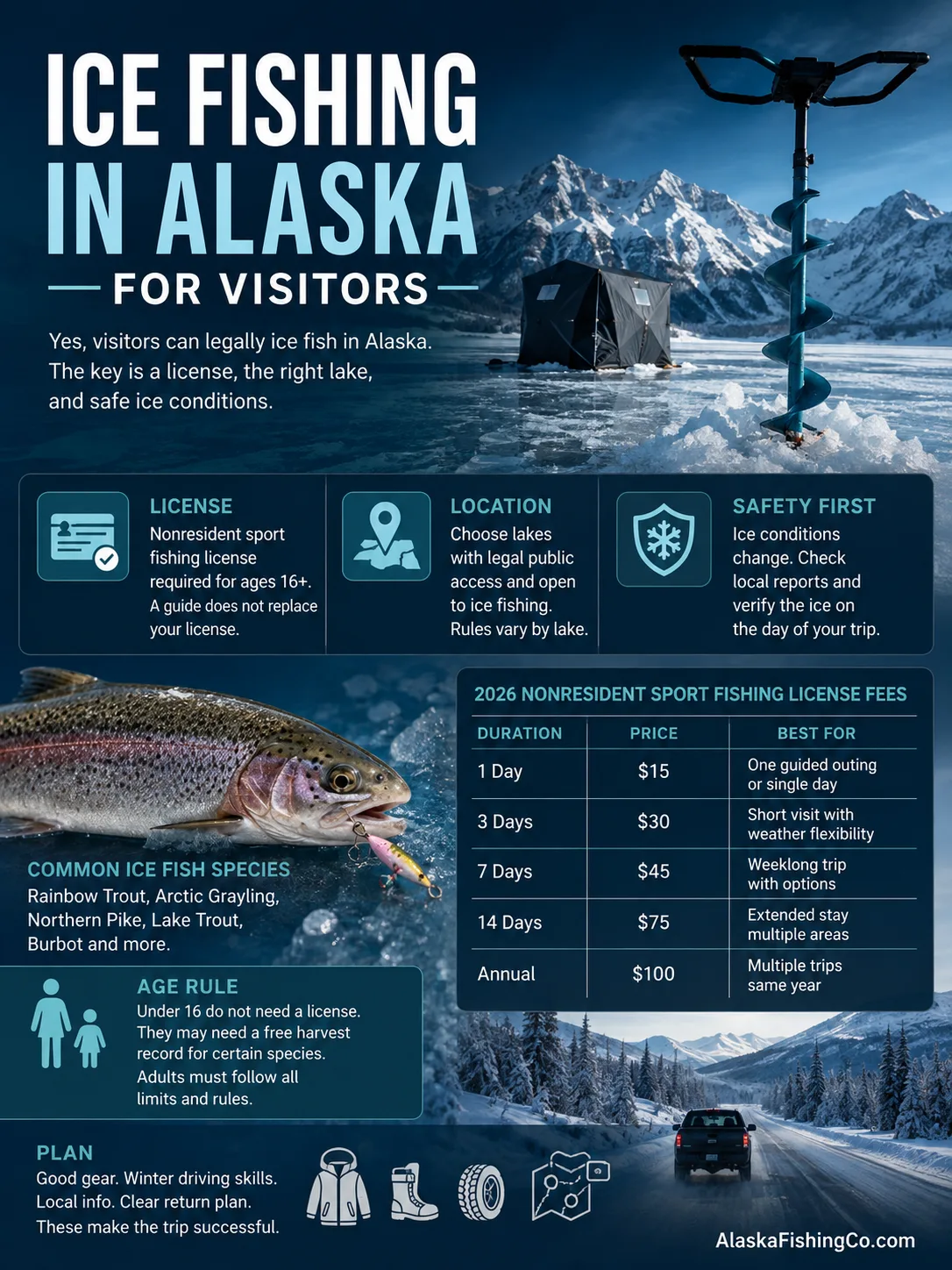
Visitors can legally go ice fishing in Alaska, including international travelers and people arriving from another U.S. state. The practical challenge is not gaining permission to fish. It is choosing the correct nonresident license, finding a lake with suitable public access, reading the rules for that exact waterbody, and confirming that the route onto the ice is suitable on the day of the trip.
For a first Alaska winter trip, a guided outing near Anchorage, the Mat-Su Valley, or Fairbanks is usually the simplest option. A self-planned day can also work, but only when the group has suitable clothing, ice-fishing equipment, winter driving experience, current local ice information, and a clear return plan.
The date on the calendar does not prove that a lake is ready for travel. Ice conditions can vary between regions, between nearby lakes, and even between the shoreline and the fishing area on the same lake.
Can Visitors Legally Ice Fish in Alaska?
Yes. Alaska does not limit ordinary sport ice fishing to state residents. A visitor may fish through the ice after obtaining the correct license and following the statewide, regional, drainage, and waterbody-specific rules that apply to the chosen lake.
Most visitors will fish under Alaska’s sport fishing regulations. Personal-use, subsistence, and commercial fisheries are separate systems and should not be treated as alternatives to a visitor sport fishing license.
- Visitors aged 16 or older generally need a nonresident sport fishing license.
- Foreign visitors use the nonresident license system.
- A guide does not replace the angler’s license requirement.
- A license does not override a closed season, closed water, gear restriction, or emergency order.
- Every person actively fishing must meet the licensing and harvest-record requirements that apply to that person.
Age rules for visiting families
Nonresidents under age 16 do not need an Alaska sport fishing license. They may still need a free harvest record when fishing for a species subject to an annual limit. Adults should check this before taking a child onto the lake, especially when the trip may include king salmon or another fish managed with an annual harvest record.[b]
A child’s license exemption does not remove the need to follow daily limits, possession limits, closed-water rules, or species-specific restrictions. It also does not allow an adult to count the child’s limit as the adult’s additional harvest.
Alaska Nonresident License Costs for an Ice-Fishing Trip
Visitors can choose a short-term license for a brief trip or an annual license for repeated fishing during the calendar year. The best choice depends on the actual fishing dates, not the total length of the Alaska vacation.
For 2026, Alaska lists the following nonresident sport fishing license prices. Foreign and other nonresident visitors are shown with the same short-term and annual sport fishing prices.[a]
| License duration | Price | When it usually fits |
|---|---|---|
| 1 day | $15 | One guided outing or a single confirmed fishing day |
| 3 days | $30 | A short winter visit with weather flexibility |
| 7 days | $45 | A weeklong trip with several possible lake days |
| 14 days | $75 | A longer Alaska stay involving several fishing areas |
| Annual | $100 | Repeated fishing trips during the same calendar year |
Short-term nonresident licenses are issued for 1, 3, 7, or 14 days. An annual license is generally valid from purchase through December 31 of that calendar year. Check the selected dates carefully before completing an online purchase.
Does an ice angler need a king salmon stamp?
Most visitors targeting rainbow trout, Arctic char, lake trout, grayling, burbot, northern pike, or landlocked coho salmon do not need a king salmon stamp. A stamp is generally required when fishing for king salmon, but Alaska provides an exception for king salmon in stocked lakes.
- Do not buy a king salmon stamp simply because a lake contains landlocked salmon.
- Confirm whether the stocked salmon are coho or Chinook.
- Check the lake’s current species listing and special regulations.
- Anglers exempt from the stamp may still need a harvest record when an annual limit applies.
How visitors can buy and carry the license
Most licenses can be purchased through the Alaska Department of Fish and Game online licensing system. A visitor can also use an ADF&G office or an authorized license vendor.
- Choose the nonresident sport fishing license category.
- Enter the angler’s legal personal information accurately.
- Select the license duration and intended start date.
- Add a king salmon stamp only when the planned fishery requires one.
- Save the issued license to the phone before leaving mobile coverage.
- Complete any required signature step.
- Carry a printed backup when cold weather may affect the phone battery.
An electronic license should be downloaded before driving to the lake. A screenshot of a purchase receipt should not be assumed to replace the issued and properly completed license.
Anchorage or Fairbanks: Choosing a Base for Ice Fishing
Anchorage is usually easier for a short visit, while Fairbanks offers a more distinctly Interior Alaska winter setting and access to many stocked-lake opportunities. Neither city is automatically the better choice for every traveler.
Anchorage and the Mat-Su Valley
Anchorage works well for visitors who have limited time, prefer an outfitter pickup, or want to combine fishing with other activities. Lakes within the Anchorage Bowl and the Palmer–Wasilla area may hold rainbow trout, landlocked salmon, Arctic char, grayling, or lake trout, depending on the waterbody.
Conditions around Southcentral Alaska can change quickly. Coastal weather, warmer spells, snow cover, overflow, inlets, and local currents can make one lake or access point very different from another.
- Choose the exact lake before buying bait or selecting tackle.
- Confirm that public access is open and usable in winter.
- Check whether parking is plowed.
- Do not assume that every stocked lake has easy shoreline access.
- Ask whether the outfitter provides transportation from Anchorage.
Fairbanks and the Interior
Fairbanks is often a better fit for visitors who want a full Interior winter experience and are prepared for lower temperatures, longer drives, and fewer services near some fishing areas. Chena, Harding, Birch, and Quartz lakes are established names in the Fairbanks–Delta area, while smaller stocked waters provide additional choices.[f]
Colder weather does not make every part of a lake dependable. Deep snow can insulate the ice, shoreline conditions can remain irregular, and pressure ridges or overflow can affect a travel route.
- Plan for a colder day than the city forecast may suggest.
- Carry enough fuel for the return drive.
- Expect reduced phone service outside populated areas.
- Ask whether an electric or powered auger is needed for the current ice depth.
- Finish the trip early enough to manage the drive back in darkness.
| Trip feature | Anchorage and Mat-Su | Fairbanks and Interior |
|---|---|---|
| Best suited to | Short stays, first outings, guided day trips | Travelers seeking a colder Interior winter experience |
| Typical logistics | City-based departure, rental car, or guide pickup | Longer highway drive and more remote lake access |
| Common targets | Rainbow trout, char, landlocked salmon, lake trout | Rainbow trout, char, landlocked salmon, lake trout, burbot, pike |
| Main planning issue | Variable Southcentral freeze and access conditions | Extreme cold, darkness, and distance from services |
| Good first choice | Guided half-day or full-day trip | Guided trip or road-accessible lake with local support |
When Is the Alaska Ice-Fishing Season?
There is no single statewide date when Alaska’s lakes become suitable for ice fishing. Interior lakes often freeze earlier and remain ice-covered longer than many Southcentral waters, but every trip still depends on the current condition of the selected lake.
Early winter
Early winter can produce active fishing, but it also brings the greatest uncertainty around newly formed ice. Snow may hide thin areas, cracks, old openings, or shoreline weaknesses.
- Do not choose a lake only because social media shows other anglers there.
- Avoid unfamiliar ice without current local confirmation.
- Stay away from inlets, outlets, moving water, springs, and visible pressure areas.
- Do not use a snowmachine track as proof that the surrounding ice is suitable.
Midwinter
Midwinter may bring more established lake ice, but the tradeoff is colder weather, shorter daylight, deeper snow, and thicker drilling conditions. A hand auger that works early in the season may be impractical later.
This period suits visitors using a heated shelter and an outfitter that provides a powered auger, insulated clothing, transportation, and current route information.
Late February and March
Late February and March often provide a more comfortable balance of winter conditions and increasing daylight. These months can be attractive for visiting families, photographers, and travelers who do not want the darkest part of the Interior winter.
- Longer daylight does not remove cold-weather risk.
- Warm afternoons can change shoreline access.
- Spring sun can weaken exposed or dark-colored ice surfaces.
- Conditions should be checked again after any warm, windy, rainy, or snowy period.
Fish Visitors May Catch Through the Ice
Alaska ice anglers may encounter stocked trout and salmonids, native lake fish, or predators such as burbot and northern pike. The species available depend on the lake, and the legal limit can change with the drainage or special waterbody rule.
Rainbow trout
Rainbow trout are a common first target in stocked lakes. They can be caught with light ice rods, small jigs, spoons, or permitted bait. They may cruise at different depths, so changing the presentation level can be more useful than repeatedly changing lures.
Arctic char
Arctic char are stocked in selected lakes and may hold close to the bottom or suspend at a particular depth. Small spoons and jigs can work, but the angler may need to test several depth bands before finding fish.
Landlocked salmon
Some stocked lakes contain landlocked coho salmon, and a smaller number may contain landlocked Chinook salmon. Correct identification matters because a landlocked salmon should not automatically be counted as a trout or char.
Lake trout
Lake trout may require heavier tackle, larger lures, and a different depth strategy. Large fish should be handled carefully when release is required or chosen. Prepare the camera and release tools before bringing the fish onto the ice.
Burbot
Burbot commonly feed near the bottom and may become more active after sunset. Night fishing adds cold, visibility, navigation, and heater risks, so it is not the easiest first choice for an independent visitor.
Northern pike
Northern pike rules deserve a separate check. Pike are native in much of Interior and western Alaska, while populations in parts of Southcentral Alaska were introduced outside their natural range. Harvest expectations, line allowances, and release instructions should never be transferred from one region to another.
| Species | Typical setting | Basic approach | Rule to confirm |
|---|---|---|---|
| Rainbow trout | Stocked lakes | Light jigging at changing depths | Lake-specific bag and size limits |
| Arctic char | Selected stocked or natural lakes | Small spoon or jig near the bottom | Species identification and combined limits |
| Landlocked salmon | Selected stocked lakes | Small lure or permitted bait | Coho or Chinook identification |
| Lake trout | Deeper lakes | Heavier jigging near structure or depth changes | Size limits and special water rules |
| Burbot | Interior lakes and rivers | Bottom presentation, often after dark | Set-line permission and hook requirements |
| Northern pike | Selected Interior and Southcentral waters | Active jigging or permitted stationary gear | Regional harvest, release, and line rules |
The Regulation Check Before Drilling a Hole
A statewide license is only the starting point. Visitors must identify the regulation region, drainage, lake, target species, legal gear, and current emergency orders before fishing.
ADF&G directs anglers to begin with the applicable regional regulations and then move to the drainage or waterbody rules. Alaska currently organizes sport fishing information under Northern, Southwest, Southcentral, and Southeast regions.[d]
- Confirm the lake’s exact name and location.
- Identify the ADF&G regulation region.
- Read the statewide methods and means.
- Open the regional booklet.
- Find the drainage or management area.
- Look for a special entry for the lake.
- Confirm the target species limit.
- Check bait, hook, line, and set-line rules.
- Review current emergency orders on the day of the trip.
Do not use a limit copied from a fishing forum, an old photograph, or another Alaska lake. A lake can have a special rule that replaces the general regional limit.
How many lines can an ice angler use?
The statewide ice-fishing rule generally allows two closely attended lines, with one hook or artificial lure on each line. Additional gear may be permitted for burbot or northern pike when the statewide and area rules allow it.[c]
“Closely attended” should be treated literally. The angler should remain near enough to control the equipment and respond promptly. Leaving ordinary lines fishing while returning to a distant vehicle or cabin may not meet that requirement.
Burbot set lines are not ordinary unattended rods
Where area rules allow burbot set lines, the statewide conditions can include a limit based on the lower of the permitted hook total or the water’s daily burbot limit. Hooks must meet the specified style and gap requirement, rest on the bottom, carry the angler’s name and address, and be inspected within the required period.
- First-time visitors should not improvise a burbot set-line system.
- Confirm that set lines are allowed in the chosen water.
- Read the exact hook and labeling requirements.
- Do not add the pike, burbot, and ordinary line allowances together.
- Use regular closely attended gear when the special rules are not fully understood.
Bait rules
Live fish may not be used as bait for sport fishing in Alaska fresh water. Other bait permissions can still vary by lake or management area, so packaged bait sold locally should not be treated as legal in every waterbody.
- Confirm whether bait is allowed.
- Confirm which fish or fish parts may be used.
- Do not transport or release live fish into another waterbody.
- Keep bait separate from harvested fish intended for food.
Emergency orders can change the printed rule
Emergency orders can open or close waters, change bag limits, and alter legal harvest methods. They may be issued during the season and carry the force of law, so a saved regulation booklet is not the final check.[e]
Before You Drill
- License is active and saved offline.
- Exact lake and access point are confirmed.
- Regional and waterbody rules have been read.
- Emergency orders have been checked.
- Target species can be identified.
- Line, hook, bait, and harvest limits are known.
- Same-day ice and weather information has been obtained.
Guided Ice Fishing or a Self-Planned Day?
A guided trip is usually the better choice for visitors without Alaska winter experience, while a self-planned trip can suit experienced ice anglers who have local information and suitable equipment.
A guide makes sense when
- No one in the group has traveled on Alaska lake ice.
- The group does not own an auger or heated shelter.
- Winter clothing must be borrowed or supplied.
- The trip is limited to one day.
- Children or older relatives are participating.
- The lake requires a long winter drive or snowmachine access.
- The visitors cannot independently verify current access conditions.
A guide may provide transportation, an auger, shelter, tackle, bait, safety equipment, local route knowledge, and fish-cleaning assistance. These services vary, and nothing should be assumed from the phrase “guided ice fishing.”
Questions to ask before booking
- Is transportation from the hotel included?
- Does the price include insulated outerwear and boots?
- Is the fishing shelter heated?
- Does the shelter carry a carbon monoxide alarm?
- Is the fishing license included or purchased separately?
- Which lake and species are normally targeted?
- How is the day’s ice route checked?
- Is there a toilet near the fishing area?
- What happens when weather or ice conditions cause cancellation?
- Can caught fish be cleaned, packaged, or cooked?
A self-planned trip can work when
- The anglers already understand ice travel and self-rescue equipment.
- The lake has verified public winter access.
- The group has current local information about the intended route.
- The vehicle is suitable for the road leading to the access point.
- Everyone has clothing for prolonged inactivity in wind.
- The group has an auger, scoop, rods, shelter, traction, lighting, and emergency supplies.
- The return time is set before fishing begins.
| Visitor situation | More suitable option |
|---|---|
| First Alaska winter trip | Guided |
| No auger, shelter, or winter clothing | Guided |
| Family with young children | Usually guided |
| Short Anchorage stopover | Guided half-day or full-day trip |
| Experienced ice anglers with local contacts | Self-planned may be reasonable |
| Remote lake requiring snowmachine travel | Specialized guide |
Ice Safety Cannot Be Reduced to One Thickness Number
A thickness measurement describes one hole at one moment. It does not certify the shoreline, the route across the lake, the return path, or conditions hidden under snow.
The National Weather Service publishes an Alaska rivers and lakes ice-thickness map using available measurement locations. Measurements are generally collected near the beginning of the month from October through June, which makes the map useful background information rather than proof that a visitor’s route is suitable today.[g]
Why thickness varies across a lake
- Inlets and outlets move water beneath the surface.
- Springs can create local weak areas.
- Snow can insulate the ice and slow further freezing.
- Overflow can place water between snow and lake ice.
- Pressure ridges and cracks can change after wind or temperature shifts.
- Old holes may be hidden by drifting snow.
- Shoreline ice can separate from land or weaken during warm weather.
- Docks, culverts, vegetation, and narrow channels can affect local conditions.
Information to confirm on the same day
- Where the most recent observation was taken
- Whether the shoreline access has changed
- Whether new snow is hiding cracks or overflow
- Whether the intended fishing area has moving water nearby
- Whether other anglers are using the same route today
- Whether weather is expected to deteriorate before the return
A lake name, a calendar date, a parked vehicle, or a visible snowmachine trail is not proof that an unfamiliar route is suitable. Visitors who cannot obtain reliable local information should change the location, book a guide, or cancel the lake trip.
Basic personal ice-safety equipment
- Wearable ice picks positioned where both hands can reach them
- Throw rope carried outside the backpack
- Flotation suit or suitable personal flotation device
- Ice cleats for traction
- Whistle
- Headlamp with spare batteries
- Dry clothing packed in a waterproof bag
- Charged phone and power bank kept warm
- First-aid kit and emergency insulation
Travel with another person and maintain enough spacing to avoid placing the whole group on the same questionable area. The group should know how to call for help, how to use a throw rope, and how to respond if someone enters the water.
What to Wear for an Alaska Ice-Fishing Day
Dress for long periods of standing or sitting, not for the short walk from the vehicle. An outfit that feels warm during setup can become inadequate after an hour of inactivity on an exposed lake.
A practical layering system
- Base layer: moisture-managing top and bottom
- Mid layer: fleece, wool, or insulated garment
- Outer layer: wind-resistant and water-resistant jacket and bib
- Feet: insulated winter boots with enough room for circulation
- Hands: warm mittens plus a thinner pair for tying tackle
- Head and face: warm hat, neck covering, and face protection
- Backup: dry socks and gloves in a waterproof bag
Cotton clothing, tight footwear, fashion boots, and a single pair of gloves are poor choices for a full lake day. A wet glove should be replaced before the hand becomes numb.
Watch for cold injury
Fishing should stop when a person develops persistent numbness, unusual clumsiness, slurred speech, confusion, uncontrollable shivering, pale or waxy skin, or difficulty completing simple tasks.
- Move the person into shelter.
- Replace wet clothing.
- Use dry insulation and controlled warmth.
- Do not rub frozen skin.
- Seek professional help when hypothermia or frostbite is suspected.
Ice-Fishing Equipment Visitors Need
A basic lake day requires more than a short rod. The group must be able to reach the water, clear the hole, handle fish, remain sheltered, and return safely if the weather changes.
Fishing equipment
- Short ice-fishing rod and reel
- Line suitable for the target species
- Legal jigs, spoons, hooks, and bait
- Ice auger with protected blades
- Slush scoop
- Pliers and hook-removal tool
- Measuring device
- Small tackle box
- Bucket, sled, or gear carrier
- Fish container when harvest is planned
Hand, electric, or fuel-powered auger?
A hand auger is simple and light, but it becomes tiring in thick late-winter ice. An electric auger is convenient, although batteries lose performance when left exposed to severe cold. Fuel-powered augers can handle thick ice but require careful transport and should never be operated inside an enclosed shelter.
- Ask how thick the ice is before selecting an auger extension.
- Carry spare or charged batteries for an electric auger.
- Keep blades covered whenever the auger is not in use.
- Do not leave a sharp auger lying in a walking path.
- Bring a scoop long enough for the expected ice depth.
What a guide may provide
| Bring personally | May be rented locally | Often supplied on a guided trip |
|---|---|---|
| Base layers | Insulated boots | Auger |
| Hat and face covering | Winter outerwear | Heated shelter |
| Personal medication | Ice rod and reel | Tackle and bait |
| Phone power bank | Ice cleats | Sled and seating |
| Snacks and water | Specialized flotation clothing | Local route information |
Supply policies differ. Confirm clothing sizes, boot sizes, tackle, food, transportation, and shelter arrangements before paying a deposit.
Heated Ice Shelters and Carbon Monoxide
A heated shelter makes an Alaska lake day more comfortable, but any fuel-burning heater can add carbon monoxide and fire risk to a small enclosed space.
Research archived by CDC/NIOSH found measurable carbon monoxide exposure among participants using propane heaters in ice-fishing shelters. The findings support continuous ventilation and careful heater use rather than sealing a shelter tightly to retain heat.[h]
- Use only equipment intended for the space and conditions.
- Follow the heater manufacturer’s clearance instructions.
- Keep ventilation openings clear.
- Carry a battery-powered carbon monoxide alarm.
- Place the heater where it cannot tip into clothing or tackle.
- Keep fuel containers away from the heat source.
- Never run an auger, generator, or vehicle engine inside the shelter.
- Do not sleep in a heated shelter unless it is designed, ventilated, and managed for that use.
Warmth is not proof of safe air. Headache, dizziness, nausea, weakness, confusion, or unusual sleepiness inside a heated shelter should be treated as a reason to move everyone into fresh air and seek help.
Getting from the Parking Area to the Fishing Hole
The trip onto the lake should follow a known access point and a planned route. The shoreline deserves a separate check because access ice can differ from the main lake surface.
Before leaving the road
- Confirm that the parking area is public and open.
- Do not block a gate, launch, snow-removal route, or private driveway.
- Save the vehicle location on an offline map.
- Check the return weather and road forecast.
- Leave the trip plan with someone who is not on the lake.
- Carry all emergency equipment rather than leaving it in the vehicle.
Setting up the fishing area
- Select an area away from the main walking route.
- Check the surface before concentrating the group and equipment.
- Secure the shelter against wind.
- Drill holes with enough spacing for safe movement.
- Clear slush without creating a hidden slippery mound.
- Keep auger blades covered.
- Make open holes visible to children and other lake users.
- Place heater and fuel away from entrances and loose fabric.
Children should remain under direct supervision around drilled holes, heaters, augers, hooks, and exposed lake surfaces.
Rental Cars, Snowmachines, and Driving on Lake Ice
A four-wheel-drive rental vehicle does not make lake travel acceptable, insured, or suitable. Visitors should normally park at an approved access point and walk, use an outfitter’s transportation, or follow a locally managed route.
- Read the rental agreement before leaving maintained roads.
- Check whether frozen-lake or off-road use is prohibited.
- Do not follow tire tracks without knowing where they lead.
- Do not assume a route used by a light snowmachine will support a vehicle.
- Remember that insurance exclusions may apply.
- Avoid driving a rental vehicle onto unfamiliar lake ice.
Snowmachine access
Snowmachine travel requires separate riding, route-finding, and cold-weather skills. Overflow, pressure ridges, open leads, poor visibility, and mechanical failure can turn a fishing trip into a remote emergency.
- Wear a suitable helmet and face protection.
- Carry recovery and repair equipment.
- Travel with another machine when going away from road access.
- Confirm fuel range in severe cold.
- Use only routes approved by the rental company or outfitter.
- Do not use a snowmachine to replace an ice-condition check.
Keeping, Releasing, and Transporting the Catch
Decide whether a fish is legal to keep before it spends unnecessary time out of the water. Species identification, size restrictions, daily limits, possession limits, and mandatory release or harvest rules should already be known.
Cold-weather release
- Prepare pliers and the camera before lifting the fish.
- Keep the fish off dry snow and rough ice.
- Support the body rather than holding a large fish by the jaw alone.
- Avoid touching the gills.
- Limit air exposure during very cold weather.
- Return the fish promptly when release is required or intended.
Keeping fish for food
Use a clean container and protect the catch from fuel, heater residue, dirty slush, and vehicle exhaust. Confirm where the fish can be cleaned before returning to a hotel or rental property.
- Do not leave entrails, bait, line, or fish remains on the ice.
- Keep enough identifying features when a regulation requires them.
- Separate each angler’s catch when limits could become unclear.
- Record any fish subject to an annual limit immediately.
- Use sealed packaging for air travel.
- Check the airline’s current baggage and frozen-food rules.
Sport-caught fish may not be sold or bartered. When fish are transferred to another person, Alaska possession and documentation rules may apply.
A Realistic One-Day Plan for a Visiting Angler
A good lake day begins before departure and ends before the group becomes cold, tired, or rushed. The fishing period should fit inside the safety and travel plan rather than determine it.
The evening before
- Buy or verify the fishing license.
- Save the regulations and license offline.
- Check emergency orders.
- Confirm the lake, access point, and target species.
- Review road, weather, and wind forecasts.
- Charge phones, lights, auger batteries, and power banks.
- Pack dry gloves, socks, food, water, and medication.
Before leaving in the morning
- Obtain an updated lake and route report.
- Recheck forecast changes.
- Tell a contact where the group is going and when it will return.
- Confirm the vehicle has enough fuel.
- Set a firm turnaround time.
At the lake
- Inspect shoreline access before unloading everything.
- Follow the confirmed route.
- Set up shelter and safety equipment before settling into fishing.
- Test several depths instead of remaining over an inactive hole all day.
- Check hands, feet, wind, visibility, and heater ventilation regularly.
Before the return
- Pack before daylight or visibility becomes a problem.
- Account for all hooks, tools, fuel containers, and trash.
- Cover auger blades.
- Package harvested fish.
- Follow the known route back.
- Notify the trip contact after reaching the vehicle or accommodation.
Mistakes That Commonly Disrupt a Visitor’s Trip
Most avoidable problems begin with an assumption: that the guide bought the license, that another lake has the same rules, or that visible tracks prove the route is suitable.
- Assuming the license is included: Confirm this directly with the outfitter.
- Buying the wrong license dates: Match the active dates to the actual fishing day.
- Buying an unnecessary king salmon stamp: Identify the target fish and stocked-lake exception first.
- Using another lake’s limit: Read the entry for the exact waterbody.
- Ignoring emergency orders: Check them again immediately before fishing.
- Following vehicle tracks onto the ice: Tracks show that someone traveled there, not that the route is suitable now.
- Wearing ordinary city boots: Frozen surfaces demand insulation, traction, and moisture protection.
- Leaving spare gloves in the car: Backup clothing only helps when it is carried.
- Relying on phone service: Save maps, licenses, and regulations offline.
- Sealing a heated shelter: Continuous ventilation is needed.
- Taking only a small hand auger: Late-winter Interior ice may require more equipment.
- Planning to drive a rental car onto the lake: Safety, permission, contract, and insurance issues are separate.
- Waiting until dark to pack: Breakdown, cold, and route-finding become harder after sunset.
- Assuming the hotel allows fish cleaning: Confirm before harvesting fish.
- Refusing to cancel: A prepaid tour or short vacation does not make poor conditions acceptable.
When to Cancel or Turn Back
Cancel the lake plan when current access information is unavailable, the group is poorly equipped, or conditions no longer match the original plan. Turning around before fishing is safer than trying to rescue a day that has already gone wrong.
- No reliable same-day ice information is available.
- Open water, soft ice, or separation is visible at the shoreline.
- New snow hides the intended route.
- Wind, temperature, or visibility is deteriorating.
- The vehicle has a weak battery, low fuel, or mechanical warning.
- A group member lacks proper boots, gloves, or outerwear.
- The heater, shelter, auger, lighting, or communication equipment is not working.
- The return route would be completed later than planned.
- A person shows numbness, confusion, poor coordination, or persistent shivering.
- The guide, park staff, or local contact expresses doubt about conditions.
Visitor Go or No-Go Check
- Is every required license active?
- Is the exact lake confirmed?
- Have the regional and lake rules been read?
- Have current emergency orders been checked?
- Is there reliable information for today’s route?
- Does everyone have proper clothing and traction?
- Are shelter ventilation and heater safety covered?
- Is the return route known?
- Is the turnaround time realistic?
- Will the group leave when conditions deteriorate?
Alaska Ice Fishing Questions Answered
Do tourists need a fishing license for ice fishing in Alaska?
Nonresident visitors aged 16 or older generally need an Alaska sport fishing license. Nonresidents under 16 are exempt from the license, although a harvest record may still be required when fishing for a species with an annual limit.
Can a foreign visitor buy an Alaska fishing license online?
Yes. Foreign visitors use Alaska’s nonresident licensing system and can generally purchase a sport fishing license online. The issued license should be completed correctly and saved offline before traveling beyond mobile coverage.
Is a king salmon stamp required for ice fishing?
Not for most ice-fishing trips targeting trout, char, landlocked coho salmon, lake trout, grayling, burbot, or pike. A stamp is generally required when fishing for king salmon, but king salmon in stocked lakes are an exception. Check the exact lake and species before purchasing a stamp.
Can visitors ice fish near Anchorage without staying overnight?
Yes. Anchorage and the Mat-Su Valley can support half-day or full-day outings, depending on lake access, weather, ice conditions, and outfitter availability. A guided trip is often easier for a short stop because equipment and transportation may be included.
Is Fairbanks better than Anchorage for ice fishing?
Fairbanks may suit visitors seeking colder Interior conditions and access to established stocked-lake fisheries. Anchorage is often easier for a short trip and offers access to Southcentral lakes. The better base depends on travel time, clothing, transportation, target species, and the desired level of winter exposure.
Can a visitor rent all the necessary ice-fishing equipment?
Some outfitters provide rods, tackle, augers, shelters, heaters, seating, boots, and insulated clothing. Others provide only fishing equipment. Confirm every item, including available clothing sizes, before booking.
Can a rental car be driven onto a frozen Alaska lake?
Do not assume that it can. The route may be unsuitable, vehicle access may be restricted, and the rental contract or insurance may exclude off-road or frozen-lake use. Visitors should normally park at an approved access point unless a local authority or outfitter has confirmed a managed vehicle route.
Is November a reliable month for Alaska ice fishing?
No month guarantees suitable ice. Some Interior lakes may support winter fishing during November, while Southcentral waters can remain variable. Confirm the exact lake, access route, recent weather, and same-day local observations before traveling onto the surface.
Alaska Fishing References
- [a] Alaska Department of Fish and Game — Sport Fishing License and King Salmon Stamp Prices. Lists current nonresident and foreign visitor sport fishing license options and fees. (Official state licensing authority.)
- [b] Alaska Department of Fish and Game — General License Information. Explains age exemptions, license validity, electronic license formats, harvest records, and the stocked-lake king salmon stamp exception. (Official state licensing authority.)
- [c] Alaska Department of Fish and Game — Statewide Sport Fish Regulations. Covers ice-fishing lines, burbot set-line conditions, freshwater bait restrictions, and statewide fishing methods. (Official state fisheries regulator.)
- [d] Alaska Department of Fish and Game — Sport Fishing Regulations by Region. Directs anglers to statewide, regional, drainage, and waterbody rules. (Official state regulation portal.)
- [e] Alaska Department of Fish and Game — Emergency Orders and Press Releases. Provides current changes to seasons, areas, bag limits, and legal harvest methods. (Official state in-season regulation source.)
- [f] Alaska Department of Fish and Game — Winter Fishing Opportunities. Describes Interior Alaska winter fishing locations, stocked species, equipment, and lake-fishing practices. (Official ADF&G educational publication.)
- [g] National Weather Service Alaska-Pacific River Forecast Center — Alaska Rivers and Lakes Ice Thickness Map. Displays available ice-thickness observations and explains the general measurement schedule. (Official NOAA and National Weather Service monitoring source.)
- [h] CDC/NIOSH Archive — Portable Heater Use in Ice Fishing Shelters and Carbon Monoxide Exposure. Reports measured carbon monoxide exposure associated with propane-heated ice shelters. (Federal public-health research repository.)