
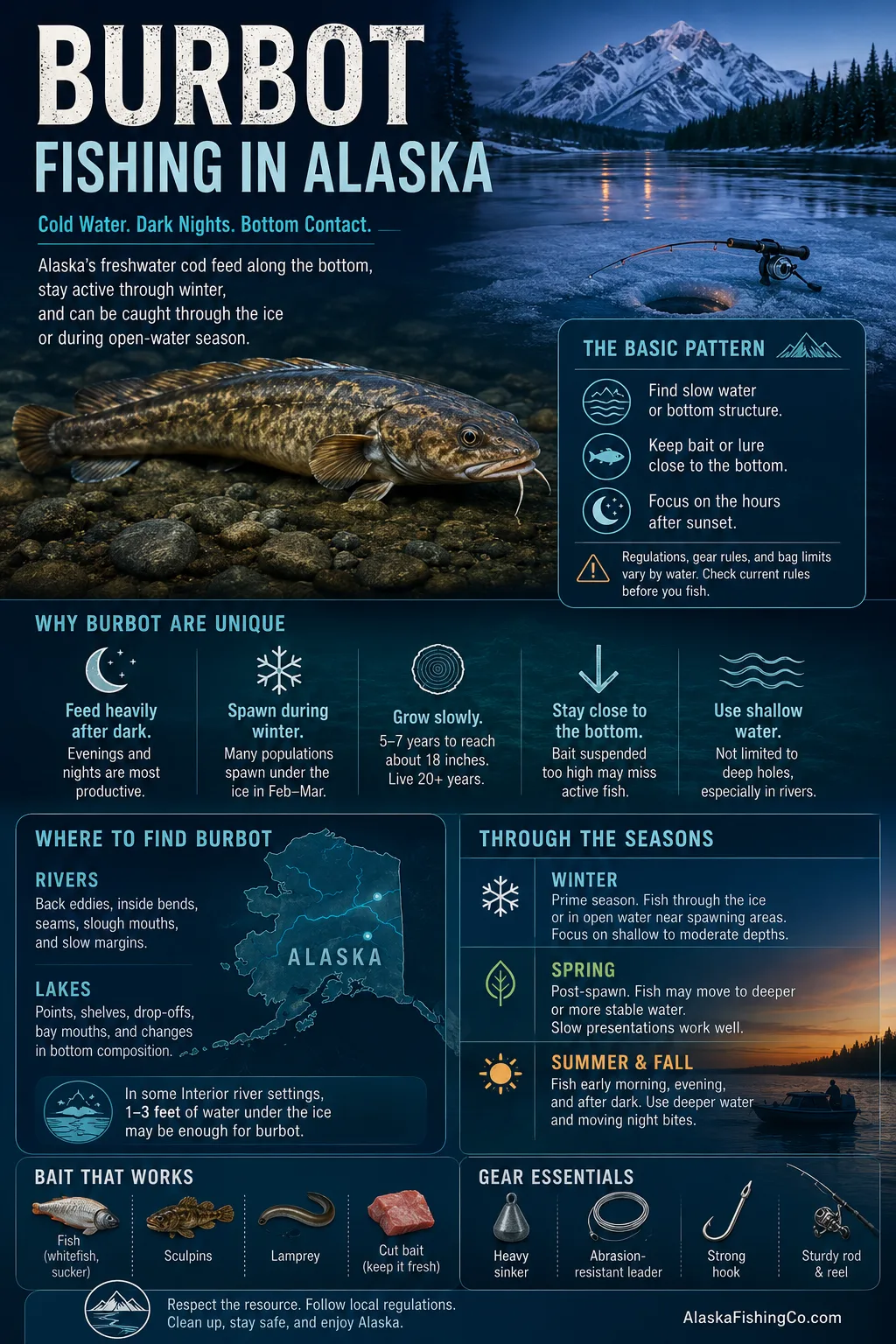
Burbot fishing in Alaska is built around cold water, darkness, and bottom contact. These long-bodied freshwater cod feed mainly near the lake or riverbed, remain active through winter, and can be caught through the ice or during the open-water season.
The most productive approach depends on the water. A baited setline may be legal in one river but prohibited in a nearby lake. Bag limits can also change by drainage or individual water. Before choosing tackle, identify the management area, read the current regional regulations, and check for emergency orders affecting the place you intend to fish.
The basic pattern: Look for slow water or useful bottom structure, keep the bait or lure close to the bottom, and give extra attention to the hours after sunset. Do not assume that setlines, bait, or a statewide-looking bag limit apply to every Alaska water.
Why Alaska Burbot Behave Differently from Other Game Fish
Burbot are the only freshwater members of the cod family in North America. They are often called ling, freshwater ling, eelpout, or even lingcod, although a true lingcod is a separate saltwater species.
An adult burbot is designed for feeding near the bottom. It has a broad mouth, inward-pointing teeth, a single chin barbel, and a long body that can move through shallow edges as easily as deeper channels. Larger fish feed mostly on other fish, including whitefish, sculpins, lampreys, and smaller burbot.
- They feed heavily after dark. Daytime catches occur, but evening and nighttime fishing is often more dependable.
- They spawn during winter. Many Alaska populations spawn beneath the ice during February and March.
- They grow slowly. Alaska burbot commonly take five to seven years to reach about 18 inches and may live for more than 20 years.
- They stay close to the bottom. A bait suspended too high may pass above fish that are actively feeding.
- They use shallow water. Burbot are not restricted to deep holes, especially in rivers and during winter movement.
Their slow growth and late maturity also explain why certain road-accessible lakes have lower limits or stricter gear rules than larger river systems.[a]
Where Burbot Are Found in Alaska
Burbot occupy many large rivers and lakes across Interior, northern, western, and parts of Southcentral Alaska. They are absent from Southeast Alaska, so travelers visiting places such as Juneau, Sitka, Ketchikan, or Petersburg should not plan a local burbot trip.
Some of Alaska’s better-known burbot fisheries occur in:
- The Tanana River and connected Interior waters
- The Yukon and Kuskokwim river systems
- Upper Tanana lakes and rivers
- Upper Copper and Upper Susitna drainages
- Selected Susitna and Yentna drainage waters
- Large northern and western river systems
Finding Burbot in Rivers
River burbot generally favor places where they can hold near the bottom without fighting the strongest current. The fastest and deepest part of the channel is not automatically the best place to fish.
Useful river features include:
- Back eddies where the current reverses or slows
- The downstream side of tributary and slough mouths
- Inside bends and inside gravel bars
- Current seams between fast and slow water
- Slow margins beside the main channel
- Areas where bait can remain on the bottom without continually rolling away
Avoid setting directly in fast main-channel current or beside an eroding cut bank. These areas are harder to fish, more likely to collect debris, and may have less dependable ice during winter.
Finding Burbot in Lakes
Lake burbot often travel along bottom contours rather than holding in one isolated hole. Points, underwater shelves, drop-offs, bay entrances, and changes between hard and soft bottom can all concentrate movement.
Start with a small spread of depths instead of drilling every hole at the same distance from shore:
- Place one presentation near the shallow edge of a break.
- Place another on the slope.
- Test the deeper base of the break.
- Move after a reasonable period if there is no contact.
Deep water can produce, especially during warmer open-water periods, but it should not be treated as a universal rule. In some Interior river settings, Alaska Department of Fish and Game material notes that only one to three feet of water beneath the ice may be enough for burbot.
When to Fish for Burbot in Alaska
Burbot can be caught throughout the year, but their location and the practical fishing method change with ice, water temperature, river level, and spawning movement. Winter receives most of the attention because burbot remain active when many other freshwater fish slow down.
| Period | Typical opportunity | Productive approach | Main concern |
|---|---|---|---|
| Freeze-up | Fish may move along shallow river edges and lake routes | Bottom bait, attended gear, or legal setlines | New and uneven ice |
| Early winter | Long nights support extended feeding periods | Setlines where allowed and active jigging after dark | Severe cold and rapidly freezing holes |
| Midwinter | Pre-spawn and spawning movement may improve local activity | Fresh bait placed directly on or just above the bottom | Weather exposure and difficult travel |
| Late ice | Burbot may continue feeding through the approach to break-up | Shallow travel routes, points, mouths, and breaks | Weak shore ice and current-damaged river ice |
| Open water | Year-round opportunity remains in many rivers and lakes | Anchored bottom rigs in slow water or deep lake structure | High water, drifting debris, wind, and boat positioning |
Does Burbot Fishing Stop During Summer?
No. Summer burbot fishing is possible, especially in large rivers. The fish remain close to the bottom and may use cooler, deeper lake water or slow river areas below tributary mouths.
Open-water success becomes less predictable when:
- A river is high and carrying heavy debris
- A boat cannot hold over the selected bottom
- The bait rolls through fast current
- Lake surface temperatures push fish into deeper water
- Bright summer conditions reduce shallow nighttime movement
On the Tanana River, baited lines can be fished in slow-flowing areas during both the ice and open-water seasons. Whitefish and herring are commonly used, and access is available near communities including Fairbanks, Delta Junction, Tok, and Nenana.[f]
Fishing Licenses for Residents, Tourists, and Foreign Visitors
Most visiting adults need an Alaska sport fishing license before targeting burbot. Foreign visitors follow the same nonresident licensing rules as visitors from other U.S. states.
For 2026, a sport fishing license is required for:
- Alaska residents aged 18 or older
- Nonresidents aged 16 or older
Nonresident anglers under 16 do not need a sport fishing license. Residents of the Yukon Territory may purchase an Alaska nonresident sport fishing license at Alaska resident rates.
| License duration | Fee | Useful for |
|---|---|---|
| 1 day | $15 | A single guided or independent outing |
| 3 days | $30 | A short winter weekend |
| 7 days | $45 | A one-week Alaska trip |
| 14 days | $75 | A longer fishing holiday |
| Annual | $100 | Multiple trips during the calendar year |
Burbot fishing does not require a king salmon stamp. A current sport fishing license can be purchased through the ADF&G online store, the mobile app, department offices, or licensed vendors. Carry the paper or electronic license while fishing.[g]
Alaska Burbot Limits and Gear Rules Are Water-Specific
There is no single burbot limit or setline rule that can safely be applied across Alaska. Statewide provisions create a starting point, but regional, drainage, and individual-water rules can lower the limit, restrict bait, shorten the setline season, or prohibit unattended lines.
Check the rules in this order:
- Confirm which Alaska sport fishing region covers the water.
- Read the region-wide freshwater rules.
- Find the correct drainage or management area.
- Look for the lake, river, or stream in the special-regulation section.
- Check current emergency orders before traveling.
Bag limit and possession limit are not always the same idea. The daily bag limit controls how many fish may be taken in one day. The possession limit controls how many unpreserved fish may be held. Read both figures in the regulation booklet rather than relying on the daily number alone.
The Statewide Baseline for Burbot Gear
Unless an area rule says otherwise, Alaska permits more than one line and hook for burbot when all statewide conditions are met.
- The total number of hooks cannot exceed 15 or the daily burbot bag limit for that water, whichever is lower.
- Each hook must be a single hook.
- The gap between the point and shank must be larger than three-quarters of an inch.
- Each hook must rest on the bottom of the lake or stream.
- Each line must carry the angler’s name and address.
- Each line must be physically inspected at least once in every 24-hour period.
The maximum number of lines and hooks is not cumulative across species. An angler cannot add the burbot allowance to a separate northern pike or ordinary ice-fishing allowance to create a larger total.[c]
Why the Individual Water Still Matters
A lake can be open to burbot fishing while setlines remain prohibited. It may also have a much lower limit than surrounding rivers.
Lake Louise shows why older assumptions should not be carried from one season to another. The 2026 Upper Copper and Upper Susitna regulations list a burbot limit of two per day and two in possession, with no size limit. Lakes in that management area prohibit setlines, so anglers must closely attend their gear.[e]
Other Alaska waters may contain rules such as:
- A lower one- or two-fish burbot limit
- A seasonal closure
- A shortened setline season
- No setlines at any time
- Unbaited artificial lure requirements
- A single-hook restriction
- Catch-and-release fishing only
Emergency orders override the printed booklet. A rule affecting another species may also change the bait or hook that can be used in a shared drainage. ADF&G advises anglers to read the regional section, continue to the drainage or water-specific section, and then check emergency orders.[d]
Setlines or Rod and Reel?
Both methods catch Alaska burbot. Setlines keep fresh bait working near the bottom for a long period, while rod-and-reel fishing lets the angler search different depths and react immediately to a bite.
| Method | Works well when | Main advantage | Legal point to check |
|---|---|---|---|
| Setline | Fishing overnight in a water where unattended gear is allowed | Keeps bait near the bottom for many hours | Setline permission, hook total, labels, and inspection time |
| Tip-up | Ice fishing while staying close enough to watch the gear | Provides a visible strike signal | Whether all lines must be closely attended |
| Baited rod | Fishing from shore, boat, or an ice shelter | Simple bottom presentation with direct control | Line, hook, and bait restrictions |
| Jigging rod | Searching several holes or bottom depths | Covers water and creates vibration | Artificial-lure and hook rules for the water |
Setlining is not a “leave it and forget it” method. The gear must remain legal, properly marked, positioned on the bottom, and inspected within the required period. Local rules may demand closer attendance or ban setlines entirely.
How to Set a Burbot Line Through the Ice
A legal setline must hold the bait on the bottom without allowing the line to freeze into the side of the hole. The strong-line and pole methods are both used in Alaska, but the selected system must suit the depth, current, ice conditions, and local regulations.
Basic Equipment
- Ice auger and ice scoop
- Shovel for clearing and replacing snow
- Strong line or nylon rope
- Legal single hook
- Heavy sinker
- Fresh fish bait
- Wooden crosspiece, dowel, or spruce pole
- Weather-resistant name and address label
- Pliers and hook-removal tools
- A retrieval hook or gaff for fish that will be retained
Setting the Line
- Choose the location before drilling. Look for a slow-water edge, tributary mouth, inside gravel bar, lake break, or another bottom route.
- Confirm safe ice. Conditions near current, springs, pressure ridges, shorelines, and flowing-water mouths can differ from nearby ice.
- Drill and clear the hole. Remove loose ice and slush that could catch the line.
- Measure the depth. The hook must reach the bottom, not hang partway through the water column.
- Attach fresh bait. Use a piece large enough to remain on the hook during current or overnight soaking.
- Add enough weight. The sinker must keep the hook and bait at the bottom. A light weight that drifts defeats the purpose of the set.
- Lower the rig slowly. Confirm bottom contact and allow enough line for current without creating excessive slack.
- Secure the line outside the hole. Use a strong crosspiece or pole that cannot fall through.
- Attach the required label. The angler’s name and address must remain readable.
- Protect the opening from freezing. A packed snow mound can reduce rapid refreezing, but loose material must not be left where it creates a hazard.
- Record the exact position. Darkness, wind, and fresh snow can erase visible tracks within hours.
- Inspect the set on time. Follow the statewide 24-hour maximum and any shorter local requirement.
ADF&G recommends fresh bait, secure bottom placement, and limiting the number of hooks on an individual set to reduce tangling. Its setline material also warns against allowing the line to freeze against the ice-hole wall.[b]
Best Baits for Alaska Burbot
Fresh fish bait is the standard choice because burbot locate food near the bottom using scent and close-range movement. Rotten bait is not necessary and may perform worse than a fresh, oily piece.
Common options include:
- Herring: Oily and strongly scented, though softer pieces may need careful hooking.
- Whitefish: A natural Alaska prey fish with skin that holds well on a hook.
- Smelt: Useful whole or in sections, depending on size.
- Lamprey: Durable and strongly scented where legally available.
- Squid: Tough enough to remain on a hook, though it is not a natural freshwater prey item.
Fresh Bait Works Better Than Washed-Out Bait
A bait can remain physically attached while losing much of its scent. Replace pale, waterlogged, damaged, or partly eaten pieces during inspection.
For better hook retention:
- Pass the hook through skin or another firm section.
- Leave the hook point exposed.
- Use a larger chunk when small fish repeatedly strip the bait.
- Do not create a bait bundle that covers the hook gap.
- Keep spare bait cold and separate from food intended for people.
Alaska Bait Restrictions
Live fish may not be used as bait in Alaska freshwater sport fisheries. The edible meat of a sport-caught fish generally cannot be converted into bait. Certain parts, including the head, tail, fins, or viscera, may be allowed, but local bait restrictions can still apply.
Do not assume that fish legally kept for dinner can be cut into bait. Pack commercially obtained bait or another clearly legal option, then check the rules for the chosen water.
Rod-and-Reel Tactics After Dark
Active fishing works well for anglers who want to search rather than leave bait in one position. The lure or bait should spend most of its time within a short distance of the bottom.
Bottom Jigging
A glow jig or baited jig can be lowered until it touches bottom. Lift it with short movements, tap the bottom several times, and then pause. Bottom contact creates vibration and can disturb a small cloud of sediment.
A simple sequence is:
- Drop until the lure reaches bottom.
- Reel up enough slack to feel the jig.
- Tap the bottom three or four times.
- Lift six to twelve inches.
- Hold still for several seconds.
- Repeat with occasional longer pauses.
Burbot bites are not always violent. A fish may feel like additional weight, a slow pull, or a lure that no longer lifts normally. Apply steady pressure before setting the hook.
Baited Bottom Rig
A baited rod can use a sinker heavy enough to hold bottom and a short leader that keeps the bait close to the lakebed or riverbed. In current, too much leader allows the bait to swing or tangle. Too little weight lets the entire rig roll downstream.
Check these points when the rig will not stay in place:
- Move to slower water before adding extreme weight.
- Use a sinker shape that resists rolling.
- Shorten the leader.
- Cast slightly upstream and allow the rig to settle.
- Reposition the boat rather than dragging the rig across the bottom.
When to Change Holes
A productive night does not require waiting indefinitely at one hole. When jigging, test several positions along the same structure. Move from shallow to deep or follow a break instead of drilling randomly.
- No bottom change and no bites: move farther along the route.
- One missed bite: remain nearby and change the pause or bait.
- One landed fish: test adjacent holes at the same depth.
- Repeated bait loss: use a tougher piece or a larger hook-appropriate bait.
- Heavy current: move toward the slower edge.
Open-Water Burbot Fishing
Open-water burbot fishing uses the same main principle as ice fishing: place a legal bait or lure near the bottom where fish can find it. Boat control and current are the main practical differences.
Fishing from a Boat
Anchor only where it is safe and legal to do so. In large glacial rivers, choose the softer edge of an eddy or the slower water below a tributary rather than anchoring in the fastest main channel.
A useful boat position should allow:
- The sinker to reach bottom without sweeping far downstream
- The bait to remain in a defined area
- Enough clearance from floating logs and debris
- A safe route for raising the anchor
- Room to land a fish without crossing another line
In lakes, summer fish may use cooler depths. Work the base of drop-offs, deep points, or channels between shallower feeding areas. Fishing after sunset can bring burbot onto more accessible structure.
Fishing from Shore
Shore fishing is possible where deeper or slower water lies within casting distance. River access sites, gravel bars, bridge-area pullouts where fishing is permitted, and lake points may provide useful bottom access.
Avoid casting into the middle of strong current simply because it appears deeper. A bait that settles at the slow edge is usually easier to detect, manage, and keep free of debris.
Ice Safety Comes Before the Fishing Spot
River ice can change over a very short distance. A productive-looking slough mouth or current seam may also contain the weakest ice in the area.
Extra caution is needed around:
- Moving water
- Tributary and spring inflows
- Narrow channels
- Pressure ridges and overflow
- Dark patches and open leads
- Shoreline cracks
- Snow-covered areas that hide surface changes
Existing tracks are not proof of safe ice. Snowmachine traffic, old footprints, or a previous drilling location cannot confirm current conditions. Weather, current, overflow, and changing water levels can weaken the same route before the return trip.
Carry equipment suited to remote winter travel:
- Ice picks worn where they can be reached
- A spud bar for checking the route ahead
- Flotation clothing or a personal flotation device
- A throw rope
- A headlamp with spare batteries
- Offline navigation and a marked return route
- Dry gloves and spare insulating layers
- An emergency shelter or bivy
- A satellite communication device outside dependable cellular coverage
Heaters in enclosed ice shelters require ventilation. A working carbon monoxide detector should be carried whenever a fuel-burning heater is used.
Landing, Releasing, and Keeping Burbot
Burbot are powerful at close range because they twist, roll, and use their long bodies against the edge of an ice hole. Their skin is also covered with heavy slime, making a secure landing harder than their swimming speed suggests.
Landing Through the Ice
- Keep steady tension as the fish approaches the hole.
- Guide the head into the opening before lifting.
- Use a larger hole when legal and safe if large fish are expected.
- Do not wrap the line around a bare hand.
- Use a gaff only on a fish that will legally be retained.
Releasing a Burbot
Release fish promptly when they are undersized under a local rule, beyond the limit, or not intended for food. Cold air can damage exposed tissue even when the fish came from water beneath the ice.
- Wet the gloves before handling the fish.
- Support the body instead of holding only the jaw or chin barbel.
- Keep the fish off dry snow and rough ice.
- Remove the hook with pliers.
- Do not gaff a fish that may be released.
- Return it to the water without a long photography session.
Preparing a Kept Fish
Burbot have tiny scales and thick, slippery skin. Many anglers skin the fish rather than trying to scale it. Pliers can help pull the skin after a shallow cut is made behind the head.
The useful meat is not limited to two narrow side fillets. Meat can also be recovered from the thick back section. Keep the catch cold, clean the body cavity carefully, and prevent slime or river sediment from contacting finished fillets.
The cooked flesh is white, mild, and firm. It works well in fish soup, baked dishes, or battered portions. The common nickname “poor man’s lobster” describes one preparation style rather than an exact match for lobster flavor or texture.
Mistakes That Reduce Burbot Catches
Most slow nights can be traced to location, bottom contact, bait condition, or a regulation assumption. Burbot equipment does not need to be complicated, but it must work at the depth and current being fished.
Keeping the Bait Too High
A suspended bait may sit above bottom-feeding fish. Measure the depth and confirm that the weight, hook, and bait have reached the lakebed or riverbed.
Fishing the Strongest Current
The deepest-looking channel often carries too much current. Move toward an eddy, seam, tributary outlet, or inside bend where the bait can remain in place.
Assuming Burbot Always Stay Deep
Shallow river margins, inside gravel bars, and nearshore winter routes can hold fish. Test the structure rather than choosing depth alone.
Using Rotten or Waterlogged Bait
Replace bait that has lost its scent, texture, or shape. Fresh herring, whitefish, smelt, or another legal fish bait normally provides a better presentation.
Using Too Little Weight
If the rig rolls, swings far downstream, or never settles, it is not fishing the chosen spot. Add weight or move to slower water.
Allowing the Hole to Freeze Around the Line
A line frozen into the ice wall may break during retrieval or prevent a fish from being brought through the hole. Protect the opening and inspect the setup carefully.
Copying Rules from Another Lake
A legal setup on the Tanana River may be illegal at Lake Louise, Harding Lake, or another regulated water. Check the named water rather than relying on a general Alaska rule.
Checking Only the Printed Booklet
An emergency order can change fishing methods, bait, seasons, or limits after a booklet is printed. Check for orders close to the fishing date.
A Practical One-Night Burbot Plan
A well-organized trip uses daylight for travel and setup, then reserves the darker hours for active fishing and inspections.
Before Leaving
- Purchase the correct sport fishing license.
- Confirm the management area and individual-water rules.
- Check emergency orders.
- Prepare and label setline equipment where setlines are legal.
- Cut fresh bait into usable portions.
- Download an offline map and save the return route.
- Check weather, wind, and travel conditions.
Before Sunset
- Test the ice along the full route.
- Identify two or three bottom features rather than one random spot.
- Drill a controlled line of holes at different depths.
- Install legal sets while visibility remains good.
- Mark each position so it can be found after snowfall.
After Dark
- Jig near the bottom while legal baited gear continues fishing.
- Move between planned holes rather than drilling without a pattern.
- Refresh damaged bait.
- Watch for refreezing holes and lines.
- Keep the shelter ventilated.
- Leave enough time and energy for the return trip.
Before Leaving the Area
- Retrieve every line, hook, label, and marker.
- Remove bait scraps and packaging.
- Count retained fish against the correct bag and possession limits.
- Cool the catch without allowing it to become contaminated.
- Check the return route again rather than assuming it remains safe.
Alaska Burbot Fishing Questions Answered
What is the best time of year to catch burbot in Alaska?
Winter is the most popular period because burbot remain active beneath the ice and move toward spawning areas. Freeze-up, early winter, and the midwinter spawning period can all produce. They can also be caught during open water, especially in slow river areas and deeper lake structure.
What time of day is best for burbot fishing?
Burbot feed mainly after dark, so evening and nighttime fishing is often more productive. Daytime catches still occur, particularly in dark water, deep lakes, beneath snow-covered ice, or during active seasonal movement.
Can tourists use setlines for burbot in Alaska?
Tourists may use setlines only where the method is legal and all labeling, hook, bottom-placement, and inspection requirements are followed. Some management areas and individual lakes prohibit setlines, even though burbot fishing remains open.
How many hooks can be used for Alaska burbot?
Under the statewide baseline, the total cannot exceed 15 hooks or the daily burbot bag limit for the water, whichever is lower. Area and individual-water rules may allow fewer hooks or prohibit setlines. The hooks must meet the required type and size rules.
What bait catches burbot in Alaska?
Fresh herring, whitefish, smelt, lamprey, and squid are commonly used. The bait should be placed near the bottom and replaced when it becomes pale, damaged, or washed out. Live fish cannot be used as freshwater bait.
Do foreign visitors need an Alaska fishing license for burbot?
Foreign visitors aged 16 or older need a nonresident Alaska sport fishing license. Visitors under 16 do not need the license. No king salmon stamp is required when fishing only for burbot.
Are burbot found near Anchorage?
Burbot occur in parts of Southcentral Alaska, including waters within the Susitna system, but they are not present in every nearby lake. Check the species information and individual regulations for the exact water before planning a trip from Anchorage.
Are burbot and lingcod the same fish?
No. Burbot are freshwater members of the cod family. Lingcod are marine fish from the greenling family. “Ling” and “lingcod” are sometimes used as local burbot nicknames, but the species are unrelated.
Alaska Fishing References
- [a] Alaska Department of Fish and Game — Burbot Species Profile — Covers identification, feeding, reproduction, range, growth, and Alaska distribution. (Official state fisheries agency.)
- [b] Alaska Department of Fish and Game — How to Set Line for Burbot — Explains legal setline construction, bottom placement, bait selection, and Interior river locations. (Official state angler education resource.)
- [c] Alaska Department of Fish and Game — Statewide Sport Fish Regulations — Provides the statewide baseline for burbot hook totals, hook size, labels, bottom placement, and inspections. (Official regulatory source.)
- [d] Alaska Department of Fish and Game — 2026 Northern Alaska Sport Fishing Regulations — Provides current regional and drainage regulation documents and explains that emergency orders override printed rules. (Official 2026 regulation portal.)
- [e] Alaska Department of Fish and Game — 2026 Upper Copper and Upper Susitna Regulations — Lists current burbot limits and water-specific methods for Lake Louise and surrounding management-area waters. (Official regional regulation booklet.)
- [f] Alaska Department of Fish and Game — Tanana River Burbot Fishing Opportunity — Describes seasonal access, slow-water placement, bottom fishing, and common baits on the Tanana River. (Official location-specific fishery resource.)
- [g] Alaska Department of Fish and Game — 2026 Sport Fishing Licensing Information — Lists age requirements, nonresident license periods, fees, purchase options, and Yukon Territory provisions. (Official 2026 licensing document.)