Alaska Arctic char fishing is mainly a lake fishery, and the quality of a trip depends on choosing the right kind of lake before choosing a lure. Wild fish live in remote cold-water systems, while hatchery-raised char create easier roadside and urban opportunities in parts of Southcentral and Interior Alaska.
The species is often confused with Dolly Varden, especially when a bright spawning fish is photographed near moving water. That matters because Alaska’s known Arctic char populations complete their lives in lakes rather than making sea-run migrations. Season, depth, lake productivity, access, and local regulations all shape the fishing more than one statewide list of “best spots.”[a]
Alaska Arctic Char Fishing Starts With the Right Habitat
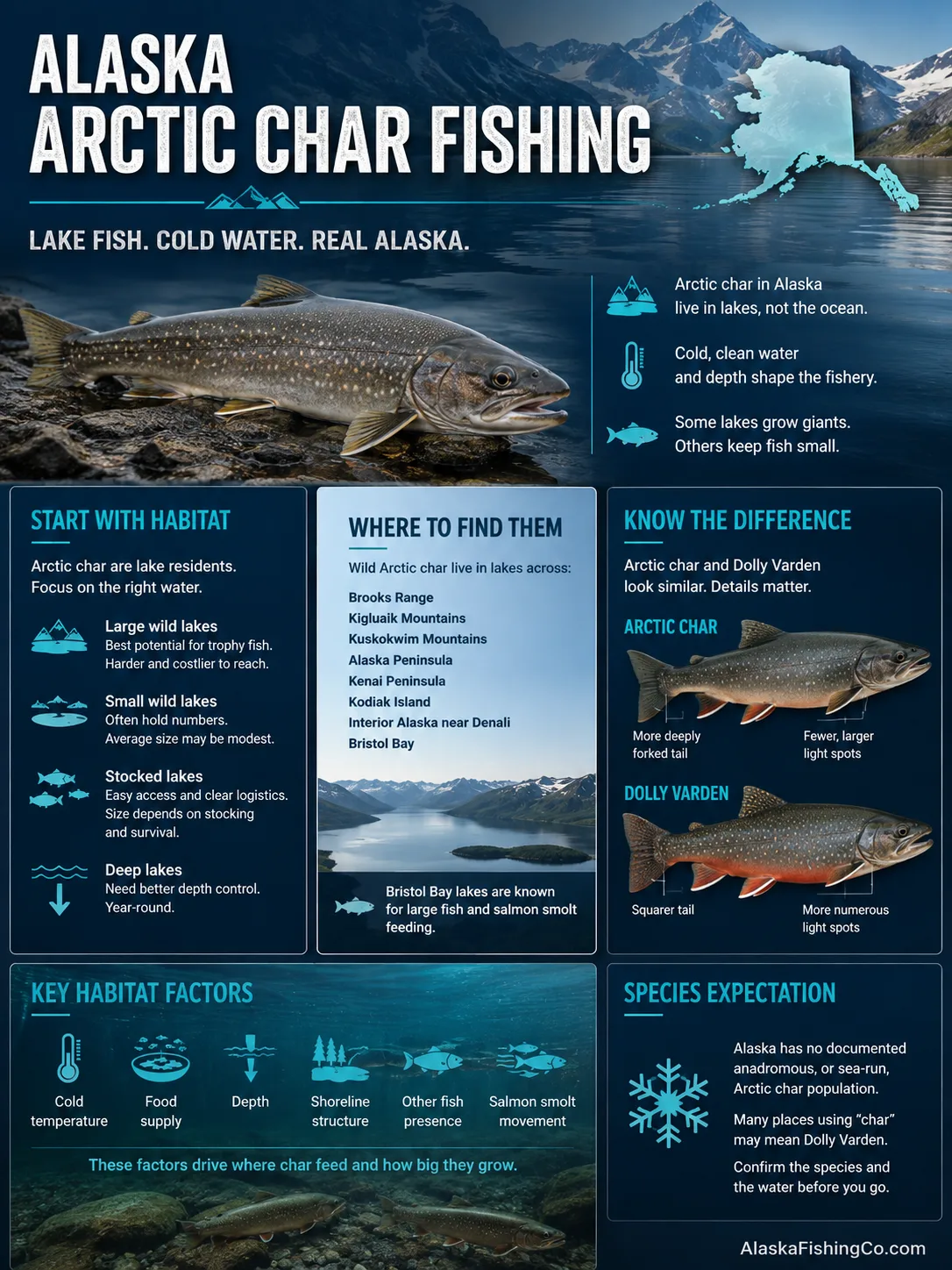
Think lake first. Arctic char may gather close to an inlet, outlet, or channel connecting two lakes, but Alaska’s known populations are lake residents. A trip built around random river stops is more likely to produce Dolly Varden, rainbow trout, or Arctic grayling than a true Arctic char.
Productive char water usually offers more than cold temperature alone. Food supply, depth, shoreline structure, salmon smolt movement, and the presence of other fish can all affect where char feed and how large they grow. In some Alaska lakes, fish above 10 pounds are possible. In other lakes, old fish may remain below 2 pounds because the water supports slower growth.[a]
- Large wild lakes: better potential for heavy fish, but often harder and more expensive to reach.
- Small wild lakes: may hold abundant char, though average size can be modest.
- Stocked lakes: easier access and clearer trip logistics, with fish size tied to stocking history and survival.
- Deep lakes: often demand better depth control during warm weather and through the ice.
Species expectation: Alaska has no documented anadromous, or sea-run, Arctic char population. A lodge or fishing report using “char” as a broad label may be referring to Dolly Varden. Confirm the species and the water before building the trip around it.
Arctic Char or Dolly Varden?
Color alone is not a safe way to identify these fish. Body shape, tail shape, spot pattern, habitat, and spawning features should be considered together.
Arctic char generally show fewer, larger light spots, a more deeply forked tail, and a narrower section of body immediately before the tail. Dolly Varden tend to have a squarer tail and a wider tail base. During spawning season, Arctic char are often gold, orange, yellow, or rose, while Dolly Varden more often show a red or pink lower body with bright red spots.[a]
| Feature | Arctic char | Dolly Varden |
|---|---|---|
| Typical Alaska habitat | Primarily lakes | Common in rivers and streams; some populations also use lakes |
| Tail | Usually more deeply forked | Usually more squared off |
| Tail base | Narrower | Wider |
| Light spots | Often fewer and larger | Often more numerous |
| Spawning colors | Often gold, orange, yellow, or rose | Often red or pink below, with brighter red spots |
| Male lower jaw | Usually a smaller spawning hook | Often a more pronounced spawning hook |
Identification can still be difficult where both species occur. When a rule applies differently by species, use the regional identification material, photograph several features, and ask the local Alaska Department of Fish and Game office rather than relying on one color trait.
Where Arctic Char Fishing Fits in Alaska
Alaska offers two very different Arctic char trips: remote fishing for wild lake populations and accessible fishing for hatchery-stocked char. Mixing the two into one location list hides the differences in fish size, cost, access, and management.
Remote Wild-Lake Regions
Wild Arctic char occur in lakes across the Brooks Range, Kigluaik Mountains, Kuskokwim Mountains, Alaska Peninsula, Kenai Peninsula, Kodiak Island, and a limited part of Interior Alaska near Denali. Bristol Bay’s large lakes are especially well known for large fish and seasonal feeding on salmon smolts.[a]
A remote lake trip commonly involves one or more of the following:
- A floatplane transfer with strict baggage limits.
- A lodge boat, skiff, packraft, or shore-based plan.
- Weather days built into the arrival and departure schedule.
- Cold-water clothing even during summer.
- A satellite communicator where cell service is absent.
Remote does not automatically mean trophy fishing. A lake can be isolated and still support slow-growing, small char. Ask about the lake’s average fish size, forage base, fishing pressure, and the exact species caught there.
Road-Accessible and Stocked Char Lakes
ADF&G stocks selected landlocked lakes in Southcentral and Interior Alaska to provide fishing near population centers. The stocking database records the species, location, release date, number, and size of fish stocked, making it more useful than an old list copied from another website.[f]
The 2026 Southcentral stocked-waters list includes Arctic char waters in the Anchorage Bowl, Palmer–Wasilla area, and Kenai Peninsula. Examples include Campbell Point Lake, Sand Lake, Thompson Lake, Finger Lake, Seventeenmile Lake, Island Lake, Elephant (Spirit) Lake, Carter Lake, Troop Lake, Upper Summit Lake, and Vagt Lake. Some JBER waters have separate access requirements, so a fish symbol on a stocking chart does not guarantee public entry.[g]
- Check the latest stocking record rather than assuming fish were released this year.
- Confirm parking, shoreline access, boat rules, and land ownership.
- Read the stocked-water rules as well as the regional rules.
- Expect a different fishery from a remote native lake.
| Trip style | Main advantage | Main limitation | Good fit for |
|---|---|---|---|
| Road-access stocked lake | Lower cost and simpler access | Fish may be smaller or recently stocked | Beginners, families, short visits |
| Remote wild lake | Native fish and low fishing pressure | Higher travel cost and weather risk | Experienced travelers and wilderness trips |
| Fly-in lodge lake | Boat access and local knowledge | Less control over schedule and higher package cost | Visitors with limited Alaska logistics experience |
| Interior ice fishing | Winter access to stocked and deep-water fish | Severe cold, ice risk, and specialized gear | Prepared winter anglers |
Best Seasons for Alaska Arctic Char
There is no single best month for every lake. Ice-out favors shallow access, early summer can bring smolt feeding, warm midsummer pushes fish deeper, fall concentrates some fish near inlet areas, and winter creates a vertical jigging fishery.
Ice-Out and Early Summer
Just after ice leaves a lake, cold water lets char use shorelines and upper layers that may become too warm later. This can be one of the better periods for shore casting, shallow trolling, and covering inlet or outlet areas.
In some large Bristol Bay lakes, late May through early July can bring char together to feed on young salmon moving toward the sea. Slim silver spoons, minnow plugs, and smolt-style streamers fit that food source better than oversized salmon gear.[a]
- Start around the first drop-off rather than casting only into featureless shallows.
- Check outlets and lake-connecting channels for moving baitfish.
- Use a steady retrieve, then add pauses if fish follow without striking.
Warm Midsummer Water
As the surface warms, char often move toward cooler layers, steep banks, and deep basins. Morning and evening may still provide shoreline chances, while midday fishing may require a boat, sinking line, weighted lure, or sonar.
- Follow contour changes rather than trolling a fixed distance from shore.
- Count a lure down to repeat a productive depth.
- Present the lure at or slightly above marked fish.
- Move when a depth band produces no signs of fish.
Late Summer and Fall
Fall char may gather near stream mouths entering lakes, first to feed on salmon eggs and flesh and later to stage before spawning. Drop-offs below the inflow can hold fish waiting for food carried from the tributary. Spinners, spoons, jigs, flesh flies, egg patterns, and streamers may all work when fish are concentrated.[h]
Spawning occurs in lakes from August through October, often over broken rock or gravel shoals. Some fish gather near inlets or lake connections before returning to the lake to spawn. Avoid wading across visible redds, repeatedly targeting fish on a spawning bed, or keeping a brightly colored fish out of the water for a long photo session.[a]
Winter and Ice Fishing
Stocked lakes can provide accessible winter fishing, while large deep lakes may hold bigger fish at difficult depths. Under the ice, location matters more than constant lure changes. A flasher or sonar can show whether char are near the bottom, suspended, or moving through only briefly.
- Use small spoons, tube jigs, or lead-head jigs for vertical control.
- Try active jigging, then a pause long enough for the fish to inspect the lure.
- Carry an auger extension where Interior ice becomes very thick.
- Check ice thickness and local travel conditions instead of relying on calendar date.
| Period | Likely location | Useful starting method | Common mistake |
|---|---|---|---|
| Ice-out | Shorelines, first drop-offs, open-water edges | Shore casting or shallow trolling | Fishing too deep before checking cold shallows |
| Late May to early July | Outlets and lake connections where smolts move | Smolt streamers, spoons, minnow plugs | Using a lure that is much larger than the forage |
| Warm midsummer | Cool layers, steep breaks, deep basins | Deep trolling, sinking fly line, vertical jigging | Changing color while staying at the wrong depth |
| Fall | Inflow drop-offs, staging water, gravel areas | Egg or flesh patterns, streamers, jigs, spoons | Standing on redds or overhandling spawning fish |
| Winter | Points, drop-offs, bottom zones, suspended depth bands | Vertical spoon or jig with sonar | Fishing only the bottom when fish are suspended |
How to Read an Arctic Char Lake
A good Arctic char lake can look empty from shore. The productive water is often defined by depth change, current entering the lake, gravel, bait movement, or a temperature break that is not obvious at the surface.
Inlets and Outlets
Moving water can carry insects, salmon eggs, flesh, and small fish. It can also create a deeper tongue or drop-off where char hold below the current. Cast across the flow edge, let the lure sink, and retrieve it through the transition rather than pulling it straight through the fastest water.
First Drop-Offs
The first sharp depth change gives char quick access to shallow feeding water and deeper cover. From shore, fan-cast across the slope. From a boat, run parallel to the contour until the active depth becomes clear.
Gravel Shoals and Broken Rock
These areas can attract spawning fish in fall. Fish the edge or adjacent deeper water, and avoid walking across clean gravel patches where eggs may be buried.
Deep Basins and Suspended Fish
The deepest point is not always the productive depth. Char may suspend over much deeper water. Match the lure to the fish’s level rather than dropping automatically to the bottom.
Wind-Facing Shorelines
Wind can collect insects and small prey along one bank. In a stocked lake, that may create a short shore-fishing opportunity even when the rest of the lake seems inactive.
- Look for birds working over bait or insect activity.
- Watch for cold inflows and visible current seams.
- Use a bathymetric map where one is available.
- Mark depth, speed, and location after each strike.
Fly Fishing for Alaska Arctic Char
Fly choice should follow the lake’s food source and the depth of the fish. A box full of patterns cannot fix a floating line that never reaches midsummer char.
Smolt-Feeding Fish
Use narrow baitfish patterns with silver, gray, olive, or white tones. An intermediate line or sink-tip helps keep the fly below fast surface current near an outlet. Retrieve speed can matter more than small differences in pattern.
- Start with steady strips that imitate a traveling smolt.
- Add a pause when char follow without taking.
- Cast slightly across the current and let the fly swing through the edge.
Insect and Leech Feeding
Smaller stocked lakes may offer fishing with nymphs, chironomids, leeches, and small streamers. A floating line works when fish are shallow, but a slow-sinking line gives more control along drop-offs.
- Fish a leech slowly near the first break.
- Suspend a nymph under an indicator when insects are emerging.
- Use a wind-assisted drift along the food-gathering bank.
Fall Inlet Fishing
Egg, flesh, and streamer patterns all have a place where salmon material enters a lake. Present the fly below the inflow and across the drop rather than casting onto spawning salmon in a tributary.
A 5- to 7-weight fly rod covers many char situations. The lighter end suits smaller stocked fish, while a 7-weight handles wind, sinking lines, and larger wild fish more comfortably. Carry both floating and sinking options when the lake is deep enough for fish to change levels during the day.
Spinning, Trolling, and Vertical Jigging
Spinning tackle is the most flexible choice for a visitor who may fish from shore one day and a boat the next. The same outfit can cast spoons, retrieve a minnow plug, or jig below the boat.
Shore Casting
Small and medium spoons, spinners, and minnow-shaped plugs cover water well. Instead of repeating the same cast, work a fan pattern and vary the sink count.
- Make the first casts close to shore before wading in.
- Increase the sink count in small steps.
- Use a slower retrieve in cold water and a quicker search retrieve when fish are active.
Trolling
Trolling is useful when fish are scattered or holding along a long contour. Track the shoreline break, alter speed, and make turns that cause one lure to rise while the other drops.
- Begin with natural baitfish colors in clear water.
- Use brighter contrast in deep, dark, or wind-stirred water.
- Add weight or a deeper-running lure before changing every lure in the box.
Vertical Jigging
Vertical fishing becomes useful when char are deep or visible on sonar. Drop a spoon, tube jig, or soft-plastic minnow to the marked level. Keep the lure above the fish when possible, because char often rise to inspect an offering more readily than they drop below it.
Braided line gives better depth control, but a short fluorocarbon or monofilament leader adds abrasion resistance and reduces visibility. Check knots often after contact with rock or ice.
Three Tackle Setups Cover Most Char Trips
Match the outfit to access, depth, and expected fish size. Heavy salmon tackle is awkward for stocked char, while a very light outfit can prolong the fight with a large wild fish.
| Situation | Rod and line | Starting presentations | Why it works |
|---|---|---|---|
| Stocked lake from shore | 6–7 ft light or medium-light spinning rod; 6–10 lb line | Small spoons, spinners, compact minnow plugs | Good casting distance without overpowering smaller fish |
| Wild lake from boat | 7 ft medium spinning rod or 6–7 wt fly rod | Medium spoons, jigs, smolt streamers, sinking flies | Handles wind, depth changes, and larger fish |
| Deep water or ice | Medium vertical rod; low-stretch main line and leader | Heavy spoon, tube jig, lead-head minnow | Keeps contact with the lure and controls exact depth |
Bring replacement leaders, forceps, a rubberized net, and a lure retriever where practical. Remote trips should include enough terminal tackle to continue fishing after lost lures without carrying a full tackle shop in the aircraft.
License, Fees, and Rules for Visitors
Most visiting anglers need an Alaska nonresident sport fishing license. Foreign visitors use the same nonresident sport-fishing license options and prices shown for nonresident foreign or alien anglers. A king salmon stamp is not needed merely to target Arctic char.
| License | Price | Typical use |
|---|---|---|
| 1-day sport fishing license | $15 | One fishing day during a short stop |
| 3-day sport fishing license | $30 | Short lodge or road-trip session |
| 7-day sport fishing license | $45 | One-week fishing trip |
| 14-day sport fishing license | $75 | Longer multi-region visit |
| Annual sport fishing license | $100 | Multiple trips or more than 14 fishing days |
These are the published nonresident sport-fishing prices. Check the official price page before purchase in case a fee changes.[c]
Age Rules
Alaska residents under 18 do not need a sport fishing license. Nonresidents under 16 do not need one. A harvest record can still be required for anglers of any age when fishing for a species with an annual limit, so the regional rules remain relevant even when a child is license-exempt.[d]
License Validity and Online Purchase
Short-term nonresident licenses are valid for the selected 1-, 3-, 7-, or 14-day period. An annual license is valid from purchase through December 31 of that calendar year. A license can be purchased online and carried as an eSigned electronic license or as a properly signed electronic or printed copy.[d]
- Choose the nonresident sport fishing license that covers every day anyone will actively fish.
- Enter the correct start date for a short-term license.
- Save the eSigned license or sign the printed or electronic version as required.
- Store an offline copy on the phone before leaving cell coverage.
- Carry identification that matches the license details.
Bag Limits and Water-Specific Rules
ADF&G states that most Alaska areas with Arctic char use a daily bag limit of two fish, while the Kenai Peninsula and Kodiak Island have more liberal limits. That statement is only a starting point. A regional rule, stocked-water provision, special regulation, closure, gear restriction, or emergency order can change what applies to a particular lake.[b]
Check the water, not only the species. Read the current regional booklet, the named-water entry, stocked-water rules, and emergency orders before fishing. The state’s regulation page lists current 2026 changes and directs anglers to the regional material.[e]
- Confirm the open season.
- Check daily bag and possession limits.
- Check size restrictions.
- Confirm whether bait is allowed.
- Check hook and line limits, especially for ice fishing.
- Review emergency orders on the day before the trip.
Handling Wild Char and Deciding What to Keep
Wild Arctic char grow slowly in many Alaska lakes and may live for more than 20 years. Large fish are not replaced quickly, which is why wild populations are managed for low harvest. Stocked lakes can have a different purpose and may be managed to provide harvest near communities.[b]
Keeping a legal fish from a stocked harvest fishery is not the same decision as keeping a large native fish from an isolated lake. Read the rule, understand the fishery, and decide before the fish is landed.
- Use a rubberized net when possible.
- Wet hands before touching the fish.
- Keep fingers away from the gills.
- Prepare the camera before lifting the fish.
- Support the body horizontally.
- Keep the fish in the water while removing the hook.
- Use tackle strong enough to avoid an unnecessarily long fight.
During fall, give extra space to fish on gravel spawning areas. A colorful fish can still be released quickly without repeated lifts, multiple camera angles, or being carried onto dry shore.
Mistakes That Cost Arctic Char Trips
Most poor Arctic char plans fail before the first cast. The usual cause is choosing a place by reputation without checking species, access, lake type, current stocking, or seasonal depth.
- Treating every red char as Arctic char. Spawning Dolly Varden can be intensely colored. Check the tail, spots, tail base, head, and habitat.
- Planning a river-only trip. Alaska Arctic char are lake residents, even when they gather near entering or exiting water.
- Assuming remote means large fish. Lake productivity and forage matter more than distance from a road.
- Using an old stocked-lake list. Stocking sites, dates, fish sizes, and access can change.
- Fishing shallow all day in warm weather. Shoreline action at dawn does not prove fish will remain shallow at noon.
- Changing color instead of depth. A perfect lure cannot catch fish ten meters above or below it.
- Dropping every ice lure to the bottom. Char may suspend over deep water.
- Reading only a statewide rule. Named-water and emergency rules can control the actual fishery.
- Booking a tight fly-in schedule. Weather delays can remove a fishing day or alter the return plan.
- Overhandling a spawning fish. Bright color is not a reason to extend air exposure.
Build the Trip Around the Lake
A workable Alaska Arctic char plan begins with one named water and one realistic access method. After that, season, depth, tackle, license length, and regulations become much easier to choose.
- For a first Alaska trip: choose a verified stocked lake with public access and recent stocking records.
- For wild fish: confirm the lake holds Arctic char rather than only Dolly Varden or lake trout.
- For large-fish potential: ask about forage and typical size, not only the largest fish ever caught.
- For summer shore fishing: favor ice-out, cool periods, and access to a sharp drop-off.
- For fall color: fish staging water without walking on redds or crowding spawning areas.
- For ice fishing: pair safe access information with bathymetry and depth-finding equipment.
The final check should cover the license, regional booklet, named-water rules, emergency orders, weather, access permission, and a backup plan. That short check prevents most avoidable problems on both roadside and fly-in trips.
Alaska Arctic Char Fishing Questions Answered
Are Arctic char native to Alaska?
Yes. Wild Arctic char occur in Alaska lakes from the Brooks Range south through western and southwestern regions to parts of the Kenai Peninsula, Kodiak Island, and a limited Interior area. Alaska also stocks hatchery-raised char in selected Southcentral and Interior lakes.
Are there sea-run Arctic char in Alaska?
No anadromous Arctic char population has been documented in Alaska. Known Alaska populations complete their lives in lakes. Sea-run char caught in Alaska are generally Dolly Varden rather than Arctic char.
What is the best month for Arctic char fishing in Alaska?
The better period depends on the lake and fishing style. Late May through early July can be productive where char feed on salmon smolts. Fall can concentrate fish near inflows before spawning. Stocked lakes may fish well after stocking and through safe ice. Warm midsummer often requires deeper presentations.
Can Arctic char be caught from shore?
Yes. Shore fishing is most practical around ice-out, during cool morning or evening periods, and where public access reaches an inlet, outlet, steep bank, or first drop-off. A shallow, featureless shoreline becomes less useful when summer water warms.
What lures work for Alaska Arctic char?
Spoons, spinners, minnow plugs, tube jigs, soft-plastic minnows, smolt streamers, leeches, egg patterns, and flesh flies can all work. Choose by forage and depth. During a smolt movement, use a slim baitfish shape. In deep water, use a lure that can hold the marked depth.
Do tourists need an Alaska fishing license for Arctic char?
Most do. Nonresidents age 16 and older need a sport fishing license. Short-term licenses are sold for 1, 3, 7, or 14 days, and an annual option is available. A king salmon stamp is not required simply for Arctic char fishing.
Can foreign visitors buy an Alaska fishing license online?
Yes. Foreign visitors can buy the appropriate nonresident sport fishing license online. Save the eSigned license or a properly signed electronic or printed version before traveling beyond cell service.
Can anglers keep Arctic char in Alaska?
Often yes, but the legal limit depends on the management area and individual water. Wild, stocked, Kenai Peninsula, Kodiak, and specially regulated waters may not use the same limit. Check the current regional booklet and emergency orders before retaining a fish.
Alaska Fishing References
- [a] Alaska Department of Fish and Game — Arctic Char Species Profile — Distribution, lake-resident life history, identification, growth, feeding, spawning, and seasonal smolt use. (Official state fisheries agency.)
- [b] Alaska Department of Fish and Game — Arctic Char Management — Harvest approach, general bag-limit context, and stocked-fish management. (Official state fisheries agency.)
- [c] Alaska Department of Fish and Game — Sport Fishing License Prices — Current resident, nonresident, and foreign-visitor license prices. (Official state licensing source.)
- [d] Alaska Department of Fish and Game — General License Information — Age exemptions, validity periods, online formats, and carrying an electronic license. (Official state licensing source.)
- [e] Alaska Department of Fish and Game — Fishing Regulations — Current regulation changes and access to Alaska sport-fishing rule material. (Official state regulatory source.)
- [f] Alaska Department of Fish and Game — Fish Stocking Search — Searchable stocking history by water, species, release date, number, and fish size. (Official state stocking database.)
- [g] Alaska Department of Fish and Game — 2026 Southcentral Stocked Lakes and Species — Named stocked waters in Anchorage, Mat-Su, Kenai Peninsula, and nearby areas. (Official 2026 regulation-book material.)
- [h] Alaska Department of Fish and Game — Fall Fishing for Bristol Bay Arctic Char — Inlet staging, salmon food sources, fall timing, and productive presentations. (Written by an ADF&G area management biologist.)