
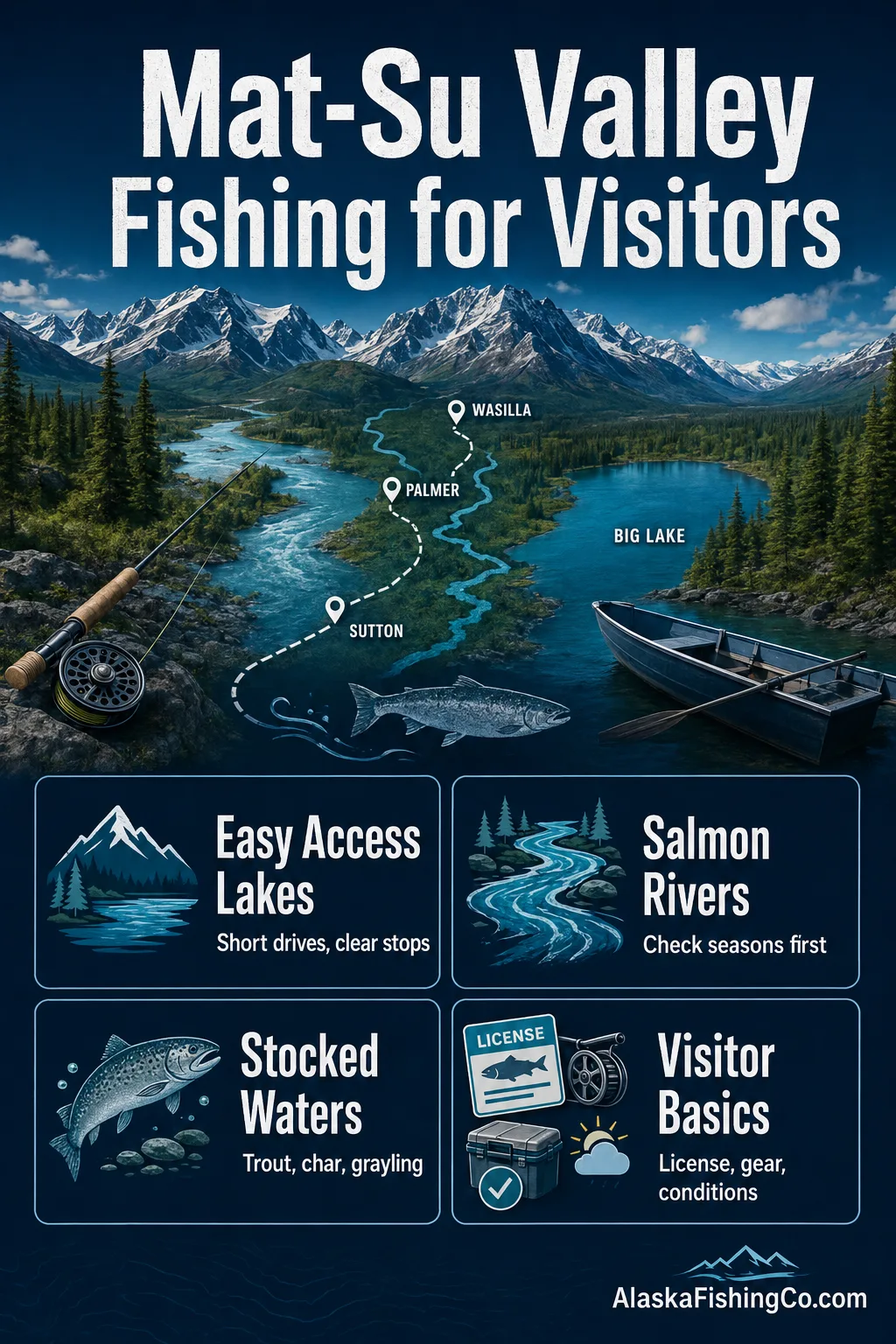
Mat-Su Valley fishing is best planned by waterbody, not by town: a stocked lake near Palmer, a Parks Highway salmon stream, and a remote Susitna tributary can all have different rules on the same day. Visitors can fish here with an Alaska sport fishing license, but salmon species, emergency orders, bait rules, and access style decide what is actually legal and practical.
For most visitors, the safest plan is simple: buy the correct nonresident license, check the Mat-Su emergency orders before fishing, then choose water that matches your time, gear, and comfort level. A lake near Wasilla is very different from a boat trip on the Susitna system.
If you remember one thing… Mat-Su fishing is not one single rule area. Always check the exact river, creek, lake, date, and species before you cast.
What To Know First
- Nonresidents age 16 and older need an Alaska sport fishing license to participate in sport fishing.
- A king salmon stamp is needed if you fish for king salmon, except for king salmon in stocked lakes.
- Emergency orders can close a fishery, change bag limits, or change allowed gear.
- Stocked lakes are often the easiest choice for families and short visits.
- Parks Highway streams can be good, but they often carry tighter salmon and trout rules.
- Some dipnet and personal use fisheries are for Alaska residents only.
Do Visitors Need a License to Fish in Mat-Su Valley?
Yes. Nonresident visitors age 16 or older need an Alaska sport fishing license to fish in Mat-Su Valley. This applies whether you are fishing from shore, fishing with a guide, casting from a boat, or helping someone actively fish.
Alaska treats foreign visitors and out-of-state U.S. visitors as nonresidents for normal sport fishing license purposes. A guide can help with access and local tactics, but the guide does not replace your license. If you are the person fishing, you need your own valid license.
ADF&G states that nonresidents age 16 or older must purchase and possess a sport fishing license, and that a king salmon stamp is required to fish for king salmon except in stocked lakes.[a]
- Adults visiting from another state: buy a nonresident sport fishing license.
- Foreign visitors: buy the nonresident/foreign visitor license option offered by ADF&G.
- Children under 16 who are nonresidents: usually do not need a sport fishing license, but harvest record rules can still matter for certain fisheries.
- Anyone targeting king salmon: check whether a king salmon stamp and harvest recording apply.
Worth Noting
A license lets you fish only where fishing is open. It does not override a closed stream, a bait ban, a single-hook rule, a salmon closure, or a private-property access issue.
Mat-Su Valley License Costs for Nonresident Visitors
Most visitors choose a short-term nonresident license based on the number of fishing days in the trip. If king salmon is part of the plan, the king salmon stamp usually needs to match the same fishing window.
Current ADF&G nonresident sport fishing license prices list 1-day, 3-day, 7-day, 14-day, and annual options. Foreign visitor pricing follows the same listed sport fishing license amounts for these common durations.[b]
| Visitor Plan | Sport Fishing License | King Salmon Stamp | Best Fit |
|---|---|---|---|
| One fishing day | 1-day nonresident license | 1-day stamp if fishing for king salmon | A guided day, a quick lake trip, or one salmon outing |
| Long weekend | 3-day nonresident license | 3-day stamp if fishing for king salmon | Visitors staying in Palmer, Wasilla, or Talkeetna for a short trip |
| One-week Alaska trip | 7-day nonresident license | 7-day stamp if fishing for king salmon | A road trip with several Mat-Su stops |
| Two-week stay | 14-day nonresident license | 14-day stamp if fishing for king salmon | Visitors mixing Mat-Su fishing with Kenai, Anchorage, or Interior waters |
| Many trips in one year | Annual nonresident license | Annual stamp if fishing for king salmon | Repeat visitors or long seasonal stays |
Buy before you fish. A digital copy may be convenient, but visitors should make sure the license can be shown in the field, even where cell service is weak.
Where Mat-Su Valley Fishing Fits in Alaska
The Mat-Su Valley sits inside the Northern Cook Inlet sport fishing area. This region includes the Susitna River drainage, Little Susitna River, Knik River, Matanuska River, many Parks Highway streams, and a large number of lakes.
ADF&G describes the Northern Cook Inlet area as a large freshwater sport fishing region with salmon streams, rainbow trout, Arctic grayling, Dolly Varden, stocked lakes, landlocked salmon, Arctic char, and widespread northern pike in some waters.[c]
- Palmer and Wasilla area: good base for stocked lakes, family fishing, and short trips.
- Parks Highway corridor: access to Willow Creek, Montana Creek, Kashwitna River, Sheep Creek, and other stream systems.
- Talkeetna area: access to the Talkeetna, Chulitna, and Susitna river systems, often with boat or guide help.
- Remote westside Susitna waters: better for guided trips, jet boats, float trips, or fly-in planning.
One Detail People Miss
Roadside access does not always mean public shoreline access. Some lakes and stream banks include private property, limited parking, or access only within a road right-of-way.
Best Fish Species for Visitors to Target
The best Mat-Su target species depends on the month, the waterbody, and the visitor’s experience level. Salmon attract the most attention, but stocked trout lakes are often more forgiving for first-time Alaska visitors.
Rainbow Trout and Arctic Char
Stocked lakes around Palmer, Wasilla, and the Matanuska Lakes area can be good choices for visitors who want a shorter outing. These waters are easier to plan than remote rivers and often work well with spinning gear or simple fly gear.
ADF&G’s stocking program places rainbow trout, Arctic char, and landlocked salmon in many Southcentral and Interior lakes, including Mat-Su waters.[d]
Coho Salmon
Coho salmon are a main late-summer draw. Many visitors look toward August and early September for coho opportunities in places such as Little Susitna, Willow Creek, Montana Creek, Talkeetna-area waters, and other Susitna drainage streams.
Coho runs can vary with water levels, rain, closures, and run strength. In 2026, ADF&G prohibited retention of coho salmon 16 inches or greater in the Susitna and Little Susitna River drainages from August 19 through December 31. Bait is also prohibited in flowing waters of both drainages during that action, with only artificial lures allowed.[i]
That means a late-season visitor should not rely on the usual August or September coho pattern without checking the current emergency order first.
King Salmon
King salmon rules are the easiest place for visitors to make a mistake. In 2026, ADF&G closed king salmon fishing in the Susitna and Little Susitna drainages from May 1 through July 13, including no targeting or retention and immediate release without removing incidentally caught king salmon from the water.[e]
Those 2026 Susitna and Little Susitna king salmon closures expired July 13. They should not be read as a current late-season closure, though the normal regulations and any later emergency orders still control the exact water and date.
That does not mean every nearby king salmon opportunity is always closed. For example, the Eklutna Tailrace has separate rules and can appear in ADF&G reports as an open king salmon option when conditions allow. Treat it as its own fishery, not as a general Mat-Su rule.
Northern Pike
Northern pike are present in many Mat-Su waters. They can be accessible in lakes and slow sloughs, but the rules and handling expectations can differ from trout and salmon. Visitors should read the local regulation page for the exact water before fishing for pike.
Good Mat-Su Fishing Areas for Short Visits
Short visits usually work best when access is simple and the goal is realistic. A stocked lake, a public-use facility, or a guided river trip is easier to manage than trying to solve a remote tributary in one afternoon.
- Matanuska Lakes area: a practical choice for stocked trout and family-style fishing near Palmer.
- Finger Lake, Lucile Lake, and other Wasilla-area lakes: useful for visitors staying near town.
- Willow Creek area: popular Parks Highway access, but visitors must read stream-specific rules.
- Montana Creek: a known Parks Highway fishing stop, especially for later salmon timing.
- Little Susitna River: productive in the right season, but closures and gear rules matter.
- Talkeetna area: better for visitors using guides, boats, or planned river access.
For stocked lake planning, ADF&G’s Mat-Su stocked lakes material lists many lakes with species, access notes, stocking information, and cautions about limited public access or private shoreline.[f]
Before You Move On
If the trip includes children, limited mobility, or only a few hours, start with a stocked lake. If the trip is built around salmon, start with the current Mat-Su fishing report and emergency orders.
How Seasons Change the Visitor Plan
Mat-Su fishing changes fast through the open-water season. A good plan in June may be the wrong plan in August, and a stream that looks perfect from the road may be under a closure or gear limit.
- May and early June: stocked lake fishing often becomes a safer visitor choice as roads and lake access improve.
- June: king salmon normally shapes many historic Mat-Su plans, but current closures can remove that option from major drainages.
- July: trout, grayling, lake fishing, and some salmon planning become more practical depending on waterbody rules.
- August: coho salmon is normally a major focus in many Mat-Su streams, but in 2026 retention of coho 16 inches or greater in the Susitna and Little Susitna drainages was prohibited beginning August 19.
- September: trout and Dolly Varden opportunities may remain, but the 2026 Susitna and Little Susitna coho no-retention order continues through December 31; rain, water level, and other closures still matter.
- Winter: ice fishing exists on some lakes, but visitors need local ice safety knowledge and current conditions.
ADF&G’s Southcentral regulation pages tell anglers to check regional rules, then the exact drainage or area, and to review emergency orders because they override the printed regulations.[g]
Online Purchase Steps for Visitors
Visitors can usually buy an Alaska sport fishing license online through ADF&G before arriving or shortly before fishing. The main step is choosing the correct residency status, duration, and stamp needs.
- Choose nonresident unless you meet Alaska residency requirements.
- Select the license duration that covers every day you may fish.
- Add a king salmon stamp if you will fish for king salmon in waters where a stamp is required.
- Save a digital copy and bring a printed copy if your trip includes weak cell service.
- Check the current Mat-Su fishing report and emergency orders on the day before fishing.
- Carry a pen or know how to record harvest digitally when harvest recording applies.
Do not wait until you are standing at a remote boat launch with poor service. Buying earlier also gives you time to check whether the water you planned to fish is open.
Common Mistakes Visitors Make
Most Mat-Su fishing mistakes come from assuming Alaska rules are broad and simple. They are not. The exact water and species matter.
“A license means I can fish any open-looking river.”
Correct explanation: A license is only the starting point. Rivers and creeks can have closures, hook limits, bait bans, seasonal restrictions, and species-specific rules.
Why it gets confused: Many visitors see public road access and assume the fishery is open under the general license.
“If I am not keeping king salmon, I can still cast for them.”
Correct explanation: If king salmon fishing is closed, targeting them can also be closed. In some closures, incidentally caught kings must be released immediately without removing them from the water.
Why it gets confused: Some places allow catch-and-release, while others close targeting completely.
“A guide covers my license.”
Correct explanation: A guide may help you buy the right license, but each angler needs the required personal license and stamp.
Why it gets confused: Charter and guide packages often include gear and logistics, so visitors assume paperwork is included too.
“Personal use fishing is the same as sport fishing.”
Correct explanation: Personal use and dipnet fisheries can have separate resident-only rules. Visitors should not assume they can join a dipnet fishery just because it is open.
Why it gets confused: Dipnet openings are widely discussed during salmon season, but many are not meant for nonresident visitors.
“All stocked lakes have the same bag limit.”
Correct explanation: Stocked lakes are often simpler, but visitors still need to check the specific lake, species, and current regulation.
Why it gets confused: Stocked lakes feel casual, especially when they are close to town.
Real-Life Visitor Scenarios
These examples show how a Mat-Su fishing day can change depending on trip style, species, and timing.
- A family staying in Wasilla for one afternoon: A stocked lake is usually easier than a salmon stream because access, gear, and timing are simpler.
- A visitor hoping for king salmon in early July 2026: Check emergency orders first, because major Susitna and Little Susitna king salmon closures can remove historic options.
- A couple driving the Parks Highway to Talkeetna: Willow Creek or Montana Creek may look easy from the road, but stream-specific salmon and trout rules still apply.
- A fly angler wanting rainbow trout: Parks Highway streams can be appealing, but seasonal closures and catch-and-release waters must be checked before fishing.
- A guided jet boat trip from the Susitna system: Confirm what species the guide is targeting and whether any emergency order changed the plan.
- A foreign visitor buying online the night before: Choose the nonresident license and add a king salmon stamp only if the planned fishery legally requires and allows king salmon fishing.
- A visitor invited to dipnet: Ask whether the fishery is personal use and resident-only before participating.
- A road-tripper with no cooler space: Catch-and-release trout or stocked lake fishing may fit better than salmon harvest planning.
Check the Latest Mat-Su Report
ADF&G Mat-Su reports can mention current run timing, suggested waters, lake stocking, and closures. Read them close to your trip date, not weeks before.
What to Check Before You Cast
Before fishing in Mat-Su Valley, check four things: license, species, waterbody, and emergency order. This order prevents most visitor mistakes.
- License: Is everyone who needs a nonresident license covered?
- Stamp: Is anyone fishing for king salmon in a fishery where a stamp is required?
- Water: Are you on the correct lake, creek section, river mile, or drainage?
- Species: Are you fishing for salmon, trout, grayling, char, pike, or landlocked fish?
- Gear: Are bait, multiple hooks, treble hooks, or single-hook artificial lures allowed?
- Harvest: Do you need to record a retained fish immediately?
- Access: Are you on public land, a public easement, a boat launch, or private shoreline?
Emergency orders are especially important because they can be issued during the season and have the force of law. ADF&G says anglers should check the emergency order site before going fishing because it is updated often.[h]
Mat-Su Valley Fishing Questions Answered
Do tourists need a fishing license in Mat-Su Valley?
Yes. Nonresident tourists age 16 or older need an Alaska sport fishing license to fish in Mat-Su Valley. A king salmon stamp may also be needed if they fish for king salmon.
Can foreign visitors buy an Alaska fishing license online?
Yes. Foreign visitors can buy Alaska nonresident sport fishing licenses online through ADF&G. They should choose the correct nonresident or foreign visitor option and carry proof while fishing.
Is Mat-Su Valley good for beginner fishing?
Yes, especially around stocked lakes near Palmer and Wasilla. Beginner visitors should be more cautious with salmon streams because closures, bait rules, and species limits can change by drainage.
Can visitors fish for king salmon in Mat-Su Valley in 2026?
Only where king salmon fishing is open under current regulations and emergency orders. The main 2026 Susitna and Little Susitna drainage king salmon closures ran from May 1 through July 13 and have expired, but visitors still need to check the exact fishery for any later rule or separate local restriction before planning around kings.
What is the easiest Mat-Su fishing option for a short trip?
A stocked lake near Palmer or Wasilla is usually the easiest option. It avoids many river-access issues and can be fished with simple gear, though lake-specific rules still apply.
Are Mat-Su dipnet fisheries open to tourists?
Often no. Some dipnet and personal use fisheries are limited to Alaska residents. Visitors should treat dipnetting as separate from normal sport fishing and verify eligibility before participating.
Should visitors hire a fishing guide in Mat-Su Valley?
A guide can be useful for salmon rivers, jet boat access, remote waters, and first-time Alaska anglers. Even with a guide, each angler still needs the required license, stamp, and harvest record compliance.
Mat-Su Valley can be a very good fishing area for visitors when the plan matches the water, species, and current rules. The most common mistake is treating all Mat-Su salmon streams as if they follow one simple rule. The easy rule to remember is this: license first, emergency orders second, exact waterbody third, then cast.
Alaska Fishing References
- [a] Sport Fishing Licenses and King Salmon Stamps — Used for nonresident age rules, license requirement, king salmon stamp requirement, and harvest record context. (Official Alaska Department of Fish and Game licensing page.)
- [b] License, Stamp, and Tag Pricing List — Used for current nonresident sport fishing license and king salmon stamp duration options and prices. (Official Alaska Department of Fish and Game pricing page.)
- [c] Northern Cook Inlet Management Area Fishing Information — Used for Mat-Su regional waters, fish species, stocked lake context, and Susitna drainage access patterns. (Official ADF&G regional fishing information.)
- [d] Fish Stocking Search — Used for stocked trout, Arctic char, and landlocked salmon context in Southcentral lakes. (Official ADF&G hatcheries and stocking database.)
- [e] Susitna and Little Susitna River Drainages Closed to King Salmon Fishing — Used for 2026 king salmon closure and gear restriction details. (Official ADF&G emergency order announcement.)
- [f] Fishing Mat-Su Valley Stocked Lakes — Used for stocked lake access, species, and lake-planning context. (Official ADF&G Mat-Su stocked lakes publication.)
- [g] Southcentral Alaska Sport Fish Regulations — Used for the rule that anglers should check region-wide rules, drainage-specific rules, and emergency orders. (Official ADF&G sport fishing regulations page.)
- [h] Emergency Orders and Press Releases — Used for how emergency orders can open, close, or modify sport fisheries and why anglers should check current updates. (Official ADF&G emergency order page.)
- [i] Susitna and Little Susitna River Drainages No Retention of Coho Salmon — Used for the August 19-December 31, 2026 prohibition on retaining coho salmon 16 inches or greater and the flowing-water bait restriction. (Official ADF&G emergency order announcement.)