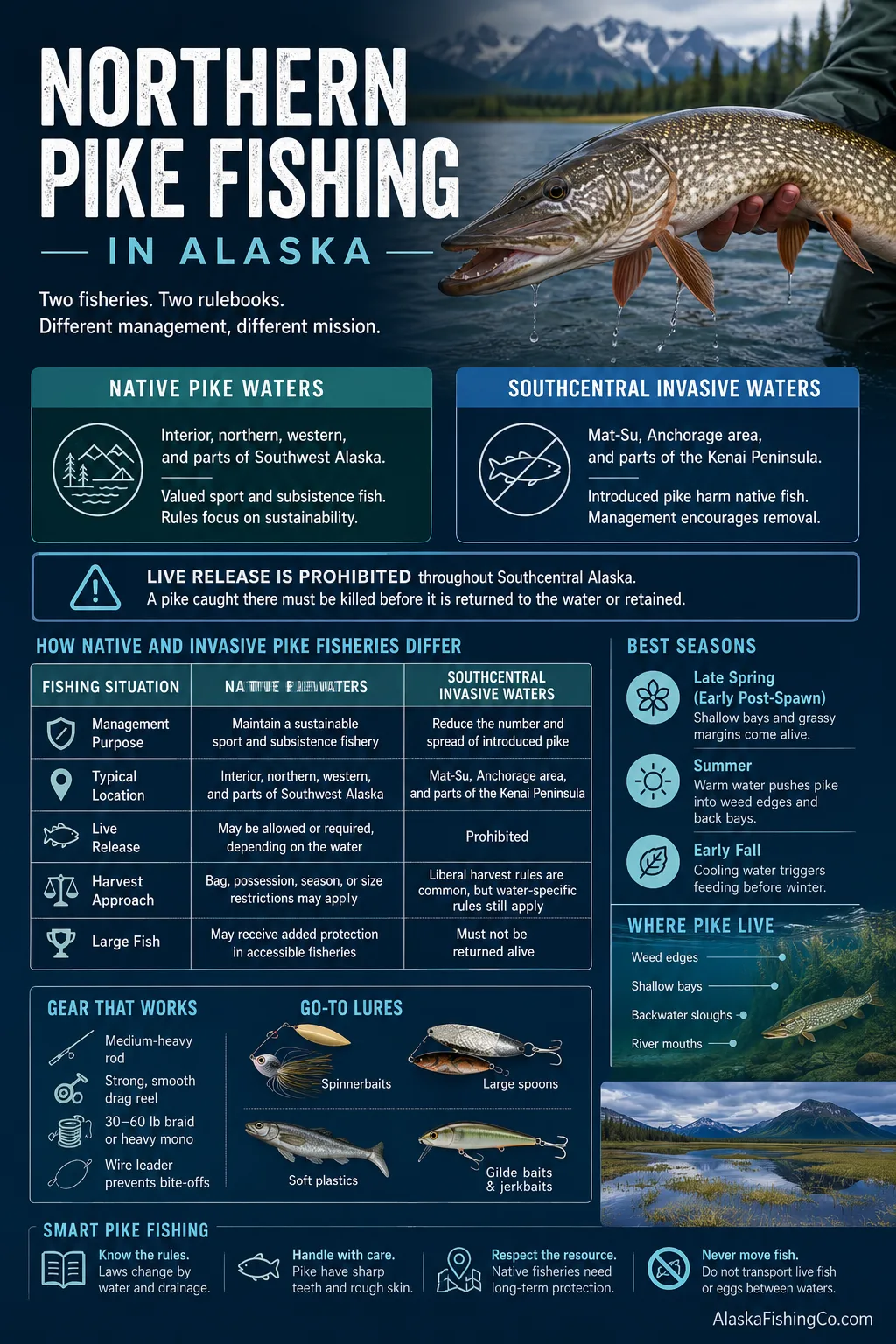
Northern pike fishing in Alaska changes completely depending on which side of the Alaska Range you fish. Pike are native sport and subsistence fish across much of northern, western, Interior, and Southwest Alaska. In Southcentral Alaska, introduced pike are invasive, and releasing one alive is prohibited. That distinction affects destination choice, harvest rules, fish handling, and the regulation booklet an angler must read.
Productive pike water can range from a roadside Interior lake to a remote Yukon River backwater reached by floatplane. The fishing is often shallow and visual, but success depends on matching the season, vegetation, water depth, and lure speed. Visitors also need to prepare for sharp teeth, cold water, limited access, and rules that may change from one lake or drainage to the next.
Alaska Has Native and Invasive Northern Pike Fisheries
Northern pike are not managed the same way throughout Alaska. In their natural range, they are valued fish that may be protected by seasons, size limits, reduced bag limits, or catch-and-release rules. In Southcentral waters, management generally encourages removal because introduced pike prey on salmon, trout, and other native fish.
- Native range: Much of Interior, northern, western, and Southwest Alaska.
- Introduced range: The Matanuska-Susitna Valley, Anchorage-area waters, and parts of the Kenai Peninsula.
- Main practical difference: Releasing a pike may be proper in one lake and illegal in another.
Native Pike in Interior, Northern, and Western Alaska
Alaska’s natural pike range extends from the Interior to the Arctic coast, west toward the Seward Peninsula, and southwest into Bristol Bay drainages. Most of these fisheries are away from roads and large communities. Remote populations are generally stable, while heavily used roadside or easily reached waters can show fewer large fish.
Pike spawn soon after ice-out, using grassy lake margins, sloughs, and slow-moving streams. Fish near 20 pounds occur in some Alaska waters, and the state sport-fishing record is a 38-pound pike from the Innoko River. Large fish may be more than a decade old, which explains why some native fisheries use restrictive harvest rules to preserve their age and size structure.[a]
Invasive Pike in Southcentral Alaska
Pike do not naturally belong in most Southcentral waters. Illegal introductions allowed them to spread through lakes, creeks, sloughs, and connected river systems. Shallow vegetation and low-flow habitat give pike excellent ambush cover, while juvenile salmon and trout provide vulnerable prey.[b]
Live release is prohibited throughout Southcentral Alaska. A pike caught there must be killed before it is returned to the water or retained for use. Anglers must never move a live pike, another fish, or fish eggs between water bodies.[c]
Do not apply one release policy across Alaska. Check whether the water holds a native or introduced population, then read the named drainage or lake regulation. A conservation-minded release in a native fishery can be appropriate, while the same action in Southcentral Alaska can violate the law.
| Fishing Situation | Native Pike Waters | Southcentral Invasive Waters |
|---|---|---|
| Management purpose | Maintain a sustainable sport and subsistence fishery | Reduce the number and spread of introduced pike |
| Typical location | Interior, northern, western, and parts of Southwest Alaska | Mat-Su, Anchorage area, and parts of the Kenai Peninsula |
| Live release | May be allowed or required, depending on the water | Prohibited |
| Harvest approach | Bag, possession, season, or size restrictions may apply | Liberal harvest rules are common, but water-specific rules still apply |
| Large fish | May receive added protection in accessible fisheries | Must not be returned alive |
Choosing an Alaska Pike Destination
The right destination depends on whether the goal is road-access fishing, a remote native fishery, a trophy-oriented trip, or harvest of invasive pike. A famous river name is less useful than knowing the access method, habitat, local rules, and amount of time available.
- Choose the Interior for a mix of road, boat, and remote native-pike options.
- Choose western Alaska for large river systems and fly-out fishing.
- Consider parts of Southwest Alaska when adding pike to a Bristol Bay fishing trip.
- Choose Southcentral only with a clear understanding of invasive-pike harvest rules.
Interior Alaska
Interior Alaska offers some of the most practical native-pike fishing for visitors. The Tanana River drainage contains lakes, slow tributaries, sloughs, backwaters, and broad wetland systems such as Minto Flats. Some locations can be reached by road or a short boat trip, while others require local transport or a fly-out.
Interior waters should not be treated as one fishery. A lake may be catch-and-release only, while a nearby drainage permits harvest under a season and size restriction. Accessible populations can receive considerable fishing pressure, making water-specific rules especially important.
Western Alaska
Western Alaska holds extensive native habitat in Yukon and Kuskokwim river systems. Pike use oxbow lakes, flooded margins, tributary mouths, side channels, and slow backwaters. Many of these places are beyond the road system and require a charter flight, lodge transfer, riverboat, or a planned wilderness route.
A remote trip offers more water and less fishing pressure, but it also adds:
- Aircraft baggage and lure-weight limits
- Weather delays
- Limited replacement tackle
- No immediate access to fuel, ice, or medical help
- A need for reliable communication equipment
Southwest Alaska and Bristol Bay Drainages
Northern pike occur naturally in parts of Southwest Alaska, including Bristol Bay drainages. Pike may be an additional target on a trip planned around salmon, rainbow trout, Arctic char, or Dolly Varden. They are commonly associated with sheltered bays, connected lakes, and slower sections away from the main current.
Do not assume that tackle packed for trout will handle large pike. Light leaders can be cut immediately, and small landing nets may be difficult to use around a long, heavily hooked fish.
Southcentral Alaska
Southcentral pike fishing is primarily a removal fishery. Opportunities occur in parts of the Susitna system, Mat-Su waters, West Cook Inlet, and other connected areas where introduced populations remain. Some former pike lakes have undergone eradication work, so an old fishing report may no longer describe current conditions.
Before selecting a Southcentral destination, confirm:
- Whether pike are currently documented in that water
- Whether public access is legal and practical
- The current bag and possession language
- Permitted fishing gear
- How a caught pike must be dispatched or disposed of
| Trip Style | Best Suited To | Main Limitation |
|---|---|---|
| Road-access lake | Short visits, shore fishing, kayaks, and small boats | More fishing pressure and limited shoreline access |
| River or slough boat trip | Covering several habitat types in one day | Shallow water, submerged wood, weeds, and changing river levels |
| Fly-out lake | Remote native populations and longer fishing sessions | Higher cost, weather delays, and aircraft weight limits |
| Lodge-based trip | Visitors who need transport, boats, meals, and local instruction | Fixed schedules and less control over daily destination choice |
| Southcentral harvest trip | Fishing for introduced pike under liberal harvest rules | Live release is prohibited, and disposal must remain lawful |
When Northern Pike Are Most Catchable
Pike can be caught during open water and through the ice, but their location changes with ice-out, spawning, vegetation growth, water temperature, and prey movement. Conditions matter more than choosing a single “best” calendar month for all of Alaska.
- Ice-out: Focus on shallow spawning habitat and warming bays.
- Early summer: Cover weed edges, creek mouths, and connected channels.
- Midsummer: Fish low-light periods and the outer edge of dense vegetation.
- Fall: Work deeper transitions and prey routes.
- Winter: Set up near vegetation-to-basin transitions where permitted.
Ice-Out and the Spawning Period
Pike move toward grassy shorelines, flooded vegetation, marshy margins, and slow channels soon after the ice leaves. Water is cold, and fish may respond better to a spoon, streamer, or suspending lure worked with long pauses.
Spring conditions can differ sharply between a low-elevation Interior lake and a northern or remote water body. Never use a calendar date as proof that remaining ice is safe. Shore ice, river mouths, springs, and moving water can weaken before the rest of a lake.
Post-Spawn Fishing
Post-spawn pike often remain close to shallow cover before spreading into summer feeding areas. This period can provide active fishing because fish are accessible and aquatic vegetation has not yet become too dense.
Useful starting points include:
- The first emerging weed line
- Small creek or drainage mouths
- Dark-bottomed bays that warm faster
- Channels between a lake and adjacent wetland
- The outside edge of spawning flats
Summer Weed-Bed Fishing
During summer, pike commonly hold within vegetation, beside it, or in open pockets between weed clumps. Early morning, evening, cloudy periods, and wind-driven shorelines may produce better shallow activity than bright midday conditions.
Do not cast only at visible shoreline weeds. Larger fish may sit along the deeper outside edge, especially when shallow water becomes warm. A boat, kayak, or sonar can help locate the depth where healthy vegetation ends.
Fall Feeding
As vegetation dies back and water cools, pike may shift toward drop-offs, creek mouths, deeper weed edges, and routes used by schooling prey fish. Larger jerkbaits, swimbaits, spoons, and weighted flies can be worked more slowly with clear pauses or direction changes.
Ice Fishing
Winter pike fishing commonly uses tip-ups or short jigging rods near remaining vegetation and nearby depth changes. The productive depth can shift as oxygen levels decline in shallow, ice-covered lakes, so an unproductive shoreline set may need to be moved toward deeper water.
Before drilling holes, verify:
- The number of lines permitted in that water
- Whether a pike-specific ice-fishing exception applies
- The allowed number and arrangement of hooks
- Whether bait is permitted
- Current ice thickness along the entire travel route
| Seasonal Phase | Likely Holding Water | Useful Presentation |
|---|---|---|
| Ice-out | Flooded grass, shallow bays, and protected channels | Slow spoon, suspending jerkbait, or streamer with long pauses |
| Post-spawn | New weed growth, creek mouths, and flat edges | Spinner, spoon, jerkbait, or unweighted streamer |
| Midsummer | Dense cover, open weed pockets, and outer weed lines | Weed-resistant spoon, spinnerbait, soft plastic, or surface lure |
| Fall | Drop-offs, remaining vegetation, and prey routes | Large swimbait, deep jerkbait, spoon, or weighted streamer |
| Ice season | Vegetation-to-basin transitions | Closely attended tip-up or vertical jig where legal |
How to Find Pike in Alaska Water
Pike are ambush predators. The highest-percentage locations usually combine cover, slower water, nearby prey, and a route between shallow and deeper habitat. Random casts across the middle of a featureless lake are rarely the best starting method.
- Begin with vegetation and its outside edge.
- Check slough entrances and backwater connections.
- Fish creek mouths from several angles.
- Look for depth changes close to shallow feeding water.
- Follow wind when it pushes prey toward one shoreline.
Shallow Vegetated Bays
Protected bays with grass, pondweed, reeds, or lily growth provide both cover and prey. Cast into open lanes, beside isolated weed clumps, and along the outer edge. A pike may follow a lure from deep in the vegetation before striking near the boat.
When the weeds reach the surface, use a lure that rides over or through cover. When vegetation is submerged, a spoon, swimbait, or streamer can be worked just above it.
Sloughs, Backwaters, and Oxbow Lakes
Alaska river systems contain many low-current side waters where pike can hold without fighting the main flow. Productive features include a narrow entrance, a deep outside bend, submerged wood, a clearer-water seam, or a channel leading into a marsh.
River levels can change access and fish position. High water may spread pike across flooded vegetation. Low water can concentrate fish in the remaining channels but make navigation difficult.
Creek Mouths and Drainage Connections
A small inlet or outlet creates a natural travel route. Moving water can carry prey, change temperature, or provide a deeper slot through a shallow flat. Cover the mouth, both sides of the current seam, and the nearby drop rather than making one cast directly upstream.
Deep Weed Edges and Drop-Offs
Large fish do not always remain in ankle-deep water. During bright or warm conditions, work the first dependable drop beyond the weed line. With sonar, look for the height and outer boundary of vegetation rather than searching only for individual fish marks.
Tackle That Handles Alaska Pike
Pike tackle must cast bulky lures, control a fish near weeds or wood, and resist sharp teeth. A balanced medium or medium-heavy setup handles many Alaska situations, while remote trophy water or very large lures may justify heavier equipment.
- Use a steel, titanium, or other purpose-built bite leader.
- Carry long-nose pliers and a strong hook cutter.
- Match the rod and reel to the lure weight.
- Bring a net large enough for a long fish.
- Inspect leaders and knots after every fish or snag.
Spinning and Baitcasting Gear
ADF&G’s basic pike setup uses a 6.5- to 8.5-foot medium or medium-heavy rod, 8- to 20-pound line, and a steel or titanium leader. Suggested lure types include spoons, spinners, jigs, and large flies.[d]
That setup suits many roadside and average-size fish situations. For heavy weeds, large swimbaits, or remote water known for larger pike, many anglers choose stronger line and a rod rated for the actual lure weight. The aim is to land the fish without a prolonged fight or broken tackle.
Fly-Fishing Gear
An 8- or 9-weight fly rod is a practical starting point for large streamers and surface patterns. A floating line covers shallow bays, an intermediate line works over submerged weeds, and a sink-tip reaches deeper fall edges.
A fly setup should include:
- A short, strong leader with a bite-resistant final section
- Streamers that shed water easily enough to cast repeatedly
- A stripping guard or finger protection
- Enough clear space behind the caster
- A hook file and cutters
Ice-Fishing Gear
A closely attended tip-up can present bait while a short medium-heavy rod allows active jigging. Both need a bite leader. Prepare the landing area before a fish arrives, especially when a large pike must be turned and guided through a small hole.
Keep pliers, cutters, gloves, and a measuring tool within reach. Searching through a tackle bag while a hooked pike lies on the ice increases handling time and the chance of an injury.
Lures, Flies, and Retrieve Patterns
Pike respond to profile, vibration, movement, and changes of direction. Color matters, but depth control and retrieve speed usually deserve attention first. A lure that stays above the weeds and remains visible to the fish is more useful than one that constantly collects vegetation.
- Use spoons and spinners to cover open or lightly vegetated water.
- Use spinnerbaits and weed-resistant lures in thicker cover.
- Use jerkbaits when pauses and direction changes are needed.
- Use swimbaits along deeper edges.
- Use streamers, poppers, and frog or mouse patterns with fly tackle.
| Condition | First Choice | Adjustment |
|---|---|---|
| Cold, clear water | Suspending jerkbait or natural-color streamer | Lengthen pauses and reduce speed |
| Stained slough | Spinnerbait, vibrating lure, or bright spoon | Add vibration and a stronger silhouette |
| Heavy vegetation | Weed-resistant spoon, spinnerbait, or soft plastic | Keep the lure high and stop it in open pockets |
| Active surface fish | Popper, walking bait, frog, or mouse pattern | Wait until the fish takes the lure before setting the hook |
| Deep fall edge | Large swimbait, weighted spoon, or sink-tip streamer | Slow the retrieve and maintain depth |
| Pike follows without striking | Jerkbait or streamer | Change direction, pause, or reduce lure size |
Retrieve Along the Weed Edge
Cast parallel to vegetation instead of retrieving straight away from it. A parallel retrieve keeps the lure in productive water longer and can draw several fish from the same edge.
Pause in Open Pockets
When a lure enters an opening between weeds, stop or slow it briefly. Pike often track a lure through cover and attack when it appears vulnerable in clear water.
Change Direction Near the Boat
Do not lift the lure immediately when a pike follows it to the boat. Continue with a wide turn, short sweep, or sudden change of direction while keeping enough line out for the lure to move naturally.
Follow a Missed Surface Strike
A pike that misses a surface lure may remain nearby. Cast back with the same lure at a slower pace or follow with a subsurface jerkbait, spoon, or soft plastic.
Landing and Handling Pike Safely
Pike teeth and exposed hooks make careless landing dangerous for both fish and angler. Organize the net, pliers, cutters, and camera before fishing so the catch can be controlled without reaching near its mouth.
- Use a large rubberized or knotless landing net.
- Keep fingers away from the mouth and gill tissue.
- Cut a badly positioned hook instead of forcing it.
- Support a large fish horizontally.
- Keep air exposure brief when release is legal.
Prepare Before the Strike
A pike with a lure across its mouth can expose several hook points at once. Long pliers provide distance, while cutters allow a treble hook to be separated and removed in sections. A first-aid kit should be accessible rather than packed under other gear.
Use the Net as a Holding Area
When release is permitted, leave the fish partly submerged in the net while tools and a camera are prepared. Do not allow it to thrash across a dry boat floor, rocks, or ice.
Support Large Fish Horizontally
For a brief photograph, control the head without touching the gills and support the belly with the other hand. Avoid hanging a heavy pike vertically from the jaw. Return it to the water promptly where release is permitted or required.
Handling Pike in Freezing Weather
Eyes and gill tissue can be damaged by prolonged exposure to very cold air. Keep a releasable fish in the water as much as possible and prepare the photograph before lifting it.
Alaska Pike Licenses and 2026 Regulations
A valid Alaska sport-fishing license is required for residents age 18 or older and nonresidents age 16 or older. International visitors purchase a nonresident license. A king salmon stamp is not needed when fishing only for northern pike, though it may be required if the same angler also targets king salmon during the trip.[g]
- Carry the license while fishing.
- Match the license dates to every planned fishing day.
- Read the regulation booklet for the correct Alaska region.
- Find the specific drainage, lake, or river entry.
- Check active emergency orders shortly before fishing.
There is no single statewide northern pike limit. A rule from one lake, drainage, or region cannot be transferred to another water. The printed regional rule, special water entry, and active emergency orders must be read together.
2026 Southcentral Example: West Cook Inlet
The 2026 West Cook Inlet regulations list northern pike as an invasive species, open year-round with no limit. Live release is prohibited. Pike may be taken with sport-fishing gear, ice gear, spear, or an attached bow-and-arrow setup. Five-line ice fishing is permitted only in named waters and only under the conditions printed in that section.[e]
This is a regional example, not a statewide rule. A five-line provision in one named Southcentral water does not authorize five lines elsewhere.
2026 Northern Alaska Examples
Changes adopted for the 2026 Tanana River drainage show how different native-pike rules can be within one general area.[f]
| Water | 2026 Rule | What It Means |
|---|---|---|
| Harding Lake | Catch-and-release fishing allowed year-round | Every northern pike must be released |
| Tolovana River drainage | Season open April 15 through October 14 | The season includes waters such as Minto Flats and listed connected drainages |
| Volkmar Lake | Five per day and five in possession; only one may be 30 inches or longer | Both the number and size composition of retained fish matter |
Statewide Methods and Means
Statewide rules provide the starting point, but area rules can modify them. Live fish may not be used as bait in fresh water. Standard ice fishing generally allows two closely attended lines unless a specific pike or burbot provision allows additional gear. Pike may generally be taken by spear unless an area regulation says otherwise. Intentional waste of sport-caught fish is prohibited, and emergency orders can change seasons, limits, or fishing methods with the force of law.[h]
A Practical Regulation Check
Use this order before traveling to the water:
- Identify the exact lake, river, slough, or drainage.
- Select the correct regional regulation booklet.
- Read the region-wide species rules.
- Read the special entry for the named water.
- Check emergency orders for the area.
- Confirm legal gear, line count, season, bag limit, possession limit, and release rule.
- Save the relevant pages where they can be viewed without cellular service.
Planning a Road, Boat, or Fly-Out Pike Trip
Pike often live in shallow, remote, or poorly marked water. Trip planning should account for access, cold-water exposure, weather, navigation, communication, fish storage, and the possibility that a narrow channel becomes difficult to cross after water levels change.
- Wear a personal flotation device while underway and when fishing cold water.
- Carry offline maps and a satellite communication device in remote areas.
- Plan fuel for searching several bays or backwaters.
- Keep fish-cooling equipment ready before harvesting.
- Leave a route and return time with a responsible person.
Road-Access Fishing
Road-access water reduces transportation cost but does not always provide easy shoreline fishing. Private property, marshy banks, dense brush, and aquatic vegetation can limit casting. A legal public launch, kayak, canoe, or small boat may open far more productive water.
Shallow-Water Boats
Sloughs and backwaters may contain submerged logs, mud bars, floating vegetation, and narrow entrances. Reduce speed, keep a spare paddle aboard, and avoid assuming the route used at high water will remain open later in the season.
Fly-Out Fishing
Aircraft limits reward simple tackle choices. Two versatile rod setups, spare leaders, replacement terminal tackle, and a small selection of proven lures are usually more useful than several heavy tackle boxes.
Pack essential equipment in a way that does not leave all fishing gear, medicine, or communication devices in one bag. Weather may change the landing location or delay pickup.
Wildlife and Camps
Do not clean fish beside a sleeping area or leave remains where they attract wildlife. Store food and harvested fish according to local bear-safety practices. Dense vegetation near sloughs can reduce visibility, so make noise when moving between the boat and shore.
Keeping, Cleaning, and Eating Northern Pike
Northern pike have firm white flesh, but rows of Y-shaped bones make ordinary filleting less convenient. Prompt dispatch, bleeding where appropriate, rapid cooling, and a suitable deboning method produce better table fish.
- Dispatch retained fish quickly and humanely.
- Place the fish on ice rather than leaving it in warm shallow water.
- Use a five-fillet method or remove the Y-bone strip from a standard fillet.
- Keep only what can be stored and used properly.
- Follow local fish-consumption advice when pike will be eaten frequently.
Cooling the Catch
A stringer in a shallow summer bay may not keep fish cold enough. Use a cooler with ice or another dependable cooling method. Remote anglers should calculate ice and storage capacity before deciding how many fish to retain.
Working Around the Y-Bones
The Y-bones extend through the upper side of the fillet. Two common options are cutting several boneless sections with a five-fillet method or removing the narrow bone strip after taking a standard side fillet. Either approach takes practice, and a sharp flexible knife reduces wasted meat.
Native and Invasive Harvest Decisions
In a native fishery, retaining smaller legal fish while releasing a large breeding fish may fit local management and personal needs, provided the water’s rules allow release. In Southcentral Alaska, that choice is different because the pike cannot be returned alive.
A no-limit regulation does not authorize waste. Fish should be retained for use or handled through a lawful disposal method stated or allowed by the applicable rules.
Mistakes That Reduce Success or Create Legal Problems
Most pike-fishing problems come from treating every Alaska water the same. The fish may behave similarly, but access, population status, legal gear, harvest rules, and release requirements can change over a short distance.
- Assuming all Alaska pike are invasive: Native populations support valued sport and subsistence fisheries.
- Releasing a Southcentral pike alive: Live release is prohibited.
- Using no bite leader: Pike can cut ordinary line and swim away with hooks attached.
- Fishing only open water: Weed edges, slough entrances, and creek mouths usually deserve attention first.
- Using a small landing net: A long fish may remain outside the net while hooks remain exposed.
- Holding a large fish vertically: Support the body horizontally when a photograph is necessary.
- Relying on an old lake report: Eradication work, seasons, limits, and emergency orders can change an opportunity.
- Assuming “no limit” means no rules: Release, gear, disposal, and waste provisions still apply.
- Checking only the regional species table: A named lake or drainage may have a separate rule.
- Waiting until the boat is launched to read regulations: Cellular service may be unavailable at the water.
Northern Pike Fishing Questions Answered
Are northern pike native to Alaska?
Yes, northern pike are native across much of northern, western, Interior, and Southwest Alaska. They are introduced and invasive in Southcentral areas such as the Mat-Su Valley, Anchorage-area waters, and parts of the Kenai Peninsula.
Where can visitors catch northern pike in Alaska?
Options include Interior lakes and Tanana River backwaters, remote Yukon and Kuskokwim drainages, parts of Bristol Bay, and invasive-pike waters in Southcentral Alaska. Access may be by road, small boat, riverboat, lodge transfer, or floatplane. Current fish presence and regulations should be confirmed for the exact water.
What is the best month for northern pike fishing in Alaska?
There is no single best month statewide because ice-out varies by latitude, elevation, and annual conditions. The period after ice-out and into early summer often provides accessible shallow-water fishing. Summer weed edges, fall drop-offs, and winter ice fishing can also be productive.
Can northern pike be released in Alaska?
It depends on the location. Release may be allowed or required in native fisheries, including catch-and-release-only waters such as Harding Lake under the 2026 rule. A northern pike caught anywhere in Southcentral Alaska may not be released alive.
Do tourists need an Alaska fishing license for pike?
Nonresidents age 16 or older need a valid Alaska sport-fishing license. Foreign visitors use the nonresident license system. A king salmon stamp is not required when fishing only for pike.
Is a steel leader necessary for northern pike?
A bite-resistant leader is strongly advised because pike have sharp teeth that can cut ordinary monofilament or light fluorocarbon. Steel and titanium are common choices. Inspect the leader after every fish.
Can live bait be used for pike in Alaska?
Live fish may not be used as bait for sport fishing in Alaska fresh water. Rules for dead bait, hook arrangement, and ice-fishing gear can vary by region and water.
Are Alaska northern pike good to eat?
Yes. Northern pike have white flesh and can make good table fish when dispatched and cooled promptly. Their Y-bones require a suitable filleting method. Anyone eating pike frequently should review current Alaska consumption advice for the region and size of fish.
Alaska Fishing References
- [a] Alaska Department of Fish and Game — Northern Pike Species Profile — Distribution, spawning, habitat, age, size, and Alaska record information. (Official state fisheries agency species account.)
- [b] Alaska Department of Fish and Game — Invasive Pike in Southcentral Alaska — Native-range distinction, Southcentral habitat, illegal introductions, and effects on salmon and trout. (Official state invasive-fish information.)
- [c] Alaska Department of Fish and Game — Invasive Fish Control and Southcentral Pike Rules — Southcentral live-release prohibition, removal methods, and lawful handling context. (Official state fisheries management source.)
- [d] Alaska Department of Fish and Game — Northern Pike Spin Fishing Setup — Suggested rod, line, leader, and lure ranges for pike fishing. (Official ADF&G tackle publication.)
- [e] Alaska Department of Fish and Game — 2026 West Cook Inlet Sport Fishing Regulations — Northern pike season, limit, live-release rule, permitted harvest methods, and named five-line ice-fishing waters. (Official 2026 regional regulation summary.)
- [f] Alaska Department of Fish and Game — 2026 Tanana River Drainage Regulation Changes — Harding Lake, Tolovana drainage, and Volkmar Lake northern pike changes. (Official state regulation announcement.)
- [g] Alaska Department of Fish and Game — Sport Fishing Licenses and King Salmon Stamps — Resident and nonresident age requirements, purchase methods, and king salmon stamp rules. (Official state licensing source.)
- [h] Alaska Department of Fish and Game — Statewide Sport Fishing Regulations — Live bait, pike gear, ice lines, fish waste, possession, and emergency-order provisions. (Official statewide rules maintained by ADF&G.)