
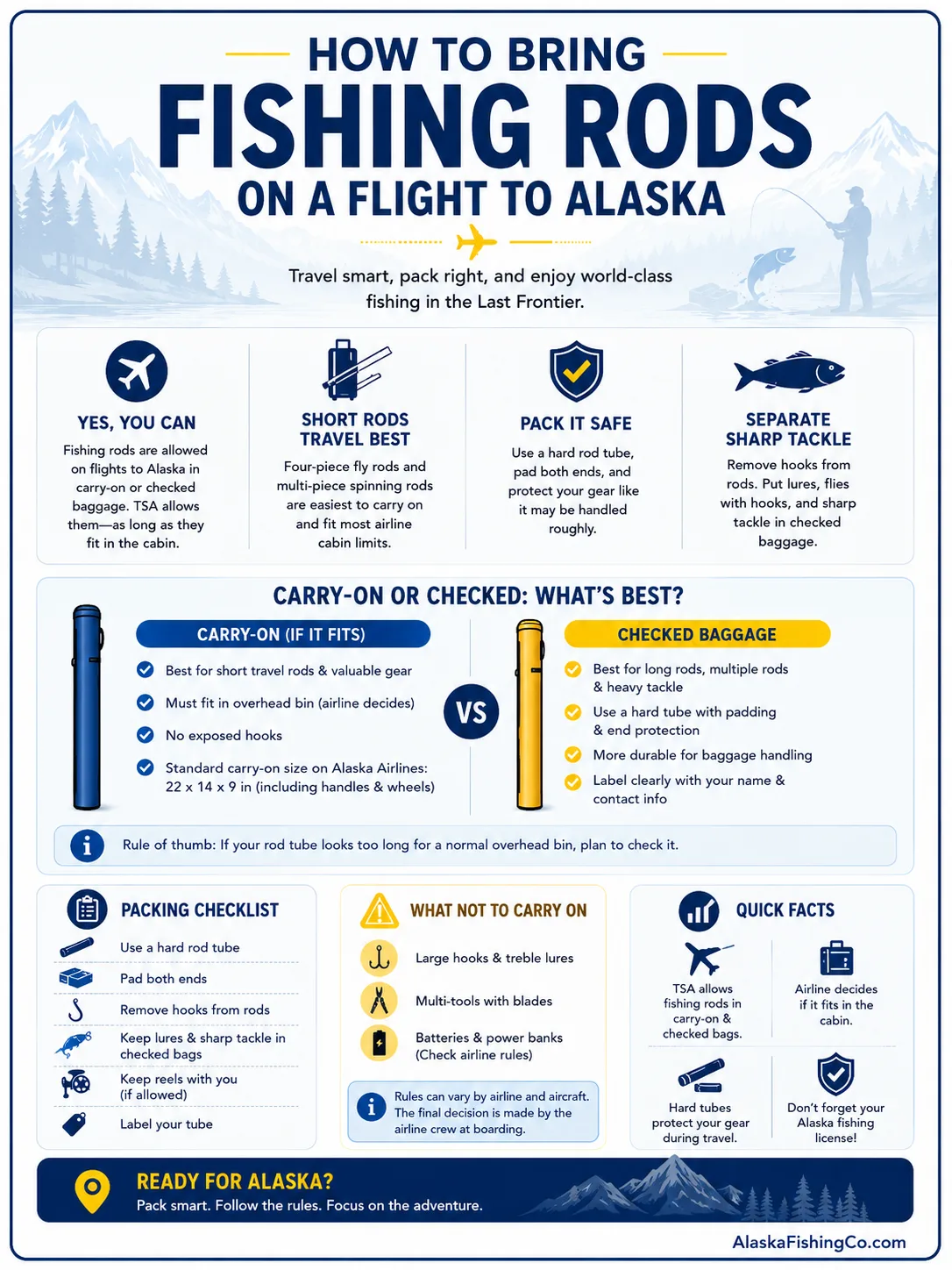
You can bring fishing rods on a flight to Alaska, but the safest plan is to carry a short travel rod in the cabin only if it fits the airline’s cabin rules and to check longer rods in a hard rod tube. TSA allows fishing rods in both carry-on and checked baggage, but the airline decides whether the rod can fit on the aircraft.[a]
For most Alaska trips, the rod itself is not the hard part. The trouble usually comes from long tubes, exposed hooks, treble lures, multi-tools, batteries, and tight overhead bins on full flights. Pack the rod like it may be handled roughly, keep expensive reels with you when allowed, and put sharp tackle in checked luggage.
If you remember one thing… bring a rod that breaks down short, protect it in a tube, and separate sharp tackle from cabin gear before you reach airport security.
What To Know First
- Short travel rods are easiest. Four-piece fly rods and multi-piece spinning rods are much easier to fly with than one-piece or two-piece rods.
- TSA and airline rules are not the same. TSA may allow the rod, but the airline still controls cabin size and stowage.
- Hooks are the gray area. Small flies and small lures are usually easier; large hooks and sharp tackle belong in checked baggage.
- A hard tube is worth using. Soft sleeves are fine in a car, but not enough for a checked rod on a flight to Anchorage, Fairbanks, Juneau, Kodiak, or another Alaska airport.
- Fishing gear does not replace a license. Visitors still need the correct Alaska sport fishing license and any required stamp before fishing.
Can You Bring Fishing Rods on a Plane to Alaska?
Yes. Fishing rods may travel by air to Alaska, either as carry-on or checked baggage, as long as they pass airport screening and fit the airline’s rules for the aircraft. A short rod tube has a better chance in the cabin. A long tube should be checked.
TSA’s rule is simple: fishing poles are permitted in carry-on bags and checked bags. The catch is the second half of the rule. For anything you want to carry on, the airline must agree that it fits in the overhead bin or under the seat. That matters on Alaska routes because many flights are full in summer, and some connecting aircraft have smaller cabin storage.
- Bring a travel rod if you want the cabin option.
- Use checked baggage for long surf rods, salmon rods, and heavy boat rods.
- Do not arrive with exposed hooks tied to the rod.
- Keep the rod tube simple, clean, and clearly labeled.
A good rule is this: if the rod tube looks too long for a normal overhead bin, plan to check it before you leave home.
Carry-On or Checked: Which Option Works Best?
Carry-on works best for compact travel rods and high-value reels. Checked baggage works best for longer rods, multiple rods, saltwater tackle, and gear that would slow you down at security.
The right choice depends on rod length, airline, aircraft, and how much risk you want to take. A four-piece fly rod in a short tube is very different from an eight-foot salmon rod in a long case. For Alaska Airlines, the standard carry-on size is 22 x 14 x 9 inches, including handles and wheels, and special carry-on exceptions exist for some items such as fishing poles; cabin stowage still has to work in practice.[b]
| Option | Best For | Main Risk | Better Packing Choice |
|---|---|---|---|
| Carry-on rod tube | Four-piece fly rods, short travel spinning rods, expensive compact rods | Gate agent or crew may decide there is no safe cabin space | Short rigid tube with no hooks attached |
| Checked rod tube | Long salmon rods, surf rods, multiple rods, heavy saltwater gear | Damage from baggage handling if the tube is weak | Hard tube with internal padding and end protection |
| Rod packed inside checked suitcase | Short rod sections under suitcase length | Pressure from clothing, boots, or other gear | Rod sock plus short hard tube or PVC-style protector |
| Rental or guide-provided gear | First-time visitors, charter trips, travelers with tight connections | Less control over exact rod model and feel | Confirm gear details with the guide before packing |
- Choose carry-on when the rod is short enough and too valuable to risk in the hold.
- Choose checked baggage when the rod is long, awkward, or paired with sharp tackle.
- Choose rental gear when fishing is only one part of a larger Alaska vacation.
Worth Noting
A carry-on rod tube is never fully guaranteed. Even when an item is allowed, the final cabin decision can depend on the aircraft, available bin space, and crew instructions at boarding.
How to Pack a Fishing Rod Tube for Air Travel
A fishing rod should be packed so it can survive pressure, sliding, drops, and baggage belts. A hard tube with padding at both ends is the safest setup for checked rods.
Start by taking the rod apart fully. Wipe the sections dry, remove any terminal tackle, and place each section in a cloth rod sock. If the sections can knock against each other, wrap the thinner tips separately. The tip section is usually the part that breaks first, so give it extra protection.
Checked rod tube packing steps
- Use a rigid tube that does not flex easily when pressed.
- Pad the bottom and top of the tube with foam, cloth, or bubble wrap.
- Face rod tips away from the end most likely to hit the ground.
- Keep rods in socks or sleeves so guides do not rub together.
- Do not overpack the tube with heavy metal tackle.
- Tape or strap the tube cap so it cannot twist open in transit.
- Add your name, phone number, email, and Alaska destination address on the outside and inside.
For a one-way trip into a fishing lodge, include the lodge name and village or city. Alaska itineraries often involve more than one flight, and clear labeling helps if a bag is delayed in Anchorage before a smaller onward flight.
Carry-on rod tube packing steps
- Keep the tube short and clean-looking.
- Do not attach lures, flies, split shot, knives, pliers, or tools to the rod case.
- Carry the reel separately in a padded pouch.
- Board with a plan for where the tube will go, not with the hope that someone else will solve it.
If the gate agent asks to check the tube, stay calm and ask whether it can be gate-checked with fragile handling. That still does not remove all risk, so the better plan is to pack the tube well from the start.
What To Do With Reels, Line, Hooks, and Lures
Pack reels in your carry-on when they are expensive and do not contain anything that may worry security. Pack large hooks, sharp lures, knives, and heavy tools in checked baggage.
Small fishing lures may be allowed through TSA, but sharp fishing tackle that could be seen as dangerous, such as large fish hooks, should be sheathed, wrapped, and packed in checked luggage.[c] Alaska fishing trips often involve large salmon hooks, treble-hook plugs, halibut rigs, jigs, fillet knives, and pliers. Those items are much easier to handle in a checked tackle box than at a checkpoint.
Where to pack common fishing items
- Reels: Carry-on is usually best for high-value reels. Remove loose hooks and secure the handle.
- Fly boxes: Small trout flies are often less of a problem, but large streamers and salmon flies should be checked if the hooks are big.
- Treble-hook lures: Checked baggage is the safer choice.
- Halibut hooks and heavy jigs: Check them, with points covered.
- Line cutters and small scissors: Follow TSA sharp-object rules; when unsure, check them.
- Fillet knives and multi-tools with blades: Checked baggage only, securely wrapped.
- Pliers and forceps: Usually better in checked gear, especially if they are large or sharp-tipped.
Do not pack loose hooks in clothing pockets, reel pouches, or the side pocket of a backpack. A small hard tackle box with individual compartments is cleaner, safer, and easier for inspection.
One Detail People Miss
The rod may pass the rules while the tackle causes the delay. Before leaving for the airport, check every backpack pocket for old flies, spare hooks, split rings, bait knives, and line snips.
Flying Alaska Airlines With Fishing Rods
Alaska Airlines is used by many anglers traveling to the state, but fishing gear still has to be packed properly. The airline’s contract describes one fishing equipment item as two rods, two reels, and one tackle box, and rods that cannot be broken down enough for onboard stowage must be checked in a cylindrical rod container suitable for normal baggage handling.[d]
This does not mean every rod tube will fly for free or fit every situation. Fees and acceptance can depend on fare, route, weight, total dimensions, and whether another airline handles part of the trip. The safest way to read the rule is practical: Alaska Airlines expects long rods to be protected in a proper tube, not carried loose or wrapped in a thin sleeve.
- For a compact fly rod, try carry-on only if the tube is short and cabin stowage is realistic.
- For salmon or halibut rods, use a checked hard tube.
- For multiple rods, keep the count and weight reasonable.
- For mixed-airline tickets, check every carrier on the itinerary, not only the first one.
What about flights operated by regional aircraft?
Some Alaska trips include smaller planes after the main flight. Even if the first leg has generous overhead bins, the next aircraft may not. Long rod tubes are more likely to be checked or handled separately on regional routes, lodge shuttles, air taxis, and float planes.
Call the lodge, charter company, or air taxi before packing a long tube. Ask three plain questions:
- What is the longest rod tube you will accept?
- Is there a weight limit for fishing gear?
- Should rods be checked through or carried to the local operator separately?
International Visitors and Connecting Flights
Foreign visitors can fly to Alaska with fishing rods, but they need to account for both aviation rules and the rules of the country where the first security screening takes place. TSA rules apply at U.S. checkpoints, but your departure airport may have stricter rules for hooks, tools, or rod tubes.
A visitor flying London to Seattle to Anchorage, for example, may face one set of rules in the United Kingdom and another if re-screened in the United States. A visitor flying Vancouver to Anchorage may deal with Canadian screening before boarding. Do not assume that a carry-on lure box accepted in one country will be accepted in another.
- Check the rules for your departure airport, transit airport, and airline.
- Put large hooks and sharp tackle in checked luggage before the first flight.
- Leave space in your checked bag in case security asks you to move an item.
- Do not bring live bait, fish eggs, or organic bait without checking Alaska rules and airline rules first.
International travelers should also clean used gear before packing. Alaska takes aquatic invasive species seriously, and felt-soled wading footwear is not legal for sport fishing in Alaska fresh water. Clean, dry rubber-soled boots are a better choice for a traveling angler.[e]
Before You Move On
Flight approval and fishing approval are separate. A rod tube can legally reach Alaska by air, but that does not mean the gear, bait, footwear, or fishing plan is legal on the water.
Battery-Powered Fishing Gear and Electronics
Keep spare lithium batteries and power banks in your carry-on, not in checked baggage. This matters for anglers carrying rechargeable headlamps, camera batteries, heated gear batteries, electric reel batteries, GPS units, and portable chargers.
The FAA says spare lithium metal and lithium-ion batteries, including portable rechargers and power banks, are prohibited in checked baggage and must stay with the passenger in the cabin. If your carry-on is gate-checked, those spare batteries and power banks must be removed and kept with you.[f]
- Carry spare batteries in original packaging or with terminals protected.
- Do not leave power banks inside a rod tube or checked tackle bag.
- Turn off devices packed in checked luggage and protect them from damage.
- Ask the airline before traveling with large batteries for electric reels or special equipment.
Small electronics are easy to forget during a fishing trip. A tracker in a rod tube, a power bank in a tackle backpack, or spare camera batteries in a checked duffel can cause problems if packed in the wrong place.
After Landing: Licenses, Stamps, and Alaska Fishing Rules
Bringing a rod to Alaska does not give you permission to fish. Nonresidents age 16 or older need an Alaska sport fishing license, and anyone fishing for king salmon generally needs a king salmon stamp unless an exception applies, such as stocked lakes.[g]
Most tourists and foreign visitors are treated as nonresidents for Alaska sport fishing license purposes. Licenses and king salmon stamps can be bought online through ADF&G, at many sporting goods stores, and at Fish and Game offices. Buy before fishing, not after reaching the river.
- Nonresident adults and teens age 16 or older need a sport fishing license.
- King salmon fishing usually requires a king salmon stamp.
- Some waters have annual limits that require harvest recording.
- Bag limits, seasons, and methods can change by region and waterbody.
Alaska also uses emergency orders to open or close seasons, change bag limits, or modify allowed methods. These orders can be issued during the season and have the force of law, so check your specific fishing area before you go.[h]
Why this matters when packing rods
Rules can change what gear makes sense. A heavy king salmon setup may not be useful if the river you planned to fish is closed to king salmon. A halibut charter may provide all rods. A trout-focused road trip may only need a light spinning rod or fly rod.
- Check your target species before packing heavy gear.
- Ask your guide whether rods are included.
- Match the license dates to actual fishing days, not travel days.
- Carry a printed or saved copy of your license in case cell service is weak.
Match the Rod to the Fishing Plan
Many Alaska visitors overpack rods and undercheck regulations. The better order is simple: choose the fishing plan, confirm the rules, then decide which rods are worth flying with.
Common Mistakes When Flying Fishing Rods to Alaska
Most problems happen before the trip starts: the rod is too long, the tube is too weak, or sharp tackle ends up in a carry-on bag. These mistakes are easy to avoid with one careful packing pass.
Mistake: “TSA allows rods, so the airline has to let me carry it on.”
Correct explanation: TSA controls screening. The airline controls cabin stowage and baggage acceptance.
Why people mix it up: Travelers often read one rule and assume it covers the whole trip. It does not.
Mistake: “A soft rod sleeve is enough.”
Correct explanation: A soft sleeve protects against scratches, not baggage belts or pressure from other bags.
Why people mix it up: A sleeve works well in a vehicle, so it feels safe until the rod enters airport handling.
Mistake: “The hooks are tiny, so no one will care.”
Correct explanation: Small flies may be fine, but larger hooks, treble hooks, and heavy lures can cause screening delays.
Why people mix it up: Anglers judge hooks by fishing use. Screeners judge items by safety and appearance.
Mistake: “My checked rod tube can include everything.”
Correct explanation: Do not put spare lithium batteries or power banks in checked luggage. Keep those in the cabin.
Why people mix it up: Fishing electronics often live in tackle bags, and tackle bags often get checked.
Mistake: “I can bring my old felt wading boots.”
Correct explanation: Felt-soled wading footwear is not legal for sport fishing in Alaska fresh water.
Why people mix it up: Felt is still familiar to many anglers in other places, so they pack it without checking Alaska rules.
Mistake: “The guide will fix it if my gear is delayed.”
Correct explanation: Some guides have backup gear, but remote trips may not have extra rods in your size or style.
Why people mix it up: Visitors assume Alaska fishing towns have easy replacement options. Many do not.
Real-Life Scenarios for Alaska Visitors
Different Alaska trips call for different packing choices. The best rod plan for a Juneau cruise stop is not the same as a week on the Kenai or a fly-out lodge in Bristol Bay.
- Anchorage and Kenai road trip: A checked hard tube with salmon rods is usually practical, especially if you are renting a car after landing.
- Four-piece fly rod to Bristol Bay: Carry the rod and reel if the tube is short, but ask the lodge about weight limits for the small aircraft leg.
- Halibut charter from Homer or Seward: Many charters provide rods, so you may only need personal clothing, license, and motion-sickness supplies.
- Juneau cruise visitor: Bringing a rod may not be worth the hassle unless you have a clear shore-fishing plan and enough time off the ship.
- Kodiak mixed saltwater and river trip: Check larger saltwater tackle and carry high-value reels separately.
- Family vacation with one fishing day: Renting gear or using guide-provided rods is often easier than flying a long tube both ways.
- International angler with large salmon flies: Put big flies and hooks in checked baggage before the first security checkpoint, not during the connection.
- Remote lodge with floatplane transfer: Confirm the rod tube length with the operator before buying or packing a case.
Check the Final Aircraft Before Packing
Remote Alaska travel is often more limiting than the main airline flight. The smaller the final aircraft, the more important rod tube length and total gear weight become.
A Simple Packing Plan That Works for Most Alaska Trips
For most visitors, the safest plan is a short carry-on kit for valuables and a checked hard tube for long rods and sharp tackle. This keeps the expensive items close while reducing trouble at security.
Carry-on bag
- Reels in padded pouches
- Short travel rod only if it is realistic for cabin storage
- Fishing license copy, itinerary, guide contact, and lodge address
- Power banks, spare lithium batteries, camera batteries, and small electronics
- Prescription medicine, glasses, and anything needed if checked bags are delayed
Checked bag or checked rod tube
- Long rods in a hard tube
- Large hooks, treble lures, jigs, sinkers, and heavy tackle
- Fillet knives, multi-tools with blades, and large pliers
- Rubber-soled wading boots, fully cleaned and dry
- Waders, rain gear, gloves, and spare clothing
Before leaving for the airport
- Measure the rod tube and weigh the bag.
- Photograph the packed rod tube and its contents.
- Remove all hooks from backpacks and jacket pockets.
- Check your airline’s current baggage page for fees and limits.
- Check ADF&G rules for the exact area and species you plan to fish.
A careful packing plan saves more than money. It protects the first fishing day of the trip.
Alaska Flight Fishing Rod Questions Answered
Can I bring a fishing rod as a carry-on to Alaska?
Yes, a fishing rod may be allowed as carry-on, but it must pass screening and the airline must allow it to fit safely in the cabin. Short travel rods have the best chance. Long rod tubes should be checked.
Should I check my fishing rod when flying to Alaska?
Check the rod if it is long, packed with other rods, or not likely to fit in an overhead bin. Use a hard tube with padding at both ends and remove all hooks before travel.
Can I bring fishing hooks in my carry-on?
Small flies or small lures may be allowed, but large hooks and sharp tackle should go in checked baggage. For Alaska salmon, halibut, and saltwater tackle, checking sharp items is usually the safer plan.
Can I fly with a fishing reel in my carry-on?
In most cases, yes. Reels are often better carried in a padded pouch inside your carry-on, especially if they are expensive. Remove attached hooks or sharp rigs before packing.
Do I need an Alaska fishing license if I bring my own rod?
Yes, if you fish and meet the license age requirement. Nonresidents age 16 or older need an Alaska sport fishing license, and king salmon fishing usually requires a king salmon stamp.
Can international visitors bring fishing rods to Alaska?
Yes, but they should check rules for the departure country, transit country, airline, and U.S. screening. Put large hooks and sharp tackle in checked luggage before the first flight.
What is the best rod case for flying to Alaska?
A rigid tube with end padding is best. It should close securely, resist crushing, and have your contact details both outside and inside. Avoid relying on a soft sleeve for checked baggage.
Can I bring felt-soled wading boots to Alaska?
Do not pack felt-soled wading boots for Alaska freshwater sport fishing. Felt-soled wading footwear is not legal in Alaska fresh water, and clean rubber-soled boots are the better travel choice.
Before You Zip the Rod Tube
Flying with fishing rods to Alaska is manageable when the gear is short, protected, and packed with airport screening in mind. Keep rods protected, keep valuable reels close, and move sharp tackle into checked baggage.
The most common mistake is treating the rod, tackle, airline rule, and Alaska fishing rule as one issue when they are separate. The simple rule to remember: carry the clean and compact, check the long and sharp, and confirm the Alaska rules before you fish.
Alaska Fishing References
- [a] TSA — Fishing Pole — Explains that fishing rods may be transported in carry-on or checked baggage and that airline size limits still matter. (Official U.S. government security screening source.)
- [b] Alaska Airlines — Carry-on luggage size limit — Gives Alaska Airlines cabin baggage size rules used when deciding whether a rod tube is realistic for carry-on travel. (Official airline baggage policy page.)
- [c] TSA — Small Fishing Lures — Covers small lures and the advice to sheath, wrap, and check sharp tackle such as large fish hooks. (Official U.S. government security screening source.)
- [d] Alaska Airlines — Contract of Carriage, Sporting Equipment section — Describes how Alaska Airlines defines fishing equipment and how rods that cannot be stowed onboard must be packed for checked baggage. (Official airline legal carriage document.)
- [e] Alaska Department of Fish and Game — Invasive Species Prevention — Explains Alaska’s felt-sole restrictions and why clean gear matters for freshwater fishing. (Official Alaska state fish and wildlife agency source.)
- [f] FAA — Lithium Batteries in Baggage — States that spare lithium batteries and power banks must travel with the passenger in carry-on baggage. (Official U.S. aviation safety source.)
- [g] Alaska Department of Fish and Game — Sport Fishing Licenses and King Salmon Stamps — Gives Alaska sport fishing license age rules and king salmon stamp requirements. (Official Alaska state licensing source.)
- [h] Alaska Department of Fish and Game — Sport Fishing Emergency Orders and Press Releases — Lists season changes, closures, openings, bag-limit changes, and method changes for Alaska sport fishing. (Official Alaska state regulation update source.)