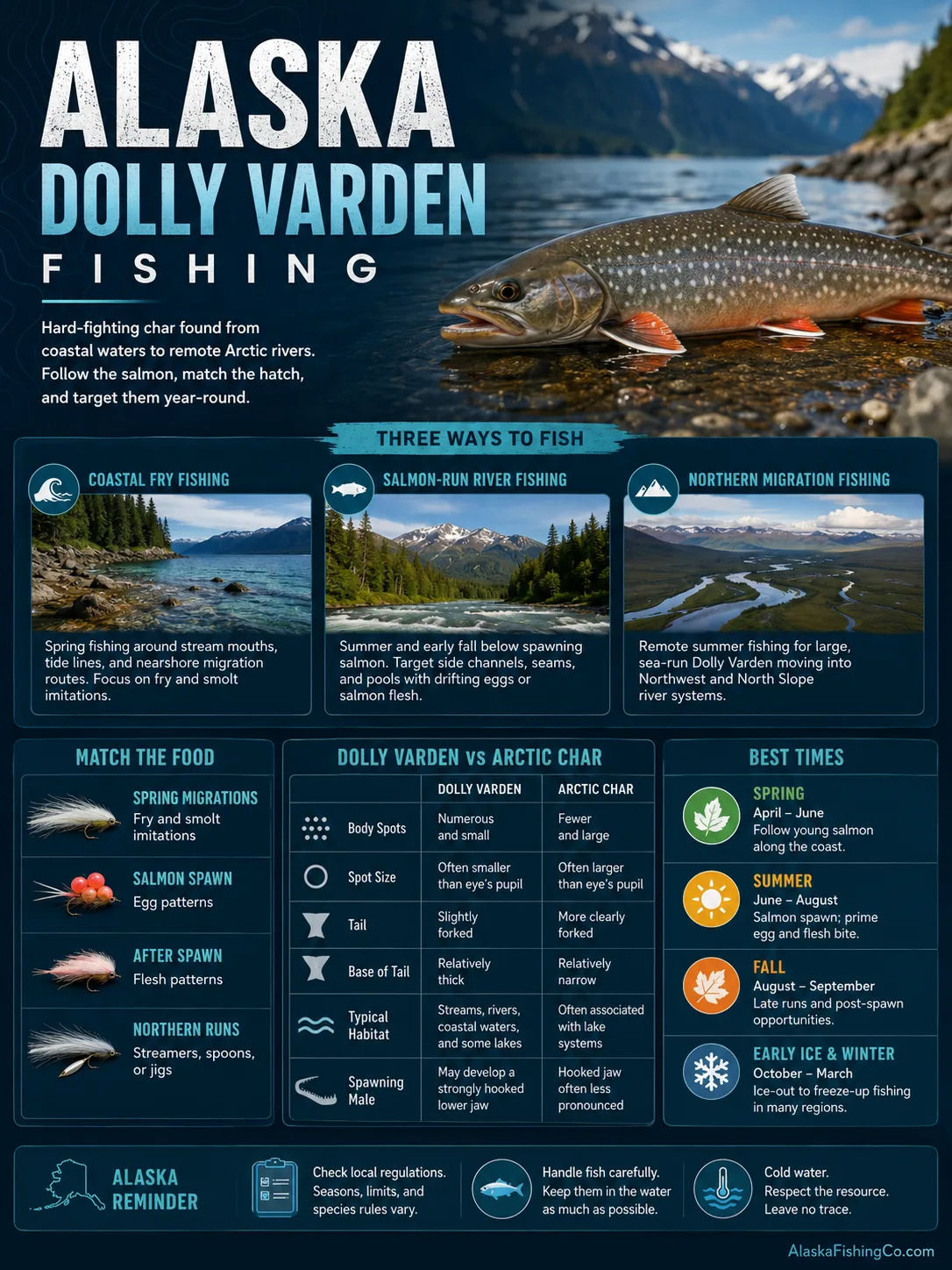
Dolly Varden fishing in Alaska changes with the salmon life cycle. In spring, these char may chase young salmon along the coast. During summer, they gather near spawning salmon to intercept loose eggs. Farther north, large sea-run fish enter remote rivers on their way to spawning areas.
The most reliable way to plan a Dolly Varden trip is to choose the type of fishery before choosing tackle. A light shoreline setup may be ideal near Juneau or Sitka, while a remote trip to the Noatak or Wulik calls for stronger gear, extra travel days, and a different approach to fish handling.
The practical answer: Match the trip to the fish’s food. Use fry or smolt imitations during spring migrations, egg patterns when salmon are spawning, flesh patterns after carcasses begin breaking down, and larger streamers, spoons, or jigs for northern spawning runs.
What Makes Dolly Varden Fishing Different in Alaska?
Alaska does not have one uniform Dolly Varden fishery. The state supports small resident fish, coastal sea-run populations, and large northern fish that may travel long distances between salt water, feeding areas, winter habitat, and spawning streams.
Dolly Varden belong to the char family rather than the trout family. Char usually have pale spots on a darker body, while trout tend to have dark spots on a lighter body. Alaska also has northern and southern forms of Dolly Varden. Northern fish can grow much larger, while some resident headwater populations mature at only a few inches long.[a]
For visiting anglers, Dolly Varden fishing usually falls into three practical categories:
- Coastal fry fishing: Spring fishing around stream mouths, protected shorelines, tidal channels, and nearshore migration routes.
- Salmon-run river fishing: Summer and early fall fishing below spawning salmon, around side channels, and in pools that collect drifting eggs or salmon flesh.
- Northern migration fishing: Remote summer fishing for large sea-run Dolly Varden moving into Northwest and North Slope river systems.
Dolly Varden or Arctic Char?
Dolly Varden and Arctic char are separate species, although telling them apart can be difficult. Identification matters because local regulations may list the species separately, combine them in one limit, or apply special rules to a particular lake or drainage.
Do not rely on body color alone. A sea-run Dolly may be bright silver, while a spawning fish may show red, green, black, orange, and white. Lighting, water color, age, sex, and spawning condition can change the fish’s appearance.
| Feature | Dolly Varden | Arctic Char |
|---|---|---|
| Body spots | Usually numerous and relatively small | Usually fewer and relatively large |
| Spot size | Often smaller than the eye’s pupil | Often larger than the eye’s pupil |
| Tail | Slightly forked | More clearly forked |
| Base of tail | Relatively thick | Relatively narrow |
| Typical Alaska habitat | Common in streams, rivers, coastal waters, and some lakes | Often associated with lake systems |
| Spawning male | May develop a strongly hooked lower jaw | The hooked jaw is often less pronounced |
Some fish will not match every feature. When identification remains uncertain, follow the more restrictive rule that could apply and avoid retaining the fish until the species can be confirmed.
Best Times for Dolly Varden Fishing in Alaska
The best period depends on the region and the food Dolly Varden are following. Spring can be productive on Southeast Alaska shorelines, summer is often tied to salmon spawning, and northern river fishing usually improves as sea-run fish move upstream.
The periods below describe common fishing patterns rather than guaranteed legal seasons. Water temperature, snowmelt, rainfall, salmon timing, tides, and emergency orders can shift the opportunity.
| Fishery | Common Period | What the Fish Are Doing | Useful Presentations |
|---|---|---|---|
| Southeast coastal shoreline | April through June | Following young salmon into tidal and nearshore water | Small fry flies, smolt streamers, spoons, and spinners |
| Spring river migration | April through early summer | Moving from winter habitat and feeding on salmon fry | Fry patterns and small silver lures |
| Salmon spawning streams | Summer through early fall | Feeding on loose salmon eggs below spawning areas | Egg flies, legally rigged beads, and small orange lures |
| Post-spawn feeding areas | Late summer through fall | Eating eggs, flesh, sculpins, and other drifting food | Flesh flies, leeches, sculpins, and egg-sucking patterns |
| Northwestern spawning migration | July through August in many rivers | Moving upstream toward spawning tributaries | Streamers, spoons, jigs, and large leech patterns |
| Togiak sea-run return | Late August through September | Returning from marine feeding areas | Streamers, spoons, egg patterns, and flesh patterns |
Spring Fry and Smolt Fishing
Spring fishing begins when young salmon leave streams and lakes. Dolly Varden position themselves where the small fish are concentrated rather than spreading evenly across the shoreline.
Productive water can include:
- The sides of a stream mouth rather than the fastest water in its center
- Current lines created by an outgoing tide
- Shallow shelves next to a deeper channel
- Protected bays where wind pushes small fish toward shore
- Rocky points that interrupt a shoreline current
In the Situk River system, Dolly Varden move downstream during spring to feed on salmon fry. During summer, they return to egg-feeding opportunities around spawning salmon, and in October they begin moving toward their own spawning tributaries.[b]
Summer Egg Fishing
Once salmon begin spawning, Dolly Varden often hold below or beside them. The aim is not to cast directly onto a salmon nest. Look for the first safe feeding position downstream, where loose eggs enter a seam, depression, side channel, or pool.
The exact timing follows the salmon species present in that drainage. A river with early sockeye may produce an egg bite well before a nearby stream dominated by pink or coho salmon.
Late-Summer and Fall Feeding
Eggs remain important, but decomposing salmon also create another food source. Flesh patterns become more useful around slow edges, eddies, logjams, tailouts, and other places where drifting material collects.
Fish approaching their own spawning period may show bright colors. A brightly colored Dolly Varden is not necessarily a fish with unlimited energy. Use tackle strong enough to shorten the fight, especially in fast water.
Where to Fish for Dolly Varden in Alaska
Dolly Varden occur across much of Alaska, but access, fish size, timing, and travel cost differ sharply by region. Road-accessible Southeast fishing is very different from a floatplane or raft trip in Northwest Alaska.
Southeast Alaska
Southeast Alaska offers some of the easiest Dolly Varden fishing for visitors. Shorelines, tidal channels, stream mouths, and road-accessible rivers can all produce fish without a remote expedition.
Areas commonly associated with this style of fishing include:
- Juneau and Gastineau Channel
- Sitka-area shorelines and stream mouths
- Prince of Wales Island
- Yakutat and the Situk River system
- Petersburg-area streams
- Small coastal drainages connected to lakes or estuaries
Spring fish are often silver and feeding near salt water. Later in the season, attention shifts upstream as salmon enter freshwater and begin spawning.
Southcentral Alaska
Southcentral Dolly Varden fishing is closely tied to salmon-bearing streams. Anglers may find them in Kenai Peninsula waters, Seward-area streams, Anchorage-area creeks, and other Gulf of Alaska drainages.
Useful places to inspect include:
- Creek mouths during an incoming or changing tide
- Deep holes below shallow spawning gravel
- Side channels with slower current
- Lake outlets and inlets
- River bends with a soft inside edge
- Small tributaries entering a larger river
Special regulations are common in Southcentral Alaska. A water may be open to Dolly Varden fishing while restricting bait, hooks, fishing dates, retention, or fishing for salmon.
Bristol Bay and Western Alaska
Bristol Bay supports resident and sea-run char fisheries, but anglers must pay close attention to species wording and tackle rules. Some regulations combine Arctic char and Dolly Varden, while individual rivers may have lower limits or catch-and-release requirements.
Sea-run Dolly Varden commonly enter Togiak-area rivers in late summer, with September often providing a stronger return. Bristol Bay also has a specific bead rule: a bead must be fixed within two inches of the fly or lure or allowed to slide freely on the line or leader. In fly-fishing-only water, a bead followed by a bare hook does not qualify as a legal fly by itself.[d]
Bead rules are not statewide instructions. A rig that is legal in one Alaska management area may be illegal in another. Check the named water, date, hook arrangement, bait rule, and fly-fishing definition before rigging.
Northwest Alaska and the North Slope
Northwestern rivers offer the best-known opportunity for very large Dolly Varden. This is usually a remote fishery involving aircraft, boats, rafts, or several forms of transport.
The Noatak and Wulik systems are widely associated with large sea-run fish. ADF&G’s July 2026 Northwest and North Slope report also noted fish moving into Noatak tributaries such as the Kelly, Kugururok, and Nimiuktuk, with the migration expected to continue into late August.[c]
Fish may pause in:
- Deep outside bends
- Tributary mouths
- Current breaks below gravel bars
- Pool entrances and exits
- Cold-water inflows
- Slower channels beside the main current
A productive river can still be difficult to fish if weather prevents the aircraft from arriving, low water limits boat travel, or high water removes visible holding areas. Remote itineraries should include spare days rather than depending on a same-day flight connection.
Find Dolly Varden by Finding Their Food
Fly selection matters, but location usually matters more. A good pattern presented in empty water will not outperform a basic pattern moving naturally through a feeding lane.
When Salmon Fry Are Moving
Small salmon often travel close to shore, along soft current edges, and through tidal channels. Watch the water before casting. Nervous surface movement, small wakes, feeding birds, or flashes from chasing fish can reveal the route.
- Cast parallel to shore before casting toward open water.
- Retrieve small streamers with short, irregular strips.
- Let spoons flutter briefly rather than retrieving at one constant speed.
- Cover several shoreline angles before moving.
- Recheck a stream mouth as the tide changes.
When Salmon Are Spawning
Dolly Varden usually feed on eggs that have left the nest and entered the current. The best drift is often below the spawning fish, not between them.
Look for:
- A depression immediately below a gravel riffle
- The seam between fast spawning water and a slower edge
- A pool entrance below several salmon
- A side channel receiving water from the main spawning area
- The downstream side of a large rock or submerged log
Keep clear of pale, freshly disturbed gravel. These areas may be active salmon redds. Wading across them can damage eggs even when no adult salmon are visible.
When Salmon Carcasses Begin Breaking Down
Flesh does not move through a river like a swimming baitfish. It drifts, tumbles, pauses, and settles. A dead drift with occasional movement is usually more natural than a fast retrieve.
Focus on water that collects drifting material:
- Inside bends
- Back eddies
- Slow banks
- Tailouts
- Logjams
- Soft water below a strong current seam
When Dolly Varden Are Migrating to Spawn
Migrating fish may travel through shallow runs but rest in deeper water. If visible fish ignore repeated casts, stop fishing directly at the group. Try the next holding area or allow the fish time to settle.
Large northern fish can respond to leeches, sculpins, streamers, spoons, and jigs. Change depth and angle before changing lure color. A lure passing at the correct level is often more useful than a new pattern moving above the fish.
Fly Fishing Setups for Alaska Dolly Varden
A single fly setup cannot cover every Dolly Varden fishery. Choose the rod, line, leader, and fly size according to fish size, current speed, wind, and the amount of room available for casting.
| Situation | Rod and Line | Leader | Useful Flies |
|---|---|---|---|
| Small streams | 4- or 5-weight floating line | Light to medium leader matched to cover | Nymphs, small leeches, egg flies, and fry patterns |
| Southeast shoreline | 5- or 6-weight floating or intermediate line | Leader that turns over small streamers in wind | Smolt, fry, small herring, and baitfish patterns |
| Egg fishing | 5- to 7-weight floating line | Abrasion-resistant tippet appropriate for the river | Egg flies or legally rigged beads |
| Flesh and streamer fishing | 6- or 7-weight floating or sink-tip line | Shorter, stronger leader where needed | Flesh flies, sculpins, leeches, and egg-sucking patterns |
| Large northern fish | 7- or 8-weight line suited to fly size and wind | Strong leader capable of controlling fish in current | Large leeches, articulated streamers, and sculpin patterns |
Fry and Smolt Presentations
A floating line works in shallow water, while a slow intermediate line can help keep a streamer below wave action or tidal current. Avoid using a fast sinking line in water only a few feet deep.
Effective presentations include:
- A controlled swing across a current seam
- Short strips followed by a pause
- A slow retrieve close to the bottom
- A shoreline-parallel retrieve
- A cast beyond visible fry followed by a retrieve through the group
Egg and Bead Presentations
The aim is to match the speed of the current near the bottom. The indicator should move naturally rather than dragging behind the surface flow or racing ahead of the weight.
Adjust the rig when:
- The fly never touches the feeding depth
- The weight catches the bottom on every drift
- The indicator moves faster than nearby bubbles
- The leader repeatedly sweeps across spawning salmon
- The hook catches fish outside the mouth
Frequent foul hooking is a warning that the rig, casting angle, depth, or fishing position needs to change.
Flesh, Leech, and Sculpin Presentations
Flesh patterns are normally drifted near the bottom. Leeches and sculpins can be dead-drifted, swung, stripped, or allowed to pulse beside cover.
Carry a limited range of sizes rather than many nearly identical colors. Water clarity and current speed should guide the choice:
- Smaller, less bulky patterns for clear and shallow water
- Heavier or denser patterns for deep runs
- Dark leeches for silhouette in stained water
- Natural sculpin colors where bottom-dwelling fish are present
- Flesh colors that resemble material already drifting in the river
Spinning Gear for Dolly Varden
Spinning tackle is effective in coastal water, rivers, and remote northern fisheries. The best lure is one that reaches the correct depth without repeatedly snagging or sweeping through spawning fish.
Light Shoreline and Stream Setup
A light or medium-light rod can handle small spoons, spinners, and jigs used for Southeast coastal fish and modest river Dolly Varden. Line strength should still account for rocks, current, woody cover, and the chance of hooking a larger fish.
Useful options include:
- Small silver spoons
- Compact spinners
- Light jigs with natural or bright bodies
- Small soft-plastic baitfish
- Legally rigged egg imitations
River Setup for Larger Fish
Use a medium rod and stronger line when fishing deep runs, heavy current, or rivers known for larger Dolly Varden. An underpowered setup can extend the fight and make controlled release more difficult.
Choose lure weight according to the water:
- Lighter spoon for shallow tailouts
- Heavier spoon for broad current
- Jig for vertical depth changes and deep pools
- Spinner for covering medium-depth runs
- Single-hook lure where easier release is a priority
Replace Weak Hardware Before the Trip
Small factory hooks and split rings may be adequate for modest fish but unsuitable for heavy northern Dolly Varden. Inspect lure hardware before traveling to a remote river.
Consider:
- Replacing weak split rings
- Using strong single hooks where legal
- Pinching barbs when easier release is desired
- Carrying long-nose pliers
- Checking leader and knots after contact with rocks
- Bringing duplicate productive lures rather than one of each type
Beads, Bait, Hooks, and Redd Etiquette
Egg imitations are widely used for Dolly Varden, but Alaska does not apply one universal bead, bait, or hook rule. Regulations can change by management area, named river, river section, and date.
Check How the Bead Must Be Attached
A bead may need to slide freely or remain within a stated distance of the hook, fly, or lure. Fly-fishing-only water may also define what counts as a fly. Do not assume that a bead-and-bare-hook setup is legal merely because it was legal on another Alaska trip.
Know Whether Bait Is Open
Bait may be allowed during one part of the season and prohibited during another. An emergency order aimed at protecting salmon can also change legal tackle while Dolly Varden remain present in the same river.
Fish Below Salmon Without Disturbing Them
Dolly Varden anglers should avoid standing on redds or casting repeatedly through dense groups of spawning salmon. Position downstream or to the side and drift the imitation through water where loose eggs naturally travel.
Stop and reposition when foul hooking becomes frequent. Repeatedly snagging salmon or Dolly Varden usually means the rig is too deep, the drift crosses the fish rather than their feeding lane, or the angler is fishing directly through a spawning group.
Fishing License Rules for Visitors
Most adult visitors need an Alaska sport fishing license before targeting Dolly Varden. Foreign tourists use the same nonresident sport fishing license options and prices listed for other nonresident anglers.
Nonresidents aged 16 or older need a sport fishing license. Alaska residents generally need one from age 18. A king salmon stamp is not required for a Dolly Varden-only trip, but anglers intentionally fishing for king salmon need the appropriate stamp even when planning to release the king salmon.[g]
Current Nonresident Sport Fishing License Prices
| License | Price | Typical Use |
|---|---|---|
| 1-day sport fishing license | $15 | A single planned fishing day |
| 3-day sport fishing license | $30 | A short fishing stop or weekend trip |
| 7-day sport fishing license | $45 | A weeklong Alaska itinerary |
| 14-day sport fishing license | $75 | A longer fishing vacation |
| Annual sport fishing license | $100 | Multiple trips or a stay longer than 14 fishing days |
These prices are listed by ADF&G for nonresident and foreign anglers.[f] An annual license is a calendar-year license rather than a license valid for 365 days after purchase.
How to Buy the License
Licenses can be purchased through the ADF&G online store, the department’s mobile app, an ADF&G office, or many licensed vendors.
- Select the nonresident sport fishing license that covers every planned fishing date.
- Enter personal information exactly as required during checkout.
- Review the starting date before completing the purchase.
- Save the electronic license to the mobile device used during the trip.
- Carry a printed copy when traveling beyond reliable phone service.
- Purchase a king salmon stamp only when the planned fishing requires it.
A guide, lodge, or charter booking does not normally replace the angler’s personal license. Confirm whether the operator expects guests to buy licenses before arrival or assists with the purchase on site.
How to Check Dolly Varden Regulations
There is no dependable statewide bag-limit answer for every Dolly Varden fishing location. The correct rule comes from the management area booklet, the special regulation for the named water, and any active emergency order.
Use This Check Order
- Identify the management area. Determine whether the water falls within Southeast, Southcentral, Southwest, Northern, or another listed area.
- Read the general char rule. Look for Dolly Varden, Arctic char, trout, or a combined char category.
- Find the named water. Rivers, lakes, tributaries, road systems, and sections may have exceptions.
- Check the date. Legal tackle, retention, and open seasons may change during the year.
- Check emergency orders. Temporary rules override the printed summary.
- Confirm methods and means. Review bait, hook, bead, fly-fishing, and fish-release restrictions.
Regional variation can be large. For example, the 2026 rule reported for drainages crossed by the Juneau road system and adjacent salt water within the defined boundary allows two Dolly Varden per day and two in possession, with no size limit.[e] That Juneau rule should not be copied to Yakutat, Bristol Bay, the Kenai Peninsula, or Northwest Alaska.
Emergency Orders Can Change More Than Bag Limits
Emergency orders may close an area, change a season, reduce or increase a limit, or restrict bait and hooks. They can affect a Dolly Varden trip even when the order is primarily intended to protect salmon in the same drainage.
ADF&G states that emergency orders may be issued at any time and carry the force of law. The department advises checking for current orders before fishing.[h]
A screenshot of an old regulation page is not enough. Recheck the official water-specific rule shortly before departure and again when arriving in the area, especially on trips planned months in advance.
Handling and Releasing Dolly Varden
Dolly Varden should be landed without a needlessly long fight and kept in the water whenever possible. Large fish, warm water, fast current, and spawning condition all increase the need for careful handling.
Before the Fish Is Hooked
- Use line strong enough to control the expected fish.
- Carry pliers or forceps where they can be reached quickly.
- Decide whether the fish will be retained before lifting it from the water.
- Prepare the camera before bringing the fish into position.
- Use a rubber or knotless net when a net is needed.
While Handling the Fish
- Keep the fish in the water during hook removal.
- Wet bare hands before touching it.
- Do not grip the gills, eyes, jaw, or gill plate.
- Do not hang the fish vertically from the hook.
- Support the body horizontally with one hand near the pectoral area and one near the tail.
- Do not place the fish on dry gravel, grass, sand, snow, or the floor of a boat.
During Release
Hold the fish upright with its head facing into gentle current. Let it regain balance and swim from the hands under its own power. Do not push it rapidly forward and backward through the water.
When a fish is deeply hooked, forcing the hook out can cause more damage than cutting the leader close to the hook. Follow any local rule that prohibits removing a fish from the water when release is required.
Planning a Roadside or Remote Dolly Varden Trip
A successful trip plan depends as much on access and weather as it does on tackle. Southeast shoreline fishing may fit into a normal road-based vacation, while a Northwest river trip needs aviation planning, communication equipment, and weather flexibility.
Road-Accessible Southeast Trip
A practical roadside kit includes:
- Light fly or spinning tackle
- Fry patterns, small spoons, and spinners
- Polarized glasses
- Waterproof layers
- Tide information for coastal fishing
- Wading staff where footing is uneven
- Printed license and saved regulations
Do not assume every visible stream mouth is open or publicly accessible. Check land ownership, park rules, posted closures, and stream-specific regulations.
Salmon-Run River Trip
For a river trip built around egg and flesh feeding, research the salmon species and run timing before selecting dates.
Pack:
- Several egg sizes and colors rather than one fixed choice
- Flesh flies in more than one weight
- Indicators and removable weight
- Leeches and sculpins for periods between salmon activity
- Wading footwear suitable for slippery gravel
- Bear-resistant storage where required
- A plan for keeping retained fish secure and attended
Remote Northwest Trip
Remote Dolly Varden fishing requires a larger margin for delay and equipment failure. A missed aircraft connection can affect several days of travel.
Plan for:
- At least one weather day before a fixed return flight
- A satellite messenger or other remote communication method
- Spare rod sections or a complete backup rod
- Replacement reel, line, leaders, hooks, and split rings
- Cold-water clothing packed separately from normal camp clothing
- Raft repair equipment when floating
- A clear pickup location and missed-pickup procedure
- Food and medication beyond the planned trip length
Remote Alaska rivers are cold even when the air is warm. Wear a personal flotation device in boats and rafts, and treat a crossing or wading route as a safety decision rather than a shortcut to better water.
Common Dolly Varden Fishing Mistakes
Most problems come from applying advice from one Alaska fishery to a different region, season, or river. The same species may require a different presentation only a few weeks later.
Choosing a Fly Before Identifying the Food
An egg pattern may be ineffective before salmon begin spawning. A large streamer may pass unnoticed when Dolly Varden are focused on tiny fry. Observe the water before tying on the first pattern.
Using One Season for the Entire State
Spring coastal fishing, Southcentral salmon-run fishing, and Northwest spawning migrations do not peak at the same time. Select dates for the exact fishery rather than searching for one statewide “best month.”
Copying a Bag Limit from Another River
A general regional limit may be replaced by a special rule for a lake, drainage, road system, tributary, or section of river. Check the named water every time.
Ignoring the Tide
At coastal stream mouths, a location that held fish at one tide stage may appear empty several hours later. Fish may move along shore, enter the stream, drop into deeper water, or spread across a broader area.
Fishing Directly on Redds
Walking on spawning gravel or dragging a rig through a dense group of salmon can damage nests and cause repeated foul hooking. Fish the downstream feeding lane instead.
Using Tackle That Is Too Light
Very light tackle may be enjoyable for small resident fish, but it is a poor match for a large Dolly Varden in heavy current. Choose tackle that allows a controlled fight and timely release.
Planning a Remote Trip Without Spare Days
Weather, water level, aircraft availability, smoke, fog, and mechanical delays can change remote schedules. Avoid placing the pickup day immediately before an international flight or another nonrefundable connection.
Build the Trip Around the Fishery
The simplest planning sequence is region, feeding stage, habitat, presentation, tackle, and current regulation. Starting with a favorite lure and trying to force it into every situation reverses that order.
A practical choice may look like one of these:
- Southeast spring shoreline: Road access, changing tides, light tackle, and fry imitations.
- Summer salmon stream: Spawning activity, careful wading, egg drifts, and water-specific bead rules.
- Late-season river: Flesh, leeches, sculpins, slower holding water, and colder conditions.
- Northwest migration: Remote logistics, stronger tackle, large flies or lures, and careful release of large fish.
When the fishery is chosen first, the packing list becomes shorter and more useful. The angler arrives with gear suited to the actual water rather than carrying equipment intended for several unrelated Alaska trips.
Dolly Varden Fishing Questions Answered
What is the best month for Dolly Varden fishing in Alaska?
There is no single best month statewide. April through June can be productive for coastal fry fishing in Southeast Alaska. Summer and early fall often produce egg and flesh fishing around salmon streams. July and August can be productive for upstream migrations in Northwest Alaska, while Togiak-area sea-run fish commonly appear later in summer and peak closer to September.
Are Dolly Varden trout or char?
Dolly Varden are char in the genus Salvelinus. They are often called trout in casual conversation, but their pale spots on a darker body are a common char feature.
Can Dolly Varden be caught from shore in Alaska?
Yes. Shore fishing is available around Southeast Alaska stream mouths, tidal channels, road-accessible rivers, lake outlets, and some coastal beaches. Access and regulations must still be checked for the exact location.
What flies work best for Alaska Dolly Varden?
Useful flies include salmon fry and smolt patterns in spring, egg flies or legally rigged beads during salmon spawning, flesh flies later in the season, and leeches or sculpins when fish are feeding on larger prey. The best choice depends on the food currently present.
Do tourists need an Alaska fishing license for Dolly Varden?
Nonresident and foreign anglers aged 16 or older generally need an Alaska sport fishing license. A separate king salmon stamp is not needed when fishing only for Dolly Varden.
Are Dolly Varden and Arctic char the same fish?
No. They are closely related but separate species. Dolly Varden usually have more numerous small spots, a thicker base of the tail, and a less deeply forked tail. Some fish remain difficult to identify, and regulations may combine the two species.
Can anglers keep Dolly Varden in Alaska?
Retention is allowed in many waters, but the daily limit, possession limit, size rule, and open season vary by location. Some waters are catch-and-release only. Read the management-area rule, special rule for the named water, and current emergency orders before keeping a fish.
Is a guide necessary for Dolly Varden fishing?
A guide is not necessary for many road-accessible Southeast and Southcentral fisheries. A guide or experienced outfitter becomes more useful when the trip requires floatplanes, rafts, unfamiliar remote rivers, bear-country camping, or complex transportation.
Alaska Fishing References
- [a] ADF&G Dolly Varden Species Profile — Identification, range, life forms, size, and differences from Arctic char (official Alaska state fisheries agency).
- [b] ADF&G Situk River Dolly Varden Fishing Opportunity — Seasonal fry, egg, and spawning movements in the Situk River system (official Alaska state fisheries agency).
- [c] ADF&G 2026 Northwest and North Slope Fishing Report — Current migration timing and river observations for Northwest Dolly Varden (official Alaska state fisheries agency).
- [d] ADF&G Bristol Bay Seasonal Fishing Information — Togiak Dolly Varden timing and Bristol Bay bead-placement rules (official Alaska state fisheries agency).
- [e] ADF&G 2026 Juneau Area Fishing Report — Juneau road-system Dolly Varden limits and current fishing conditions (official Alaska state fisheries agency).
- [f] ADF&G License, Stamp, and Tag Pricing List — Nonresident and foreign visitor sport fishing license prices (official Alaska licensing authority).
- [g] ADF&G Sport Fishing License and King Salmon Stamp Rules — License ages, online purchasing, harvest records, and king salmon stamp requirements (official Alaska licensing authority).
- [h] ADF&G Sport Fishing Emergency Orders — Temporary closures, limit changes, and legal tackle updates that override printed summaries (official Alaska state fisheries agency).