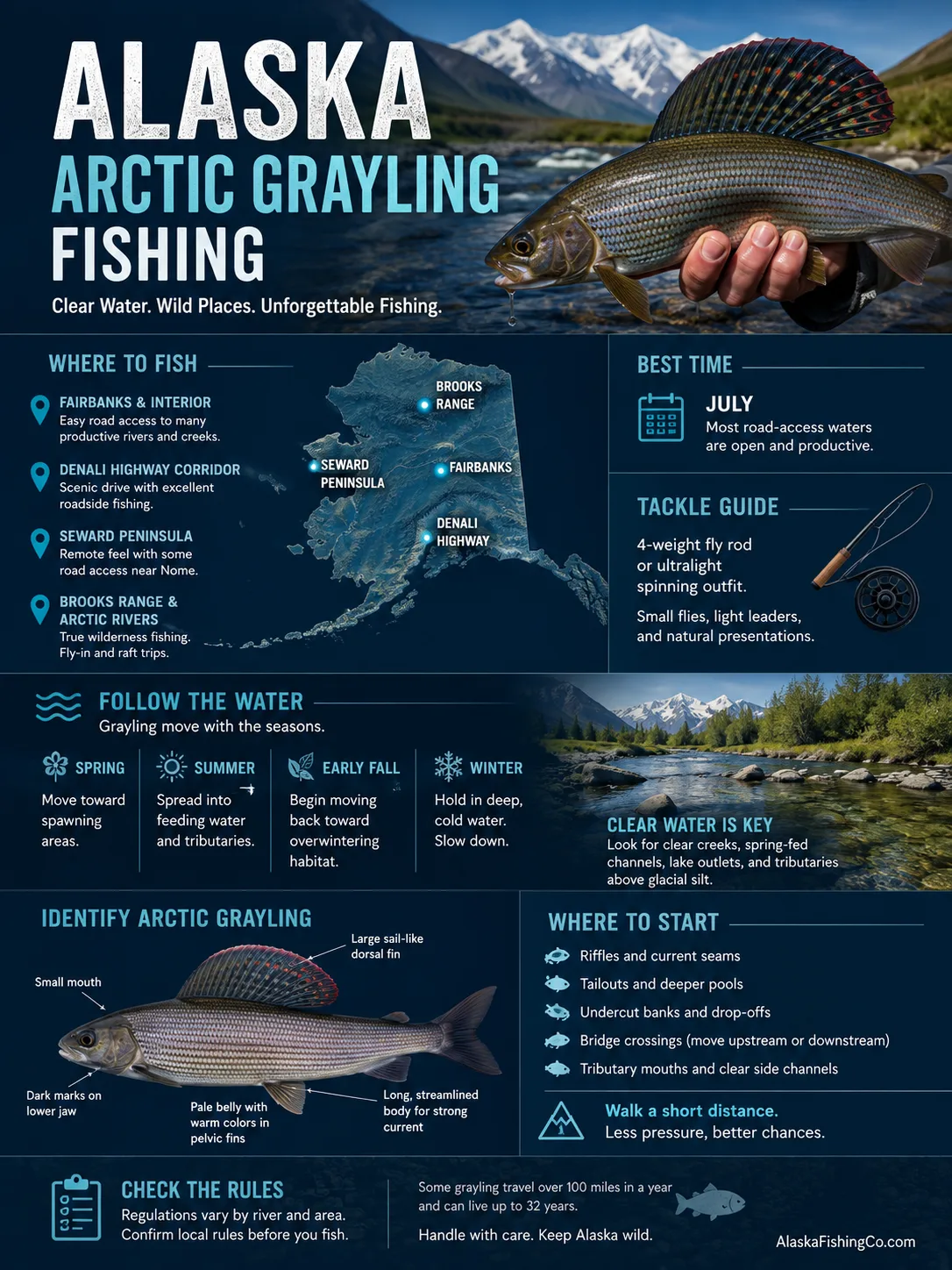
Arctic grayling fishing in Alaska is often easier to arrange than visitors expect. These sail-finned freshwater fish live in clear rivers, roadside creeks, tundra streams and outlet-connected lakes across much of the state. A light fly rod or spinning outfit is usually enough, but finding the right water and checking the exact local rule matter more than carrying a large tackle collection.
For a first trip, the most practical choices are the Fairbanks area, the Denali Highway corridor and parts of the Seward Peninsula road system near Nome. Remote waters in the Brooks Range, Kobuk and Noatak country offer a different experience, with short open-water seasons, bush-plane logistics and much less room for planning errors.
A practical starting point: July is often the simplest month for a road-access grayling trip. Bring a 4-weight fly rod or an ultralight spinning outfit, begin around clear tributaries and current seams, and confirm the regulation for the named river before fishing.
Why Arctic Grayling Fishing in Alaska Works Differently
Alaska grayling do not remain in one pool or stream section throughout the year. Many populations move between spawning water, summer feeding areas and deeper overwintering habitat, so a productive location in one month may hold few fish in another.
- Spring movement is generally directed toward spawning areas.
- Adults move into summer feeding water after spawning.
- Early fall movement often leads back toward overwintering habitat.
- Some populations travel between small tributaries, larger rivers and lakes.
- Other populations complete their entire life cycle within a short stream or lake system.
Alaska Department of Fish and Game records show that some Arctic grayling travel as far as 100 miles in a year. Older and larger adults also tend to occupy cooler upper portions of river systems, while smaller fish are more common farther downstream. Grayling may live for as long as 32 years, so a large fish can represent many seasons of survival in cold, slow-growing northern water.[a]
What Arctic Grayling Look Like
The easiest identifying feature is the oversized dorsal fin. It is tall, rounded and often marked with red, purple, aqua or pink spots. Other useful features include:
- A relatively small mouth
- Dark marks on each side of the lower jaw
- Silver, blue, gold or dark body tones
- A pale belly with warmer colors in the pelvic fins
- A long, streamlined body suited to river current
Arctic char and Dolly Varden have light-colored spots on a darker body and lack the grayling’s large sail-like dorsal fin. Young grayling can appear much plainer than mature adults, but the dorsal-fin shape remains a reliable clue.
Why Clear Water Is Usually the Better Starting Point
Grayling can use large glacial rivers for migration and overwintering, but clear tributaries are normally easier for visiting anglers. Clear water makes it possible to identify current lanes, see rising fish and present small flies naturally.
A muddy main river does not mean the entire drainage is unfishable. Look for:
- A clear creek entering a colored river
- A spring-fed side channel
- A lake outlet with visible current
- A tributary above the influence of glacial silt
- A sheltered pool below a riffle
Where to Fish for Arctic Grayling in Alaska
The best area depends on how much travel and backcountry work the trip can support. Fairbanks offers the easiest concentration of road-access options, while the Brooks Range and western Arctic provide remote fishing that normally requires an aircraft, raft or both.
- First Alaska trip: Fairbanks and the Interior road system
- Road-based camping: Denali Highway and Tangle Lakes country
- Remote feel with some road access: Nome and the Seward Peninsula
- Fly-in wilderness trip: Brooks Range, Kobuk or Noatak country
Fairbanks and the Interior Road System
Fairbanks is one of the most useful bases for a dedicated grayling trip. The surrounding highway system reaches portions of the Chena, Chatanika, Delta Clearwater and other Tanana River tributaries. Fuel, food, rental vehicles and lodging are also easier to arrange here than in smaller northern communities.
Common Interior access corridors include:
- Chena Hot Springs Road
- Richardson Highway
- Alaska Highway
- Steese Highway
- Tok Cutoff
Road crossings are obvious starting points, but the water immediately beside a bridge often receives the most fishing pressure. Where access is legal, walking a short distance away from the parking area may produce quieter water and less disturbed fish.
Chena River
The Chena is well known for Arctic grayling, but it cannot be treated as one uniform fishery. The lower river, the flood-control project area and the upper drainage may have different retention and tackle rules.
Look for grayling around:
- Riffle-to-pool transitions
- Outside bends with moderate depth
- Current seams below gravel bars
- Tributary mouths
- Shaded banks and submerged cover
The upper river is especially suitable for light tackle and catch-and-release fishing. ADF&G’s 2026 Tanana-area information also recommends small dry flies, bead-head nymphs, size 0–2 spinners and small spoons for Interior grayling.[b]
Delta Clearwater and Other Spring-Fed Water
Spring-fed systems can remain clearer than nearby runoff-driven rivers. Their steady flows and cooler summer temperatures make them useful when other Interior streams are high, warm or discolored.
In this type of water, concentrate on:
- Edges of the main current
- Submerged weed lines
- Small depth changes
- Side channels with visible flow
- Areas where insects collect behind structure
Clear water also makes grayling easier to disturb. Avoid entering the head of a pool before fishing it. Begin with short casts from downstream and gradually extend the presentation.
Denali Highway and Tangle Lakes Country
The Denali Highway corridor suits anglers who want to combine camping with lake and stream fishing. Grayling may be found in small rivers, lake inlets, outlets and connected waterways throughout the region.
A trip here requires more preparation than a day near Fairbanks:
- Road conditions can change after rain.
- Fuel is not available at frequent intervals.
- Phone service is limited or absent in many places.
- Strong wind can make lake fishing difficult.
- Cold nights are possible even during summer.
In lakes, begin near moving water rather than casting randomly across open water. Inlet mouths, outlet channels, shallow points and wind-blown shorelines usually offer more useful clues.
Nome and the Seward Peninsula
Nome provides access to tundra rivers without requiring every fishing day to begin with a charter flight. The local road system is limited, but it reaches several streams and offers a more remote setting than most Interior highway fishing.
Conditions can change quickly in small tundra rivers. Rain may raise the water within a short period, while a dry stretch can leave pools low and exceptionally clear. Carry offline maps, extra food, warm clothing and equipment for a vehicle delay.
Regulations around Nome vary sharply between neighboring waters. Some rivers are closed to Arctic grayling fishing, while others allow limited harvest. River names and drainage boundaries must be confirmed before fishing.
Brooks Range and Gates of the Arctic
Brooks Range grayling fishing is normally part of a fly-in camp or multi-day float trip. Grayling occur in many cold, clear rivers and in lakes connected to outlet streams, but access is the main challenge.
A remote northern trip should account for:
- Aircraft weight limits
- Weather-related flight delays
- Cold rain, frost and possible snow
- Satellite communication
- Emergency food and fuel
- Raft repair equipment
- Safe food storage in bear country
The National Park Service notes that Arctic waters have low growth and production rates. It encourages anglers in Gates of the Arctic to release fish or retain only what can be eaten immediately. Ice can remain on some lakes and streams until late June, leaving a short open-water season.[c]
Kobuk, Noatak and Remote Western Rivers
Grayling are often one part of a mixed-species float trip in western and Arctic Alaska. Sheefish, Arctic char, Dolly Varden, northern pike or salmon may also be present, depending on the drainage.
The main river is not always the best grayling water. Check:
- Small clear tributaries
- Back channels with steady flow
- Creek mouths
- Pool heads below rapids
- Lake outlets near the float route
| Region | Typical access | Fishing style | Main planning issue |
|---|---|---|---|
| Fairbanks and Interior | Rental vehicle and short walks | Roadside rivers and clear tributaries | Water-specific rules |
| Denali Highway | Vehicle and camping | Lakes, outlets and small streams | Road, fuel and weather |
| Nome area | Flight to Nome, then vehicle | Small tundra rivers | Sharp regulation differences |
| Brooks Range | Bush plane | Remote rivers and outlet lakes | Flight delays and isolation |
| Kobuk and Noatak country | Fly-in and raft | Multi-day float fishing | Route and evacuation planning |
Many productive grayling waters are accessible from the Parks, Glenn, Denali, Richardson, Alaska, Steese and Dalton highway corridors. ADF&G also identifies the road system outside Nome as a known grayling-fishing area.[d]
Best Time for Alaska Arctic Grayling Fishing
Late June through August is the main open-water period for most visitors. July is often the easiest month for road-system fishing, while late July and August are usually more practical in the far north. Water level, ice breakup and insect activity still matter more than a fixed calendar date.
- Late spring: spawning movement and variable water
- June: movement toward summer feeding areas
- July: dependable open water and active insect feeding
- August: dry flies, terrestrials and salmon-egg opportunities
- September: cooling water, fall movement and harder travel
Ice-Out and Spring Movement
Grayling move upstream toward spawning grounds in spring. Timing varies by elevation, latitude, snowpack and local weather. Interior rivers may become fishable while lakes and high-elevation waters remain partly frozen.
Spring is not the best period for a rigid itinerary. A better plan includes several types of water:
- A clear spring-fed stream
- A lower-elevation river
- A lake outlet
- A backup drainage with different runoff conditions
June and the Move to Summer Water
After spawning, adults spread into feeding areas. Some rivers remain high, but clearer tributaries and edge water may fish well. Fish often hold close to shore when the main current is strong.
Useful June locations include:
- Soft water behind gravel points
- Inside bends
- Side channels
- Tributary junctions
- Pool tails with moderate current
July Surface Fishing
July commonly offers the best balance of access, open water and insect activity. Mayflies, caddisflies, midges, mosquitoes and other insects can bring grayling to the surface throughout the day.
Long daylight does not mean every hour fishes equally well. A calm morning or evening may produce visible rises, while strong afternoon wind can make a nymph or spinner easier to control.
August and Salmon-Egg Feeding
In rivers with spawning salmon, grayling may shift toward drifting eggs. A dry fly can still work, but an egg imitation or small nymph may produce more fish near active spawning areas.
Fish these areas carefully:
- Do not step on visible salmon redds.
- Stand downstream of spawning fish rather than among them.
- Allow the imitation to drift naturally near the bottom.
- Avoid snagging salmon while targeting grayling.
- Check whether bead rigs and bait are permitted in that water.
Late August and September in Northern Alaska
Late-season fishing can be productive as grayling feed before winter and begin moving toward deeper water. Travel becomes less predictable, however. Shorter daylight, colder storms and early snow can affect aircraft schedules and river travel.
| Period | Interior | Denali Highway | Nome area | Brooks Range |
|---|---|---|---|---|
| Late May | Variable runoff | Often early | Often early | Usually too early |
| June | Improving access | Ice-out varies | Small rivers begin opening | Ice may remain late |
| July | Reliable general period | Good lake and stream access | Good road-system period | Main open-water period begins |
| August | Dry flies and egg patterns | Productive but cooler | Good fishing with changing weather | Often the most practical period |
| September | Possible fall fishing | Snow risk rises | Colder and less predictable | Short season closing quickly |
How to Find Arctic Grayling in Rivers and Lakes
Grayling usually hold where current delivers food without forcing them to spend excessive energy. The best cast is often made to the boundary between fast and slow water rather than the deepest part of a pool.
- Fish the near edge before making a long cast.
- Approach pools from downstream when possible.
- Watch for insects and rising fish before entering the water.
- Change position before changing the entire tackle setup.
- Leave a pool quietly if fish stop rising after several casts.
Riffle-to-Pool Transitions
The head of a pool receives a steady supply of drifting insects. Grayling may hold directly below the broken water or slightly to one side of the strongest current.
Begin with the softer edge. Then work toward the center. Casting immediately across the full pool can line fish holding closer to the bank.
Current Seams
A current seam forms where two water speeds meet. Foam, bubbles and small debris often reveal the line. Grayling can remain in slower water while taking food from the faster lane.
For a natural presentation:
- Keep extra line off conflicting currents.
- Mend before the fly begins to drag.
- Shorten the cast when control is poor.
- Move closer rather than forcing a long presentation.
Tributary Mouths
A clear tributary entering a larger river can provide cooler water, food and a travel route. Fish may hold inside the tributary, along the mixing line or in the main river below the mouth.
Do not begin by standing in the creek entrance. Cover the junction from downstream and fish each visible current lane separately.
Deep Pools and Outside Bends
Deep, slower pools provide shelter during bright conditions, high flows and colder periods. Fish may sit near the pool head while feeding, then move deeper when disturbed.
If a dry fly receives no response, try:
- A bead-head nymph
- A soft-hackle fly
- A small dark streamer
- A size 0–2 spinner
- A small jig retrieved near the bottom
Lake Inlets and Outlets
Moving water narrows the search area in a lake. Grayling often feed where an inlet delivers insects or where an outlet concentrates current.
Other useful lake features include:
- Protected bays
- Shallow points beside deeper water
- Edges of aquatic vegetation
- Wind-blown shorelines
- Drop-offs near a stream channel
Fly Fishing Setup for Alaska Arctic Grayling
A 4-weight fly rod with a floating line is the most useful all-purpose setup. A 3-weight suits small creeks, while a 5-weight handles wind, larger rivers and heavier nymphs more comfortably.
- Small creek: 3- or 4-weight rod
- General road trip: 4-weight rod
- Windy lake or larger river: 5-weight rod
- Mixed-species trip: 5- or 6-weight rod
Line, Leader and Tippet
A weight-forward floating line covers most grayling situations. An 8- to 10-foot leader works well in rivers and lakes. Longer leaders may help in calm, clear water, but they become harder to turn over in wind.
Carry at least two tippet strengths. Very fine tippet is not always needed, especially around rocks, submerged wood or larger fish. A balanced setup offers cleaner presentations without extending the fight.
Dry Flies
Grayling are known for taking surface flies, but the pattern matters less than size, drift and placement on many days.
A compact dry-fly selection can include:
- Adams
- Parachute Adams
- Elk Hair Caddis
- Griffith’s Gnat
- Mosquito
- Black Gnat
- Small beetle or ant pattern
Sizes 10–16 cover many summer situations. Smaller patterns can be useful during a midge hatch, while a larger caddis or terrestrial is easier to see in broken water.
Nymphs and Subsurface Flies
Use a nymph when fish are not rising, the water is cold or the pool is deeper than a dry fly can cover.
Useful patterns include:
- Bead-head Hare’s Ear
- Pheasant Tail
- Prince Nymph
- Small stonefly nymph
- Soft hackle
- Small Woolly Bugger
Add only enough weight to reach the feeding depth. A heavily weighted rig that repeatedly catches the bottom is not drifting through the water where most grayling feed.
Egg Patterns
An egg imitation belongs in the box when fishing a river with spawning salmon. It has little value in an isolated headwater or lake system without salmon.
Before using a bead or egg pattern, check:
- Whether the water is fly-only
- Whether bait is prohibited
- The allowed distance between an attractor and hook
- Single-hook requirements
- Seasonal restrictions around spawning fish
Dry Fly or Nymph?
Start with what the water shows. Repeated surface rises support a dry-fly approach. Bulges below the surface may indicate emergers. No visible activity calls for a nymph, soft hackle or small streamer.
ADF&G describes 2- to 6-weight rods, floating lines and leaders around 8–10 feet as suitable for grayling. It also lists patterns such as Adams, Elk Hair Caddis, Griffith’s Gnat and Mosquito for surface fishing.[e]
Spinning for Arctic Grayling
Fly fishing is not required. An ultralight spinning rod with small spinners, spoons or jigs is effective and easier to manage in strong wind or tight roadside water.
- Use a light or ultralight rod.
- Match the lure to the stream size.
- Set the drag lightly enough to protect the line.
- Carry single-hook replacements.
- Remove or crush barbs where release efficiency matters.
Practical Spinning Setup
A small spinning reel with light line provides enough capacity for grayling. Heavy salmon tackle makes small lures difficult to cast and removes much of the control needed for short presentations.
A useful box may contain:
- Size 0–2 inline spinners
- Small spoons
- Light lead-head jigs
- Small minnow-shaped lures
- Single replacement hooks
- A small float for presenting a fly
How to Retrieve a Spinner
Cast across or slightly upstream and retrieve only fast enough to keep the blade turning. Allow the lure to pass naturally through the current seam.
Change the casting angle before changing the lure:
- Fish the near edge.
- Cast across the head of the pool.
- Allow the lure to swing through the center.
- Cover the far seam last.
- Move to a new position if no fish respond.
Using a Fly With a Spinning Rod
A small clear float placed above a dry fly allows spinning anglers to cast light patterns. This method can be useful for families, beginners or travelers who do not want to carry a separate fly-fishing outfit.
Keep the float small. A large float lands heavily and may disturb fish in shallow, clear water.
Choosing a Tactic From What the Water Shows
Grayling tackle selection becomes simpler when it is tied to visible conditions. Surface activity, water clarity, depth and salmon presence provide more useful information than changing flies after every few casts.
- Watch the water before assembling the final rig.
- Check insects on the surface and along the bank.
- Look for salmon before choosing an egg pattern.
- Use depth changes before making constant color changes.
| Observed condition | First choice | Second choice | Adjustment |
|---|---|---|---|
| Regular surface rises | Small dry fly | Emerger | Improve drift or reduce fly size |
| Clear water with no rises | Bead-head nymph | Soft hackle | Change depth |
| Spawning salmon present | Egg imitation | Small nymph | Follow the natural egg-drift lane |
| Wind blowing onto a lake shore | Terrestrial fly | Small spinner | Fish the windward bank |
| Deep, cold pool | Weighted nymph | Small jig | Slow the presentation |
| Fish follow but do not take | Smaller pattern | Thinner tippet | Reduce drag or retrieve speed |
| Slightly colored water | Spinner | Dark Woolly Bugger | Add movement and contrast |
Alaska Fishing License Requirements for Grayling
Alaska residents age 18 or older and nonresidents age 16 or older need a valid sport fishing license. This applies to U.S. visitors and international visitors. A king salmon stamp is not needed when fishing only for Arctic grayling.
- Nonresident anglers under 16 do not need a sport fishing license.
- Foreign visitors use the nonresident fishing-license system.
- A guide or lodge booking does not replace the license.
- The license must cover every day the visitor actively fishes.
- A king salmon stamp is needed only if the angler also fishes for king salmon, subject to listed exceptions.
Nonresident License Prices
Short-term options allow visitors to match the license to the fishing portion of a trip. The current nonresident and foreign-visitor sport fishing prices are the same.
| License | Price | Typical use |
|---|---|---|
| 1-day | $15 | Single fishing day |
| 3-day | $30 | Short stop or weekend |
| 7-day | $45 | One-week trip |
| 14-day | $75 | Longer road or float trip |
| Annual | $100 | Extended or repeated visits |
These prices are published by Alaska Department of Fish and Game for nonresident sport fishing licenses.[f]
Buying the License Online
A license can be purchased through the ADF&G online store or from an approved vendor. Online purchase is generally the easiest choice for an international visitor who wants the document ready before traveling.
- Open the official ADF&G license store.
- Create an account or use the available guest-purchase route.
- Enter the angler’s legal personal information.
- Select the correct nonresident duration.
- Check the fishing dates before payment.
- Complete the purchase and save the issued document.
- Carry a signed printed or accepted electronic version while fishing.
Short-term nonresident licenses are issued for 1, 3, 7 or 14 days. ADF&G permits several carrying formats, including a signed paper copy and eligible electronic versions stored on a mobile device.[g]
International visitors: Save an offline copy of the license before leaving a town with reliable internet. Remote roads, float routes and fly-in camps may have no mobile service.
2026 Arctic Grayling Regulations Require a Water-by-Water Check
There is no single Alaska grayling limit that can be applied to every river. General regional limits may be replaced by catch-and-release rules, lower bag limits, closures or special hook restrictions in a named drainage.
- Identify the exact river, lake and drainage.
- Read the regional regulation table.
- Check the special-regulation pages.
- Check emergency orders before the trip.
- Repeat the emergency-order check on the fishing day.
Chena River Example
The Chena shows why a river name alone is not enough. Under the 2026 rules described by ADF&G:
- The entire Chena is catch-and-release for Arctic grayling until June 1.
- After June 1, limited retention is allowed in the specified lower section downstream of the flood-control dam.
- The upper section remains catch-and-release for grayling throughout the year.
- Grayling fishing in the drainage is subject to unbaited, single-hook lure or fly restrictions.
Anglers should use the regulation map and written boundary description rather than estimating where the lower and upper rules change.
Nome and Northwestern Alaska Example
The 2026 Northwestern regulations contain several different rules within a relatively small travel region:
- Nome River: closed to Arctic grayling fishing; grayling must be released immediately.
- Solomon River: closed to Arctic grayling fishing; grayling must be released immediately.
- Northern Norton Sound waters: two grayling per day and in possession.
- Pilgrim River drainage: one grayling per day and in possession.
- Snake River: one grayling per day and in possession.
- Unalakleet River drainage: five per day, with only one measuring 15 inches or longer.
These are 2026 examples, not a replacement for reading the full regulation covering the water being fished.[h]
Bag Limit and Possession Limit
A daily bag limit controls how many fish may be taken in a day. A possession limit controls how many unpreserved fish may be possessed. The two terms should not be treated as interchangeable.
Other restrictions may include:
- A maximum or minimum size
- A limit on fish above a stated length
- Catch-and-release only
- Artificial-lure-only rules
- No bait
- Single-hook requirements
- Seasonal closures
Emergency Orders
Emergency orders can change seasons, open or close waters, alter bag limits or change permitted fishing methods. They have the force of law and may be issued after a printed regulation booklet has been released.
Before casting: Check the ADF&G emergency-order page for the management area. A saved regulation booklet may no longer show the rule currently in effect.
ADF&G states that the emergency-order system is updated frequently and should be checked before fishing.[i]
Planning a Roadside or Remote Grayling Trip
A successful trip begins with an access plan, backup water and a realistic estimate of travel time. Alaska distances, gravel roads and weather can turn a short map distance into most of a day.
- Choose one main fishing corridor.
- Carry offline maps.
- Identify two backup waters.
- Store extra food, water and warm clothing in the vehicle.
- Do not rely on mobile service for regulations or navigation.
One-Day Fairbanks Trip
A single-day trip works best when the fishing area is selected before leaving town. Check recent water conditions, choose the correct Chena or Tanana-drainage regulation and carry both surface and subsurface options.
A practical day kit includes:
- 4-weight fly rod or ultralight spinning rod
- Small dry flies and nymphs
- Size 0–2 spinners
- Rain jacket
- Insect protection
- Drinking water
- Offline regulation copy
Three-Day Denali Highway Camp
A short camping trip allows time to compare lakes, outlets and streams rather than remaining on one unproductive water.
Bring:
- A reliable spare tire and repair equipment
- Enough fuel for the intended route
- Cold-weather sleeping equipment
- Food stored securely from wildlife
- A backup fishing location closer to a maintained road
- A plan for strong wind on open lakes
Remote Fly-In or Float Trip
Remote fishing requires more than choosing a river with grayling. Aircraft limitations, pickup locations, river level and weather days must be settled before departure.
Discuss these points with the air service or outfitter:
- Total passenger and equipment weight
- Rod-tube dimensions
- Fuel restrictions
- Pickup communication procedure
- Weather-delay charges
- Alternate landing locations
- Emergency evacuation process
Guide, Lodge or Independent Trip
A guide is not required for sport fishing for grayling, but local support can reduce logistical risk in remote areas.
| Trip format | Planning load | Access | Best suited to |
|---|---|---|---|
| Roadside independent trip | Moderate | Highway rivers and lakes | First-time visitors |
| Guided day trip | Low | Local road or boat access | Limited fishing time |
| Lodge with fly-outs | Low after booking | Aircraft-supported waters | Mixed-species trips |
| Independent float trip | Very high | Remote river corridor | Experienced backcountry groups |
Handling and Releasing Arctic Grayling
Grayling should be handled quickly and kept wet, especially when regulations require release. Large fish deserve extra care because northern grayling grow slowly and may be decades old.
- Use a rubber or fish-friendly landing net.
- Wet hands before touching the fish.
- Keep the fish in the water while removing the hook.
- Do not squeeze the body or touch the gills.
- Prepare the camera before lifting the fish.
- Release it as soon as it can maintain balance.
Photographing the Dorsal Fin
The dorsal fin often opens naturally when a grayling is supported in shallow water. There is no need to hold or pull the fin upright.
For a quick photograph:
- Leave the fish in the net while preparing the camera.
- Support the fish horizontally with wet hands.
- Lift it only a short distance above the water.
- Take one or two photographs.
- Return it to the water immediately.
When Keeping a Grayling Is Legal
Where retention is allowed, take only fish that will be eaten and stored properly. Check the daily limit, possession limit and any size restrictions first.
Releasing a large adult can be a reasonable choice even where harvest is legal. Smaller remote lakes and Arctic streams may support fewer slow-growing fish than their appearance suggests.
Common Alaska Grayling Fishing Mistakes
Most poor grayling trips result from choosing the wrong water for current conditions, carrying oversized tackle or reading only a general regional limit. These problems are usually preventable.
Bringing Only Salmon Tackle
Heavy rods and large lures are difficult to control in small grayling water. Carry a separate light outfit even when salmon are part of the same trip.
Fishing Only Beside the Bridge
Bridge pools receive repeated pressure and foot traffic. Where public access allows it, move quietly upstream or downstream and fish less obvious current seams.
Standing in the Pool Before Casting
Grayling often hold closer to the bank than expected. Entering immediately can disturb the first fish and alert the rest of the pool.
Assuming Bait Is Legal
Bait, single-hook and artificial-lure rules vary by water. A method allowed in one Tanana tributary may be illegal in another.
Using an Egg Pattern Without Salmon
Egg imitations are useful where salmon are actively spawning. They are not an automatic choice for every grayling river.
Ignoring Water Temperature and Clarity
A famous river may fish poorly when high or colored. A smaller clear tributary can be the better choice on the same day.
Scheduling a Remote Flight Too Close to Departure
Weather delays are normal in bush aviation. A return pickup on the same day as a major commercial flight leaves little room for a delay.
Applying One Limit to the Entire Region
Nome, Solomon, Pilgrim and Snake rivers provide a clear example of neighboring waters with different grayling rules. Always read the named-water section.
Alaska Arctic Grayling Fishing Questions Answered
These answers cover the trip-planning questions most visitors face before choosing a region, license and tackle setup.
What is the best month for Arctic grayling fishing in Alaska?
July is often the easiest month for a road-access trip in Interior Alaska. Late June through August can all fish well. In the Brooks Range and other far-northern areas, late July and August are often more practical because ice can remain later and weather windows are short.
Can you catch Arctic grayling near Fairbanks?
Yes. Fairbanks is one of the best bases for road-access grayling fishing. The Chena River and several other Tanana River tributaries can be reached by vehicle, although each drainage and river section must be checked for special rules.
Can Arctic grayling be caught with a spinning rod?
Yes. Use a light or ultralight rod with size 0–2 spinners, small spoons or light jigs. A small float can also be used to cast a dry fly with spinning gear.
Do tourists need an Alaska fishing license for grayling?
Nonresident visitors age 16 or older need an Alaska sport fishing license. International visitors follow the nonresident system. Nonresidents under age 16 do not need a sport fishing license.
Is a king salmon stamp needed for Arctic grayling?
No. A king salmon stamp is not required when fishing only for Arctic grayling. It may be required if the same angler also fishes for king salmon during the trip.
Can you keep Arctic grayling in Alaska?
It depends on the water. Some rivers allow harvest under a daily limit, some have size restrictions, some are catch-and-release, and others are closed to grayling fishing. Check the regional regulation, special rules and emergency orders for the exact water.
Where are the largest Arctic grayling usually found?
Larger adults often occupy cooler upper reaches of river systems. Remote waters and lightly pressured headwaters may also hold older fish, but no location can guarantee trophy-sized grayling.
What flies work for Alaska Arctic grayling?
Adams, Parachute Adams, Elk Hair Caddis, Griffith’s Gnat and Mosquito patterns are useful on the surface. Hare’s Ear, Pheasant Tail, Prince Nymph and small Woolly Bugger patterns cover subsurface fishing. Egg imitations are useful where salmon are spawning and the rig is legal.
Alaska Fishing References
The sources below cover Arctic grayling biology, fishing methods, visitor licensing and the regional rules discussed on this page.
- [a] Alaska Department of Fish and Game — Arctic Grayling Species Profile — Distribution, migration, diet, age, growth and habitat information. (Reliable because it is the official Alaska state fisheries agency.)
- [b] Alaska Department of Fish and Game — 2026 Tanana Area Fishing Report — Chena River seasonal rules and recommended grayling flies and lures. (Reliable because it is an official area-management report.)
- [c] National Park Service — Fishing in Gates of the Arctic — Arctic fishing access, grayling habitat, license requirements and low-productivity conservation advice. (Reliable because it is official federal park guidance.)
- [d] Alaska Department of Fish and Game — The Art of Grayling — Road-access areas, fly tackle, spinning tackle and fish-holding water. (Reliable because it is published by the state fisheries agency.)
- [e] Alaska Department of Fish and Game — Arctic Grayling Fishing and Biology — Fly-fishing methods, feeding behavior and common patterns. (Reliable because it is a species-specific state reference.)
- [f] Alaska Department of Fish and Game — Sport Fishing License Prices — Current nonresident and foreign-visitor fishing-license fees. (Reliable because it is the official state pricing page.)
- [g] Alaska Department of Fish and Game — General License Information — Age requirements, license durations and accepted license formats. (Reliable because it is official licensing guidance.)
- [h] Alaska Department of Fish and Game — 2026 Northwestern Sport Fishing Regulations — Grayling closures and limits for Nome, Solomon, Pilgrim, Snake, Norton Sound and Unalakleet waters. (Reliable because it is the official regulation summary for the area.)
- [i] Alaska Department of Fish and Game — Sport Fishing Emergency Orders — Current openings, closures, bag-limit changes and method restrictions. (Reliable because emergency orders are issued and maintained by the managing state agency.)