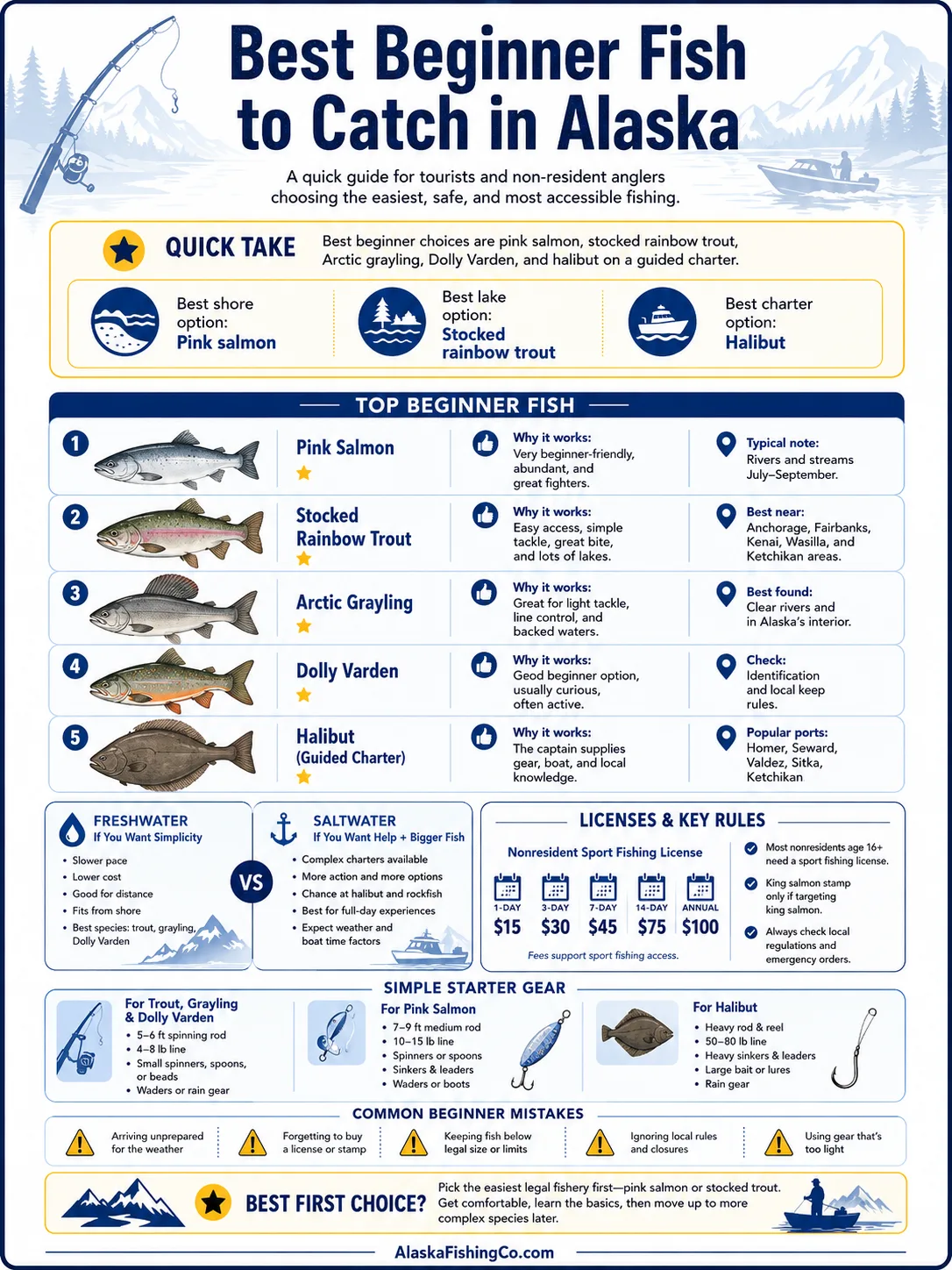
The best beginner fish to catch in Alaska are pink salmon, stocked rainbow trout, Arctic grayling, Dolly Varden, and, with a charter, halibut. These species give new anglers a realistic chance because they are either aggressive biters, widely stocked, reachable from shore, or guided by crews who provide the gear and know the water.
For most first-time visitors, the easiest starting point is not the biggest fish. It is the fish that matches the season, location, tackle, and rules. A beginner standing near a stocked lake in Anchorage has a very different best option than a traveler joining a saltwater charter in Homer, Seward, or Ketchikan.
If you remember one thing… start with a fishery that is easy to access and simple to understand before chasing trophy salmon or remote river species.
What To Know First
- Best shore option: pink salmon when they are running near coastal streams, harbors, or beaches.
- Best lake option: stocked rainbow trout in ADF&G-stocked lakes and ponds.
- Best light-tackle fish: Arctic grayling in Interior and selected stocked waters.
- Best charter option: halibut, because the captain supplies heavy gear and finds the fishing grounds.
- Best rule to follow: check the local regulation page and emergency orders before fishing, because Alaska rules can change by region, water, species, and date.
The Best Beginner Fish to Catch in Alaska
The best beginner fish in Alaska are species that are willing to bite, do not require expert casting, and can be found in places visitors can actually reach. For many travelers, that means stocked trout lakes, roadside salmon streams, coastal beaches, or a guided saltwater trip.
Alaska is famous for large king salmon and remote wilderness fishing, but those are not always the smartest first targets. Beginners usually do better with species that offer more bites, shorter learning time, and fewer gear problems.
1. Pink Salmon
Pink salmon are often the easiest salmon for beginners in Alaska. They are smaller than king salmon, travel in large numbers, and can be aggressive when fresh from the ocean. ADF&G describes pink salmon as the most numerous Pacific salmon and notes that they are the smallest Pacific salmon in North America, usually around 3.5 to 5 pounds on average.[a]
They are a good first salmon because the setup can be simple. A medium spinning rod, a bright spinner, a small spoon, or a simple fly can be enough when fish are moving through the area.
- Best for: first salmon, kids, shore fishing, short Alaska trips.
- Common places: coastal streams, harbor mouths, beaches, hatchery return areas, and roadside waters.
- Typical timing: mid-summer to late summer, depending on region and run timing.
- Beginner caution: pinks are best for eating when bright and fresh; dark, spawning fish are usually poor table fare.
Worth Noting
Pink salmon can look easy when the run is strong and frustrating when the timing is off. Before choosing a day, check local fishing reports or ask a nearby ADF&G office, tackle shop, or licensed guide.
2. Stocked Rainbow Trout
Stocked rainbow trout are one of the easiest Alaska fish for true beginners. ADF&G stocks fish into many lakes and streams, including rainbow trout, Arctic char, Arctic grayling, and landlocked salmon in many Southcentral and Interior waters.[b]
This is the simplest option for visitors staying near Anchorage, Fairbanks, the Mat-Su Valley, or the Kenai Peninsula. You do not need a boat, ocean gear, tide knowledge, or long travel time. Many stocked lakes have parking, bank access, and enough room for a new angler to practice casting.
- Best for: families, short evening trips, kids, first-time anglers.
- Common baits and lures: small spinners, small spoons, flies, bait under a bobber where bait is legal.
- Best approach: fish early or late in the day, cast near drop-offs, docks, weeds, and stocked shoreline areas.
- Beginner caution: some trout waters are catch-and-release or have special size rules, so do not assume all trout can be kept.
3. Arctic Grayling
Arctic grayling are one of Alaska’s friendliest fish for light tackle and beginner fly anglers. They are known for taking small flies and lures readily, and ADF&G notes that grayling have a broad natural range across much of Alaska, though not in every region.[c]
Grayling are not usually huge, but they are fun. Their large dorsal fin, quick strikes, and surface feeding make them one of the most rewarding fish for someone learning how to read moving water.
- Best for: light spinning rods, beginner fly fishing, Interior Alaska trips.
- Common places: clear streams, Interior rivers, roadside creeks, and selected stocked lakes.
- Simple tackle: small dry flies, nymphs, spinners, and tiny spoons.
- Beginner caution: grayling rules vary by drainage; some places may be catch-and-release or have special limits.
One Detail People Miss
A fish can be easy to catch and still have strict rules. Beginner-friendly does not mean regulation-free.
4. Dolly Varden
Dolly Varden are a strong beginner choice in many coastal and freshwater areas. They often feed near salmon eggs, small fish, insects, and shoreline food sources. They can be caught on small spoons, spinners, beads where legal, and flies.
ADF&G explains that Dolly Varden are char, not trout, and gives a simple identification clue: char usually have light spots on a dark body, while trout usually have dark spots on a lighter body.[d]
- Best for: anglers who want action without targeting large salmon.
- Common places: coastal streams, lakes, estuaries, and areas near salmon activity.
- Simple tackle: small spoons, spinners, egg patterns, beads where allowed, and streamers.
- Beginner caution: identify them correctly and check local char/trout rules before keeping fish.
5. Halibut on a Guided Charter
Halibut is not the easiest fish to handle alone, but it can be one of the easiest big fish for a beginner on a charter. The reason is simple: the captain and crew provide heavy rods, bait, safety support, and local knowledge. A first-timer does not need to know how to anchor on a halibut spot or choose deep-water tackle.
Halibut trips are managed under federal and international rules as well as state sport fishing rules. NOAA Fisheries explains that charter halibut operators in IPHC Areas 2C and 3A must have a valid Charter Halibut Permit onboard when carrying clients.[e]
- Best for: visitors who want a guided saltwater trip and a chance at a large fish.
- Common places: Homer, Seward, Valdez, Kodiak, Juneau, Sitka, Ketchikan, and other coastal ports.
- Simple approach: book a licensed charter, bring a valid Alaska sport fishing license, and follow crew instructions.
- Beginner caution: seasickness, weather, size rules, charter limits, and retention rules can affect the trip.
6. Rockfish on a Saltwater Trip
Rockfish can be easy to catch once a boat is over structure, but they are not the best do-it-yourself beginner fish unless someone experienced is helping. The catch rates can be good, but identification and release rules matter.
Alaska has many rockfish species, and ADF&G separates them into groups such as pelagic and nonpelagic rockfish. Some rockfish live a long time and are sensitive to overharvest, so anglers must be careful with identification and release methods.[f]
- Best for: guided saltwater anglers who want steady action.
- Common places: rocky saltwater areas, kelp edges, reefs, and nearshore structure.
- Simple tackle: jigs, bait, and medium-heavy saltwater rods.
- Beginner caution: rockfish release rules can require a deepwater release device, and limits vary by area.
Beginner Fish Comparison Table
The right fish depends on where the visitor is staying, how much time they have, and whether they want to fish from shore or book a boat. This table gives a practical starting point.
| Fish | Beginner Rating | Best Setting | Why It Works | Main Caution |
|---|---|---|---|---|
| Pink salmon | Very good | Shore, creek mouths, beaches | Aggressive, visible, often reachable without a boat | Timing matters; darker fish are poor eating |
| Stocked rainbow trout | Very good | Stocked lakes and ponds | Easy access, simple gear, good for kids | Some waters have special trout rules |
| Arctic grayling | Good | Interior streams and stocked lakes | Willing biters, great for light tackle | Not found everywhere in Alaska |
| Dolly Varden | Good | Coastal streams, lakes, estuaries | Often active around salmon runs and small baitfish | Can be confused with trout or Arctic char |
| Halibut | Good with a charter | Saltwater charter boat | Guide supplies gear and finds fish | Weather, cost, and changing charter rules |
| Rockfish | Fair to good with help | Saltwater boat over rocky structure | Can bite readily once located | Identification and release rules are easy to mishandle |
Freshwater or Saltwater: Which Is Easier for a Beginner?
Freshwater is usually easier for a first-time angler who wants a low-cost, short trip. Saltwater is easier when the beginner books a charter, because the boat, captain, and gear solve many of the hard parts.
A lake near town is a good place to learn casting, knots, hook-setting, and fish handling. A charter is better for visitors who want a full-day experience and do not mind seas, weather changes, and a higher price.
Choose Freshwater If You Want Simplicity
- You only have a few hours.
- You are traveling with children.
- You want to fish from shore.
- You want to avoid charter costs.
- You are happy catching trout, grayling, Dolly Varden, or small salmon.
Choose Saltwater If You Want Help and Bigger Fish
- You want a captain to choose the location.
- You do not own Alaska saltwater gear.
- You want a chance at halibut, rockfish, lingcod, or salmon.
- You are comfortable spending several hours on a boat.
- You can handle weather delays or schedule changes.
Before You Move On
For a first Alaska trip, the easiest plan is often one stocked-lake outing plus one guided saltwater charter. That gives a beginner two very different fishing experiences without overcomplicating the trip.
License Rules Beginners Should Know
Most visiting adults need an Alaska sport fishing license before fishing. ADF&G states that Alaska residents age 18 or older and nonresidents age 16 or older must buy and carry a sport fishing license to participate in sport and personal use fisheries. A king salmon stamp is also required to fish for king salmon, except for king salmon in stocked lakes.[g]
This matters even if someone is only “helping.” If a person is actively fishing, holding the rod, setting the hook, or taking part in the catch, they should have the right license unless an age or status exemption applies.
Nonresident and Foreign Visitor Fees
ADF&G lists nonresident sport fishing license options for visitors, including foreign or alien nonresidents. Current listed sport fishing license prices include 1-day, 3-day, 7-day, 14-day, and annual options.[h]
| License Type | Listed Fee | Best For |
|---|---|---|
| 1-day sport fishing license | $15 | One charter or one short fishing day |
| 3-day sport fishing license | $30 | Weekend fishing or short cruise stop extension |
| 7-day sport fishing license | $45 | Most one-week visitor trips |
| 14-day sport fishing license | $75 | Longer Alaska road trips |
| Annual sport fishing license | $100 | Multiple trips or extended seasonal stays |
Nonresident king salmon stamps are separate from the basic license when fishing for king salmon. Beginners who are not targeting king salmon do not normally need the king salmon stamp, but they should avoid fishing in a way that targets kings unless they have it and the water is open.
Simple Gear for Beginner Alaska Fish
Beginners do not need a full tackle shop to catch fish in Alaska. They need gear that fits the species, a few proven lures, and enough backup tackle to handle snags, wind, and line breaks.
Easy Starter Setup for Trout, Grayling, and Dolly Varden
- Light or medium-light spinning rod.
- 6- to 8-pound test line.
- Small spinners in silver, gold, pink, orange, or chartreuse.
- Small spoons.
- Small hooks, split shot, and bobbers for legal bait fishing.
- Needle-nose pliers for hook removal.
Easy Starter Setup for Pink Salmon
- Medium spinning rod.
- 10- to 15-pound test line.
- Bright spinners and spoons.
- A few simple flies if fly fishing is allowed and practical.
- A landing net, especially around rocks or steep banks.
Saltwater Setup
For halibut and many rockfish trips, beginners should not buy heavy gear unless they plan to fish Alaska often. A charter usually provides rods, reels, bait, and terminal tackle. Ask before booking what is included, whether fish cleaning is available, and whether the crew helps with shipping or processing.
One Detail People Miss
Alaska weather is part of the tackle list. Bring rain gear, warm layers, sunglasses, and a small towel even on a sunny morning.
Best Beginner Choices by Alaska Trip Type
The easiest fish changes with the trip. A cruise passenger, road-trip visitor, family camper, and charter guest should not all target the same species.
Cruise Visitor with One Day in Port
A guided salmon, halibut, or rockfish trip is often the easiest choice because time is limited. In some ports, shore fishing for pink salmon or coho salmon may also work if the run is in.
- Best target: pink salmon from shore when timing is right, or halibut on a charter.
- Avoid: long DIY drives to unfamiliar rivers.
- Smart move: book a trip that fits the ship schedule with time to spare.
Anchorage Visitor with a Rental Car
Stocked lakes are the easiest way to fish without committing a full day. Some lakes near town or within a short drive receive stocked trout or other species, and many are workable from shore.
- Best target: stocked rainbow trout.
- Good second target: Arctic char or grayling in stocked waters where present.
- Smart move: use the ADF&G stocking search before choosing a lake.
Fairbanks or Interior Alaska Visitor
Arctic grayling and stocked rainbow trout are two of the best beginner options in Interior Alaska. Streams can be clear and scenic, while stocked lakes can be easier when rivers are high or muddy.
- Best target: Arctic grayling in streams or stocked rainbow trout in lakes.
- Best style: small spinners or simple fly patterns.
- Smart move: carry insect protection in summer.
Kenai Peninsula Road Trip
The Kenai Peninsula offers many options, but not all are beginner-friendly. Sockeye fishing can be productive yet crowded and technique-specific. Beginners may do better with stocked lakes, pink salmon when available, or a guided saltwater trip.
- Best target: stocked trout, pink salmon, or halibut by charter.
- Avoid: assuming famous rivers are easy just because they are popular.
- Smart move: check emergency orders before targeting salmon.
Southeast Alaska Visitor
Southeast Alaska has shore-based salmon chances, saltwater charters, and productive coastal waters. Pink salmon, Dolly Varden, rockfish, and halibut can all fit a beginner trip depending on the location and rules.
- Best target: pink salmon from shore during the run.
- Good charter target: halibut or rockfish.
- Smart move: be careful with salmon and rockfish identification.
Common Mistakes Beginners Make
Most beginner mistakes in Alaska come from assuming the rules are simple, choosing the wrong species for the season, or bringing gear that does not match the fish.
Thinking All Salmon Are Equally Easy
Wrong idea: any salmon is a good beginner target.
Correct explanation: pink salmon and some coho fisheries can be friendly for beginners, but king salmon and sockeye often require more timing, technique, and rule awareness.
Why it gets confusing: Alaska is known for salmon, so visitors often assume salmon fishing is one single activity. It is not. Each salmon species behaves differently.
Buying a License but Forgetting the King Salmon Stamp
Wrong idea: a sport fishing license covers every fish.
Correct explanation: anglers who fish for king salmon generally need a king salmon stamp unless an exemption applies or they are fishing for king salmon in stocked lakes under the stated exception.
Why it gets confusing: many visitors buy the basic license online and miss the species-specific stamp question.
Keeping Fish Before Checking Local Rules
Wrong idea: if the fish is legal somewhere in Alaska, it is legal everywhere.
Correct explanation: Alaska regulations vary by region, drainage, water body, and date. Emergency orders can also change seasons, closures, and limits.
Why it gets confusing: maps and travel articles often talk about broad regions, while fishing rules may apply to a single river, bay, or management area.
Targeting Rockfish Without Knowing Release Rules
Wrong idea: rockfish are just another easy bottom fish.
Correct explanation: some rockfish require careful identification, and released rockfish may need to be returned with a deepwater release device depending on the fishery and rule in effect.
Why it gets confusing: rockfish may bite readily, so the catch feels simple even when the rule side is not.
Using Gear That Is Too Heavy or Too Light
Wrong idea: one rod can handle every Alaska fish.
Correct explanation: trout and grayling gear is too light for large salmon or halibut, while heavy saltwater gear is clumsy for stocked lakes.
Why it gets confusing: visitors often pack one travel rod and hope it works for every plan.
Real-Life Beginner Scenarios
These examples show how a visitor might choose a first Alaska fish without overthinking the trip.
- A family staying in Anchorage for two nights: choose a stocked lake and target rainbow trout with small spinners or bait where legal.
- A cruise passenger in Ketchikan during a pink salmon run: shore fishing near a legal public access point may be easier than a complicated inland trip.
- A visitor in Fairbanks with one free evening: try a stocked lake for trout or a nearby grayling stream if water conditions are good.
- A couple visiting Homer for the first time: book a half-day or full-day halibut charter instead of buying heavy saltwater gear.
- A camper on the Kenai Peninsula with kids: pick a stocked lake before attempting crowded salmon banks.
- A beginner fly angler in Interior Alaska: start with Arctic grayling because they often respond well to small, simple flies.
- A traveler who wants fresh fish for dinner: target bright pink salmon, stocked rainbow trout where harvest is legal, or halibut with a charter.
- A visitor unsure about regulations: fish with a licensed guide or choose a stocked lake with clear posted rules.
Worth Noting
The best beginner plan is not always the most famous Alaska plan. A simple legal fishery with steady bites usually creates a better first day than a famous river at the wrong time.
How to Pick the Right Beginner Fish Before You Go
Pick the fish after you know the region, dates, access, and rules. This order prevents the most common planning mistakes.
Step 1: Choose the Area
Alaska is too large for one simple answer. Decide whether you will be in Southcentral, Southeast, Interior, Southwest, or Northern Alaska, then narrow the plan to a specific town, lake, river, bay, or charter port.
Step 2: Check the Season
Salmon are seasonal. Stocked lakes can be better for flexible timing. Halibut charters depend on port, weather, and current rules.
Step 3: Check the Regulation Page and Emergency Orders
ADF&G states that emergency orders can open or close sport fishing seasons or areas, change bag limits, or modify harvest methods, and that these orders may be issued at any time with the force of law.[i]
Step 4: Match the Gear
Use light tackle for trout and grayling, medium gear for pink salmon and Dolly Varden, and charter-provided heavy gear for halibut. Do not try to make one setup do everything.
Step 5: Decide Whether You Want to Keep Fish
Harvest adds extra responsibility. Beginners should know the limit, size rule, recording requirement, cleaning rules, and transport plan before keeping fish.
Beginner Fish Questions Answered
What is the easiest fish to catch in Alaska for beginners?
For most visitors, stocked rainbow trout are the easiest freshwater fish, while pink salmon are often the easiest salmon when they are running. Halibut can also be beginner-friendly on a guided charter because the crew provides the gear and finds the fishing grounds.
What is the best salmon for a beginner to catch in Alaska?
Pink salmon are usually the best first salmon. They are smaller, often aggressive, and can be reachable from shore during the right run timing. Coho salmon can also be good, but they usually require more timing and persistence.
Can tourists fish in Alaska without a guide?
Yes, tourists can fish without a guide if they have the required license, follow the local rules, and fish in legal public-access areas. A guide or charter is still helpful for halibut, remote waters, unfamiliar salmon rivers, and saltwater rockfish trips.
Do foreign visitors need an Alaska fishing license?
Most foreign visitors age 16 or older need a nonresident Alaska sport fishing license. Foreign visitors are treated as nonresident anglers for sport fishing license purposes, and the ADF&G price list includes nonresident foreign or alien license options.
Do beginners need a king salmon stamp in Alaska?
Only if they are fishing for king salmon and do not qualify for an exemption. Beginners targeting pink salmon, rainbow trout, grayling, Dolly Varden, halibut, or rockfish generally do not need a king salmon stamp unless their activity targets king salmon.
Is halibut a good beginner fish in Alaska?
Halibut is a good beginner fish on a charter, not usually as a first do-it-yourself fish. The gear is heavy, the water can be rough, and regulations can vary, but a licensed charter crew handles much of the hard work.
What fish should beginners avoid on their first Alaska trip?
Beginners may want to avoid starting with king salmon, remote fly-in fisheries, complicated sockeye crowds, and self-guided rockfish trips unless they have experienced help. These fisheries can be rewarding, but they leave less room for mistakes.
Before Your First Alaska Fishing Day
The best beginner fish in Alaska is the one that matches the place, season, and rules in front of you. Pink salmon, stocked rainbow trout, Arctic grayling, Dolly Varden, and charter halibut give new anglers the best mix of access and realistic success.
The most common mistake is choosing a famous fish before checking whether it is open, reachable, and suitable for beginner gear. A simple rule works well: pick the easiest legal fishery first, then upgrade the challenge after the first fish is caught.
Alaska Fishing References
- [a] Alaska Department of Fish and Game — Pink Salmon Species Profile (supports pink salmon size, abundance, and species background; official state fish and wildlife agency source).
- [b] Alaska Department of Fish and Game — Fish Stocking Search (supports stocked lake species and stocking program details; official state stocking database).
- [c] Alaska Department of Fish and Game — Arctic Grayling Species Profile (supports grayling range and species background; official state species profile).
- [d] Alaska Department of Fish and Game — Dolly Varden Species Profile (supports Dolly Varden identification and biology; official state species profile).
- [e] NOAA Fisheries — Sport Halibut Fishing in Alaska (supports charter halibut permit context; federal fisheries management source).
- [f] Alaska Department of Fish and Game — Rockfish Identification and Conservation (supports rockfish identification and management group context; official state conservation resource).
- [g] Alaska Department of Fish and Game — Sport Fishing Licenses, King Salmon Stamps, IDs and Harvest Record Cards (supports age rules, license requirement, and king salmon stamp requirement; official state licensing source).
- [h] Alaska Department of Fish and Game — Sport Fishing License and King Salmon Stamp Prices (supports nonresident and foreign visitor license fees; official state price list).
- [i] Alaska Department of Fish and Game — Sport Fishing Emergency Orders and Press Releases (supports rule-change and emergency-order warnings; official state emergency order page).