
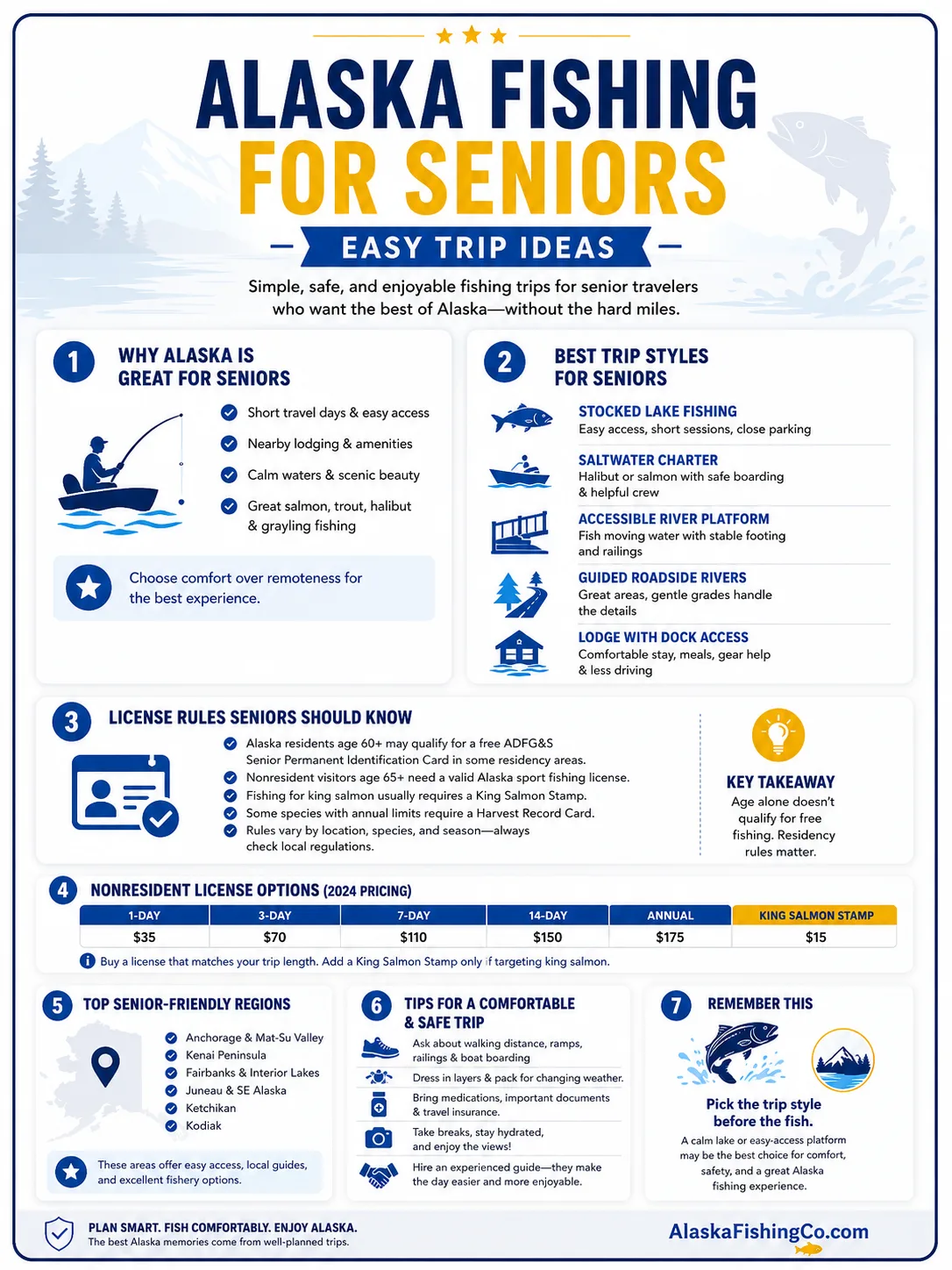
Alaska can be a very good fishing destination for seniors when the trip is built around short travel days, steady footing, nearby lodging, and simple species choices. The easiest senior-friendly Alaska fishing trips are usually road-access lakes, calm charter days, accessible river platforms, or half-day guided outings close to Anchorage, the Kenai Peninsula, Mat-Su, Fairbanks, Juneau, Ketchikan, or Kodiak.
For most older visitors, the best plan is not the most remote plan. It is the one that keeps walking short, avoids rough water when possible, gives the group a bathroom and parking plan, and still leaves room for salmon, trout, halibut, or grayling.
If you remember one thing… choose the trip style before choosing the fish. A calm lake or accessible platform may be better than a famous river if someone in the group needs easy footing, seating, or a shorter day.
What To Know First
- Senior does not always mean license-free. Alaska’s senior resident card applies to Alaska residents age 60 or older who meet residency rules, not to every senior visitor.
- Nonresident seniors usually still need a sport fishing license. Nonresidents age 16 or older need a valid Alaska sport fishing license.
- King salmon can add a stamp requirement. Anglers fishing for king salmon usually need a king salmon stamp unless an exception applies.
- Easy access matters. Ask about walking distance, boat boarding, restroom access, railings, seating, and fish-cleaning help before booking.
- Local rules change by region and season. Alaska regulations can differ by river, lake, species, and emergency order.
Best Alaska Fishing Trip Styles for Seniors
The easiest Alaska fishing trips for seniors are usually half-day charters, stocked-lake outings, accessible river platforms, and slow-paced lodge or cabin trips. These options reduce long hikes, rough terrain, and complicated gear handling.
Many travelers picture Alaska fishing as remote fly-outs and long days in waders. Those trips can be excellent, but they are not the only way to fish Alaska well. A senior-friendly trip should match the angler’s balance, stamina, medications, weather tolerance, and comfort with boats.
Easy trip styles to consider
- Stocked lake fishing: Good for short sessions, simple gear, and close parking in many developed areas.
- Saltwater charter from a harbor: Good for halibut or salmon when the boat has safe boarding, cabin space, and crew help.
- Accessible river platform: Good for anglers who want moving water without climbing down a bank.
- Guided roadside river trip: Good when the guide can choose gentle access points and handle fish safely.
- Fishing lodge with dock access: Good for multi-day comfort, meals, gear, and less driving.
Worth Noting
For senior anglers, “easy” usually means more than short walking distance. It also means stable footing, predictable bathrooms, shaded rest options, clear license help, and a plan for handling the fish after it is caught.
License Rules Seniors Should Check Before Fishing
Alaska residents age 18 or older and nonresidents age 16 or older generally need a sport fishing license to fish in Alaska. Alaska resident seniors age 60 or older may qualify for a free ADF&G senior permanent identification card, but that benefit is tied to Alaska residency, not age alone.[a]
This is where many visitors get caught off guard. A 68-year-old from Florida, Germany, Texas, Ontario, or Australia is not treated the same as a 68-year-old Alaska resident with the correct ADF&G senior card. Senior visitors should plan as nonresidents unless they meet Alaska’s residency definition.
License basics for senior travelers
- Alaska resident senior: Age 60 or older, meets ADF&G residency rules, and has the required permanent identification card.
- U.S. out-of-state senior: Usually buys a nonresident sport fishing license if age 16 or older.
- Foreign senior visitor: Usually buys a nonresident sport fishing license if age 16 or older.
- King salmon anglers: Usually need a king salmon stamp unless an ADF&G exception applies.
- Annual-limit species: Some anglers need a harvest record card, especially where annual limits apply.
ADF&G states that Alaska resident seniors age 60 or older who meet residency rules may apply for a senior permanent identification card to hunt, sport fish, or trap for free. The applicant must be physically present in Alaska to apply, and the card becomes void if the person is no longer an Alaska resident.[b]
Simple License Cost Planning for Senior Visitors
For nonresident seniors, the simplest cost plan is to match the license length to the number of fishing days, then add a king salmon stamp only if the trip will target king salmon. Current ADF&G pricing lists nonresident sport fishing license options by 1-day, 3-day, 7-day, 14-day, and annual lengths.[c]
Do not buy more license than the trip needs, but do not cut it too close either. If a traveler might fish on arrival day and again after the main charter, a 3-day or 7-day license can be easier than buying separate 1-day licenses.
| Trip type | Likely license choice | King salmon stamp? | Senior-friendly note |
|---|---|---|---|
| One half-day lake outing | 1-day nonresident sport fishing license for most visiting seniors | Usually no, unless fishing for king salmon where required | Best when walking is short and gear is simple |
| Two or three days on the Kenai Peninsula | 3-day nonresident sport fishing license for most visiting seniors | Only if targeting king salmon where a stamp is required | Good for one charter plus one relaxed river or lake day |
| Weeklong Alaska vacation with several fishing stops | 7-day nonresident sport fishing license for most visiting seniors | Add if king salmon is part of the plan | Leaves room for weather changes and rest days |
| Alaska resident senior with valid PID | No regular sport fishing license required under the senior PID rule | Usually no king salmon stamp required under the senior PID rule | Still check harvest record card and permit needs |
One Detail People Miss
A senior permanent identification card does not remove every paperwork duty. In fisheries with annual limits, Alaska senior resident card holders may still need a free harvest record card and must record fish when required.
Easy Alaska Fishing Locations to Put on a Senior Trip List
The best senior-friendly locations are places with road access, parking, bathrooms or nearby services, and a realistic way to stop early if the weather or fatigue changes the day. Alaska State Parks lists several sites with accessible fishing docks, platforms, paved access, or boardwalk features, though conditions can still vary by weather and maintenance.[d]
No single Alaska fishing spot is perfect for every senior. A strong walker may enjoy a gravel path to a lake dock. Someone using a cane or wheelchair may need paved access, railings, and a platform. A traveler prone to motion sickness may do better on a lake or riverbank than a long saltwater run.
Senior-friendly areas to consider
- Anchorage area: Good for travelers who want fishing without leaving the city far behind. Stocked lakes and nearby streams can work well for short outings.
- Mat-Su Valley: A strong choice for road-access lakes, river access, and relaxed pacing north of Anchorage.
- Kenai Peninsula: Good for salmon, trout, and halibut trips, with many guide and charter options. Ask carefully about walking, boat boarding, and restroom plans.
- Fairbanks and Interior Alaska: Good for Arctic grayling, stocked lakes, and slower-paced freshwater fishing when conditions are right.
- Juneau, Sitka, Ketchikan, and Kodiak: Good for cruise visitors or fly-in travelers who want a short charter or accessible shore option.
Accessible sites worth checking before a trip
- Bird Creek near Anchorage: Alaska State Parks notes paved access to a fishing pier over the river.
- Matanuska Lake near Palmer: Listed with a trail to an accessible fishing dock, though the path is gravel and has grade.
- Bings Landing near Sterling: Listed with an accessible boardwalk along the Kenai River.
- Quartz Lake near Delta Junction: Listed with gravel trails to accessible fishing docks at campground areas.
- Buskin River near Kodiak: Listed with a paved trail to an accessible fishing platform.
Before relying on any access feature, call the park, guide, or local office. Alaska weather, gravel surfaces, water levels, construction, and seasonal closures can change what “accessible” feels like on the day of the trip.
Best Fish Choices for a Lower-Stress Senior Trip
For many senior anglers, rainbow trout, Arctic grayling, stocked lake fish, pink salmon, silver salmon, and halibut on a calm charter are easier choices than technical king salmon fishing. The best species depends on the month, region, mobility level, and whether the group wants to keep fish or simply enjoy the outing.
King salmon can be exciting, but it often adds more rules, more pressure, and sometimes more time on the water. Halibut can be excellent for seniors on the right boat, but deep-water reeling can be tiring. A good charter crew can help, but travelers should be honest about grip strength, back issues, and balance.
Easy species planning
- Stocked rainbow trout: Good for short lake trips near towns and family groups with mixed ages.
- Arctic grayling: Often a good freshwater target in Interior trips where access is simple.
- Pink salmon: Often easier for casual salmon fishing in the right year and location.
- Silver salmon: A popular late-summer target, but access and crowding vary by area.
- Halibut: Good for charter comfort when seas are calm and the boat is senior-ready.
Before You Move On
Ask the guide this simple question: “What happens if we need a shorter fishing day?” The answer tells you a lot about whether the trip is truly senior-friendly.
How to Choose a Senior-Friendly Charter or Guide
A senior-friendly charter is not just a boat with available seats. It is a trip where boarding, seating, weather calls, fish handling, bathroom access, and trip length are explained before money changes hands.
When booking, avoid vague answers. A good operator should be able to describe the dock, boat steps, rail height, cabin shelter, bathroom setup, sea conditions, and whether crew can help with baiting, netting, lifting, and fish processing.
Questions to ask before booking
- How far is the walk from parking to the boat or fishing spot?
- Are there steps, ladders, loose gravel, mud, or steep banks?
- Is there a restroom on the boat or nearby?
- Can the trip be shortened if someone becomes tired?
- Will the crew help with heavy reeling or fish handling?
- Is the boat covered or heated?
- What is the cancellation policy for rough seas or unsafe weather?
- Can the guide help confirm license and stamp needs before the trip?
For seniors who are new to Alaska, a half-day trip is often the right first choice. If the first day goes well, a second outing can be added. That is usually better than booking two long days before knowing how the body handles Alaska weather, travel, and fishing conditions.
Online License Buying Steps for Senior Travelers
Most visiting seniors can buy Alaska sport fishing licenses online through the ADF&G store, at many sporting goods stores, and at Fish and Game offices. Buying online before the trip helps avoid delays on the morning of a charter.[e]
The process is usually simple, but travelers should slow down when choosing resident status, license length, and king salmon stamp options. A wrong residency choice can create problems in the field.
Basic online buying steps
- Go to the official ADF&G online store.
- Choose the correct customer type and residency status.
- Select the sport fishing license length that matches the fishing days.
- Add a king salmon stamp only if the trip requires it.
- Print or save the license in a format that can be shown while fishing.
- Ask the guide whether a harvest record card is needed for the planned species or area.
Do not wait until cell service is weak. Many Alaska fishing areas have limited reception, and some seniors prefer a paper copy in a waterproof bag even when a digital copy is available.
Common Mistakes Seniors Make When Planning Alaska Fishing
Most senior fishing problems in Alaska come from mismatched expectations, not lack of interest. The trip becomes easier when the group plans around access, weather, rules, and rest time from the start.
Mistake 1: Assuming all seniors fish free
Wrong idea: “I am over 60, so I do not need an Alaska fishing license.”
Correct explanation: The senior free sport fishing benefit is for qualifying Alaska residents age 60 or older with the proper ADF&G identification card. Nonresident seniors generally still need a license.
Why it gets mixed up: Many states have senior discounts or exemptions, but Alaska’s senior resident rule is tied to Alaska residency.
Mistake 2: Booking the fish before checking the access
Wrong idea: “The best fish makes the best trip.”
Correct explanation: The best senior trip is the one the angler can enjoy safely. A modest trout lake with easy access may beat a famous river with steep banks.
Why it gets mixed up: Alaska fishing marketing often highlights trophy fish more than walking surfaces, seating, bathrooms, or trip length.
Mistake 3: Forgetting the king salmon stamp
Wrong idea: “A fishing license covers every fish.”
Correct explanation: King salmon usually requires a king salmon stamp in addition to a sport fishing license, unless a listed exception applies.
Why it gets mixed up: Many casual anglers do not realize a stamp is separate from the base license.
Mistake 4: Ignoring emergency orders and current reports
Wrong idea: “If it was open last year, it is open this year.”
Correct explanation: ADF&G notes that emergency orders can supersede published regulations, and fishing reports are updated during the busy season with current area information.[f]
Why it gets mixed up: Older web pages, saved screenshots, and past trip reports may not reflect current conditions.
Real-Life Scenarios for Senior Alaska Fishing Trips
These examples show how different senior travelers can choose easier Alaska fishing without giving up the feeling of a real trip.
- The cruise visitor in Juneau: A short shore-based or half-day charter plan is better than a full-day trip with tight return timing.
- The couple staying in Anchorage: A stocked lake outing can give them a low-pressure fishing day without a long drive.
- The 72-year-old who wants halibut: A charter with cabin seating, helpful crew, and a flexible weather policy is the safest starting point.
- The Alaska resident senior with a PID card: The license may be covered, but harvest card and local regulation checks still matter.
- The foreign visitor over 65: Age alone does not remove the nonresident license requirement, so online license planning should happen before the fishing day.
- The adult child planning for a parent: Call guides directly and ask about boarding steps, bathroom access, and how much walking is involved.
- The senior with balance concerns: An accessible platform, dock, or calm lake edge is usually smarter than wading a slippery river.
Worth Noting
Travel companions should plan around the slowest comfortable pace in the group. A fishing day feels much better when no one has to rush over gravel, docks, stairs, or wet riverbanks.
Simple Packing Tips for Older Anglers
Senior anglers should pack for warmth, grip, hydration, medication timing, and easy license access. Alaska weather can shift during a short outing, even near town.
The goal is not to overpack. The goal is to avoid small problems that can end the day early. Cold hands, wet socks, missed medication, or no place to sit can turn an otherwise easy trip into a hard one.
Useful items for a senior fishing day
- Printed license, stamp, and harvest card if needed
- Photo ID
- Waterproof outer layer
- Warm hat and light gloves
- Non-slip shoes or boots
- Small cushion or folding seat if allowed
- Medication, snacks, and water
- Sunglasses and sunscreen
- Bug repellent in summer
- Waterproof bag for phone and documents
If the trip is a charter, ask what the boat already provides. Some boats provide rods, bait, tackle, fish cleaning, rain gear, or packaging. Others expect guests to bring more of their own items.
How to Build a Gentle Alaska Fishing Itinerary
A good senior fishing itinerary leaves rest between travel and fishing. Avoid scheduling a long charter the morning after a late flight, especially if the group is adjusting to time zones or long drives.
For most senior visitors, one fishing activity every other day is a comfortable pace. Use the open days for wildlife viewing, scenic drives, local restaurants, museums, or a second short fishing stop if everyone feels good.
Sample relaxed 5-day plan
- Day 1: Arrive, pick up rental car, confirm licenses, and rest.
- Day 2: Easy stocked lake or short guided freshwater outing.
- Day 3: Scenic drive, wildlife viewing, or local sightseeing.
- Day 4: Half-day charter or accessible river fishing.
- Day 5: Flexible weather day, fish processing pickup, or relaxed departure.
This kind of plan gives the trip room to breathe. Alaska weather can be part of the experience, but it should not control every hour of the vacation.
Alaska Fishing for Seniors Questions Answered
Do seniors need a fishing license in Alaska?
Many seniors do need a fishing license in Alaska. The free senior resident identification card applies to qualifying Alaska residents age 60 or older. Nonresident seniors age 16 or older generally need a nonresident sport fishing license.
Can foreign seniors buy an Alaska fishing license online?
Yes. Foreign visitors can generally buy Alaska nonresident sport fishing licenses online through the ADF&G store. They should choose the correct nonresident or foreign visitor option and match the license length to their fishing days.
What is the easiest Alaska fishing trip for older adults?
For many older adults, the easiest trip is a short stocked-lake outing, an accessible fishing platform, or a half-day charter with safe boarding and crew help. The best choice depends on mobility, weather, and comfort with boats.
Is halibut fishing too hard for seniors?
Halibut fishing can be comfortable for seniors on the right charter, but deep-water reeling can be tiring. Ask about boat seating, cabin shelter, sea conditions, crew help, and whether the trip can be shortened if needed.
Do Alaska resident seniors need a king salmon stamp?
Qualifying Alaska resident seniors with an ADF&G senior permanent identification card are generally not required to buy a king salmon stamp, but they may still need harvest records or permits depending on the fishery.
Are there accessible fishing spots in Alaska?
Yes. Alaska State Parks lists several sites with accessible fishing platforms, piers, docks, paved access, or boardwalks. Conditions still vary, so travelers should check the specific site before relying on it.
Should seniors book a full-day or half-day fishing trip in Alaska?
A half-day trip is usually better for a first Alaska fishing outing, especially after travel. Full-day trips can work well for active seniors, but they should be booked only after checking seating, bathrooms, weather exposure, and cancellation options.
Before You Pick the Trip
Alaska fishing can be very rewarding for seniors when the plan fits the person, not just the species. Start with easy access, then choose the fish, license length, guide, and region around that comfort level.
The most common mistake is assuming age alone changes the rules or makes a difficult access point easier. A good rule to remember: the best senior Alaska fishing trip is the one that keeps the day simple enough to enjoy from the first cast to the ride back.
Alaska Fishing References
- [a] ADF&G Sport Fishing Licenses, King Salmon Stamps, IDs and Harvest Record Cards — Used for Alaska sport fishing license age rules, nonresident requirements, king salmon stamp basics, and harvest record card notes. (Official Alaska Department of Fish and Game source.)
- [b] ADF&G Senior Licensing: Sport Fishing Licenses and King Salmon Stamps — Used for Alaska resident senior PID eligibility, residency limits, and senior card conditions. (Official Alaska Department of Fish and Game source.)
- [c] ADF&G Product Prices: Licenses, Stamps, and Tags — Used for current license length categories and sport fishing stamp price structure. (Official Alaska Department of Fish and Game pricing page.)
- [d] Alaska State Parks ADA Facilities — Used for accessible fishing docks, platforms, paved access, boardwalks, and site-specific access notes. (Official Alaska Department of Natural Resources page.)
- [e] ADF&G Online Store — Used for online license purchasing direction. (Official Alaska Department of Fish and Game store.)
- [f] ADF&G Sport Fish Reports by Area — Used for current fishing report, seasonal update, and emergency order planning advice. (Official Alaska Department of Fish and Game fishing reports page.)