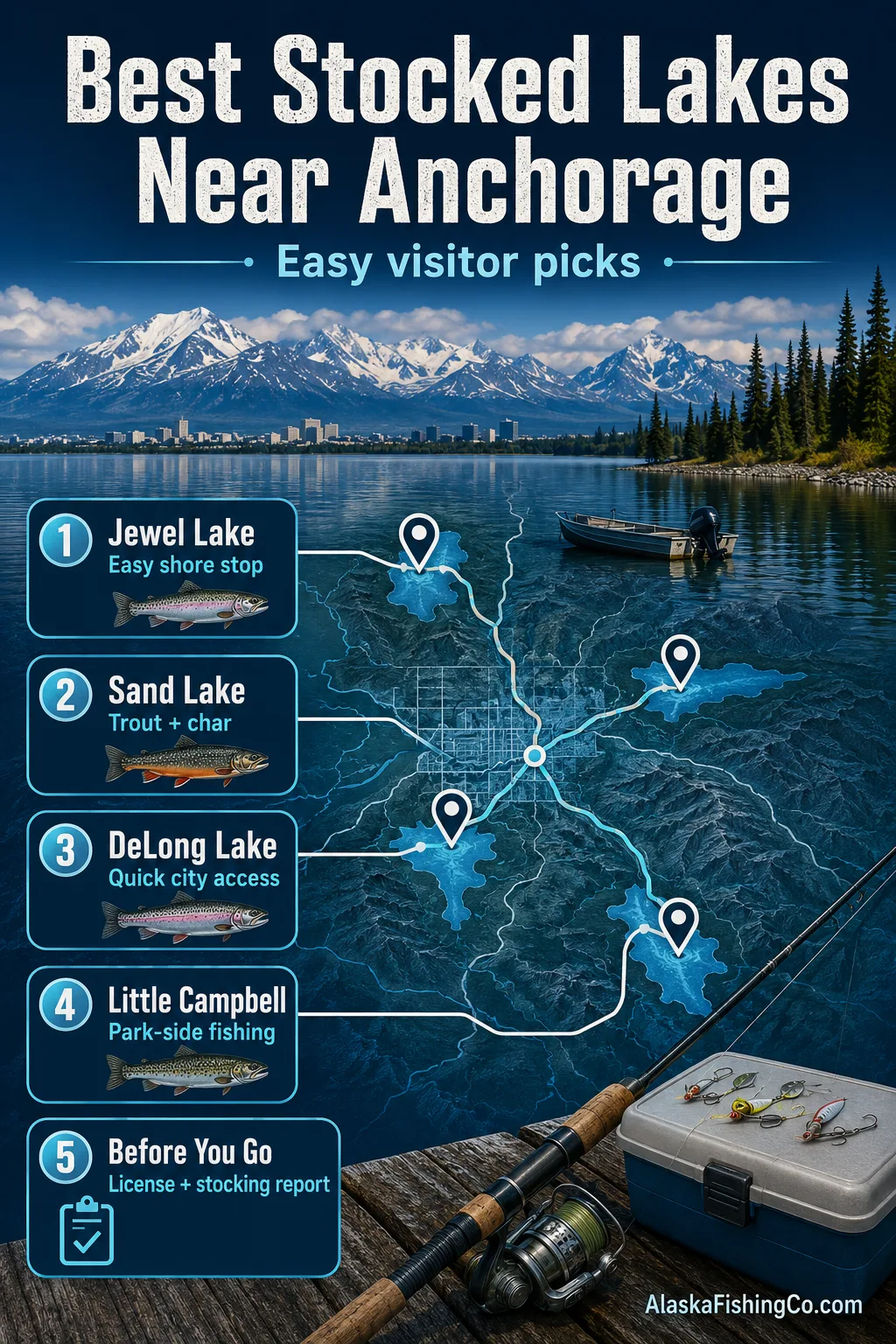
Anchorage is one of the easiest places in Alaska for visitors to try stocked-lake fishing without driving far from town. Jewel Lake, Cheney Lake, DeLong Lake, Campbell Point Lake, Taku-Campbell Lake, Mirror Lake, Beach Lake, and Sand Lake are among the most useful choices for travelers because they offer stocked fish, public access, and realistic half-day fishing plans.
Most visitors are looking for a simple answer: where can someone fish near Anchorage with a fair chance at rainbow trout or stocked salmon, without booking a full charter or learning a remote river system first? The best answer depends on whether you need easy bank access, a family park setting, canoe water, or a quieter lake with fewer people.
If you remember one thing… choose Jewel Lake or Cheney Lake if you want the simplest shore-based option, and choose DeLong Lake, Campbell Point Lake, Mirror Lake, Beach Lake, or Sand Lake if you have a canoe, float tube, or more time to move around.
What To Know First
- Best easy family pick: Jewel Lake, because it has park facilities, bank access, and a long history as a heavily stocked Anchorage lake.
- Best beginner shore option: Cheney Lake, especially for simple spinning tackle or learning to fly fish from the bank.
- Best canoe or float-tube option: DeLong Lake, where shore access is limited but small craft fishing is practical.
- Best quiet urban option: Campbell Point Lake in Kincaid Park, with dock access and a more tucked-away feel.
- Best larger-water option: Sand Lake, mainly for anglers with a canoe or small craft because bank access is limited.
- License reminder: nonresidents age 16 and older generally need an Alaska sport fishing license before fishing fresh or salt water.
Best Stocked Lakes Near Anchorage for Visitors
The best stocked lakes near Anchorage are the ones that match a visitor’s transportation, time, and comfort level. A lake can be stocked and still be a poor choice for a traveler if public access is awkward, the shoreline is mostly private, or the best water requires a boat.
ADF&G describes the Anchorage area as a place where much of the sport fishing opportunity comes from hatchery stockings, and its lake information separates public access, species present, and stocking notes for many local waters.[a] That matters because a stocked lake is not just a name on a map. It is a place where access, timing, and regulations all shape the actual fishing day.
For visitors, these are the lakes that usually make the most sense:
- Jewel Lake: easy access, family-friendly, good for bank anglers.
- Cheney Lake: simple urban access, good walking paths, beginner-friendly fishing.
- DeLong Lake: better from a canoe, inflatable, or float tube.
- Campbell Point Lake: quieter Kincaid Park setting with dock and small-craft potential.
- Taku-Campbell Lake: under-fished feel, bank access, walking trails, canoe-friendly water.
- Mirror Lake: north of central Anchorage, good family day-trip option.
- Beach Lake: useful for canoe or float-tube fishing near Chugiak.
- Sand Lake: larger, productive water, but less convenient from shore.
Worth Noting
Stocking schedules are not a promise that fish will be easy every day. Weather, water temperature, recent pressure, and the time since stocking all affect catch rates.
How To Choose the Right Lake
Choose the lake by access first, then by species. A visitor with two free evening hours will usually do better at an easy shoreline lake than at a larger lake that fishes better from a canoe.
ADF&G’s stocking search shows recent stocking records by water, species, date, number, size, and fish type. The records are useful before a trip because they show whether a lake has recent rainbow trout, landlocked salmon, Arctic char, or other stocked fish entries.[b]
| Lake | Best For | Access Style | Visitor Notes |
|---|---|---|---|
| Jewel Lake | Families, first-time Alaska lake anglers, bank fishing | Road access, parking, park facilities, bank access | One of the easiest stocked-lake choices in Anchorage. |
| Cheney Lake | Beginners, shore anglers, short evening trips | Park access, paths, bank fishing | Good choice when visitors do not have a boat or much time. |
| DeLong Lake | Canoes, inflatables, float tubes | Road access, dock, limited shore fishing | Better for anglers who can get off the bank. |
| Campbell Point Lake | Quiet water, Kincaid Park visitors, small craft | Foot trail, parking, dock | A more tucked-away stocked lake with a park setting. |
| Taku-Campbell Lake | Bank access, walking trails, light pressure | Urban access, trails, canoe-friendly | Good when visitors want a lake inside the city but away from busy park beaches. |
| Mirror Lake | Family day trip north of Anchorage | Parking, facilities, bank access, small craft | A practical option for travelers already heading toward Eagle River or Chugiak. |
| Beach Lake | Canoe fishing, float tubes, Chugiak-area visitors | Parking, unimproved boat launch | Useful if the trip includes north Anchorage or Eagle River. |
| Sand Lake | Larger stocked-water fishing, canoe or small craft | Limited bank access, some trail/canal access | Not the easiest first stop, but it can hold larger local fish. |
Jewel Lake: The Easiest All-Around Visitor Lake
Jewel Lake is often the best stocked lake near Anchorage for visitors who want a simple, low-stress place to fish. It has public park access, parking, toilets, picnic areas, a dock, and bank access that makes it usable even without a boat.
ADF&G’s lake notes describe Jewel Lake as a family-friendly location with a sandy beach, plenty of bank access, and heavy stocking.[c] That combination makes it a strong choice for travelers staying in Anchorage hotels or visiting with children.
- Fish to expect: rainbow trout and landlocked salmon are the main stocked-lake targets.
- Best visitor setup: small spinners, spoons, or bait under a bobber where legal.
- Best time: spring after stocking, cool summer mornings, evenings, and fall after fresh plants.
- Good for kids: yes, because the park layout is easier than most local lakes.
Jewel Lake can also be busy in summer because it is a park lake, not a remote fishing spot. Fish early or late if the goal is a quieter session.
Cheney Lake: A Good Beginner Shore Spot
Cheney Lake is a strong pick for visitors who want to fish from shore, walk a little, and keep the day simple. It is not the biggest stocked lake near Anchorage, but it is one of the most practical for beginners.
The lake has city park access, walking and bike paths nearby, and bank areas that suit short sessions. ADF&G notes that Cheney Lake is a good place to learn to fly fish and lists rainbow trout and landlocked salmon among the species present.
- Why visitors like it: easy urban access and a manageable shoreline.
- Best approach: walk slowly, cover water, and avoid standing in one spot too long.
- Useful tackle: small spinners, wet flies, bead-head nymphs, or a simple bobber rig where allowed.
- Trip length: one to three hours is enough for a realistic visit.
One Detail People Miss
A stocked lake with bank access is often better for a visitor than a lake with bigger fish but awkward shoreline. Time spent reaching fishable water is still part of the fishing day.
DeLong Lake: Better With a Canoe or Float Tube
DeLong Lake is a good choice when visitors can bring or rent a canoe, inflatable, or float tube. It can produce nicer rainbow trout, but shore access is more limited than at Jewel or Cheney.
ADF&G describes DeLong Lake as a good opportunity for canoeing or float-tube fishing, with some nicer-sized rainbow trout and limited shore access. It also notes park facilities, parking, picnic tables, toilets, and a handicap-accessible dock.
- Best for: travelers who want a more active fishing session.
- Less ideal for: someone with only a rod, no small craft, and no time to explore.
- Fish present: rainbow trout and landlocked salmon.
- Practical note: respect private property around the shoreline.
DeLong can be a smart pick after checking recent stocking records. If a fresh plant happened recently, it may fish well even during a short trip.
Campbell Point Lake: Quiet Water in Kincaid Park
Campbell Point Lake, also known locally as Beer Can Lake, is a useful stocked option for visitors who want a quieter park setting. It is better with a canoe or float tube, but dock access gives bank anglers a workable place to start.
This lake sits in Kincaid Park, so it can pair well with a half-day Anchorage plan that includes trails, scenery, and fishing. ADF&G lists rainbow trout, landlocked salmon, and Arctic char among the species present and describes the lake as stocked annually.
- Best for: visitors who want a less urban feel without leaving Anchorage.
- Access: foot trail, parking, and dock.
- Good method: small lures, flies, or slow presentations near structure and drop-offs.
- Safety note: Kincaid Park can have wildlife nearby, so give animals space and keep food secure.
Taku-Campbell Lake: Under-Fished Urban Water
Taku-Campbell Lake is a practical stocked lake for visitors who want bank access, walking trails, and a lake that does not always feel as busy as better-known park waters.
ADF&G describes Taku-Campbell as having plenty of bank access, walking trails along Campbell Creek, and canoe or float-tube friendly water. Recent stocking search entries also show rainbow trout and landlocked coho records for Taku-Campbell Lake.
- Best for: short urban sessions with room to move.
- Good visitor plan: fish the bank first, then walk to another angle if bites slow down.
- Species to check: rainbow trout and stocked landlocked salmon entries.
- Useful timing: after spring stocking, after fall stocking, or during cooler parts of summer days.
Before You Move On
Use ADF&G’s stocking search close to the day you fish. A lake stocked last week and a lake stocked months ago can feel like two different places.
Mirror Lake and Beach Lake: Good North-Side Options
Mirror Lake and Beach Lake are useful choices when a visitor is staying north of Anchorage, visiting Eagle River or Chugiak, or driving the Glenn Highway. They are not as central as Jewel or Cheney, but they can be more convenient depending on the day’s route.
Mirror Lake has park facilities, bank access, and small-craft potential. ADF&G lists landlocked salmon, rainbow trout, and Arctic grayling for Mirror Lake. Beach Lake is larger and works well for canoe or float-tube fishing, with an unimproved boat launch and stocked species including rainbow trout, landlocked salmon, and Arctic grayling.
- Mirror Lake: better for families who want facilities and a simple day trip.
- Beach Lake: better for visitors with a canoe or float tube.
- Driving note: both make more sense if the day already includes north Anchorage or Chugiak.
- Access note: not all shoreline is public, so use marked public access points.
Sand Lake: Bigger Water, Less Simple From Shore
Sand Lake is one of the more interesting stocked waters near Anchorage, but it is not the easiest first lake for every visitor. It is larger, has limited bank access, and generally makes more sense for anglers with a canoe or small craft.
ADF&G describes Sand Lake as a local hot spot in open-water months and notes that it can offer a chance at some of the larger fish found in Anchorage stocked lakes. It also notes limited bank access and private shoreline concerns.
- Best for: anglers who can cover water by canoe, inflatable, or another small craft.
- Less ideal for: visitors who want quick parking-to-bank fishing.
- Species listed: rainbow trout, Arctic char, grayling, and invasive northern pike.
- Winter note: Sand Lake is also known as an ice-fishing option when conditions are safe.
License and Rule Checks Before You Fish
Most adult visitors need an Alaska sport fishing license before fishing stocked lakes near Anchorage. ADF&G states that residents age 18 or older and nonresidents age 16 or older must buy and carry a sport fishing license to participate in Alaska sport fisheries.[d]
For nonresident visitors, Alaska offers short-term licenses that fit common trip lengths. Current ADF&G pricing lists nonresident sport fishing licenses as 1-day, 3-day, 7-day, 14-day, and annual options.[e]
- Nonresident age rule: visitors age 16 and older generally need a sport fishing license.
- Foreign visitors: foreign travelers are treated as nonresidents for Alaska sport fishing license purposes.
- King salmon stamp: required when fishing for king salmon, except for king salmon in stocked lakes.
- Carry proof: keep a digital or printed license available while fishing.
- Check the area: Anchorage is in the Southcentral regulation region.
Regulations can differ by water, species, and emergency order. ADF&G’s Southcentral sport fishing regulation page gives the current booklet and area sections, and it states that emergency orders supersede published regulations.[f]
Common Mistakes Visitors Make
The most common mistakes come from assuming every stocked lake works the same way. They do not. Access, timing, recent stocking, and regulations all matter.
Mistake: Choosing the lake only by stocking numbers
Correct explanation: A recent stocking record helps, but it does not tell you whether a visitor can fish comfortably from shore.
Why it gets mixed up: stocking data is easy to compare, while public access takes more reading.
Mistake: Going to Sand Lake without a small craft
Correct explanation: Sand Lake can be productive, but bank access is limited.
Why it gets mixed up: larger lakes sound better on paper, even when smaller lakes are easier to fish.
Mistake: Forgetting the nonresident age rule
Correct explanation: nonresident visitors age 16 and older generally need a license.
Why it gets mixed up: Alaska’s resident youth rule is different from the nonresident youth rule.
Mistake: Assuming a king salmon stamp is always needed
Correct explanation: a king salmon stamp is generally required to fish for king salmon, but ADF&G lists an exception for king salmon in stocked lakes.
Why it gets mixed up: many visitors hear “king salmon” and apply river or saltwater rules to stocked lakes.
Mistake: Ignoring emergency orders
Correct explanation: emergency orders can change seasons, methods, or limits and have the force of law.[g]
Why it gets mixed up: printed or saved regulation pages may not show a later emergency change.
Worth Noting
Fishing reports can help visitors choose between stocked lakes after arrival. ADF&G Anchorage reports often mention whether local lakes have been stocked and what simple tackle is working.[h]
Real-Life Visitor Scenarios
These common Anchorage visitor situations show how the lake choice changes once time, gear, and transportation are included.
- Family staying near west Anchorage: Jewel Lake is the simplest first stop because it has park access, bank fishing, and facilities.
- Solo traveler with a rental car and two evening hours: Cheney Lake is a practical choice because it is easy to reach and fish from shore.
- Couple with an inflatable kayak: DeLong Lake gives more room to fish away from the bank.
- Visitor already hiking in Kincaid Park: Campbell Point Lake fits naturally into the same outing.
- Traveler heading north toward Eagle River: Mirror Lake or Beach Lake may save driving time compared with returning to central Anchorage.
- Angler who wants larger water: Sand Lake is worth considering with a canoe or small craft, but it is less friendly for quick bank fishing.
- Beginner fly angler: Cheney Lake is a good learning lake because the water is manageable and public access is straightforward.
- Visitor checking reports after arrival: choose the lake with recent stocking or active report mentions, then match it to the access style.
Best Times and Simple Tackle
The best time to fish stocked lakes near Anchorage is usually soon after a spring or fall stocking, during cool mornings, or in the evening. Summer midday fishing can still work, but stocked trout often respond better when light and temperature are lower.
Visitors do not need a complicated setup. A light spinning rod or simple fly rod covers most stocked-lake fishing in Anchorage.
- Spinning gear: small spinners, small spoons, and light line are enough for many stocked trout.
- Bait where legal: a small bait rig under a bobber can work well for newly stocked fish.
- Fly gear: wet flies, small streamers, bead-head nymphs, and dry flies in the evening can all be useful.
- Small-craft fishing: use a life jacket and avoid windy conditions on larger lakes.
- Winter fishing: only go when ice conditions are clearly safe and local advice supports it.
Anchorage’s stocked lakes are useful because they give visitors a real chance to fish without turning the day into a long drive. The most common mistake is choosing a lake that does not match the gear or time available. The easiest rule to remember is simple: pick access first, then check stocking and regulations.
Stocked Lakes Near Anchorage Questions Answered
What is the best stocked lake near Anchorage for visitors?
Jewel Lake is usually the best all-around choice for visitors because it has public park access, facilities, bank fishing, and a long history as a heavily stocked Anchorage lake.
Which stocked lake near Anchorage is best without a boat?
Jewel Lake and Cheney Lake are the most practical choices without a boat. Both are easier for bank anglers than larger or more private-shoreline lakes such as Sand Lake.
Do tourists need a fishing license for stocked lakes in Anchorage?
Yes, most nonresident tourists age 16 and older need an Alaska sport fishing license before fishing stocked lakes near Anchorage. Younger nonresidents generally do not need a sport fishing license.
Do foreign visitors buy a different Alaska fishing license?
Foreign visitors generally buy nonresident Alaska sport fishing licenses. The common short-term choices are 1-day, 3-day, 7-day, and 14-day licenses, with an annual option for longer stays.
Is a king salmon stamp needed for stocked lakes?
A king salmon stamp is generally required when fishing for king salmon in Alaska, but ADF&G lists an exception for king salmon in stocked lakes. Visitors should still check the specific water and current regulations before fishing.
Can visitors keep fish from Anchorage stocked lakes?
Often yes, but harvest depends on the current Southcentral Alaska regulations, the species, the lake, and any emergency orders. Always check the current rule for the exact lake before keeping fish.
When are Anchorage lakes stocked?
Stocking varies by lake and year. Many Anchorage stocked lakes receive fish in spring, and some receive later plants. ADF&G’s stocking search is the best place to check recent records before a trip.
Is Sand Lake good for visitors?
Sand Lake can be good for visitors who have a canoe, float tube, or small craft. It is less ideal for a first-time visitor who wants easy bank access close to parking.
Alaska Fishing References
- [a] ADF&G Anchorage Area Fishing Opportunities — explains Anchorage-area sport fishing opportunities and the role of hatchery stocking. (Official Alaska Department of Fish and Game publication.)
- [b] ADF&G Fish Stocking Search — provides searchable stocking records by water, species, date, number, and fish size. (Official ADF&G database.)
- [c] ADF&G Fishing in the Anchorage Bowl — gives lake-by-lake access notes, species present, and stocking notes for Anchorage stocked lakes. (Official ADF&G PDF.)
- [d] ADF&G Sport Fishing Licenses and King Salmon Stamps — states who needs an Alaska sport fishing license and explains the king salmon stamp rule. (Official licensing source.)
- [e] ADF&G License, Stamp, and Tag Pricing List — lists current nonresident sport fishing license durations and prices. (Official Alaska license fee list.)
- [f] ADF&G Southcentral Alaska Sport Fish Regulations — provides current regional regulation booklets and Anchorage-area rule sections. (Official regulations page.)
- [g] ADF&G Emergency Orders and Press Releases — explains that emergency orders can change sport fishing rules and should be checked before fishing. (Official ADF&G emergency order source.)
- [h] ADF&G Anchorage Sport Fishing Report — gives current Anchorage-area fishing conditions, stocking notes, and tackle suggestions. (Official ADF&G area report.)