
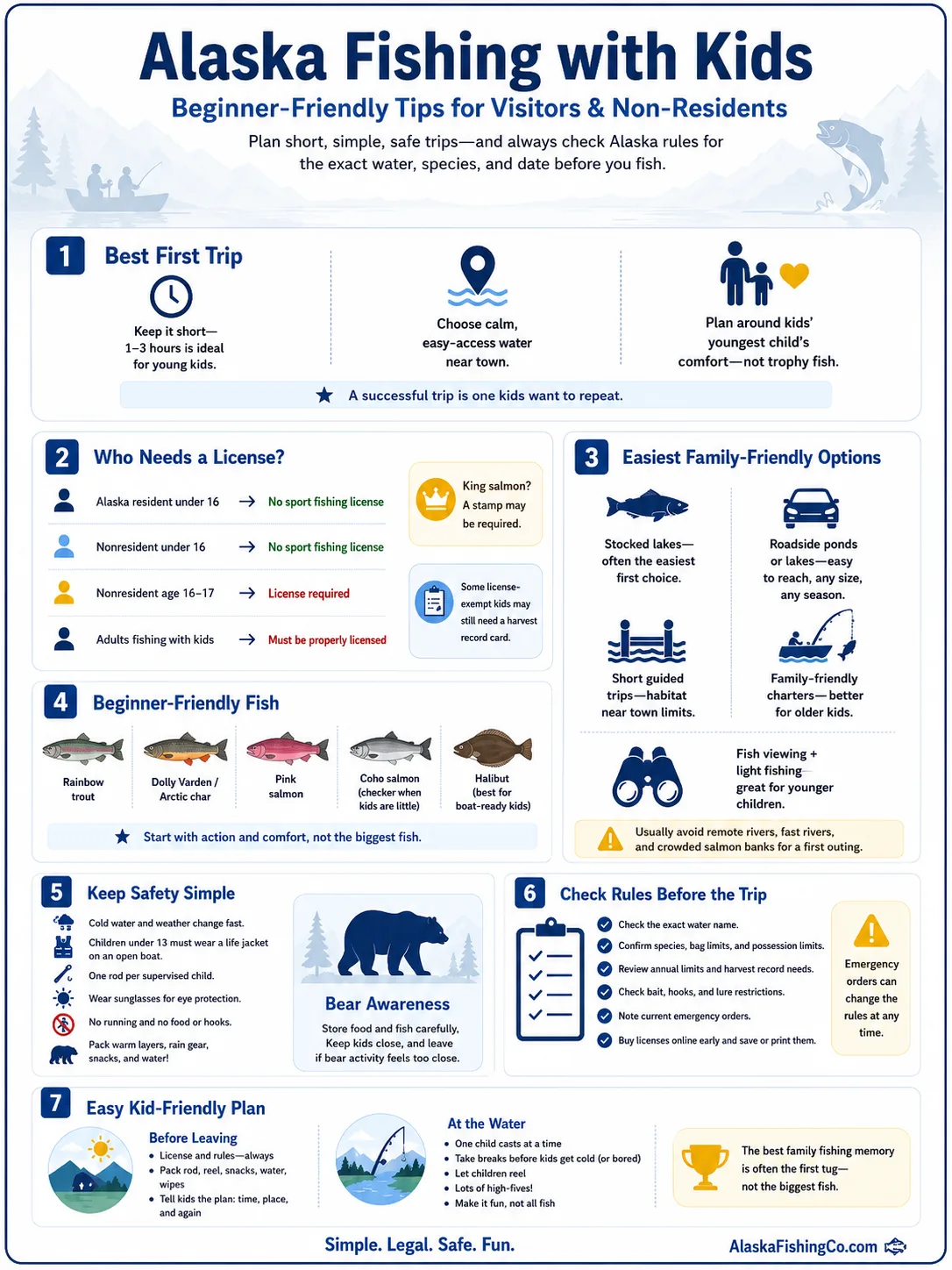
Fishing in Alaska with kids is easiest when the trip is short, legal, close to help, and built around simple fish targets. Children do not always need their own Alaska sport fishing license, but the adult plan still matters: age, residency, species, location, and emergency orders can change what your family must carry before a line goes in the water.
The best first Alaska fishing trip for children is usually not a remote salmon mission. It is a calm lake, a stocked water, a short bank session near town, or a half-day charter where the crew understands families. A good kid-friendly trip leaves room for snacks, warm layers, bathroom breaks, and quitting before everyone is tired.
If you remember one thing… plan the trip around the youngest child’s comfort, then check Alaska Department of Fish and Game rules for the exact water, species, and date before you fish.
What To Know First
For most families, the first decision is not what fish to chase. It is how to make the day easy enough that children want to fish again.
- Keep the first session short: one to three hours is often better than a full day.
- Pick simple water: calm lakes, easy banks, docks, and beginner charters usually beat fast rivers.
- Check license age rules: Alaska residents under 18 and nonresidents under 16 do not need a sport fishing license, but harvest record rules can still apply for species with annual limits.[a]
- Know the target species: king salmon, halibut, trout, and rockfish are not handled under one single rule set.
- Watch the weather: wind, rain, cold water, and tired children can end a trip faster than poor fishing.
Start With the Easiest Kind of Alaska Fishing
The easiest Alaska fishing with kids is usually close to town, close to parking, and simple enough that children can cast, reel, rest, and try again without pressure.
For a first trip, think less about trophy fish and more about steady action. A child who catches a small trout, watches salmon move through a creek, or helps net a fish on a calm charter will usually remember the day better than a long, cold attempt at a larger fish.
Good beginner trip types
- Stocked lake fishing: often the best choice for young children because the water is calmer and the setup is simple.
- Roadside lake or pond: easier for snacks, extra clothing, and breaks.
- Short guided trip: helpful when parents are new to Alaska fishing rules or gear.
- Family-friendly saltwater charter: a good option for older children who can handle boat time and changing weather.
- Viewing plus light fishing: useful for younger kids who may enjoy spotting salmon as much as catching them.
Fast rivers, crowded salmon banks, bear-heavy creeks, and remote fly-out trips can be great later. They are not usually the best first step for a child who is still learning how to hold a rod, manage hooks, and stay patient.
Worth Noting: A trip can be “successful” even if the child does not catch much. Let kids reel in a practice cast, touch safe gear, look at fish, help choose a lure, or take a snack break before they get frustrated.
License Rules for Families Fishing in Alaska
Alaska license rules for children depend on residency and age. Alaska residents under 18 do not need a sport fishing license, while nonresidents under 16 do not need one. Adults and older teens usually need the right sport fishing license before they participate.
Visitors should be careful with the word “kids.” A 16-year-old visitor from outside Alaska is treated differently from a 12-year-old visitor. A child may also be license-exempt but still need a free harvest record card when fishing for species with annual limits.
Basic family license rules
- Alaska resident children: under 18, no sport fishing license is needed unless special circumstances apply.
- Nonresident children: under 16, no sport fishing license is needed.
- Adults: residents 18 and older and nonresidents 16 and older need a sport fishing license to participate in sport fishing.
- Foreign visitors: international tourists generally buy nonresident or foreign/alien licenses listed by ADF&G, with the same short-duration sport fishing license options shown for visitors.[b]
- King salmon: most anglers who are old enough to need a license also need a king salmon stamp when fishing for king salmon, except in stocked lakes and other listed exemptions.
If a parent is casting, setting the hook, fighting the fish, or taking over the rod, that parent should be properly licensed. Letting a child reel for fun is common, but the adult should not treat the child’s exemption as a way to avoid buying the adult license.
Family license and record card comparison
| Family situation | What usually applies | What to check before fishing |
|---|---|---|
| Alaska resident child under 18 | No sport fishing license required | Harvest record card if fishing for species with annual limits |
| Nonresident child under 16 | No sport fishing license required | Harvest record card if required for the species and water |
| Nonresident teen age 16 or 17 | Sport fishing license required | King salmon stamp if fishing for king salmon, unless an exemption applies |
| Adult visitor | Nonresident sport fishing license required | Duration, start date, target species, and any regional rule |
| Family targeting halibut | State sport license rules still matter, but halibut rules also involve federal management | Charter versus unguided rules, annual measures, and area limits |
Pick the Right Fish for a Child’s First Alaska Trip
The best first fish target is the one that gives a child a realistic chance to stay involved. For many families, that means trout in a lake, pink salmon when they are present, Dolly Varden, or a charter target chosen by a captain who works well with families.
Some Alaska fish are exciting but not beginner-friendly for every child. Sockeye salmon fishing in current can require technique and patience. King salmon often come with added stamp and record rules. Halibut can be memorable, but a long saltwater day may be too much for young children.
Beginner-friendly options to consider
- Stocked rainbow trout: a good first choice near many communities.
- Dolly Varden or Arctic char: fun for children when legal, accessible, and active.
- Pink salmon: often more forgiving for beginners when the run is in and the location is suitable.
- Coho salmon: exciting for older kids, but timing and local rules matter.
- Halibut: better for children who are ready for boat motion, long waits, and heavier gear.
King salmon deserve extra care in planning. If your family wants to fish for kings, check whether the water is open, whether a stamp is needed, whether a harvest record card is required, and whether any emergency order has changed the normal rule.
One Detail People Miss: A child who does not need a license may still need a free harvest record card when fishing for species with annual limits. This is easy to miss because families often stop checking after they learn the child is license-exempt.
Choose a Kid-Friendly Fishing Spot
A good Alaska fishing spot for kids has safe footing, simple access, room to step away from hooks, and a backup plan if the fishing is slow.
Parents often choose a spot based only on the fish. With children, the better question is: can the family park nearby, stay warm, use a restroom, move away from crowds, and leave without a long hike if the weather turns?
What to look for
- Short walk from parking: less gear carrying and fewer tired children before fishing begins.
- Open casting space: fewer snags, fewer hook accidents, and less stress.
- Stable bank or dock: safer than steep, muddy, or slippery edges.
- Clear local rules: posted signs, ADF&G area pages, and current regulation summaries help avoid mistakes.[c]
- Exit plan: a nearby playground, picnic area, short walk, or café can save the day when attention fades.
For toddlers and early elementary-age children, a small lake may be better than a famous salmon river. For older children who can follow directions, a guided river or saltwater trip can work well if the operator knows the ages, experience level, and patience level of the group.
Use Simple Gear, Not Too Much Gear
Kids do better with light, manageable gear that fits their hands. A short spinning rod, easy reel, small tackle box, and a few legal lures are usually enough for a first Alaska fishing day.
Do not turn the trip into a tackle lesson. The child needs a setup that casts without constant tangles and is safe enough for close supervision. Parents should handle knives, heavy weights, fish cleaning, and treble-hook problems.
Simple family gear list
- Light or medium-light spinning rod sized for the child
- Simple spinning reel with fresh line
- Small legal lures, bobbers, and hooks suited to the water
- Needle-nose pliers or hemostats for hook removal
- Landing net
- Polarized sunglasses for eye protection
- Warm layers, rain jacket, gloves, and dry socks
- Snacks, water, wipes, and a trash bag
Bait rules can vary by water. Some places allow bait; others restrict it. Do not assume that a lure, bait, hook style, or salmon technique is legal everywhere in Alaska.
Before You Move On: If the child is new to fishing, practice casting in a yard or open area before the Alaska trip. Ten minutes of practice can prevent a lot of riverbank frustration.
Keep Safety Simple: Water, Weather, Bears, and Hooks
Alaska family fishing safety starts with cold water and supervision. A child can get cold, wet, or tired quickly, even in summer.
Children under 13 must wear a U.S. Coast Guard-approved life jacket in an open boat or on the deck of a boat, and Alaska’s Kids Don’t Float program places loaner life jackets at many harbors and public boat access areas.[d] Even when a life jacket is not legally required from shore, it can still be a smart choice near deep, fast, or slippery water.
Safety rules that work with kids
- One rod per supervised child: do not give more hooks than adults can safely watch.
- Sunglasses on: they protect eyes from sun glare and stray hooks.
- No running with rods: hooks and uneven banks do not mix.
- Stay back from fast water: Alaska rivers can be colder and stronger than they look.
- Warm before wet: pack layers even when the forecast looks mild.
Bear awareness for family fishing
Most Alaska is bear country. The goal is not to scare children; it is to avoid teaching bears that anglers mean easy food. ADF&G advises anglers not to leave fish, food, backpacks, garbage, or fish waste where bears can get them, and to stop fishing if a nearby bear notices splashing fish.[e]
- Keep food packed away unless the family is eating.
- Never let children carry fish away from adults.
- Clean fish only where it is safe and legal.
- Leave crowded bear-fishing spots to experienced groups or guided trips.
- Teach kids to stay together and speak calmly, not scream or run.
Check Regulations and Emergency Orders Before the Trip
Alaska fishing rules are local. A rule that works on one river, lake, bay, or charter may not work on another.
ADF&G publishes regional sport fishing regulation information for Northern, Southwest, Southcentral, and Southeast Alaska. Families should check the exact area where they plan to fish, then check emergency orders because they can open or close areas, change bag limits, or change legal methods.
What families should check
- The exact water name, not just the nearest town
- The species the family may keep
- Daily bag and possession limits
- Annual limits and harvest record card needs
- Hook, bait, lure, and tackle restrictions
- Emergency orders for the current date
Emergency orders are not optional updates. ADF&G says emergency orders may be issued at any time and have the same force and effect as law.[f] For families, the safest habit is to check them the day before fishing and again the morning of the trip if the target is salmon or another closely managed fishery.
Buy Licenses Online Before You Arrive at the Water
The easiest way for most visiting families to avoid license stress is to buy online before the fishing day. Alaska sport fishing licenses, king salmon stamps, and some related items can be purchased through ADF&G’s online store.
Do not wait until the boat is loading or the kids are already wearing rain gear. Buying early gives you time to confirm names, ages, start dates, license duration, and whether a king salmon stamp or harvest record card is needed.
Simple online buying steps
- Go to the ADF&G online store.
- Choose guest checkout or sign in.
- Select the correct residency status for each angler.
- Choose the sport fishing license duration: 1-day, 3-day, 7-day, 14-day, or annual for nonresidents.
- Add a king salmon stamp only for anglers who need one and will fish for king salmon.
- Print or save the license where it can be shown without a weak cell signal.
- Get a free harvest record card when the trip involves species with annual limits and the angler needs one.
For a family visiting Alaska for one fishing day, the 1-day nonresident license may be enough for adults and older teens. For a weeklong trip with more than one fishing day, compare the 3-day, 7-day, and 14-day options before buying.
Small Detail, Big Hassle: Match the license start date to the fishing date. A family that buys too early with the wrong start date may not be covered on the day they actually fish.
Know When a Charter Makes Sense
A charter can be a good choice for families when the children are old enough for boat time, the operator is comfortable with kids, and the parents want help with gear, bait, handling fish, and local rules.
Not every charter is right for children. A long offshore halibut trip may be too much for a six-year-old. A shorter nearshore trip, lake outing, or river guide can be a better fit. Ask direct questions before booking.
Questions to ask before booking
- Do you regularly take children this age?
- How long is the actual fishing time?
- Is there a bathroom available?
- What happens if the weather changes?
- What licenses or stamps should each family member buy?
- Will the captain or guide help kids safely handle rods and fish?
- Are life jackets provided in child sizes?
For halibut, families should pay extra attention to guided versus unguided rules. NOAA Fisheries explains that recreational halibut regulations in Alaska involve international, federal, and state roles, and charter rules can differ by area and year.[g]
Common Mistakes Families Make
Most problems on family Alaska fishing trips come from planning too much fishing and not enough child comfort, rule checking, and safety margin.
Mistake: Assuming all children fish license-free
Correct explanation: Alaska resident children under 18 and nonresident children under 16 do not need a sport fishing license. A nonresident teen who is 16 or 17 does need one.
Why it gets confused: Families often hear “kids fish free” and miss that Alaska uses different age lines for residents and nonresidents.
Mistake: Forgetting the harvest record card
Correct explanation: Some license-exempt children still need a free harvest record card when fishing for species with annual limits.
Why it gets confused: Parents treat “no license required” as “no paperwork required,” which is not always true.
Mistake: Choosing famous water instead of easy water
Correct explanation: A calm, simple location is usually better for a first child fishing trip than a crowded salmon river.
Why it gets confused: Alaska trip planning often centers on big-name rivers and fish, while children usually need comfort, space, and quick wins.
Mistake: Buying a king salmon stamp for everyone automatically
Correct explanation: A king salmon stamp is only for anglers who need it and will fish for king salmon. Some children and some special license holders are exempt.
Why it gets confused: King salmon are a famous Alaska target, so families may add the stamp without checking whether their actual trip needs it.
Mistake: Ignoring emergency orders
Correct explanation: Emergency orders can change normal fishing rules. Always check the current order for the area and species.
Why it gets confused: Printed regulation summaries and old travel articles can look final, but Alaska fisheries can change during the season.
Real-Life Family Fishing Scenarios
The right plan changes with age, weather, patience, and the species your family wants to target. These examples show how to think through common visitor situations.
- Two parents and a 7-year-old visiting Anchorage: Try a stocked lake or easy-access water first; the child may not need a license, but adults need the right licenses if they fish.
- Family with a 15-year-old from Canada: The teen is under 16, so a sport fishing license is usually not required, but a harvest record card may still be needed for annual-limit species.
- Family with a 16-year-old from Germany: The teen is a nonresident age 16 or older, so plan on buying a nonresident sport fishing license.
- Parent and child hoping to catch king salmon: Check whether the water is open, whether a king salmon stamp is required, and whether a harvest record card is needed before fishing.
- Family booking a halibut charter out of a coastal town: Ask the operator what each person needs, then check NOAA and ADF&G rules because halibut has its own management details.
- Young child who loses interest after 30 minutes: Switch to snacks, fish watching, casting practice, or a short walk; do not turn the trip into a test of patience.
- Family fishing near salmon and bear habitat: Keep fish and food controlled, leave if bear activity feels close, and do not let children handle fish waste.
- Rainy day during a vacation: Shorten the session, stay near the vehicle, and keep dry clothes ready instead of forcing a long plan.
Beginner Trip Plan for a Half-Day With Kids
A half-day plan is often enough for a first Alaska fishing outing. It gives children a real fishing experience without turning the day into a long endurance test.
Before leaving
- Check licenses, stamps, and harvest record cards.
- Read local regulations and emergency orders.
- Pack rain layers, warm clothing, snacks, and water.
- Set up rods before arriving at the water.
- Tell children the plan: fish, snack, fish again, then leave while it is still fun.
At the water
- Start with one child casting at a time if space is tight.
- Keep hooks pointed down and rods away from faces.
- Let children reel even if an adult casts.
- Take short breaks before anyone gets cold or annoyed.
- Stop early if the weather, current, crowd, or wildlife makes the spot uncomfortable.
For many families, the best Alaska fishing memory is not the largest fish. It is the first cast, the first tug, the first fish in the net, or the moment a child realizes wild water has living things inside it.
Alaska Fishing with Kids Questions Answered
Do kids need a fishing license in Alaska?
Alaska resident children under 18 do not need a sport fishing license. Nonresident children under 16 do not need a sport fishing license. Nonresident teens age 16 or older usually need the proper nonresident sport fishing license.
Can foreign visitors take kids fishing in Alaska?
Yes. Foreign visitors can take children fishing in Alaska, but older teens and adults usually need nonresident or foreign/alien sport fishing licenses. The family should also check species rules, harvest record card needs, and any emergency order for the exact water.
Do children need a king salmon stamp in Alaska?
Resident children under 18 and nonresident children under 16 do not need a king salmon stamp. Older anglers who fish for king salmon usually need one unless a listed exemption applies, such as certain stocked lake situations.
What is the easiest fish for kids to catch in Alaska?
Stocked rainbow trout are often one of the easiest beginner targets near towns. Pink salmon can also be a good family target when they are present and the spot is safe. The best choice depends on timing, location, weather, and local rules.
Is Alaska river fishing safe for children?
Some river spots work well for older children, but fast current, slippery banks, bears, crowds, and hook hazards make many rivers harder for beginners. Calm lakes, docks, and short guided trips are often better for a first outing.
Should kids wear life jackets while fishing in Alaska?
Children under 13 must wear a U.S. Coast Guard-approved life jacket in an open boat or on the deck of a boat. Near cold, deep, or fast water, a properly fitted life jacket is also a smart choice from shore, even when it is not legally required.
How long should a first Alaska fishing trip with kids be?
For young children, one to three hours is often enough. Older children may enjoy a half-day trip. A shorter, happier outing is usually better than staying until everyone is cold, hungry, or bored.
Fishing in Alaska with kids works best when the plan is simple, legal, warm, and flexible. Choose water that fits the child, not just the fish on the family wish list.
The most common mistake is assuming that famous fishing spots are automatically good beginner spots. A useful rule is this: check the rules, shorten the trip, dress for cold water, and leave while the kids still want to come back.
Alaska Fishing References
- [a] Alaska Department of Fish and Game — Sport Fishing Licenses, King Salmon Stamps, IDs and Harvest Record Cards — Used for license age rules, king salmon stamp basics, and free harvest record card details. This is reliable because it is the official Alaska fish and wildlife agency page for sport fishing licensing.
- [b] Alaska Department of Fish and Game — License, Stamp, and Tag Pricing List — Used for visitor license duration options and nonresident/foreign visitor pricing categories. This is reliable because it is the state agency’s official pricing list.
- [c] Alaska Department of Fish and Game — Sport Fishing Regulations — Used for regional sport fishing regulation context. This is reliable because it is the official regulation hub for Alaska sport fishing areas.
- [d] Alaska Department of Natural Resources — Kids Don’t Float Life Jacket Loaner Board Program — Used for Alaska life jacket loaner board information and child boating safety context. This is reliable because it is a State of Alaska boating safety program page.
- [e] Alaska Department of Fish and Game — Bear Safety for Anglers — Used for bear-aware fishing behavior, fish storage, and splashing fish guidance. This is reliable because it is an official ADF&G bear safety page for anglers.
- [f] Alaska Department of Fish and Game — Sport Fishing Emergency Orders and Press Releases — Used for emergency order timing and legal effect. This is reliable because it is the official ADF&G page for current sport fishing emergency orders.
- [g] NOAA Fisheries — Sport Halibut Fishing in Alaska — Used for halibut management and charter versus unguided rule context. This is reliable because NOAA Fisheries is the federal agency involved in Alaska halibut regulation.