
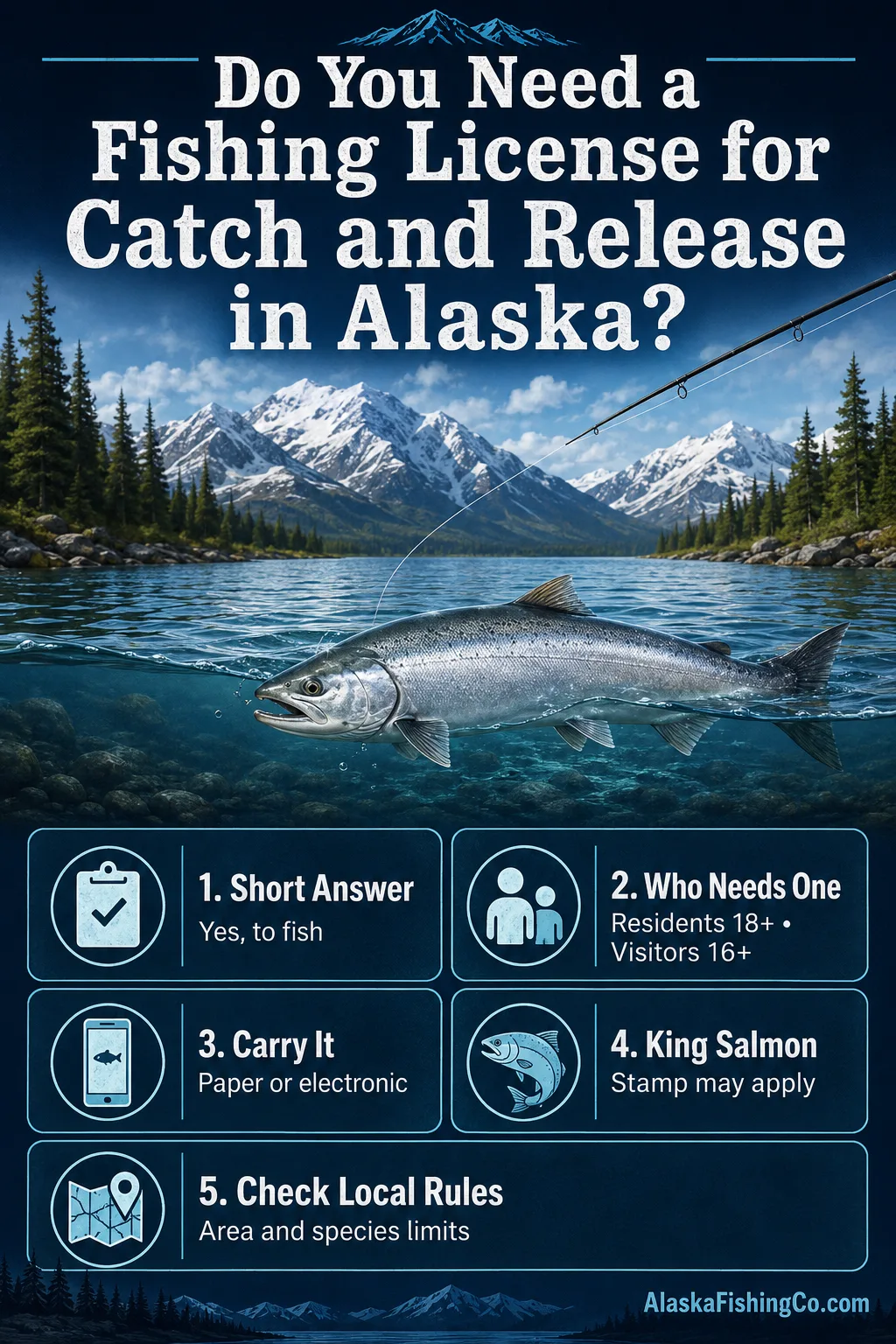
Yes. If you are a non-resident age 16 or older, you need an Alaska sport fishing license even when every fish will be released. Alaska treats catch and release as sport fishing because the act of casting, hooking, playing, or trying to catch fish counts as fishing, not just keeping fish.[a]
If you remember one thing: catch and release does not remove the license requirement in Alaska. The license rule is based on participation, not on whether a fish ends up in a cooler.
What To Know First
Catch and release anglers still need the correct Alaska fishing license, and some trips also need a king salmon stamp. The exact answer depends on your age, residency, species, and where you plan to fish.
- Non-residents age 16 and older need a sport fishing license.
- Alaska residents age 18 and older need a sport fishing license.
- Foreign visitors use the non-resident license options unless they qualify for Alaska residency.
- King salmon usually requires a separate king salmon stamp, even if you plan to release the fish (stocked lakes are the main exception).
- Closures still matter. If an area is closed to sport fishing, catch and release is not a workaround.
Worth Noting: A charter captain may help with the rules, but the license is still personal. Each angler who needs a license must have one in their own name before fishing.
Why Catch and Release Still Needs a License
Alaska does not wait until a fish is kept before it treats the activity as fishing. State definitions include taking or attempting to take fish for personal use by hook and line, which is exactly what catch and release anglers do.[b]
This is the part many visitors miss. If a person is actively fishing, the license rule already applies. It does not matter whether the fish is released beside the boat, released in the river, or never brought to hand.
- Casting a lure or fly counts as fishing.
- Hooking and releasing a fish counts as fishing.
- Taking turns with the rod can count as fishing for each person who participates.
- Helping net, handle, or release a fish can create problems if the person is clearly part of the fishing activity and should have been licensed.
What If You Never Keep Fish?
You still need a license if your age and residency category require one. Catch and release changes what happens after the fish is caught. It does not change the license rule before the cast.
What If You Are Only Watching?
Watching from shore or riding along on a charter does not usually require a sport fishing license. The line is crossed when someone starts fishing, takes a turn with the rod, or otherwise joins the actual fishing activity.
Who Needs a License in Alaska?
Most visiting adults need a non-resident Alaska sport fishing license. The main age rule is simple: non-residents need one at age 16 or older, while Alaska residents need one at age 18 or older.
For tourists, the non-resident rule is the one to focus on. A 16-year-old visitor from another state, Canada, Europe, Asia, or anywhere outside Alaska generally needs a non-resident sport fishing license. A 15-year-old non-resident does not need the sport fishing license, but may still need to follow harvest record rules in fisheries with annual limits.
- Adult tourist: Needs a non-resident sport fishing license.
- Foreign visitor: Buys a non-resident license, not a resident license.
- Alaska resident adult: Needs a resident sport fishing license from age 18.
- Young non-resident under 16: No sport fishing license required, but all fishing rules still apply.
- Resident senior or disabled veteran: May use an ADF&G identification card if eligible under Alaska rules.
One Detail People Miss: Residency is not based on where you are staying during your trip. A visitor renting a cabin for two weeks is still a non-resident for license purposes.
License Lengths and Fees for Catch and Release Visitors
Catch and release uses the same sport fishing license choices as keeping fish. In 2026, Alaska lists non-resident sport fishing licenses for 1 day, 3 days, 7 days, 14 days, and annual use, with fees rising as the license period gets longer.[c]
Choose the license by fishing days, not by vacation days. If you are in Alaska for eight days but only plan to fish one afternoon in Anchorage, a 1-day license may be enough. If you will fish several days across a Kenai Peninsula trip, a 7-day or 14-day license may fit better.
| License Type | 2026 Fee | Best Fit | Catch and Release Use |
|---|---|---|---|
| Non-resident 1 Day Sport Fishing License | $15 | One charter, one shore session, or one planned fishing stop | Valid for catch and release during that licensed day |
| Non-resident 3 Day Sport Fishing License | $30 | Short weekend or lodge stay | Valid for catch and release across the selected period |
| Non-resident 7 Day Sport Fishing License | $45 | Most one-week Alaska trips with several fishing days | Valid for catch and release across the selected period |
| Non-resident 14 Day Sport Fishing License | $75 | Longer road trip, cruise extension, or mixed-region visit | Valid for catch and release across the selected period |
| Non-resident Annual Sport Fishing License | $100 | Repeat visits or a long season in Alaska | Valid for catch and release through the calendar year |
Annual licenses are valid from the date of purchase through December 31 of that calendar year. Short-term non-resident fishing licenses are valid for the number of days printed on the license: 1, 3, 7, or 14 days.[d]
Do Foreign Visitors Pay More?
For sport fishing, foreign visitors generally use the same non-resident sport fishing license options shown for non-residents. Alaska also lists foreign or alien non-resident sport fishing products in its pricing page at the same common sport fishing fees. Special reciprocal items, such as Yukon Territory products, are narrow cases and should not be assumed for ordinary travel.
When You Need a King Salmon Stamp
If you fish for king salmon in Alaska, you usually need a king salmon stamp in addition to your sport fishing license. This applies even if the plan is to release every king salmon, because the stamp is tied to fishing for king salmon, not only keeping one.
The main exception is king salmon in stocked lakes. Also, resident anglers under 18, non-residents under 16, and eligible ADF&G identification card holders do not need to buy a king salmon stamp. Everyone still needs to follow open seasons, gear rules, closed waters, and any emergency orders.
- Targeting king salmon in a river: License plus king salmon stamp if your age and status require it.
- Targeting king salmon from salt water: License plus king salmon stamp if required.
- Fishing for stocked king salmon in a stocked lake: The king salmon stamp exception may apply.
- Fishing near king salmon during a closure: Read the local rule carefully; some orders prohibit targeting kings, including catch and release.
Before You Move On: A king salmon stamp is not a general salmon stamp. It is tied to king salmon. Sockeye, pink, chum, and coho rules can still have bag limits, seasons, and area restrictions, but they do not use the same stamp requirement.
Catch and Release Rules by Species and Area
A license lets you fish where fishing is open, but it does not override species rules, river rules, or emergency orders. Alaska regulations can vary by drainage, marine area, species, date, gear, and whether fishing is guided or unguided.
This matters more in Alaska than many first-time visitors expect. One river may allow catch and release for a species while another nearby river is closed. One saltwater area may allow fishing for other species but require immediate release of incidentally caught king salmon without removing the fish from the water.
- King salmon: Often has the strictest rules, with stamp needs, annual limits, closures, and emergency orders.
- Rainbow trout and steelhead: Some waters have annual limits or special harvest record needs.
- Halibut: Managed through federal, international, and state rules, especially for guided charter fishing.[g]
- Rockfish and lingcod: Can have area-based retention and handling rules.
- Stocked lakes: Often easier for visitors, but the license rule still applies for non-residents age 16 and older.
Closed Means Closed
If a water is closed to sport fishing, do not cast there for catch and release. Alaska statewide rules state that it is unlawful to cast, drift, or place a hook, bait, lure, or fly into waters closed to sport fishing.[f]
Emergency Orders Can Change the Plan
Emergency orders can open or close seasons, change bag limits, or modify harvest methods. They can be issued during the season and have the same force as law, so checking them before fishing is part of the trip plan.[e]
How to Buy and Carry Your Alaska Fishing License Online
Most visitors can buy an Alaska sport fishing license online before they fish. The safest route is the official Alaska Department of Fish and Game online store or an approved license vendor.
Buying online is usually simple, but the license must be valid, signed or eSigned, and in your possession while fishing. Do not assume an email receipt alone is enough unless the license itself is available and properly signed.
- Choose the official ADF&G license store or an approved vendor.
- Select the correct non-resident sport fishing license length.
- Add a king salmon stamp if you will fish for king salmon and your age/status requires it.
- Enter your personal details exactly as they should appear on the license.
- Download, print, or save the license to your phone.
- Make sure the license is signed or eSigned before fishing.
- Carry photo ID, especially on charters or when fishing away from towns.
Phone Copy or Paper Copy?
A phone copy can work if it is valid and signed or eSigned, but Alaska fishing often happens where batteries die, screens crack, and cell service drops. A paper backup is a practical move for visitors, especially on remote rivers or full-day saltwater charters.
Common Mistakes With Catch and Release Licensing
Most license mistakes come from treating catch and release as a separate legal category. In Alaska, the safer reading is simple: if you are fishing and your age/residency category requires a license, get the license first.
Wrong Belief: “I Do Not Need a License Because I Am Releasing Everything”
Correct explanation: You still need a license if you are required by age and residency status. The act of trying to catch fish is enough.
Why it gets mixed up: Many people connect fishing rules with possession limits. License rules start before possession happens.
Wrong Belief: “The Charter Covers My License”
Correct explanation: Some operators remind guests to buy licenses or help them do it, but the license belongs to the angler. Confirm before the trip.
Why it gets mixed up: Charter trips often bundle rods, bait, tackle, and fish cleaning, so visitors assume paperwork is bundled too.
Wrong Belief: “A Fishing License Is Enough for King Salmon”
Correct explanation: King salmon often requires a king salmon stamp in addition to the sport fishing license.
Why it gets mixed up: Visitors hear “salmon fishing” and do not realize king salmon has its own stamp rule.
Wrong Belief: “A Closed Retention Season Still Allows Catch and Release”
Correct explanation: Sometimes it does, sometimes it does not. If an order or regulation closes sport fishing for that species or water, catch and release may also be prohibited.
Why it gets mixed up: Some places use catch and release as a management tool, while others close fishing entirely.
Wrong Belief: “Kids Never Need Anything”
Correct explanation: Young non-residents under 16 do not need the sport fishing license, but may still need a free harvest record card in fisheries with annual harvest limits.
Why it gets mixed up: License exemptions and record requirements are separate items.
Real-Life Scenarios for Alaska Visitors
The license answer is easier when placed into ordinary travel plans. These examples cover the situations visitors ask about most often.
- A 42-year-old visitor from Florida fly fishes for trout near Anchorage and releases everything. A non-resident sport fishing license is required.
- A 15-year-old visitor from Germany fishes from shore with family and releases every fish. No sport fishing license is required because the angler is under 16, but all local rules still apply.
- A couple books a Kenai River king salmon trip and plans to release all kings. Each adult needs a non-resident sport fishing license and likely a king salmon stamp unless a specific exception applies.
- A cruise passenger fishes one afternoon in Ketchikan for salmon. A 1-day non-resident sport fishing license may fit, and a king salmon stamp is needed if fishing for king salmon.
- A family rents a cabin for two weeks and fishes several stocked lakes. Adults and non-resident teens age 16 or older need sport fishing licenses; stocked-lake king salmon stamp exceptions should be checked before fishing.
- A visitor joins friends on a private boat for halibut and releases small fish. A non-resident sport fishing license is still needed for anglers age 16 or older, and halibut rules should be checked for the area and guided or unguided status.
- A photographer rides along but never touches a rod, reel, line, net, or fish. A fishing license is generally not needed for simply observing.
- A tourist wants to cast in a creek that is temporarily closed. Do not fish there, even for release, unless the current rule clearly allows that activity.
Worth Noting: When a rule says fish must be released immediately and not removed from the water, that is a handling rule as well as a harvest rule. Plan your tackle and camera habits around it.
A Simple Pre-Trip Check
Before fishing in Alaska, match the license to the person, the species, and the place. A few minutes of checking can prevent the most common visitor problems.
- Check each angler’s age and residency status.
- Buy the correct non-resident sport fishing license length.
- Add a king salmon stamp if targeting king salmon and required.
- Check the regulation page for the exact river, lake, drainage, or marine area.
- Check emergency orders on the day before fishing, and again on the day of the trip if the fishery is changing fast.
- Carry the license, stamp, photo ID, and any needed harvest record.
- Use legal gear for the water you are fishing.
- Release fish according to the local rule, especially when a fish may not be removed from the water.
Catch and release is still fishing in Alaska, so the license question should be settled before the first cast. The most common mistake is assuming “not keeping fish” means “not needing paperwork.” The easiest rule to remember is this: if you are old enough to need a license and you are trying to catch fish, buy the license first.
Catch and Release Questions Answered
Do tourists need a fishing license for catch and release in Alaska?
Yes. Non-resident tourists age 16 or older need an Alaska sport fishing license even if they release every fish. The rule is based on fishing activity, not only on keeping fish.
Can foreign visitors buy an Alaska fishing license online?
Yes. Foreign visitors can buy Alaska non-resident sport fishing licenses online through the official state system or from approved vendors. The license must be valid, signed or eSigned, and carried while fishing.
Do you need a king salmon stamp if you release the king salmon?
Usually yes, if you are fishing for king salmon and your age/status requires a stamp. The stamp requirement is tied to fishing for king salmon, not only keeping one. Stocked lakes are the main exception.
Does a child need an Alaska fishing license for catch and release?
A non-resident child under 16 does not need an Alaska sport fishing license. An Alaska resident under 18 does not need one. Young anglers still have to follow seasons, gear rules, limits, closures, and any harvest record requirements that apply.
Can you fish catch and release in a closed Alaska river?
Not if the water is closed to sport fishing or the emergency order prohibits catch and release for that species. Some rules allow release-only fishing, but others close fishing entirely. Always read the exact rule for the water and date.
Do you need a license if you only help someone release a fish?
If you are only observing, a license is generally not needed. If you actively participate in the fishing activity, such as taking the rod, working the line, or acting as an angler, you should have the proper license if your age and residency category requires one.
How long is an Alaska non-resident fishing license valid?
Short-term non-resident sport fishing licenses are sold for 1, 3, 7, or 14 days. A non-resident annual sport fishing license is valid from the date of purchase through December 31 of that calendar year.
Alaska Fishing References
- [a] Alaska Department of Fish and Game – Sport Fishing Licenses, King Salmon Stamps, IDs and Harvest Record Cards – Used for age rules, license possession rules, king salmon stamp requirements, and harvest record notes. (Official Alaska state fish and game agency.)
- [b] Alaska Department of Fish and Game – Statewide Definitions for Sport Fishing – Used for the definition of sport fishing, take, resident, and related fishing terms. (Official state regulatory definitions page.)
- [c] Alaska Department of Fish and Game – License, Stamp, and Tag Pricing List – Used for 2026 non-resident sport fishing license fees and king salmon stamp fees. (Official state license pricing page.)
- [d] Alaska Department of Fish and Game – General License Information – Used for license validity periods and license format details. (Official Alaska licensing information page.)
- [e] Alaska Department of Fish and Game – Sport Fish Emergency Orders and Press Releases – Used for how emergency orders can change seasons, limits, and methods during the fishing year. (Official state emergency order page.)
- [f] Alaska Department of Fish and Game – Sport Fish Statewide Regulations – Used for closed-water rules, gear rules, possession notes, and license display requirements. (Official statewide sport fishing regulations page.)
- [g] NOAA Fisheries – Sport Halibut Fishing in Alaska – Used for Pacific halibut sport fishing management and guided versus unguided regulation context. (Federal fisheries agency with Alaska halibut authority.)