
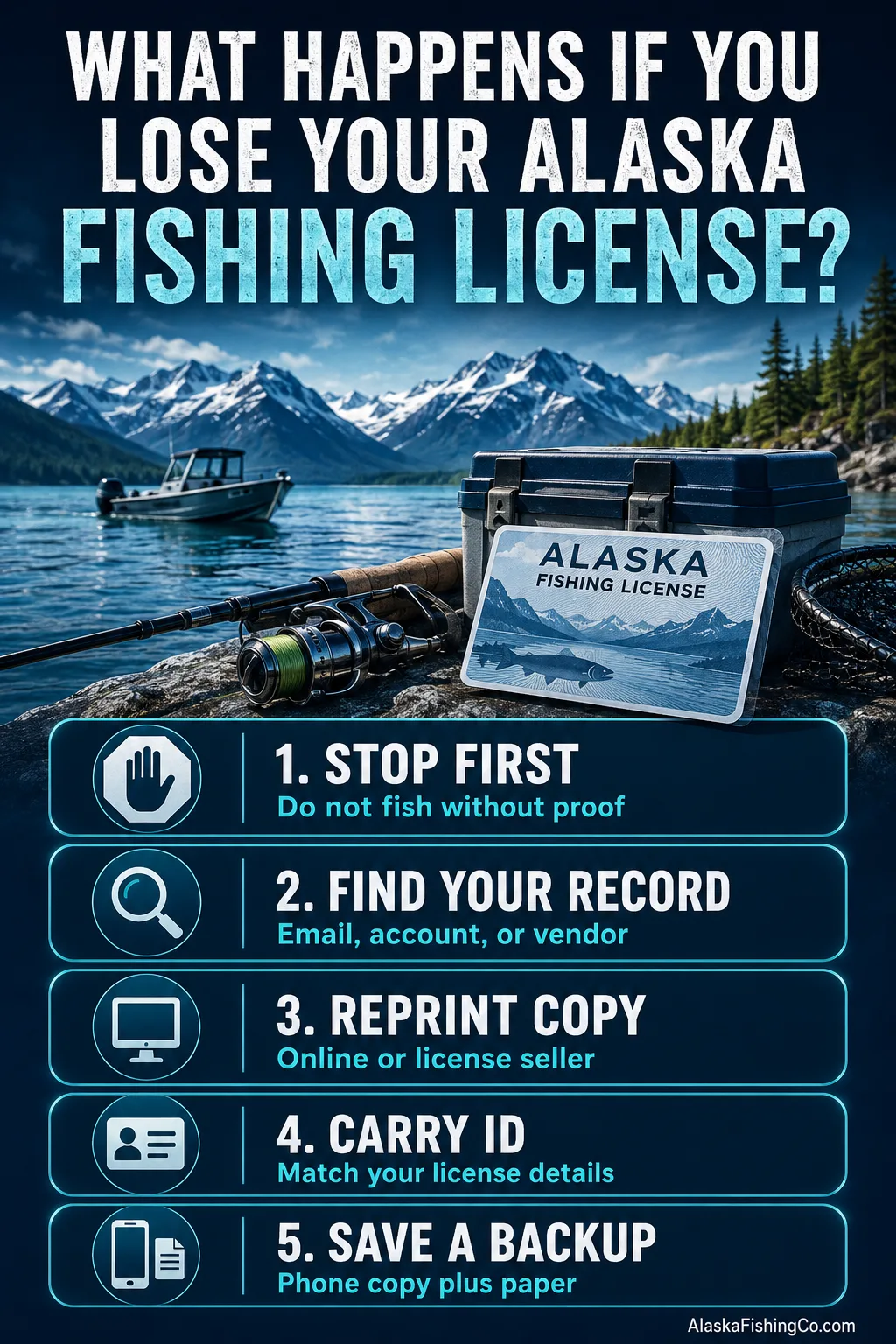
Losing an Alaska fishing license does not usually mean buying a full new license. In most cases, you either reprint the license, show the electronic version, or get a duplicate replacement if the original was a handwritten carbon copy.
For visitors, the main rule is simple: if Alaska requires you to have a sport fishing license, you must have a valid license in your possession while fishing, whether that copy is paper or electronic. ADF&G and law enforcement can ask to see your license, king salmon stamp, harvest record, and catch while you are fishing or while you possess sport-caught fish or shellfish.[a]
If you remember one thing… do not keep fishing after you realize your license is missing unless you can immediately access a valid paper or electronic copy.
What To Know First
- Online and eSigned licenses can usually be saved, shown on a device, or printed again.
- Carbon copy licenses need a duplicate replacement if lost.
- Duplicate replacement licenses cost $5 for residents and nonresidents on the ADF&G pricing list.[b]
- A phone copy only helps if it can be shown. A dead battery or no access to the file can leave you without proof in the field.
- Harvest records matter. If your lost license had annual-limit fish recorded on it, those records must be transferred to the new license or harvest record card.
What Happens Right After You Lose It?
If you lose your Alaska fishing license, your first job is to get a valid copy back in your possession before fishing again. The license itself is not automatically canceled just because the paper copy is gone, but you still need to be able to present it when asked.
Alaska recognizes several license formats. A printed/electronic license can be printed, downloaded to a phone, or carried as a digital image of the signed license. An eSigned license can be stored on a device and may also be printed. A handwritten carbon copy license is different; if that one is lost, ADF&G says a duplicate must be issued for $5.[c]
- If you bought online, sign in to your ADF&G account and look for your current items.
- If you saved a PDF, open it, make sure it is signed or eSigned, and keep it available offline if possible.
- If you bought a carbon copy license from a vendor or office, ask for a duplicate replacement.
- If you also lost a king salmon stamp, check whether a duplicate stamp is needed.
Worth Noting
A screenshot can be useful, but it should show the actual valid license clearly. If the license requires a signature and the copy you show is unsigned, that can be a problem.
Can You Keep Fishing Without the License in Hand?
No, not safely. Alaska rules require a valid sport fishing license to be in your possession while fishing in fresh or salt water. “Possession” can be paper or electronic, but it still has to be available when asked.
This matters even if you paid for the license. A receipt, a credit-card charge, or a memory of your license number is not the same as having the license ready to present. Enforcement officers may be able to verify records in some situations, but visitors should not rely on that as their plan.
- Good: a printed signed license in a dry bag.
- Good: an eSigned license saved on a charged phone.
- Risky: a license stored only in email when you have no service.
- Risky: a phone photo that does not show the full license or signature.
How to Replace or Reprint an Alaska Fishing License
The replacement path depends on how the license was issued. Online licenses are usually easier because you can access the document again. Handwritten carbon copy licenses are the ones most likely to require a paid duplicate.
ADF&G’s eSignature information says all license types require a physical signature or electronic signature to be valid. It also says eSigned licenses can be downloaded to a mobile device, and printed if you do not want to rely only on a device in the field.[d]
If You Bought the License Online
- Sign in to the ADF&G online store or app using the account used for purchase.
- Go to your current licenses or documents.
- Download the license again or print a fresh copy.
- Check the signature area before fishing.
- Save an offline copy if you will be away from cell service.
If You Bought From a Store or ADF&G Office
- If the license was printed/electronic, ask whether it can be reprinted from the licensing system.
- If it was a carbon copy license, ask for a duplicate replacement.
- Bring photo ID and any purchase details you have.
- If a vendor cannot help, contact ADF&G Licensing or visit an ADF&G office.
If You Use the ADF&G Mobile App
The ADF&G app can display licenses, permits, stamps, and tags, and it uses the same login as the ADF&G online store. The app can also help with harvest recording and access to regulations, but the practical point is simple: the document must be visible when needed.[e]
| License Format | What To Do | Likely Cost | Visitor Note |
|---|---|---|---|
| Online printed/electronic license | Download or print another copy from your account if available. | Usually no new license purchase if you can access the copy. | Make sure it is signed before fishing. |
| eSigned license | Show it on a device or print it. | Usually no duplicate needed if accessible. | Keep the phone charged and the license saved offline. |
| Carbon copy license | Get a duplicate replacement from ADF&G or a license vendor. | $5 duplicate replacement. | Do this before returning to the water. |
| Lost king salmon stamp | Replace the stamp if required for your fishing. | $5 duplicate king salmon stamp. | Needed when fishing for king salmon unless an exception applies. |
One Detail People Miss
A license copy is not the only document that may matter. If you are fishing for king salmon or a species with an annual limit, your stamp and harvest record can be just as important as the license itself.
What If You Lost the License After Recording Fish?
If your lost license included harvest records, do not ignore that part. Alaska requires anglers to record certain annual-limit harvests, and the 2026 sport fishing regulations say that if you get a duplicate or additional license or harvest record card, you must transfer your harvest records to the new one.[f]
This is most relevant for fish with annual limits, such as many king salmon fisheries and certain other regulated fisheries. The exact species and record rules can vary by management area, so the safe habit is to record fish immediately and keep a backup note until the season is over.
- Write down the species, date, and location from your previous record if you have it.
- Transfer the information to the replacement license or harvest record card.
- Do not reset your count because the paper was lost.
- Ask ADF&G if you are unsure how to reconstruct a missing harvest record.
Does a Lost License Affect Nonresidents and Foreign Visitors Differently?
The lost-license process is mostly the same for Alaska residents, U.S. nonresidents, and foreign visitors. The bigger difference is the type and price of the license you originally needed.
Nonresident visitors age 16 or older generally need an Alaska sport fishing license. Alaska residents need one at age 18 or older. Foreign visitors are treated under nonresident fishing license categories, with short-term options such as 1-day, 3-day, 7-day, and 14-day sport fishing licenses available at the same listed prices as other nonresidents.
- Nonresident 1-day sport fishing license: $15.
- Nonresident 3-day sport fishing license: $30.
- Nonresident 7-day sport fishing license: $45.
- Nonresident 14-day sport fishing license: $75.
- Nonresident annual sport fishing license: $100.
- Nonresident duplicate replacement license: $5.
Visitors from outside the United States should use the same practical plan: keep the license on the phone, save an offline copy, and carry a printed backup when fishing away from town.
What About King Salmon Stamps?
If you lose your fishing license and you were also fishing for king salmon, check the stamp immediately. Alaska requires a current king salmon stamp for anglers sport fishing for king salmon, including catch-and-release, except in stocked landlocked lakes and certain exempt groups.
The stamp requirement is easy to overlook because it is separate from the sport fishing license. A lost license may mean the attached physical stamp is lost too. If so, you may need a duplicate king salmon stamp before fishing for king salmon again.
- Resident annual king salmon stamp: $10.
- Nonresident 1-day king salmon stamp: $15.
- Nonresident 3-day king salmon stamp: $30.
- Nonresident 7-day king salmon stamp: $45.
- Nonresident 14-day king salmon stamp: $75.
- Nonresident annual king salmon stamp: $100.
- Duplicate king salmon stamp: $5.
Before You Move On
If your Alaska trip includes salmon fishing, check whether “salmon” means king salmon in the specific water you are fishing. The stamp rule depends on the species, not just the word salmon.
Do Regional Rules Change the Lost-License Process?
The replacement process does not usually change by region. A lost sport fishing license is handled through ADF&G licensing, vendors, the online store, or the app. What does change by region is the fishing rule you must follow once the license issue is fixed.
Alaska sport fishing can change during the season through emergency orders. ADF&G says emergency orders may open or close seasons or areas, change bag limits, or modify harvest methods, and they can be issued at any time with the force of law.[g]
- Replacing a license does not reopen a closed river.
- A valid license does not override a local emergency order.
- A king salmon stamp does not allow king salmon fishing where retention is closed.
- Regulations should be checked for the exact area, date, and species.
Common Mistakes After Losing an Alaska Fishing License
Most problems come from assuming proof of purchase is enough. It is better to treat the missing license as something that must be fixed before the next cast.
Thinking a Receipt Is the Same as a License
Wrong idea: A store receipt or email receipt proves the purchase, so it should be enough.
Correct answer: Carry the actual license copy, paper or electronic, with the required signature.
Why it gets mixed up: Many online purchases feel complete once the payment receipt arrives, but fishing rules focus on the license document itself.
Using Someone Else’s License
Wrong idea: A spouse, parent, or charter partner has a license, so the group is covered.
Correct answer: Sport fishing licenses cannot be loaned or transferred.
Why it gets mixed up: Visitors often book fishing as a group activity, but licenses apply to individual anglers.
Relying on a Phone With No Backup
Wrong idea: A phone copy is always enough.
Correct answer: A phone copy works only if the license can be shown when asked.
Why it gets mixed up: Digital licenses are valid, but a dead battery, broken screen, or no saved file can still leave the angler without a presentable license.
Forgetting the Harvest Record
Wrong idea: A duplicate license starts the harvest record over.
Correct answer: Previous annual-limit harvest records must be transferred to the new license or harvest record card.
Why it gets mixed up: People often think about the license fee first and the recorded fish later.
Buying a Full New License Too Fast
Wrong idea: Losing the license means paying the full license fee again.
Correct answer: Many online and eSigned licenses can be accessed again, while duplicate replacement licenses are listed at $5.
Why it gets mixed up: Visitors may not know whether their license was issued as a PDF, eSigned item, or carbon copy.
Real-Life Scenarios for Alaska Visitors
Lost-license problems usually happen at awkward times: early morning, on a charter dock, beside a river, or after gear gets wet. These examples show how to handle the situation without guessing.
- A cruise passenger in Ketchikan loses a printed license before a half-day charter. The fastest fix is to open the ADF&G account or app and show or print the valid signed license before boarding.
- A visitor on the Kenai River realizes the paper license is in a hotel room. Fishing should pause until an electronic copy can be shown or the paper license is retrieved.
- A traveler bought a handwritten carbon copy license from a small vendor and it washed away. That situation points to a duplicate replacement, normally $5.
- A family has one adult with the licenses saved on one phone. Each angler who needs a license should be able to present their own license, not rely on one person’s device.
- A nonresident teenager age 15 loses their license copy. Nonresidents under 16 do not need a sport fishing license, but harvest record rules may still apply for annual-limit species.
- An angler loses a license after recording a king salmon harvest. The harvest information should be transferred to the replacement license or harvest record card.
- A foreign visitor wants to fish another day after losing a 3-day license. If the 3-day license is still valid, try to retrieve the existing license before buying another one.
- A phone dies while the license is stored only in the app. A printed backup would solve the problem; without one, the angler may not be able to present the license in the field.
How to Avoid the Problem Before You Fish
The best fix is to make the license hard to lose. Alaska trips often involve water, weather, remote roads, and long days, so one copy is not a great plan.
- Print one signed copy and keep it in a waterproof pouch.
- Save a signed PDF or eSigned license on the phone for offline access.
- Take a clear photo of the signed license if allowed by your license format.
- Keep the license separate from cash, boarding passes, and hotel papers.
- Write down your ADF&G login before traveling to areas with poor service.
- Carry a power bank if you plan to rely on a mobile license.
For guided trips, ask the charter or guide what they want to see before departure. They cannot make the license rule disappear, but they can often tell you where visitors usually get replacements nearby.
When to Contact ADF&G
Contact ADF&G Licensing if you cannot access your online license, need help with a duplicate, have a carbon copy issue, or are unsure how to handle a lost harvest record. The official licensing contact page lists the Licensing Section in Juneau, including email and phone support.[h]
- You bought the license but cannot find it in your account.
- Your name or date of birth is wrong on the license.
- You lost a carbon copy license and need a duplicate.
- You lost a license with recorded annual-limit harvest information.
- You are not sure whether a king salmon stamp was attached to the lost copy.
Losing an Alaska fishing license is usually fixable, but it should be fixed before fishing continues. The most common mistake is treating payment proof as the same thing as the license. The rule to remember is plain: if you need a license, you need a valid, signed copy with you where you fish.
Lost Alaska Fishing License Questions Answered
Can I fish in Alaska if I lost my license but already paid for it?
You should not keep fishing unless you can present a valid paper or electronic copy of the license. Proof of payment alone is not the same as having the license in your possession.
How much is a duplicate Alaska fishing license?
ADF&G lists duplicate replacement licenses at $5 for residents and nonresidents. Duplicate king salmon stamps are also listed at $5.
Can I show my Alaska fishing license on my phone?
Yes, Alaska allows electronic license formats, including eSigned licenses and signed electronic copies, but the license must be viewable when requested. A dead phone or inaccessible file can create trouble.
Do foreign visitors need a different replacement process?
Usually no. Foreign visitors are generally handled under nonresident fishing license categories. The replacement steps depend more on license format than nationality.
What if I lost my license with a king salmon stamp attached?
You may need a duplicate king salmon stamp before fishing for king salmon again, unless an exception applies. Check your online account first if the stamp was purchased electronically.
Do children need to replace a lost Alaska fishing license?
It depends on age and residency. Alaska residents under 18 and nonresidents under 16 do not need a sport fishing license, but harvest record rules can still apply for some annual-limit species.
What if I lost my harvest record too?
If the lost document included annual-limit harvest records, transfer those records to the duplicate license or new harvest record card. If you cannot reconstruct the record, contact ADF&G for help before continuing to fish for annual-limit species.
Alaska Fishing References
- [a] ADF&G 2026 Sport Fishing Regulations Summary, Licensing Page — explains license possession, presentation requirements, harvest records, and king salmon stamp basics (official Alaska Department of Fish and Game regulation summary).
- [b] ADF&G License, Stamp, and Tag Pricing List — lists resident, nonresident, foreign/alien, duplicate license, and duplicate stamp fees (official state pricing source).
- [c] ADF&G General License Information — describes license formats, validity periods, and carbon copy replacement rules (official licensing guidance).
- [d] ADF&G eSigned License FAQs — explains electronic signatures, printing eSigned licenses, and carrying licenses on a device (official online license instructions).
- [e] ADF&G Mobile App FAQ — explains app use for displaying licenses, permits, stamps, tags, and harvest records (official ADF&G app information).
- [f] ADF&G 2026 Licensing and Harvest Record Instructions — states that harvest records must be transferred to a duplicate or additional license or harvest record card (official regulation summary).
- [g] ADF&G Sport Fishing Emergency Orders and Press Releases — explains how emergency orders can change seasons, areas, bag limits, and harvest methods during the season (official current regulation update source).
- [h] ADF&G Licensing Contact Information — provides official contact details for license questions and replacement help (official licensing contact page).