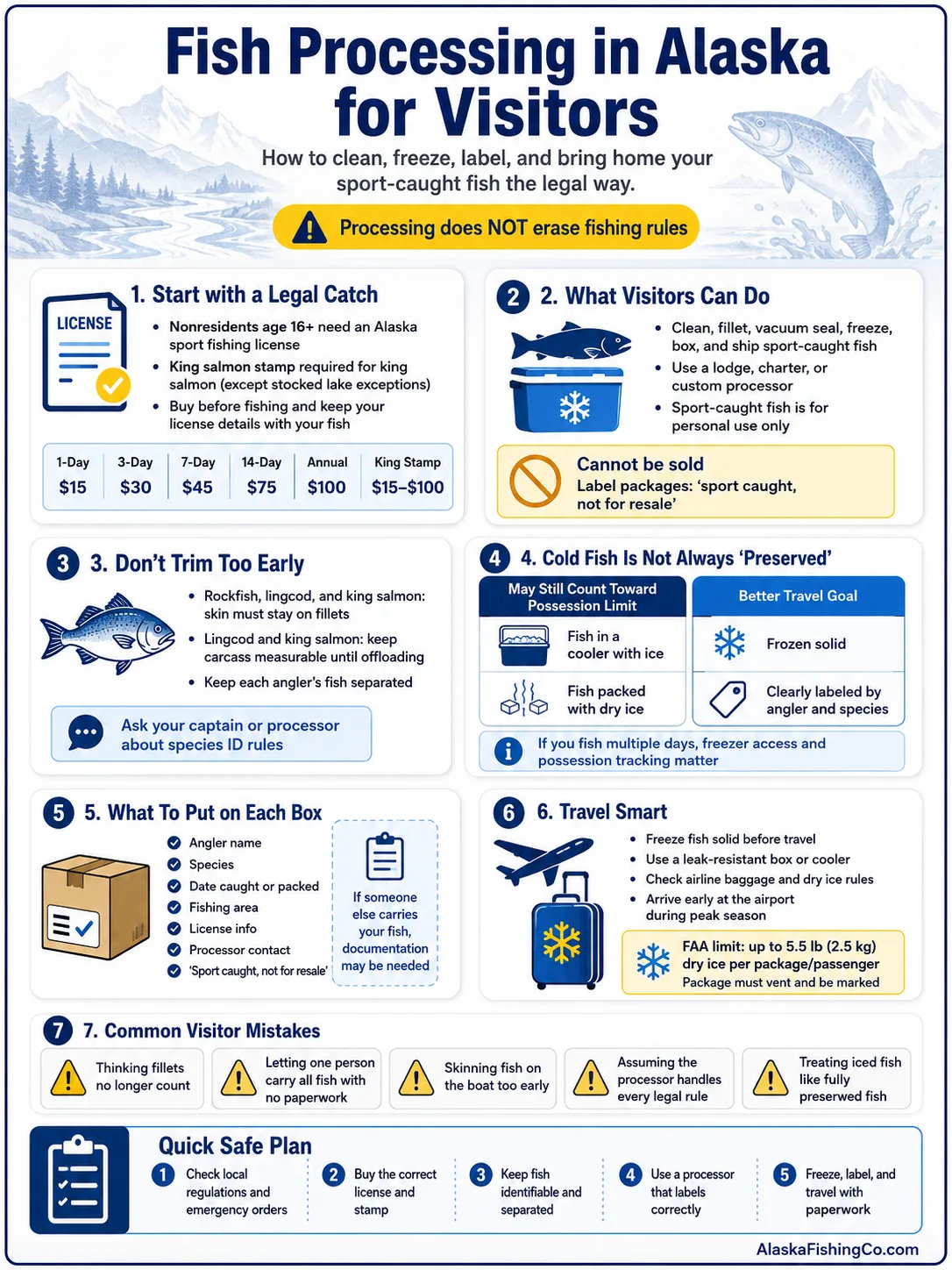
Fish processing in Alaska is the step that turns a legal catch into clean, frozen, labeled fish you can bring home without losing quality or running into trouble at the dock, airport, or processing counter. For visitors, the safest plan is simple: know your fishing license and retention rules before you fish, keep fish identifiable until the rules allow trimming, use a processor that handles sport-caught fish correctly, and keep paperwork with every box.
If you remember one thing, remember this: processing does not erase fishing rules. Bag limits, possession limits, species rules, king salmon stamp requirements, halibut rules, and proof-of-catch details still matter after a fish is filleted, vacuum sealed, frozen, packed, or shipped.
What To Know First
- Nonresident anglers age 16 and older need an Alaska sport fishing license before fishing, and a king salmon stamp is required when fishing for king salmon, except in stocked lakes.[a]
- Visitors can usually have sport-caught fish headed, filleted, vacuum packed, and frozen, but sport-caught fish cannot be sold.
- Unfrozen fish sitting in a cooler with ice or dry ice may still count toward a possession limit if it is not legally preserved.[c]
- Some species must remain identifiable until the vessel is tied up or the shore angler is done fishing for the day.
- Airlines and shippers care about packaging, dry ice, weight, labeling, leaks, and timing.
Can Visitors Have Fish Processed in Alaska?
Yes. Visitors can have their sport-caught fish cleaned, filleted, vacuum packed, frozen, boxed, and shipped by a lodge, charter operation, or custom processor, as long as the fish were legally taken and are handled as sport-caught fish, not seafood for sale.
For most tourists, “fish processing” means the practical work done after the catch: bleeding, heading, gutting, filleting, trimming, vacuum sealing, freezing, boxing, and sometimes arranging air shipment. This is different from commercial seafood processing. You are not turning your sport catch into a retail product. You are preparing your own fish for personal use.
Alaska’s Department of Environmental Conservation says a DEC seafood processor permit is not needed for custom processing of sport-caught fish when the work is limited to heading, butchering, filleting, vacuum packaging, and freezing. The packaging must say “sport caught, not for resale”, and vacuum packages need a pack date and a holding statement such as “keep frozen” or “refrigerate below 38F.” Higher-risk work such as smoking, pickling, or canning falls under different permit requirements.[e]
- Common visitor option: the charter or lodge drops fish at a processor after the trip.
- Road-trip option: fish are cleaned, frozen, and held until pickup before departure.
- Shipping option: the processor ships frozen boxes to your home using a carrier or air cargo.
- DIY option: you clean and freeze your own fish, but you must still follow identification, possession, and transport rules.
Worth Noting
A processor can make your fish easier to travel with, but the processor cannot make an illegal catch legal. The angler is still responsible for the license, species, size, date, and limit rules that applied when the fish was taken.
License, Stamp, and Age Rules Before Processing
Processing starts after a legal catch, so the first check is not the freezer or the shipping box. It is whether the angler was properly licensed and whether the species required an extra stamp or harvest record.
For visitors, Alaska generally treats U.S. out-of-state travelers and foreign tourists as nonresidents for sport fishing license purposes. Nonresidents age 16 and older must have a sport fishing license to participate in Alaska sport fisheries, and anglers fishing for king salmon need a king salmon stamp unless the fishery is a stocked lake exception.[a]
ADF&G lists nonresident sport fishing licenses and nonresident king salmon stamps in 1-day, 3-day, 7-day, 14-day, and annual options. Current listed prices are shown below, but visitors should confirm the price at checkout before buying because fees can change.[b]
| Option | Typical visitor use | Listed nonresident price |
|---|---|---|
| 1-day sport fishing license | Single charter, cruise stop, or one shore-fishing day | $15 |
| 3-day sport fishing license | Weekend trip or short lodge stay | $30 |
| 7-day sport fishing license | One-week Alaska fishing trip | $45 |
| 14-day sport fishing license | Longer road trip with several fishing days | $75 |
| Annual sport fishing license | Multiple Alaska trips in the same calendar year | $100 |
| Nonresident king salmon stamp | Required when fishing for king salmon, except stocked lake situations | $15 to $100, depending on duration |
Buy the license before fishing, save an electronic copy, and keep the license information with the fish if someone else will transport it. For mixed groups, each person who is actively fishing needs their own license. A shared cooler does not create a shared license.
The Processing Rule Visitors Often Miss: Fish Must Stay Identifiable
Do not assume every fish can be skinned, portioned, and packed on the boat as soon as it is caught. Alaska has identification and size rules that can require skin, carcasses, or other proof to remain with the fish until a specific point in the trip.
For rockfish, lingcod, and king salmon in all waters, ADF&G’s statewide retention rules say you may fillet the catch, but all skin must remain attached to the fillets. For lingcod and king salmon, the carcass must be kept in one piece so length can be measured. Those requirements apply until the vessel is tied up at a docking location where the fish will be offloaded, or until a shore angler is done fishing for the day or leaving the fishing site for the day.[d]
Rockfish, Lingcod, and King Salmon
- Do not remove all skin from the fillet too early.
- Do not cut lingcod or king salmon carcasses into pieces before the measuring rule no longer applies.
- Keep each angler’s fish separated when limits, annual limits, or harvest records matter.
- Ask the captain or processor how they keep species and angler identity clear during cleaning.
Halibut
Pacific halibut is managed under federal rules as well as state sport fishing rules. Charter halibut regulations can change by year and area, especially in Southeast Alaska and the Central Gulf of Alaska. NOAA Fisheries publishes current sport halibut information and charter halibut regulation summaries for Alaska.[f]
One detail matters for transport: ADF&G states that the state Transfer of Possession form is not valid for halibut. If halibut is part of your catch, ask the charter, processor, or NOAA/ADF&G office what documentation is expected for your situation before handing the box to someone else.[d]
Salmon After Offloading
Once fish are legally offloaded and identification rules have been met, processors commonly portion salmon into meal-size packs. If the salmon is king salmon, keep license, stamp, harvest record, and date information organized. If the fish came from a region with emergency orders or nonresident restrictions, keep that context with your trip notes.
Possession Limits, Frozen Fish, and What “Preserved” Means
A possession limit is about how many unpreserved fish a person may have. Freezing and preservation matter because a cooler full of unfrozen fillets is not treated the same way as fish that are truly preserved for later use.
ADF&G defines a possession limit as the maximum number of unpreserved fish a person may have. It also defines preserved fish as fish prepared and in a state of preservation fit for human consumption after a 15-day period. The definition specifically says unfrozen fish temporarily stored in coolers with ice, dry ice, or lightly salted fish are not preserved fish.[c]
- Iced fish: cold, but not automatically preserved.
- Fish packed with dry ice: may stay cold, but dry ice alone does not solve possession-limit questions if the fish is not otherwise preserved.
- Frozen fish: usually the goal for travel, but keep labels and documentation clear.
- Smoked, canned, or pickled fish: may involve different processing rules for the business doing the work.
One Detail People Miss
A cooler can make fish safe to eat for the moment, but that does not always mean the fish has become “preserved” under Alaska sport fishing definitions. If you plan to fish several days in a row, ask how your lodge, charter, or processor handles frozen storage and possession tracking by angler.
Using a Custom Processor: What They Can Do for Visitors
A good processor saves time, improves quality, and reduces travel stress. The best processors also help keep sport-caught fish separated, labeled, frozen, and ready for pickup or shipment.
Common services include filleting, trimming, vacuum sealing, flash freezing, boxing, cold storage, airline-ready packaging, and shipping. Some lodges and charters include basic fish care in the trip price, while others send fish to a separate processor and bill processing by the pound.
Questions to Ask Before You Drop Off Fish
- Will each angler’s catch be processed and labeled separately?
- Will the box show “sport caught, not for resale”?
- Will the label include the date packed and a holding statement?
- Can the processor keep species separated?
- Can they ship to your home state or country?
- Do they use wet ice, gel packs, or dry ice for travel boxes?
- What happens if weather or flight delays keep you in Alaska another day?
What To Put on Each Fish Box
Labeling is not only about neatness. It helps connect the fish to the person who caught it. For visitor travel, each box should be easy to understand without the angler standing next to it.
- Angler name
- License number or a copy of the fishing license, when practical
- Species and number of fish or packages
- Date caught or date packed
- Location or fishing area, especially when limits vary
- “Sport caught, not for resale”
- Processor name and contact details, if handled by a business
If a friend, relative, charter employee, lodge driver, or processor is transporting fish that they did not catch, documentation becomes more important. ADF&G’s sport-caught fish possession rules allow transport and export, but if someone has unpreserved fish taken by another angler, the person may need a signed statement showing the type and number of fish, where and when they were taken, and the license number of the angler who caught them. The statement is not needed when the person carrying the fish is accompanied by the person who caught it, and no one may possess fish that were not legally caught.[d]
Taking Fish on a Plane or Shipping It Home
Most visitors either check frozen fish as airline baggage or let a processor ship it home. Both can work, but the fish must be frozen hard, packed to prevent leaks, labeled clearly, and timed around your flight or delivery window.
Airline fish boxes are usually waxed boxes, insulated boxes, foam-lined cartons, or hard coolers. Processors in fishing towns often know what local airlines accept, but the airline has the final say at check-in. Check weight limits, baggage fees, and dry ice policies before departure day.
Flying With Frozen Fish
- Use a leak-resistant box or cooler.
- Freeze fish solid before travel.
- Keep packages flat and tight so they do not shift.
- Write your name and phone number on the outside.
- Ask the airline whether fish boxes count as checked bags or special items.
- Arrive early, especially in smaller Alaska airports during peak fishing season.
Dry Ice Rules for Air Travel
Dry ice can help keep fish frozen, but it is regulated because it releases carbon dioxide gas. The FAA allows up to 2.5 kg, or 5.5 pounds, of dry ice per package and per passenger when used for perishables. Airline approval is required, packages must not be airtight, and checked packages must be marked “Dry ice” or “Carbon dioxide, solid” with the net quantity of dry ice or a statement that it is 2.5 kg or less.[g]
Before You Move On
Wet ice is often a bad travel choice for flights because it melts and can leak. Frozen gel packs may be easier, but they must stay frozen for security screening if packed in carry-on luggage. For checked fish boxes, ask the processor what local airlines commonly accept.
Species-by-Species Processing Notes
Different fish create different processing problems. The fish that is easiest to fillet may not be the easiest to travel with, and the fish that tastes best fresh may have the strictest identification rule.
| Species or group | Processing concern | Visitor tip |
|---|---|---|
| King salmon | Skin must remain attached to fillets until the rule no longer applies; carcass must remain in one piece until length can be measured. | Keep license, king salmon stamp, harvest record, date, and location details together. |
| Sockeye, coho, chum, and pink salmon | Usually processed into fillets or meal-size vacuum packs after legal retention and offloading. | Separate packages by angler when limits or multiple fishing days are involved. |
| Halibut | Federal rules apply, and charter rules can vary by area and year. | Ask the charter how your halibut will be filleted, boxed, and documented before the trip starts. |
| Rockfish | Skin must remain attached to fillets until the required point in the trip. | Do not skin rockfish fillets on the boat just to make a neater package. |
| Lingcod | Skin and measurable carcass rules can apply before offloading or departure from shore. | Keep the carcass intact when required, even if the fillets are already removed. |
| Trout, char, and Dolly Varden | Rules can vary by drainage, size, and season. | Check the exact water you are fishing before keeping and cleaning fish. |
| Shellfish and crab | Different permits, seasons, and transport rules may apply. | Do not assume salmon or halibut processing advice applies to shellfish. |
Regional Differences Visitors Should Expect
Alaska fishing rules are local. A fish that can be kept in one area may be closed, restricted, or subject to different size and annual limits in another area.
ADF&G publishes regional regulation summaries, and emergency orders can open or close waters, change bag limits, adjust methods, or restrict harvest during the season. ADF&G says emergency orders have the same force and effect as law and that anglers should check current updates before fishing.[h]
Southeast Alaska
Southeast trips often involve salmon, halibut, rockfish, and lingcod. Nonresident limits can be different from resident limits, and charter halibut rules in IPHC Area 2C are updated annually. Visitors using cruise ports such as Ketchikan, Juneau, Sitka, or Skagway should ask the charter about same-day processing and airport timing before booking.
Southcentral Alaska
Southcentral trips often involve Homer, Seward, Whittier, Valdez, Anchorage, the Kenai Peninsula, and Mat-Su waters. Halibut, salmon, rockfish, lingcod, trout, and char can all be part of a visitor trip. Many travelers fish multiple days and move between freshwater and saltwater, so frozen storage and possession tracking matter.
Interior and Remote Rivers
Fly-out or road-access trips can involve fewer processing options nearby. Visitors may need to plan ice, freezer space, or same-day transport before catching more fish than they can safely care for. In remote areas, the first processing decision is often not “how do I ship this?” but “how do I cool this fish fast enough?”
Common Mistakes With Alaska Fish Processing
Most processing problems start with a simple assumption: the fish is caught, so the rule part is over. In Alaska, that assumption can create trouble.
Misunderstanding: Once a fish is filleted, it no longer counts.
Correct explanation: Filleting does not erase possession limits, species rules, annual limits, or documentation needs. If the fish is not legally preserved or cannot be tied to a lawful catch, it can still create a problem.
Why it gets confusing: Visitors often think of fillets as groceries. Alaska regulations still treat them as sport-caught fish.
Misunderstanding: A friend can carry everyone’s fish home with no paperwork.
Correct explanation: If someone possesses unpreserved fish taken by another angler and the angler is not present, a signed statement may be needed for non-halibut sport-caught fish. Halibut has separate federal handling.
Why it gets confusing: Families and fishing groups often share coolers, freezers, trucks, and baggage tags.
Misunderstanding: All fish can be skinned on the boat.
Correct explanation: Some fish must remain identifiable until the legal point in the trip. Rockfish, lingcod, and king salmon have statewide retention requirements involving skin, and lingcod and king salmon can also require a measurable carcass.
Why it gets confusing: Processed fish looks cleaner and packs better without skin, but enforcement may need skin or carcass proof before offloading.
Misunderstanding: Dry ice makes any fish box ready to fly.
Correct explanation: Dry ice has airline and FAA rules. The package must vent, it must be marked, airline approval is required, and there is a 5.5-pound limit per package and passenger.
Why it gets confusing: Dry ice is sold casually in many places, but it is treated differently once it enters air travel.
Misunderstanding: The processor is responsible for every legal detail.
Correct explanation: The processor handles fish care and packaging, but the angler remains responsible for fishing legally. Keep your license, stamp, harvest record, and trip details.
Why it gets confusing: Visitors may see a professional counter and assume all legal questions transfer with the fish.
Real-Life Visitor Scenarios
Fish processing gets easier when the plan matches the trip. These examples show how visitors should think before the cooler fills up.
- Cruise passenger in Ketchikan: A half-day salmon charter may offer same-day processing or shipment, but the visitor should confirm pickup time before returning to the ship.
- Family halibut charter in Homer: Each angler’s halibut should be tracked separately, and the group should ask how charter-area rules affect size, bag limits, filleting, and shipment.
- Kenai sockeye road trip: Fish kept on ice during several days of travel may not be legally preserved, so freezer access and possession limits should be planned before the second fishing day.
- Fly-out lodge guest: Remote lodges may process and freeze fish on site, but weather delays can affect shipment timing and freezer capacity.
- International visitor returning home: Alaska may allow export of sport-caught fish, but the visitor’s home country may have food import rules, customs limits, or inspection requirements.
- Mixed rockfish and lingcod trip: Skin and carcass rules should be discussed before filleting starts, not after the fish are already trimmed.
- Friend taking fish on a later flight: The box should be labeled by angler and species, with documentation showing who caught the fish, when, where, and under what license.
- DIY camper with a small cooler: Keeping fish cold is not the same as processing it for a long trip home; the visitor should limit harvest to what can be cleaned, chilled, frozen, and documented properly.
A Safe Way to Plan Your Fish Processing
Plan the processing before the first cast. Decide who will clean the fish, where it will freeze, how it will be labeled, who will carry it, and whether it will fly as baggage or ship separately.
- Check the exact fishing area and current emergency orders.
- Buy the correct license and king salmon stamp if needed.
- Ask the guide what identification rules apply before filleting.
- Keep each angler’s catch separate.
- Use a processor that labels sport-caught fish correctly.
- Freeze fish solid before travel whenever possible.
- Check airline or shipping rules before adding dry ice.
- Keep license and catch details with the box until you are home.
A good Alaska fish box should answer three questions without a long explanation: whose fish is it, what fish is it, and was it legally kept? The most common error is treating a cooler of iced fillets as paperwork-free frozen freight. A safe rule is simple: if an officer, airline agent, processor, or customs official cannot understand the package, it is not ready to travel.
Fish Processing in Alaska Questions Answered
Can tourists process fish in Alaska?
Yes. Tourists can process legally caught sport fish for personal use. Most visitors use a lodge, charter, or custom processor for filleting, vacuum packing, freezing, boxing, and shipping.
Can I bring frozen fish home from Alaska on a plane?
Yes, many visitors check frozen fish as baggage. The fish should be frozen solid, packed in a leak-resistant box or cooler, labeled clearly, and accepted under the airline’s baggage rules. If dry ice is used, FAA and airline rules apply.
Does fish processing change my Alaska possession limit?
Not automatically. Possession limits apply to unpreserved fish. Fish kept temporarily in a cooler with ice or dry ice is not necessarily preserved. Freezing and labeling should be handled carefully when fishing more than one day.
Can I ship sport-caught fish from Alaska?
Yes. Processors commonly ship sport-caught fish, but the package should be labeled as sport caught and not for resale. International visitors should also check the import rules of their destination country.
Can I sell fish that I caught in Alaska as a visitor?
No. Sport-caught fish is for personal use and cannot be sold, bartered, or traded. Processing and shipping do not turn a sport catch into a commercial seafood product.
Can someone else carry my Alaska fish home?
Sometimes, but documentation matters. For non-halibut sport-caught fish, a signed statement may be needed if someone possesses unpreserved fish taken by another angler and the angler is not present. Halibut has separate federal rules.
Do I need a king salmon stamp if I only keep the processed fillets?
The stamp requirement applies when fishing for king salmon, not when the fish is already packed. If you fished for king salmon as a nonresident age 16 or older, you generally needed the proper license and king salmon stamp before fishing.
Should I process fish myself or use a professional processor?
For a short local meal, careful DIY cleaning may be enough. For flying, shipping, multi-day trips, or mixed species, a professional processor is usually easier because they can freeze, label, box, and hold fish properly.
Alaska Fishing References
- [a] Alaska Department of Fish and Game — Sport Fishing Licenses and King Salmon Stamps — Used for visitor license age rules, king salmon stamp requirements, and purchase options. (Reliable because it is the official Alaska agency page for sport fishing licenses.)
- [b] Alaska Department of Fish and Game — Prices: Sport Fishing Licenses and King Salmon Stamps — Used for listed nonresident license and king salmon stamp prices. (Reliable because it is the official ADF&G price list.)
- [c] Alaska Department of Fish and Game — Statewide Definitions for Sport Fishing — Used for the meanings of possession limit and preserved fish. (Reliable because it is the official statewide definitions page.)
- [d] Alaska Department of Fish and Game — 2026 Northern Alaska Sport Fishing Regional Regulations — Used for sport-caught fish possession, transfer statement details, halibut transfer warning, and statewide retention requirements for rockfish, lingcod, and king salmon. (Reliable because it is an official ADF&G regulation summary.)
- [e] Alaska Department of Environmental Conservation — Seafood Permitting FAQ — Used for custom processing of sport-caught fish, package labeling, and when higher-risk processing needs a permit. (Reliable because it is the official Alaska DEC Food Safety and Sanitation guidance.)
- [f] NOAA Fisheries — Sport Halibut Fishing in Alaska — Used for Pacific halibut sport fishing management and annual charter halibut regulation context. (Reliable because NOAA Fisheries manages federal halibut rules in Alaska.)
- [g] Federal Aviation Administration — PackSafe: Dry Ice — Used for dry ice limits, package venting, marking, and airline approval rules. (Reliable because the FAA is the U.S. aviation safety authority.)
- [h] Alaska Department of Fish and Game — Emergency Orders and Press Releases: Sport Fish — Used for in-season rule changes and the need to check current emergency orders before fishing. (Reliable because it is the official ADF&G emergency order page.)