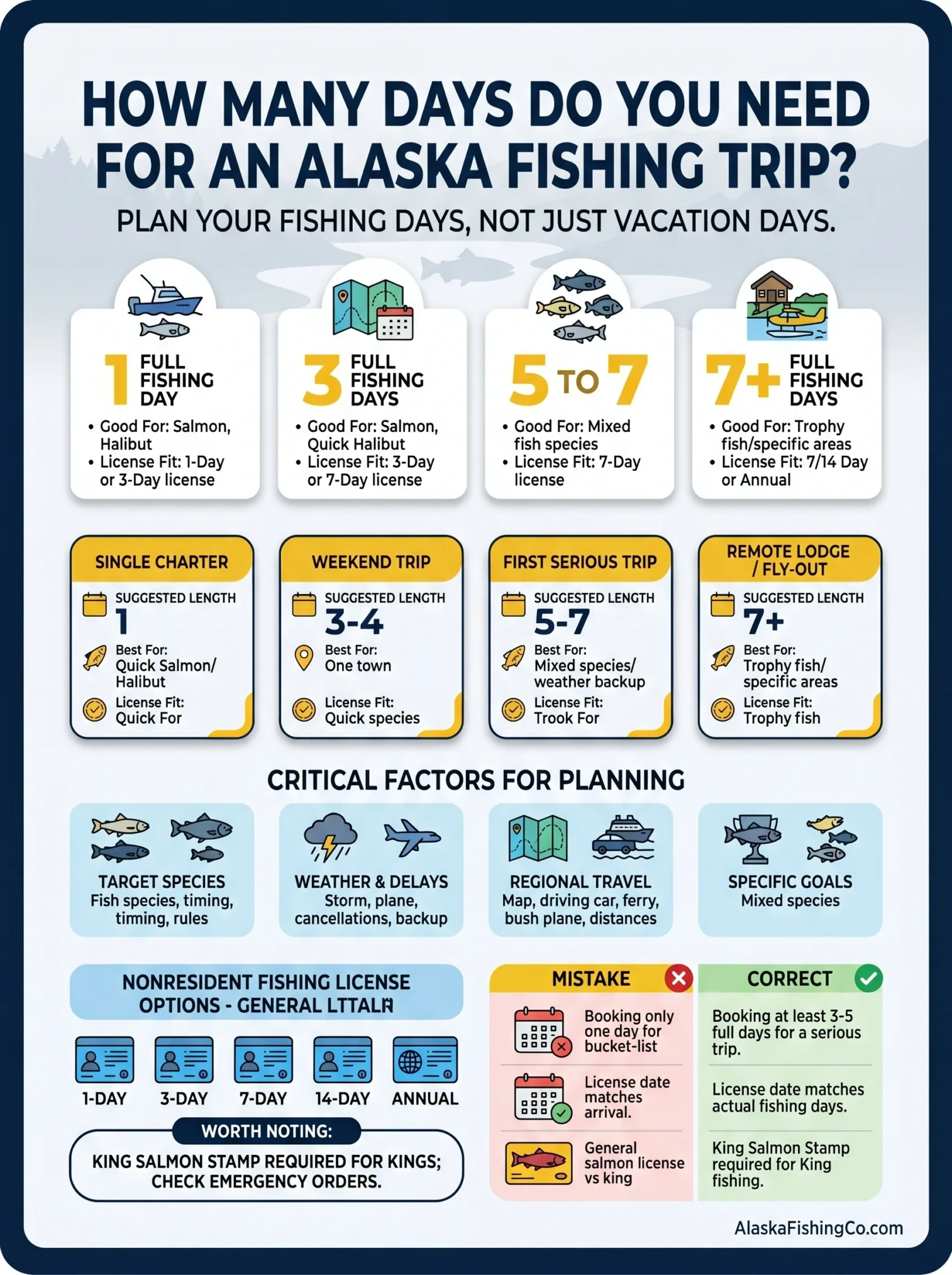
Most Alaska fishing trips work best with at least 3 full fishing days, not just 3 calendar days in the state. A single charter day can be enough for a simple halibut or salmon outing, but 5 to 7 days gives visitors a much safer plan for weather, travel delays, changing fish runs, and license timing.
For a first Alaska fishing trip, the best trip length depends on how far you are traveling, whether you are using a charter, and whether you want one species or several. A visitor flying to Anchorage for a Kenai Peninsula charter has a very different schedule from someone flying into Bristol Bay, Kodiak, Southeast Alaska, or a remote lodge.
If you remember one thing… plan around fishing days, not vacation days. In Alaska, the day you land, the day you drive or fly to the fishing area, and the day you leave often do not count as useful fishing time.
What To Know First
- 1 day is enough for a single charter if you are already near the port or river.
- 3 days is the minimum practical plan for most visitors who want one main fishing goal.
- 5 to 7 days is the better choice for salmon timing, weather backup, and mixed fishing.
- 7 to 10 days works best for remote lodges, fly-out trips, or more than one region.
- License length matters. Alaska offers short nonresident sport fishing licenses for 1, 3, 7, and 14 days, plus an annual option.[a]
How Many Days Do You Really Need?
The short answer is this: book 3 to 5 days if fishing is one part of your Alaska trip, and 5 to 7 days if fishing is the main reason you are going. A shorter trip can work, but it leaves very little room for weather, tired travel days, or a slow bite.
Alaska fishing is not like adding a quick lake stop to a normal vacation. Distances are long, flights can be early, and many productive fishing areas require a drive, boat ride, floatplane, or a full-day charter. The more moving parts your trip has, the more days you need.
- 1 full fishing day: best for cruise passengers, a simple charter, or travelers already in the right town.
- 2 full fishing days: useful if you want a backup day but are not building the whole trip around fishing.
- 3 full fishing days: a solid minimum for first-time visitors targeting salmon, halibut, or trout.
- 5 full fishing days: a better plan for mixed species or changing conditions.
- 7 or more full fishing days: best for remote trips, multiple waters, or serious anglers.
The Best Trip Length by Fishing Style
The right number of days depends heavily on the type of trip. A half-day salmon charter near town has a very different rhythm from a fly-out trout trip or a lodge-based week in Bristol Bay.
Use the table below as a planning range, not a strict rule. Alaska fishing conditions can shift by area, date, species, and current regulation changes.
| Trip Style | Suggested Length | Best For | License Fit |
|---|---|---|---|
| Single charter day | 1 to 2 days | Cruise stops, quick halibut trip, casual salmon outing | 1-day or 3-day license |
| Weekend-style fishing trip | 3 to 4 days | One main town, one or two guided days, limited sightseeing | 3-day or 7-day license |
| First serious Alaska fishing trip | 5 to 7 days | Salmon plus halibut, Kenai Peninsula, Southeast Alaska, Kodiak, or Prince William Sound | 7-day license |
| Remote lodge or fly-out trip | 7 to 10 days | Bristol Bay, remote rivers, trophy trout, mixed species | 7-day, 14-day, or annual license |
| Multi-region fishing vacation | 10 to 14 days | Anchorage plus Kenai, Southeast plus inland fishing, multiple charters | 14-day or annual license |
Worth Noting
A 7-day license does not mean you need to fish every day. It often gives visitors a calmer schedule because they can move a fishing day if wind, river levels, or travel problems get in the way.
Is One Day Enough for an Alaska Fishing Trip?
One day can be enough if your goal is simple: take a charter, catch what is available, and enjoy the experience. It is not enough if you are trying to time a salmon run, visit remote water, or build a trip around a specific species.
A one-day plan works best when the fishing location is already built into your route. For example, a traveler staying in Homer can book a halibut charter without losing a day to long driving. A cruise passenger in Ketchikan, Juneau, or Sitka may also be able to fish during a port call.
- Good fit: half-day salmon charter, full-day halibut charter, shore fishing near town.
- Risk: no backup day if the water is rough or the charter is canceled.
- Best license choice: usually a 1-day nonresident sport fishing license.
- Extra check: a king salmon stamp is needed if you fish for king salmon, unless an age-based exemption applies.[b]
Is Three Days Enough?
Three days is the lowest comfortable plan for many visitors. It gives enough time for travel, one or two full fishing days, and a little space if the first plan changes.
A 3-day Alaska fishing trip works best when you stay in one area. Do not try to fish the Kenai Peninsula, fly to Bristol Bay, and add a Southeast Alaska charter inside the same short window. The travel time will eat the trip.
- Best use: one base town, one main species, one backup slot.
- Good areas: Seward, Homer, Soldotna, Anchorage-area streams, Ketchikan, Juneau, or Sitka.
- License fit: a 3-day license works if all fishing days are packed together.
- Watch for: arrival-day fatigue, early charter check-ins, and fish processing pickup times.
One Detail People Miss
The best fishing day may not be the first open day on your calendar. Tide, river height, charter availability, and local closures can matter more than the date printed on your itinerary.
Why 5 to 7 Days Is the Best Plan for Most Visitors
For most first-time visitors, 5 to 7 days is the most practical Alaska fishing trip length. It gives enough room for two or three fishing days, travel between towns, fish processing, and at least one weather or rest day.
This is especially true if you want both freshwater and saltwater fishing. A common plan is to spend part of the trip on the Kenai Peninsula, then mix a river salmon day with a halibut or rockfish charter. In Southeast Alaska, the same idea may mean a salmon charter, a halibut day, and a lighter shore or stream option.
- Day 1: arrive, collect gear, confirm license and charter details.
- Day 2: first fishing day.
- Day 3: second fishing day or sightseeing day.
- Day 4: backup day for weather or a different species.
- Day 5: fish processing, local travel, or final half-day outing.
- Days 6–7: optional extra fishing, wildlife viewing, or a relaxed return schedule.
When You Need 7 to 10 Days or More
You need 7 to 10 days or more when the trip includes remote travel, a lodge stay, multiple fishing regions, or a narrow species window. The more specific your fishing goal is, the more time you should give yourself.
Remote Alaska trips often involve scheduled floatplanes, small airports, weather holds, and lodge transfer days. Those days are part of the trip, but they are not always full fishing days. A week-long lodge package may only include five strong fishing days once arrival and departure are counted.
- Remote trout or salmon lodge: plan 7 days or more.
- Fly-out fishing from Anchorage or Soldotna: add at least one backup day.
- Two-region trip: plan 10 days if possible.
- Multiple species goal: 7 to 14 days gives a better chance to adapt.
Before You Move On
Remote does not always mean better for every visitor. A short, well-planned charter from the right town can be more enjoyable than losing half a vacation to transfers.
How License Length Affects Your Trip Plan
License length should match your actual fishing days, not your hotel stay. Alaska short-term nonresident fishing licenses are sold in 1-day, 3-day, 7-day, and 14-day lengths, while annual licenses are valid through the calendar year except for short-term license rules.[c]
For nonresidents and foreign visitors, the same short sport fishing license lengths are listed on the ADF&G price schedule. Foreign visitors should treat themselves as nonresidents unless they clearly meet Alaska resident rules. The license does not remove the need to follow area regulations, species limits, harvest recording rules, or stamp requirements.
- 1-day license: best for one charter or a port stop.
- 3-day license: best for a short trip with back-to-back fishing days.
- 7-day license: often the safest choice for a normal Alaska fishing vacation.
- 14-day license: good for longer road trips or mixed fishing and sightseeing.
- Annual license: useful for long stays, repeat trips, or flexible travel.
Common License Timing Example
If you land on Monday, drive on Tuesday, fish Wednesday and Thursday, and fly home Saturday, you may only need a short license for the fishing days. But if you may fish from shore between charters, a longer license can avoid awkward gaps.
Species Can Change the Number of Days You Need
The species you want to catch can change the whole trip length. Some fish are available over broad windows, while others depend more on run timing, emergency orders, local conditions, or charter rules.
ADF&G run-timing tables are useful for planning, but the department notes that those tables show fish availability only and that some waters may be closed to fishing, so current regulations still need to be checked before a trip.[d]
- Halibut: often works well as a single full-day charter, but weather can cancel saltwater trips.
- King salmon: allow more flexibility because rules and run strength can vary by area.
- Sockeye salmon: timing can be very important, especially on river systems with defined runs.
- Coho salmon: often suits late-summer trips, but local timing still matters.
- Rainbow trout and Dolly Varden: often fit better into lodge trips, float trips, or guided river days.
- Rockfish and lingcod: check local saltwater rules, retention limits, and emergency orders before booking.
Worth Noting
Fishing for king salmon is not the same as fishing for any salmon. If king salmon is part of the plan, check stamp rules, harvest recording, local limits, and current orders before buying only the basic license.
Regional Differences That Affect Trip Length
Alaska regions do not fish the same way. A trip based in one road-access town can be short and efficient, while a remote or island-based trip usually needs more days.
Visitors often underestimate how much time Alaska geography takes. A map may make two places look close, but road routes, ferry schedules, small-plane logistics, and charter departure times can make them feel far apart.
- Anchorage and nearby waters: good for short add-on fishing days.
- Kenai Peninsula: strong choice for 3 to 7 days because visitors can mix rivers, saltwater charters, and towns such as Seward, Soldotna, and Homer.
- Southeast Alaska: good for cruise visitors, saltwater charters, and town-based trips, but island and ferry logistics can add time.
- Bristol Bay: usually better as a lodge or guided package, often 7 days or more.
- Kodiak: plan more time for flights, weather, and species variety.
- Interior Alaska: useful for grayling, pike, and river fishing, but not the same plan as coastal salmon and halibut trips.
Charter Trips, Weather Days, and Backup Planning
A charter day is one of the easiest ways to fish Alaska, but it still needs backup thinking. Saltwater weather, river conditions, and local rule changes can move or cancel plans.
This matters most on short trips. If you only have one fishing day and the boat cannot safely run, the fishing part of the trip may be gone. With 5 to 7 days, the charter may be moved, or you may add a shore, river, or lighter local option.
- Ask the charter how often weather changes the schedule for your month and port.
- Do not book your only charter on the morning after a late arrival if you can avoid it.
- Leave time for fish processing if you plan to take fish home.
- Keep one flexible day on trips where fishing is the main goal.
- Check current emergency orders because they can change seasons, limits, methods, or open areas.[e]
One Detail People Miss
For halibut, guided charter rules can differ from unguided sport fishing rules in certain Alaska regulatory areas. If halibut is a major goal, confirm the current charter rule for the exact port and date before locking in a short trip.[f]
Common Mistakes When Planning Alaska Fishing Days
The biggest mistake is treating every vacation day as a fishing day. In Alaska, travel, weather, license timing, and fish processing can all reduce the number of real fishing days.
Mistake: Booking Only One Fishing Day for a Bucket-List Species
Correct explanation: One day can work, but it gives no room for a slow run, poor weather, or a local restriction.
Why it gets confused: Many visitors see charter photos and assume the same result is likely on any date.
Mistake: Buying a License Before the Fishing Dates Are Clear
Correct explanation: Short-term licenses should match the dates you will actually fish.
Why it gets confused: Travelers often buy based on arrival date, even when fishing starts later.
Mistake: Assuming a Salmon License Covers King Salmon Without Extra Steps
Correct explanation: A king salmon stamp may be required if you fish for king salmon, and some harvests must be recorded.
Why it gets confused: Many visitors use the word “salmon” as one category, while Alaska rules can treat king salmon differently.
Mistake: Planning Too Many Regions in Too Few Days
Correct explanation: A focused 5-day trip in one area is often better than a rushed 7-day trip across several regions.
Why it gets confused: Alaska looks easier on a map than it feels on a real travel schedule.
Mistake: Ignoring Emergency Orders Until Arrival
Correct explanation: Emergency orders can change the fishing plan before or during the trip.
Why it gets confused: Visitors often read a general season page and think the rule is fixed for the whole summer.
Real-Life Scenarios
These examples show how different Alaska visitors should think about trip length. The right answer is not the same for every traveler.
- Cruise passenger in Ketchikan: A half-day or full-day charter may be enough if the ship schedule allows it.
- Family staying in Anchorage: Plan 2 to 3 days if fishing is a side activity, especially with a guided local outing.
- Couple driving to Seward and Homer: A 5 to 7 day trip gives time for halibut, scenery, and one backup day.
- Angler focused on Kenai River salmon: Plan at least 4 to 6 days so timing and rule changes do not control the whole trip.
- Visitor booking a Bristol Bay lodge: A 7-day or longer package is usually the normal rhythm because travel days are part of the plan.
- Traveler wanting salmon and halibut: A 5 to 7 day plan is much better than trying to force both into one weekend.
- Repeat visitor chasing a specific run: A 7 to 10 day window gives more room to adjust if fish arrive early, late, or in waves.
- Foreign visitor on a longer Alaska vacation: A 14-day or annual license may make sense if fishing days are spread across the trip.
Before You Buy
Choose the trip length first, then buy the license that matches your fishing dates. It is easier to match a license to a clear plan than to rebuild a trip around the wrong license window.
A Simple Planning Rule
For a casual Alaska fishing experience, plan 1 to 2 fishing days. For a real fishing trip, plan 3 to 5 full fishing days. For a remote, species-focused, or once-in-a-long-time Alaska trip, plan 7 days or more.
A practical schedule should include arrival time, transfer time, at least one main fishing day, and a backup plan. If the fishing area is remote or the target species has tight timing, add more days before adding more destinations.
- Minimum: 1 full day for one easy charter.
- Better: 3 full days for one main fishing goal.
- Best for most visitors: 5 to 7 days.
- Best for serious anglers: 7 to 14 days, depending on region and species.
Alaska rewards a slower plan. A trip with fewer moves and more flexible fishing days is usually easier, safer, and more productive than a packed schedule.
The most common mistake is counting arrival, transfer, and departure days as if they were full fishing days. Keep this rule in mind: for Alaska, plan the number of fishing days first, then build the vacation around them.
Alaska Fishing Trip Length Questions Answered
How many days should a first-time visitor spend fishing in Alaska?
Most first-time visitors should plan 3 to 5 full fishing days. This gives enough time for one main fishing goal, a backup day, and a less rushed travel schedule.
Is a 3-day Alaska fishing trip enough?
Yes, 3 days can be enough if you stay in one area and focus on one main type of fishing. It is tight for remote trips, multiple regions, or a narrow salmon run window.
Is one day enough for halibut fishing in Alaska?
One full charter day can be enough for halibut if you are already near the port and the weather cooperates. A second available day gives you a backup if the charter cannot run.
How many days do you need for salmon fishing in Alaska?
Plan at least 3 full fishing days for salmon if the trip is built around catching fish rather than only trying the experience. Salmon timing varies by species, river, region, and current rules.
Should I buy a 3-day or 7-day Alaska fishing license?
Buy a 3-day license if all fishing days are back-to-back and your plan is short. A 7-day license is often better if you want flexibility, a weather backup day, or casual shore fishing between guided trips.
Do foreign visitors need more time for an Alaska fishing trip?
Foreign visitors do not need more fishing days because of their nationality, but they often need more total travel time because of long flights, jet lag, and connections to smaller Alaska towns.
How many days do you need for a remote Alaska fishing lodge?
Most remote lodge trips work best at 7 days or longer. Arrival and departure days may involve small aircraft or boat transfers, so not every calendar day is a full fishing day.
Alaska Fishing References
- [a] ADF&G Sport Fishing License and King Salmon Stamp Prices — used for current Alaska nonresident license durations and listed fees. (Official Alaska Department of Fish and Game source.)
- [b] ADF&G General License Information — used for license validity, age rules, license formats, king salmon stamp guidance, and harvest record notes. (Official Alaska Department of Fish and Game source.)
- [c] ADF&G General License Information — used for short-term nonresident license validity rules. (Official Alaska Department of Fish and Game source.)
- [d] ADF&G Sport Fish Run Timing — used for the note that run-timing tables show fish availability and must be checked with current regulation summaries. (Official Alaska Department of Fish and Game source.)
- [e] ADF&G Sport Fishing Emergency Orders and Press Releases — used for current emergency order planning and mid-season rule changes. (Official Alaska Department of Fish and Game source.)
- [f] NOAA Fisheries Sport Halibut Fishing in Alaska — used for guided and unguided halibut planning notes. (Official NOAA Fisheries federal source.)