
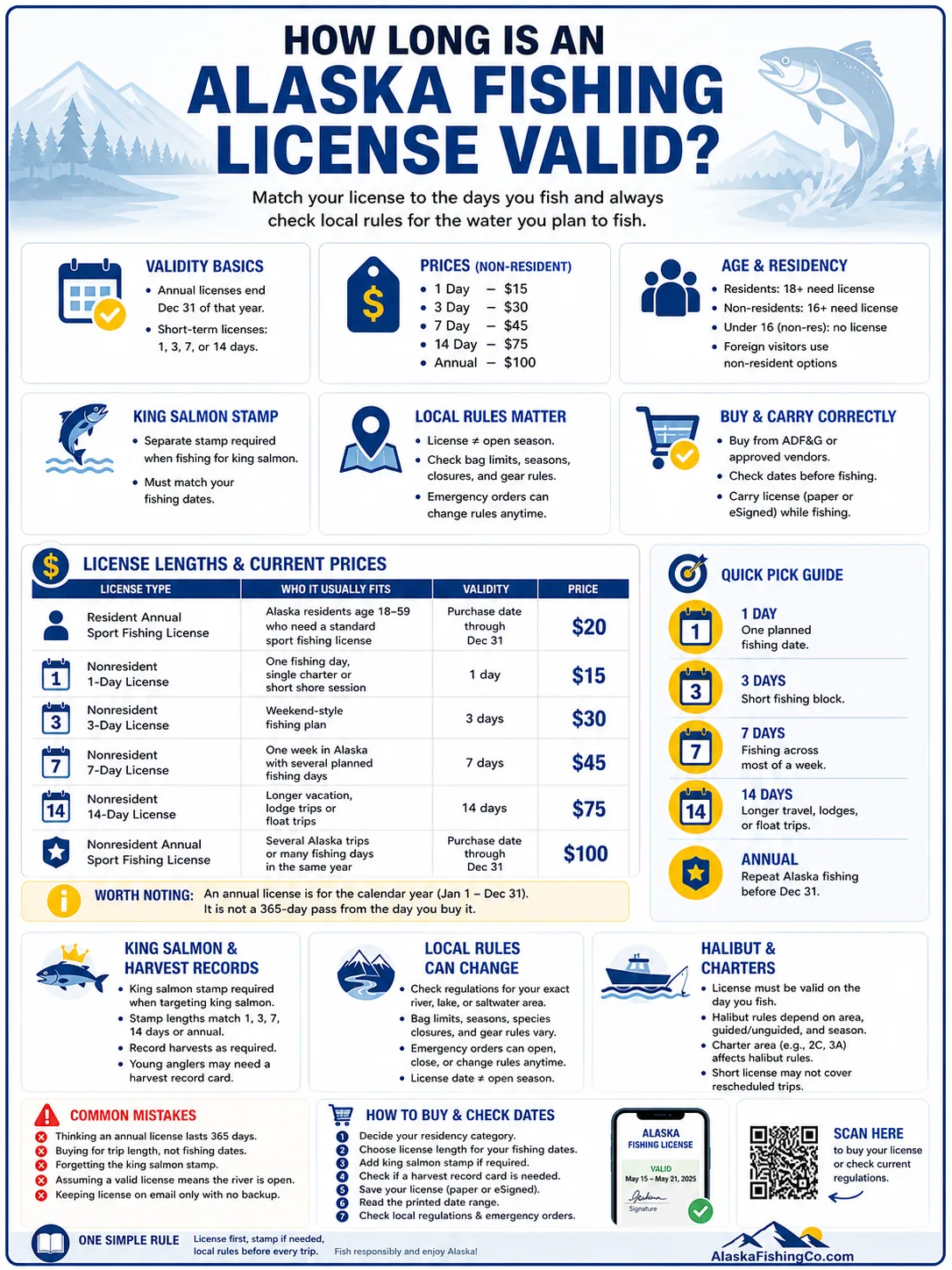
An Alaska sport fishing license is valid only for the period printed on that license: most annual licenses run from the purchase date through December 31, while short-term non-resident sport fishing licenses last 1, 3, 7, or 14 days. That means a visitor should choose the license length by actual fishing dates, not by the full length of the Alaska trip. A valid license also does not override local seasons, bag limits, species closures, king salmon stamp rules, or emergency orders.
If you remember one thing, match your Alaska fishing license to the days you will actually fish, then check the area rules for the river, lake, or saltwater location before you go.
What To Know First
The short answer is simple: annual Alaska sport fishing licenses end on December 31, and short-term non-resident licenses end after the selected 1, 3, 7, or 14-day period. The license must cover every day you fish, including shore fishing, charter fishing, freshwater fishing, and saltwater fishing.
- Residents: most resident sport fishing licenses are annual licenses.
- Non-residents: visitors can choose 1-day, 3-day, 7-day, 14-day, or annual sport fishing licenses.
- Foreign visitors: overseas visitors are generally handled under Alaska’s nonresident license choices for sport fishing.
- King salmon: a king salmon stamp may be needed in addition to the license.
- Local rules: a valid license does not mean every species is open in every Alaska region.
The Direct Validity Rule
An annual Alaska fishing license is not valid for 12 rolling months. It is valid from the date of purchase through December 31 of that calendar year, with short-term non-resident sport fishing licenses treated as a separate exception for 1, 3, 7, or 14 days.[a]
This matters most for late-season trips. If a visitor buys an annual non-resident license in September, it still ends on December 31 of that same year. It does not run into the next September.
- Annual license: best when fishing on many dates in the same calendar year.
- Short-term license: best when the fishing plan is short and fixed.
- Late-year purchase: still ends on December 31 if it is annual.
- Next-year trip: usually needs a new license for the new calendar year.
Worth Noting
A 2026 annual Alaska sport fishing license is a 2026 license. It is not a 365-day pass from the day you buy it.
License Lengths and Current Prices
Alaska’s license length choices are easy to compare once you separate resident annual licenses from non-resident short-term licenses. For visitors, the main choice is usually between a short license for a fixed trip and an annual license for repeat fishing in the same year.
The current ADF&G price table lists a resident annual sport fishing license at $20 and non-resident sport fishing licenses at $15 for 1 day, $30 for 3 days, $45 for 7 days, $75 for 14 days, and $100 for an annual license.[b]
| License Type | Who It Usually Fits | Validity | Listed Price |
|---|---|---|---|
| Resident Annual Sport Fishing License | Alaska residents age 18 to 59 who need a standard sport fishing license | Purchase date through December 31 | $20 |
| Nonresident 1-Day Sport Fishing License | One fishing day, often a single charter or short shore session | 1 day | $15 |
| Nonresident 3-Day Sport Fishing License | Weekend-style fishing plan | 3 days | $30 |
| Nonresident 7-Day Sport Fishing License | One week in Alaska with several planned fishing days | 7 days | $45 |
| Nonresident 14-Day Sport Fishing License | Longer vacation or lodge trip | 14 days | $75 |
| Nonresident Annual Sport Fishing License | Several Alaska trips or many fishing days in the same calendar year | Purchase date through December 31 | $100 |
For many visitors, the price break is easy to see. A 14-day non-resident license costs less than an annual license, but two separate 14-day licenses cost more than buying the annual option once. The annual license can make sense when Alaska fishing is spread across more than one trip in the same year.
- Choose 1 day for one planned fishing date.
- Choose 3 days when the trip has a short fishing block.
- Choose 7 days when fishing may happen across most of a week.
- Choose 14 days for longer travel plans, lodges, or float trips.
- Choose annual if repeat Alaska fishing is likely before December 31.
Age, Residency, and Foreign Visitor Rules
License validity depends on the license type, but the need to buy a license depends on age and residency. Alaska residents generally need a sport fishing license at age 18 or older, while non-residents need one at age 16 or older.
ADF&G states that residents under 18 do not need a sport fishing license, and non-residents under 16 do not need a sport fishing license. The same ADF&G license information also explains that anglers who fish for species with annual limits may need a harvest record card, even when they are too young to need the license itself.[c]
For visitors from outside the United States, the practical rule is plain: buy the Alaska nonresident sport fishing license that matches your fishing dates unless you qualify under a narrower Alaska residency rule. ADF&G also lists foreign/alien nonresident sport fishing prices in the same 1-day, 3-day, 7-day, 14-day, and annual structure as standard nonresident sport fishing licenses.
- Alaska resident under 18: no standard sport fishing license needed.
- Alaska resident 18 or older: license generally needed unless another Alaska exemption applies.
- Non-resident under 16: no standard sport fishing license needed.
- Non-resident 16 or older: license generally needed for sport fishing.
- Foreign visitor: usually buys from the nonresident sport fishing license choices.
- Yukon Territory resident: ADF&G lists a reciprocal annual sport fishing option at Alaska resident pricing.
One Detail People Miss
A child may be too young to need a license and still need a harvest record card for certain fish with annual limits. Do not assume “no license” means “no paperwork at all.”
King Salmon Stamps and Harvest Records
An Alaska sport fishing license is the base permission to fish, but king salmon often adds another step. If you plan to fish for king salmon, you may need a current king salmon stamp in addition to the license, except for stocked lake situations and listed exemptions.
For a non-resident, king salmon stamps are sold in matching time lengths: 1 day, 3 days, 7 days, 14 days, and annual. The stamp should cover the same king salmon fishing dates as the sport fishing license. A short-term stamp does not make a short-term license last longer, and an annual license does not include the king salmon stamp automatically.
- Fishing for king salmon: check whether a king salmon stamp is needed before buying.
- Catch-and-release plans: do not assume a stamp is only for keeping fish.
- Short trips: match the stamp length to the actual king salmon fishing dates.
- Annual limits: record required harvest right away when rules require it.
- Young anglers: use the harvest record card when a license or stamp exemption applies but harvest reporting is still required.
For example, a non-resident adult who buys a 7-day sport fishing license for a Kenai Peninsula trip and plans to target king salmon should also check whether a 7-day or annual nonresident king salmon stamp is the right match for those dates. If local king salmon fishing is closed, the stamp does not reopen that fishery.
Regional Rules Can Change What You Can Fish For
A valid license tells you when you are allowed to participate as an angler. It does not tell you which fish may be kept, which waters are open, which gear is legal, or whether a river has been closed for part of the season.
Alaska publishes sport fishing regulations by region, and ADF&G tells anglers to select the region and then the drainage or area they plan to fish. The same regulations page notes that emergency orders can override the printed regulations.[d]
- Southeast Alaska: check salmon, rockfish, and halibut-related rules for the exact port or water.
- Southcentral Alaska: check Cook Inlet, Kenai, Kasilof, Mat-Su, Kodiak, and Prince William Sound updates.
- Northern and Interior waters: check drainage-level rules, especially for salmon closures.
- Freshwater versus saltwater: the same license can apply, but the regulations may differ.
- Charter fishing: the captain may explain rules, but the angler still needs the right license and documents.
Emergency orders deserve special attention because they may open or close sport fishing seasons or areas, change bag limits, or adjust legal methods. ADF&G says these orders may be issued at any time and have the same force and effect as law.[e]
Before You Move On
Do not treat a fishing license as a season calendar. The license date and the fishery season are two different things.
Halibut, Charters, and Species-Specific Timing
For many Alaska visitors, halibut is the reason they buy a license. The license must be valid on the day of the trip, but halibut rules can also depend on whether the trip is guided, which regulatory area is being fished, and what the annual federal rules allow.
NOAA Fisheries explains that guided sport halibut regulations in Alaska are set annually through the North Pacific Fishery Management Council and the International Pacific Halibut Commission, with different treatment for areas such as 2C and 3A.[f]
- Unguided halibut fishing: check the current federal and state rules for the area.
- Guided charter halibut: ask the charter which IPHC area applies to your trip.
- Mixed-species charters: king salmon, rockfish, lingcod, and halibut may each have separate limits.
- License length: your license must cover the date you are actually fishing, even if the boat was booked months earlier.
This is where visitors sometimes get caught off guard. A 1-day license may be fine for one halibut charter, but it will not cover a second day of shore fishing or a rescheduled trip after weather delays unless the printed license dates still cover that fishing day.
How to Buy Online and Check the Dates
The safest buying habit is to purchase through ADF&G or an approved license vendor, then read the license date range before fishing. Do not rely only on the receipt or the booking date for a charter.
ADF&G licenses and king salmon stamps can be bought online, at many sporting goods stores, and at Fish and Game offices. Online licenses may be printed, carried as a signed electronic copy, or stored as an eSigned license when bought through a myADF&G account.
- Decide whether you are a resident, non-resident, nonresident military member, or foreign visitor.
- Choose the license length that covers each planned fishing date.
- Add a king salmon stamp if the fishing plan includes king salmon and no exemption applies.
- Check whether a free harvest record card is needed for young anglers or exempt anglers.
- Save the license in a form you can show while fishing.
- Read the date range printed on the license before your first cast.
- Check regional regulations and emergency orders for the exact water you plan to fish.
A phone copy can be convenient, but battery life and poor service can become a real problem in remote areas. A printed backup is still a smart habit for lodge trips, float trips, fly-out fishing, or any plan far from town.
Common Mistakes
Most license problems come from mixing up the license date, the fishing season, and the species rule. They sound related, but each one answers a different question.
Mistake: Thinking an Annual License Lasts 365 Days
Correct explanation: An annual Alaska sport fishing license ends on December 31 of the calendar year.
Why it gets confused: Many travel passes and memberships run for one full year from purchase. Alaska annual sport fishing licenses do not work that way.
Mistake: Buying for the Vacation Length Instead of Fishing Dates
Correct explanation: The license only needs to cover the days you fish, but it must cover every fishing day.
Why it gets confused: A traveler may spend 10 days in Alaska but fish only 3 days. The license choice should follow the fishing plan, not the hotel stay.
Mistake: Forgetting the King Salmon Stamp
Correct explanation: A sport fishing license and a king salmon stamp are separate items when a stamp is required.
Why it gets confused: Visitors often assume the license covers all fish equally. King salmon is the common exception that needs extra attention.
Mistake: Assuming a Valid License Means the River Is Open
Correct explanation: A valid license lets you fish only where the current regulations allow fishing for that species.
Why it gets confused: The license feels like permission for the whole state, but Alaska manages fisheries by region, area, drainage, species, and season.
Mistake: Leaving the License on Email Only
Correct explanation: You need to be able to present your license while fishing, whether it is paper or electronic.
Why it gets confused: Online purchase feels finished once payment goes through. In the field, access and proof matter just as much as purchase.
Real-Life Scenarios
These examples show how the validity rule works for real Alaska travel plans. The right license still depends on the final fishing dates printed on the license and the current rules for the area.
- One-day cruise stop in Ketchikan: A non-resident adult booked for one afternoon of fishing may only need a 1-day nonresident sport fishing license, plus any extra stamp or rule required for the target species.
- Three fishing days during a week in Anchorage: A 3-day license may work if the fishing days fit the printed period; otherwise, a 7-day license may be cleaner.
- Kenai trip with king salmon plans: The angler needs the sport fishing license and should check whether a matching king salmon stamp is required for those dates.
- Two Alaska trips in one summer: A nonresident annual license may cost less than buying short licenses for each trip.
- Late December fishing plan: An annual license bought near the end of the year still ends on December 31.
- Family with a 15-year-old non-resident child: The child may not need a sport fishing license, but harvest record requirements can still matter for species with annual limits.
- Foreign visitor on a lodge package: The visitor should buy the nonresident license length that covers every planned fishing day, then confirm any king salmon or halibut rules with the lodge.
- Weather-delayed charter: A short-term license may not cover the new fishing date if the trip is moved beyond the printed license period.
Worth Noting
Weather delays are normal in Alaska. If a charter or fly-out trip might move by a day or two, the cheapest license is not always the easiest one.
Resident Status Can Change the Answer
Most tourists are non-residents for Alaska fishing license purposes. Living in the United States, owning property in Alaska, or visiting often does not automatically make someone an Alaska resident for Fish and Game licensing.
ADF&G defines nonresident and nonresident alien status separately from Alaska resident status, and the residency rules focus on factors such as domicile, physical presence, and not claiming residency benefits elsewhere.[g]
- Out-of-state U.S. visitor: usually buys a nonresident sport fishing license.
- International visitor: usually buys under the nonresident foreign/alien sport fishing choices.
- New Alaska arrival: should not assume resident pricing until the Fish and Game residency rules are met.
- Active-duty military in Alaska: may have separate reduced-price options depending on stationing and duration.
When in doubt, use the category that matches ADF&G’s license definitions rather than the category that feels closest. Wrong residency selection can cause bigger trouble than choosing a longer license than needed.
A Simple Rule Before You Fish
An Alaska fishing license is valid for the date range printed on it: annual licenses end on December 31, and short-term non-resident licenses last only for the selected short period. The cleanest plan is to buy once your fishing dates are known, add any needed stamp, and check the exact region before going.
The most common mistake is treating the license as proof that every fishery is open. Remember this rule: license first, stamp if needed, local rules before every trip.
Alaska License Validity Questions Answered
How long is an annual Alaska fishing license valid?
An annual Alaska sport fishing license is valid from the date of purchase through December 31 of that calendar year. It does not last for 365 days from the purchase date.
How long is a non-resident Alaska fishing license valid?
A non-resident Alaska sport fishing license can be valid for 1 day, 3 days, 7 days, 14 days, or through December 31 if an annual nonresident license is bought.
Do tourists need a fishing license in Alaska?
Most tourists age 16 or older need a nonresident sport fishing license to fish in Alaska. Non-resident anglers under 16 do not need a standard sport fishing license, but harvest record rules may still apply for certain species.
Can foreign visitors buy an Alaska fishing license?
Yes. Foreign visitors generally use Alaska’s nonresident sport fishing license choices. ADF&G lists 1-day, 3-day, 7-day, 14-day, and annual options for foreign/alien nonresident sport fishing licenses.
Does an Alaska fishing license include a king salmon stamp?
No. A king salmon stamp is a separate item when required. A person fishing for king salmon should check the current rule for the water and buy a stamp that covers the fishing dates unless an exemption applies.
Can I use this year’s Alaska fishing license next year?
No. An annual Alaska sport fishing license ends on December 31 of the calendar year. A new calendar year usually requires a new license.
Is a valid Alaska fishing license enough for halibut fishing?
The license must be valid on the day you fish, but halibut rules may also depend on whether the trip is guided, the regulatory area, the season, and current federal management measures.
Alaska Fishing References
- [a] ADF&G General License Information — Explains license validity periods, license formats, and age rules for Alaska fishing and hunting licenses. (Official Alaska Department of Fish and Game source.)
- [b] ADF&G Sport Fishing License Prices — Lists resident, nonresident, foreign/alien, military, king salmon stamp, and duplicate license prices. (Official Alaska Department of Fish and Game price table.)
- [c] ADF&G Sport Fishing Licenses, King Salmon Stamps, IDs and Harvest Record Cards — Covers who needs a sport fishing license, king salmon stamp basics, and harvest record card use. (Official Alaska Department of Fish and Game licensing page.)
- [d] ADF&G Sport Fishing Regulations — Provides Alaska region and drainage-level sport fishing regulation access and notes that emergency orders override printed rules. (Official Alaska Department of Fish and Game regulation page.)
- [e] ADF&G Sport Fishing Emergency Orders and Press Releases — Explains that emergency orders can open or close areas, change bag limits, and alter methods. (Official Alaska Department of Fish and Game emergency order page.)
- [f] NOAA Fisheries Sport Halibut Fishing in Alaska — Explains guided sport halibut management in Alaska and annual rules for areas such as 2C and 3A. (Official NOAA Fisheries source.)
- [g] ADF&G Residency Definitions — Defines resident, nonresident, nonresident military, and nonresident alien license status. (Official Alaska Department of Fish and Game licensing definition page.)