
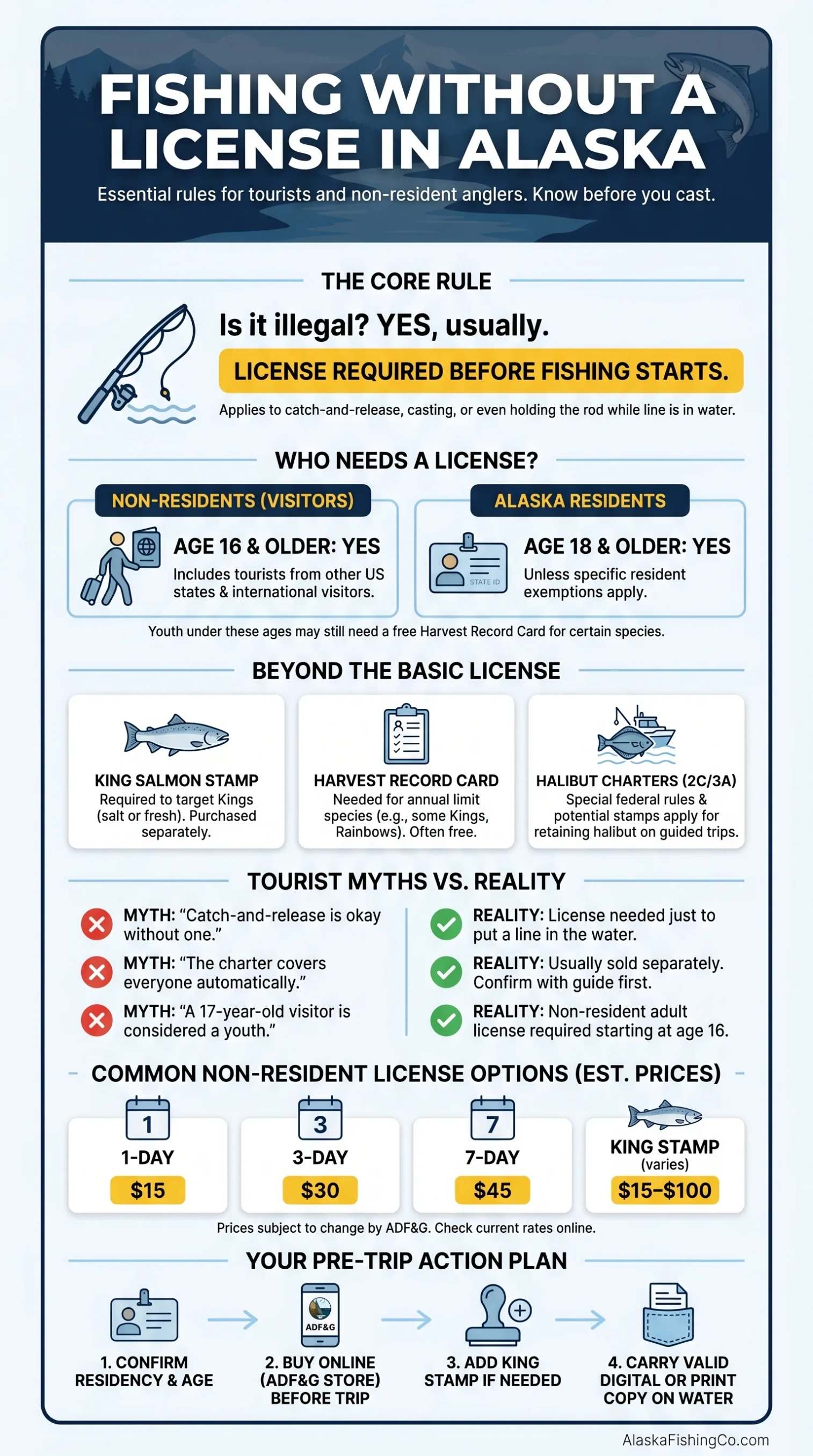
Fishing without a license in Alaska is usually illegal if you are old enough to need one, even if you only fish for a few minutes or plan to release everything. Alaska residents age 18 and older, and nonresidents age 16 and older, must buy and carry a valid sport fishing license to fish in Alaska’s fresh or marine waters.[a]
A license is not only about keeping fish. It is the basic permission to take part in sport fishing. Depending on the fishery, you may also need a king salmon stamp, a harvest record card, a federal charter halibut stamp, or a local permit.
If you remember one thing… buy the right Alaska sport fishing license before you touch a rod, and check the exact water, species, and date before you fish.
What To Know First
- Visitors are usually nonresidents. If you are visiting from another U.S. state or another country, the nonresident rules normally apply.
- Age matters. Nonresidents need a sport fishing license at age 16 and older; Alaska residents need one at age 18 and older.
- King salmon is separate. A sport fishing license does not replace a king salmon stamp when one is required.
- Charters do not erase the rule. A guide may remind you, but the angler still needs the right license before fishing.
- Regulations can change during the season. Emergency orders can close areas, change limits, or restrict methods.
Can You Fish Without a License in Alaska?
You can fish without a sport fishing license in Alaska only if you fall into a specific exempt group. For most tourists and visiting anglers, fishing without a license is not allowed once they are 16 or older.
Alaska’s rule applies to both freshwater and saltwater sport fishing. That means the same basic license requirement can apply whether you are casting from shore, fishing from a lodge skiff, joining a salmon charter, or taking a halibut trip.
- Nonresident visitors age 16 and older need a sport fishing license.
- Alaska residents age 18 and older need a sport fishing license, unless a resident exemption applies.
- Foreign visitors are treated as nonresidents for sport fishing license purposes.
- A license must be valid for the day or days you fish.
- A license alone does not guarantee the fishery is open.
The safest way to think about the rule is simple: if you are old enough to need a license and you are actively fishing, buy the license first.
Who Is Allowed to Fish Without an Alaska Sport Fishing License?
Only a few groups can legally sport fish in Alaska without buying the regular sport fishing license. Some of those anglers still need a harvest record card if they fish for species with annual limits.
The exemption is not the same for residents and visitors. This is where many travelers make mistakes, especially when fishing with teenagers.
| Angler type | Needs sport fishing license? | What to watch for |
|---|---|---|
| Alaska resident age 18–59 | Yes | Annual resident sport fishing license is normally required. |
| Alaska resident under 18 | No | May still need a free harvest record card for species with annual limits. |
| Alaska resident age 60 or older | Not if holding the proper ADF&G identification card | The card must be applied for and carried when fishing. |
| Alaska disabled veteran resident | Not if holding the proper ADF&G identification card or license | Resident status and the correct ADF&G document matter. |
| Nonresident age 16 or older | Yes | This includes visitors from other states and most international tourists. |
| Nonresident under 16 | No | May still need a harvest record card for annual-limit species. |
| Foreign visitor age 16 or older | Yes | Use the nonresident sport fishing license category. |
Worth Noting
“No license needed” does not always mean “no paperwork needed.” Young anglers, resident seniors, and qualified resident disabled veterans may still need a harvest record card when fishing for species with annual limits.
What Counts as Fishing Without a License?
If you are participating in sport fishing and you are in a group that needs a license, assume you must have the license before fishing begins. Do not wait until a fish is hooked or kept.
Visitors sometimes think the rule starts only when a fish is landed. That is not how to plan a legal Alaska fishing day. The license should already be valid and in your possession when you start fishing.
- Casting a line counts as fishing.
- Holding the rod while the line is in the water can create a license problem.
- Catch-and-release fishing still needs a license if the angler is old enough to need one.
- Fishing from shore, dock, riverbank, lake, charter boat, or private boat does not remove the license rule.
- Using someone else’s license is not a workaround.
For families and tour groups, the practical rule is to decide who will actually fish before the trip starts. Anyone who may take a turn with the rod should have the right license, stamp, or record card before doing so.
What Happens If You Fish Without a License in Alaska?
Fishing without a required license can lead to a citation, a fine or bail amount, and added trouble if another rule was broken at the same time. The risk is higher when the missing license is paired with a missing stamp, a closed area, a wrong method, or an unrecorded harvest.
Alaska officers can check licenses in the field. ADF&G also explains that licenses may be carried in printed, electronic, or eSigned form, depending on how they were issued, but the angler must be able to show the valid license while fishing.[c]
- Missing base license: a visitor age 16 or older fishes without buying a nonresident license.
- Missing king salmon stamp: an angler has a license but targets king salmon without the required stamp.
- Missing harvest record: an exempt youth catches a species with an annual limit but has no record card.
- Wrong residency claim: a visitor buys a resident license to save money.
- Closed fishery: an angler has a license but fishes in an area closed by emergency order.
If you realize you do not have the right license, stop fishing first. Then buy the proper license or stamp before fishing again. Buying it after a contact with enforcement does not undo the time spent fishing without it.
One Detail People Miss
A valid license does not fix a closed season, closed river, wrong gear type, or missing species stamp. Alaska fishing compliance is a combination of license, location, date, species, and method.
Alaska Sport Fishing License Types and Current Fees
Most visitors need a nonresident sport fishing license for the number of days they plan to fish. Alaska residents normally buy an annual resident sport fishing license, while nonresidents can choose 1-day, 3-day, 7-day, 14-day, or annual options.
ADF&G lists separate prices for resident licenses, nonresident sport fishing licenses, nonresident foreign visitor licenses, and king salmon stamps.[b] The prices below reflect the ADF&G-listed sport fishing products used by most recreational anglers.
| Product | Who it fits | Listed price |
|---|---|---|
| Resident Annual Sport Fishing License | Alaska residents age 18–59 who do not qualify for a resident exemption | $20 |
| Resident Annual King Salmon Stamp | Resident anglers who need a king salmon stamp | $10 |
| Nonresident 1 Day Sport Fishing License | One-day visitor trip | $15 |
| Nonresident 3 Day Sport Fishing License | Weekend or short lodge stay | $30 |
| Nonresident 7 Day Sport Fishing License | One-week Alaska trip | $45 |
| Nonresident 14 Day Sport Fishing License | Longer visitor trip | $75 |
| Nonresident Annual Sport Fishing License | Multiple Alaska fishing trips in one calendar year | $100 |
| Nonresident King Salmon Stamp | Visitors fishing for king salmon where a stamp is required | $15 to $100, depending on duration |
Short-term nonresident licenses are built around fishing days. Annual licenses run through the end of the calendar year, while short-term nonresident fishing licenses are valid only for the selected 1, 3, 7, or 14 days.
King Salmon Stamp, Harvest Record Cards, and Species Rules
A sport fishing license is the base requirement, but it may not be the only requirement. King salmon, some annual-limit fisheries, and guided halibut trips can add extra steps.
ADF&G states that a king salmon stamp is required to fish for king salmon, except for king salmon in stocked lakes. Exempt youth and certain resident card holders do not need to buy the stamp, but they may need a harvest record card for fish with annual limits.
King salmon stamp
- Required when fishing for king salmon, except stocked-lake king salmon.
- Separate from the sport fishing license.
- Available in resident and nonresident versions.
- Must match the time period of your fishing activity.
Harvest record card
- Used to record harvest of species with annual limits.
- Often relevant for many king salmon and some rainbow trout fisheries.
- May be required even for anglers who do not need a regular sport fishing license.
- Should be carried while fishing and filled out immediately when required.
Halibut and charter rules
Pacific halibut rules are partly federal. NOAA Fisheries explains that sport halibut regulations in Alaska involve the International Pacific Halibut Commission, NOAA Fisheries, the North Pacific Fishery Management Council, and ADF&G.[g]
For 2026, NOAA also describes a charter halibut stamp requirement for charter vessel anglers age 18 or older who intend to catch and retain halibut on charter trips in IPHC Areas 2C and 3A. The stamp is handled through charter halibut permit holders and is separate from the Alaska sport fishing license.[h]
Before You Move On
Ask your charter operator two direct questions before the trip: “Which Alaska sport fishing license should each person buy?” and “Are any king salmon, halibut, or harvest-record requirements part of this trip?”
Where Alaska Visitors Commonly Get the Rule Wrong
The most common mistake is treating the fishing license as a detail to handle later. In Alaska, it should be handled before the rod is used.
Mistaken belief: “I only need a license if I keep fish.”
Correct explanation: If you are required to have a sport fishing license, you need it to participate in sport fishing, not only to keep fish.
Why it gets confused: Many travelers connect fishing rules with harvest limits, but licensing comes before harvest.
Mistaken belief: “The charter license covers everyone.”
Correct explanation: A charter business may hold guide or vessel-related permits, but individual anglers still need their own sport fishing licenses when required.
Why it gets confused: Some trips include help with licensing, so visitors assume the license is automatically included.
Mistaken belief: “A teenager follows the Alaska resident youth rule.”
Correct explanation: A visiting 16- or 17-year-old nonresident needs a nonresident sport fishing license.
Why it gets confused: Alaska residents under 18 do not need a sport fishing license, but the visitor cutoff is under 16.
Mistaken belief: “A king salmon stamp is a fishing license.”
Correct explanation: The king salmon stamp is an add-on. It does not replace the base sport fishing license.
Why it gets confused: The stamp is bought through the same licensing system and can look like a separate license product.
Mistaken belief: “If the online license is on my phone, nothing else matters.”
Correct explanation: The license must be valid, properly carried, and usable in the field. Poor service, dead battery, missing signature, or wrong dates can create problems.
Why it gets confused: Digital proof feels simple until an angler is checked far from reliable cell service.
How to Buy the Right Alaska Fishing License Online
The easiest route for most visitors is the ADF&G online store. Buy the license before the fishing day, save a digital copy, and keep a backup screenshot or printed copy if you will be away from service.
Before buying, decide whether you are fishing for one day, several days, or more than one Alaska trip in the same year. Also decide whether your trip may involve king salmon or guided halibut retention.
- Go to the ADF&G online store.
- Choose to shop as a guest or sign in with an account.
- Select the correct residency category.
- Choose the sport fishing license duration that matches your fishing dates.
- Add a king salmon stamp if your fishing plan requires one.
- Complete payment and save the license document.
- Make sure the license is signed or eSigned as required.
- Carry the license while fishing, not back at the hotel.
For international visitors, the process is generally the same: buy the nonresident license that matches your fishing dates. Do not buy a resident license unless you actually meet Alaska’s residency definition.
Regional and Seasonal Rules Still Apply After You Buy a License
A fishing license gives you permission to fish only where and when fishing is open under the applicable rules. Alaska regulations are organized by region, drainage, species, and sometimes even small sections of a river.
ADF&G tells anglers to check the region-wide rules and then the exact drainage or area where they plan to fish. Emergency orders can override the printed regulations and should be checked before final plans are made.[d]
- Southeast Alaska: king salmon, lingcod, rockfish, and halibut rules can vary by area and date.
- Southcentral Alaska: Kenai, Kasilof, Cook Inlet, Prince William Sound, and Kodiak rules may change during the season.
- Interior Alaska: some king salmon fisheries can be closed or restricted by drainage.
- Stocked lakes: some special king salmon stamp exceptions may apply, but area rules still matter.
- Personal use fisheries: these are not the same as ordinary sport fishing and are limited to Alaska residents.
ADF&G emergency orders can open or close seasons or areas, change bag limits, or modify legal fishing methods. The agency says emergency orders may be issued at any time and have the same force and effect as law.[e]
Personal Use and Subsistence Fishing Are Not Tourist Shortcuts
Nonresident visitors should not treat Alaska personal use or subsistence fisheries as alternatives to a sport fishing license. These are separate regulatory categories with different eligibility rules.
ADF&G states that all Alaska residents, and only Alaska residents, are eligible to participate in both subsistence and personal use fisheries. A valid resident sport fishing license is required for personal use fisheries, while some permits and area rules may also apply.[f]
- Tourists should normally look at sport fishing rules, not personal use rules.
- Dipnetting opportunities are often resident-only personal use fisheries.
- Resident-only permits do not become available to a visitor because they are staying with an Alaska resident.
- Buying fish or trading for personal use fish can create separate legal issues.
This distinction matters because some online discussions about Alaska fishing focus on local resident fisheries. A visitor planning a salmon or halibut trip should base decisions on nonresident sport fishing rules unless ADF&G clearly says otherwise.
Worth Noting
“Resident-only” means more than being physically in Alaska. It is a legal status, not a travel location.
Real-Life Scenarios for Alaska Visitors
Most license mistakes happen in ordinary travel situations. These examples show how the rule usually works before the fishing starts.
- A 34-year-old cruise passenger books a Ketchikan salmon charter.
They need a nonresident sport fishing license, and they should ask whether king salmon or halibut rules add any stamp requirement. - A 15-year-old visitor fishes from shore with a parent.
The teen does not need a nonresident sport fishing license, but may need a harvest record card for species with annual limits. - A 17-year-old visitor joins a lodge fishing day.
The visitor needs a nonresident sport fishing license because the nonresident cutoff is under 16, not under 18. - A family fishes for stocked rainbow trout near Anchorage.
Each adult visitor needs a nonresident sport fishing license; check local lake rules and harvest limits before keeping fish. - A tourist joins a Homer halibut charter in Area 3A.
The angler needs an Alaska sport fishing license, and adults intending to retain halibut on a charter should confirm the charter halibut stamp process. - A visitor catches and releases salmon on a river for ten minutes.
Catch-and-release does not remove the license requirement for a nonresident age 16 or older. - An Alaska resident grandparent has a senior identification card and takes a grandchild fishing.
The resident senior may not need the regular sport fishing license, but harvest record rules can still apply to annual-limit species. - A visitor buys a sport fishing license but forgets the king salmon stamp.
If the trip targets king salmon where the stamp is required, the missing stamp is still a problem.
What to Do Before You Fish in Alaska
The best way to avoid fishing without a license is to build a simple check before every trip. Match the license to the angler, the dates, the species, and the exact location.
- Confirm whether each angler is a resident or nonresident.
- Check each angler’s age under Alaska’s resident and nonresident cutoffs.
- Buy the correct sport fishing license before fishing.
- Add a king salmon stamp if the trip may target king salmon.
- Ask about charter halibut stamp handling if retaining halibut on a guided charter in Areas 2C or 3A.
- Get a harvest record card when required.
- Check the exact region, drainage, and species regulation.
- Check emergency orders close to the fishing date.
- Carry proof of license on the water.
Alaska fishing rules are manageable when handled before the trip. Most problems come from waiting until the dock, assuming the charter has handled everything, or using the wrong age rule.
The most common mistake is thinking “not keeping fish” means “no license.” The rule to remember is simple: license first, species stamp second, local regulation before every cast.
Fishing Without a License in Alaska Questions Answered
Do tourists need a fishing license in Alaska?
Yes. Most tourists age 16 or older need a nonresident Alaska sport fishing license before fishing in fresh or marine waters. Younger nonresident anglers may not need the base license, but harvest record rules can still apply.
Can foreigners buy an Alaska fishing license online?
Yes. International visitors can buy Alaska nonresident sport fishing licenses online through ADF&G. The same short-term options used by other nonresidents are generally available to foreign visitors.
Can you catch and release fish in Alaska without a license?
Not if you are in an age and residency group that needs a sport fishing license. Catch-and-release fishing is still sport fishing, so buy the proper license before fishing.
Does a child need a fishing license in Alaska?
It depends on residency and age. Alaska residents under 18 do not need a sport fishing license. Nonresidents under 16 do not need a sport fishing license. Youth anglers may still need a harvest record card for certain annual-limit species.
Do I need a king salmon stamp if I already have an Alaska fishing license?
Yes, if you fish for king salmon where a stamp is required. The king salmon stamp is separate from the sport fishing license, although some exempt anglers do not need to buy the stamp.
Can I buy an Alaska fishing license after I start fishing?
You should not fish until the required license is already valid and in your possession. If you discover you forgot to buy it, stop fishing and buy the correct license before continuing.
Does a fishing charter include the Alaska fishing license?
Sometimes a charter may help guests buy licenses, but anglers should not assume the license is included. Confirm before the trip and make sure each person who will fish has the required license and any needed stamp.
Do I need a separate license for halibut in Alaska?
You need an Alaska sport fishing license if your age and residency status require one. For guided charter halibut in IPHC Areas 2C and 3A, adults intending to retain halibut may also be covered by the federal charter halibut stamp process handled through charter permit holders.
Alaska Fishing References
- Alaska Department of Fish and Game — Sport Fishing Licenses, King Salmon Stamps, IDs and Harvest Record Cards — Explains who must buy and possess an Alaska sport fishing license, king salmon stamp requirements, and harvest record card rules. (Official Alaska state fish and wildlife agency source.)
- Alaska Department of Fish and Game — Product Prices: Licenses, Stamps, and Tags — Lists current resident, nonresident, foreign visitor, and king salmon stamp prices. (Official Alaska state licensing price page.)
- Alaska Department of Fish and Game — Fishing and Hunting License General Information — Covers license validity, license formats, age requirements, and king salmon stamp exemptions. (Official Alaska state licensing guidance.)
- Alaska Department of Fish and Game — Sport Fishing Regulations — Shows how anglers should use region, drainage, and area-specific sport fishing regulations. (Official Alaska sport fishing regulation page.)
- Alaska Department of Fish and Game — Emergency Orders and Press Releases: Sport Fishing — Explains that emergency orders may change seasons, areas, bag limits, and methods during the season. (Official ADF&G in-season regulation update source.)
- Alaska Department of Fish and Game — Subsistence and Personal Use Fishing Licenses and Permits — Explains that subsistence and personal use fisheries are limited to Alaska residents and follow separate rules. (Official Alaska resident fishing permit source.)
- NOAA Fisheries — Sport Halibut Fishing in Alaska — Explains the federal, international, and state roles in Alaska sport halibut regulations. (Official NOAA Fisheries resource.)
- NOAA Fisheries — Pacific Halibut Recreational Quota Entity Program Fee Collection — Describes the 2026 federal charter halibut stamp requirement for adult charter anglers intending to retain halibut in Areas 2C and 3A. (Official NOAA Fisheries final rule page.)