
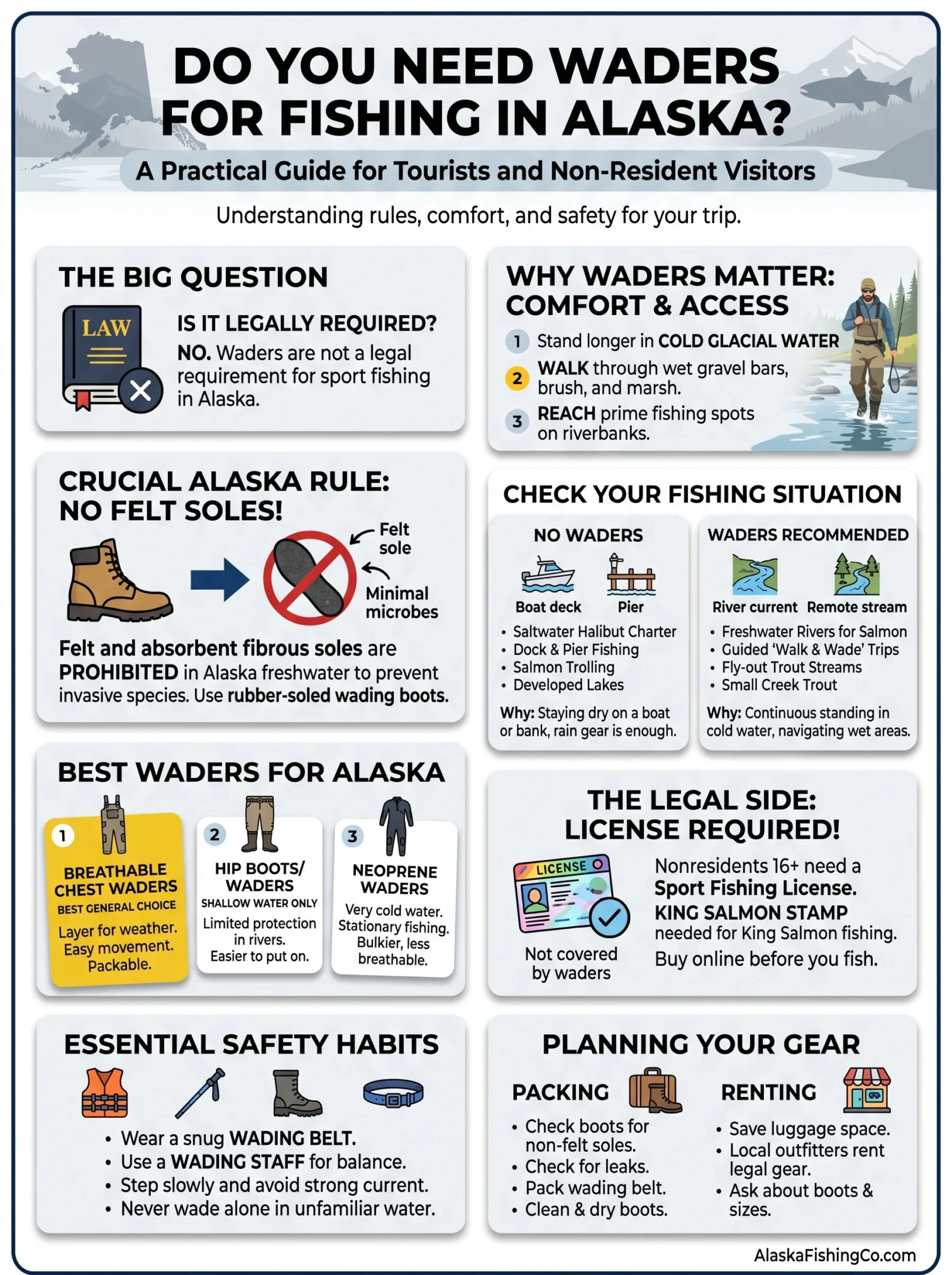
You do not legally need waders to fish in Alaska, but many visitors should bring or rent them if they plan to fish rivers, streams, tidal creeks, or shallow lake edges. For boat charters, dock fishing, and some roadside salmon spots, waders may not be needed at all.
Waders are not a permit, license, or statewide requirement. They are a comfort and access tool. The right choice depends on where you will fish, how cold the water is, whether you will stand in moving current, and whether your trip involves a guide, a charter boat, or a walk-in riverbank.
If you remember one thing… bring waders for freshwater river fishing, but do not assume waders make every crossing safe. In Alaska, cold water and fast current matter more than looking prepared.
What To Know First
- Waders are not legally required for ordinary sport fishing in Alaska.
- Freshwater wading footwear matters: felt or other absorbent fibrous soles are prohibited while sport fishing in Alaska fresh water.
- Boat-based trips usually do not require waders, especially saltwater charters for halibut, rockfish, or salmon.
- River trips often feel much better with waders, especially on cold glacial water or long gravel bars.
- A fishing license is separate from waders: most nonresident anglers age 16 or older need an Alaska sport fishing license.
- Do not wade deeper just because you have waders. A wading belt, traction, and judgment matter.
Do You Need Waders for Alaska Fishing?
The short answer is no: Alaska does not require anglers to wear waders. A visitor can legally fish from shore, from a boat, from a dock, or with a guide without waders, as long as the person has the right license, stamp, harvest record, and follows the local sport fishing regulations.
The practical answer is different. Many of Alaska’s best-known fishing experiences involve cold, shallow, moving water. Think of sockeye fishing on the Kenai Peninsula, trout fishing around clear streams, or casting near a river mouth while salmon move upstream. In those settings, waders can keep you warmer, drier, and more comfortable for longer.
Waders make the most sense when you need to:
- stand in cold water for more than a few minutes;
- walk along wet gravel bars, marshy edges, or shallow crossings;
- keep rain, splash, and mud off your base layers;
- fish with a fly rod where positioning matters;
- reach legal water without trampling soft banks or vegetation.
They make less sense when you will stay on a charter boat, cast from a pier, fish from a dry bank, or spend most of the day sightseeing between short fishing stops.
When Waders Are Worth Packing
Waders are worth packing when your Alaska plan includes freshwater rivers, walk-and-wade fishing, fly fishing, or repeated shore access in cold water. They are also useful when weather shifts quickly, which is common in coastal and mountain areas.
Most visitors who regret skipping waders are not trying to cross a deep river. They are usually standing calf-deep in cold water, walking through wet grass, kneeling near the bank, or moving around a muddy salmon stream. Regular waterproof boots may work for a few minutes, but they do not offer the same coverage.
| Fishing Situation | Waders Needed? | Why It Matters |
|---|---|---|
| Saltwater halibut charter | Usually no | You are normally fishing from a boat deck, not standing in the water. |
| Roadside salmon river | Often yes | Standing near the edge may mean cold water, slick stones, and changing flows. |
| Fly-out trout or salmon lodge | Usually yes | Remote streams often require walking, shallow wading, and long hours outside. |
| Dock or pier fishing | Usually no | Good rain gear and non-slip footwear are often more useful. |
| Shore casting at a beach | Sometimes | Hip boots or knee boots may be enough if you are not entering deeper water. |
| Small creek trout fishing | Often yes | Waders help with low banks, wet brush, and careful positioning. |
- Bring waders if your trip description says “walk-and-wade,” “riverbank,” “fly fishing,” or “gravel bar.”
- Ask before buying if you booked a guided trip; many outfitters include or rent waders.
- Skip waders for most saltwater charters unless the operator tells you otherwise.
Worth Noting
For many Alaska visitors, waders are less about catching more fish and more about staying comfortable long enough to fish well. Cold feet can end a good day early.
When You Can Fish Without Waders
You can fish without waders when your feet and lower body can stay dry from a safe, legal fishing position. This includes many boat trips, public docks, some lakeside areas, and high-bank river spots where stepping into the water is not needed.
Saltwater charters are the easiest example. On most halibut, rockfish, lingcod, and ocean salmon trips, visitors wear layered clothing, rain gear, and deck-safe footwear. Chest waders are usually unnecessary and can be awkward on a boat.
Waders may also be unnecessary for:
- short family fishing stops near a stocked lake;
- fishing from a developed pier or harbor area;
- charter boat salmon trolling;
- bank fishing where the casting area is dry and stable;
- guided trips where the guide provides rental gear.
The main mistake is assuming “Alaska fishing” always means standing in a river. Alaska has marine charters, roadside lakes, stocked urban waters, remote fly-out streams, and tidal shorelines. Each one asks for a different clothing setup.
The Alaska Wading Rule Visitors Miss
The rule visitors miss is not “you must wear waders.” It is that felt-soled wading footwear is prohibited while sport fishing in Alaska fresh water. ADF&G explains that freshwater anglers must use wading footwear with non-absorbent soles because felt can carry aquatic invasive species between waters.[c]
This matters if you are bringing your own boots from another state or country. Many anglers still own felt-soled boots because felt can grip well on slick rocks. In Alaska fresh water, that advantage does not make them legal for sport fishing.
For a visitor, the safe packing choice is simple:
- choose rubber-soled wading boots;
- use studs or cleats only where allowed and appropriate;
- clean and dry boots before moving between waters;
- ask your guide if local traction rules or boat rules apply;
- do not pack old felt-soled boots “just in case.”
Rubber soles can still be slippery on algae-covered rock or glacial silt. That is why traction is not only about the sole material. Fit, ankle support, a wading staff, slow steps, and reading the current all matter.
One Detail People Miss
“No felt” does not mean “any rubber boot is perfect.” Alaska rivers can be slick, silty, uneven, and cold. Legal footwear still needs good traction and support.
Which Waders Make Sense for Alaska?
For most traveling anglers, breathable chest waders are the best all-around choice for Alaska. They give more coverage than hip waders, pack better than heavy neoprene, and can be layered for different weather.
Neoprene waders can be warm, but they are bulky and can feel too hot during active walking. Hip waders are useful for shallow shorelines, but they are limiting on rivers where depth changes. Waist-high waders can work for mellow water, but chest waders give more margin when rain, splash, or uneven bottom depth becomes part of the day.
Best General Choice: Breathable Chest Waders
Breathable chest waders are the easiest recommendation for most Alaska visitors. Wear warm base layers underneath on cold days, and go lighter when the weather is mild.
- Good for river fishing, fly fishing, and guided freshwater trips.
- Better range of motion than heavy rubber or neoprene waders.
- Packable enough for luggage if sized correctly.
- Works with separate wading boots, which usually grip better than bootfoot designs.
Good for Shallow Water: Hip Boots or Hip Waders
Hip boots can work when you only need to step through shallow water, wet grass, or muddy shorelines. They are not a good choice for unknown river depth or strong current.
- Useful around some lakes, marshy access points, and calm edges.
- Easier to put on quickly than chest waders.
- Less protective if you misjudge depth.
Cold-Weather Option: Neoprene Waders
Neoprene waders are warm, but that warmth comes with weight and less breathability. They can be helpful for very cold stationary fishing, but they are not always pleasant for long hikes.
- Warmer for slow, cold-water fishing.
- Bulkier in luggage.
- Less comfortable during active walking.
Waders Are Gear, Not a Fishing License
Waders do not replace an Alaska fishing license. ADF&G states that Alaska residents age 18 or older and nonresidents age 16 or older must purchase and possess a sport fishing license to participate in Alaska sport and personal use fisheries, and a king salmon stamp is required to fish for king salmon except in stocked lakes.[a]
This applies whether you are fishing in fresh water or salt water. It also applies whether you are wearing chest waders, standing on a bank, or fishing from a charter boat.
| Angler Type | Main Rule | Visitor Note |
|---|---|---|
| Nonresident age 16 or older | Sport fishing license required | This includes out-of-state U.S. visitors and foreign visitors. |
| Nonresident under 16 | No sport fishing license required | Harvest record rules may still matter for species with annual limits. |
| Resident age 18 or older | Sport fishing license required | Resident eligibility has its own Alaska residency rules. |
| Anyone fishing for king salmon | King salmon stamp may be required | Some youth and resident ID card holders have exceptions, but harvest records may still apply. |
Current ADF&G price listings show nonresident sport fishing licenses at $15 for 1 day, $30 for 3 days, $45 for 7 days, $75 for 14 days, and $100 for an annual license. The listed foreign/alien nonresident sport fishing prices match those short-duration nonresident prices. Nonresident king salmon stamp prices follow the same 1-day, 3-day, 7-day, 14-day, and annual price pattern.[b]
- Do not buy gear first and forget the license. Your license is what makes the fishing legal.
- Add a king salmon stamp if your trip targets king salmon and you are not covered by an exception.
- Keep your license available in paper or electronic form while fishing.
Before You Move On
A person can be dressed perfectly for Alaska water and still be unprepared legally. Waders help your body; the license, stamp, harvest record, and local rules cover the fishing side.
Buying Your License Before a Wading Trip
Buying the license before your first fishing morning is the easiest option for most travelers. It avoids store hours, slow phone service near remote water, and confusion when the guide or charter captain asks who is already licensed.
ADF&G license pages direct anglers to online purchase options, licensed vendors, and Fish and Game offices. For visitors, online purchase is usually the simplest route because it can be handled before landing in Alaska.
A Simple Online Purchase Flow
- Choose the correct resident or nonresident category.
- Select the license length that covers every day you may fish.
- Add a king salmon stamp if you will fish for king salmon and need one.
- Check whether a harvest record card or permit is needed for your area or species.
- Save the license where it can be shown in the field.
If your itinerary includes more than one region, do not rely on a single broad rule from a friend, guidebook, or forum. ADF&G tells anglers to check region-wide regulations first, then the specific drainage or area, and notes that Emergency Orders can override the published regulations.[d]
Regional and Species Differences Still Matter
Waders may change where you can stand, but they do not change the bag limit, size limit, season, tackle rule, or recording requirement. Alaska fishing rules can vary by region, river, species, and even by emergency order during the season.
This is especially relevant for salmon and trout. A visitor may see other people fishing nearby and assume the same rule applies everywhere along the road. That can be wrong. A regulation may change above or below a bridge, at a stream mouth, near a lake outlet, or after an emergency order.
Before stepping into the water, check:
- the region: Northern, Southwest, Southcentral, or Southeast;
- the exact river, creek, lake, or saltwater area;
- the species you plan to target;
- emergency orders and news releases;
- stamp, permit, and harvest record needs;
- gear rules such as bait, hook type, or artificial lure limits.
Waders can make it easier to reach fish, but they can also make it easier to accidentally fish from the wrong side of a boundary. When in doubt, stay conservative and check the local rule before casting.
Worth Noting
In Alaska, “I saw other anglers doing it” is not a reliable rule check. Your license, species, location, and the current emergency orders still matter.
Common Mistakes Visitors Make with Waders
Most wader problems come from overconfidence, poor fit, wrong soles, or treating waders as a safety device. Waders help, but they do not turn a cold, fast river into safe ground.
Mistake 1: Thinking Waders Are Required Everywhere
Wrong idea: Every Alaska fishing trip requires chest waders.
Correct explanation: Many saltwater charters, docks, developed lakes, and dry bank spots can be fished without waders.
Why it gets confused: Photos of Alaska fly fishing often show anglers standing in rivers, so visitors assume that is the default setup.
Mistake 2: Bringing Felt-Soled Boots
Wrong idea: Felt soles are fine because they grip well.
Correct explanation: Felt and other absorbent fibrous soles are not legal for Alaska freshwater sport fishing.
Why it gets confused: Felt is still sold in some places outside Alaska, and many anglers learned to wade with felt before invasive-species rules became common.
Mistake 3: Buying Waders Too Tight
Wrong idea: A snug fit is better because it feels less bulky.
Correct explanation: Waders should allow layers, bending, careful stepping, and kneeling without pulling hard at the seams.
Why it gets confused: Travelers often try waders over thin clothing in a store, then wear thicker layers in Alaska.
Mistake 4: Wearing Cotton Under Waders
Wrong idea: Any pants and socks are fine because the waders keep water out.
Correct explanation: Wool or synthetic layers are better because they handle moisture and cold more safely.
Why it gets confused: Cotton feels comfortable indoors, but it can stay cold and damp after sweat, rain, or a leak.
Mistake 5: Wading Too Deep
Wrong idea: Chest waders mean chest-deep water is acceptable.
Correct explanation: Knee-deep moving water can already be risky depending on speed, bottom shape, and footing.
Why it gets confused: Waders keep water off your clothes, so the danger feels less obvious until the current pushes hard.
Mistake 6: Forgetting the License Side
Wrong idea: Gear preparation is the main thing to solve before fishing.
Correct explanation: A license, stamp, harvest record, permit, and local regulation check may all matter.
Why it gets confused: Packing lists talk about clothing and rods, while legal requirements feel like a separate task.
Real-Life Scenarios: Should You Bring Waders?
The easiest way to decide is to match the wader choice to the actual day you have planned. Here are common Alaska visitor scenarios.
- Half-day halibut charter from Homer: Skip waders unless the charter operator says otherwise; wear rain gear and deck-safe shoes.
- Guided Kenai River sockeye bank trip: Bring or rent breathable chest waders with legal non-felt boots because standing near the river edge is likely.
- Fly fishing a small trout stream near a lodge: Waders are usually worth it for warmth, positioning, and wet banks.
- Family stop at a stocked lake near town: Waders are usually optional; waterproof boots may be enough if everyone stays on dry ground.
- Southeast Alaska salmon from a harbor or dock: Waders are often unnecessary, but rain gear matters a lot.
- Remote fly-out day to a gravel-bar river: Waders are usually part of the expected setup; confirm whether the outfitter provides them.
- Beach casting near a tidal area: Hip boots or waders may help, but tides, slick rocks, and soft mud need extra care.
- RV traveler trying several roadside streams: Pack waders if space allows, but clean and dry boots between waters.
One Detail People Miss
Renting can be smarter than buying if Alaska is a once-in-a-while trip. A local outfitter may also steer you away from the wrong sole, wrong size, or wrong insulation.
Safety: Waders Help, But They Do Not Make Deep Water Safe
Waders keep water out when used correctly. They do not stop cold shock, strong current, unstable gravel, sweepers, slippery rocks, or a bad river crossing decision.
The National Park Service advises planning for river crossings, checking current conditions, using three points of contact with a pole or sturdy stick, learning signs of hypothermia, and turning around if the water is too high, cold, or swift.[e]
For fishing and wading, visitors should think about safety before thinking about casting distance. A river that looks shallow from the bank can be much faster once you step in. Glacial water can hide depth and bottom shape. Salmon streams can have soft edges, cut banks, submerged wood, and uneven rock.
Basic Wader Safety Habits
- Wear a snug wading belt.
- Use a wading staff in current.
- Step slowly and keep a wide stance.
- Avoid crossing above rapids, falls, logjams, or sweepers.
- Do not wade alone in unfamiliar moving water if you can avoid it.
- Turn back before the water reaches a level that feels hard to control.
- Keep warm dry layers available after fishing.
The U.S. Fish & Wildlife Service also warns that Alaska’s rivers deserve careful scouting, safe exit planning, and good timing. Its river-crossing advice includes keeping a wader belt snug and wearing a properly fitted personal flotation device when one is available.[f]
How to Pack or Rent Waders for an Alaska Trip
Pack waders only after you know the fishing style. A visitor with one saltwater charter and one short lake stop may not need them. A visitor spending three days on rivers probably should have a plan for waders before arriving.
Guides and lodges are the first place to ask. Some provide waders and boots. Some rent them. Some expect you to bring your own. Size availability can be limited during peak season, especially for very small, very large, or youth sizes.
Before You Pack Your Own
- Confirm that your boots are not felt-soled.
- Try the waders with the base layers you will actually wear.
- Check for leaks before the trip.
- Pack a wading belt and gravel guards if your setup needs them.
- Clean and dry your boots before travel.
Before You Rent
- Ask whether boots are included or rented separately.
- Confirm sizes in advance.
- Ask whether the soles are rubber, studded, or plain.
- Check whether the guide prefers no studs in boats.
- Inspect seams, feet, buckles, and belt before leaving the shop.
For international visitors, renting can reduce luggage weight and avoid airline issues with wet gear after the trip. For repeat anglers, buying a good breathable setup may be worth it, as long as the boots meet Alaska’s freshwater rules.
A Simple Rule Before You Pack
If your Alaska fishing day keeps you on a boat or a dry dock, waders are usually optional. If your day puts you on a riverbank, gravel bar, creek edge, or cold shallow water, waders are usually worth having.
The most common mistake is buying or packing waders while forgetting the legal and safety details that go with them. Remember the rule: waders are for comfort and access, not permission or protection from every river hazard.
Alaska Fishing Waders Questions Answered
Do tourists need waders to fish in Alaska?
No. Tourists do not legally need waders to fish in Alaska. Waders are useful for many river and stream trips, but they are usually not needed for most boat charters, docks, or dry bank fishing.
Are felt-soled wading boots allowed in Alaska?
Felt-soled boots are prohibited while sport fishing in Alaska fresh water. Visitors should choose rubber-soled wading boots and clean and dry them between waters.
Do I need waders for an Alaska salmon charter?
Usually no for saltwater salmon trolling or halibut-style boat trips. For a guided riverbank salmon trip, waders are often useful or expected. Ask the charter or guide before packing.
What kind of waders are best for Alaska?
Breathable chest waders are the best general choice for most traveling anglers. They allow layering, pack better than heavy neoprene, and work well for many freshwater river situations.
Can foreign visitors buy an Alaska fishing license online?
Yes. Foreign visitors can buy Alaska nonresident sport fishing licenses, and ADF&G lists foreign/alien nonresident sport fishing license options. A king salmon stamp may also be needed if fishing for king salmon.
Do kids need waders for fishing in Alaska?
Kids do not need waders by law, but properly fitted waterproof gear can help if they will stand near cold water. Children should avoid strong current, deep edges, and slippery banks, even with waders.
Should I buy waders before my first Alaska trip?
Buy waders if your trip includes several days of river or stream fishing and you expect to use them again. Rent or ask your guide if you only need them for one guided day.
Alaska Fishing References
- [a] Sport Fishing Licenses, King Salmon Stamps, IDs, and Harvest Record Cards — used for Alaska sport fishing license age rules, king salmon stamp basics, and harvest record notes. (Official Alaska Department of Fish and Game source.)
- [b] License, Stamp, and Tag Pricing List — used for current resident, nonresident, foreign/alien nonresident, and king salmon stamp fee amounts. (Official Alaska Department of Fish and Game pricing page.)
- [c] New Regulations Address Invasive Species — used for Alaska’s freshwater non-absorbent sole and felt-soled wading footwear rule. (Official Alaska Department of Fish and Game article.)
- [d] Sport Fishing Regulations — used for ADF&G guidance on checking region, drainage, and Emergency Orders before fishing. (Official Alaska Department of Fish and Game regulations page.)
- [e] Safe River Crossings — used for river crossing planning, cold-water caution, hypothermia awareness, and when to turn around. (Official U.S. National Park Service safety resource.)
- [f] How To Cross A River — used for Alaska river scouting, exit planning, wader belt advice, and personal flotation device reminders. (Official U.S. Fish & Wildlife Service safety resource.)