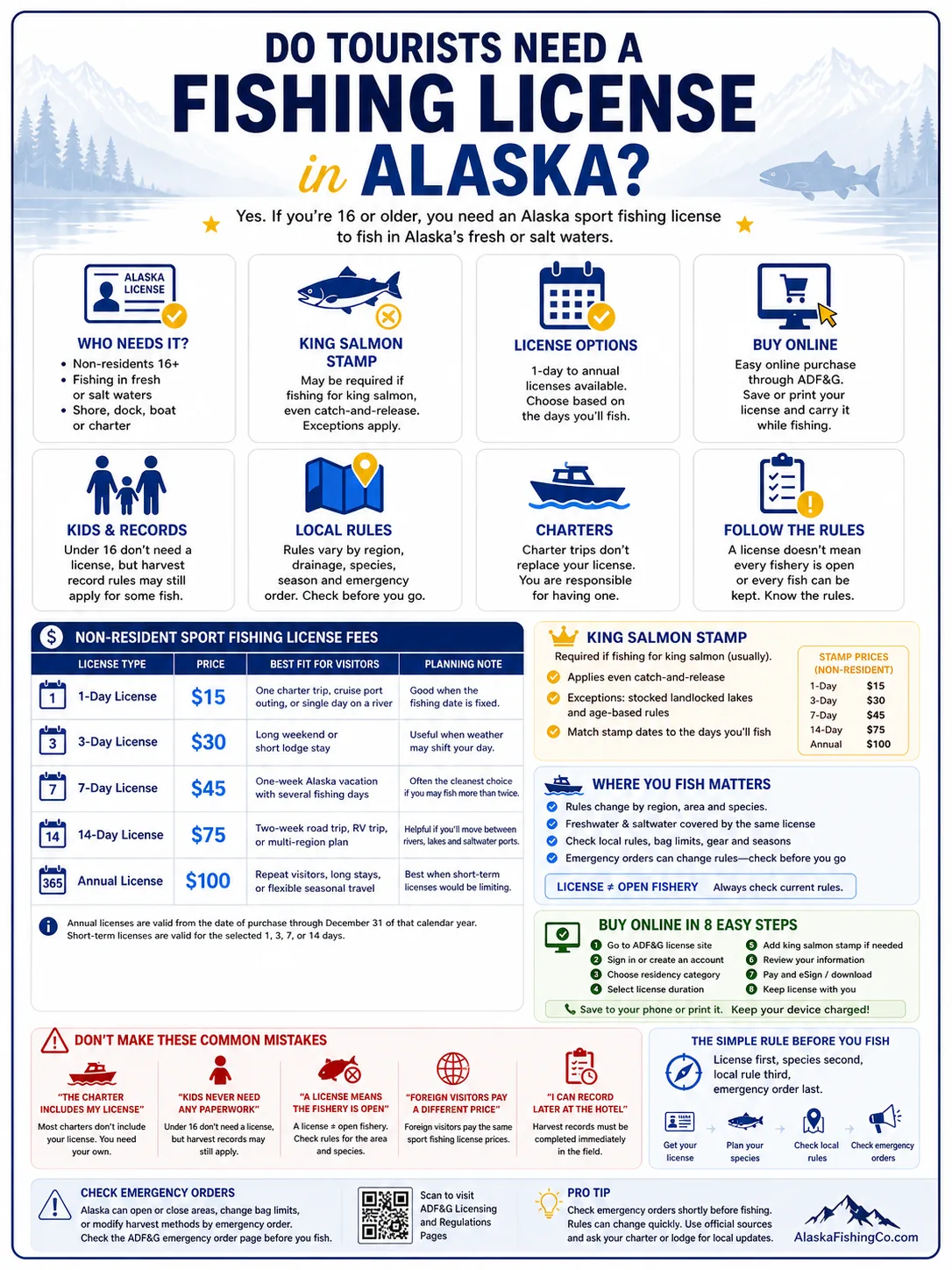
Tourists need an Alaska sport fishing license if they are 16 or older and plan to fish in Alaska’s fresh or salt waters. This applies whether the trip is from shore, from a public dock, on a private boat, or with a charter captain. A king salmon stamp may also be needed if the tourist plans to fish for king salmon, except for stocked landlocked lakes and age-based exceptions. [a]
For most visitors, the rule is simple: buy the right non-resident sport fishing license before the first cast, keep it with you, and check the local regulations for the exact place and species you plan to fish.
If you remember one thing… a license lets you fish legally, but it does not automatically mean every fishery is open, every species can be kept, or every salmon can be harvested without another stamp or record card.
What To Know First
- Non-resident tourists age 16 and older need an Alaska sport fishing license.
- Children who are non-residents and under 16 do not need a sport fishing license, but annual-limit harvest record rules can still matter.
- Foreign visitors can buy Alaska non-resident fishing licenses online in most cases.
- King salmon fishing may require a separate king salmon stamp.
- Charter boats do not usually replace the visitor’s own license requirement.
- Alaska fishing rules vary by region, drainage, species, season, and emergency order.
The Short Answer for Tourists
Yes. A tourist who is 16 or older needs an Alaska sport fishing license to fish in Alaska. This includes non-residents from other U.S. states and many international visitors.
The license requirement covers sport fishing in both freshwater and saltwater. That means rivers, lakes, streams, bays, inlets, and marine waters can all fall under the same basic license rule. The exact bag limits, gear rules, and open seasons are separate from the license itself.
- Fishing from shore still counts as fishing.
- Fishing from a charter boat still counts as fishing.
- Catch-and-release fishing still counts as fishing.
- Keeping fish may trigger harvest record rules for some species.
A person who is only riding along, taking photos, or watching without fishing does not usually need a sport fishing license just for being on the boat. Once that person casts, reels, actively fishes, or takes part as an angler, the license rule matters.
Who Counts as a Tourist or Non-Resident?
Most visitors count as non-residents for Alaska sport fishing. A short vacation, seasonal trip, cruise stop, lodge stay, or charter booking does not make someone an Alaska resident.
Alaska residency for licensing is tied to domicile, intent to remain, and a 12-month residency standard. A visitor from California, Texas, Germany, Japan, Canada, the United Kingdom, or another place should usually expect to buy a non-resident license unless they clearly qualify under Alaska’s own residency rules. ADF&G also defines a nonresident alien category for people who are not U.S. citizens and have not lived in Alaska for the preceding 12 consecutive months. [d]
- Out-of-state U.S. visitor: usually buys a non-resident sport fishing license.
- Foreign visitor: usually buys under the non-resident or nonresident alien category shown by ADF&G.
- Cruise passenger: still needs the license if fishing during a port stop.
- Lodge guest: still needs the license unless the person is under the non-resident age cutoff.
One practical detail: do not guess residency to save money. If the trip is temporary and your home is outside Alaska, the non-resident route is the safer planning assumption.
License Options and Current Non-Resident Fees
Tourists can choose short-term or annual non-resident sport fishing licenses. The right choice depends on how many days you will actually fish, not how long you will be in Alaska.
ADF&G lists non-resident sport fishing license prices by duration, with the same sport fishing prices shown for the foreign/alien nonresident entries. Current listed prices include 1-day, 3-day, 7-day, 14-day, and annual options. [b]
| License Type | Current Non-Resident Price | Best Fit for Visitors | Planning Note |
|---|---|---|---|
| 1-Day Sport Fishing License | $15 | One charter trip, cruise port outing, or single day on a river | Good when the fishing date is fixed. |
| 3-Day Sport Fishing License | $30 | Long weekend or short lodge stay | Useful when weather may shift your fishing day. |
| 7-Day Sport Fishing License | $45 | One-week Alaska vacation with several fishing days | Often the cleanest choice for tourists who may fish more than twice. |
| 14-Day Sport Fishing License | $75 | Two-week road trip, RV trip, or multi-region fishing plan | Helpful if you will move between rivers, lakes, and saltwater ports. |
| Annual Sport Fishing License | $100 | Repeat visitors, long stays, or flexible seasonal travel | Best when short-term license dates would be limiting. |
Annual licenses are not the same as a rolling 365-day visitor pass. ADF&G states that most licenses are valid from the date of purchase through December 31 of that calendar year, while short-term non-resident fishing licenses are valid for the selected 1, 3, 7, or 14 days. [c]
- Buy a license for the days you will fish, not just the days you will travel.
- Leave room for weather delays if fishing from a remote lodge or charter port.
- Choose the annual license if several short licenses would cost about the same.
Worth Noting
A license fee is only one part of the trip budget. If king salmon, guided halibut, remote access, fish processing, or shipping is part of the plan, ask about those items before buying the shortest license available.
King Salmon Stamp, Harvest Records, and Species Rules
A sport fishing license is the base requirement. Some species and fisheries add another step, especially king salmon and fish with annual limits.
Tourists who plan to fish for king salmon usually need a king salmon stamp in addition to their sport fishing license. This can apply even when the plan is catch-and-release, because the rule is tied to fishing for king salmon, not only keeping one. The main exception is king salmon in stocked landlocked lakes, and age-based exceptions also apply.
- King salmon: may require a king salmon stamp.
- Species with annual limits: may require immediate harvest recording after landing a fish.
- Rainbow trout and some salmon fisheries: can have annual-limit record rules depending on the area.
- Halibut: may involve additional charter rules when fishing on a guided vessel.
A harvest record is not the same thing as a license. It is a record used when certain annual-limit species are landed. For visitors with children, this point matters because a non-resident child under 16 may not need a sport fishing license, yet may still need to record harvest for species with annual limits.
King Salmon Stamp Prices for Non-Residents
Non-resident king salmon stamp options usually mirror the short-term license durations: 1-day, 3-day, 7-day, 14-day, and annual. A tourist fishing for king salmon should match the stamp dates to the fishing dates, not simply to the travel dates.
- 1-day non-resident king salmon stamp: $15
- 3-day non-resident king salmon stamp: $30
- 7-day non-resident king salmon stamp: $45
- 14-day non-resident king salmon stamp: $75
- Annual non-resident king salmon stamp: $100
Freshwater, Saltwater, Charters, and Regional Differences
The Alaska sport fishing license requirement applies broadly, but local fishing rules are not one-size-fits-all. The place you fish can change what is open, what can be kept, the legal gear, and the daily or annual limits.
ADF&G directs anglers to check region-wide rules first, then the specific drainage or area they plan to fish. The agency also notes that emergency orders can override published regulations, which is why a license check alone is not enough before a fishing day. [f]
- Southeast Alaska: cruise ports, salmon charters, halibut trips, and marine waters often require careful species checks.
- Southcentral Alaska: Kenai Peninsula, Anchorage-area waters, Mat-Su streams, and Prince William Sound can have area-specific salmon and trout rules.
- Interior Alaska: rivers and lakes can involve different freshwater seasons, methods, and limits.
- Southwest and remote areas: lodges may fish several drainages with different regulations during one trip.
Charter captains and lodge staff can help explain local rules, but the license belongs to the angler. Tourists should still know what license and stamps they have, where the license is stored, and whether a fish must be recorded immediately.
What About Guided Halibut Trips?
Tourists still need the normal Alaska sport fishing license when they fish for halibut. For guided charter halibut in some Alaska areas, federal rules can also affect daily bag limits, size rules, closed retention days, and charter halibut stamp validation. NOAA explains that charter halibut stamps apply to charter vessel anglers age 18 or older who intend to catch and retain halibut in IPHC Areas 2C and 3A, with the stamp handled through the charter permit holder and guide process. [h]
- Ask the charter operator what license you must buy before arrival.
- Ask whether king salmon or halibut retention is part of the booked trip.
- Ask whether any additional stamp or logbook step will be handled on the boat.
- Check the trip date, because halibut charter rules can change by area and year.
One Detail People Miss
A license does not freeze the rules for your trip. Alaska can change fishing rules by emergency order, sometimes close to the date you plan to fish.
How Tourists Can Buy an Alaska Fishing License Online
Tourists can usually buy an Alaska sport fishing license online before the trip. This is often easier than waiting until arrival, especially if the first fishing day starts early or the group is heading straight to a boat, lodge, or remote area.
ADF&G explains that online and eSigned license formats can be saved to a mobile device or printed, but the license must be signed or eSigned and in the license holder’s possession before fishing. The person holding the license is also responsible for keeping a mobile device charged if using an electronic version. [e]
Basic Online Buying Steps
- Go to the official ADF&G license purchasing area.
- Create or sign in to an ADF&G account if needed.
- Choose the correct residency category, such as non-resident or nonresident alien when shown.
- Select the sport fishing license duration that matches your fishing dates.
- Add a king salmon stamp if you plan to fish for king salmon and do not qualify for an exception.
- Review the name, date of birth, license dates, and email address before paying.
- Download, save, print, or eSign the license as allowed.
- Keep the license with you while fishing.
For families or groups, each person who needs a license should have their own license. A parent, friend, guide, or booking organizer should not assume one license covers the group.
Common Mistakes Tourists Make
The most common errors are not complicated. They usually happen when visitors buy too late, buy the wrong duration, forget the king salmon stamp, or assume a charter booking handles every legal requirement.
Wrong Idea: “The Charter Includes My License”
Correct explanation: Many charters remind guests to buy a license, but the angler usually needs their own Alaska sport fishing license.
Why it gets mixed up: Charter trips often include rods, bait, fish cleaning, and local guidance, so visitors may assume legal paperwork is also included.
Wrong Idea: “Kids Never Need Any Paperwork”
Correct explanation: Non-resident anglers under 16 do not need a sport fishing license, but harvest record rules can still apply for annual-limit species.
Why it gets mixed up: “No license required” sounds like “no rules apply,” but those are not the same thing.
Wrong Idea: “A License Means the Fishery Is Open”
Correct explanation: A license only gives the person permission to sport fish when the fishery is open and the angler follows local rules.
Why it gets mixed up: Visitors often buy the license first and check the exact river, saltwater area, or species rule later.
Wrong Idea: “Foreign Visitors Pay a Different Sport Fishing Price”
Correct explanation: ADF&G’s listed nonresident sport fishing fees for foreign/alien entries match the main nonresident sport fishing license fees for the standard 1-day, 3-day, 7-day, 14-day, and annual options.
Why it gets mixed up: Hunting categories can be more complex, and travelers sometimes carry that confusion into sport fishing.
Wrong Idea: “I Can Record My Harvest Later at the Hotel”
Correct explanation: When harvest recording is required, the catch must be recorded right away in the field.
Why it gets mixed up: Visitors treat the harvest record like a travel diary instead of a legal field record.
Before You Move On
The safest routine is license first, species plan second, local regulation check third, emergency order check last. That order catches most tourist mistakes before they become a problem.
Real-Life Scenarios for Alaska Visitors
Most tourist license questions become easier when matched to a real trip style. These examples show how the rule works in common Alaska travel plans.
- Cruise passenger in Juneau booking a half-day salmon charter: If the passenger is 16 or older, they need a non-resident sport fishing license, and a king salmon stamp may be needed if targeting king salmon.
- Family staying near the Kenai River with a 14-year-old and two adults: The adults need non-resident sport fishing licenses; the 14-year-old does not need the license but may need a harvest record for annual-limit fish.
- Visitor fishing one day in Seward for halibut: The visitor needs a sport fishing license, and the charter operator should explain any guided halibut rules or stamp validation tied to the trip.
- International traveler staying at a remote lodge for six fishing days: A 7-day non-resident license may fit better than several 1-day licenses, especially when weather can shift the schedule.
- Road trip traveler fishing rivers in multiple regions: One license can cover sport fishing, but the traveler still needs to check each region and drainage before fishing.
- Tourist planning catch-and-release king salmon fishing: A king salmon stamp may still be required because the rule can apply to fishing for king salmon, not only keeping one.
- Friend riding along on a charter but not fishing: A non-fishing observer generally does not need a sport fishing license, but they should not take part as an angler.
- Repeat visitor returning later in the same year: An annual non-resident license may be easier if multiple short trips fall within the same calendar year.
Check Emergency Orders Before Fishing
Tourists should check emergency orders shortly before fishing, not only when booking the trip. Alaska can open or close areas, change bag limits, or modify harvest methods by emergency order.
ADF&G says sport fishing emergency orders may open or close seasons or areas, increase or reduce bag limits, and change allowed harvest methods. The agency also states that the emergency order site is updated often and anglers should check it before going fishing. [g]
- Check the emergency order page for your region.
- Search by the exact river, bay, port, or drainage when possible.
- Ask the charter or lodge whether any recent order affects the trip.
- Do not rely on old screenshots, older blog posts, or last year’s rules.
This is especially useful for salmon trips, where run strength, conservation needs, and local conditions can change what anglers are allowed to keep.
The Simple Rule Before You Fish
Tourists age 16 and older should have an Alaska non-resident sport fishing license before fishing, and they should add the right stamp or record step when the species requires it. Local rules can change by region, drainage, saltwater area, date, and emergency order.
The most common mistake is assuming a paid trip, a child’s age, or a printed license answers every legal question. A useful rule is: license first, species second, local rule third, emergency order last.
Tourist Fishing License Questions Answered
Do tourists need a fishing license in Alaska?
Yes. Tourists who are non-residents and age 16 or older need an Alaska sport fishing license to fish in Alaska’s fresh or salt waters.
Can foreign visitors buy an Alaska fishing license online?
Yes, foreign visitors can usually buy an Alaska non-resident sport fishing license online through ADF&G. They should choose the correct non-resident or nonresident alien category when purchasing.
Do kids visiting Alaska need a fishing license?
Non-resident anglers under 16 do not need an Alaska sport fishing license. Harvest record rules can still apply when they land species with annual limits.
Does an Alaska fishing charter include the license?
Not usually. A charter may remind guests where to buy a license, but each angler who needs a license is normally responsible for having one before fishing.
Do tourists need a king salmon stamp in Alaska?
Tourists generally need a king salmon stamp if they are required to have a sport fishing license and plan to fish for king salmon. Exceptions can apply, including stocked landlocked lakes and certain age-based rules.
How long is an Alaska non-resident fishing license valid?
Short-term non-resident sport fishing licenses are available for 1, 3, 7, or 14 days. Annual licenses are generally valid from the date of purchase through December 31 of that calendar year.
Can a tourist fish in both freshwater and saltwater with the same Alaska sport fishing license?
Yes. The Alaska sport fishing license covers sport fishing in fresh and salt waters, but local species rules, area rules, stamps, and emergency orders still apply.
Should tourists check regulations after buying a license?
Yes. Buying a license is only the first step. Tourists should check the current rules for the region, drainage, species, and any emergency order before fishing.
Alaska Fishing References
- [a] Alaska Department of Fish and Game — Sport Fishing Licenses and King Salmon Stamps — Used for the tourist license requirement, fresh and marine waters rule, king salmon stamp basics, and harvest record context. (Official Alaska state fish and wildlife agency.)
- [b] Alaska Department of Fish and Game — License, Stamp, and Tag Pricing List — Used for current non-resident sport fishing license fees and king salmon stamp prices. (Official state pricing page.)
- [c] Alaska Department of Fish and Game — General License Information — Used for license validity, age requirements, online availability, and harvest record explanation. (Official state licensing guidance.)
- [d] Alaska Department of Fish and Game — Residency: Sport Fishing Licenses and King Salmon Stamps — Used for resident, nonresident, and nonresident alien definitions. (Official state residency definition page.)
- [e] Alaska Department of Fish and Game — Purchasing Your License Online and eSigning Your License FAQs — Used for online purchase, eSigned license, printing, and carrying license details. (Official state online licensing FAQ.)
- [f] Alaska Department of Fish and Game — Sport Fishing Regulations — Used for region, drainage, and emergency order planning guidance. (Official Alaska sport fishing regulations hub.)
- [g] Alaska Department of Fish and Game — Emergency Orders and Press Releases, Sport Fish — Used for emergency order meaning and why anglers should check current changes before fishing. (Official state emergency order page.)
- [h] NOAA Fisheries — Charter Halibut Stamp Program FAQ and Small Entity Compliance Guide — Used for guided halibut charter stamp validation details in IPHC Areas 2C and 3A. (Federal fisheries regulator guidance.)