
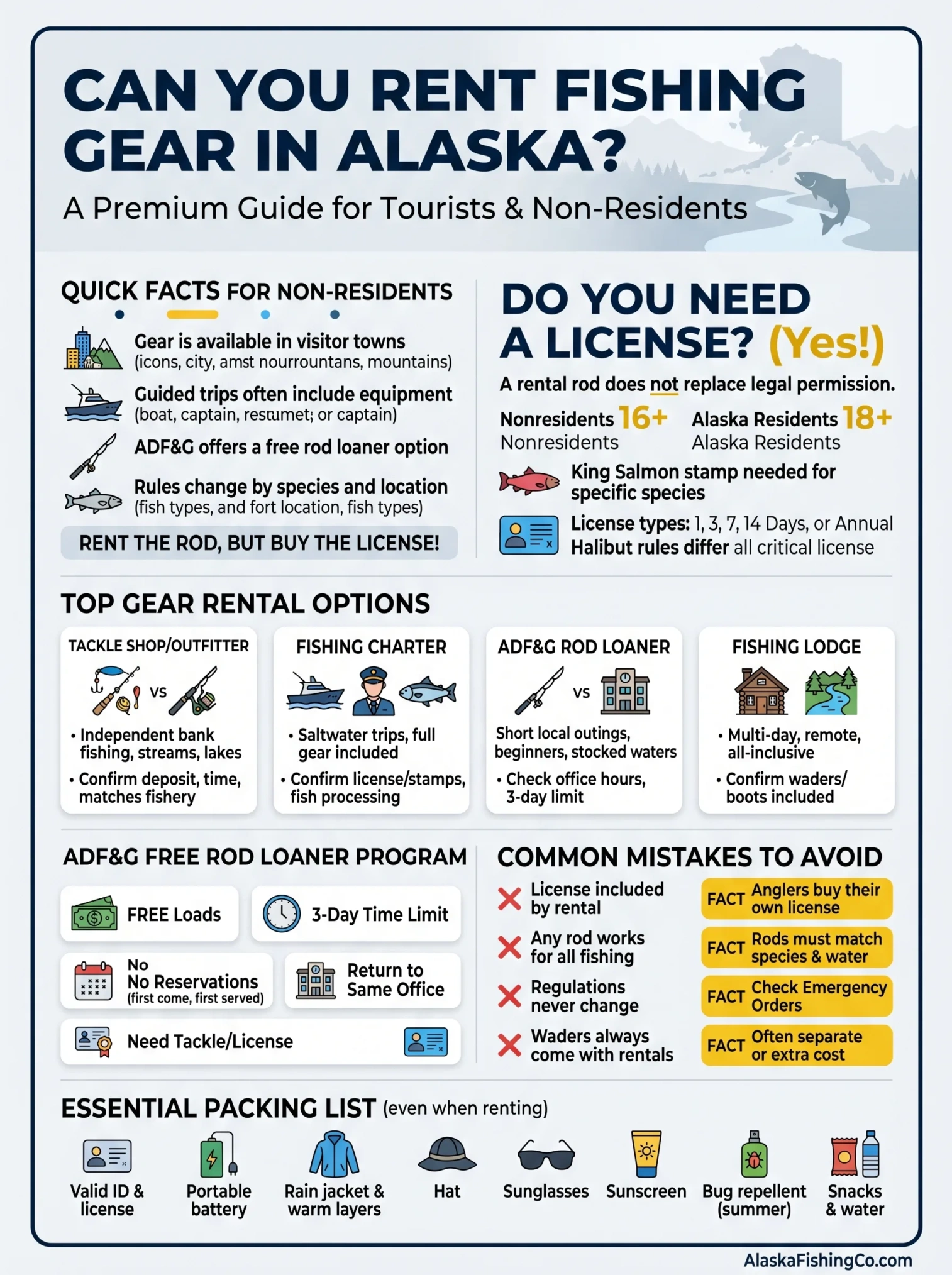
Yes, you can rent fishing gear in Alaska, and in some places you can even borrow rods free of charge. The easiest options are local tackle shops, outdoor outfitters, charter boats, fishing lodges, and the Alaska Department of Fish and Game Rod Loaner Program.
For most visitors, renting gear makes more sense than flying with rods, reels, waders, tackle boxes, and fish-processing gear. The main thing to understand is simple: gear rental does not replace your fishing license. If you are required to have an Alaska sport fishing license, you still need one before you cast, even if the rod came from a guide, shop, lodge, or public loaner program.[a]
If you remember one thing… rent or borrow the rod, but buy the license, check the local rules, and ask whether the gear matches the species and water you plan to fish.
What To Know First
- Gear is available in many visitor areas: Anchorage, Homer, Soldotna, Seward, Fairbanks, Juneau, and other fishing towns usually have some mix of rental shops, guide services, or charters.
- Guided trips often include gear: Many salmon, halibut, trout, and fly-fishing charters provide rods, reels, bait, and basic tackle, but you should confirm before booking.
- ADF&G has a free rod loaner option: Some Alaska Department of Fish and Game offices lend fishing rods, with rules on time limits and availability.[b]
- You may still need extra items: Waders, rain gear, boots, dip nets, coolers, fish boxes, and vacuum packing are usually separate from basic rod rental.
- Rules change by place and species: Salmon, trout, halibut, rockfish, and stocked lake fishing may all require different tackle and different regulation checks.
Can Tourists Rent Fishing Gear in Alaska?
Tourists can rent fishing gear in Alaska, especially in areas built around visitor fishing. Rental access is easiest near road-system towns, public salmon streams, popular stocked lakes, and charter ports.
In Anchorage, for example, visitors can fish Ship Creek close to downtown, and Travel Alaska notes that downtown outfitters offer rental fishing equipment, including waders for muddy bank fishing.[c] Homer, Soldotna, Seward, Cooper Landing, Juneau, and Fairbanks also have fishing businesses that may rent, lend, sell, or include equipment with a guided trip.
- Best for simple bank fishing: spinning rod, reel, line, terminal tackle, and possibly hip or chest waders.
- Best for charter fishing: use the charter’s gear unless the operator tells you to bring your own.
- Best for fly fishing: ask for the right rod weight, line type, flies, and wading setup for the river and season.
- Best for stocked lakes: light spinning gear is often enough for rainbow trout, Arctic char, or landlocked salmon, depending on the lake.
Availability is not the same everywhere. A shop in Anchorage may have waders and salmon rods ready in summer, while a small community may have only limited tackle for sale. Remote lodges may provide gear as part of the package, but independent travelers in rural areas should not assume rental gear will be easy to find.
Where Can You Rent or Borrow Fishing Gear?
The most common places to get fishing gear in Alaska are tackle shops, outdoor outfitters, charter companies, lodges, and ADF&G rod loaner offices. Each option works a little differently.
If you are fishing for one afternoon near town, a local outfitter or free rod loaner may be enough. If you are fishing saltwater for halibut, lingcod, or rockfish, a charter is usually the simpler choice because offshore rods, heavy reels, bait, boat access, and fish handling are part of the trip.
| Gear Option | Best For | Usually Included | What To Confirm |
|---|---|---|---|
| Tackle Shop or Outdoor Outfitter | Independent bank fishing, local salmon streams, stocked lakes | Rod, reel, sometimes waders or basic tackle | Deposit, return time, tackle cost, and whether the setup matches the local fishery |
| Fishing Charter | Halibut, salmon trolling, rockfish, lingcod, saltwater trips | Boat, captain, rods, reels, bait, tackle, fish handling basics | License, king salmon stamp if needed, halibut rules, fish processing, and gratuity expectations |
| Fishing Lodge | Multi-day trips, remote rivers, fly-out fishing, all-inclusive stays | Often rods, reels, flies or tackle, guides, boats, and fish care | Whether waders, boots, rain gear, and flies are included or rented separately |
| ADF&G Rod Loaner Program | Short local outings, families, beginners, stocked waters | Borrowed rods at participating offices | Office hours, no reservations, three-day return limit, tackle needed, and license rules |
| Hotel, Campground, or Local Host | Casual fishing near visitor lodging | Sometimes basic rods or local advice | Condition of gear, legal tackle, and whether the water is open to fishing |
Worth Noting
In Alaska, the right gear depends heavily on where you fish. A light trout rod that works on a stocked lake is not the right tool for halibut, fast salmon water, or surf casting near a tidal area.
How the ADF&G Rod Loaner Program Works
The Alaska Department of Fish and Game offers a free rod loaner program at participating offices. It is a good option for visitors who want to try local sport fishing without buying or packing a rod.
ADF&G says many of its offices have fishing rods to lend, and the type of rods available depends on local fishing opportunities and conditions. Borrowers still need the required Alaska sport fishing license if they are old enough, plus terminal tackle such as hooks, lures, weights, or bait where legal.[d]
- Cost: The rod loaner program is free, but it is not a full tackle package.
- Time limit: Equipment must be returned after a maximum of three days.
- Reservations: ADF&G says equipment cannot be reserved.
- Return location: Gear must be returned to the same office during normal business hours.
- Limit: Borrowers may check out no more than three fishing rods at a time, with limited exceptions.
- Responsibility: Borrowers are responsible for knowing the regulations and emergency orders for the place they fish.
This option is especially useful for families, first-time anglers, and visitors staying near a participating office. It is less useful for remote trips, late-night arrivals, or travelers who need specialized fly gear, saltwater rods, or waders.
Do You Need a Fishing License if You Rent Gear?
Yes, if Alaska law requires you to have a license, you need one even when the gear is rented, borrowed, or supplied by a charter. The rod does not carry the legal permission. The angler does.
ADF&G states that Alaska residents age 18 or older and nonresidents age 16 or older must purchase and possess a sport fishing license to participate in Alaska sport and personal use fisheries. A king salmon stamp is also required to fish for king salmon, except in stocked lakes and for certain exempt groups.[e]
- Nonresident adults: Need an Alaska sport fishing license from age 16 and older.
- Foreign visitors: Usually treated as nonresidents or nonresident aliens for license purposes.
- Children visiting Alaska: Nonresidents under 16 do not need a sport fishing license, but harvest record rules can still apply for species with annual limits.
- King salmon: If you plan to fish for king salmon, check whether a king salmon stamp is needed for your age, residency status, and location.
- Halibut: Halibut rules are different from many state-managed fisheries, especially on guided charter trips.
Short-term nonresident licenses are built for visitors. ADF&G lists 1-day, 3-day, 7-day, 14-day, and annual sport fishing license options for nonresidents, with separate king salmon stamp prices when needed.[f]
What Fishing Gear Can You Usually Rent?
Visitors can usually find basic freshwater spinning gear, salmon rods, fly-fishing setups, waders, and sometimes ice-fishing gear in the right season and location. Saltwater gear is more often included through a charter rather than rented as a stand-alone item.
Do not rent by asking only for “a fishing rod.” Ask for the fishery. A good local shop or guide will want to know whether you are fishing for stocked trout, coho salmon, king salmon, grayling, Dolly Varden, halibut, or something else.
- Spinning rods: Common for salmon streams, stocked lakes, and beginner-friendly fishing.
- Fly rods: Often available through fly shops or guides near rivers such as the Kenai, Russian, Chena, or streams in Southeast Alaska.
- Waders and boots: Useful for bank fishing, but sizes can run out during busy salmon periods.
- Ice-fishing rods: Seasonal and mostly useful in winter or early spring where safe ice conditions exist.
- Heavy saltwater rods: Usually supplied on halibut or multi-species charters.
- Terminal tackle: Hooks, lures, sinkers, flies, bait, leaders, and swivels may be sold separately or replaced if lost.
One Detail People Miss
Rental rods are often only part of the setup. Ask whether the price includes line, leader, hooks, lures, bait, waders, landing net, stringer, fish bag, and local advice on legal fishing methods.
What About Charters and Guided Trips?
Most fishing charters and guided trips in Alaska provide the main fishing gear, but the exact list depends on the operator. A halibut charter from Homer or Seward is not the same as a half-day fly-fishing trip on a river.
ADF&G recognizes guides, lodges, and charter operators as part of Alaska’s visitor fishing experience, and businesses providing sport fishing services must follow registration rules before offering guided sport fishing services in the state.[g]
- Saltwater charters: Usually provide rods, reels, bait, tackle, boat, safety equipment, and crew help.
- River guides: Often provide rods, flies or lures, boat or raft access, and instruction.
- Fly-out lodges: May provide specialized fly rods, waders, boots, flies, rain gear, and fish handling, but this varies by lodge.
- Self-guided lodge stays: May include boats and basic gear, but visitors should ask exactly what is included.
Before booking, ask the operator four direct questions: “Is gear included?”, “Do I need to bring waders?”, “What license or stamp do I need?”, and “Are there any species or day restrictions during my trip dates?”
Species-Based Gear and Rule Differences
The fish you target decides the gear, and in Alaska it can also change the legal details. Salmon, trout, grayling, rockfish, and halibut are not handled with one universal setup.
ADF&G tells anglers to check the area they plan to fish, then check the drainage or water-specific rules. Emergency orders can override printed regulations, so a rental shop’s advice should be paired with the current official regulation check before fishing.[h]
- Salmon: Ask whether the rented setup is for king, sockeye, coho, pink, or chum salmon. Gear strength and legal methods can vary by water.
- King salmon: May require a king salmon stamp, and some waters have tight seasonal limits or closures.
- Trout and grayling: Often use lighter spinning or fly gear. Some areas have catch-and-release rules, artificial lure restrictions, or special size limits.
- Halibut: Usually requires heavy saltwater gear and careful attention to charter rules, especially in Southeast and Southcentral Alaska.
- Rockfish: Needs proper release gear and local rule checks. Some areas have special conservation practices.
- Stocked lakes: Often the simplest choice for beginners using borrowed or rented light gear.
NOAA Fisheries notes that guided sport halibut regulations in Alaska are set annually through the North Pacific Fishery Management Council and International Pacific Halibut Commission process, then published through federal management measures. That is why charter halibut rules can change from year to year and differ from unguided fishing rules.[i]
Regional Differences Visitors Should Expect
Fishing gear rental is easiest where visitor fishing is common. Southcentral Alaska and the Kenai Peninsula usually offer the most straightforward mix of shops, charters, public access, and guided options.
In Southeast Alaska, many visitors fish through charter boats in places such as Juneau, Sitka, Ketchikan, and Petersburg. In Interior Alaska, gear choices may lean toward stocked lakes, Arctic grayling, northern pike in some areas, and seasonal river fishing. In remote Western or Arctic communities, gear rental may be limited or tied to lodges, local guides, or pre-arranged trips.
- Anchorage: Good for short visitor fishing, Ship Creek, stocked lakes, outfitters, and ADF&G resources.
- Kenai Peninsula: Strong choice for salmon, trout, halibut, charters, lodges, and river guides.
- Homer and Seward: Better for saltwater charters than casual stand-alone rod rental.
- Fairbanks: Better for stocked lakes, Interior rivers, grayling, and seasonal family fishing.
- Juneau and Southeast towns: Good charter access, salmon opportunities, and some local rental or outfitter support.
- Remote destinations: Arrange gear before arrival unless your lodge or guide clearly includes it.
Before You Move On
If a trip depends on rented waders or a specific rod type, reserve through a private outfitter where reservations are offered. Public rod loaner gear cannot be reserved through ADF&G.
How To Rent Fishing Gear in Alaska Step by Step
The best way to rent fishing gear in Alaska is to decide where and what you plan to fish first, then match the gear, license, and rules to that plan.
Visitors often make the process harder by starting with a rod. Start with the water. A stocked lake, salmon creek, glacial river, tidal lagoon, and offshore halibut ground all require different equipment and different judgment.
- Choose your fishing area: Pick the town, river, lake, beach, or charter port before asking for gear.
- Choose the species: Say whether you want salmon, trout, grayling, halibut, rockfish, or casual catch-and-release fishing.
- Check the license need: Buy the right Alaska sport fishing license before fishing if your age and residency status require it.
- Ask about stamps or records: King salmon stamps and harvest records can matter even when someone else provides the gear.
- Call the rental source: Ask what is included, what is extra, and whether sizes are available for waders and boots.
- Check current regulations: Review the region, water, species, and emergency orders before your fishing day.
- Inspect the gear: Look at line condition, reel drag, rod guides, wader seams, boot soles, and the tackle supplied.
- Confirm return rules: Ask about return time, deposit, damage fees, cleaning expectations, and after-hours returns.
Common Mistakes When Renting Fishing Gear in Alaska
The biggest mistakes are assuming the gear includes the legal permission to fish, renting the wrong setup, or skipping current rule checks. These errors are easy to avoid with a few direct questions.
Mistake: “The Charter or Rental Shop Covers My License”
Correct explanation: Most visitors who are 16 or older still need their own Alaska sport fishing license. A charter may help you understand what to buy, but the license belongs to the angler.
Why people mix it up: Some charters provide almost everything else, so visitors assume the license is bundled too.
Mistake: “Any Rod Will Work in Alaska”
Correct explanation: A trout rod, salmon rod, fly rod, and halibut rod are different tools. The wrong rod can make fishing harder, damage gear, or create unsafe handling problems.
Why people mix it up: Visitors often picture fishing as one activity, while Alaska fishing changes sharply by water and species.
Mistake: “Printed Regulations Are Enough”
Correct explanation: Emergency orders can open, close, or change sport fishing seasons, areas, bag limits, and methods. ADF&G says emergency orders have the same force and effect as law and should be checked before fishing.[j]
Why people mix it up: People rent gear after reading an older booklet or blog post and do not realize local rules can change during the season.
Mistake: “Waders Are Always Included”
Correct explanation: Many rentals are rod-and-reel only. Waders, boots, and rain gear may cost extra or may not be available in your size.
Why people mix it up: Photos of Alaska fishing often show anglers standing in rivers, but bank fishing gear and wading gear are often rented separately.
Mistake: “A Free Loaner Rod Means a Full Free Fishing Kit”
Correct explanation: ADF&G’s program lends rods, but borrowers still need terminal tackle, proper clothing, the correct license if required, and knowledge of current regulations.
Why people mix it up: The word “loaner” sounds like a complete kit, but the program is mainly about access to rods.
Real-Life Scenarios for Alaska Visitors
Most rental decisions become clear when you match the visitor plan to the gear source. These examples show how the choice usually works.
- A family staying in Anchorage wants to fish a stocked lake for two hours.
Borrowing or renting light spinning rods may be enough, but adults need to check license rules before fishing. - A traveler lands in Anchorage and wants to try Ship Creek.
A downtown outfitter may be the easiest source for a rod and waders, especially when the banks are muddy. - A couple books a halibut charter from Homer.
The charter will usually provide heavy saltwater gear, but each angler should confirm license needs, fish-processing costs, and current halibut rules. - A visitor wants to fly fish for trout near Cooper Landing.
A guide or fly shop is better than a generic rental because rod weight, flies, waders, and local river conditions matter. - A cruise passenger has four hours in Juneau.
A short charter or pre-arranged outfitter is safer than trying to find gear after arrival, because port time is limited. - A backpacker is heading to a remote lake.
Renting in town before departure or bringing travel gear is safer than assuming rental gear will exist near the trailhead. - A winter visitor in Fairbanks wants to try ice fishing.
Seasonal loaner or rental gear may work, but safe ice, local conditions, and proper clothing matter as much as the rod. - A parent wants a child to try salmon fishing.
Ask for age-appropriate gear and check whether harvest record rules apply, even if the child does not need a sport fishing license.
Worth Noting
For first-time visitors, a guided half-day trip can be cheaper than buying the wrong gear, losing tackle, missing the legal access point, and spending a day guessing where to fish.
Should You Rent, Borrow, Buy, or Bring Your Own Gear?
Renting is usually best for short trips, city-based fishing, and visitors who do not fish Alaska often. Bringing your own gear makes sense if you already own travel rods, waders, reels, and tackle suited to your exact destination.
Buying cheap gear after arrival can work for simple stocked lake fishing, but it may not be cheaper once you add line, lures, leaders, pliers, waders, fish storage, and airline baggage limits. For saltwater trips, use the charter’s gear unless the operator has a clear reason for you to bring your own.
- Rent or borrow: Best for one-day fishing, family outings, stocked lakes, and casual salmon attempts near town.
- Book a guided trip: Best for halibut, remote rivers, fly fishing, first salmon trips, or high-value travel days.
- Bring your own: Best for experienced anglers who know the fishery and trust their gear.
- Buy locally: Best when you will fish several days and want advice from a local tackle shop.
What To Ask Before Paying for Fishing Gear Rental
Before renting, ask direct questions. A five-minute conversation can prevent a wasted fishing day.
- Is this rod set up for the species I plan to fish?
- Does the rental include line, leader, hooks, lures, flies, bait, or weights?
- Are waders and boots available, and are they included in the price?
- Do I need a deposit or credit card hold?
- What happens if a rod breaks or a reel fails?
- Can I use this gear in saltwater, freshwater, or both?
- Are there any local closures, emergency orders, or gear restrictions today?
- Where can I legally access the water without crossing private property?
- Do I need a king salmon stamp or harvest record card?
- How and when do I return the gear?
What Visitors Should Pack Even When Renting Gear
Even if the rod is handled, visitors should bring clothing and personal items that match Alaska’s weather. Rain, wind, cold water, mud, and changing tides can make a simple fishing day uncomfortable if you pack too lightly.
- Valid photo ID and fishing license access on your phone or paper copy
- Portable battery if you carry an electronic license
- Rain jacket and warm layer
- Hat, sunglasses, and sunscreen
- Waterproof bag or dry pouch
- Bug repellent in summer
- Snacks and water
- Cooler plan if you expect to keep fish
- Gloves for cold weather or fish handling
- Phone number for the rental shop, guide, or ADF&G office
ADF&G allows several license formats, including electronic and eSigned options, but a license must be signed or electronically signed and in the angler’s possession before fishing. If your phone dies on the riverbank, that can become a problem, so many visitors carry a printed copy as a backup.
Gear Rental and Fish Processing
Gear rental usually does not include fish processing. If you plan to keep salmon, halibut, trout, or rockfish where legal, ask how the fish will be cleaned, packed, frozen, and transported.
Charters often help with basic fish handling and can point you toward processors. Independent bank anglers need a plan for legal harvest, cleaning areas, coolers, ice, transport, and airline rules. Do not keep fish just because you caught them. Keep fish only if the regulations allow it and you can care for the meat properly.
- Ask before the trip: Is filleting included or extra?
- Check bag limits: Your legal limit depends on species, area, date, and sometimes guided versus unguided status.
- Plan cold storage: Summer fish spoil quickly without ice or refrigeration.
- Know transport rules: Processed fish should be labeled and packed correctly for travel.
Gear Rental Questions Answered
Can you rent fishing rods in Alaska?
Yes. Fishing rods can be rented from some outfitters, tackle shops, lodges, and guides. Some ADF&G offices also lend rods free through the Rod Loaner Program, but gear cannot be reserved and must be returned under program rules.
Do Alaska fishing charters provide gear?
Most Alaska fishing charters provide rods, reels, bait, and tackle for the trip. Always confirm what is included before booking, especially for waders, rain gear, fish processing, and license guidance.
Do tourists need a fishing license if they rent gear in Alaska?
Yes, if they meet Alaska’s license requirements. Nonresidents age 16 or older generally need an Alaska sport fishing license, even when using rented, borrowed, or charter-provided gear.
Can foreigners rent fishing gear in Alaska?
Yes. Foreign visitors can rent gear the same way other tourists can. For license purposes, they should expect to buy the correct nonresident or nonresident alien fishing license option unless an age-based exemption applies.
Can you borrow fishing gear for free in Alaska?
Yes, in some places. ADF&G’s Rod Loaner Program lends rods free of charge at participating offices. Borrowers still need terminal tackle, proper clothing, and any required fishing license or stamp.
Are waders included with fishing gear rental in Alaska?
Sometimes, but not always. Many rod rentals do not include waders or boots. Ask about size availability, cleaning rules, deposit, and whether waders are suitable for the specific river or shoreline you plan to fish.
Is it better to rent gear or book a fishing guide in Alaska?
For a simple stocked lake or easy bank-fishing trip, renting or borrowing gear can work well. For halibut, remote rivers, fly fishing, or a first salmon trip, a guide or charter is often easier because gear, access, and local know-how are bundled together.
Renting fishing gear in Alaska is a practical choice for many visitors, especially around major fishing towns and charter ports. The safest plan is to match the gear to the water, buy the right license, and check the current regulations before fishing.
The most common mistake is assuming rented gear means the legal details are handled for you. The simple rule is this: rent the equipment, but personally verify the license, stamp, species rule, and local opening before you cast.
Alaska Fishing References
- [a] Alaska Department of Fish and Game — General License Information — Explains license validity, formats, age rules, signatures, and harvest record basics. (Official Alaska state fish and wildlife agency.)
- [b] Alaska Department of Fish and Game — Rod Loaner Program — Details the free fishing rod loaner program, borrower responsibilities, time limits, and participating offices. (Official Alaska state fish and wildlife agency.)
- [c] Travel Alaska — One Week Fishing Trip on the Kenai Peninsula — Notes visitor fishing access, Anchorage outfitters, Ship Creek, and gear rental context for popular travel routes. (Official Alaska tourism information source.)
- [d] Alaska Department of Fish and Game — Rod Loaner Program Requirements — Used for the program rules on licenses, terminal tackle, three-day return limits, and no reservations. (Official Alaska state fish and wildlife agency.)
- [e] Alaska Department of Fish and Game — Sport Fishing Licenses, King Salmon Stamps, IDs, and Harvest Record Cards — Explains who needs a sport fishing license, king salmon stamp rules, and harvest record card requirements. (Official Alaska state fish and wildlife agency.)
- [f] Alaska Department of Fish and Game — Product Prices for Licenses, Stamps, and Tags — Lists current resident, nonresident, and nonresident alien sport fishing license and king salmon stamp prices. (Official Alaska state fish and wildlife agency.)
- [g] Alaska Department of Fish and Game — Sport Fish Business, Guide, and Vessel Registration — Explains registration requirements for guided sport fishing services, guides, businesses, and vessels. (Official Alaska state fish and wildlife agency.)
- [h] Alaska Department of Fish and Game — Sport Fishing Regulations — Provides regional sport fishing regulation access and notes that emergency orders supersede published regulations. (Official Alaska state fish and wildlife agency.)
- [i] NOAA Fisheries — Sport Halibut Fishing in Alaska — Explains guided sport halibut management and annual charter regulation context. (U.S. federal fisheries management agency.)
- [j] Alaska Department of Fish and Game — Sport Fishing Emergency Orders and Press Releases — Explains that emergency orders can change seasons, areas, bag limits, and methods and should be checked before fishing. (Official Alaska state fish and wildlife agency.)