
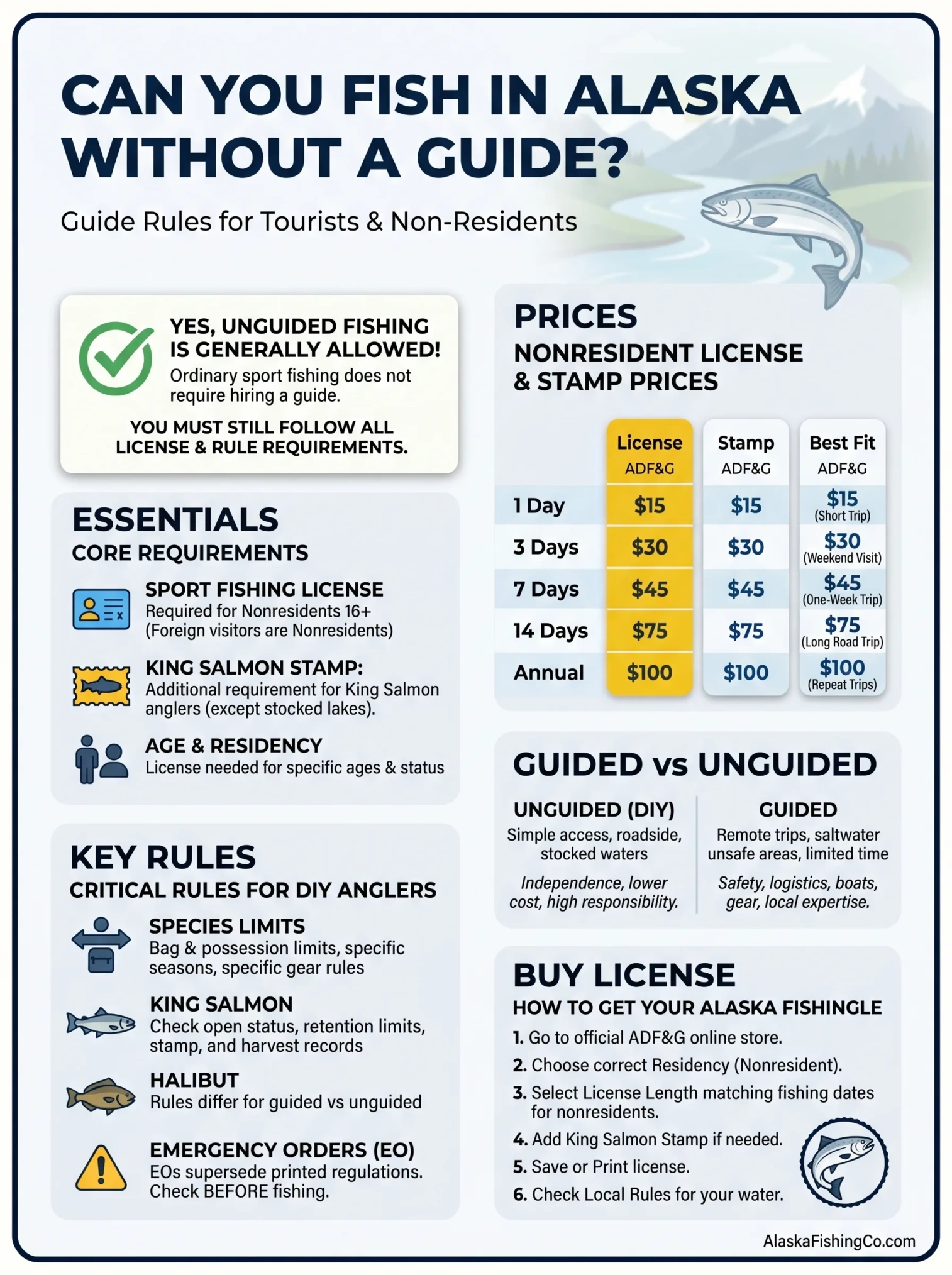
Yes, you can fish in Alaska without a guide. Most visitors can fish on their own in Alaska as long as they have the right sport fishing license, follow the rules for the exact water they are fishing, and buy any required stamp before targeting species such as king salmon.
A fishing guide is optional for ordinary sport fishing. A guide can help with local knowledge, boats, tides, remote rivers, bear safety, and gear, but Alaska does not make most tourists hire one just to cast a line.
If you remember one thing… unguided fishing is usually allowed, but an unguided angler still has to follow the same license, stamp, bag limit, possession limit, season, and emergency order rules as everyone else.
What To Know First
The basic answer is simple: you can usually fish without a guide in Alaska, but you cannot ignore Alaska fishing rules just because you are fishing alone.
- A guide is not normally required for sport fishing from shore, a public access area, a rental boat, or a privately arranged trip.
- Nonresidents age 16 or older need an Alaska sport fishing license.
- Alaska residents age 18 or older need an Alaska sport fishing license unless they qualify for a listed resident exemption.
- A king salmon stamp is required when fishing for king salmon, except for king salmon in stocked lakes.
- Foreign visitors are treated as nonresidents for Alaska sport fishing license purposes.
- Emergency orders can change the rule for a river, bay, species, method, or date after the printed regulation booklet is released.
The Short Legal Answer
You may fish in Alaska without a guide if the fishery is open and you personally meet the license and regulation requirements. The guide question and the license question are separate.
For most tourist trips, the real test is not “Do I have a guide?” It is “Am I legal for this exact place, date, species, and method?” Alaska Department of Fish and Game says residents age 18 or older and nonresidents age 16 or older must buy and possess a sport fishing license to participate in Alaska sport and personal use fisheries. The same page also states that a king salmon stamp is needed to fish for king salmon, except for king salmon in stocked lakes, and that these rules apply in fresh and marine waters.[a]
- You can fish alone from many public riverbanks, lakes, harbors, beaches, and roadside pullouts.
- You can fish with friends or family without hiring a guide.
- You can use a rented boat or your own boat where boating and access rules allow it.
- You still need to check the current area regulation before fishing.
Worth Noting: A guide’s license or charter business paperwork does not replace your personal sport fishing license. If you are old enough to need a license, you need your own license even when you pay for a guided trip.
When You Still Need a Fishing License
You need a license based on your age and residency status, not based on whether you hire a guide. A nonresident tourist age 16 or older normally needs a sport fishing license before fishing in Alaska.
This includes many common visitor situations: shore fishing in Juneau, salmon fishing near Anchorage, trout fishing from a roadside river, or saltwater fishing from a private boat. If you are actively fishing, you should assume the license rule applies unless a clear exemption covers you.
- Nonresident adults and teens age 16 or older: need an Alaska sport fishing license.
- Foreign visitors age 16 or older: generally buy the same nonresident sport fishing license options listed for foreign or alien nonresidents.
- Children under the nonresident license age: may still need a free harvest record card in fisheries with annual harvest limits.
- King salmon anglers: need a king salmon stamp unless fishing for king salmon in stocked lakes or covered by a listed exemption.
License and Stamp Costs for Unguided Visitors
For most visiting anglers, the main cost is the nonresident sport fishing license. A separate nonresident king salmon stamp is needed if you plan to fish for king salmon outside the stocked-lake exception.
ADF&G’s pricing page currently lists the following common nonresident sport fishing license and nonresident king salmon stamp prices. Foreign visitor prices are listed under the nonresident foreign or alien section with the same main sport fishing license and king salmon stamp prices shown below.[b]
| Option | Sport Fishing License | King Salmon Stamp | Best Fit |
|---|---|---|---|
| 1 Day | $15 | $15 | One short shore, river, or charter day |
| 3 Day | $30 | $30 | Weekend visitor or cruise stop extension |
| 7 Day | $45 | $45 | One-week Alaska fishing trip |
| 14 Day | $75 | $75 | Long road trip or multi-region visit |
| Annual | $100 | $100 | Repeat trips or longer Alaska stay |
- Buy the license for the days you will actually fish.
- Add the king salmon stamp only if you plan to fish for king salmon where a stamp is required.
- Carry proof of your license while fishing, whether printed or available digitally.
- Do not wait until you are standing on the riverbank with poor cell service.
One Detail People Miss: A short license can be enough for a short trip, but your license dates need to cover the actual fishing day. If your flight lands late and you fish after midnight, check the date range before you buy.
When a Guide Helps but Is Not Required
A guide is helpful when the trip is remote, boat-based, tide-sensitive, or species-specific. That is a practical choice, not a general legal requirement for most sport anglers.
Alaska does regulate businesses, guides, and vessels that provide guided sport fishing services. ADF&G requires annual registration before providing guided sport fishing services in Alaska, and vessels used for sport fishing services also have registration rules.[c] That rule is aimed at guide operations, not at a visitor who wants to fish legally on their own.
- Use a guide if access is difficult: remote rivers, fly-out lodges, complex float trips, and unfamiliar saltwater areas can be harder than they look.
- Use a guide if safety is a concern: bears, cold water, tides, fast rivers, and changing weather are real planning issues.
- Use a guide if time is limited: a one-day visitor may not want to spend half the day learning access points and legal boundaries.
- Fish unguided if the plan is simple: roadside lakes, stocked waters, public docks, and easy salmon viewing areas are often better suited to a careful DIY trip.
Species Rules That Matter Most for DIY Anglers
Unguided anglers must pay close attention to species rules. In Alaska, the legal details can change by species, drainage, saltwater area, date, size, method, and residency status.
King salmon are the species most likely to surprise visitors because they often require a stamp and may have special limits, harvest recording rules, closures, or nonresident annual limits in some areas. Trout, char, rockfish, lingcod, shrimp, and halibut can also have special rules depending on where you fish.
- King salmon: check whether fishing is open, whether retention is allowed, and whether a stamp and harvest record apply.
- Sockeye, coho, pink, and chum salmon: check daily limits, possession limits, gear rules, snagging rules, and river section boundaries.
- Rainbow trout and Dolly Varden: some waters have special size limits, catch-and-release rules, or annual limits.
- Rockfish: saltwater anglers may face special release-device and species identification rules.
- Halibut: federal and state rules overlap, and charter rules may differ from unguided rules.
Before You Move On: Do not plan an Alaska trip around a species name alone. Plan around the exact water, the exact date, and the exact rule for that species in that area.
Regional Differences and Emergency Orders
Alaska fishing rules are local. A river on the Kenai Peninsula, a lake near Fairbanks, a Southeast Alaska saltwater area, and a Bristol Bay trout stream can all have different rules.
ADF&G tells anglers to select the region and then the drainage or area they plan to fish. Its sport fishing regulation pages also state that emergency orders supersede the published regulations, so the current emergency order check should happen before finalizing plans.[d]
- Southcentral Alaska: includes many popular visitor areas such as Anchorage, Mat-Su, Kenai Peninsula, Cook Inlet, Prince William Sound, and Resurrection Bay.
- Southeast Alaska: includes Juneau, Ketchikan, Sitka, Petersburg, Wrangell, Haines, Skagway, and many marine fisheries.
- Interior and Northern areas: can involve river systems, remote access, grayling, pike, salmon, trout, and seasonal travel limits.
- Southwest Alaska: includes famous salmon and trout destinations, but access and local rules can be very specific.
Emergency orders are not suggestions. ADF&G explains that emergency orders can open or close seasons or areas, change bag limits, or modify harvest methods, and that they can be issued at any time with the same force and effect as law.[e]
Guided vs Unguided Halibut: The Big Difference to Understand
You can fish for halibut without a guide, but halibut rules are different from many other Alaska sport fisheries because federal rules are involved. Charter halibut fishing also has its own rule set.
NOAA Fisheries describes Alaska sport halibut fishing as covering both charter boats, meaning guided fishing, and unguided recreational fishermen. NOAA also notes that recreational Pacific halibut rules in Alaska are developed across international, federal, and state levels.[f]
- Unguided halibut fishing: may be possible from a private or rented boat if you follow federal and state rules and can operate safely.
- Charter halibut fishing: means you are using a guided charter vessel and must follow charter rules for that area.
- Areas 2C and 3A: Southeast Alaska and Southcentral/Central Gulf charter halibut rules are often more detailed than a visitor expects.
- Safety matters: unguided halibut fishing is not just a legal question; it is also a cold-water, tide, distance, gear, and navigation question.
Worth Noting: Starting in 2026, NOAA’s charter halibut stamp rule applies to charter vessel anglers age 18 or older who intend to catch and retain halibut on a charter vessel in IPHC Areas 2C and 3A. The charter permit holder buys the electronic stamp, and the guide validates it for the angler.[g]
How To Buy an Alaska Fishing License Before Fishing Alone
The safest move is to buy your license before you leave reliable internet. You can buy through the ADF&G online store, at many sporting goods stores, or at Fish and Game offices.
For an unguided visitor, the online path is usually the easiest. Match the license length to your actual fishing dates and add a king salmon stamp only if your plan includes king salmon where a stamp is needed.
- Go to the official ADF&G license store.
- Select the correct residency type, usually nonresident for out-of-state and foreign visitors.
- Choose the sport fishing license length that covers your fishing dates.
- Add a king salmon stamp if you will fish for king salmon outside the stocked-lake exception.
- Check whether your fishery has an annual harvest limit and whether you need a harvest record card.
- Save or print your license and keep it with you while fishing.
- Check the regulation page and emergency orders for the water you plan to fish.
Common Mistakes Unguided Visitors Make
Most fishing problems for visitors come from mixing up guide rules, license rules, and area rules. These are separate pieces of the same trip.
Wrong Idea: “If I Fish Without a Guide, I Avoid Extra Rules”
Correct explanation: Fishing without a guide does not remove license, stamp, season, bag limit, or emergency order rules.
Why it gets mixed up: People often connect “charter rules” with “all fishing rules,” then assume DIY fishing is informal. It is not.
Wrong Idea: “A Guide’s Permit Covers My Personal License”
Correct explanation: Guide and business registrations cover the guide operation. Your sport fishing license is still personal to you.
Why it gets mixed up: Charter trips often bundle rods, bait, boat time, and fish cleaning, so visitors assume the license is bundled too.
Wrong Idea: “A Fishing License Lets Me Keep King Salmon Anywhere”
Correct explanation: King salmon may require a stamp, harvest recording, and open retention rules for that exact area and date.
Why it gets mixed up: Alaska is famous for salmon, but king salmon management can be very local and can change during the season.
Wrong Idea: “Children Never Need Any Paperwork”
Correct explanation: Young anglers may not need a paid sport fishing license, but some fisheries with annual harvest limits may require a free harvest record card.
Why it gets mixed up: Families hear “kids fish free” and miss the difference between a paid license and a harvest record requirement.
Wrong Idea: “Last Year’s Rule Is Good Enough”
Correct explanation: Printed regulations, advisory announcements, and emergency orders can change what is open, closed, or restricted.
Why it gets mixed up: Many trip plans are built from old forum posts, old lodge pages, or last season’s personal experience.
One Detail People Miss: The phrase “catch and release” does not always make a closed fishery legal. Some emergency orders can close fishing for a species, including catch-and-release fishing.
Real-Life Scenarios for Fishing Without a Guide
These examples show how the guide question works in normal Alaska visitor situations. The answer is often yes, but the legal details still matter.
- A cruise visitor wants to fish from shore in Juneau: You can usually fish without a guide if the access is legal, but a nonresident age 16 or older needs a license and must check local regulations.
- A family near Anchorage wants to fish a stocked lake: The adults who fish need licenses if they meet the age rule, while younger children may not need a paid license.
- A visitor wants to target king salmon on the Kenai Peninsula: A guide is not the only issue; king salmon stamps, emergency orders, river sections, and retention rules need checking first.
- Two friends rent a boat for halibut: Unguided halibut fishing can be legal, but they must follow federal and state halibut rules and be ready for real marine safety demands.
- A tourist books a halibut charter in Homer or Seward: That is guided fishing, so charter rules apply, but the visitor still needs their own sport fishing license if old enough.
- A fly-out angler wants to fish a remote trout river: The state may not require a guide, but a guide or lodge may be the safer and more realistic way to handle access, gear, and local conditions.
- A foreign visitor wants one day of salmon fishing: Buy the correct nonresident license before fishing and add the king salmon stamp only if the plan includes king salmon where a stamp is required.
Should You Hire a Guide Anyway?
You should hire a guide when the trip would be hard to do safely or legally without local help. You can skip a guide when the access is simple, the rules are clear, and you are comfortable identifying fish and following limits.
For many first-time Alaska visitors, the best plan is mixed: use a guide for one specialized trip, then fish simple public-access spots on your own after learning the basics.
- Hire a guide for: remote rivers, fly-out trips, saltwater charters, unfamiliar king salmon fisheries, and trips where you have only one day.
- Go unguided for: stocked lakes, easy public shore access, simple trout or salmon outings, and low-pressure fishing days near town.
- Pause before going alone if: the fishery has fast-changing rules, bear concerns, boat risk, poor access, or species you cannot identify confidently.
A Simple Rule Before You Cast
You can fish without a guide in Alaska, but the responsibility shifts to you. Check your license, stamp, species, location, method, and current emergency orders before your first cast.
The most common mistake is treating Alaska as one statewide rule instead of many local fisheries. The rule to remember is simple: no guide is usually fine; no current rule check is not.
Unguided Alaska Fishing Questions Answered
Do tourists need a guide to fish in Alaska?
No. Tourists usually do not need a guide for ordinary sport fishing in Alaska. They do need the correct sport fishing license, any required stamp, and the current rules for the exact water they plan to fish.
Can foreigners fish in Alaska without a guide?
Yes. Foreign visitors can generally fish without a guide, but they are treated as nonresidents for sport fishing license purposes. A foreign visitor age 16 or older normally needs an Alaska nonresident sport fishing license.
Do I need a guide to fish for salmon in Alaska?
Not usually. You can often fish for salmon without a guide if the fishery is open and you follow the local rules. King salmon need extra care because a stamp, harvest record, nonresident limit, or emergency order may apply.
Can I fish for halibut in Alaska without a charter?
Yes, unguided halibut fishing is possible, but it requires following federal and state halibut rules and handling marine safety, navigation, tides, gear, and fish care on your own. Many visitors use charters because halibut fishing is boat-based and conditions can be demanding.
Does a fishing charter include my Alaska fishing license?
Do not assume it does. A charter may provide the boat, guide, gear, bait, and fish handling, but your sport fishing license is usually your own responsibility. Ask the operator before the trip and buy your license early if needed.
Can kids fish in Alaska without a license?
Nonresident anglers under age 16 do not need to buy a sport fishing license, and Alaska resident anglers under age 18 do not need to buy one. Some young anglers may still need a free harvest record card for fisheries with annual harvest limits.
Is fishing without a guide safe in Alaska?
It can be safe for simple, accessible waters when you plan carefully. Remote rivers, cold saltwater, fast currents, tides, bears, and changing weather can make a guided trip the better choice, even when a guide is not legally required.
Alaska Fishing References
- [a] Alaska Department of Fish and Game — Sport Fishing Licenses, King Salmon Stamps, IDs and Harvest Record Cards — Used for age rules, license possession rules, king salmon stamp requirements, and harvest record card notes. (Official state fish and game agency.)
- [b] Alaska Department of Fish and Game — License, Stamp, and Tag Pricing List — Used for nonresident, foreign visitor, resident, and king salmon stamp price examples. (Official state licensing price page.)
- [c] Alaska Department of Fish and Game — Sport Fish Business, Guide, and Vessel Registration — Used to explain that guide operations, guide services, and vessels have their own registration rules. (Official state page for guided sport fishing services.)
- [d] Alaska Department of Fish and Game — Sport Fishing Regulations — Used for regional regulation structure and the need to check the specific area or drainage before fishing. (Official state sport fishing regulation hub.)
- [e] Alaska Department of Fish and Game — Emergency Orders and Press Releases, Sport Fishing — Used for emergency order authority, openings, closures, bag limit changes, and method changes. (Official state in-season regulation update page.)
- [f] NOAA Fisheries — Sport Halibut Fishing in Alaska — Used for guided and unguided halibut fishing context and federal/state/international halibut management notes. (Official federal fisheries agency.)
- [g] NOAA Fisheries — Pacific Halibut Recreational Quota Entity Program Fee Collection — Used for the 2026 charter halibut stamp rule for adult charter anglers in IPHC Areas 2C and 3A. (Official federal rule and program page.)