
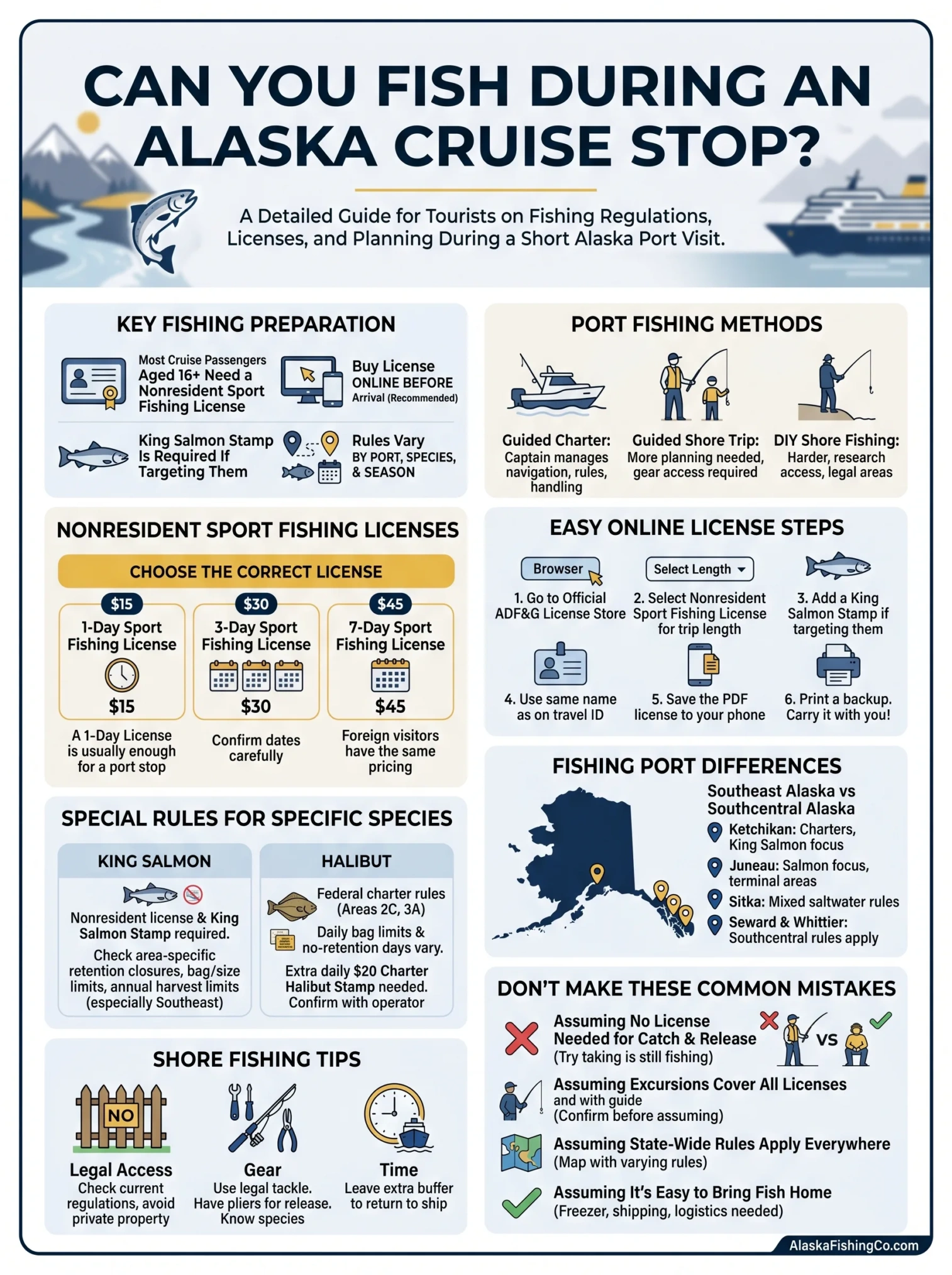
Yes, you can fish during an Alaska cruise stop if you have enough time, legal access to the water, the right Alaska sport fishing license, and the current rules for the place you are fishing. For most cruise visitors, the simplest setup is a 1-day nonresident sport fishing license bought before the ship reaches port.
A cruise stop is short, so the real question is not only “Can I fish?” It is “Can I fish legally, safely, and without missing the ship?” Alaska treats sport fishing as taking or trying to take fish for personal use, so even catch-and-release fishing can count as sport fishing when a line is in the water.[a]
If you remember one thing… buy the correct license before you fish, check the local port rules for that exact date, and do not assume a cruise excursion automatically covers every stamp or harvest rule.
What To Know First
- Most cruise passengers aged 16 or older need a nonresident Alaska sport fishing license.
- A 1-day license is usually enough for a single cruise port stop.
- Foreign visitors use the nonresident/foreign visitor license category; there is no separate tourist exemption.
- A king salmon stamp is required if you fish for king salmon, unless a narrow exception applies.
- Halibut charters can involve extra federal charter rules, especially in Southeast and Southcentral Alaska.
- Local rules change by port, species, and season, so Juneau, Ketchikan, Sitka, Skagway, Seward, and Whittier should not be treated as one rule area.
Can You Fish During an Alaska Cruise Stop?
Yes. A cruise passenger can fish during a port stop in Alaska as long as the fishing is allowed in that water, the passenger has the right license or stamp, and the timing works with the ship’s schedule.
Most cruise-stop fishing happens in one of three ways: a booked charter, a guided shore trip, or a simple DIY shore session near town. A charter is the easiest choice for many visitors because the captain already knows the tide, run timing, boat travel time, local closure areas, and fish-handling rules. Shore fishing can also work, but it needs more planning because public access, gear rental, and fishable water are not always close to the dock.
- Best for short stops: a half-day charter or shore trip arranged around the cruise schedule.
- Best for lower cost: shore fishing with rented or packed travel gear, if legal access is nearby.
- Best for first-timers: a guided trip where the operator explains local limits before fishing starts.
- Worst idea: walking off the ship, buying random gear, and fishing without checking the port-specific rules.
What Alaska Fishing License Do Cruise Passengers Need?
Most cruise passengers are nonresidents. Alaska requires residents age 18 or older and nonresidents age 16 or older to have and carry a sport fishing license when taking part in sport fisheries, and the rule applies in both fresh and marine waters.[b]
For a one-port fishing plan, a 1-day nonresident sport fishing license is usually the cleanest option. If your cruise includes more than one fishing day, a 3-day or 7-day license may make more sense. A foreign visitor does not get a special cruise exemption; Alaska lists foreign/alien nonresident sport fishing licenses at the same short-term sport fishing prices as other nonresidents.
The main license choices for a cruise visitor are shown below. Fees can change in future license years, so check the official ADF&G price page before buying for a later trip.[c]
| License or Stamp | 2026 Nonresident Price | Best Fit for a Cruise Visitor |
|---|---|---|
| 1-Day Sport Fishing License | $15 | One fishing stop in Juneau, Ketchikan, Sitka, Skagway, Seward, Whittier, or another Alaska port. |
| 3-Day Sport Fishing License | $30 | Two or three Alaska port stops where fishing is planned. |
| 7-Day Sport Fishing License | $45 | A cruise plus extra land days before or after sailing. |
| 14-Day Sport Fishing License | $75 | Longer Alaska travel with several fishing days. |
| Annual Sport Fishing License | $100 | Repeat visits, longer Alaska stays, or multiple fishing trips in the same calendar year. |
| 1-Day King Salmon Stamp | $15 | Needed in addition to the sport fishing license if fishing for king salmon on that day. |
Worth Noting
A fishing license belongs to the angler, not the group. If four adults are actively fishing during a cruise stop, each adult needs the right license unless a specific age or residency exception applies.
How Long Is an Alaska Cruise-Stop Fishing License Valid?
A short-term nonresident Alaska sport fishing license is valid only for the selected 1, 3, 7, or 14-day period. Annual sport fishing licenses run from the date of purchase through December 31 of that calendar year, while short-term nonresident licenses are the exception to that calendar-year pattern.[d]
This matters on cruises because your fishing day may not be the same as your boarding day. Do not buy a 1-day license for the wrong date. If your ship reaches Ketchikan on Tuesday and Juneau on Thursday, a 1-day license for Tuesday will not cover Thursday.
- One port, one fishing trip: choose a 1-day license for that exact date.
- Two ports close together: compare two 1-day licenses with a 3-day license.
- Fishing before and after the cruise: look at 7-day, 14-day, or annual options.
- Uncertain excursion timing: ask the charter which calendar date appears on the fishing logbook.
Can You Buy an Alaska Fishing License Online Before the Ship Arrives?
Yes. Cruise visitors can buy most Alaska sport fishing licenses online through the Alaska Department of Fish and Game system, then carry the license as a printed or signed electronic license.
Buying before arrival is usually smarter than waiting until port. Cruise stops can be busy, cell service can be patchy near the dock, and a charter crew may not have time to fix license problems five minutes before departure.
Simple Online Buying Steps
- Go to the official ADF&G license store before your fishing day.
- Choose the nonresident sport fishing license that matches your trip length.
- Add a king salmon stamp if you will fish for king salmon.
- Use the same legal name that appears on your travel ID.
- Save the license PDF or eSigned license to your phone.
- Print a backup copy if possible, especially before sailing.
- Keep the license with you while fishing, not back in your cabin.
One Detail People Miss
A screenshot is useful only if it clearly shows the valid license details. Save the PDF, keep your phone charged, and carry a paper copy when your trip leaves town or goes into weak signal areas.
Does a Cruise Fishing Charter Include the License?
Sometimes the charter helps you buy the license, but the license is still your responsibility. Do not assume it is included unless the operator clearly says so in writing.
Many Alaska cruise fishing excursions send license instructions before the trip. Some may direct you to buy online. Some may have a process at the dock. Others may sell or help arrange licenses through a vendor. Either way, you should know what you need before the day of the excursion.
- Ask before booking: “Is the Alaska sport fishing license included, or do I buy it myself?”
- Ask about stamps: “Are we fishing for king salmon or halibut, and are any extra stamps needed?”
- Ask about timing: “Will the trip return with enough time to reboard the ship?”
- Ask about fish processing: “Can fish be cleaned, frozen, shipped, or released?”
For cruise passengers, the safest approach is simple: buy your own Alaska sport fishing license in advance unless the operator gives clear, official instructions to do something else.
When Do Cruise Passengers Need a King Salmon Stamp?
A king salmon stamp is needed when a licensed angler fishes for king salmon in Alaska, except for limited exceptions such as stocked lakes. This applies in fresh and salt water, so a saltwater cruise charter can still trigger the stamp requirement.
King salmon rules can be more restrictive than visitors expect. In Southeast Alaska, 2026 king salmon rules include area-specific retention closures, dates when king salmon may not be kept, and nonresident annual harvest limits. For example, some Ketchikan-area marine waters had 2026 periods when king salmon retention was prohibited and later periods with a one king salmon bag and possession limit for nonresidents, 28 inches or longer.[e]
What This Means on a Cruise Stop
- If the trip targets king salmon: buy the sport fishing license and the correct king salmon stamp.
- If king salmon retention is closed: you may have to release any king salmon immediately, depending on the local rule.
- If you keep a king salmon as a nonresident: harvest recording rules may apply right away.
- If you are unsure what salmon species is being targeted: ask the guide before buying only the basic license.
Do Alaska Cruise Ports Have Different Fishing Rules?
Yes. Alaska cruise ports sit in different management areas, and even nearby waters can have different salmon, rockfish, trout, and shellfish rules. Southeast Alaska has its own current regulation booklets and special area pages for places such as Haines-Skagway, Juneau-Glacier Bay, Sitka, and Ketchikan-area waters.[f]
This is why a rule someone used in Seward may not fit Juneau, and a Sitka charter answer may not fit Ketchikan. Cruise itineraries also cross the line between Southeast Alaska and Southcentral Alaska. The fish species may look familiar, but the dates, limits, and local closures can differ.
Common Cruise Port Differences
- Ketchikan: strong saltwater charter focus, including salmon and halibut; king salmon rules can be area-specific.
- Juneau: salmon and saltwater trips are common, but local terminal harvest areas and closure dates matter.
- Sitka: popular for saltwater salmon, halibut, lingcod, and rockfish; species-specific limits need close checking.
- Skagway and Haines: freshwater and nearby saltwater options can be more timing-sensitive.
- Seward and Whittier: Southcentral rules apply, and halibut charters often use different federal area rules than Southeast trips.
Before You Move On
Do not plan from a statewide rule alone. Start with the port, then the exact water, then the species, then the date.
What About Halibut Fishing During a Cruise Stop?
Halibut fishing is possible during many Alaska cruise stops, but guided halibut trips have extra federal rules. Southeast Alaska is IPHC Area 2C, while much of the Southcentral cruise-charter area is Area 3A.
For 2026, charter halibut anglers in Area 2C were under a one-fish daily bag limit with a reverse slot size rule and Thursday retention closures from June 18 through September 10. In Area 3A, 2026 charter rules allowed two halibut per day with one fish of any size and one fish under a maximum size, plus Tuesday and Wednesday retention closures during part of the summer.[g]
There is also a federal charter halibut stamp program. In IPHC Areas 2C and 3A, charter vessel anglers age 18 or older who intend to catch and retain halibut need a daily charter halibut stamp. The daily stamp cost is $20, and the charter halibut permit holder is responsible for buying and holding those electronic stamps; the charter guide validates them before gear goes into the water.[h]
What To Ask a Halibut Charter
- Is this trip in Area 2C or Area 3A?
- Does the trip target halibut, salmon, rockfish, lingcod, or a mix?
- Is the federal charter halibut stamp handled by the operator?
- Are there no-retention days during my cruise date?
- Can the fish be processed and shipped, or is catch-and-release better for a cruise schedule?
Can You Fish from Shore Near the Cruise Dock?
Sometimes, yes. Shore fishing can work in Alaska cruise towns, but it is not as simple as seeing water and casting a line.
You need legal access, safe footing, enough time, and the right gear. Some waterfront areas are private, industrial, crowded, or unsafe for casting. Some streams have special rules near mouths, bridges, hatchery zones, or local markers. If you are not using a guide, check the current local regulation page and avoid fishing where signs, closures, or private property make access unclear.
Shore Fishing Checklist
- Carry your license before you start casting.
- Know whether you are in salt water, fresh water, or near a stream mouth.
- Check whether bait is allowed in that water.
- Know the species you are likely to catch.
- Bring pliers, a measuring tool, and a plan for safe release.
- Leave more time than you think you need to get back to the ship.
Common Mistakes Cruise Visitors Make
Most Alaska cruise fishing problems come from timing, license assumptions, or species confusion. The fix is usually easy if you check before the trip instead of at the dock.
“I’m Only Catching and Releasing, So I Don’t Need a License”
- Wrong idea: A license is only needed if you keep fish.
- Correct answer: In Alaska, trying to take fish can still count as sport fishing.
- Why it gets confused: Some visitors think “harvest” and “fishing” are the same legal moment. They are not always the same.
“The Cruise Line Sold the Excursion, So Everything Is Covered”
- Wrong idea: A ticket for a fishing excursion automatically includes all licenses and stamps.
- Correct answer: Some operators help with licenses, but you must confirm what is included.
- Why it gets confused: Cruise excursions bundle transportation and activity planning, but state licenses still attach to individual anglers.
“One Alaska Rule Works Everywhere”
- Wrong idea: If salmon fishing is open in one port, it is open the same way in every port.
- Correct answer: Alaska rules vary by region, water, species, date, and emergency order.
- Why it gets confused: Cruise itineraries make ports feel close together, but Alaska fisheries are managed in smaller local areas.
“A King Salmon Stamp Lets Me Keep Any King Salmon”
- Wrong idea: Buying the stamp overrides local closures or size rules.
- Correct answer: The stamp only covers the stamp requirement. You still must follow open seasons, size limits, bag limits, and nonresident annual limits.
- Why it gets confused: The word “stamp” sounds like permission, but it is only one part of the rule set.
“I Can Keep Fish and Carry It Back to the Ship Easily”
- Wrong idea: Keeping fish on a cruise stop is always simple.
- Correct answer: Fish handling, processing, freezing, shipping, and cruise-line food policies all need planning.
- Why it gets confused: Fishing shows make harvest look instant, but travel logistics can be harder than catching the fish.
Worth Noting
If you cannot identify the fish, do not keep it. Alaska limits often depend on species, size, and area, and a wrong guess can turn a good day into a problem.
Real-Life Scenarios for Alaska Cruise Fishing
These examples show how the rules usually play out for cruise passengers. They are not substitutes for checking the current rule for your exact port and date.
- A couple books a half-day salmon charter in Ketchikan.
Each adult should have a nonresident sport fishing license, and they should ask whether the trip targets king salmon before deciding on a king salmon stamp. - A family wants to fish from shore in Juneau for one hour.
Adults and nonresident teens age 16 or older need licenses before casting, even if they plan to release everything. - A visitor books a Sitka halibut charter.
The visitor needs an Alaska sport fishing license, and the operator should explain any charter halibut stamp, size rule, and no-retention day issue. - A grandparent watches while a child fishes.
If the adult only watches and does not cast, hold the rod, reel fish, or help actively fish, the adult is not the angler for that moment. - A passenger catches a salmon but does not know the species.
The safest move is to ask the guide or release it carefully if legal to do so; keeping an unknown salmon can create limit and stamp problems. - A cruise guest has two Alaska fishing days in the same week.
A 3-day or 7-day nonresident license may be cleaner than buying separate 1-day licenses, depending on the dates. - A traveler wants to ship fish home after the cruise.
Choose a charter that offers processing or shipping help, and confirm timing before assuming fish can go back to the ship.
A Simple Plan Before You Walk Off the Ship
The easiest way to fish during an Alaska cruise stop is to decide the port, species, and trip type before sailing. Then buy the license that matches the actual fishing date.
Use this order:
- Pick the port: Juneau, Ketchikan, Sitka, Skagway, Seward, Whittier, or another stop.
- Pick the trip style: charter, guided shore trip, or DIY shore fishing.
- Pick the species: salmon, halibut, trout, rockfish, lingcod, or mixed fishing.
- Check the current local rule: do not rely on last year’s forum post or a general Alaska travel page.
- Buy the license: match the license length to the fishing date or dates.
- Add stamps if needed: especially king salmon, and ask about charter halibut rules.
- Plan the return: leave a buffer for cleaning fish, traffic, tender lines, and ship boarding time.
Before You Fish During an Alaska Cruise Stop
Fishing during an Alaska cruise stop can be legal, easy, and memorable when the license, port rules, and timing are handled before the day starts. The cleanest path for most visitors is a 1-day nonresident sport fishing license, plus any needed stamp for the species being targeted.
The most common mistake is assuming a short cruise stop is too casual to need the same rules as a full fishing trip. The rule to remember is simple: if you are actively fishing in Alaska, treat it like a real Alaska fishing day.
Alaska Cruise Fishing Questions Answered
Do tourists need a fishing license during an Alaska cruise stop?
Yes, most tourists need a nonresident Alaska sport fishing license if they actively fish during a cruise stop. Nonresidents age 16 or older generally need a license, whether fishing from shore or from a charter boat.
Can foreigners buy an Alaska fishing license online?
Yes. Foreign visitors can buy Alaska nonresident/foreign visitor sport fishing licenses online through the official Alaska Department of Fish and Game license system. Save the license to your phone and carry a printed backup if possible.
Is a 1-day Alaska fishing license enough for a cruise stop?
Usually, yes. A 1-day nonresident sport fishing license is often enough for one port stop. If you plan to fish in more than one port, compare the dates with 3-day, 7-day, or 14-day license options.
Do I need a king salmon stamp on an Alaska cruise fishing charter?
You need a king salmon stamp if you fish for king salmon, unless a specific exception applies. A sport fishing license and king salmon stamp still do not override local closures, size limits, or nonresident annual harvest limits.
Does an Alaska halibut charter include every required stamp?
Not always. You still need an Alaska sport fishing license. For guided halibut trips in IPHC Areas 2C and 3A, adult charter anglers who intend to retain halibut may also be covered by a federal charter halibut stamp process handled by the charter halibut permit holder. Confirm this with the operator before the trip.
Can I fish from the cruise ship itself in Alaska?
In normal cruise travel, fishing is planned from shore, a legal pier or bank, or a licensed charter vessel, not from the cruise ship. Follow the ship’s rules, port rules, and Alaska fishing regulations.
Can my child fish during an Alaska cruise stop without a license?
A nonresident child under 16 generally does not need an Alaska sport fishing license, but the child still must follow seasons, bag limits, size limits, and local rules. Adults helping in a way that counts as active fishing may need their own license.
Alaska Fishing References
- [a] ADF&G Statewide Definitions for Sport Fishing — Used for the meaning of sport fishing, taking, attempting to take, and related terms. (Reliable because it is the official Alaska Department of Fish and Game definitions page.)
- [b] ADF&G Sport Fishing Licenses and King Salmon Stamps — Used for age rules, nonresident license requirements, fresh and marine water coverage, and king salmon stamp basics. (Reliable because it is the state agency page for Alaska sport fishing licenses.)
- [c] ADF&G Sport Fishing License and King Salmon Stamp Prices — Used for 2026 nonresident sport fishing license and king salmon stamp prices. (Reliable because it is the official ADF&G price list.)
- [d] ADF&G General License Information — Used for license validity periods and printed, electronic, and eSigned license formats. (Reliable because it is the official ADF&G license information page.)
- [e] ADF&G 2026 Southeast Alaska and Ketchikan King Salmon Regulations — Used for Ketchikan-area king salmon retention closures, nonresident limits, and recording notes. (Reliable because it is an official ADF&G 2026 emergency order and advisory announcement.)
- [f] ADF&G Southeast Alaska Sport Fish Regulations — Used for Southeast Alaska area regulation booklets and special regulation pages for cruise-port regions. (Reliable because it is the official ADF&G regional regulations page.)
- [g] Federal Register: 2026 Pacific Halibut Annual Management Measures — Used for 2026 Area 2C and Area 3A charter halibut bag, size, and day-of-week retention measures. (Reliable because it is the official federal rule publication for NOAA/IPHC annual halibut measures.)
- [h] NOAA Fisheries Charter Halibut Stamp Program FAQ — Used for the 2026 charter halibut stamp requirement, $20 daily cost, age threshold, and operator validation process. (Reliable because it is a NOAA Fisheries compliance guide for the federal charter halibut stamp program.)