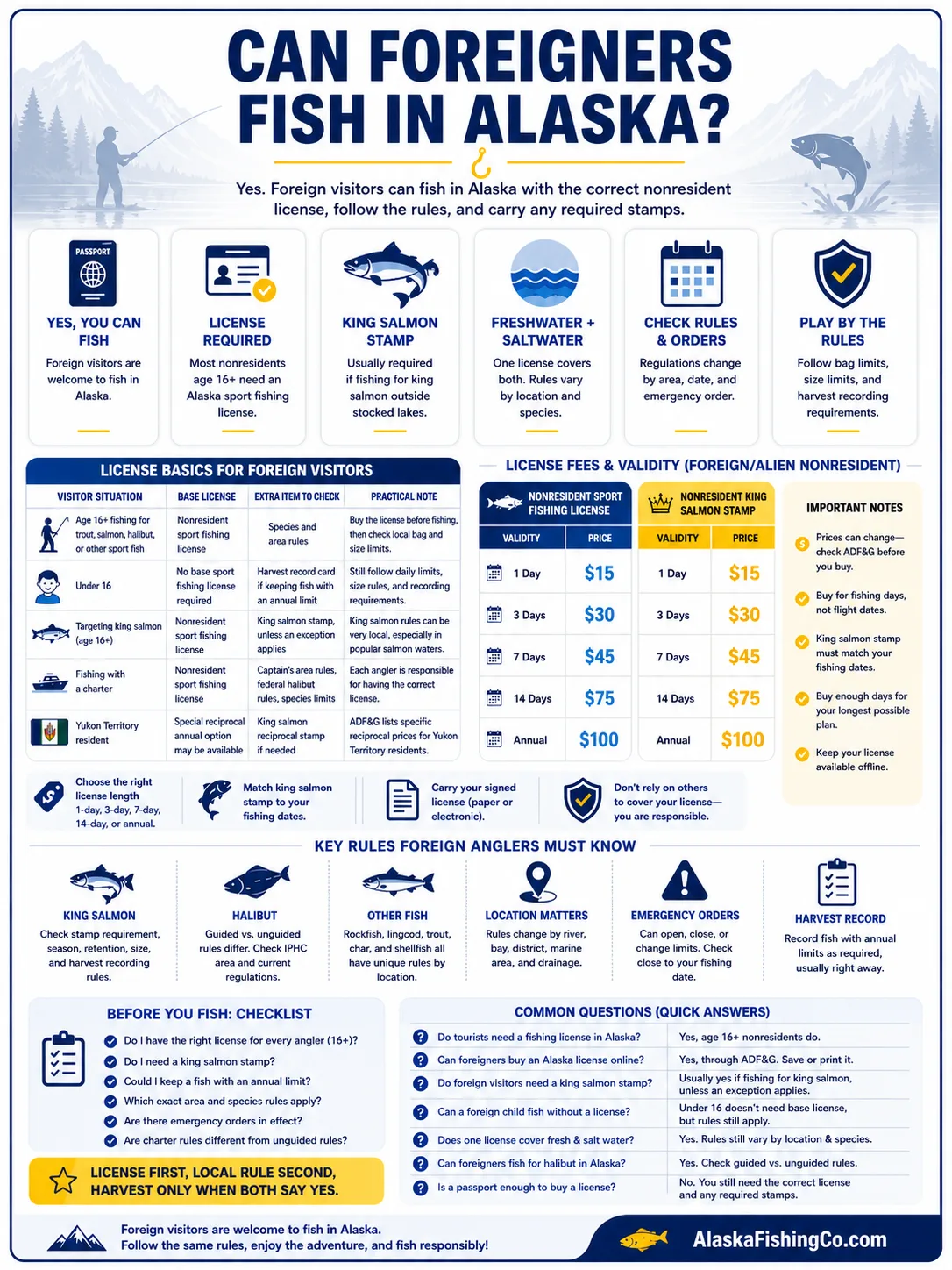
Foreigners can fish in Alaska, but most international visitors age 16 or older need an Alaska nonresident sport fishing license before they cast a line. The same base license covers sport fishing in both fresh water and salt water, and a separate king salmon stamp is usually needed if the visitor plans to fish for king salmon outside stocked lakes. [a]
For a tourist, the rule is usually simple: buy the correct nonresident license for the exact days you will fish, carry it with you, and check the area rules before keeping anything. Alaska’s fishing rules can change by river, coast, species, date, and emergency order, so the license is only the first step.
If you remember one thing… a foreign visitor is treated like a nonresident angler for Alaska sport fishing unless they meet Alaska’s residency rules. That means the visitor can fish, but they must follow nonresident license, stamp, bag limit, size limit, and harvest recording rules.
What To Know First
- Yes, foreign visitors can fish in Alaska. A passport or foreign citizenship does not stop someone from buying a sport fishing license.
- Age matters. Nonresidents age 16 or older need a sport fishing license; nonresidents under 16 do not need the base sport fishing license.
- King salmon is separate. A king salmon stamp is required for many anglers who fish for king salmon, with an exception for stocked lakes and younger nonresident anglers.
- Freshwater and saltwater are both covered by the sport license. The rules for keeping fish still vary by place and species.
- Emergency orders can change the trip plan. A river that looked open on a printed booklet may be closed or restricted later.
Can Foreign Visitors Fish in Alaska?
Yes. Foreign visitors can legally fish in Alaska when they have the correct nonresident sport fishing license, follow the current regulations, and carry any required stamp or harvest record. The fishing rules apply to the act of fishing, not just to keeping fish.
A visitor from Canada, Germany, Japan, Australia, the United Kingdom, or any other country can buy an Alaska sport fishing license. The usual category for a short-term international tourist is nonresident or nonresident alien, depending on the wording used in the license system. ADF&G defines a nonresident alien as a person who is not a U.S. citizen and has not lived in Alaska for the preceding 12 consecutive months. [c]
That does not mean every foreign-born person must always buy a tourist-style license. A person who lives in Alaska and meets the state’s residency rules may fall under resident rules even if they were born outside the United States. For most vacation visitors, though, the safe assumption is simple: use the nonresident license rules.
- Fishing from shore counts as fishing.
- Fishing from a charter boat counts as fishing.
- Fishing in a lake, river, creek, bay, or ocean water counts as fishing.
- Helping with the rod, bait, landing net, or harvest may still matter if the person is taking part in the fishing activity.
Which Alaska Fishing License Does a Foreigner Need?
A foreign visitor age 16 or older usually needs a nonresident sport fishing license. The license length should match the days the person will actually fish, not simply the length of the Alaska vacation.
Alaska sells short-term and annual nonresident sport fishing licenses. This is helpful for visitors because a three-day fishing trip does not require an annual license. The base sport fishing license is the entry point, and any extra stamp or record requirement depends on the species and fishery.
| Visitor Situation | Base License | Extra Item To Check | Practical Note |
|---|---|---|---|
| Foreign visitor age 16 or older fishing for trout, salmon, halibut, or other sport fish | Nonresident sport fishing license | Species and area rules | Buy the license before fishing, then check the local bag and size limits. |
| Foreign visitor under 16 | No base sport fishing license required | Harvest record card if keeping fish with an annual limit | The young angler still has to follow daily limits, size rules, and recording rules when they apply. |
| Foreign visitor targeting king salmon | Nonresident sport fishing license if age 16 or older | King salmon stamp, unless an exception applies | King salmon rules can be very local, especially in popular salmon waters. |
| Foreign visitor fishing with a charter | Nonresident sport fishing license if age 16 or older | Captain’s area rules, federal halibut rules, and species limits | A charter may help explain rules, but each angler is still responsible for having the correct license. |
| Yukon Territory resident | Special reciprocal annual option may be available | King salmon reciprocal stamp if needed | ADF&G lists specific reciprocal prices for Yukon Territory residents. |
- Choose a 1-day, 3-day, 7-day, 14-day, or annual license based on fishing days.
- Match a king salmon stamp to the same fishing period if you plan to fish for king salmon.
- Keep a signed paper or electronic license with you while fishing.
- Do not rely on a lodge, friend, or captain to “cover” your personal license unless they have actually purchased it for you and you have signed it.
Worth Noting
A foreign visitor does not need a separate “freshwater license” and “saltwater license” for Alaska sport fishing. The same nonresident sport fishing license applies in both, but the rules for what you may keep can be completely different from one place to another.
Alaska Nonresident Fishing License Fees and Validity
For a foreign tourist, the main license cost depends on how many days they plan to fish. The current ADF&G price page lists the same sport fishing license fees for nonresident foreign/alien anglers as it lists for other nonresident sport anglers. [b]
The license period is important. A 1-day license is not the same as “one fishing trip”; it covers one date. If a visitor fishes late one evening and again the next morning, they need license coverage for both dates unless a longer license already covers the second day.
| Item | Validity | Current Price | When It Matters |
|---|---|---|---|
| Nonresident Sport Fishing License | 1 day | $15 | One planned fishing date, such as a half-day charter or evening shoreline session. |
| Nonresident Sport Fishing License | 3 days | $30 | A long weekend or short Alaska stop with several fishing windows. |
| Nonresident Sport Fishing License | 7 days | $45 | A one-week trip with multiple fishing days. |
| Nonresident Sport Fishing License | 14 days | $75 | A longer vacation, float trip, road trip, or lodge stay. |
| Nonresident Sport Fishing License | Annual | $100 | Repeat trips, long stays, or visitors who expect to fish across many dates. |
| Nonresident King Salmon Stamp | 1 day | $15 | Fishing for king salmon on one date when the stamp is required. |
| Nonresident King Salmon Stamp | 3 days | $30 | Short king salmon trip. |
| Nonresident King Salmon Stamp | 7 days | $45 | Weeklong trip where king salmon fishing is part of the plan. |
| Nonresident King Salmon Stamp | 14 days | $75 | Longer king salmon trip. |
| Nonresident King Salmon Stamp | Annual | $100 | Multiple king salmon trips in the same license year. |
Prices can change, so visitors should check the ADF&G price page before buying. The listed fees above reflect the official ADF&G public price page available at the time this article was prepared.
- Buy the license for the fishing dates, not the flight dates.
- Check whether the king salmon stamp must cover the same dates as your king salmon fishing.
- For mixed trips, buy enough days for the longest possible fishing plan.
- Keep the license available offline if you will be away from cell service.
King Salmon, Halibut, and Species-Based Rules
The base sport fishing license lets a foreign visitor take part in Alaska sport fishing, but it does not give open permission to keep every fish. King salmon, halibut, rockfish, lingcod, trout, shellfish, and other species may have their own limits, dates, size rules, closed waters, or recording steps.
King salmon is the species that most often adds a state stamp requirement. ADF&G says a king salmon stamp is required to fish for king salmon, except king salmon in stocked lakes, with exceptions for nonresidents under age 16 and certain resident license holders. A harvest record may also be needed for species with annual limits. [h]
Halibut has another layer. Alaska sport halibut rules involve state, federal, and international management, and guided charter rules can differ from unguided fishing, especially in Southeast Alaska and the Central Gulf of Alaska. NOAA Fisheries notes that guided sport halibut rules in Areas 2C and 3A are set annually through the North Pacific Fishery Management Council and the International Pacific Halibut Commission process. [g]
- King salmon: check stamp, season, retention, size, and harvest recording rules.
- Halibut: check whether the trip is guided or unguided and which IPHC area applies.
- Rockfish and lingcod: check species group, area, release rules, and annual limits where listed.
- Rainbow trout and char: check drainage-specific limits, tackle rules, and annual recording rules.
- Shellfish: check the exact fishery, permit needs, closures, and whether a visitor may participate.
One Detail People Miss
A license does not guarantee harvest. You may be allowed to fish but required to release a certain species because of a local restriction, emergency order, size rule, or closed retention period.
Freshwater, Saltwater, and Regional Differences
Foreign visitors should treat Alaska as a set of local fishing areas, not one single rule sheet. A legal plan in one river, bay, or marine area may be illegal somewhere nearby on the same date.
ADF&G tells anglers to start with the region-wide sport fishing rules, then check the exact drainage or area where they will fish. The agency also states that emergency orders supersede the published regulations, which means a newer order can override a printed booklet or earlier plan. [e]
This matters for visitors because many Alaska trips move through more than one fishing area. A traveler might fish a stocked lake near Anchorage, book a halibut charter from Homer, try salmon near Seward, and stop at a roadside river on the way back. Those may all involve different rules.
- Southcentral Alaska: many visitors fish around Anchorage, the Kenai Peninsula, Mat-Su, Prince William Sound, Seward, Homer, and Kodiak-area waters.
- Southeast Alaska: popular ports include Juneau, Ketchikan, Sitka, Haines, Skagway, Petersburg, Wrangell, Yakutat, and Prince of Wales Island.
- Interior and Northern Alaska: visitors may encounter different trout, grayling, pike, sheefish, and salmon rules depending on the drainage.
- Southwest Alaska: remote lodges and fly-out trips often require careful planning around drainage-specific rules.
Emergency Orders Can Change a Foreign Visitor’s Fishing Plan
An emergency order is a rule change that can open, close, limit, or expand a sport fishery after the normal regulation booklet is published. For a foreign visitor, this is the rule check that should happen close to the actual fishing date.
ADF&G explains that emergency orders may open or close seasons or areas, change bag limits, or modify methods of harvest. The agency also notes that emergency orders may be issued at any time and have the same force and effect as law. [f]
A visitor should check emergency orders before buying final trip gear, before driving to a river, and again before a charter day if a target species is under active management. This is especially true for king salmon, certain rockfish, lingcod, shrimp, and local salmon runs.
- Check the ADF&G emergency order page for your region.
- Read the release date and expiration date.
- Confirm the exact water body, district, or marine area.
- Ask a charter captain or local ADF&G office if the order’s map or boundary is unclear.
- Do not rely only on old screenshots, hotel handouts, or printed brochures.
Before You Move On
The license answers “May this person fish?” Local regulations answer “Where, when, how, and what may this person keep?” Both questions matter before the first cast.
How Foreign Visitors Can Buy an Alaska Fishing License Online
Foreign visitors can usually buy an Alaska sport fishing license online through ADF&G, or in person from license vendors and Fish and Game offices. Buying online is often easiest before travel, especially when a trip starts early in the morning or in a smaller community.
ADF&G’s online licensing information says an eSigned license requires an email account, an ADF&G account, and an internet-connected device. The license holder can save the eSigned license to a mobile device, and printed or electronic licenses must be signed and in the licensee’s possession before fishing. [d]
For an international visitor, the best time to buy is usually after the fishing dates are clear but before leaving reliable internet service. Remote rivers, lodges, boat launches, and coastal areas may have weak signal.
- Go to the ADF&G license purchasing system from the official ADF&G site.
- Create or sign in to an ADF&G account.
- Choose the nonresident sport fishing license that covers your fishing dates.
- Add a nonresident king salmon stamp if you will fish for king salmon and no exception applies.
- Complete the purchase and sign the license electronically, or print and sign it.
- Save a copy to your phone and, when possible, carry a paper backup.
- Check harvest record rules if you may keep fish with annual limits.
Common Mistakes Foreign Visitors Make
Most Alaska fishing license mistakes come from assuming the license is the only rule. A visitor can buy the correct license and still break a rule by keeping the wrong fish, fishing during a closure, forgetting a stamp, or failing to record a harvest.
Mistake 1: “The Charter Covers My License”
Wrong idea: A guided trip automatically includes the angler’s personal Alaska fishing license.
Correct explanation: Some operators may help guests buy licenses, but each angler must have the correct personal license before fishing.
Why it gets confused: Charter bookings often include rods, bait, boat, captain, and fish processing help, so visitors may assume paperwork is included too.
Mistake 2: “Under 16 Means No Rules”
Wrong idea: A nonresident child under 16 can fish with no limits or records.
Correct explanation: The child may not need the base sport fishing license, but harvest record rules, daily limits, size limits, and closures can still apply.
Why it gets confused: The license exemption is easier to remember than the separate harvest rules.
Mistake 3: “A Salmon Is Just a Salmon”
Wrong idea: If salmon fishing is open, every salmon species can be kept under the same rules.
Correct explanation: King, coho, sockeye, chum, and pink salmon may have different rules by location and date. King salmon often adds a stamp requirement.
Why it gets confused: Visitors often plan around “salmon season,” but Alaska rules are usually more exact than that.
Mistake 4: “The Printed Booklet Is Always Enough”
Wrong idea: A regulation booklet from the start of the season is all an angler needs.
Correct explanation: Emergency orders can change seasons, limits, methods, and retention rules after publication.
Why it gets confused: Printed rules feel official, but Alaska fisheries can be adjusted in season.
Mistake 5: “Foreign Visitor Means a Special Tourist License”
Wrong idea: International travelers need a separate foreign tourist fishing license.
Correct explanation: In the sport fishing price list, foreign/alien visitors use the nonresident foreign/alien options, which mirror the ordinary nonresident sport fishing options for the main sport license and king salmon stamp.
Why it gets confused: The wording “nonresident,” “foreign,” and “alien” can look like separate trip categories when the visitor is only trying to buy a fishing license.
- Check the license category before paying.
- Check the species before keeping a fish.
- Check the exact place before fishing.
- Check emergency orders close to the fishing date.
Worth Noting
The most expensive mistake is not usually buying the wrong license length. It is keeping a fish during a local closure or forgetting to record a fish with an annual limit.
Real-Life Scenarios for Alaska Visitors
These examples show how the rules work in normal visitor situations. They are not a replacement for checking the current ADF&G rules for the exact date and water.
- A couple from the United Kingdom books a one-day halibut charter from Homer.
Each angler age 16 or older should have a nonresident sport fishing license for that date, and the charter’s guided halibut rules should be checked before the trip. - A family from Germany fishes a stocked lake near Anchorage with a 14-year-old child.
The adults need nonresident sport fishing licenses; the 14-year-old does not need the base license, but any harvest rule still applies. - A visitor from Australia wants to target king salmon on a guided river trip.
The visitor will usually need a nonresident sport fishing license plus a matching king salmon stamp, unless the fishery falls under a stated exception. - A Canadian traveler drives from Yukon Territory into Alaska for an annual fishing trip.
The traveler should check the Yukon Territory reciprocal license option and confirm whether a reciprocal king salmon stamp fits the plan. - A cruise passenger in Ketchikan wants to fish for a few hours from shore.
If the passenger is 16 or older and actively fishing, they need a nonresident sport fishing license even for a short shoreline session. - A visitor joins friends at a river and only plans to “try a few casts.”
Trying a few casts is still fishing, so the license should be handled before the rod is used. - A lodge guest plans to fish several remote rivers in one week.
A 7-day or 14-day nonresident license may fit better than several 1-day licenses, but each river’s drainage rules still need checking. - A traveler catches a fish with an annual limit and plans to keep it.
The harvest must be recorded as required, usually right away in the field, using the license or harvest record method that applies.
What Foreign Anglers Should Check Before Fishing
A foreign angler should check four things before fishing in Alaska: license, species, location, and current orders. That small check prevents most problems before they happen.
The best trip plan is not complicated. It starts with the correct nonresident license, adds the king salmon stamp if needed, then confirms the local rules for the water and target fish. If the trip involves a charter, ask the captain what the current rule is for the exact date, area, and species.
- License: Is each angler age 16 or older covered for every fishing date?
- Stamp: Is anyone fishing for king salmon?
- Harvest record: Could anyone keep a fish with an annual limit?
- Area: Which region, drainage, bay, district, or marine area applies?
- Emergency order: Has anything changed since the normal rules were published?
- Charter rules: Are guided halibut, rockfish, or salmon rules different from unguided rules?
Foreign visitors are welcome to fish in Alaska when they follow the same basic path other nonresident anglers use. Buy the right license, check the target species, and match the plan to the exact water and date.
The most common mistake is assuming that a license alone makes every fish legal to keep. The easiest rule to remember is this: license first, local rule second, harvest only when both say yes.
Foreign Visitors Fishing in Alaska Questions Answered
Do tourists need a fishing license in Alaska?
Yes. Most tourists and other nonresident visitors age 16 or older need an Alaska nonresident sport fishing license before fishing in Alaska. Nonresidents under 16 do not need the base sport fishing license, but they still have to follow harvest, size, and area rules.
Can foreigners buy an Alaska fishing license online?
Yes. Foreign visitors can usually buy a nonresident Alaska sport fishing license online through the Alaska Department of Fish and Game. They should save or print the signed license and keep it with them while fishing.
Do foreign visitors need a king salmon stamp in Alaska?
Usually yes if they are age 16 or older and plan to fish for king salmon, unless the fishery falls under an exception such as king salmon in stocked lakes. A king salmon stamp is separate from the base sport fishing license.
Can a foreign child fish in Alaska without a license?
A nonresident child under 16 does not need the base Alaska sport fishing license. The child still needs to follow all fishing rules, and a harvest record card may be required when keeping fish with annual limits.
Does an Alaska fishing license cover both freshwater and saltwater?
Yes. The Alaska sport fishing license applies in both fresh water and marine waters. The location and species rules still vary, so an angler must check the exact area before keeping fish.
Can foreigners fish for halibut in Alaska?
Yes. Foreign visitors can fish for halibut in Alaska with the proper nonresident sport fishing license, but guided and unguided halibut rules can differ. Charter halibut rules are set through federal and international management processes and should be checked for the exact year and area.
Is a passport enough to buy an Alaska fishing license?
A passport may help identify a visitor, but it is not a fishing license. The angler still needs the correct Alaska nonresident sport fishing license and any required stamp or harvest record.
Alaska Fishing References
- [a] Alaska Department of Fish and Game — Sport Fishing Licenses, King Salmon Stamps, IDs and Harvest Record Cards — Used for who needs a sport fishing license, fresh and marine water coverage, king salmon stamp basics, and harvest record notes. (Official Alaska state fish and game agency.)
- [b] Alaska Department of Fish and Game — Sport Fishing License and King Salmon Stamp Prices — Used for current nonresident and foreign/alien sport fishing license and king salmon stamp prices. (Official Alaska state licensing price page.)
- [c] Alaska Department of Fish and Game — Residency Definitions — Used for resident, nonresident, and nonresident alien definitions. (Official Alaska state licensing definition page.)
- [d] Alaska Department of Fish and Game — Purchasing Your License Online and eSigning Your License FAQs — Used for online license purchase, eSignature, signed license, and carrying format details. (Official Alaska state licensing FAQ.)
- [e] Alaska Department of Fish and Game — Sport Fishing Regulations — Used for regional regulation checks, drainage-specific rules, and the notice that emergency orders supersede published regulations. (Official Alaska sport fishing regulation hub.)
- [f] Alaska Department of Fish and Game — Sport Fishing Emergency Orders and Press Releases — Used for how emergency orders can change seasons, areas, bag limits, and harvest methods. (Official Alaska emergency order source.)
- [g] NOAA Fisheries — Sport Halibut Fishing in Alaska — Used for Alaska sport halibut management and annual guided charter rule context. (Federal fisheries agency.)
- [h] Alaska Department of Fish and Game — Fishing and Hunting License General Information FAQs — Used for age rules, harvest record card notes, and king salmon stamp requirements. (Official Alaska state licensing FAQ.)