
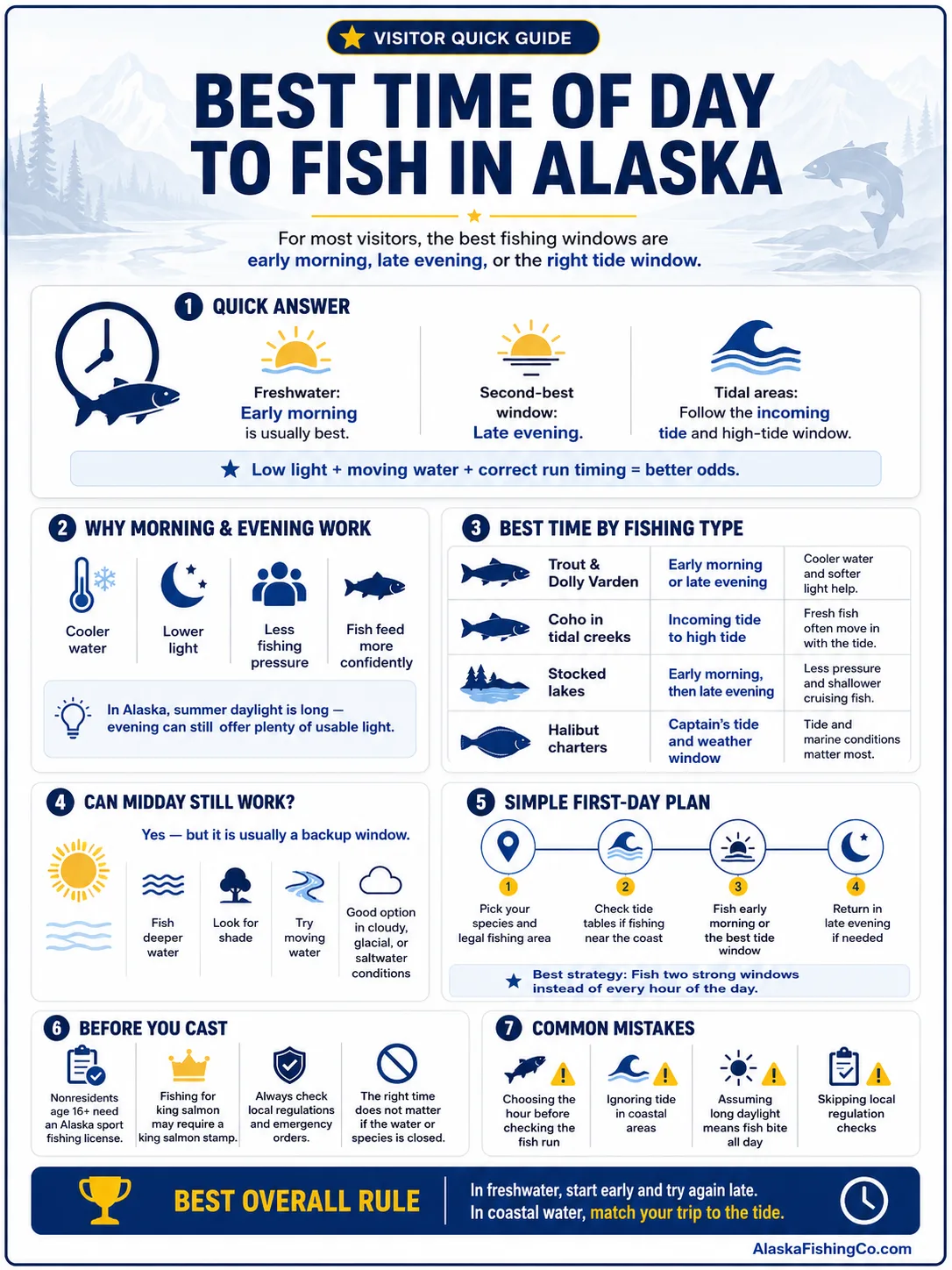
The best time of day to fish in Alaska is usually early morning or late evening, especially for freshwater trout, Dolly Varden, coho salmon, and stocked lakes. For saltwater, tidal creeks, and river mouths, the better answer is often the tide window rather than the clock.
Alaska has long summer daylight, cold water, fast-changing weather, and fish runs that vary by region. That means a 6 a.m. cast on a shaded stream can be far better than a bright noon cast in the same place, while a mid-afternoon tide in a coastal creek may beat both.
If you remember one thing… plan your fishing time around low light, moving water, and the fish run you are targeting, then check the local regulation page before you go.
What To Know First
- Freshwater: early morning and late evening are usually the safest choices.
- Tidal salmon creeks: fish the incoming tide and the window around high tide when salmon push in from saltwater.
- Saltwater charters: the best departure time is often set by tide, distance, weather, and the captain’s plan.
- Summer daylight: “evening” in Alaska may still mean full usable light.
- Regulations: time of day does not matter if the water is closed, the species is closed, or a special rule applies.
Is There One Best Time of Day to Fish in Alaska?
The best overall time is early morning, followed closely by late evening. These windows often bring cooler water, softer light, less boat traffic, and fish that are more willing to move or feed.
That said, Alaska is not one simple fishery. A tourist casting for stocked rainbow trout near Anchorage, a family fishing for coho at Ship Creek, and a charter guest heading offshore for halibut are all solving different timing problems. The Alaska Department of Fish and Game publishes run-timing tables by region, and it notes that those tables show fish availability only; anglers still need to check current regulations before planning a trip.[a]
- For rivers and lakes: start early, then try again late.
- For tidal areas: match your fishing window to the tide.
- For salmon: pick the right week first, then the right hour.
- For halibut: expect the tide and marine weather to matter more than sunrise.
Why Morning and Evening Usually Fish Better
Morning and evening work well because fish often feel safer and feed more actively when the sun is lower. In clear Alaska streams, bright overhead light can push fish into deeper water, shaded seams, undercut banks, or slower holding areas.
ADF&G’s Mat-Su area guidance gives a useful pattern for visitors: lake fishing can be especially good in early morning and late evening, while pike often slow as shallow water warms during the day.[b]
- Cooler water: fish may be more comfortable and active.
- Lower light: fish are less exposed to predators and less wary of anglers.
- Less pressure: popular roadside waters are often quieter before breakfast.
- Better bank access: low-angle light can make it easier to see seams, current edges, and moving salmon.
Worth Noting
In Alaska, “early” does not always mean painfully early. During summer, many places have usable light well before normal vacation wake-up time, so a 5:30 a.m. session can feel surprisingly easy once you are there.
Best Time of Day by Fishing Type
The right fishing time depends on what you are trying to catch and where you are standing. Use the table below as a practical starting point, then adjust it for local rules, weather, water clarity, and tide.
| Fishing situation | Best time to try first | Why it works | Visitor note |
|---|---|---|---|
| Freshwater trout and Dolly Varden | Early morning or late evening | Lower sun, cooler water, and less pressure often help. | Look for deeper pools, shade, and current seams. |
| Sockeye salmon in clear rivers | Early morning or late evening | Low light helps in shallow, clear, busy water. | Long casts are often not needed when fish travel near the bank. |
| Coho salmon in tidal creeks | Incoming tide through the high-tide window | Fresh fish may move in with the tide. | Arrive before the tide turns so you are set up in time. |
| Stocked lakes near towns | Early morning, then late evening | Trout may cruise shallower before bright sun and heavy pressure. | Good choice for families and short Alaska itineraries. |
| Halibut on saltwater charters | Captain’s tide and weather window | Anchoring, drift, current speed, and travel distance shape the day. | Do not book only by clock time; ask how tides affect the trip. |
| Northern pike in warm shallow lakes | Early morning or later evening | Warm midday water can slow shallow-water activity. | Focus on weed edges, shore cover, and ambush areas. |
How Tides Change the Best Fishing Time
For coastal Alaska and tidal river mouths, tide can matter more than sunrise or sunset. The best window may be the hour or two before high tide, the tide turn, or the first part of the outgoing tide, depending on the water and species.
ADF&G’s Anchorage-area guidance gives a clear example: many silver salmon caught in Ship Creek and Bird Creek are taken about two hours before high tide or about one hour after high tide, while Campbell Creek often fishes better early in the morning before direct sun reaches the creek.[c]
- Incoming tide: salmon may enter small creeks and channels from saltwater.
- High tide: fish can reach holding water that was too shallow earlier.
- Outgoing tide: bait and current movement can create feeding lanes.
- Slack tide: sometimes useful for boat control, but it can also slow action.
One Detail People Miss
A perfect tide at the wrong access point may not help. In small Alaska creeks, fish may hold below a tide line, below a bridge, in a lower channel, or near a legal boundary that changes by regulation.
Morning Fishing in Alaska
Morning is the safest first choice for most visitors because it gives you the first low-light window of the day and leaves room to adjust. If the bite is slow, you still have time to change water, take a break, check tide tables, or return for the evening.
Morning also helps on crowded road-system fisheries. Parking lots, bank space, and casting lanes can fill quickly during salmon runs. Being early does not guarantee fish, but it often gives you a cleaner start.
- Best for: trout, Dolly Varden, stocked lakes, coho, sockeye, grayling, and warm-weather pike.
- Good plan: fish from first usable light through mid-morning, then reassess.
- Watch for: cold hands, slick banks, bears near salmon streams, and fog on lakes.
- Simple tactic: start shallow or near cover, then move deeper as sun hits the water.
Evening Fishing in Alaska
Evening can be just as good as morning, and sometimes better, especially after a sunny day. As light softens, fish may move out of deeper holding water, insects may become more active, and salmon may travel more comfortably through shallow edges.
For visitors, evening fishing has one extra advantage: it can fit around daytime travel. You can drive, hike, take a tour, or check into lodging, then still fish several hours of usable light in summer.
- Best for: trout in lakes, Dolly Varden in streams, grayling, coho, and pike.
- Good plan: arrive before the sun leaves the water, not after.
- Watch for: fatigue, changing weather, low phone battery, and bear activity near fish carcasses.
- Simple tactic: fish shade first, then cover the soft edges as the light drops.
Before You Move On
Long daylight does not mean fish feed hard all day. In summer, the better bite may still come during the lower-light edges, even when the sky never feels fully dark.
Can Midday Fishing Still Be Good?
Yes, midday fishing can still be good in Alaska. It is not the first choice for many freshwater situations, but it can work when the water is cold, cloudy, shaded, glacial, or moved by tide.
Midday is also common on guided saltwater trips. A halibut charter may run when the tide, current, weather, and travel distance line up. A slow freshwater midday session does not mean the whole day is lost; it may simply mean fish have shifted deeper or tighter to cover.
- Fish deeper: bright sun often pushes fish into deeper pools or lake drop-offs.
- Find shade: undercut banks, logjams, bridge shade, and cliff shadows can hold fish.
- Use moving water: riffles, inlets, outlets, and tide channels add oxygen and cover.
- Downsize when needed: pressured clear water often calls for a quieter presentation.
Best Time by Species
Species matters because Alaska fish do not all behave the same way. Salmon runs, trout feeding patterns, halibut tides, and pike ambush behavior each point to different timing choices.
Salmon
For salmon, the best day often matters more than the best hour. A perfect sunrise will not help much if the run is not in, while an ordinary afternoon can be good when fresh fish are moving.
- Kings: often managed tightly; check the water, date, and stamp rules before fishing.
- Sockeye: early and late often help in clear rivers with bank-traveling fish.
- Coho: early morning, late evening, and tide windows can all be strong.
- Pink and chum: timing depends heavily on local run timing and open water.
Rainbow Trout, Dolly Varden, and Arctic Char
These fish often reward low-light sessions, especially in clear water. In late summer, trout and Dolly Varden may also focus around salmon eggs or flesh where regulations allow fishing.
- Morning: good for shallow cruising fish and quiet banks.
- Evening: good after bright sun leaves the water.
- Midday: look deeper, cooler, and closer to current.
Halibut
Halibut timing is more about the marine window than the vacation clock. Charter captains plan around tide, current speed, wind, distance, and the area they want to fish.
- Ask about tide: current speed affects anchoring, bait presentation, and drift.
- Plan a full day: travel time may be part of the fish plan.
- Check rules: guided and unguided halibut rules are not always the same.
Rockfish and Lingcod
Rockfish and lingcod are structure-oriented, so location and depth can matter more than sunrise. For visitors, the safer planning question is often which species are open, which area you are in, and how the fish must be handled.
- Morning: calmer seas may make the run easier.
- Midday: can fish well if conditions are safe.
- Regulations: some areas have special retention, recording, or handling rules.
Northern Pike
Pike often feed best when shallow water is not too warm and they can ambush prey near weeds or shoreline cover.
- Try first: early morning.
- Try second: late evening.
- Midday backup: deeper weed edges, shade, or moving water.
Fish Movement Can Matter More Than the Clock
When fish are migrating, the best time may be “when new fish arrive.” That can be a tide change, a rain bump, a cooler night, or the first quiet hour after heavy bank pressure.
Regional Differences Visitors Should Expect
Alaska is too large for one clock-based answer. A good evening bite in Southcentral Alaska may not match the right tide in Southeast, and Bristol Bay trout timing can feel different from an Interior pike lake.
Use region first, species second, and time of day third. ADF&G’s sport fishing regulations are organized by region and local drainage, and the site states that emergency orders override the published regulations.[d]
- Southcentral Alaska: mornings and evenings are strong for stocked lakes, trout streams, and many road-system salmon spots; tides matter in coastal creeks.
- Kenai Peninsula: clear water, bank pressure, salmon runs, and special tackle rules can shape the best hour.
- Southeast Alaska: saltwater tides, marine weather, and local king salmon rules can matter as much as time of day.
- Bristol Bay: trout, char, and salmon timing can shift with run stage, water clarity, and camp access.
- Interior and Arctic waters: summer daylight is long, but fish may still respond best to cooler, lower-light windows.
Licenses, Stamps, and Rules That Can Affect Your Fishing Time
The best fishing window is only useful if you are legal when you cast. Alaska residents age 18 or older and nonresidents age 16 or older need a sport fishing license, and a king salmon stamp is required when fishing for king salmon except for king salmon in stocked lakes.[e]
Foreign visitors are treated as nonresidents for sport fishing license purposes. There is not a separate “international tourist” license category for ordinary sport fishing, so most visitors choose a nonresident license duration that matches their fishing dates.
- License type: resident or nonresident sport fishing license.
- Validity: choose a duration that covers every calendar day you plan to fish.
- King salmon: add the required stamp if you plan to fish for kings, unless a listed exemption applies.
- Harvest records: some annual-limit fisheries require immediate recording after harvest.
- 2026 halibut note: charter anglers age 18 or older need a Charter Halibut Stamp to keep halibut in Areas 2C or 3A.[f]
Online Buying Steps for Visitors
- Go to the official ADF&G online license system.
- Select the correct residency status and sport fishing license duration.
- Add a king salmon stamp if you will fish for king salmon and are not exempt.
- Save a digital copy and carry what the rules require while fishing.
- Check the region, drainage, species, and any emergency order before the trip.
A Valid License Does Not Override a Closure
A fishing license does not open closed water. If an emergency order closes a stream, changes a bag limit, or changes legal gear, that rule controls your trip even if your license is valid.
Common Mistakes When Picking a Fishing Time
Most timing mistakes come from treating Alaska like a small, predictable fishery. The better approach is to match the hour to the species, water type, and regulation page.
Wrong idea: “Sunrise is always best.”
Correct explanation: Sunrise is often excellent, but a moving tide can beat sunrise in tidal water.
Why it gets mixed up: Many freshwater articles talk about sunrise, but Alaska salmon creeks may run on tide time.
Wrong idea: “Long daylight means fish bite all day.”
Correct explanation: Summer daylight gives you more time to fish, but fish may still feed better during lower-light windows.
Why it gets mixed up: Visitors see bright skies late at night and assume fish behavior stays the same all day.
Wrong idea: “Midday is wasted time.”
Correct explanation: Midday can work in saltwater, glacial systems, cloudy weather, deep pools, and tide-driven areas.
Why it gets mixed up: Clear, shallow, pressured streams often slow down under direct sun, but not all Alaska water behaves that way.
Wrong idea: “One Alaska fishing calendar covers the whole state.”
Correct explanation: Run timing changes by species and region, and some waters may be closed even when fish are present.
Why it gets mixed up: Broad salmon charts are useful for trip planning, but they cannot replace local rules and current reports.
Wrong idea: “A charter leaving early must be better.”
Correct explanation: For halibut and other saltwater trips, a later departure may match safer weather, better current, or a better tide.
Why it gets mixed up: Many freshwater habits do not transfer cleanly to offshore fishing.
Real-Life Scenarios
These visitor situations show how the best time changes once the species and location are clear.
- Anchorage family with two free hours: Try a stocked lake early in the morning before the shore gets busy.
- Tourist fishing Ship Creek for coho: Check the high tide and plan to arrive well before the incoming tide peaks.
- Kenai visitor hoping for sockeye: Start early or late, watch the legal boundaries, and do not assume long casts are needed.
- Foreign visitor booking a halibut charter: Ask the captain how tide and current shape the departure time, then confirm license and stamp needs.
- Road-trip angler near a clear trout stream: Fish the first shaded hours, rest during bright sun, and return in the evening.
- Southeast cruise passenger with a short port stop: Pick the legal, reachable water first; then match the time to tide if saltwater is involved.
- Summer camper under long daylight: Use the extra light for a second evening session, but still respect quiet hours, bears, and safe travel back.
- Rainy-day angler: Cloud cover can extend the bite, but rising or muddy water can change the plan fast.
A Simple Timing Plan for a First Alaska Fishing Day
For a first trip, build the day around two strong fishing windows and one flexible backup. This keeps the plan realistic without trying to fish every bright hour.
- Before the trip: choose the region, species, and legal water.
- The night before: check the tide table if you are near the coast; NOAA provides official U.S. high and low tide predictions.[g]
- First session: fish early morning in freshwater, or the best tide window in tidal water.
- Midday: move, rest, scout, buy supplies, or fish deeper water if conditions look good.
- Second session: return for late evening or the next tide window.
- Final check: look for emergency orders, because ADF&G says they may be issued at any time and have the same force and effect as law.[h]
Make the Most of Your Fishing Day
The best time of day to fish in Alaska is usually early morning or late evening in freshwater, and the best tide window in coastal or river-mouth fisheries. Match the clock to the species, then adjust for weather, water clarity, crowding, and local rules.
The most common mistake is picking a time before checking whether the fish are present and the water is open. A good rule to remember: run timing tells you when to travel, tide tells you when to stand there, and low light tells you when to make the first cast.
Best Time of Day to Fish in Alaska Questions Answered
What is the best time of day to fish in Alaska?
Early morning is usually the best first choice, especially for freshwater trout, Dolly Varden, coho salmon, and stocked lakes. Late evening is often the second-best window. In tidal areas, the best time may be the tide window rather than sunrise or sunset.
Is morning or evening better for Alaska salmon fishing?
Both can be good. Morning is often better for clear, crowded streams, while evening can improve after bright sun leaves the water. For coho in tidal creeks, the tide can matter more than either morning or evening.
Can you fish at night in Alaska during summer?
In many areas, yes, there is enough summer light to fish very late. Whether it is legal depends on the specific water, species, and current regulations. Some waters have closures, date limits, or area rules that matter more than daylight.
What time is best for halibut fishing in Alaska?
For halibut, tide, current, wind, and boat travel often matter more than the clock. Charter captains usually choose departure times around the safest and most productive marine window.
Do tides affect Alaska fishing?
Yes. Tides can strongly affect salmon in coastal creeks, river mouths, estuaries, and saltwater. Incoming tide and the window around high tide are often worth planning around, but each location fishes differently.
Do tourists need a license to fish in Alaska?
Most tourists do. Nonresidents age 16 or older need an Alaska sport fishing license, and anglers fishing for king salmon usually need a king salmon stamp unless a listed exemption applies.
Is midday fishing bad in Alaska?
No. Midday can be slower in clear, shallow freshwater under bright sun, but it can still work in deeper water, cloudy weather, glacial systems, and tide-driven saltwater areas.
Alaska Fishing References
- [a] ADF&G Sport Fish Run Timing — Region-by-region fish availability tables and planning caution that availability does not replace current regulations. (Official Alaska fishery agency.)
- [b] ADF&G Mat-Su Area Sport Fishing Report — Local timing notes for early and late lake fishing, coho catch rates, and pike behavior in warm shallow water. (Official regional report from Alaska’s fishery agency.)
- [c] ADF&G Anchorage Coho and Tide Guidance — Ship Creek, Bird Creek, and Campbell Creek timing examples for silver salmon. (Official ADF&G local sport fishing report.)
- [d] ADF&G Sport Fishing Regulations — Region and drainage regulation pages, including the notice that emergency orders override published regulations. (Official Alaska regulatory source.)
- [e] ADF&G Sport Fishing Licenses and King Salmon Stamps — License age rules, nonresident license requirement, king salmon stamp rules, and purchase options. (Official license source.)
- [f] ADF&G Charter Halibut Fishing — 2026 charter halibut stamp note and guided halibut information. (Official state fishery agency page.)
- [g] NOAA Tides and Currents — Official U.S. tide predictions and local water-level tools used for coastal fishing planning. (Federal ocean and coastal data source.)
- [h] ADF&G Sport Fishing Emergency Orders and Press Releases — Current emergency orders that can open, close, or modify sport fisheries. (Official Alaska fishery agency update page.)