Fishing in Alaska means sharing salmon streams, riverbanks, beaches, and backcountry trails with bears. The safest rule is simple: give bears room, keep fish and food away from them, and stop fishing before a bear connects anglers with an easy meal.
Most bear problems during Alaska fishing trips start with surprise, food smell, a splashing fish, or someone staying too long in a spot a bear wants to use. Brown bears, black bears, and in far northern coastal areas polar bears all live in Alaska, but anglers most often think about brown and black bears around salmon waters.
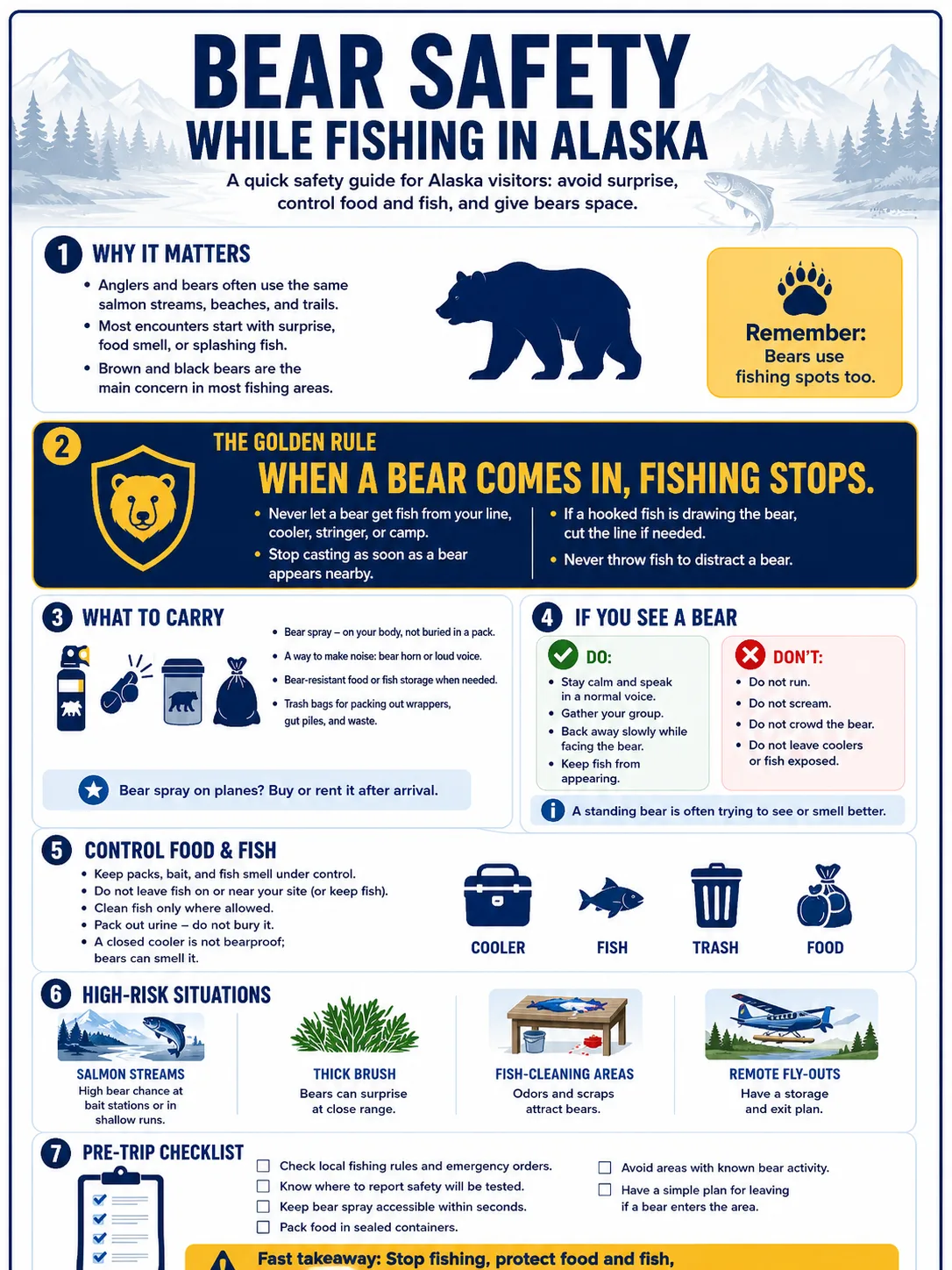
If you remember one thing… if a bear is close enough to notice your fish, stop fishing, secure or release what you can safely control, and leave the bear its space.
What To Know First
- Bears use fishing spots too. Salmon streams, tidal flats, and berry edges can draw bears at the same time anglers arrive.
- A bear should never get your fish. Once a bear learns that anglers mean food, the next visitor may face a worse situation.
- Bear spray must be reachable. A can buried in a backpack is almost useless in a fast encounter.
- Clean habits matter. Fish slime, bait, coolers, lunch wrappers, and fillet scraps can all attract bears.
- Local rules can change. Some areas may have closures, food storage rules, or special instructions from land managers.
The Basic Rule: Do Not Let Bears Get Fish From You
The clearest fishing-specific safety rule is this: do not let a bear take a fish from your line, cooler, stringer, backpack, boat, or cleaning station. A bear that gets food from people may approach anglers again, and that puts both people and bears at risk.
If a bear walks into the same fishing area, stop casting. If you already have a fish on, avoid letting it thrash on the surface. If the fish cannot be controlled without drawing the bear closer, cut the line rather than landing it near the bear. The National Park Service gives the same practical advice for Alaska anglers: stop fishing when a bear approaches, keep a hooked fish from splashing, and cut the line if needed.[a]
- Stop casting as soon as a bear appears nearby.
- Do not wave a fish, stringer, or open cooler around a bear.
- Never toss a fish to distract a bear.
- Leave the fishing spot calmly if the bear keeps moving in.
Why Alaska Fishing Spots Bring Bears and Anglers Together
Bears are not looking for trouble at a river. They are often looking for calories. Salmon runs, dead fish, bait, fish guts, and human food can all pull bears into the same places people choose for fishing.
This is why a quiet river bend can feel empty at 7 a.m. and crowded by noon. A bear may appear from thick alder, step out below a cutbank, or move along the shore with little warning. Wind, rushing water, rain jackets, and boat noise can also make it harder for both you and the bear to hear each other.
- Salmon streams: higher chance of bears during active runs.
- Thick brush: higher chance of surprise at close distance.
- Fish-cleaning areas: higher odor and scraps risk.
- Remote beaches: bears may travel the same shorelines used by anglers.
- Camp areas: food storage becomes part of fishing safety.
Worth Noting
A bear standing up is not always about aggression. Bears often stand to see or smell better. Stay calm, speak in a normal voice, gather your group, and make it easy for the bear to identify you as human.
Bear Safety Gear Anglers Should Carry
The best tool is distance, but Alaska anglers should still carry bear spray in many fishing settings. It should be EPA-registered for use on bears, not expired, and carried where it can be reached within seconds.
Bear spray is not a repellent. Do not spray it on your tent, clothes, tackle bag, cooler, or boat. It is meant to create a cloud between you and an aggressive or charging bear. Alaska Department of Fish and Game notes that bear deterrents can help, but they are not a replacement for clean habits, alert travel, and calm behavior around bears.[b]
What to carry on most Alaska fishing days
- Bear spray in a chest holster, belt holster, or outer pocket you can reach fast.
- A way to make noise, especially in brush or near loud water.
- Bear-resistant food storage when camping or keeping fish in bear country.
- Heavy-duty bags for packing out trash, bait packaging, and fish waste where required.
- A clean plan for lunch, snacks, and fish handling before the first cast.
Travel note for visitors
Airlines do not allow bear spray in passenger baggage, and small aircraft operators may have their own handling rules. ADF&G’s bear spray flier advises travelers to check before flying and to dispose of expired or partly used cans properly.[c]
How to Act When You See a Bear While Fishing
When you see a bear, your job is to avoid surprise, avoid food reward, and avoid crowding the animal. Most encounters can be handled by staying calm, stopping the activity that attracts the bear, and moving away slowly when it is safe.
Do not run. Running can trigger a chase response, and you cannot outrun a bear. Do not scream. Do not throw food or fish. Speak in a calm, firm voice so the bear can recognize you as a person.
| Situation | Safer response | What to avoid |
|---|---|---|
| Bear appears across a small stream | Stop fishing, gather your group, speak calmly, and give the bear the route it wants. | Keep casting across the bear’s path. |
| Bear approaches while a fish is hooked | Keep the fish from splashing if possible; cut the line if needed. | Land the fish near the bear. |
| Bear walks toward your cooler | Move away if safe, speak firmly, and do not try to physically block the bear at close range. | Leave coolers open or unattended. |
| Bear and cubs are near the trail out | Wait at a safe distance or choose another route. | Walk between a bear and cubs. |
| Bear charges | Stand your ground, have bear spray ready, and use it if the bear comes within range. | Turn and run. |
Keeping Food, Fish, and Smells Under Control
Clean storage is bear safety. Food, garbage, bait, fish eggs, scented drinks, fillet scraps, and coolers can all bring bears into camp or onto a riverbank.
Alaska law also treats feeding bears seriously. ADF&G explains that a person may not intentionally feed bears or leave food, animal food, or garbage in a way that attracts them.[d] For anglers, that means sloppy fish handling is not just bad camp behavior. It can create a dangerous pattern.
Better habits around fish and food
- Keep lunch and snacks packed away until you are ready to eat.
- Do not leave stringers in shallow water while you keep fishing.
- Use approved bear-resistant storage where it is required or available.
- Clean fish only where allowed, and follow local instructions for fish waste.
- Wash hands, tools, and surfaces after handling bait or fish.
- Pack out trash instead of burying it.
One Detail People Miss
A cooler is not bear-proof just because it is closed. If it smells like fish or bait, treat it like an attractant and store it under the rules for that area.
Fishing With a Guide, Charter, or Fly-Out Operator
A good guide can reduce risk, but the guide does not remove your responsibility. Listen before the trip starts, ask where fish will be stored, and follow instructions the first time they are given.
Guided fishing often puts visitors in productive bear habitat on purpose. Remote fly-out trips, salmon streams, and national park waters may have clear bear protocols. Katmai National Park notes that anglers are often in areas where bears want to fish and need extra care to reduce bear-human conflict.[e]
Questions to ask before a guided trip
- Do guests carry their own bear spray, or does the guide carry it?
- Where are caught fish stored?
- What happens if a bear enters the fishing area?
- Are there park, refuge, or local food storage rules?
- Will the group move if bears are using the same stretch of water?
Regional Differences: Where Bear Risk Changes
Bear safety is not the same everywhere in Alaska. The risk can shift by region, season, salmon run, visibility, and how much human use a place receives.
Southcentral rivers near Anchorage and the Kenai Peninsula can have both heavy fishing pressure and bear movement. Katmai and Lake Clark are known for brown bear habitat. Southeast Alaska has dense forest, salmon streams, and many black bear areas, plus brown bears on some islands and mainland coastlines. Arctic coastal fishing trips may bring a different set of wildlife concerns, including polar bears in some far northern areas.
How to think about place
- Roadside streams: do not assume crowds make the area bear-free.
- Remote fly-outs: carry a plan for fish storage, lunch, and emergency communication.
- National parks: check park-specific food storage and bear distance rules.
- Thick coastal brush: make more noise before blind bends and river access points.
- Urban edges: bears may still use salmon streams inside or near communities.
Rules, Closures, and Seasonal Changes
Bear safety is mostly behavior, but anglers still need to watch official rules. Some closures are about fish conservation, while others may protect people, bears, or crowded bear-use areas.
ADF&G emergency orders can open or close sport fishing areas, change bag limits, or modify legal methods, and the agency notes that these orders can be issued at any time and carry the force of law.[f] Land managers such as the National Park Service, U.S. Forest Service, U.S. Fish and Wildlife Service, or local authorities may also post area-specific safety instructions.
Before you go, check three things
- The current sport fishing regulations for your management area.
- Any emergency orders for the water you plan to fish.
- Park, refuge, forest, or private operator rules for food, fish, and bear distance.
Before You Move On
A legal fishing spot is not always a smart fishing spot at that moment. If bears are actively feeding there, move or come back later.
Common Mistakes Around Bears While Fishing
Most Alaska bear problems do not begin with someone trying to be careless. They begin with small decisions that feel harmless in the moment.
“If I throw the fish away from me, the bear will leave me alone.”
Correct explanation: Do not feed or distract a bear with fish. That can teach the bear to approach anglers for food.
Why it gets mixed up: In a stressful moment, people think of the fish as a decoy. In bear country, it can become a lesson the bear remembers.
“The bear is far across the river, so I can keep fishing.”
Correct explanation: Stop fishing if the bear is close enough to see or hear a splashing fish. A hooked fish can pull a bear’s attention fast.
Why it gets mixed up: Water makes distance look safer than it is, and bears can move quickly along banks, gravel bars, and shallow crossings.
“My guide has bear spray, so I do not need to think about it.”
Correct explanation: Follow the guide’s plan, but know where the deterrent is and what the group will do if a bear appears.
Why it gets mixed up: Visitors often treat bear safety like a background service. It works better when everyone understands the plan.
“A busy fishing area means bears will avoid it.”
Correct explanation: Bears may still use salmon water near people, roads, cabins, and towns.
Why it gets mixed up: Many visitors picture bears only in remote wilderness. Alaska bears also move through well-used places.
“Bear spray should be in my pack so it stays safe.”
Correct explanation: Bear spray should be carried where you can reach it within seconds.
Why it gets mixed up: People pack it like normal gear. In a surprise encounter, a zipped backpack is too slow.
Real-Life Alaska Fishing Scenarios
These examples are common visitor situations. The safe choice is usually simple: stop fishing, control smells, create distance, and do not let the bear win food.
- A tourist hooks a salmon as a brown bear steps out downstream.
The angler should stop trying to land the fish near the bear and cut the line if the fish starts splashing. - A family leaves lunch beside the tackle bags while everyone spreads along the bank.
Food should stay attended and packed away because unattended food can turn a fishing stop into a bear problem. - A black bear crosses a trail between the river and the parking area.
The group should wait, speak calmly, stay together, and avoid crowding the bear’s route. - A fly-out group reaches a remote stream and sees fresh tracks in the mud.
Fresh sign means the group should make noise, stay close, and be ready to move if bears are actively using the area. - An angler keeps a stringer of fish in shallow water while casting for more.
That stringer can attract bears and should be secured under local rules instead of left in the water. - A bear stands up across the river and looks toward the group.
The group should talk calmly, gather together, and avoid sudden movement rather than assuming a standing bear is charging. - A visitor wants a closer photo of a bear feeding near a salmon stream.
The visitor should back away and use distance, not a phone, as the safety tool.
What To Do if a Bear Charges or Makes Contact
A charge is rare, but every angler in bear country should know the basic response. Stand your ground, keep your group together, have bear spray ready, and do not run.
Lake Clark National Park explains that defensive encounters often happen when a bear is surprised or feels threatened near cubs or food. In those moments, calm behavior, slow movement, and bear spray within range can matter.[g]
If a bear charges
- Stand your ground.
- Speak calmly unless the bear is showing non-defensive interest and needs to be driven away more firmly.
- Use bear spray if the bear comes within range and conditions allow.
- Do not run, turn your back, or scatter your group.
If contact happens
Advice can differ by bear species and by whether the encounter is defensive or predatory. In a defensive brown bear attack, playing dead is often advised after contact. In a black bear attack, fighting back is generally advised. If any bear appears to treat you as prey, enters a tent, or the attack continues, fight back.
These are last-resort rules, not the main plan. The safer plan is to prevent the encounter from reaching that point.
A Simple Pre-Trip Bear Safety Checklist
Bear safety starts before the first cast. A few minutes of planning can prevent the most common mistakes.
- Check local fishing rules, emergency orders, and land manager notices.
- Buy or rent bear spray after arrival if flying commercially.
- Practice removing the safety clip on an inert trainer or empty practice can if available.
- Keep bear spray on your body, not inside a daypack.
- Pack food in sealed containers and keep it attended.
- Know where fish will go after being caught.
- Plan how the group will leave if a bear enters the fishing area.
- Avoid earbuds near brush, loud water, and low visibility trails.
Alaska fishing is safer when anglers treat bears as normal users of the same water, not as rare surprises. The most common mistake is staying focused on the fish after a bear appears. The rule to remember is simple: when a bear comes in, fishing stops.
Bear Safety While Fishing in Alaska Questions Answered
Do bears usually attack people who are fishing in Alaska?
No. Most bears avoid people or ignore them, but fishing creates special risk because bears are attracted to salmon, splashing fish, bait, and fish waste. The safer approach is to prevent surprise and never let a bear get food from you.
Should I stop fishing if I see a bear across the river?
Yes, if the bear is close enough to notice your activity or hear a fish splash. Stop casting, keep the group together, and give the bear room to use the stream.
Can I bring bear spray on a plane to Alaska?
Bear spray is not allowed in passenger baggage on commercial flights. Many visitors buy or rent it after arriving in Alaska. Small aircraft operators may have separate rules, so ask before a fly-out trip.
Is it okay to throw a fish to a bear so it leaves?
No. Feeding a bear with fish can teach it to approach anglers for food. It also creates danger for the next person using that riverbank.
What should I do with fish after catching them in bear country?
Follow local rules and your guide’s instructions. In general, keep fish secured, attended, and away from camp smells. Do not leave fish on a stringer, open bank, or unattended cooler where bears can reach them.
Are black bears and brown bears handled the same way?
Many prevention steps are the same: make noise, stay alert, store food properly, and do not run. If physical contact happens, advice can differ. Defensive brown bear contact often calls for playing dead, while black bear attacks generally call for fighting back.
Do guided fishing trips still require bear awareness?
Yes. Guides can help manage risk, but guests still need to follow instructions, keep food controlled, and stop fishing when told. Bear safety works best when the whole group follows the same plan.
Alaska Fishing References
- [a] National Park Service — Bear Safety in Alaska — Used for fishing-specific advice on stopping when a bear approaches and cutting the line if a hooked fish cannot be controlled. (Reliable because it is an official National Park Service safety page.)
- [b] Alaska Department of Fish and Game — The Essentials for Traveling in Bear Country — Used for general Alaska bear behavior, deterrent limits, and staying alert in bear country. (Reliable because ADF&G is Alaska’s state fish and wildlife agency.)
- [c] Alaska Department of Fish and Game — What You Should Know About Bear Spray — Used for bear spray travel, storage, expiration, and handling notes. (Reliable because it is an official ADF&G public safety flier.)
- [d] Alaska Department of Fish and Game — Living in Harmony with Bears — Used for Alaska’s rule against intentionally or negligently feeding bears and leaving attractants. (Reliable because it cites Alaska regulation and comes from the state wildlife agency.)
- [e] National Park Service — Fishing in Katmai National Park and Preserve — Used for the point that anglers often fish in the same places bears want to fish. (Reliable because it is an official park page for a major Alaska bear and salmon area.)
- [f] Alaska Department of Fish and Game — Sport Fishing Emergency Orders and Press Releases — Used for the need to check current fishing closures and rule changes before a trip. (Reliable because it is ADF&G’s official page for current sport fishing emergency orders.)
- [g] National Park Service — Staying Safe in Bear Country, Lake Clark National Park and Preserve — Used for defensive bear encounter behavior and what to do during a charge or contact. (Reliable because it is an official National Park Service safety page for Alaska bear habitat.)