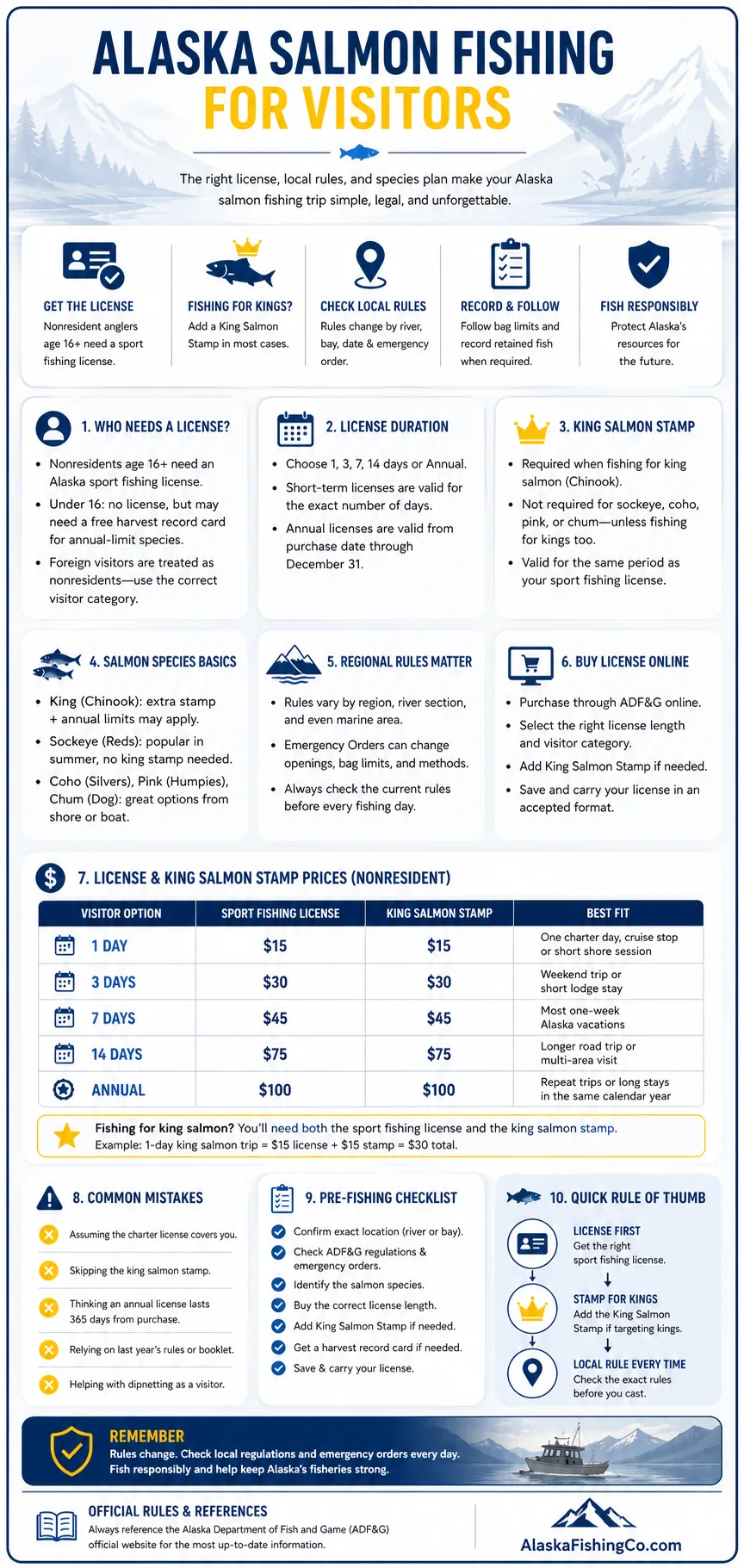
Alaska salmon fishing for visitors is simple only after the trip is matched to the exact water, salmon species, and license rule. Most tourists and foreign visitors age 16 or older need a nonresident sport fishing license, and anyone fishing for king salmon usually needs a king salmon stamp as well. Rules can change by river, bay, date, and emergency order, so the license is only the first step.
If you remember one thing… buy the license for the days you will actually fish, add a king salmon stamp if kings are part of the plan, and check the current rule for the exact place before making a cast.
What To Know First
- Nonresidents age 16 or older need an Alaska sport fishing license to participate in sport fishing [a].
- A king salmon stamp is required when fishing for king salmon, except for king salmon in stocked lakes and a few age/status exceptions [a].
- Foreign visitors are treated as nonresident anglers for sport fishing license purposes; ADF&G also lists foreign/alien nonresident license and stamp prices separately, with the same sport fishing fees shown for most visitor license lengths [b].
- Published regulation booklets are not enough on their own because emergency orders can open, close, or change fisheries at any time [f].
- Tourists should not confuse sport fishing with Alaska personal use dipnetting. Personal use fishing is for Alaska residents only [h].
Alaska Salmon Fishing for Visitors: The Short Answer
Visitors can fish for salmon in Alaska if they have the right license, follow the local salmon rule for that water, and carry any required stamp or harvest record. The exact answer depends on age, residency, salmon species, and where the fishing happens.
For a typical adult tourist, the baseline setup is a nonresident sport fishing license. If the plan includes king salmon, add a king salmon stamp. After that, check the area regulation and current emergency orders before fishing, even when a charter captain or lodge is involved.
- Fishing for sockeye, coho, pink, or chum: usually requires a sport fishing license, but not a king salmon stamp.
- Fishing for king salmon: usually requires both a sport fishing license and a king salmon stamp.
- Fishing with a charter: does not remove the visitor’s personal license responsibility.
- Fishing in fresh water: river-specific rules may change by section, date, and gear type.
- Fishing in salt water: marine rules can differ from nearby rivers, even for the same salmon species.
Who Needs an Alaska Salmon Fishing License?
Most visiting adults need their own Alaska sport fishing license before fishing for salmon. ADF&G states that residents age 18 or older and nonresidents age 16 or older must purchase and possess a sport fishing license to participate in Alaska sport fisheries [a].
This rule applies in fresh water and marine waters. It also applies whether the visitor is fishing from shore, a public dock, a private boat, or a charter vessel.
Visitor age rules
- Nonresident age 16 or older: needs a sport fishing license.
- Nonresident under age 16: does not need a sport fishing license, but may still need a harvest record card when fishing for species with annual limits [c].
- Alaska resident under age 18: does not need a sport fishing license, but may need a harvest record card for annual-limit species [c].
Foreign visitors
International visitors should plan as nonresident anglers. A foreign passport, tourist visa, ESTA entry, cruise stop, student visit, or short-term work trip does not make someone an Alaska resident for sport fishing license purposes.
- Buy the nonresident license length that matches the fishing days.
- Use the foreign/alien nonresident category when the ADF&G license system asks for it.
- Carry the license in a format accepted by ADF&G.
License Types, Prices, and How Long They Last
Visitors usually choose a 1-day, 3-day, 7-day, 14-day, or annual nonresident sport fishing license. Short-term nonresident fishing licenses last only for the selected number of days, while annual licenses are valid from the date of purchase through December 31 of that calendar year [c].
The prices below are the nonresident sport fishing license and nonresident king salmon stamp prices listed by the Alaska Department of Fish and Game [b].
| Visitor option | Sport fishing license | King salmon stamp | Best fit |
|---|---|---|---|
| 1 day | $15 | $15 | One charter day, cruise stop, or short shore session |
| 3 days | $30 | $30 | Weekend trip or short lodge stay |
| 7 days | $45 | $45 | Most one-week Alaska vacations |
| 14 days | $75 | $75 | Longer road trip or multi-area visit |
| Annual | $100 | $100 | Repeat trips or long stays within the same calendar year |
A visitor fishing for king salmon must budget for both items. For example, a nonresident adult on a one-day king salmon charter normally needs a $15 sport fishing license plus a $15 king salmon stamp.
Worth Noting
An annual Alaska sport fishing license is not a 365-day license. It runs only through December 31, so a license bought late in the year still ends at the end of that calendar year.
King Salmon Stamp and Harvest Record Rules
The king salmon stamp is the extra requirement visitors miss most often. If a visitor is fishing for king salmon, also called Chinook salmon, the stamp is normally required in addition to the sport fishing license, except for king salmon in stocked lakes and the listed age/status exceptions [a].
The stamp is tied to the act of fishing for king salmon, not only to keeping one. If the trip is designed around king salmon, the safe plan is to have the stamp before the first cast or trolling pass.
- King salmon: sport fishing license plus king salmon stamp for most nonresident visitors age 16 or older.
- Sockeye, coho, pink, and chum: sport fishing license, but no king salmon stamp unless the visitor is also fishing for kings.
- Annual-limit species: harvest recording may apply. Do not wait until the end of the day to fill it out.
- Youth visitors: a nonresident under 16 does not need a license, but may still need a free harvest record card for annual-limit fish [c].
When to record a retained king salmon
For 2026 Southeast Alaska king salmon rules, ADF&G says nonresidents must record the species, date, and location immediately after landing and retaining a king salmon [g]. That is a useful habit anywhere harvest recording applies: record the fish in the field, not later at the cabin, hotel, or dock.
Salmon Species Visitors Usually Target
Alaska has several salmon fishing experiences, and the license question changes most sharply when king salmon are part of the plan. Timing also matters because salmon runs vary by area, and ADF&G notes that run-timing charts show availability only; some waters may still be closed [d].
Visitors often hear different names for the same fish. King and Chinook refer to the same salmon. Coho are often called silvers. Sockeye are often called reds. Pink salmon are often called humpies, and chum salmon may be called keta or dog salmon.
King salmon
King salmon are the species most likely to require extra paperwork, strict annual limits, and emergency rule checks. Visitors should treat king salmon as the highest-attention salmon from a licensing standpoint.
- Usually requires a king salmon stamp.
- May have annual limits for nonresidents.
- Can be closed or restricted in specific rivers, marine areas, or dates.
Sockeye salmon
Sockeye are a major summer target in places such as the Kenai, Russian River area, Bristol Bay systems, and other salmon waters. A king salmon stamp is not needed for sockeye alone, but local bag limits, open areas, and legal methods still matter.
- Often planned around run timing.
- Popular for shore and river fishing.
- Rules can change by river section.
Coho, pink, and chum salmon
Coho, pink, and chum salmon can be good visitor targets because many fisheries are accessible from shore or short local trips. These species usually do not require a king salmon stamp, but daily limits and area rules still apply.
- Coho: often a later-season target in many areas.
- Pink: often easier for first-time salmon anglers when runs are present.
- Chum: strong fighters, with opportunity varying by place and timing.
One Detail People Miss
Do not plan only by the word “salmon.” A king salmon trip has different paperwork than a sockeye-only trip, and a river rule can differ from the nearby saltwater rule on the same day.
Regional Differences That Change the Rules
Alaska salmon rules are local. ADF&G tells anglers to select the region, then the exact drainage or area, and to check emergency orders before finalizing plans because emergency orders supersede published regulations [e].
This matters for visitors because many Alaska trips cross more than one fishery. A traveler might fish Ship Creek near Anchorage, then the Kenai River, then a Homer saltwater charter. Those are not one single rule set.
Southcentral Alaska and the Kenai area
Southcentral Alaska is popular because visitors can reach many waters by road from Anchorage, Soldotna, Kenai, Seward, and Homer. It is also an area where king salmon restrictions and closures are common in some years, so emergency orders must be checked before fishing.
- Kenai and Kasilof rules can change by run, date, and river section.
- Cook Inlet saltwater king rules may differ from nearby river rules.
- Sockeye and coho trips still require local rule checks, even without a king stamp.
Southeast Alaska
Southeast Alaska has many marine salmon opportunities near Ketchikan, Juneau, Sitka, Petersburg, Wrangell, and Yakutat. For 2026, ADF&G announced Southeast marine king salmon rules that include a nonresident bag and possession limit of one king salmon 28 inches or greater, with annual limits changing by date [g].
- Nonresident king salmon annual limits may change after June 30.
- Some local areas may have nonretention periods or terminal harvest exceptions.
- Retained king salmon must be recorded immediately when the rule requires it.
Southwest, Interior, and northern areas
Remote salmon trips can involve more than a simple license purchase. Access, local closures, subsistence areas, conservation actions, and exact river rules can all affect whether a visitor can fish and what can be kept.
- Remote lodges should still tell visitors to check ADF&G rules directly.
- Air taxi or lodge logistics do not replace fishing regulations.
- Some waters may be open for one salmon species and closed for another.
How to Buy an Alaska Salmon Fishing License Online
Visitors can buy sport fishing licenses and king salmon stamps online through ADF&G, and license formats can include printed/electronic licenses and eSigned licenses depending on how they are purchased [c].
Before buying, decide the exact dates you will fish and whether king salmon are part of the plan. Do not wait until the boat is leaving the harbor or the group is standing at the riverbank.
- Choose the nonresident sport fishing license length that covers every fishing day.
- Select the foreign/alien nonresident option if the online system asks for visitor status.
- Add the matching king salmon stamp if fishing for king salmon.
- Check whether anyone in the group needs a free harvest record card.
- Save the license in an accepted format and make sure it is signed or eSigned as required.
- Keep the license available while fishing, not packed away in luggage or offline storage you cannot open.
Before You Move On
Buy the license for the person who will fish, not for the family group. A license and king salmon stamp are personal documents and should not be shared.
Common Mistakes Visitors Make
Most Alaska salmon fishing problems for visitors come from small assumptions. The fishery may look casual from the dock or riverbank, but the rules are specific.
Mistake: Assuming the charter license covers everyone
Wrong idea: “The captain has a license, so the guests are covered.”
Correct explanation: Each visitor who fishes needs the required personal license, and king salmon anglers usually need their own king salmon stamp.
Why it gets mixed up: Charters often help with instructions, tackle, and local rule reminders, so visitors may think the paperwork is included automatically.
Mistake: Buying a salmon license but skipping the king salmon stamp
Wrong idea: “A fishing license covers every salmon.”
Correct explanation: A sport fishing license covers the base permission to fish, but king salmon usually require the extra stamp.
Why it gets mixed up: The word “salmon” makes the species sound interchangeable, but king salmon are treated differently.
Mistake: Treating an annual license like it lasts one full year from purchase
Wrong idea: “I bought it in August, so it should last until next August.”
Correct explanation: Annual licenses run through December 31 of the calendar year, while short-term nonresident licenses last for the chosen 1, 3, 7, or 14 days [c].
Why it gets mixed up: Many travel passes and memberships run for 12 months, but Alaska fishing licenses do not work that way.
Mistake: Relying on last year’s blog post or printed booklet only
Wrong idea: “The regulation booklet said this river was open.”
Correct explanation: Emergency orders can change openings, closures, bag limits, and harvest methods, and they have the force of law [f].
Why it gets mixed up: Visitors often plan months ahead, while salmon management can change during the season.
Mistake: Helping with dipnetting as a visiting friend or relative
Wrong idea: “I am not keeping fish, so I can help handle the net.”
Correct explanation: Alaska personal use fishing is open to Alaska residents only [h].
Why it gets mixed up: Dipnetting may look like a family activity on the beach, but it is not a tourist sport fishery.
Real-Life Visitor Scenarios
The easiest way to understand Alaska salmon rules is to place them in normal visitor situations. These examples show how the license, stamp, and local rule checks fit together.
- Cruise passenger booking a one-day Ketchikan king salmon charter:
That visitor usually needs a 1-day nonresident sport fishing license and a 1-day king salmon stamp, plus a check of Southeast king salmon annual limits. - Family fishing for sockeye near the Kenai Peninsula:
Adult nonresidents need sport fishing licenses, but they do not need king salmon stamps unless they are also fishing for kings. - Foreign visitor age 15 fishing with parents:
The 15-year-old nonresident does not need a sport fishing license, but may need a harvest record card if fishing for an annual-limit species. - Visitor in Anchorage trying shore fishing after work:
A nonresident adult needs a sport fishing license and must check the exact local water, because urban streams can have special openings, closures, or gear rules. - Homer saltwater trip targeting coho and halibut, not king salmon:
A nonresident sport fishing license is still needed, but a king salmon stamp is not usually needed unless the trip also fishes for kings. - Traveler staying with Alaska friends during dipnet season:
The visitor may watch, but should not participate in personal use fishing because that fishery is limited to Alaska residents. - Southeast visitor keeping a July king salmon:
The visitor must pay attention to the nonresident annual limit and record the retained king salmon immediately when required.
Worth Noting
The same visitor may need different answers on different days of the same trip. A sockeye river day, a king salmon trolling day, and a coho shore-fishing evening are three separate rule checks.
A Simple Planning Checklist Before You Fish
A visitor should finish the paperwork and rule check before arriving at the water. This avoids rushed license purchases, poor cell service, and confusion about species or area rules.
- Confirm the exact fishing location, including river section or marine area.
- Check the current ADF&G regional regulation page.
- Check emergency orders for the same region and area.
- Identify the salmon species you plan to fish for.
- Buy the correct nonresident license length.
- Add a king salmon stamp if fishing for king salmon.
- Get a harvest record card if anyone in the group needs one.
- Save and carry the license in an accepted format.
Alaska salmon fishing is easiest when the paperwork, species plan, and local rules are checked in that order. The most common mistake is treating “salmon” as one rule instead of checking the exact water and species. A good rule to remember: license first, stamp for kings, local rule before every cast.
Alaska Salmon Fishing Questions Answered
Do tourists need a fishing license for salmon in Alaska?
Yes. Most nonresident tourists age 16 or older need an Alaska sport fishing license to fish for salmon. A king salmon stamp is usually required if they fish for king salmon.
Can foreign visitors buy an Alaska salmon fishing license online?
Yes. Foreign visitors can buy nonresident sport fishing licenses online through ADF&G. They should choose the correct nonresident or foreign/alien visitor category when purchasing.
Do visitors need a king salmon stamp for sockeye or coho?
No, not for sockeye or coho alone. The king salmon stamp applies to fishing for king salmon. A sport fishing license is still required for most nonresident visitors age 16 or older.
How long is an Alaska nonresident fishing license valid?
Short-term nonresident licenses are valid for 1, 3, 7, or 14 days, depending on the option purchased. Annual licenses are valid through December 31 of the calendar year.
Can visitors dipnet salmon in Alaska?
No. Alaska personal use fisheries, including personal use dipnet fisheries, are limited to Alaska residents. Visitors should use sport fishing opportunities instead.
Do children visiting Alaska need a salmon fishing license?
Nonresident children under 16 do not need an Alaska sport fishing license. They may still need a free harvest record card when fishing for a species with an annual limit.
What should visitors check before fishing for salmon in Alaska?
Visitors should check the license requirement, species rules, area regulation page, emergency orders, bag limits, possession limits, size rules, and any harvest recording requirement for the exact water they plan to fish.
Alaska Fishing References
- [a] Alaska Department of Fish and Game — Sport Fishing Licenses, King Salmon Stamps, IDs and Harvest Record Cards. Used for age rules, king salmon stamp rules, stocked lake exception, and harvest record card basics. (Official state fish and wildlife agency.)
- [b] Alaska Department of Fish and Game — License, stamp, and tag prices. Used for nonresident sport fishing license prices and king salmon stamp prices. (Official state licensing source.)
- [c] Alaska Department of Fish and Game — General license information. Used for license validity periods, license formats, age rules, and harvest record card notes. (Official state licensing FAQ.)
- [d] Alaska Department of Fish and Game — Sport Fish Run Timing. Used for the point that salmon timing depends on location and that run-timing charts do not override closures. (Official state sport fishing planning resource.)
- [e] Alaska Department of Fish and Game — Sport Fishing Regulations. Used for regional regulation navigation and the reminder that anglers must check area rules. (Official state regulation page.)
- [f] Alaska Department of Fish and Game — Emergency Orders and Press Releases. Used for the rule that emergency orders can change seasons, areas, bag limits, and methods and have legal effect. (Official state emergency order source.)
- [g] Alaska Department of Fish and Game — 2026 Southeast Alaska Regional King Salmon Sport Fishing Regulations. Used for 2026 Southeast nonresident king salmon limits and immediate recording language. (Official 2026 ADF&G advisory announcement.)
- [h] Alaska Department of Fish and Game — Personal Use Fishing. Used for the visitor warning that personal use fishing is open to Alaska residents only. (Official state personal use fishery page.)