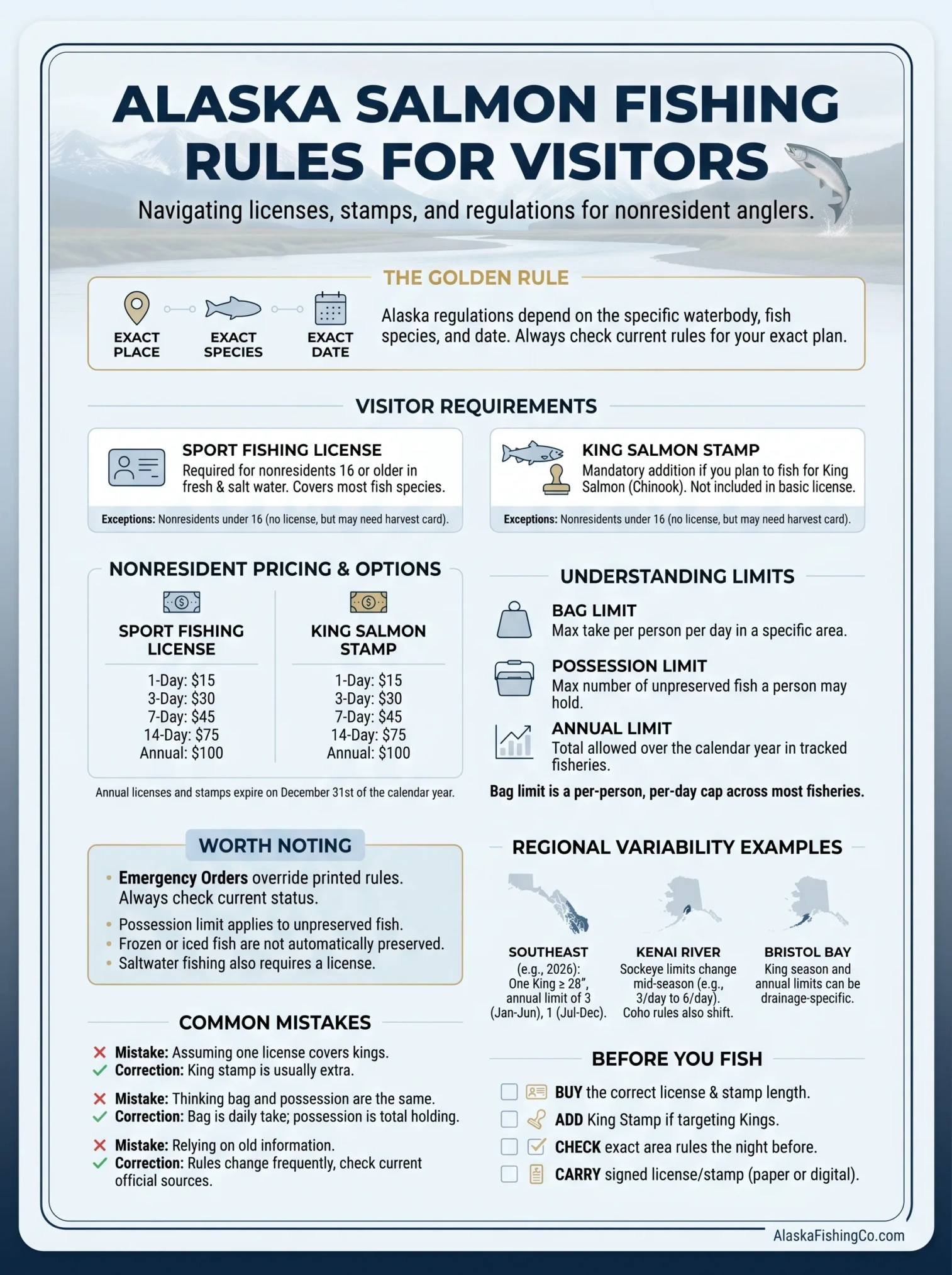
Visitors to Alaska usually need a sport fishing license if they are 16 or older, and they also need a king salmon stamp if they plan to fish for king salmon. Salmon limits are not one statewide number. They change by species, river, marine district, and date.[a]
That is the part many visitors miss. A rule that is legal on one river can be wrong on another, and an emergency order can change what the printed booklet said before your trip started.[h]
If you remember one thing… Alaska salmon fishing is regulated by exact place + exact species + exact date. Always match your license and stamp to your plan, then read the current rule for the water you will actually fish.[d]
What To Know First
The short version is simple. Most visitor mistakes happen before the first cast, not after the first fish.
- Age matters: nonresidents under 16 do not need a sport fishing license, but annual-limit fisheries can still require a harvest record card.[a]
- King salmon is different: if kings are part of the plan, assume you need extra paperwork unless the fishery clearly says otherwise.[a]
- Short trip or long trip: Alaska sells nonresident sport licenses and king stamps in 1-day, 3-day, 7-day, 14-day, and annual options.[b]
- Saltwater still counts: the license rule applies in both fresh and marine waters.[a]
- Emergency orders come first: the current order on the day you fish is the rule that matters.[h]
What visitors actually need before salmon fishing in Alaska
For most visitors, the legal checklist is this: buy the right nonresident sport fishing license, add a king salmon stamp only if king salmon are part of the trip, and carry whatever harvest record is required for any fishery with an annual limit.[a]
Sport fishing license
Nonresidents age 16 and older must have an Alaska sport fishing license to fish in fresh water or salt water. Current nonresident prices are $15 for 1 day, $30 for 3 days, $45 for 7 days, $75 for 14 days, and $100 for an annual license.[b] Annual licenses run through December 31 of the calendar year, while short-term nonresident licenses are valid only for the number of days purchased.[c]
- Pick the license length that covers every day you may fish, not just your main guided day.
- If weather delays the trip and you might fish another day, buy enough coverage from the start.
- Carry the signed license with you in the field, whether it is on paper or on your phone.[c]
King salmon stamp
If you plan to fish for king salmon, Alaska also requires a king salmon stamp, except for king salmon in stocked lakes.[a] Current nonresident king stamp prices are $15 for 1 day, $30 for 3 days, $45 for 7 days, $75 for 14 days, and $100 for an annual stamp.[b]
- Buy the stamp even if kings are only part of the day’s plan.
- Do not assume a general salmon trip covers king salmon automatically.
- Read the area rule to see whether king retention is open, closed, or limited to certain sizes.[h]
Under-16 anglers and foreign visitors
Nonresidents under 16 do not need a sport fishing license. Still, if they fish in a place with an annual limit, they may need a free harvest record card.[a] Foreign visitors can buy Alaska fishing licenses online too, and the current fishing prices on the state price sheet match the standard nonresident prices.[b]
| Trip situation | What you need | What to double-check |
|---|---|---|
| Adult visitor chasing sockeye, coho, pink, or chum | Nonresident sport fishing license | Exact river or marine area limit, season dates, and any emergency order |
| Adult visitor fishing for king salmon | Nonresident sport fishing license + king salmon stamp | Retention status, size rule, annual limit, and recording rule |
| Visitor under age 16 | No sport fishing license | Whether the fishery has an annual limit and needs a harvest record card |
| Short trip with one or two fishing days | 1-day or multi-day short-term license | Make sure the license covers every day you may actually fish |
| Long stay with flexible plans | Annual license, and annual king stamp if needed | Annual items run by calendar year, not twelve months from purchase |
Worth Noting
A possession limit is not the same thing as “whatever fits in the cooler.” Alaska defines possession limit as the maximum number of unpreserved fish you may have. Fish packed on ice, dry ice, or lightly salted are not automatically treated as preserved fish.[d]
How Alaska salmon limits really work
When visitors ask about “the limit,” Alaska usually means one of three different rules: a bag limit, a possession limit, and sometimes an annual limit. You need to know which one applies before you keep fish.[d]
ADF&G defines a bag limit as the maximum legal take per person per day in the area where that person is fishing. A possession limit is the maximum number of unpreserved fish a person may have in possession.[d] In annual-limit fisheries, harvest must also be tracked across the calendar year.[a]
- Bag limit: what one angler may take in that area on that day.
- Possession limit: how many unpreserved fish that angler may legally hold.
- Annual limit: the total allowed over the calendar year in fisheries where Alaska uses yearly harvest tracking.
There is another rule many visitors overlook. You cannot take a full daily bag in one area, move to another area, and then take another full daily bag of the same species just because the name of the water changed. Alaska treats the daily bag as a per-person, per-day cap across fisheries, with only narrow exceptions where one area has a more liberal limit and the math still stays within the legal total.[d]
- Read “in combination” carefully. It means the total can be a mix of salmon species up to that limit, not a full limit of each species.
- Read size rules carefully. Some king salmon rules change at 20 inches or 28 inches.
- Read recording rules carefully. Annual-limit fisheries often require immediate harvest recording.
How the Five Pacific Salmon Species Differ for Visitors
Alaska recognizes five Pacific salmon species: king (Chinook), coho (silver), sockeye (red), pink (humpy), and chum (dog). The extra king salmon stamp applies only when fishing for king salmon; the other four species still require the normal sport fishing license when the angler is old enough to need one.[a]
The exact bag, possession, season, gear, and size rules remain local. The 2026 Kenai River regulations show how coho, sockeye, pink, and chum can have different limits or combination rules on the same river.[f]
| Species | Common Alaska name | Extra king stamp? | What visitors should check most closely |
|---|---|---|---|
| King salmon | Chinook / king | Yes, unless an exemption applies | Retention status, size thresholds, annual limits, harvest recording, and local closures |
| Coho salmon | Silver | No | Season dates, daily limits, combination limits, and local in-season closures |
| Sockeye salmon | Red | No | Run timing, drainage-specific bag and possession limits, and in-season increases or restrictions |
| Pink salmon | Humpy | No | Area-specific bag limits, season timing, and whether the fish count separately or in combination |
| Chum salmon | Dog | No | Combination limits, season dates, and gear rules for the exact river or marine area |
Where seasons and limits change the most
The biggest visitor trap is assuming every Alaska salmon fishery works the same way. It does not. Southeast marine king rules changed several times in 2026.[e] Kenai sockeye timing follows its own seasonal structure,[f] while Bristol Bay king and gear rules can change by drainage.[g]
Southeast Alaska king salmon in 2026
Southeast Alaska’s nonresident marine king salmon limits changed several times during 2026. All of the regional limits below apply to king salmon 28 inches or greater, and local nonretention areas or special hatchery-area rules can still be more restrictive.[e]
- April 1-June 30: 1 king salmon per day and in possession; annual limit 3.
- July 1-July 10: 1 per day and in possession; annual limit 2.
- July 11-July 31: 2 per day and in possession; annual limit 3.
- August 1-September 30: 2 per day and in possession; annual limit 4.
- October 1-December 31: the temporary summer liberalizations ended, so the underlying regional rule returned to 1 per day and in possession with a 1-fish annual limit for the July 1-December 31 period.
King salmon retained earlier in the year counted toward the revised annual limits as the summer orders changed. Nonresidents must record a retained king salmon immediately with the species, date, and location. When fishing in the exclusive economic zone between 3 and 200 nautical miles from shore, all anglers follow the nonresident Southeast king salmon limits in force for that date.[e]
Kenai River and Russian River examples
Southcentral rules show how one drainage can shift by season. In the lower Kenai River, sockeye salmon 16 inches or longer are listed at 3 per day, 6 in possession from August 16 through June 19, but from June 20 through August 15 the limit is 6 per day, 12 in possession, sockeye only. Coho rules shift by season as well. On the Russian River, sockeye are open June 11 through August 20 at 3 per day, 6 in possession, while coho are open July 1 through September 30 at 1 per day, 1 in possession.[f]
- Kenai limits can change in the middle of summer, not just at the start or end of the season.
- Some waters are open year-round for one salmon species and closed for another.
- Tackle, boat, and same-day fishing restrictions can attach to a retained fish in popular waters.[f]
Bristol Bay example
Bristol Bay shows why serious salmon trips need drainage-specific reading before arrival. In a July 14, 2026 advisory, ADF&G confirmed that new Bristol Bay sport fishing regulations adopted during the 2026 Board of Fisheries cycle were in effect.[g]
In the Naknek River drainage, king salmon 20 inches or longer are limited to 3 per day and 3 in possession, with only 1 fish 28 inches or longer allowed in that daily and possession limit. The annual limit is 5 king salmon 20 inches or longer from the drainage, only 2 of which may be 28 inches or longer. Every retained king salmon 20 inches or longer must be recorded. Kings under 20 inches have a 10-per-day, 10-in-possession limit and no annual limit.[g]
In the Nushagak River drainage, the use of bait and multiple hooks is prohibited from May 1 through July 31. Separate emergency orders can still tighten seasons, retention, gear, or waters during the run.[g]
- A lodge itinerary does not replace the actual regulation for that drainage.
- Naknek and Nushagak do not use one interchangeable king salmon rule.
- If kings are part of the plan, check the base regulation and the latest in-season order before fishing.
One Detail People Miss
In Southeast Alaska’s exclusive economic zone, between 3 and 200 nautical miles from shore, anglers must follow the nonresident king salmon rules, including annual limits, even if they are Alaska residents.[e]
How to buy the right Alaska salmon license online
Buying online is straightforward if you decide the trip length and target species before checkout. Most mistakes come from buying a short license that ends too soon or forgetting the king stamp when a guide mentions kings later.[a]
- Choose your trip window first. Count every day you may legally fish, including backup weather days.
- Select the nonresident sport fishing license length. Short-term licenses work for fixed itineraries. Annual licenses make more sense for longer or repeated trips.[c]
- Add a king salmon stamp only if kings are part of the trip. If the plan is sockeye only, you usually do not need the stamp.[a]
- Sign the license. Alaska requires the license to be signed and in possession before fishing.[c]
- Save and carry it properly. A printed copy or valid electronic copy is fine, but the license holder needs to have it available in the field.[c]
- Check the exact area regulation the night before. The online purchase is only the start. It does not tell you today’s river-specific closure or retention change.[h]
Common mistakes visitors make
The most common Alaska salmon errors are not complicated. They usually come from carrying the wrong paperwork, reading the wrong river page, or misunderstanding how daily and yearly limits work. Current area rules and emergency orders control the first problem;[h] the statewide definitions explain the daily and possession-limit terms.[d]
1) “I’m fishing saltwater, so I don’t need a license.”
Wrong idea: some visitors assume the license rule is only for rivers.
Correct rule: Alaska’s sport fishing license requirement applies in both fresh and marine waters.[a]
Why it gets mixed up: in some places outside Alaska, saltwater licensing works differently.
2) “I bought a salmon license, so I’m covered for kings too.”
Wrong idea: one fishing license covers every salmon situation.
Correct rule: king salmon usually needs a separate stamp on top of the sport fishing license.[a]
Why it gets mixed up: many visitors treat “salmon” as one category, but Alaska does not regulate kings that way.
3) “My guide said the river was open last year, so the rule is probably the same.”
Wrong idea: last season’s screenshot is close enough.
Correct rule: emergency orders override the printed summary, so the current order controls.[h]
Why it gets mixed up: Alaska uses in-season management when runs are stronger or weaker than expected.
4) “Bag limit and possession limit mean the same thing.”
Wrong idea: if the cooler looks fine, the rule must be fine.
Correct rule: bag limit is what you may take that day; possession limit is how many unpreserved fish you may hold.[d]
Why it gets mixed up: travelers often think frozen or iced fish automatically stop counting, which is not always how Alaska defines preserved fish.
5) “A child never needs any salmon paperwork.”
Wrong idea: under-16 anglers are exempt from everything.
Correct rule: nonresidents under 16 do not need a sport fishing license, but annual-limit fisheries can still require a harvest record card.[a]
Why it gets mixed up: people hear “no license needed” and stop reading there.
6) “I can catch my limit on one river, then drive to another and do it again.”
Wrong idea: each river gives a fresh same-day limit.
Correct rule: Alaska treats the daily bag as a per-person, per-day cap across fisheries, subject only to narrow exceptions where the combined take still fits the legal math.[d]
Why it gets mixed up: visitors see a new access point and assume it means a new daily count.
Before You Move On
If your plan includes more than one river, more than one species, or a guided day plus a self-guided day, build your paperwork around the most restrictive legal path first. It is much easier to buy one extra day of coverage than to explain an expired license in the field.
Real-Life Scenarios
These are the kinds of situations Alaska visitors actually run into. The rule changes are easier to remember when they are tied to real trip plans.
- A family from Germany books one sockeye day on the Russian River.
Adults need nonresident sport fishing licenses, the 14-year-old does not, and nobody needs a king stamp if the trip is truly sockeye-only. - A couple from Arizona books a halibut charter, then hears kings are around too.
If they may fish for king salmon, they should add king stamps before boarding rather than assuming the charter paperwork covers it. - A visitor buys a 3-day license but weather pushes the trip into day four.
The legal answer is not “close enough.” The license has to cover the actual day fished. - A teenager from California fishes with family in a fishery that has an annual king limit.
No sport fishing license may be needed under age 16, but a harvest record card can still matter in annual-limit fisheries. - A lodge guest in Bristol Bay assumes every nearby river uses the same king rule.
That is risky. In 2026, Naknek and Nushagak use different king and gear rules, and in-season orders can add another layer. - An angler keeps salmon in one area, then wants to stop at a second river on the drive back.
The first catch still counts toward that day’s legal bag, so a second full daily limit is not automatically allowed. - A Southeast angler sees an old summer king limit online and stops reading.
The 2026 regional limits changed on July 1, July 11, August 1, and again when the temporary summer orders expired after September 30. Local nonretention zones can still be more restrictive.
Before your Alaska salmon trip starts
The safest approach is simple. Buy the right license length, add the king salmon stamp if kings are anywhere in the plan, and read the exact waterbody rule one more time before you leave the hotel or lodge.
That extra check matters more in Alaska than in many visitor fisheries because salmon runs are managed closely and in-season changes are normal. The legal answer depends on the water in front of you, not on a generic statewide memory.
The most common mistake is assuming last year’s screenshot, a forum comment, or a guide’s older handout is still current.
The rule worth keeping in your head is this: the legal salmon limit is the rule in force on that water on that day.
Visitor Salmon Fishing Questions Answered
Do tourists need a fishing license in Alaska for salmon?
Yes. Nonresidents age 16 and older need an Alaska sport fishing license to fish for salmon in fresh water or salt water. Nonresidents under 16 do not need the license, but annual-limit fisheries can still require a harvest record card.
Do foreigners need a special Alaska salmon permit?
Usually no special salmon permit is needed beyond the normal nonresident sport fishing license. If the trip includes king salmon, a king salmon stamp is usually required as well.
Do I need a king salmon stamp if I already have an Alaska fishing license?
Yes, if you plan to fish for king salmon. The king salmon stamp is separate from the sport fishing license, except in the specific situations Alaska lists as exempt.
How long is an Alaska nonresident fishing license valid?
Short-term nonresident licenses are valid for 1, 3, 7, or 14 days. Annual licenses run through December 31 of the calendar year.
Are Alaska salmon limits the same everywhere?
No. Limits change by species, river or marine district, season dates, and emergency orders. There is no single statewide visitor salmon limit that works everywhere.
Can I keep salmon in one area and then catch another full limit somewhere else the same day?
Not as a general rule. Alaska treats the bag limit as a per-person, per-day cap across fisheries, with only narrow exceptions when the combined take still fits the legal limit structure.
Alaska Fishing References
- [a] Sport Fishing Licenses, King Salmon Stamps, IDs and Harvest Record Cards — Used for who needs a sport fishing license, king salmon stamp requirements, nonresident age exemptions, fresh and marine water coverage, and harvest record cards. (Reliable because it is the Alaska Department of Fish and Game’s official sport licensing page.)
- [b] Product Prices: Licenses, Stamps, and Tags — Used for current nonresident sport fishing license and king salmon stamp prices, including foreign/alien price lines. (Reliable because it is the Alaska Department of Fish and Game’s official price list.)
- [c] Fishing and Hunting License General Information — Used for annual and short-term license validity, signed/eSigned license rules, and age-based harvest record requirements. (Reliable because it is the Alaska Department of Fish and Game’s official licensing guidance.)
- [d] 2026 Southcentral Alaska Sport Fishing Definitions — Used for bag limit, possession limit, preserved fish, calendar-year definitions, and the rule that a daily bag limit applies across fisheries. (Reliable because it is a 2026 Alaska Department of Fish and Game regulation summary drawn from Alaska statutes and administrative code.)
- [e] Southeast Alaska Regional King Salmon Sport Fishing Regulations for 2026; July 11 Southeast King Salmon Liberalization; August 1 Southeast King Salmon Increase — Used together for the 2026 nonresident Southeast king salmon timeline, annual limits, recording rule, and EEZ treatment. (Reliable because all three are official Alaska Department of Fish and Game emergency-order or advisory records.)
- [f] 2026 Kenai River Sport Fishing Regulations — Used for current lower Kenai and Russian River salmon examples and for the different 2026 coho, sockeye, pink, and chum limit patterns. (Reliable because it is the 2026 Alaska Department of Fish and Game regulation booklet for the Kenai River.)
- [g] 2026 Bristol Bay Sport Fishing Regulation — Used for the Naknek River king salmon bag, possession, annual, size, and recording rules and the May 1-July 31 Nushagak bait and multiple-hook prohibition. (Reliable because it is an official Alaska Department of Fish and Game 2026 Bristol Bay regulation announcement.)
- [h] Sport Fishing Regulations — Used for checking the exact region and drainage and for the rule that emergency orders supersede published regulation summaries. (Reliable because it is the Alaska Department of Fish and Game’s current sport fishing regulation portal.)