
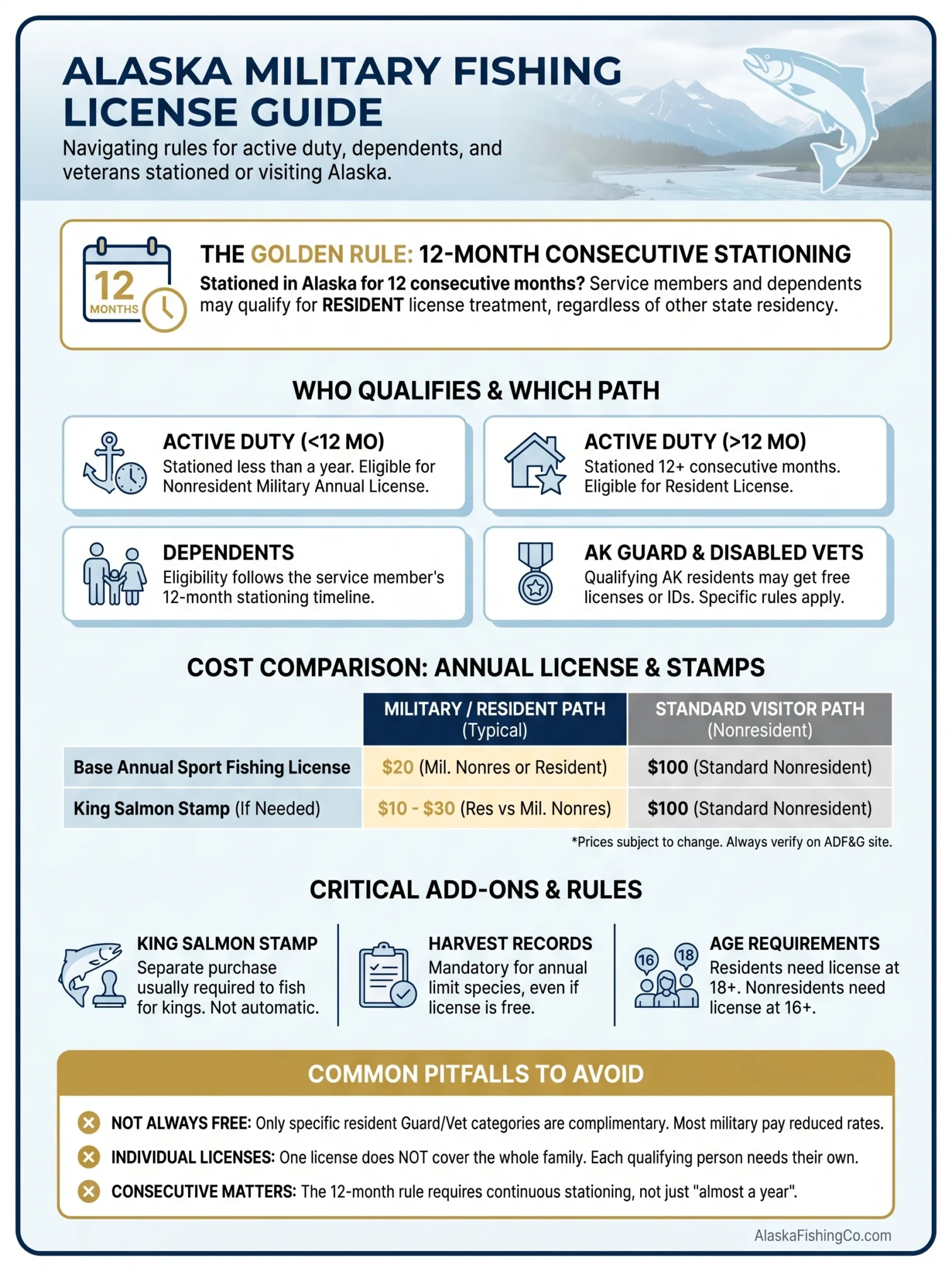
Active-duty military members stationed in Alaska may be able to buy an Alaska fishing license at a military rate, and after 12 consecutive months in the state they may be able to buy a resident license instead. Dependents can qualify in some cases too, but the right choice changes based on military status, time stationed in Alaska, age, and whether king salmon is part of the plan.[a]
Alaska also has a separate free annual sport fishing license for qualifying Alaska resident National Guard and Reserve members, plus a free identification card for qualifying Alaska resident disabled veterans. That means “military license” is not one single product in Alaska. It is a group of different rules.[a]
If you remember one thing… the Alaska military fishing rule that matters most is the 12-month stationing mark. Before that point, many service members use the annual nonresident military license. After that point, many can move into resident-license treatment instead.[d]
What To Know First
- The current Alaska military fishing option on the pricing page is an annual sport fishing license, not a short weekend military pass.[b]
- Military dependents can matter just as much as the service member. Alaska mentions dependents in both the under-12-month and over-12-month stationing rules.[a]
- If you plan to fish for king salmon, you may need a separate king salmon stamp unless you fall into a stated exemption.[c]
- Resident and nonresident age cutoffs are different: Alaska uses 18+ for residents and 16+ for nonresidents for the basic sport fishing license.[c]
- Local fishery rules can change during the season. Alaska tells anglers to check current regulations and emergency orders before fishing.[g]
Who Gets the Alaska Military Fishing License
The short answer is simple: Alaska gives military-related fishing breaks to a few specific groups, not to every person with military background. The biggest categories are active-duty U.S. military or U.S. Coast Guard members stationed in Alaska, certain dependents, Alaska resident National Guard and Reserve members, and Alaska resident disabled veterans who meet the state’s rules.[a]
Here is how those groups break out in practice:
- Active-duty U.S. military or U.S. Coast Guard stationed in Alaska for less than 12 months: may buy the nonresident military annual sport fishing license at the reduced military rate.
- Dependents of those service members: Alaska includes dependents in the less-than-12-month and 12-month military stationing rules.
- Service members and dependents stationed in Alaska for 12 consecutive months: may buy a resident license under Alaska’s military rule, even without giving up another state’s residency privileges.
- Alaska resident National Guard and qualifying Reserve members actively serving: may apply for a complimentary annual sport fishing license.
- Alaska resident disabled veterans certified 50% disabled or greater: may apply for a free disabled veteran identification card that works in place of a sport fishing license.
What does not automatically appear on Alaska’s military licensing page is a blanket rule that every veteran, retiree, contractor, or visiting military guest fishes for free. If someone does not fit one of Alaska’s listed categories, the safer move is to treat the trip like a standard resident or nonresident fishing-license question until ADF&G says otherwise.[a]
What It Costs Right Now
The basic price picture is easy to remember. Alaska’s current official pricing page lists the nonresident military annual sport fishing license at $20 and the nonresident military annual king salmon stamp at $30. On the same page, Alaska lists the regular resident annual sport fishing license at $20 and the resident annual king salmon stamp at $10.[b]
That means the real money difference is usually not the standard fishing license itself. It shows up more clearly when:
- you are comparing military pricing with the standard nonresident annual sport fishing license at $100,
- you need a king salmon stamp, or
- you are trying to decide whether the 12-month resident rule changes your setup.
| Angler type | Fishing license path | Base sport fishing cost | King salmon add-on | What matters most |
|---|---|---|---|---|
| Active-duty military / Coast Guard stationed in Alaska less than 12 months | Nonresident military annual sport fishing license | $20 | Military annual king salmon stamp: $30 if needed | Good fit for stationed military who are not yet at 12 months |
| Service member or dependent stationed in Alaska 12 consecutive months | Resident sport fishing license | $20 | Resident annual king salmon stamp: $10 if needed | Resident-license treatment starts to matter more than the military discount |
| Alaska resident National Guard / Reserve member actively serving | Complimentary annual sport fishing license | Free | King salmon stamp may still be needed | Residency and active service status matter |
| Alaska resident disabled veteran, 50%+ certified | Disabled veteran ID card | Free | No king salmon stamp purchase required | Must keep Alaska residency; harvest-record rules can still apply |
| Standard nonresident visitor | 1-day, 3-day, 7-day, 14-day, or annual nonresident license | $15 / $30 / $45 / $75 / $100 | $15 / $30 / $45 / $75 / $100 | Best fit when no military category applies |
One Detail People Miss
Alaska’s pricing page shows a military annual sport fishing license. It does not list separate 1-day, 3-day, 7-day, or 14-day military fishing licenses the way it does for standard nonresidents. That catches a lot of stationed service members by surprise when they only plan to fish once or twice.[b]
Age Rules, Dependents, and Which License Length Makes Sense
The short answer is this: in Alaska, resident anglers 18 and older and nonresident anglers 16 and older need a sport fishing license. Younger anglers under those cutoffs do not buy the basic license, but they can still fall into harvest-record rules in some fisheries with annual limits.[c]
This matters a lot for military families because Alaska does not treat “family fishing” as one shared license. The adult service member has a license question, the spouse has a license question, and older teenage dependents can have one too.
- Dependent child age 15: usually no sport fishing license is needed because the nonresident cutoff is age 16.
- Dependent spouse: if that spouse is actively fishing and is old enough to need a license, they need their own license or qualifying ID.
- Older teen dependent age 16 or 17: often needs a separate license unless already qualifying under resident treatment after the 12-month rule.
- King salmon plans: stamp rules can still change the answer, even when the basic license question seems settled.
For trip length, Alaska’s standard nonresident system offers short options. The military fishing product on the pricing page does not. So a short Alaska visit with no qualifying military category usually points toward the standard 1-day, 3-day, 7-day, or 14-day nonresident license. A stationed service member who does qualify for Alaska’s military rate usually ends up choosing the annual military product Alaska publishes.[b]
How the 12-Month Rule Changes Everything
This is the part most military anglers need to get right. Alaska says U.S. military and Coast Guard members, and their dependents, who are permanently stationed in Alaska for less than 12 months can buy the special military license. After 12 consecutive months stationed in Alaska, those service members and dependents can buy a resident license without giving up residency privileges in another state.[a]
In plain English, that means the price break is only half the story. The bigger shift is that after the 12-month point, Alaska lets many military households move into the resident-license lane for fishing.
How to think about the 12-month mark
- Less than 12 months in Alaska: use the special military path if you qualify.
- At 12 consecutive months in Alaska: check whether you now fit Alaska’s military resident-license rule.
- Transferred out of Alaska later: the military-based temporary resident path ends when the transfer happens, unless you separately meet Alaska’s ordinary domicile-style residency rule.
Alaska also publishes a residency-qualification page that repeats the military benchmark in a simpler form: a member of the military service, or their dependent, stationed in Alaska for the preceding 12 consecutive months probably meets the fishing-residency test for licensing purposes.[d]
Worth Noting
The 12-month military exception is not the same thing as ordinary Alaska residency. Alaska also has a separate domicile-style residency rule for people who truly make Alaska home and stop claiming resident benefits somewhere else. Mixing those two paths together is where people start buying the wrong license.[a]
King Salmon, Harvest Records, and Region Rules
The short answer is that the military license does not replace king-salmon rules. Alaska says anglers generally need a king salmon stamp to fish for king salmon, except for king salmon in stocked lakes and a few stated exemptions. Alaska also uses harvest records in fisheries with annual limits, and those requirements still matter even when a person is otherwise exempt from buying a standard license.[c]
For military anglers, the usual pressure points are these:
- Stationed less than 12 months: the current military king salmon product on the pricing page is the annual military stamp at $30.
- Resident treatment after 12 months: the resident annual king salmon stamp is $10 if no exemption applies.
- Resident disabled veterans: Alaska says a disabled veteran ID holder does not need to buy a king salmon stamp, but may still need a free harvest record card for fisheries with annual limits.
- Under-age anglers: resident anglers under 18 and nonresidents under 16 do not buy a king salmon stamp, but some still need harvest-record paperwork in annual-limit fisheries.
Just as important, military status does not freeze local fishery rules in place. Alaska says emergency orders can open or close areas, change bag limits, or change methods, and the regulations page says those emergency orders always supersede the printed regulations. That is why a valid license is only step one.[g]
What should be checked before a king salmon trip
- The correct license class for the service member or dependent
- Whether a king salmon stamp is needed
- Whether a harvest record card is required
- The region-specific regulation page
- The current emergency-order page for that region
How To Buy Online Without Getting the Wrong Item
The short answer is that Alaska makes online purchase fairly easy, but the person-by-person details matter. ADF&G sells licenses through its online store, and licenses can be carried in paper form or electronically. Every license must be signed to be valid, and one person cannot electronically sign another person’s license for them.[e]
- Start with the correct person. If more than one family member is fishing, treat each person as a separate license choice.
- Pick the right status. That may be nonresident military annual, resident annual after 12 months, Guard/Reserve application, disabled veteran ID, or a standard nonresident license.
- Add the king salmon stamp if needed. Do not assume military pricing automatically covers it.
- Finish the signature step. Alaska says a license must carry a physical signature or eSignature to be valid.
- Carry the license the right way. Alaska allows paper, electronic, or eSigned formats, but the angler is still responsible for having it on hand.
The Alaska mobile app can display licenses, permits, stamps, and tags, record fishing harvest, and show regulations. It also keeps some functions available offline after the app has been opened online, but Alaska still recommends carrying paper if battery life is shaky.[f]
Before You Move On
If you buy licenses for a spouse or older child in the same order, do not stop at checkout and assume the job is done. Alaska says each individual must sign their own license. That small step is easy to miss and easy to fix before you leave the dock.[e]
Common Mistakes Military Anglers Make
The short answer is that most Alaska military-license mistakes come from using the right word but the wrong category. “Military,” “resident,” “veteran,” and “dependent” sound close, but Alaska treats them differently.
“I’m military, so I can fish for free.”
- Wrong assumption: Any military connection means no fishing-license cost.
- Correct explanation: Alaska offers several military-related paths, but only some are free, and each has its own eligibility rule.
- Why it gets mixed up: Active-duty pricing, Guard/Reserve benefits, and disabled veteran benefits all sit under Alaska’s military licensing umbrella.[a]
“I’ve been in Alaska almost a year, so I can already buy a resident license.”
- Wrong assumption: Close enough to 12 months is good enough.
- Correct explanation: Alaska uses 12 consecutive months for the military resident-license rule.
- Why it gets mixed up: PCS timing, arrival dates, and informal local advice often blur the exact date.[d]
“My spouse can fish under my military license.”
- Wrong assumption: One family license covers the boat.
- Correct explanation: Each fishing adult or older teen who needs a license needs their own license or qualifying ID.
- Why it gets mixed up: Alaska includes dependents in the eligibility rule, but that does not turn a personal license into a shared family pass.[a]
“The fishing license covers king salmon too.”
- Wrong assumption: Once the sport fishing license is handled, salmon is handled too.
- Correct explanation: King salmon often needs a separate stamp unless a listed exemption applies.
- Why it gets mixed up: People focus on the license purchase and forget that salmon has its own extra step.[c]
“The app means I don’t need to check local rules.”
- Wrong assumption: Buying the license is the same thing as checking the fishery conditions.
- Correct explanation: Alaska says emergency orders can change fishing rules during the season and can override printed regulations.
- Why it gets mixed up: License purchase feels like the finish line, but for Alaska fisheries it is really the starting point.[g]
Real-Life Scenarios
The short answer is that most people understand the Alaska military fishing license faster when they picture a real trip. These examples are close to what stationed anglers and visiting military families actually run into.
- Air Force member at Joint Base Elmendorf-Richardson, in Alaska for 4 months, fishing on a weekend:
Even for a short trip, the military fishing product Alaska lists is the annual nonresident military license, not a weekend military pass. - Coast Guard member in Kodiak for 13 months, still keeping a Florida driver’s license:
Alaska says a service member stationed in Alaska for 12 consecutive months can buy a resident fishing license without giving up another state’s residency privileges under the military exception. - Army spouse who also wants to fish the Kenai:
The spouse is not covered by the service member’s personal license; they need their own license if they are old enough to require one. - Dependent child age 15 fishing with the family:
That child generally does not need the basic nonresident sport fishing license, but king-salmon and annual-limit harvest-record rules should still be checked before the trip. - Alaska resident Army Reserve member living in Anchorage:
If actively serving and otherwise eligible, that angler may apply for the complimentary annual Guard/Reserve sport fishing license, but king salmon still needs a separate look before the trip. - Alaska resident disabled veteran rated 70% disabled:
If the veteran meets Alaska’s residency rule and gets the disabled veteran ID card, Alaska says the person does not need to buy a sport fishing license or king salmon stamp, though a harvest record card may still be needed in annual-limit fisheries. - Service member transferred out of Alaska after previously using the 12-month military resident rule:
The temporary military resident path ends on transfer, so the angler should not assume the resident fishing license still works unless a separate Alaska residency basis remains valid.
Before You Head To The Water
The Alaska military fishing license can be easy to handle once the angler matches the trip to the right military category. The hard part is usually not buying a license at all. It is buying the right one for the service member, spouse, child, or veteran who will actually be fishing.
The mistake seen most often is buying a resident license too early, or assuming a military discount covers every person in the group. The rule worth keeping in mind is simple: check the person, the 12-month stationing status, and the king-salmon plan before paying for anything.
Alaska Military Fishing License Questions Answered
Do active-duty military members need a fishing license in Alaska?
Yes, in most cases. Alaska offers special military pricing for qualifying active-duty service members and Coast Guard members stationed in Alaska, but that is still a fishing-license system, not a blanket waiver.
Can military dependents get the Alaska military fishing rate?
Yes, Alaska includes dependents in the under-12-month and 12-consecutive-month stationing rules on its military licensing page. The dependent still needs their own qualifying license if they are old enough to need one.
Can a service member keep another state’s residency and still buy an Alaska resident fishing license after 12 months in Alaska?
Yes, under Alaska’s military rule. After 12 consecutive months stationed in Alaska, a service member and dependent can buy a resident license without giving up residency privileges in another state for that Alaska licensing purpose.
Do military anglers need a king salmon stamp in Alaska?
Usually yes, if they are fishing for king salmon and no listed exemption applies. The military annual king salmon stamp is a separate item from the military annual sport fishing license.
Do veterans get a free Alaska fishing license?
Not every veteran does. Alaska’s free veteran fishing benefit is for qualifying Alaska resident disabled veterans who are certified 50% disabled or greater and receive the disabled veteran ID card.
Can I buy an Alaska military fishing license online?
Yes. Alaska sells licenses through the ADF&G online store, and the license can be carried in approved paper or electronic form. It still needs a valid signature.
What happens to the military resident-license rule after I transfer out of Alaska?
Alaska says the temporary military resident status tied to being stationed in Alaska expires immediately upon transfer to another state. A separate Alaska residency path may still exist, but that is a different test.
Alaska Fishing References
- [a] Military Licenses — Alaska Department of Fish and Game — Supports the military categories used in this article: active-duty stationed in Alaska, dependents, the 12-month rule, Alaska resident National Guard/Reserve licensing, disabled veteran licensing, and transfer-related residency notes. (Reliable because it is the official state licensing page from the agency that sets and administers these rules.)
- [b] Prices: Sport Fishing Licenses and King Salmon Stamps — Alaska Department of Fish and Game — Used for the current price amounts for resident, nonresident, and military fishing licenses and king salmon stamps. (Reliable because it is the official Alaska pricing page for these products.)
- [c] Sport Fishing Licenses, King Salmon Stamps, IDs and Harvest Record Cards — Alaska Department of Fish and Game — Supports the age cutoffs, basic license requirement, king salmon stamp rule, stocked-lake exception, purchase locations, and harvest-record basics. (Reliable because it is the official statewide sport-fishing licensing information page.)
- [d] Residency Qualifications — Alaska Department of Fish and Game — Used for the 12-consecutive-month military stationing test and the plain-language residency checkpoint. (Reliable because it is an official ADF&G residency page tied to fishing and hunting licensing.)
- [e] Purchasing Your License Online and eSigning Your License FAQ — Alaska Department of Fish and Game — Supports the online-purchase steps, signature requirement, license formats, and the rule that each person must sign their own license. (Reliable because it is the official ADF&G FAQ for online licensing and eSigned licenses.)
- [f] Mobile App FAQ — Alaska Department of Fish and Game — Used for app-based license display, harvest recording, regulation access, offline use, and paper-copy caution. (Reliable because it is the official ADF&G app help page.)
- [g] Emergency Orders & Press Releases — Sport Fish — Alaska Department of Fish and Game — Supports the warning that Alaska sport-fishing rules can change during the season and that anglers should check current emergency orders before they fish. (Reliable because it is the official ADF&G sport-fishing emergency-order page.)