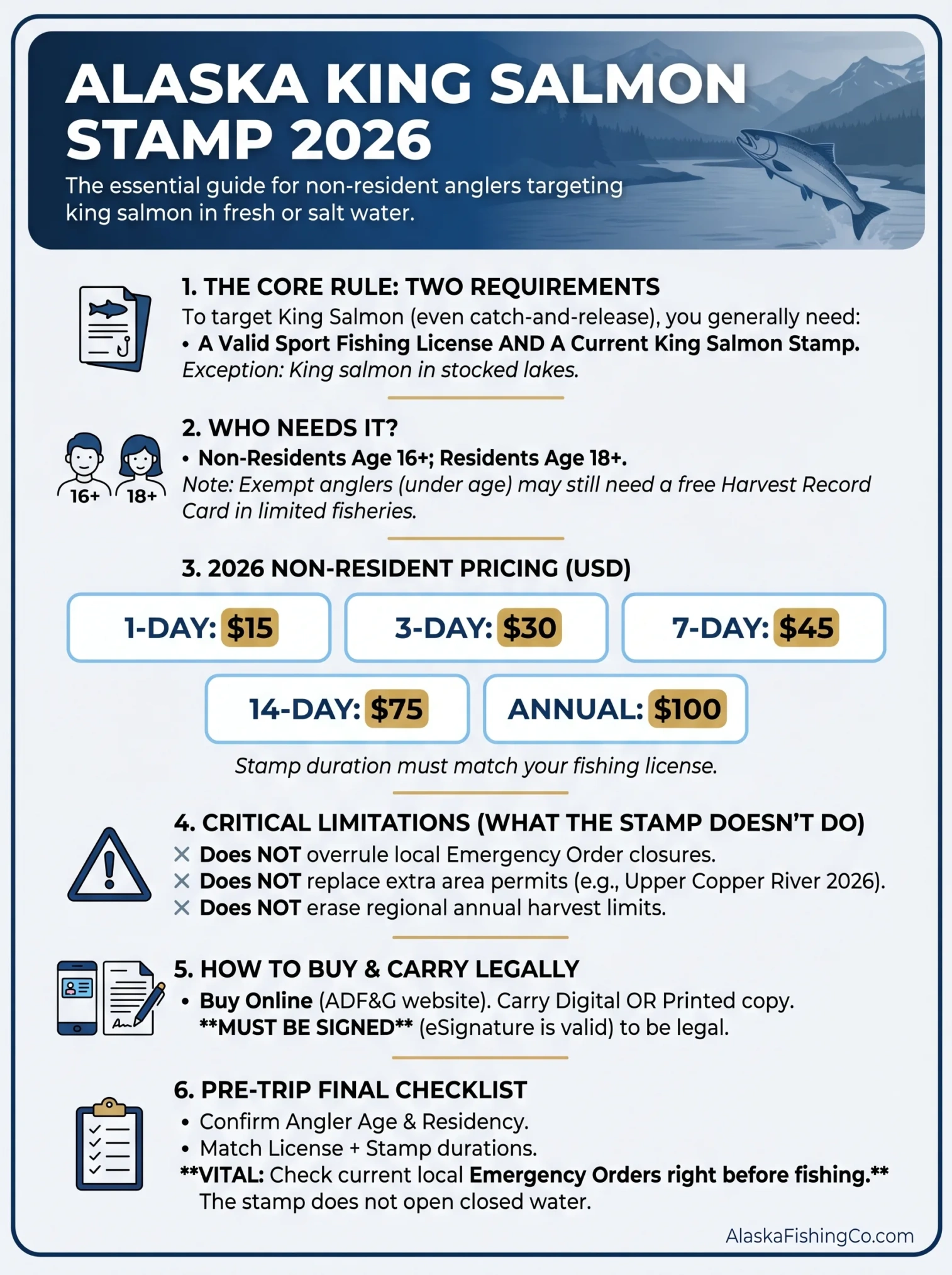
An Alaska King Salmon Stamp is the extra state requirement for most anglers who plan to sport fish for king salmon in Alaska. For 2026, that usually means carrying two things: a valid Alaska sport fishing license and a current king salmon stamp, with a narrow exception for king salmon in stocked lakes.[a] Residents age 18 and older and nonresidents age 16 and older are the main groups who need the license, and those same anglers generally need the stamp when they are targeting king salmon in fresh or salt water.[a]
If you remember one thing, remember this: the stamp lets you legally fish for king salmon, but it does not overrule local closures, bag limits, annual harvest limits, harvest-record rules, or extra area permits.[e]
What To Know First
- Fishing for kings usually means license + stamp. One without the other is not enough for most adult anglers.[a]
- Catch-and-release still counts. If you are fishing for king salmon, the stamp rule still applies, except in stocked lakes.[a]
- Foreign visitors use nonresident options. There is no separate tourist-only king salmon stamp product.[b]
- 2026 rules vary by area. Some fisheries are restricted, closed, or have extra paperwork even when you already bought the stamp.[e]
- Online purchase is normal. ADF&G allows printed and electronic license formats, but the license must be signed to be valid.[d]
Who actually needs the Alaska King Salmon Stamp?
For most adults, the answer is simple: if you are sport fishing for king salmon in Alaska, you need the stamp in addition to your sport fishing license. That applies in both fresh water and marine water, and it also applies when the plan is catch-and-release rather than harvest.[a]
The rule catches people because they focus on keeping fish, not targeting fish. Alaska’s licensing page is more direct than that. The stamp is tied to fishing for king salmon, not only to keeping one. The usual exception is king salmon in stocked lakes.[a]
There are also a few age and resident-status exceptions. Resident anglers under 18 and nonresident anglers under 16 do not need to buy the stamp. Some Alaska resident-only categories also do not need it, including holders of a senior Permanent Identification Card, disabled veteran cards, low-income sport fishing licenses, and resident blind sport fishing licenses. In fisheries with annual limits, though, those exempt anglers may still need a harvest record card.[a]
- Need the stamp: Most resident anglers 18+ and nonresident anglers 16+ who are fishing for king salmon.[a]
- Do not need the stamp: Residents under 18, nonresidents under 16, and certain Alaska resident exemption categories.[a]
- Still may need paperwork: Harvest record cards and, in some fisheries, extra permits.[a]
2026 prices and what a king salmon trip usually costs
The short answer is that the stamp is not expensive by itself for residents, but it changes the total for visitors because nonresidents need to buy both the license and the matching stamp option. In many common trip setups, the stamp cost mirrors the nonresident short-term license cost.[b]
For Alaska residents, the annual king salmon stamp is $10. For nonresidents, king salmon stamp choices are sold as 1-day, 3-day, 7-day, 14-day, and annual options at $15, $30, $45, $75, and $100. Nonresident military anglers stationed in Alaska for less than 12 months have a separate annual king salmon stamp price of $30.[b]
| Trip setup | Sport fishing license | King salmon stamp | Total |
|---|---|---|---|
| Resident annual king salmon setup | $20 | $10 | $30 |
| Nonresident 1-day king salmon trip | $15 | $15 | $30 |
| Nonresident 3-day king salmon trip | $30 | $30 | $60 |
| Nonresident 7-day king salmon trip | $45 | $45 | $90 |
| Nonresident 14-day king salmon trip | $75 | $75 | $150 |
| Nonresident annual king salmon setup | $100 | $100 | $200 |
Foreign visitors are listed separately in the state fee schedule, but for sport fishing and king salmon stamp pricing they are effectively using the same common nonresident price ladder most travelers use.[b]
- Resident: annual sport fishing license + annual king salmon stamp.[b]
- Visitor from another U.S. state: short-term or annual nonresident license + matching king salmon stamp choice.[b]
- Foreign visitor: same practical trip planning approach as a nonresident angler.[b]
One Detail People Miss
A lot of anglers budget for the fishing license and forget the stamp. If the trip is really about king salmon, plan for two separate items, not one.[b]
What foreign visitors and other nonresidents should know
If you are coming from outside Alaska, the state treats you as a nonresident angler for sport fishing license purposes. That means you pick a short-term license or annual license, then add the king salmon stamp if king salmon are on the plan.[b]
This part matters because Alaska trips vary a lot. Some people come for a one-day charter out of Seward or Ketchikan. Others fish across a week at a lodge or split time between halibut, trout, and salmon. The state’s nonresident structure works well for that, but only if the duration matches what you are actually doing.[b]
Age rules matter too. A 15-year-old nonresident does not need the sport fishing license or the king salmon stamp, but that does not always mean “no paperwork.” In fisheries with annual limits, younger anglers may still need the free harvest record card.[c]
- Under 16 and visiting Alaska: usually no sport fishing license and no king salmon stamp, but check harvest-record needs.[c]
- Age 16 and older and visiting Alaska: buy the nonresident sport fishing license and add the king salmon stamp if targeting kings.[a]
- Only fishing for species other than king salmon: the stamp is generally not part of the purchase unless you are actually fishing for kings.[a]
How to buy it online and carry it legally
The easy answer is that Alaska makes online buying normal, and you can carry your license in printed or electronic form. What matters is that the license is valid, signed, and in your possession while you fish.[d]
ADF&G says anglers can buy sport fishing licenses and king salmon stamps online, through the mobile app, from local vendors, or at Fish and Game offices. For online purchases, the system supports printed/electronic licenses and eSigned licenses. A paper copy is fine. A stored electronic copy is also fine. The part people forget is the signature requirement.[a][d]
For a normal trip, the order is straightforward. Pick the sport fishing license first, add the king salmon stamp for the same angler, then save or print the final documents. If the fishery has annual harvest limits or extra permit rules, add those pieces before the trip rather than trying to sort it out on the dock.[a]
- Go to the ADF&G online store and choose the correct angler profile.[a]
- Select the sport fishing license that fits the trip length.[b]
- Add the king salmon stamp if the trip includes fishing for king salmon.[a]
- Use a valid signature or eSignature so the license is actually usable.[d]
- Save the electronic copy or print it before leaving cell service behind.[d]
- Bring any harvest record card or extra permit the area requires.[a]
Worth Noting
Buying the stamp online is the easy part. The step that causes trouble is showing up with an unsigned license, or without the extra harvest record or area permit a king fishery may also require.[d][h]
What the stamp does not cover in 2026
The king salmon stamp is not blanket permission to fish for kings anywhere in Alaska. It is only one layer of compliance. Area rules, emergency orders, harvest limits, and special permits can still control the trip.[e]
This is where many generic articles fall short. They tell you what to buy, but not how fast local king rules can change. Alaska’s own regulations page says emergency orders can open or close areas, change bag limits, or modify fishing methods, and those emergency orders have the force of law and override the published summaries.[e]
That matters in real 2026 fishing, not just in theory. In Southeast Alaska marine waters, nonresidents are on a one-fish bag and possession limit, with an annual limit of three king salmon from January 1 through June 30 and one king salmon from July 1 through December 31, with earlier harvest counting toward the later one-fish annual limit.[f] In Southcentral, 2026 orders include examples such as Kenai closures and Kasilof restrictions rather than open-ended king opportunity everywhere.[g] In the Upper Copper River drainage, anglers fishing for king salmon in 2026 also need a separate no-cost permit on top of the license and stamp.[h]
- It does not override a closure. If the area is closed to king salmon fishing, the stamp does not reopen it.[e]
- It does not replace harvest recording. Some fisheries still require immediate recording of retained fish.[f]
- It does not replace extra area permits. Upper Copper River is the clearest 2026 example.[h]
- It does not erase annual harvest limits. Southeast nonresident rules show how much that can matter over a long trip.[f]
Common mistakes anglers make with the Alaska King Salmon Stamp
The short answer is that most mistakes come from assuming the stamp works like a souvenir add-on. It does not. It is tied to a living set of Alaska sport fishing rules that can vary by age, area, and season.[a][e]
“I’m releasing everything, so I don’t need the stamp.”
Correct: If you are fishing for king salmon, the stamp still applies even for catch-and-release, except in stocked lakes.[a]
Why people mix it up: In some places, extra salmon paperwork is tied only to harvest. Alaska’s stamp rule is broader.
“I bought the Alaska fishing license, so I’m fully covered.”
Correct: A king salmon trip usually requires both the sport fishing license and the king salmon stamp.[a]
Why people mix it up: The store sells them as separate items, and guides sometimes talk about “license” as shorthand for the whole setup.
“My child never needs any Alaska salmon paperwork.”
Correct: Younger anglers may be exempt from the license and stamp, but harvest record card rules can still apply in fisheries with annual limits.[c]
Why people mix it up: “No license required” sounds like “nothing required,” and those are not always the same thing.
“The stamp means the season is open where I’m going.”
Correct: Emergency orders and local regulations still control the fishery and can close or restrict it even after you buy the stamp.[e]
Why people mix it up: The word “stamp” sounds like permission, but Alaska manages king fisheries area by area.
“Foreign visitors need some extra tourist-only salmon stamp.”
Correct: In ordinary trip planning, foreign visitors use the nonresident sport fishing and king salmon stamp options.[b]
Why people mix it up: The fee schedule has a separate foreign/alien section, which makes it look like a different product when the common price ladder is effectively the same for sport fishing and king salmon stamps.
- When in doubt, check four things: the species you are targeting, the area rules, the current emergency orders, and whether a harvest record or extra permit is part of that fishery.[e]
Before You Move On
A valid stamp is not the last step. In 2026 Alaska king fisheries, the final answer often comes from the local ADF&G area page and current emergency order for the place you are about to fish.[e]
Real-Life Scenarios
The easiest way to understand the stamp is to picture normal visitor trips. These are the situations where people either get it right the first time or realize too late that one piece is missing.
- A Seattle angler books a one-day June charter and wants to target king salmon.
Buy a 1-day nonresident sport fishing license and a 1-day king salmon stamp, then check the current area emergency orders before boarding.[b][e] - A couple from Germany will fish for a week at a lodge that mixes trout days and king days.
Use nonresident license options and add the king salmon stamp if king salmon are part of the week, because foreign visitors are handled through the nonresident structure.[b] - A 15-year-old from California is fishing with family for kings.
The youth angler usually does not need the sport fishing license or the king salmon stamp, but may still need a harvest record card where annual-limit rules apply.[c] - An Alaska resident already has the annual sport fishing license and decides to chase kings for one weekend in July.
The resident still needs the annual king salmon stamp, because the regular sport fishing license by itself is not enough for king salmon fishing.[b] - An Alaska senior resident with a Permanent Identification Card plans to fish the Upper Copper River in 2026.
The resident may not need to buy the regular sport fishing license or stamp, but the fishery still requires the separate Upper Copper king permit for anglers targeting king salmon there in 2026.[h] - A visitor is fishing the Kasilof River in late May and thinks the stamp means any king can be kept.
The stamp does not change the 2026 Kasilof rule set, where the season, hatchery-only retention, and other restrictions still control what can happen that day.[g] - A nonresident spends part of the year in Southeast Alaska and keeps fishing after July 1.
The stamp still does not override the Southeast nonresident annual limit structure, which tightens after June 30 and counts earlier harvest toward the later one-fish annual limit.[f]
Before you leave for the water
The best last-minute answer is simple: check your documents, then check your area rules again. That second step matters more in Alaska king salmon fishing than many visitors expect.[e]
A strong pre-trip routine keeps the day easy. Confirm the angler’s age category, make sure the sport fishing license and king salmon stamp are both in place if kings are the target, confirm whether a harvest record card or extra permit applies, and read the current area page one more time before heading out. Alaska’s own regulations site says emergency orders can change the fishery at any time and supersede the printed summaries.[e]
- Check the angler’s age. The age threshold changes what must be purchased.[a]
- Match the trip length. Nonresident short-term choices are there for a reason.[b]
- Confirm target species. If king salmon are truly on the plan, add the stamp.[a]
- Check current local rules. Closures, limits, and methods can change in season.[e]
- Carry signed documents. Printed and electronic formats are both workable when done correctly.[d]
For most visitors, the right move is straightforward: buy the sport fishing license that fits the trip, add the king salmon stamp if kings are part of the plan, and read the local ADF&G rules one more time before fishing. The mistake seen most often is treating the stamp like blanket permission for every Alaska king fishery. The rule worth remembering is this: the stamp opens the door, but the river, saltwater area, season, and current emergency order decide what happens next.[e]
Alaska King Salmon Stamp Questions Answered
Do tourists need a king salmon stamp in Alaska?
Yes, if they are sport fishing for king salmon and they are in the age group that needs a sport fishing license. Most adult visitors need both a nonresident sport fishing license and a king salmon stamp.
Can foreigners buy an Alaska King Salmon Stamp online?
Yes. ADF&G sells sport fishing licenses and king salmon stamps online, and the state fee structure includes nonresident options that foreign visitors can use for trip planning.
Do I need the stamp if I am only doing catch-and-release for king salmon?
Usually yes. Alaska says anglers fishing for king salmon, including catch-and-release, need the current-year stamp, except for king salmon in stocked lakes.
How much is a nonresident Alaska King Salmon Stamp in 2026?
The common nonresident options are $15 for 1 day, $30 for 3 days, $45 for 7 days, $75 for 14 days, and $100 for an annual stamp.
Do kids need an Alaska King Salmon Stamp?
Resident anglers under 18 and nonresident anglers under 16 do not need to buy the stamp, but some fisheries still require a harvest record card when annual limits apply.
Does the stamp let me fish for king salmon anywhere in Alaska?
No. Local regulations, emergency orders, annual harvest limits, and extra permits can still close or restrict a fishery even when you already bought the stamp.
Alaska Fishing References
- [a] Sport Fishing Licenses, King Salmon Stamps, IDs and Harvest Record Cards — licensing trigger, age thresholds, stocked-lake exception, and harvest-record basics for king salmon trips. (Official Alaska Department of Fish and Game licensing page; primary state rule source)
https://www.adfg.alaska.gov/index.cfm?adfg=sportlicense.main - [b] Prices: Sport Fishing Licenses and King Salmon Stamps — 2026 resident, nonresident, foreign visitor, and military pricing used for planning actual trip cost. (Official Alaska Department of Fish and Game fee schedule; state pricing authority)
https://www.adfg.alaska.gov/index.cfm?adfg=sportlicense.prices - [c] Fishing and Hunting License General License Information — age rules, short-term nonresident license duration, and harvest-record reminders that matter for family travel. (Official Alaska Department of Fish and Game licensing FAQ; explains how the rule structure works in practice)
https://www.adfg.alaska.gov/index.cfm?adfg=license.general - [d] Purchasing Your License Online Frequently Asked Questions — eSigned licenses, printed versus electronic copies, and signature requirements before fishing. (Official Alaska Department of Fish and Game purchase/compliance instructions; direct source for carrying documents legally)
https://www.adfg.alaska.gov/index.cfm?adfg=license.onlinefaqs - [e] Emergency Orders and Press Releases — explains that emergency orders can open or close fisheries, change limits, and override published sport fishing regulations. (Official Alaska Department of Fish and Game live regulatory bulletin; current in-season control point)
https://www.adfg.alaska.gov/sf/EONR/ - [f] Southeast Alaska Regional King Salmon Sport Fishing Regulations for 2026 — used for the 2026 Southeast example on nonresident bag limits and annual harvest limits. (Official Alaska Department of Fish and Game 2026 area announcement; current regional king salmon rule source)
https://www.adfg.alaska.gov/sf/EONR/index.cfm?NRID=4006&Year=2026&adfg=region.NR - [g] Emergency Orders and Press Releases — Southcentral — used for current 2026 examples such as Kenai closures and Kasilof king salmon restrictions. (Official Alaska Department of Fish and Game regional emergency order index; live Southcentral status source)
https://www.adfg.alaska.gov/sf/EONR/index.cfm?ADFG=region.R2 - [h] Upper Copper River King Salmon Sport Fishery Will Require New Permit in 2026 — used for the extra no-cost permit example that applies on top of the license and king salmon stamp. (Official Alaska Department of Fish and Game 2026 advisory announcement; current area-specific permit rule)
https://www.adfg.alaska.gov/sf/EONR/index.cfm?NRID=4022&Year=2026&adfg=region.NR