
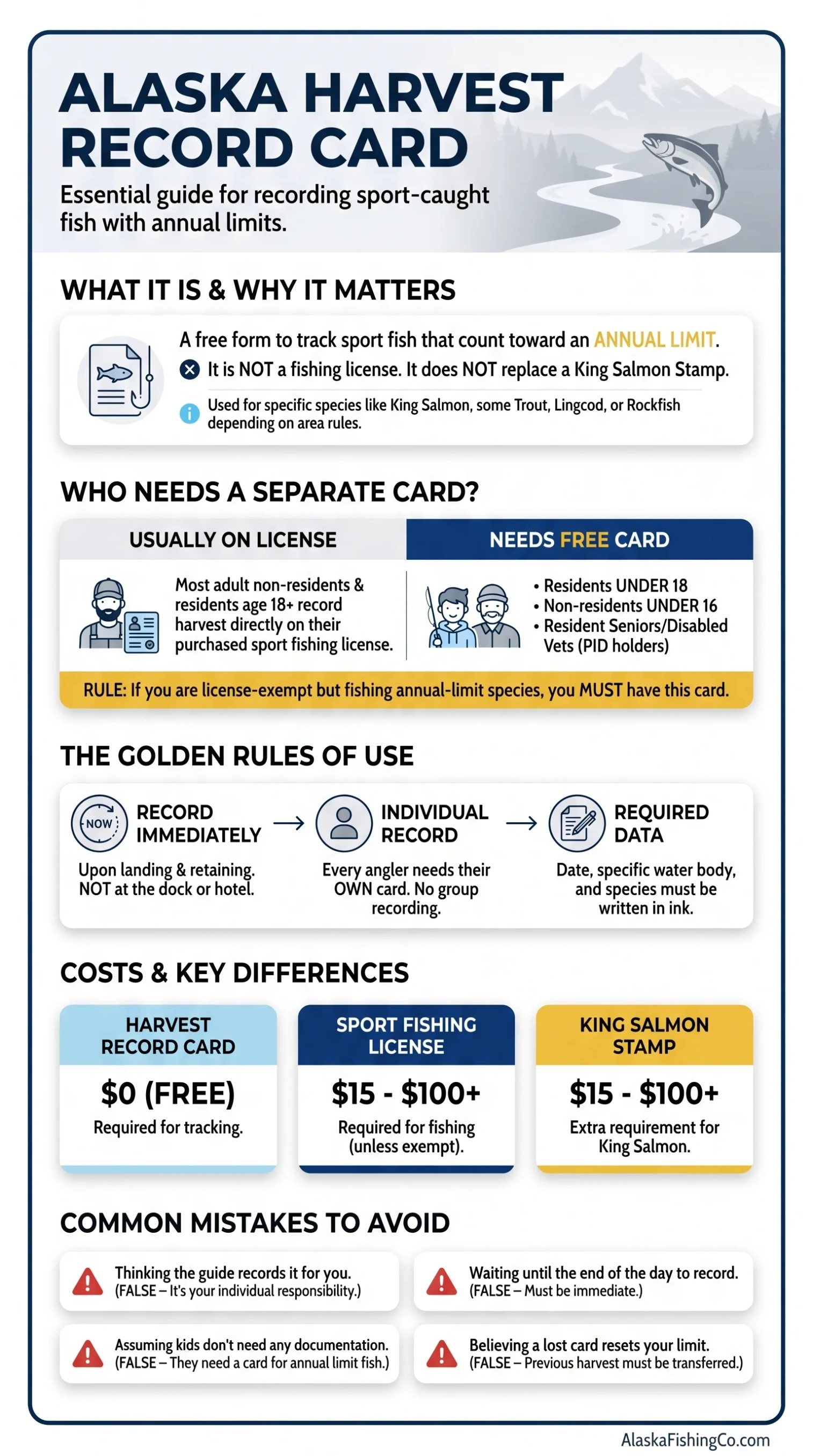
An Alaska Harvest Record Card is the form used to record sport-caught fish that count toward an annual limit. It matters most for anglers who do not have a regular printed or electronic sport fishing license but still need a legal place to record certain kept fish, such as many king salmon and some trout, lingcod, or rockfish depending on the area.
Alaska does not treat every fish the same for recordkeeping. Daily limits tell you what you can keep in one day, while annual limits track how many of a certain fish you keep across the season. When an annual limit applies, the harvest must be recorded right away in the field, not later at the lodge, hotel, dock, or cleaning table.[a]
If you remember one thing… a Harvest Record Card is not a fishing license, and it does not replace a king salmon stamp when a stamp is required. It is a free record form for anglers who must record annual-limit fish and do not already have the proper record space on a license or electronic record.
What To Know First
- The card is free. It is available online, at some license vendors, and at Alaska Department of Fish and Game offices.[b]
- It is used for sport fishing only. Do not record personal use or subsistence fish on this card.[c]
- Recording is immediate. If a fish with an annual limit is landed and retained, the date, water, and species must be entered in the field.
- Each angler needs their own record. One parent, guide, or group leader cannot record everyone’s fish on a single card.
- Digital records have their own field rules. If you use the ADF&G mobile app offline, prepare it while you still have service and understand how paper and app records interact.[f]
- Area rules matter. The fish that require recording can change by region, drainage, saltwater area, emergency order, season, or special permit.
What an Alaska Harvest Record Card Does
The card gives an angler a legal place to write down sport-caught fish that are subject to an annual harvest limit. It is mainly used by people who are exempt from buying a regular sport fishing license because of age or certain Alaska resident status, but who still must record annual-limit fish.
Think of the card as a running tally for certain kept fish. Alaska uses daily, possession, size, seasonal, and annual limits. The Harvest Record Card is tied to the annual-limit part. If a regulation says a fish must be recorded, the angler records it immediately after landing and keeping that fish.
- What gets written down: harvest date, water where the fish was harvested, and fish species.
- How it should be written: in ink on the paper card when using the printable card.[c]
- Where it must be kept: with the angler while fishing or possessing the recorded fish.
- What it is not: it is not a license, stamp, permit, or substitute for checking current sport fishing regulations.
The card is small once printed, cut, and folded. ADF&G formats the printable version so it can fit in a wallet or license holder, which is useful for shore anglers, charter guests, and families carrying several youth records.[c]
Who Needs an Alaska Harvest Record Card?
A Harvest Record Card is required for resident anglers under 18, nonresident anglers under 16, and Alaska resident senior or disabled veteran anglers using ADF&G identification or qualifying license status when they fish for species with annual limits.[a]
The rule can feel confusing because most adult visitors focus on the fishing license first. For many adult license buyers, the harvest record may be connected to the license or electronic record. The separate card becomes especially relevant when the angler does not have a standard sport fishing license but still has to record annual-limit harvest.
| Angler situation | Sport fishing license? | King salmon stamp? | Harvest Record Card? |
|---|---|---|---|
| Alaska resident age 18 or older | Usually required | Required when fishing for king salmon, unless an exemption applies | Use the license or record method required for annual-limit fish |
| Alaska resident under 18 | Not required | Not required | Required when fishing for species with annual limits |
| Nonresident age 16 or older | Required | Required when fishing for king salmon, unless fishing an exempt stocked lake | Use the license or record method required for annual-limit fish |
| Nonresident under 16 | Not required | Not required | Required when fishing for species with annual limits |
| Foreign visitor age 16 or older | Required as a nonresident foreign visitor | Required when fishing for king salmon, unless an exemption applies | Use the license or record method required for annual-limit fish |
| Alaska resident senior with PID card | Sport fishing license not required after qualifying | Not required | Required when fishing for species with annual limits |
- Families with children should check each child’s age and residency status separately.
- Charter guests should not assume the captain records the fish for them.
- Foreign visitors should follow the nonresident rules unless ADF&G states a narrower category applies.
Worth Noting
A person can be exempt from buying a fishing license and still need a Harvest Record Card. This is common with youth anglers and Alaska resident senior PID holders fishing for species with annual limits.
License, Stamp, and Card Costs
The Harvest Record Card itself is free. The cost most visitors need to plan for is the sport fishing license and, if they intend to fish for king salmon, the king salmon stamp. Alaska residents age 18 or older and nonresidents age 16 or older generally need a sport fishing license to participate in sport fisheries.[a]
For 2026 trip planning, ADF&G lists short-term and annual sport fishing licenses for nonresidents, with a separate king salmon stamp schedule. Foreign visitors are listed under the nonresident foreign/alien license category, with sport fishing license fees matching the standard nonresident short-term and annual sport fishing prices shown by ADF&G.[d]
| Item | Resident price | Nonresident or foreign visitor price | When it matters |
|---|---|---|---|
| Sport Fishing Harvest Record Card | $0 | $0 | For anglers who need a separate annual-limit harvest record |
| Annual sport fishing license | $20 | $100 | For anglers required to hold a license |
| 1-day sport fishing license | Not the usual resident format | $15 | Short visitor trips |
| 3-day sport fishing license | Not the usual resident format | $30 | Weekend or charter add-on trips |
| 7-day sport fishing license | Not the usual resident format | $45 | One-week Alaska fishing trips |
| 14-day sport fishing license | Not the usual resident format | $75 | Longer visitor trips |
| Annual king salmon stamp | $10 | $100 | Fishing for king salmon unless exempt |
| Short-term nonresident king salmon stamp | Not applicable | $15 to $75 depending on length | Visitor king salmon trips |
- The card being free does not make the fishing free.
- A king salmon stamp is separate from a Harvest Record Card.
- A short-term license should cover the actual fishing days, not just the travel dates.
- Yukon Territory reciprocal options appear separately in the ADF&G price list and should be checked directly if they apply to the angler.
When a Fish Must Be Recorded
A fish must be recorded when it is a sport-caught fish with an annual limit and the angler lands and keeps it. ADF&G states that harvest records are required by all anglers when harvesting any species of sport-caught fish with an annual limit.[c]
The exact species and sizes depend on where the fishing happens. Alaska is divided into sport fishing regions and management areas, and emergency orders can change the rule after printed regulations are released. This is why one river, saltwater district, or year can have a recording rule while another does not.
- King salmon: often tied to annual limits and stamp rules, but the details change by area and season.
- Rainbow/steelhead trout: some Southcentral fisheries require recording for larger retained fish.
- Lingcod: some Southeast nonresident fisheries have annual limits and harvest record requirements.
- Demersal shelf rockfish: Southeast nonresident rules may require immediate recording for retained fish such as yelloweye, quillback, tiger, China, canary, copper, and rosethorn rockfish.[e]
The safest reading is simple: if the regulation for your exact water says “annual limit,” “harvest record required,” or “must record,” treat the record as part of keeping the fish legally.
One Detail People Miss
The record is not filled out at the end of the day. It is filled out immediately after landing and retaining the fish that must be recorded.
How to Get and Use the Card
The card can be obtained online, at some license vendors, or at ADF&G offices. The printable card should be printed on letter-size paper, then cut and folded so it fits in a wallet or license holder.[c]
Visitors can also use ADF&G’s online store or mobile app for many license and record tasks. The mobile app can display licenses, permits, and stamps, record fishing harvest, and display downloaded regulations and maps.[f]
Before fishing
- Confirm whether each person needs a sport fishing license.
- Confirm whether each person needs a king salmon stamp.
- Print or obtain a Harvest Record Card for youth, PID/DAV holders, or anyone else who needs a separate record.
- Check the regulation page for the region, then check emergency orders for the exact area.
- Carry a pen if using a paper card.
When keeping a recordable fish
- Stop and record it immediately.
- Write the correct date.
- Write the water where the fish was harvested, not just the nearest town.
- Write the species clearly.
- Keep the card available for inspection while fishing or possessing the fish.
Using the ADF&G Mobile App Offline
The ADF&G mobile app can display licenses, permits, and stamps and can record and display harvest while the phone is outside cellular or Wi-Fi coverage. Maps and regulations can also be available offline if they were downloaded while the device still had service.[f]
Before relying on offline mode, open the app while online for at least two minutes. ADF&G says this online period is required to activate the app’s offline capabilities. The app retains the user’s login for 28 days from the most recently detected online activity.[f]
- Open the app online before a remote trip: leave it open for at least two minutes while connected.
- Refresh your online activity before long trips: the login is retained for 28 days from the last detected online activity.
- Download regulations or maps before losing service: they are available offline only if previously downloaded.
- Do not plan to buy new documents offline: new or additional licenses, permits, and stamps cannot be obtained without a connection.
Paper and App Together Means Recording in Both
A paper backup is allowed, but it creates a second recording obligation. If you carry both the paper record and the app, any harvest that must be recorded has to be entered on the paper copy and in the app.[f]
Do not keep the paper copy only as an untouched emergency backup while recording harvest solely in the app. ADF&G specifically tells anglers carrying both formats to keep both harvest records current.
Correcting a Mobile-App Harvest Entry
Check the information carefully before submitting a harvest record in the app. Once a harvest record is submitted, the app user cannot change it. ADF&G says some errors can be amended by a Permit Coordinator, but the angler must contact the permit contact and provide the requested permit and error information.[f]
This is different from editing an unsent note on a phone. Once the harvest record has been submitted, correction may require ADF&G involvement.
If the card is lost
ADF&G says an angler should get a new card, but the harvest information from the lost card must be transferred to the new one.[c] A lost card is not a clean reset of the annual limit.
- Replace the card as soon as possible.
- Re-enter all previous required harvest information.
- Do not keep fishing for annual-limit species if you cannot legally record the harvest.
Regional and Season Differences
Harvest record rules are not statewide in the same practical way for every fish. The need to record depends on the species, water, size, annual limit, resident or nonresident status, and any emergency order or special permit in effect.
ADF&G tells anglers to choose the sport fishing region, then the drainage or area they will fish. It also warns that emergency orders supersede published regulations, which means a current order can override what someone printed earlier.[g]
Examples of how the rule changes by area
- Southeast king salmon: 2026 Southeast marine king salmon rules set different resident and nonresident bag, possession, and annual limits, with nonresident annual limits changing during the year in some areas.[h]
- Southeast demersal shelf rockfish: a 2026 ADF&G announcement reduced the nonresident season and required immediate recording when a nonresident retains a demersal shelf rockfish.
- Southeast lingcod: 2026 rules for the Yakutat area require nonresidents to record retained lingcod and remind anglers that limits are not additive across lingcod management areas.
- Southcentral trout: certain waters use annual limits for larger rainbow/steelhead trout, so anglers must check the exact area before keeping one.
2026 Upper Copper River King Salmon Permit Exception
The Upper Copper River king salmon fishery uses a different record system in 2026. Anglers fishing for king salmon in the Upper Copper River drainage are required to have a free Upper Copper River King Salmon Sport Fishery Permit in addition to the sport fishing license and king salmon stamp normally required for that angler.[i]
The individual permit replaces the king salmon harvest entry that would normally be made on the sport fishing license or Harvest Record Card. King salmon 20 inches or longer that are legally retained must be recorded immediately on the Upper Copper River permit rather than on the standard harvest record.[i]
- Permit cost: free.
- 2026 availability: ADF&G made the permit available beginning May 1 online, through the ADF&G mobile app, at ADF&G offices, and through some private vendors.
- While fishing: carry the Upper Copper River permit, sport fishing license, and king salmon stamp when those license and stamp requirements apply.
- Recorded fish: retained king salmon 20 inches or longer are entered immediately on the permit.
- Reporting: 2026 permit holders were required to report online by August 31, even if they did not fish for king salmon.[i]
Why This Exception Matters
Do not automatically put an Upper Copper River king salmon on the normal license harvest record or separate Harvest Record Card simply because that is the usual method elsewhere. For the 2026 Upper Copper River king salmon fishery, the dedicated permit is the required harvest record for kings covered by the permit.
The same visitor can face different record rules on two parts of the same trip. A family fishing stocked lakes near town, the Upper Copper River, a Kenai Peninsula river, and a Southeast saltwater charter should not rely on one general record method for every day.
Before You Move On
Do not use another region’s rule as a shortcut. Alaska fishing rules are often written by drainage, saltwater sector, species, size, date, and permit type.
Common Mistakes With Alaska Harvest Record Cards
Most Harvest Record Card problems come from treating the card as a minor formality. Alaska expects the record to be personal, current, and available in the field.
Wrong idea: “The guide or captain records it for everyone.”
Correct explanation: Every angler must have their own harvest record when one is required.
Why it gets mixed up: Charter crews often help guests understand rules, but the retained fish belongs to the angler’s limit and record.
Wrong idea: “My child does not need a license, so they do not need anything.”
Correct explanation: Resident anglers under 18 and nonresident anglers under 16 do not need a sport fishing license, but they need a Harvest Record Card when fishing for species with annual limits.
Why it gets mixed up: License exemption and harvest recording are separate requirements.
Wrong idea: “The card replaces a king salmon stamp.”
Correct explanation: A regular adult angler who is required to have a king salmon stamp still needs that stamp when fishing for king salmon, unless a stated exemption applies.
Why it gets mixed up: King salmon often involves both a stamp rule and a recording rule.
Wrong idea: “Recording at the dock is close enough.”
Correct explanation: Required harvest is recorded immediately after landing and retaining the fish.
Why it gets mixed up: Many anglers naturally wait until gear is packed away, but that is not how the rule is written.
Wrong idea: “A paper backup does not need harvest entries if I use the app.”
Correct explanation: If you carry both paper and app versions, ADF&G requires you to record required harvest in both.[f]
Why it gets mixed up: Anglers often think of paper as a backup only, but carrying both formats means maintaining both records.
Wrong idea: “I can fix a submitted app entry later.”
Correct explanation: Once a harvest record is submitted in the ADF&G app, the user cannot change it. Some errors may be corrected through an ADF&G Permit Coordinator.[f]
Why it gets mixed up: Most phone forms can be edited later, but submitted ADF&G harvest records work differently.
Wrong idea: “The app will automatically work offline because I logged in once.”
Correct explanation: ADF&G says the app must be opened for at least two minutes while online before its offline functions are available. The login is retained for 28 days from the most recently detected online activity.[f]
Why it gets mixed up: A license may already appear on the phone, but remote-field use still depends on the app being prepared online before service disappears.
Wrong idea: “Every king salmon goes on my normal harvest record.”
Correct explanation: Not always. In the 2026 Upper Copper River king salmon fishery, the required free individual permit replaces the normal king salmon harvest record on the sport fishing license or Harvest Record Card.[i]
Why it gets mixed up: The standard harvest-record method is common elsewhere, so anglers may not expect a drainage-specific permit to replace it.
Wrong idea: “A lost card means the count starts over.”
Correct explanation: The old harvest information must be transferred to the replacement card.
Why it gets mixed up: The card is small, but it tracks a legal annual limit.
Wrong idea: “Personal use fish go on the same card.”
Correct explanation: The Sport Fishing Harvest Record Card is for sport-caught fish only, not personal use or subsistence fish.
Why it gets mixed up: Alaska has more than one harvest system, and some visitors use “fishing” as one broad category.
- Carry a pen if you use a paper record.
- Prepare the mobile app online before entering areas without service.
- Check the area before every fishing day.
- Keep each person’s record separate.
Real-Life Alaska Visitor Scenarios
The card is easier to understand when matched to real travel situations. These examples show how ordinary Alaska trips can create different record needs.
- A family books a Kenai Peninsula trout day with a 15-year-old nonresident.
The child may not need a sport fishing license, but a Harvest Record Card may be needed if the fishery has an annual limit for retained trout. - A father and daughter join a Southeast saltwater charter for king salmon.
The adult nonresident usually needs a license and king salmon stamp, while the child’s age determines whether she needs a license or a free Harvest Record Card. - A foreign visitor buys a 7-day license online before arriving in Anchorage.
The license covers sport fishing for the selected days, but king salmon fishing still needs the proper stamp unless an exemption applies. - A resident senior with a PID card fishes for king salmon.
The PID status may remove the need for a regular sport fishing license and king stamp, but the angler still needs the proper harvest record for annual-limit fish. - A nonresident keeps a lingcod in a Southeast area with an annual limit.
The fish must be recorded as required by the local rule, and moving to another lingcod area does not create a second annual limit. - A youth angler catches a recordable fish and the parent puts it on the parent’s card.
That is the wrong record; the youth angler must have their own card filled out with their own information. - A group prints regulations in March and fishes after an April emergency order.
The current emergency order controls, so the group should recheck ADF&G before fishing. - An angler plans to use the ADF&G app in an area without service.
The app should be opened online for at least two minutes before the trip, and the angler should make sure their most recent online activity is within the 28-day login window. - An angler carries the license in the app and also carries a paper copy in case the phone dies.
If a required harvest occurs, it must be recorded in both the app and the paper record. - An angler enters the wrong water when submitting harvest through the app.
The user cannot edit the record after submission. The angler should contact the appropriate ADF&G Permit Coordinator about whether the error can be amended. - An angler plans a 2026 Upper Copper River king salmon trip.
The normal harvest-record setup is not enough. The angler needs the free Upper Copper River King Salmon Sport Fishery Permit in addition to the required sport fishing license and king salmon stamp, and retained kings 20 inches or longer are recorded on that permit.
A Simple Rule Before You Fish
The Alaska Harvest Record Card is a small form, but it sits at the point where license status, age, species, area rules, digital records, and special permits meet. Before keeping fish with an annual limit, each angler should know where their harvest will be recorded and have that record ready in the field.
The most common mistake is assuming “no license needed” means “no record needed.” The rule to remember is simple: if Alaska says the fish has an annual limit and must be recorded, use the record or permit required for that exact fishery and record it immediately.
Alaska Harvest Record Card Questions Answered
Do tourists need an Alaska Harvest Record Card?
Many adult tourists do not need a separate card if they have a regular sport fishing license with the required harvest record method. A tourist under 16, or any angler without a standard license who fishes for annual-limit species, may need the free Harvest Record Card.
Is the Alaska Harvest Record Card free?
Yes. The Sport Fishing Harvest Record Card is free and can be obtained online, at some license vendors, or at ADF&G offices.
Does the Harvest Record Card replace an Alaska fishing license?
No. The card is only a harvest record. It does not replace a sport fishing license for anglers who are required to buy one.
Does the Harvest Record Card replace a king salmon stamp?
No. Anglers who are required to have a king salmon stamp still need the stamp when fishing for king salmon, except where Alaska rules provide a specific exemption.
Can the ADF&G app be used without cell service?
Yes. The app can display documents and record harvest offline, but ADF&G says it must first be opened for at least two minutes while online. The login is retained for 28 days from the most recently detected online activity, and maps or regulations must be downloaded before losing service.
What happens if I carry both a paper record and the ADF&G app?
If you carry both formats, required harvest must be recorded in both the paper copy and the app. The paper version cannot remain blank simply because the harvest was entered digitally.
Can I edit a harvest record after submitting it in the app?
No. A submitted harvest record cannot be changed by the app user. ADF&G says some errors may be amended by a Permit Coordinator after the angler provides the permit and error details.
What is different about Upper Copper River king salmon in 2026?
Anglers fishing for king salmon in the Upper Copper River drainage need the free Upper Copper River King Salmon Sport Fishery Permit in addition to the required sport fishing license and king salmon stamp. The permit replaces the normal license or Harvest Record Card entry for covered king salmon harvest, and retained kings 20 inches or longer are recorded immediately on the permit.
What fish must be written on the card?
Sport-caught fish with annual limits must be recorded when the local regulation requires it. The exact fish can vary by region and season, and some fisheries use a separate permit instead of the standard card, so anglers should check the current ADF&G sport fishing regulations and emergency orders for their area.
When do you fill out an Alaska Harvest Record Card?
Fill it out immediately after landing and retaining a fish that must be recorded. Waiting until later can create a violation.
Can one Harvest Record Card be used for a whole family?
No. Each angler must have their own harvest record. A child’s fish should not be recorded on a parent’s card.
Do you have to turn in the card at the end of the season?
No. ADF&G says the standard Sport Fishing Harvest Record Card does not need to be turned in at the end of the season. A separate permit can have its own reporting deadline; for example, the 2026 Upper Copper River King Salmon Sport Fishery Permit required online reporting by August 31.
Alaska Fishing References
- [a] ADF&G Sport Fishing Licenses, King Salmon Stamps, IDs and Harvest Record Cards — Explains who needs a sport fishing license, king salmon stamp, and free Harvest Record Card for annual-limit fisheries. (Official Alaska Department of Fish and Game source.)
- [b] ADF&G General License Information and FAQs — Covers age rules, license formats, and the requirement to record annual-limit sport fish harvest. (Official Alaska Department of Fish and Game licensing reference.)
- [c] ADF&G Sport Fishing Annual Harvest Record Card PDF — Printable card with instructions on what to record, when to record it, lost-card handling, and sport-only use. (Official ADF&G form.)
- [d] ADF&G Sport Fishing License and King Salmon Stamp Prices — Lists resident, nonresident, foreign visitor, and king salmon stamp prices. (Official ADF&G price page.)
- [e] ADF&G 2026 Southeast Alaska Demersal Shelf Rockfish Announcement — Explains the 2026 nonresident season, annual limit, and recording rule for demersal shelf rockfish. (Official ADF&G emergency order announcement.)
- [f] ADF&G Mobile App FAQ — Covers electronic licenses and harvest recording, the two-minute online preparation requirement for offline use, 28-day login retention, dual paper/app harvest recording, and correction limits after a harvest record is submitted. (Official ADF&G mobile app support page.)
- [g] ADF&G Sport Fishing Regulations — Regional regulation hub noting that emergency orders supersede published regulations. (Official ADF&G regulations page.)
- [h] ADF&G Southeast Alaska Regional King Salmon Sport Fishing Regulations for 2026 — Provides the underlying 2026 Southeast marine king salmon limits and nonresident harvest-record requirement. (Official ADF&G advisory announcement.)
- [i] ADF&G Upper Copper River King Salmon Sport Fishery Will Require New Permit in 2026 — Establishes the free Upper Copper River king salmon permit, the requirement to carry the permit with the required sport fishing license and king salmon stamp, immediate recording of retained king salmon 20 inches or longer on the permit, the August 31 reporting deadline, and the rule that the permit replaces the normal license or Harvest Record Card entry. (Official ADF&G 2026 announcement.)