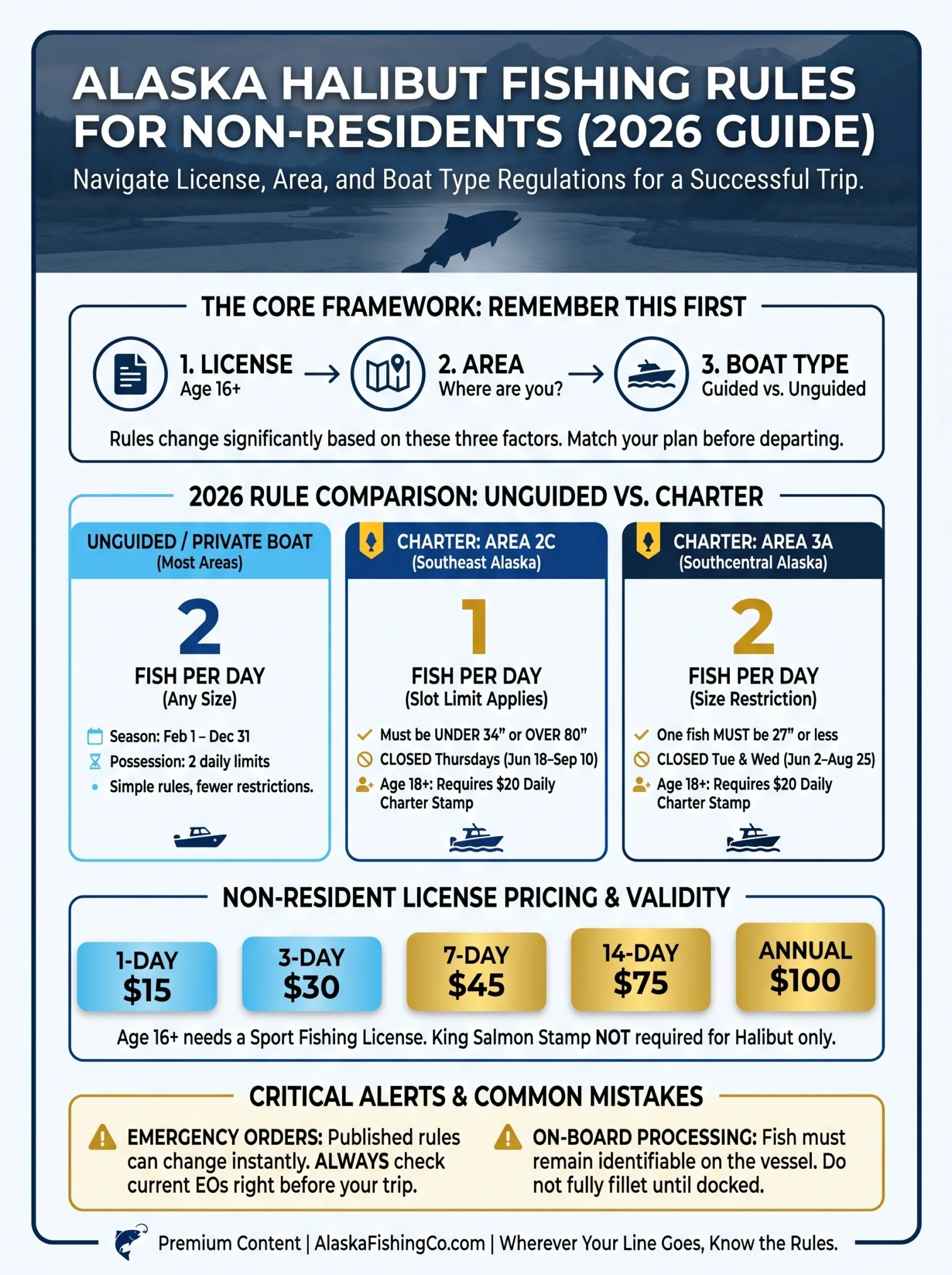
Most non-residents can legally fish for halibut in Alaska with a sport fishing license, but the rule set changes once the trip is guided. On a private boat or other unguided trip, the standard Alaska halibut rule is usually two fish per day. On charter trips in Area 2C in Southeast Alaska and Area 3A in Southcentral Alaska, the 2026 rules are tighter and include day closures, size limits, or both.[f]
That split is what catches many visitors off guard. The license is the easy part. The real question is whether you are fishing unguided or on a charter, and exactly where in Alaska the boat will fish.[e]
If you remember one thing… non-resident halibut fishing in Alaska is mostly simple until the trip is a charter in Southeast or Southcentral Alaska; then you need to match your plan to the correct IPHC area rules before you leave the dock.[f]
What To Know First
- Non-residents age 16 and older need an Alaska sport fishing license to fish halibut in fresh or salt water.[a]
- A king salmon stamp is not a halibut requirement; it matters only if you are fishing for king salmon.[a]
- Unguided halibut fishing in Alaska generally follows the two fish per day rule, with a possession limit of two daily bag limits unless a stricter area rule applies.[f]
- Charter trips in Area 2C and Area 3A follow separate 2026 federal halibut measures.[f]
- On charter halibut trips in Areas 2C and 3A, anglers age 18 and older who plan to keep halibut need a daily charter halibut stamp, which costs $20 and is handled through the charter permit system.[g]
- Emergency Orders can change what the printed regulation pages say, so the final check should happen right before the trip.[d]
Short Answer
Yes. Non-residents can fish for halibut in Alaska, including tourists and foreign visitors, as long as they follow Alaska sport fishing license rules and the halibut rules for the area and trip type. If you are 16 or older, get the correct non-resident sport fishing license first. Then check whether your halibut trip is unguided or a charter in Area 2C or 3A, because that is where the stricter 2026 limits apply.[a]
For halibut-only trips, there is no separate Alaska state halibut license. The main items are your sport fishing license, your location, and whether the boat is guided. If the charter is in Southeast or Southcentral Alaska and you plan to retain halibut, the adult charter halibut stamp rule can also apply.[g]
One Detail People Miss
The fish species did not change, but the rule set did. A halibut trip out of Homer or Sitka on a charter can be much more restricted than an unguided halibut trip in the same broad part of Alaska.[e]
Do Non-Residents Need a License to Catch Halibut in Alaska?
Yes, if they are 16 or older. Alaska requires non-residents age 16 and up to purchase and carry a sport fishing license for sport fishing, including halibut. Foreign visitors are treated as non-residents for fishing license purposes, and Alaska posts the same sport fishing prices for non-resident and foreign/alien sport fishing licenses.[a]
That means a visiting angler from another U.S. state, Canada, Europe, or anywhere else can legally fish halibut in Alaska after buying the correct non-resident sport fishing license. There is no separate Alaska state halibut endorsement for ordinary sport anglers. The extra species stamp that confuses people most often is the king salmon stamp, but that applies to king salmon fishing, not halibut fishing.[a]
- Age 16 and older: non-resident sport fishing license required.[a]
- Under 16: no non-resident sport fishing license required.[c]
- Age 18 and older on charter halibut trips in Areas 2C and 3A: daily charter halibut stamp required if planning to catch and retain halibut.[g]
- Age 16–17 on those charters: sport fishing license required, but no charter halibut stamp.[a]
If your trip includes both halibut and king salmon, treat those as two separate rule sets. Halibut rules do not create a king salmon stamp requirement, but adding king salmon to the plan can.[a]
How Many Halibut Can a Non-Resident Keep in Alaska?
Usually two per day, but not always. In Alaska, the general recreational halibut rule is a season from February 1 through December 31, a daily bag limit of two halibut of any size, and a possession limit of two daily bag limits, unless a stricter federal rule applies. The stricter rules that matter most to visitors are the 2026 guided charter limits in Areas 2C and 3A.[f]
This is the part to slow down and read carefully. Many visitors read a statewide Alaska halibut rule and assume that every charter follows it. That is not how it works in the two busiest visitor areas.[e]
| Trip type | What you need | Daily retention | What changes the plan |
|---|---|---|---|
| Unguided / private boat / shore-based Alaska trip | Non-resident sport fishing license if age 16+ | 2 halibut of any size | Season runs Feb 1–Dec 31; possession is up to two daily bag limits unless a stricter rule applies.[f] |
| Charter in Area 2C (Southeast Alaska) | Sport fishing license if age 16+; daily charter halibut stamp if age 18+ and keeping halibut | 1 halibut | 2026: no charter retention on Thursdays from June 18 through September 10, and fish in the 34- to under-80-inch slot may not be kept.[f] |
| Charter in Area 3A (Southcentral Alaska) | Sport fishing license if age 16+; daily charter halibut stamp if age 18+ and keeping halibut | 2 halibut | 2026: one fish may be any size, but at least one retained fish must be 27 inches or less; no charter retention on Tuesdays and Wednesdays from June 2 through August 25.[f] |
| Charter outside Areas 2C and 3A | Sport fishing license if age 16+ | Same as unguided rule | Federal guidance says charter anglers outside 2C and 3A follow the unguided halibut rule, but local area rules and emergency changes still need a final check.[e] |
Unguided Halibut Fishing
If you are fishing from a private boat, a rental boat without a guide, or another unguided setup, the plain reading is simple: two halibut per day, any size, during the Alaska halibut sport season, unless a stricter area measure applies.[f]
- Season: February 1 through December 31.[f]
- Daily bag: 2 halibut.[f]
- Possession: up to 2 daily bag limits.[f]
- Gear: single line with no more than two hooks, or a spear.[f]
Charter Halibut Fishing in Southeast Alaska (Area 2C)
If the trip is a guided charter in Southeast Alaska, the 2026 rule is one halibut per day per angler, with a slot-style size restriction. A retained halibut cannot be more than 34 inches and less than 80 inches in head-on length, which means the fish you keep must be either small enough to fall below that slot or large enough to clear it.[f]
- Bag limit: 1 halibut per day.[f]
- Closed charter retention days in 2026: Thursdays, June 18 through September 10.[f]
- Extra adult charter rule: daily charter halibut stamp if age 18+ and keeping fish.[g]
Charter Halibut Fishing in Southcentral Alaska (Area 3A)
If the trip is a guided charter in Area 3A, the 2026 rule is two halibut per day, but at least one of those retained fish must be 27 inches or less. If you keep only one halibut in a day on an Area 3A charter, that single fish may be any length.[f]
- Bag limit: 2 halibut per day.[f]
- Size rule: at least one retained fish must be 27 inches or less.[f]
- Closed charter retention days in 2026: Tuesdays and Wednesdays from June 2 through August 25.[f]
There is also no annual charter halibut limit in 2026, which matters because older Alaska halibut articles sometimes still mention annual retention limits for charter anglers. That is outdated for 2026.[f]
Worth Noting
Halibut on a charter trip in Areas 2C or 3A must stay on the same charter vessel until that charter trip ends. That matters on multi-stop days and is one reason to let the captain handle the trip flow.[f]
License Prices and Validity for Non-Residents
Most visitors only need one of five license lengths. Alaska sells non-resident sport fishing licenses in 1-day, 3-day, 7-day, 14-day, and annual versions. The annual non-resident sport fishing license is valid through December 31 of the calendar year, while short-term non-resident licenses are valid only for the length purchased.[b]
The current non-resident fishing prices published by Alaska are:[b]
- 1 day: $15
- 3 day: $30
- 7 day: $45
- 14 day: $75
- Annual: $100
Foreign visitors pay the same listed sport fishing prices as other non-residents for Alaska fishing licenses.[b]
For halibut trips, that usually means the only cost decision is how long you need the license to last. The one extra charge to know about is the $20 daily charter halibut stamp for anglers age 18 and older who intend to catch and retain halibut on charter trips in Areas 2C and 3A.[g]
- Best for a cruise stop or single outing: 1-day license
- Best for a weekend trip: 3-day license
- Best for a standard fishing week: 7-day license
- Best for a longer lodge stay: 14-day license
- Best for multiple Alaska trips in one calendar year: annual license
How to Buy an Alaska Halibut Fishing License Online
Buying online is the normal visitor route. Alaska says sport fish licenses may be purchased online, and the state license page notes that you receive the license immediately after purchase. The state also allows printed/electronic and eSigned formats, so most visitors can keep the license on a phone or print a copy before the trip.[a]
A clean way to do it is this:
- Go to the Alaska Department of Fish and Game online store.[c]
- Choose the non-resident sport fishing license length that matches your trip.[b]
- Save the license right away and make sure it is signed in the allowed format.[c]
- If your charter is in Area 2C or 3A and you are 18 or older, ask the operator before departure how the daily charter halibut stamp will be handled.[g]
- Check area regulations and current emergency changes again just before fishing.[d]
The practical point is simple: buy the license before the fishing starts, keep it accessible, and do not assume the charter captain’s permit replaces your personal sport fishing license.[c]
Before You Move On
Printed regulation pages are helpful, but Alaska states plainly that Emergency Orders supersede published sport fishing regulations. A rule that looked settled a week ago can still change before your trip date.[d]
Common Mistakes Non-Residents Make With Alaska Halibut Rules
Most problems come from mixing license rules and charter rules together. Visitors often read one correct statement, then apply it to the wrong boat type or the wrong area.[e]
“My charter booking covers my fishing license.”
What people think: The boat’s paperwork replaces the angler’s license.
What is correct: Non-residents age 16 and older still need their own Alaska sport fishing license, and adults keeping halibut on charters in Areas 2C and 3A also fall under the daily charter halibut stamp rule.[a]
Why this gets mixed up: Charter operators handle a lot of behind-the-scenes compliance, so visitors assume everything is bundled.
“Halibut is halibut, so the catch limit is the same everywhere.”
What people think: The statewide two-fish rule applies on every Alaska halibut trip.
What is correct: Guided charter halibut trips in Area 2C and Area 3A have separate 2026 federal limits, including day closures and size rules.[f]
Why this gets mixed up: Broad travel pages often talk about Alaska as one fishery, while the law is written by area.
“A king salmon stamp is part of a halibut trip.”
What people think: Any saltwater fishing trip needs the king stamp.
What is correct: The king salmon stamp applies to king salmon fishing, not halibut fishing by itself.[a]
Why this gets mixed up: Many Alaska charters offer mixed-species trips, so visitors hear about the stamp even when halibut is the main target.
“I can fully fillet the halibut on the boat.”
What people think: Once the fish is landed, it can be cut any way the angler wants.
What is correct: Alaska halibut on board a vessel must remain identifiable; the federal rule allows only limited cuts with skin patches naturally attached.[f]
Why this gets mixed up: Fish processing often happens later at the dock or lodge, so the on-boat rule is easy to overlook.
“The regulations I checked a month ago are enough.”
What people think: Once the trip is booked, the rule check is done.
What is correct: Alaska says Emergency Orders override the published regulations, so the final check should happen close to the fishing date.[d]
Why this gets mixed up: Travelers plan far ahead, but fishing closures and in-season changes do not always wait for travel plans.
Real-Life Scenarios
These are the kinds of Alaska halibut plans visitors actually make. If one looks like your trip, it usually points you toward the right rule set faster than reading every regulation page from top to bottom.
Two adults book a July charter out of Homer.
That is an Area 3A charter trip, so each adult needs a non-resident sport fishing license, the trip falls under the 2026 Area 3A halibut limits, and if they plan to keep halibut, the adult charter halibut stamp rule applies as well.[f]
A visitor rents a private boat near Seward and fishes without a guide.
That trip usually follows the unguided Alaska halibut rule rather than the tighter charter rule, which is why boat type matters just as much as location.[e]
A family books a guided halibut trip out of Sitka on a Thursday in July 2026.
If the trip is in Area 2C, that Thursday falls inside the 2026 charter closure window for halibut retention, so the family may be able to fish but not keep halibut under the normal charter rule that day.[f]
A 17-year-old joins a charter out of Juneau.
The teenager still needs a non-resident sport fishing license, but the daily charter halibut stamp rule applies only to charter anglers age 18 and older.[g]
A foreign visitor from Germany wants to fish halibut during a short Alaska cruise stop.
That angler can buy the same non-resident sport fishing license Alaska offers to other visitors, and a 1-day license is often enough for a single port-day trip.[b]
A halibut trip might also troll for king salmon.
Once king salmon becomes part of the actual fishing plan, the angler should treat that as a separate species requirement and check whether a king salmon stamp is needed in addition to the sport fishing license.[a]
An angler wants to bring halibut back after a multi-day lodge stay.
The angler needs to think about both the possession rule and the on-vessel cutting rule, because Alaska allows up to two daily bag limits in possession unless a stricter rule applies, but still restricts how halibut may be cut while on board a fishing vessel.[f]
Worth Noting
Outside Areas 2C and 3A, guided halibut anglers generally follow the same federal halibut rules as unguided anglers. That makes those two areas the main places where visitors need to slow down and read the charter-specific fine print.[e]
Before You Head Out
For most visitors, Alaska halibut rules are manageable once the trip is broken into three pieces: license, area, and boat type. Buy the correct non-resident license, confirm whether the trip is unguided or a charter in Area 2C or 3A, and then check for any late changes before the trip date.[d]
The mistake seen most often is assuming every charter trip follows the same two-fish rule as private-boat fishing.
Rule to remember: license first, area second, boat type third—that order solves most non-resident halibut questions before they turn into a dockside problem.
Non-Resident Halibut Questions Answered
Do tourists need a fishing license for halibut in Alaska?
Yes. Non-residents age 16 and older need an Alaska sport fishing license to fish for halibut in Alaska, whether they are visiting from another U.S. state or another country.
Can foreigners buy an Alaska fishing license online?
Yes. Alaska allows sport fishing licenses to be purchased online, and the state lists foreign/alien sport fishing prices in the same non-resident fishing range.
Do non-residents need a king salmon stamp for halibut fishing?
No, not for halibut by itself. A king salmon stamp applies to king salmon fishing, not ordinary halibut fishing.
What is the 2026 halibut charter rule in Southeast Alaska?
For Area 2C charter trips in 2026, the rule is one halibut per day, no retention on Thursdays from June 18 through September 10, and no retained fish in the 34-inch to under-80-inch slot.
What is the 2026 halibut charter rule in Southcentral Alaska?
For Area 3A charter trips in 2026, the rule is two halibut per day, but at least one retained fish must be 27 inches or less, and retention is closed on Tuesdays and Wednesdays from June 2 through August 25.
Do kids need a halibut license or charter stamp in Alaska?
Non-residents under 16 do not need a sport fishing license. The daily charter halibut stamp rule applies only to anglers age 18 and older who plan to keep halibut on charters in Areas 2C and 3A.
Can Alaska halibut rules change after I buy my license?
Yes. Alaska states that Emergency Orders supersede published sport fishing regulations, so it is smart to recheck the area pages right before your trip.
Alaska Fishing References
- Alaska Department of Fish and Game, Sport Fishing Licenses, King Salmon Stamps, IDs and Harvest Record Cards — supports age rules, online purchase access, and when a king salmon stamp applies. (Reliable because it is the Alaska state agency that issues and administers sport fishing licensing rules.) View source
- Alaska Department of Fish and Game, Prices: Sport Fishing Licenses and King Salmon Stamps — supports current non-resident and foreign/alien sport fishing license prices. (Reliable because it is the official Alaska price schedule for licenses and stamps.) View source
- Alaska Department of Fish and Game, General License Information — supports license validity periods, digital/printed license formats, and non-resident age requirements. (Reliable because it is an official Alaska licensing FAQ maintained by the issuing agency.) View source
- Alaska Department of Fish and Game, Sport Fishing Regulations — supports the warning that Emergency Orders supersede the published regulations. (Reliable because it is the state’s official sport fishing regulations portal.) View source
- NOAA Fisheries, Halibut Sport Fishing in Alaska — supports the guided versus unguided rule split and explains that guided anglers outside Areas 2C and 3A follow the unguided halibut rule. (Reliable because NOAA is the federal fisheries authority involved in Pacific halibut sport management in Alaska.) View source
- Federal Register / NOAA Fisheries, Pacific Halibut Fisheries; Catch Sharing Plan; 2026 Annual Management Measures — supports 2026 charter limits for Areas 2C and 3A, Alaska season dates, daily bag rules, possession limits, fillet rules, and the current no-annual-limit statement for charter anglers. (Reliable because it is the published federal rule notice for the current year’s halibut management measures.) View source
- NOAA Fisheries, Charter Halibut Stamp Program Frequently Asked Questions and Small Entity Compliance Guide — supports the daily charter halibut stamp requirement, age threshold, one-day validity, $20 fee, and operator validation process in Areas 2C and 3A. (Reliable because it is an official NOAA compliance guide for the active federal charter halibut stamp program.) View source