
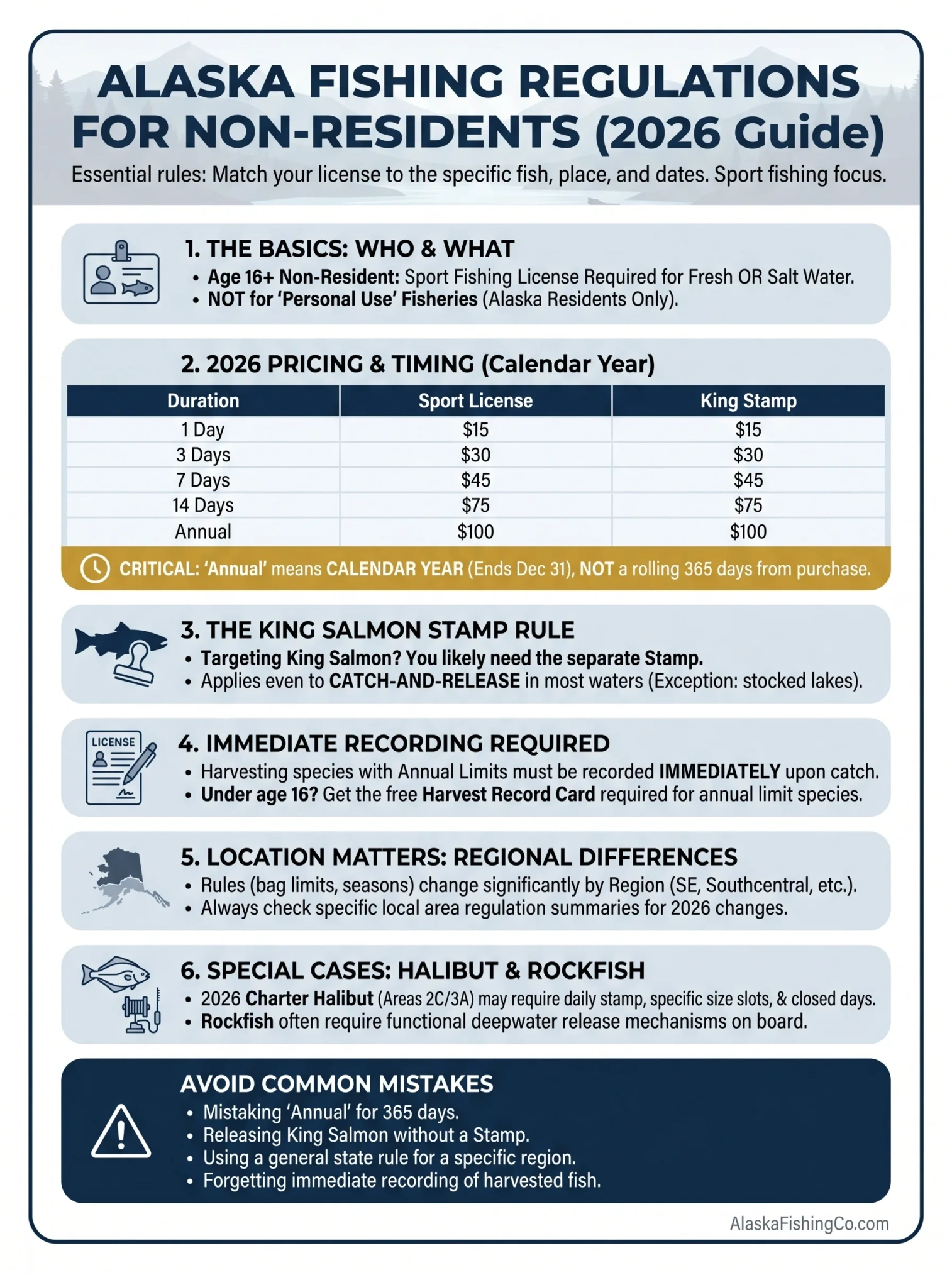
If you are not an Alaska resident and you are age 16 or older, you need an Alaska sport fishing license to fish in Alaska, whether you are fishing a river, a lake, or salt water. If you plan to fish for king salmon, you usually need a separate king salmon stamp too.[a]
For most visitors, the legal check is simple: match the license to the number of days you will fish, add any species-specific extras, and then confirm the area rules for the exact water you plan to fish. That matters because Alaska publishes separate regional sport-fishing summaries, and 2026 rules for some nonresident fisheries changed by species and by area.[e]
If you remember one thing… buy for the fish, place, and dates you will actually fish, not for the state in general.
What To Know First
- Most visitors need a nonresident sport fishing license. Out-of-state anglers and foreign visitors should plan around the nonresident license structure.[b]
- King salmon usually means an extra stamp. The basic license alone is not enough if you are targeting kings, even in catch-and-release fishing in most waters.[c]
- Some fish must be recorded right away. Species with annual limits have to be entered on your license or harvest record card immediately after harvest.[c]
- Region matters. Southeast, Southcentral, Southwest, and Northern Alaska do not all read the same on bag limits, seasons, and local restrictions.[e]
- Not every Alaska fishery is open to visitors. Personal use fisheries are for Alaska residents only, so nonresidents should focus on sport fishing rules.[d]
Who Needs a License, and What Counts as “Nonresident”?
The short answer is that a visitor who is 16 or older needs a nonresident Alaska sport fishing license for sport fishing in both fresh and marine waters. That basic rule covers the trip most tourists take, whether they are casting from shore, fishing from a private boat, or heading out with a guide.[a]
ADF&G publishes separate nonresident pricing for standard visitors and “foreign/alien” visitors, but the sport-fishing license prices and king salmon stamp prices are the same in both columns. In practical terms, a traveler from another U.S. state and a traveler from abroad should both expect to buy the nonresident version of the Alaska sport fishing license.[b]
One point that trips people up is the difference between sport fishing and personal use fishing. This article is about sport fishing. Personal use fisheries are not a visitor option; Alaska says only Alaska residents are eligible to participate in them.[d]
- Age 16 and over, nonresident: sport fishing license required.[a]
- Under 16, nonresident: no sport fishing license required, but extra paperwork can still apply for annual-limit species.[a]
- Fresh water or salt water: the same Alaska sport fishing license covers both.[a]
- Sport fishing vs. personal use: visitors can do the first; the second is resident-only.[d]
License Types, 2026 Prices, and How Long They Last
Most nonresidents choose a 1-day, 3-day, 7-day, 14-day, or annual Alaska sport fishing license. In 2026, the price ladder is simple, and the same day-based choices exist for a nonresident king salmon stamp.[b]
The part people miss is the timing. Alaska’s annual nonresident sport fishing license and annual king salmon stamp are calendar-year products, not rolling 365-day products. Alaska also allows paper or electronic licenses, but the license must be in your possession while you fish, and it cannot be loaned or transferred to someone else.[c]
| Item | 1 day | 3 days | 7 days | 14 days | Annual |
|---|---|---|---|---|---|
| Sport fishing license | $15 | $30 | $45 | $75 | $100 |
| King salmon stamp | $15 | $30 | $45 | $75 | $100 |
ADF&G also lists a reduced annual nonresident military sport fishing license for active-duty members stationed in Alaska for less than 12 months, and a reduced annual nonresident military king salmon stamp. Those are narrow cases, so most visitors can ignore them unless they clearly qualify.[b]
- Pick a short-duration license if your fishing dates are fixed and limited.
- Pick the annual license if you will fish on more than one Alaska trip in the same calendar year.
- Add the matching king salmon stamp only if you will target king salmon.
- Do not wait until the dock if your trip depends on a specific start date or you need your records ready in advance.
Worth Noting
If you buy an annual nonresident license late in the year, it still ends with that calendar year. For a short late-season trip, a 1-day, 3-day, 7-day, or 14-day license is often the cleaner choice.[c]
What You May Need Beyond the Basic License
A nonresident sport fishing license is the starting point, not the whole legal checklist. Depending on the fish, the area, and the trip style, you may also need a king salmon stamp, a harvest record card, or separate charter-halibut compliance in parts of the state.[c]
King salmon usually means a separate stamp
If you are sport fishing for king salmon, Alaska generally requires a current king salmon stamp in addition to the sport fishing license. Alaska also says that anglers targeting king salmon in catch-and-release fishing still need the stamp, with the main exception being king salmon in stocked landlocked lakes.[c]
- Basic rule: nonresident age 16 or older needs both the license and the stamp for king salmon fishing.[a]
- Under age 16: no nonresident sport fishing license and no king salmon stamp, but harvest record rules can still apply.[c]
- Common miss: “I only plan to release kings” is not a stamp exception in most waters.[c]
Harvest records apply to annual-limit species
When you harvest a species that has an annual limit, Alaska requires the fish to be recorded immediately on the harvest record portion of your license or on a separate harvest record card. This applies to all anglers when harvesting species with annual limits, and nonresidents under 16 need a free harvest record card because they do not have a license document to write on.[c]
- Record it right away. Do not wait until you get back to the lodge, car, or airport cooler.[c]
- Check the area book. Species with annual limits are listed in the regulations for the area you are fishing.[c]
- If you replace a license, move your record. Alaska tells anglers to transfer harvest records to the duplicate or additional license.[c]
Charter halibut in 2026 can add another layer
If your trip is a guided halibut charter in Southeast Alaska (Area 2C) or Southcentral Alaska (Area 3A), federal charter-halibut rules apply alongside Alaska sport fishing requirements. In 2026, charter anglers age 18 or older who intend to catch and retain halibut in those areas need a $20 daily charter halibut stamp.[h]
- Area 2C: Southeast Alaska charter-halibut restrictions are set under federal and international management measures.
- Area 3A: Southcentral charter-halibut restrictions can differ from Area 2C.
- Unguided anglers: the 2026 charter halibut stamp does not apply to unguided fishing.[h]
- Practical move: ask the charter which federal halibut rule applies to your exact port and date before departure.
One Detail People Miss
The Alaska sport fishing license is not a king-salmon pass and not a blanket halibut-charter pass. Species-specific add-ons and area-specific rules are where many nonresident mistakes start.
Regional Differences Matter More Than Most Visitors Expect
The statewide basics stay fairly stable, but Alaska does not run on one flat set of sport-fishing rules. ADF&G publishes separate sport-fishing regulation summaries for Northern, Southwest, Southcentral, and Southeast Alaska, and that is where you confirm local seasons, bag limits, gear limits, annual limits, and area exceptions for the water you will actually fish.[e]
This is why copying a rule from a lodge website, a forum post, or a screenshot from last season is risky. The right question is not “What is Alaska’s salmon rule?” but “What is the rule for this species, in this area, on this date?”
Which Rule Controls?
- Start with the statewide and regional rule. This gives the normal season, bag, possession, gear, and licensing structure.
- Then check the named water or special area. A river, drainage, harbor, terminal harvest area, or other named location can have a different rule from the surrounding region.
- Check current emergency orders. An ADF&G emergency order can change or replace the published state regulation for the affected species, water, and dates.[e]
- Add any federal rule that applies. Halibut is the main visitor example. Federal charter-halibut requirements in Areas 2C and 3A apply in addition to Alaska licensing requirements.[h]
When several rules apply at once, follow all of them. An emergency order can supersede a published Alaska rule, while a federal requirement may sit alongside the state rule rather than replace it.
Statewide fish-identification rule status
The new statewide rule described in Proposal 183 for retaining evidence of species on rockfish, lingcod, and king salmon, and evidence of length for lingcod and king salmon where length restrictions apply, is not in effect until further notice. Do not treat it as a blanket statewide 2026 processing rule. Separate regional or port-specific emergency orders can still require fish to remain identifiable or restrict filleting and de-heading in particular places and periods.[e]
Southeast Alaska gives a good 2026 example
The basic Southeast marine king salmon order sets a nonresident bag and possession limit of one king salmon, 28 inches or longer. It also sets an annual limit of three through June 30 and one from July 1 through December 31. That base rule did not remain unchanged throughout the 2026 season because ADF&G issued several temporary liberalizations.[f]
- April 1–June 30: 1 king salmon per day and in possession; annual limit 3.
- July 1–July 10: 1 king salmon per day and in possession; annual limit 2.
- July 11–July 31: 2 king salmon per day and in possession; annual limit 3.
- August 1–September 30: 2 king salmon per day and in possession; annual limit 4.
- October 1–December 31: the temporary summer liberalizations expired, returning the regional nonresident rule to 1 king salmon per day and in possession with an annual limit of 1 for the July 1–December 31 period.
King salmon kept earlier in the year counted toward the revised annual limits as the temporary rules changed. Local nonretention areas and hatchery-area rules could still be different from the regionwide limit, and retained nonresident kings had to be recorded immediately.[f]
- Do not describe 1/day and annual 1 as the rule for all of 2026. It is the underlying rule that applied again after the temporary summer orders ended.
- Do not assume Southeast is uniform. Area-specific king salmon restrictions can sit on top of the regional rule.
- Record retained kings immediately. That remains part of the nonresident rule.
- Offshore trips are not a loophole. In the Southeast exclusive economic zone, all anglers follow the nonresident king salmon rules in force for that date.[f]
Another 2026 example: demersal shelf rockfish in Southeast
ADF&G reduced the 2026 Southeast Alaska demersal shelf rockfish season for nonresident anglers to July 1 through August 25. For nonresidents, that fishery is one fish daily, one in possession, with an annual limit of one fish, and the retained fish has to be recorded immediately. Alaska also requires a functional deepwater release mechanism on board when saltwater sport fishing is taking place in that fishery.[g]
- Species-specific restrictions can be sharper than the basic license rules.
- Rockfish handling rules matter. Release tools are part of legal compliance.[g]
- One extra species can change your checklist. A mixed-species boat day is never just a “general license” day.
How to Buy Online Without Choosing the Wrong Combination
The simple version is this: buy the Alaska nonresident sport fishing license for the days you will fish, add the king salmon stamp only if you will target king salmon, and make sure you also have any harvest record or area-specific requirements covered before the trip starts. Alaska lists licenses, king salmon stamps, and harvest record cards as available through ADF&G offices, vendors, the ADF&G mobile app, and the online store.[c]
Most mistakes happen before the first cast, not after it. People choose the wrong duration, forget that annual means calendar year, or assume a lodge or charter will automatically fix missing paperwork for them.
- Step 1: lock in the exact dates you expect to fish.
- Step 2: decide whether you are fishing for king salmon at all, even on a catch-and-release basis.
- Step 3: check the regulation summary for the correct Alaska region and then scan the named water or special-area regulations.[e]
- Step 4: check current emergency orders before fishing because they can override the published state summary.[e]
- Step 5: keep the license with you in paper or electronic form and ready to show if asked.[c]
- Step 6: if your trip includes a species with an annual limit, have the harvest-record piece ready before fishing starts.[c]
Before You Move On
If your Alaska plan includes a dipnet trip or a “local-use” fishery that friends mentioned, stop and recheck the fishery type. Many nonresidents mix up sport fishing with Alaska personal use fisheries, and personal use is resident-only.[d]
Common Mistakes Nonresidents Make
The biggest errors are not obscure legal traps. They are ordinary planning mistakes: wrong license length, missing king stamp, missing harvest-record entry, and using the wrong region’s rules.[c]
| What people think | What the rule actually says | Why it gets mixed up |
|---|---|---|
| “My annual license lasts one year from the day I buy it.” | Annual nonresident sport fishing licenses and annual king salmon stamps run for the calendar year, not a rolling 365 days.[c] | The word “annual” sounds like a rolling pass. |
| “If I release king salmon, I do not need the stamp.” | Alaska requires a current king salmon stamp when fishing for king salmon, including catch-and-release, except in stocked landlocked lakes.[c] | Many anglers think stamps only matter when a fish is kept. |
| “My child is under 16, so there is no paperwork at all.” | A nonresident under 16 does not need the sport fishing license or king stamp, but still needs a harvest record card when harvesting a species with an annual limit.[c] | No license often gets mistaken for no documentation. |
| “The same Alaska rule applies everywhere.” | ADF&G uses separate regional summaries, named waters can have special rules, and emergency orders can change the published rule.[e] | Visitors see “Alaska” as one fishery, but the regulation structure is layered. |
| “The new evidence-of-species rule applies statewide now.” | The Proposal 183 statewide evidence-of-species and evidence-of-length regulation is not in effect until further notice. Separate local emergency orders can still impose fish-condition restrictions.[e] | The rule appeared in 2026 regulation material before its effective status was settled. |
| “My regular sport license covers every halibut charter situation.” | In 2026, adult charter anglers intending to retain halibut in Areas 2C and 3A need the federal daily charter halibut stamp, and other federal charter rules apply by area.[h] | Halibut rules sit partly outside the standard state-license structure. |
| “I can just use my friend’s license if we made a mistake.” | Alaska says sport fishing licenses cannot be altered, loaned, or transferred.[c] | Visitors sometimes treat licenses like generic trip documents instead of personal permits. |
Real-Life Scenarios
The easiest way to check your own trip is to compare it to a real visitor setup. Most nonresident questions become simpler once the species, region, and trip style are fixed.
- One day in Anchorage, fishing without kings: a 1-day nonresident sport fishing license is usually the starting document if the trip is standard sport fishing and does not involve a species with extra paperwork.[b]
- Three days in Ketchikan chasing king salmon: plan for a 3-day nonresident sport fishing license, a 3-day king salmon stamp, and a date-specific check of the 2026 Southeast king rules before the boat leaves.[f]
- Family trip with a 14-year-old who wants to keep a king salmon: the adult visitor needs the license and stamp, while the under-16 nonresident does not need those two items but still needs the proper harvest-record setup if an annual-limit rule applies.[c]
- A visitor from Germany fishing the same trip as a visitor from Oregon: both should expect the same nonresident sport-fishing and king-stamp price schedule for Alaska sport fishing.[b]
- June trip out of Juneau for charter halibut: the state sport license is not the whole story, because 2026 charter halibut rules in Southeast also include a daily federal charter-halibut stamp for adults intending to retain halibut.[h]
- July rockfish add-on in Southeast: if the target list includes demersal shelf rockfish, nonresident season dates, annual limits, and release-tool rules become part of the legal plan.[g]
- Buying an annual license for a late-December trip: that can still work, but it is only a smart value if you will fish again before December 31 of the same year.[c]
One Last Check
If your week includes kings, halibut, and rockfish, build separate rule checks for each species instead of relying on one general Alaska rule. Then check the named water and current emergency orders before the first cast.
Before You Leave the Dock
Alaska is very fishable for visitors once the pieces are lined up in the right order. Start with the nonresident sport fishing license, add species-specific extras only when your trip really needs them, and then match your plan to the correct region, named water, and current season rules.
The mistake seen most often is buying the basic license and assuming the job is finished.
A good rule to keep in mind is this: match the fish, the place, and the date before the first cast.
Alaska Non-Resident Fishing Questions Answered
Do tourists need a fishing license in Alaska?
Yes. A nonresident age 16 or older needs an Alaska sport fishing license to sport fish in Alaska’s fresh or salt water.[a]
Can foreigners buy an Alaska fishing license online?
Yes. Alaska sells sport fishing licenses online through ADF&G.[a] ADF&G also publishes foreign/alien nonresident sport-fishing and king-salmon price entries for visitors from abroad.[b]
How long does an Alaska annual nonresident fishing license last?
It is a calendar-year product, not a rolling 365-day pass from the purchase date.[c]
Do nonresidents under 16 need any Alaska fishing paperwork?
They do not need a sport fishing license, and they do not need a king salmon stamp, but they still need a harvest record card when they harvest a species with an annual limit.[c]
Do I need a king salmon stamp if I only plan to catch and release king salmon?
Usually, yes. Alaska says anglers sport fishing for king salmon, including catch-and-release, need a current king salmon stamp, except for king salmon in stocked landlocked lakes.[c]
Can nonresidents take part in Alaska personal use fisheries?
No. Alaska says only Alaska residents with the appropriate resident license or equivalent are eligible to participate in personal use fisheries.[d]
Is the new statewide evidence-of-species and size rule in effect?
No. ADF&G states that the statewide rule adopted under Proposal 183 is not in effect until further notice. Separate emergency orders or area-specific fish-condition rules can still apply.[e]
When does a charter halibut stamp matter in Alaska?
In 2026, charter vessel anglers age 18 or older who intend to catch and retain halibut in Areas 2C and 3A need a daily charter halibut stamp. The guide handles the stamp, and separate federal charter rules apply by area.[h]
Alaska Fishing References
- [a] Alaska Department of Fish and Game, “Sport Fishing Licenses, King Salmon Stamps, IDs and Harvest Record Cards.” Supports who needs a sport fishing license, nonresident age cutoffs, fresh-vs-saltwater coverage, king salmon stamp basics, and online purchasing. (Reliable because it is the official Alaska state licensing page.) View source
- [b] Alaska Department of Fish and Game, “Product Prices: Licenses, Stamps, and Tags.” Supports 2026 nonresident sport fishing prices, king salmon stamp prices, foreign/alien price entries, and reduced military pricing. (Reliable because it is the official ADF&G price table.) View source
- [c] Alaska Department of Fish and Game, “2026 Southwest Sport Fishing Regulations — Licensing, King Salmon, Harvest Records.” Supports license possession and transfer rules, calendar-year validity, king salmon stamp requirements, under-16 exemptions, immediate harvest recording, mobile-app availability, and current nonresident licensing details. (Reliable because it is an official 2026 ADF&G regulation summary.) View source
- [d] Alaska Department of Fish and Game, “Personal Use Fishing Regulations.” Supports the rule that personal use fisheries are limited to eligible Alaska residents rather than ordinary nonresident visitors. (Reliable because it is the official ADF&G personal use regulations page.) View source
- [e] Alaska Department of Fish and Game, “Sport Fishing Regulations.” Supports the statewide-to-region-to-specific-area structure, the rule that emergency orders supersede published regulations, and the current notice that the new statewide evidence-of-species and size regulation is not in effect until further notice. (Reliable because it is ADF&G’s current sport fishing regulation portal.) View source
- [f] Alaska Department of Fish and Game, 2026 Southeast Alaska marine king salmon actions. Supports the underlying 1-fish regional rule and the July 1, July 11, and August 1 temporary nonresident liberalizations that produced the 2026 timeline. (Reliable because these are official ADF&G emergency-order and advisory records.) Base regional order · July 1 action · July 11 action · August 1 action
- [g] Alaska Department of Fish and Game, “Southeast Alaska 2026 Demersal Shelf Rockfish Sport Fishing Season Reduced for Nonresident Anglers.” Supports the 2026 nonresident season, bag and possession limits, annual limit, immediate recording requirement, and deepwater release requirement. (Reliable because it is an official ADF&G fishery announcement.) View source
- [h] NOAA Fisheries, “New Requirements for Halibut Charter Fishing in Alaska.” Supports the 2026 $20 daily charter halibut stamp for adult charter anglers intending to retain halibut in Areas 2C and 3A, the guide-handled stamp process, and the unguided exemption. (Reliable because NOAA Fisheries is the federal agency administering the charter halibut stamp requirement.) View source